Intricate Lace Trimmings

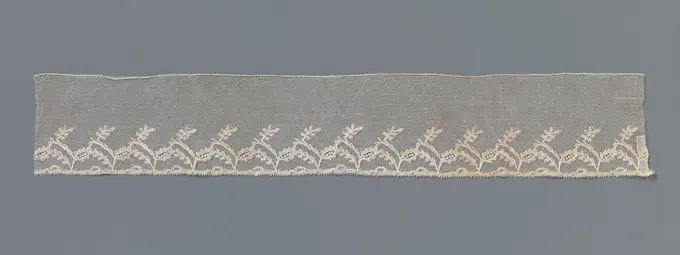
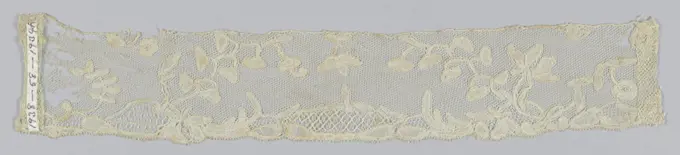
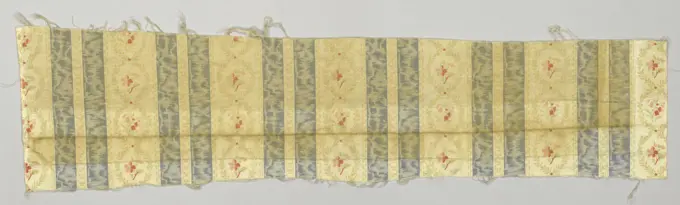
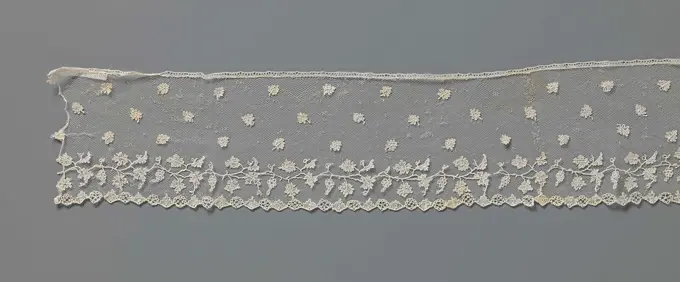
A variety of delicate lace edgings featuring floral motifs and decorative patterns. Perfect for sewing and textile embellishments.

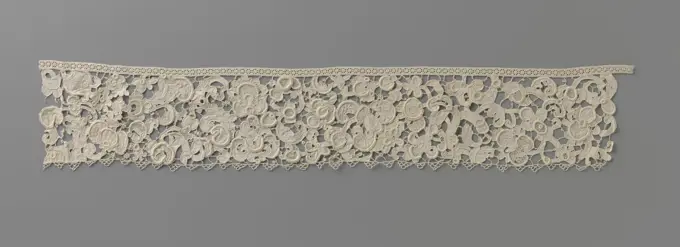
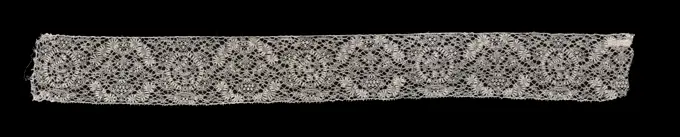
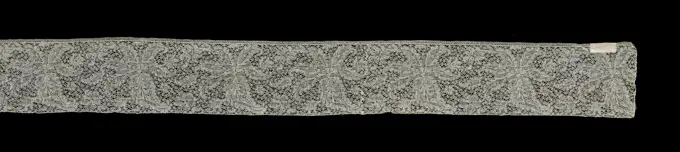
Border, Medium: linen Technique: bobbin lace, discontinuous tape, Border of large-scale floral and foliated forms in a serpentine pattern., Milan, Italy, late 17th century, lace, Border
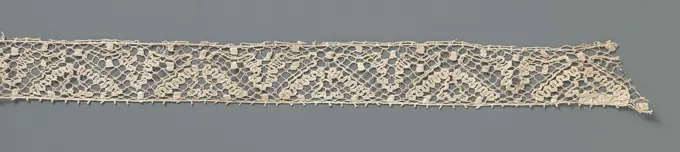
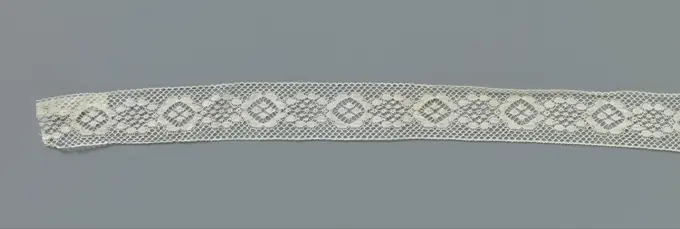
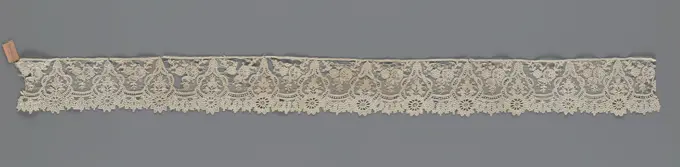
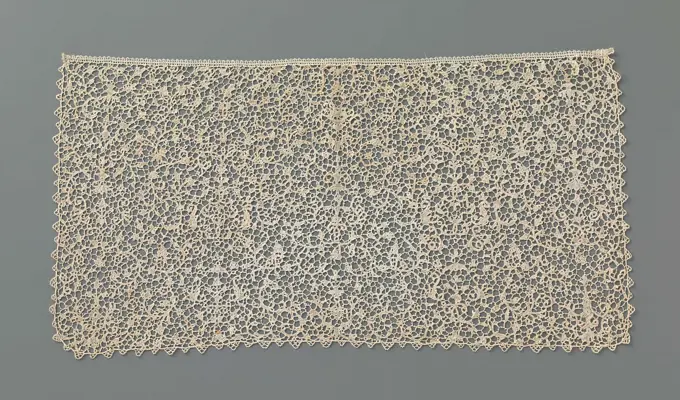
Edging 18th century German. Edging. German. 18th century. Bobbin lace. Textiles-LacesFragment of silk fabric  styIIsed floral ornamentation unknownEdging, Medium: linen Technique: bobbin lace, Mechlin style with five hole ground, Mechlin lace worked with a design of a plumed leaf form and conventionalized floral motifs with five hole ground and snow ball fillings., Belgium, early 18th century, lace, EdgingBand, Medium: linen Technique: needle lace, Lace band showing small-scale scrolling floral forms with raised outlines. A variety of filling stitches lightens areas of dense buttonhole stitches., France, 1670-90, lace, BandTrimming (Italy); silk, metallic threadBorder, Medium: linen Technique: bobbin lace, discontinuous tape, Border of large-scale floral and foliated forms in a serpentine pattern., Milan, Italy, late 17th century, lace, BorderStrip 18th century Flemish. Strip. Flemish. 18th century. Bobbin lace. Textiles-LacesBorder early 18th century Flemish, Mechlin. Border. Flemish, Mechlin. early 18th century. Bobbin lace. Textiles-LacesTrimming (Italy); silkStrook kloskant met driehoekige velden en gestileerde kelkbloem.Strip natural colosside. The repeating pattern consists of two alternating triangular fields. One field is formed by a straight down hanging, stylized chalis flour between two leaves. The other triangular field is formed by the space between two consecutive fields with bowl flowers. There is a more or less Christmas tree-shaped motif in this field. The motifs are interconnected by a coarse diamond-shaped mesh soil, a fat mat of grille, strewn with square moes. The motifs are made with thick contour wires and regularly winding braided straps. The Moeses are made in shape stroke. Upper and bottom of the strip are straight finished, the underside with picots.Band (China); cottonBand, Medium: linen Technique: bobbin lace, Binche ground, Band with leaf form enclosed diamond shaped grid., Belgium, 18th century, lace, BandStrip bobbin with connected wavy flower stems with one flower, anonymous, c. 1650 - c. 1699 Strip of natural -colored bobbin: Old Flemish side. The repeating pattern consists of connected wavy flower stems, with one flower and one leaf on either side of the stem. The flower consists of six lobes around a circular flower heart. The motifs are made in linen battle with openwork edges and with recesses in the Bloemhart. The motifs are connected by a traly land: a five -part ground. The top and bottom of the strip are straight. Southern Netherlands linen (material) bobbin lace / old Flemish lace Strip of natural -colored bobbin: Old Flemish side. The repeating pattern consists of connected wavy flower stems, with one flower and one leaf on either side of the stem. The flower consists of six lobes around a circular flower heart. The motifs are made in linen battle with openwork edges and with recesses in the Bloemhart. The motifs are connected by a traly land: a five -part ground. The top aGalloon 17th-18th century Unknown. Galloon 213844Band 16th century Italian, possibly Sardinia. Band 212327Edge; straw, silkStrip bobbin with palmets, anonymous, c. 1700 - c. 1709 Strip of natural-colored bobbin: binche side. The repeating, not so clearly defined pattern consists of a palmet, which is alternated by C-shaped motifs that are connected to each other with snowflakes. The motifs are connected by a braid ground in combination with a coarse snowflake land. The motifs are made in linen battle and mains with openwork edges. At the top and bottom are straight finished and provided with picots, but they are a bit ragged due to damage. Binche (Possible) linen (material) bobbin lace / Binche lace / snowflake filling Strip of natural-colored bobbin: binche side. The repeating, not so clearly defined pattern consists of a palmet, which is alternated by C-shaped motifs that are connected to each other with snowflakes. The motifs are connected by a braid ground in combination with a coarse snowflake land. The motifs are made in linen battle and mains with openwork edges. At the top and bottom are straight fStrip early 18th century Flemish, Mechlin. Strip 218176Textile, Medium: silk, cotton Technique: slit tapestry, Romania, 18th-19th century, woven textiles, TextileBorder, Medium: linen Technique: needle lace, Border in a design of asymmetric floral and foliated sprays rising from urn-shaped forms in an inverted repeat pattern., Belgium, early 18th century, lace, BorderMachinial side with chain of stylized round flowers, anonymous, c. 1850 - c. 1899 Machine-side intermediate edge: Machinal Valenciennes side. The repeating pattern consists of a succession of two different stylized round flowers with a coarser and a finer mechanical snowflake land as a flower heart. One flower consists of eight loose round petals that form a circle. The other flower consists of a circle of eight connected semi -circle -shaped motifs. The motifs seem to be made in linen battle with openwork edges. They are connected by a machining tralion ground. France (possibly) cotton (textile) Machine-side intermediate edge: Machinal Valenciennes side. The repeating pattern consists of a succession of two different stylized round flowers with a coarser and a finer mechanical snowflake land as a flower heart. One flower consists of eight loose round petals that form a circle. The other flower consists of a circle of eight connected semi -circle -shaped motifs. The motifs seem to be mBorder, Medium: linen Technique: bobbin lace, Brussels style, Border with a floral spray in a serpentine pattern. Fond: Droschel. Modes: fond simple, venises., Belgium, 1750-1800, lace, BorderStrip of needle side with thin spiral ranks, anonymous, c. 1690 - c. 1699 Strip of natural -colored needle side: Venetian rose side. On a regular six-sided Maas soil there is an open backdrop of thin spiral vines that are decorated here and there with a relief rose. Straight outer edge with a row of contiguous arcs. Venice linen (material) Venetian rose point Strip of natural -colored needle side: Venetian rose side. On a regular six-sided Maas soil there is an open backdrop of thin spiral vines that are decorated here and there with a relief rose. Straight outer edge with a row of contiguous arcs. Venice linen (material) Venetian rose pointStrook naaldkant met hangende bloemen.Elongated slopes of a wavy ribbon, interspersed by medallions with grid work, form the outer edges of a ground, on which there are an evenings a wavy branch with hanging flowers and pomegranates and a short flower branch. In the strip, the pattern is symmetrical with respect to a standing center branch. Alençon side.Fragment of the lace;  1st half XVII century (1600-00-00-1650-00-00);CDK unknownEdging (Belgium); linenSleeve ruffle, Medium: linen Technique: bobbin lace, Mechlin style, Border of Mechlin lace has the upper part ornamented with buds in diagonal rows. At the border, a row of scrolls with flowers and leaves. Edge is straight., Belgium, early 19th century, lace, Sleeve ruffleGalloon 17th century () European. Galloon 225123Borders early 18th century French. Borders 226057Fragment of the lace;  2. PO. 19th century (1851-00-00-1900-00-00);Needlepoint (Ventian Raised Point) Lace Flounce, 17th century. Italy, Venice, 17th century. Lace, needlepoint; average: 21 x 133.3 cm (8 1/4 x 52 1/2 in.).Lace, 1790-1800s, Mechelen, maker unknown. Gift of Mrs G. Acland Allen, 1955.Band, Medium: linen Technique: bobbin lace (late Valenciennes ground), Valenciennes style lace band worked with a floral design and conventional borders., France, 19th century, lace, BandTextile 19th century Japan. Textile 68004Sampler, Medium: silk Technique: sprang, One end of a piece of sprang with thirteen different patterns. Blue silk threaded through decorative holes divides the patterns., possibly Sweden, 19th century, embroidery & stitching, SamplerBorder Made 1810-1820 France. .Fragment of the Bordic;  early xxw (1900-00-00-1910-00-00);Border, Medium: linen Technique: needle lace with ground of loop and twist with twist return, Band of Point de Venise à Réseau in a design of floral clusters balanced by foliated forms in a dense, allover pattern. Fond: bride tortillée. Modes: portes, enchainettes., Italy, 1700-1750, lace, BorderStrip of needle side with snail house, anonymous, c. 1875 - c. 1909 Strip of natural -colored needle side: Venetian relief side. Despite repairs, an axis of symmetry can be recognized, on the sides of which two large extending arabesk leaves have been committed to each other. With some branches, they spring on two snail -oriented small volutes, which have been cut and encounter the straight inside. Moreover, two tenders spring from the same junction, which run into two overhoeks placed irises. Venice linen (material) Venetian raised work Strip of natural -colored needle side: Venetian relief side. Despite repairs, an axis of symmetry can be recognized, on the sides of which two large extending arabesk leaves have been committed to each other. With some branches, they spring on two snail -oriented small volutes, which have been cut and encounter the straight inside. Moreover, two tenders spring from the same junction, which run into two overhoeks placed irises. Venice linen (material) VPiece 18th-19th century Japan. Piece. Japan. 18th-19th century. Silk. Textiles-WovenDoek; Tung.Cloth with animal figures and geometric motifs.Trimming; silk, metallicTrimming (Italy); silk, metallic threadBobbin Lace Edging, 18th-19th century. Italy, Abruzzi, 18th-19th century. Lace, bobbin; average: 9 x 88.9 cm (3 9/16 x 35 in.).Textile, Bird and Anemone; Made by Morris & Co. (United Kingdom); England; cottonFringe (France); silkStrip ca. 1700 Flemish. Strip 212877Trimming (France); silk, metallic thread, metallic stripsStrook kloskant met v-vormende takken waaraan een korenaar.Strip natural colosside: Lille side. The repetitive pattern only covers the lower half of the strip and consists of adjacent v-forming branches, with small oval leaves and one ear. The thin branches display a line along the bottom of the strip, which constitutes one oval between the branches. The motifs are connected by a fine grille, a tulet. The motifs are made in linen stroke, with thicker and shiny contour wires. The ears of corn are filled with a list of cubes made in shape stroke. The top and bottom of the strip are straight finished, the underside with picots.Bobbin Lace Runner, 18th-19th century. Russia, 18th-19th century. Lace,bobbin; overall: 41.4 x 235.5 cm (16 5/16 x 92 11/16 in.).Needlepoint (Point Alençon) Lace Lappet, 18th century. France, Alençon, 18th century (Louis XV Period, 1715-1774). Lace, needlepoint: linen; overall: 66 x 10.5 cm (26 x 4 1/8 in.).Strip of mechanical side with lying flour followed by a lying leaf, anonymous, c. 1850  Strip of natural -colored machine side: machine blonde. The repeating pattern consists of a horizontal flower followed by a lying leaf and some smaller leaf branches. The flowers and leaves ensure a sculpy edge along the underside of the strip. The motifs are equipped with thick shiny contour threads and are connected to each other with a traly land, a mechanical tuler land. A decorative land has been used in the Bloemharten, a machine rose ground. The top of the strip is straight finished. The scrap edge is finished with picots.  silkTextile; cottonStrip 18th century Flemish. Strip 212844Sash, 18th century. Poland, 18th century. Brocade; silk and metal; overall: 327.6 x 35.5 cm (129 x 14 in.).Gimp mid-19th century French. Gimp 214217Belt, Medium: wool Technique: double cloth, Belt with geometrical motifs in a star pattern, center motifs brown. Warp ends are braided., Nayarit, Mexico, probably 19th century, woven textiles, BeltTussenzetsel van kloskant met voluutmotief aan overblijfselen van linnen beddengoed met werk met uitgetrokken draden.Interesting of natural Dutch clamping side. The repetitive and symmetrical pattern consists of a voluntary motif that has been placed vice versafter. The motifs are made in linen stroke with openwork edges and are connected by a grille. Upper and bottom of the strip are straight finished and each attached to a narrow strip of linen - hems - with a narrow edge work with pulled out wires. On a long side, a part of the work with pulled wires has disappeared and the middle section is a separate zoom where no traces of work with pulled wires can be seen. Every short side is sewn to one end. It concerns the remains of bedding, probably a pillowcase. The side may be manufactured in Flanders and the bed linen is made in the northern Netherlands.Fragment, Medium: bobbin lace (Brussels style), 18th century, lace, FragmentFragment upholstery of a four-poster bed. Fragment upholstery belonging to a wall sky bed.Galloon 17th-18th century Unknown. Galloon 213843Strook applicatiekant met wijnrank.Strip natural colored Brussels application side: needle side applicated on slighten ground. Under a spreading pattern of vine leaves, a continuous rank runs along the bottom edge, showing twigs with wine leaves and grape fees to two sides. The very flat sloping edge is formed by straight upholstered wine leaves, interspersed by wreaths with pearl edges and filled with decorative stitches. Motives are made up with feston stitches and are accentuated by relief contours of widely scented thread bundles. The top is straight finished with a splitting strap.Piece early 19th century British, Northamptonshire. Piece 214397Striping closen with hanging sepals, anonymous, c. 1820 Strip of natural -colored bobbin: Lille side. Under a spreading pattern of square mouses, the repeating pattern consists of a hanging chalice flower, on a curved stalk with three round leaves. The chalice flowers are placed against each other and form the shells along the underside of the strip. The motifs are connected by a fine grid, a tuler land. The fullwork in the Kelkbloem is made in linen battle, with an openwork center track and equipped with thicker and shiny contour threads. The stalk and the leaves are made with contour threads where a decorative land has been used in the leaves. The Mosjes are made in form. The top of the strip is straight finished. The shells along the bottom are finished with picots. Southern Netherlands linen (material) bobbin lace / Lille lace Strip of natural -colored bobbin: Lille side. Under a spreading pattern of square mouses, the repeating pattern consists of a hanging chalice flower, on a cuStrip of black machine side with wavy dotted line between daisies, anonymous, c. 1900 - c. 1914 Strip of black machining side. The repeating pattern consists of a row of six -leaf daisies on the center line that are connected with a wavy dotted line. The motives are connected to a machine tuler. A very fine pearl list forms a sculpy edge of semi -circular shells under each flower. The scrap edge is finished with picots. The top of the strip is straight finished. Calais cotton (textile) Strip of black machining side. The repeating pattern consists of a row of six -leaf daisies on the center line that are connected with a wavy dotted line. The motives are connected to a machine tuler. A very fine pearl list forms a sculpy edge of semi -circular shells under each flower. The scrap edge is finished with picots. The top of the strip is straight finished. Calais cotton (textile)Border, Block-printed paper, Open-weave rope border, with stylized floral motif in space between ribbons. Printed in grisaille. Similar in nature to rope twist or cable molding borders., France, 1820-1840, Wallcoverings, BorderBobbin Lace Edging, 18th century. Belgium, Binche, 18th century. Lace, bobbin: linen; average: 42 x 5.1 cm (16 9/16 x 2 in.).Ceintuur ribbon of side brokaat; On a silver surface, a repeating pattern in dark red, pink and brown is in the shape of a snail house () From which fruits and leaves come, anonymous, c. 1735 Ceintuur ribbon of side brokaat; On a silver surface, a repeating pattern in dark red, pink and brown is in the shape of a snail house () From which fruits and leaves come. The edges are trimmed with silver -colored decorative tape. West-Europa geheel: silk. brocade (textile). silver thread Ceintuur ribbon of side brokaat; On a silver surface, a repeating pattern in dark red, pink and brown is in the shape of a snail house () From which fruits and leaves come. The edges are trimmed with silver -colored decorative tape. West-Europa geheel: silk. brocade (textile). silver threadFragment of Coptic fabric unknownScarf, Medium: wool Technique: printed on twill weave, Fine printed wool scarf; fringed at ends; black background in body of scarf; red background at ends; polychrome print in persian cone pattern; one long edge hemmed., Europe, 1860-70, printed, dyed & painted textiles, ScarfRibbon, China, 18th century, woven textiles, RibbonNeedlepoint (Venetian Raised Point) Lace Lappet, 18th century. Italy, Venice, 18th century. Lace, needlepoint: linen; average: 8.9 x 82.6 cm (3 1/2 x 32 1/2 in.).Ribbon, Medium: silk, metallic threads Technique: woven, Design of feather-like leaves in green, white and gold metallic threads on a gilt ground., France, 18th century, woven textiles, RibbonRibbon (China)Machine -side intermediate edge with drop -shaped leaves on a wavy slender, anonymous, c. 1800 - c. 1899 Machine -side intermediate edge: Machinal Mechelen side. The repeating and continuous pattern consists of a wavy slender with a drop -shaped leaf alternately at the top and bottom. The slender and leaves are made in loosely worked linen battle with thicker and shiny contour threads. The motif is made in a grid, a mechanical Mechelen soil. Top and bottom of the strip are straight. The strip is wrapped on a blue card with a price indication. Europe cotton (textile) Machine -side intermediate edge: Machinal Mechelen side. The repeating and continuous pattern consists of a wavy slender with a drop -shaped leaf alternately at the top and bottom. The slender and leaves are made in loosely worked linen battle with thicker and shiny contour threads. The motif is made in a grid, a mechanical Mechelen soil. Top and bottom of the strip are straight. The strip is wrapped on a blue card with a pLace, 1800-1825, Brussels, maker unknown. Gift of Mrs G. Acland Allen, 1955.Fragment of an aurifries, with embroidery of silk and gold council, anonymous, c. 1475 - c. 1500 Fragment of an aurifries, with embroidery. The pattern has awashed soil of gold thread on which angels with shields, on which a crown of thorns, select rods, a chalice with hostie, a trumpet, a bucket, a short sword, a cross, a bishopsmijter and a hat. Southern Netherlands (possibly) silk. embroidering Fragment of an aurifries, with embroidery. The pattern has awashed soil of gold thread on which angels with shields, on which a crown of thorns, select rods, a chalice with hostie, a trumpet, a bucket, a short sword, a cross, a bishopsmijter and a hat. Southern Netherlands (possibly) silk. embroideringTrimming, Medium: silk Technique: woven, Trimming fragment in a striped design of red alternating with stripes of green, yellow and white., France, 18th century, trimmings, TrimmingBorder, Medium: linen Technique: needle lace, Border of Plat Point de Venise with a swirling floral and foliated branch connected by brides picotées. Toilé showing gaze quadrillée and portes., Italy, 17th century, lace, BorderFan box with lid, made of thick paper, covered on the outside with sit paper with diamond pattern, c. 1795  Fan box with lid, made of thick paper, covered on the outside with sit paper with a diamond pattern. Inside unpacht. Netherlands (possibly) whole: Paper. Decoration: Paper paintingGalloon 18th century French. Galloon 214069Dasslip van naaldkant met candelabre-motieven.Natural-colored needle side: Flat Venetian side or point de france. On a coarse hexagonal Maas soil there is a setting of five symmetrical and very thin candelabre motifs, which are connected by branched spiral drinks, to which miniature palm tree flowers and buds. Finished on three sides with alternately large and small triangular arches.Galloon 18th century French. Galloon 214099Bobbin Lace Edging, 17th-18th century. Belgium, Binche, 17th-18th century. Lace, bobbin; average: 7.7 x 120.7 cm (3 1/16 x 47 1/2 in.).Bobbin Lace Lappet, 18th century. Belgium, Binche, 18th century. Lace, bobbin: linen; average: 61 x 10.9 cm (24 x 4 5/16 in.).Strikdas, rectangular, linen batist with smoothly set sculpted and potented strip of Valenciennes side, anonymous, c. 1880 - c. 1890 Strikdas, rectangular, of linen batist with smooth-set sculpted and potented strip of Valenciennes side. Netherlands linen (material) Valenciennes lace Strikdas, rectangular, of linen batist with smooth-set sculpted and potented strip of Valenciennes side. Netherlands linen (material) Valenciennes laceBand Fragment 6th century. Band Fragment 448042Strip bobbin oval formed by whimsical leaf motifs, anonymous, c. 1800 - c. 1810 Strip of natural -colored bobbin, blonde. The repeating pattern consists of alternately a small and a large shape under the center line, which is made up of whimsically shaped leaf motifs that lie around a center of a fine tulip land like a ring. Along the bottom runs a border with a succession of such motifs. The motifs are connected by a Maas soil, a Parisian soil. The motifs are made in Ovenlag, with the thick and shiny contour threads having a strong accentuating effect. The top of the strip is straight finished. The very faintly scalloped underside is finished with fine picots. France silk bobbin lace / blonde (lace) Strip of natural -colored bobbin, blonde. The repeating pattern consists of alternately a small and a large shape under the center line, which is made up of whimsically shaped leaf motifs that lie around a center of a fine tulip land like a ring. Along the bottom runs a border with a succeTrimming (France); silkBobbin Lace (Point d'Angleterre) Edging, 18th century. Belgium, Brussels, 18th century. Lace, bobbin: linen; average: 6.1 x 71.8 cm (2 3/8 x 28 1/4 in.).Belt, 20th century, 36 x 3 5/8 in. (91.44 x 9.21 cm) (without ties), Wool, Bolivia, 20th centuryStrook naaldkant met kruisende ranken.Strip natural needle side: Venetian rosion side. On an open ground of most smooth bars there is a symmetrical pattern of widely spread tendrils, which crossed each other frequently. On the axes of symmetry alternately a fan plant and a group of three hanging clovers.Trimming (Italy); linen, silk, silver threadTrimming (France); 1909-2-185Shoulder Cloth(Limar)Lacework in progress, 18th century, 33 x 3 5/8 in. (83.82 x 9.21 cm) (linen backing)29 1/8 x 1 15/16 in. (73.98 x 4.92 cm) (paper pattern with lace), Linen, paper; point d'Alençon; lace, France, 18th centuryNeck or Armhole Panel. Ica; Peru, south coast, Ica Valley. Date: 1000-1532. Dimensions: 39.4 × 7.0 cm (15 1/2 × 2 3/4 in.). Origin: Peru. Museum: The Chicago Art Institute, Chicago, USA.Ribbon, Medium: silk Technique: satin weave, Pink silk ribbon with a broad central satin stripes and plain weave border with picot., USA, mid- 19th century, woven textiles, RibbonGalloon early 19th century French. Galloon 213773