My Boards
View Pictures
  • My Boards
← Artworks

Japanese Edo Period Woodblock Prints

A collection of colorful woodblock prints showcasing actors in traditional costumes, portraying various roles in classic Japanese theater against floral or scenic backdrops.

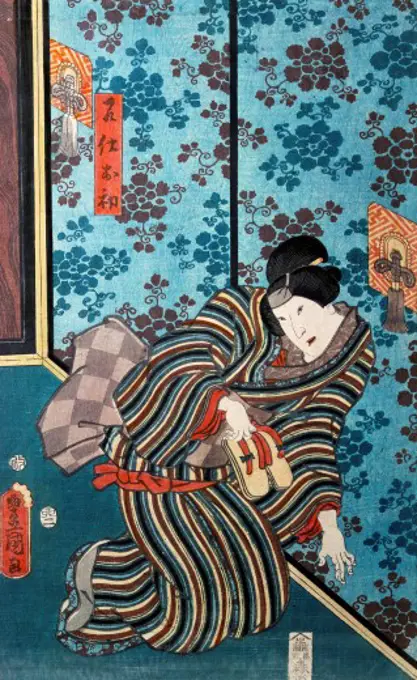
SAMOERAI AOYAMA EN HET SPOOK OKIKU. \, Toyohara kunichika, 1892 print Bottom part of a triptych, in which the actor Ichikawa Danjuro looks up like the Samurai Aoyama. Two helpers next to him.  paper color woodcut spirit, ghost
SAMOERAI AOYAMA EN HET SPOOK OKIKU. \, Toyohara kunichika, 1892 print Bottom part of a triptych, in which the actor Ichikawa Danjuro looks up like the Samurai Aoyama. Two helpers next to him. paper color woodcut spirit, ghost
471 assets in this story
1899-18793157
Kitagawa Utamaro (ca. 1753 - October 31, 1806) was a Japanese printmaker and painter, who is considered one of the greatest artists of woodblock prints (ukiyo-e). He is known especially for his masterfully composed studies of women, known as bijinga. He also produced nature studies, particularly illustrated books of insects.
4409-17514022
Woman Cleaning a Fish, central sheet of the triptych The Fourth Month: The First Cuckoo, from the series The Twelve Months. Date: sixth month 1854. Dimensions: 37 cm x 26 cm. Museum: Van Gogh Museum, Amsterdam. Author: UTAGAWA KUNISADA.
4409-17399493
Yamauba and Kintoki. Artist: Kitagawa Utamaro (Japanese, ca. 1754-1806). Culture: Japan. Dimensions: H. 15 1/16 in. (38.3 cm); W. 9 7/8 in. (25.1 cm). Date: ca. 1795. Museum: Metropolitan Museum of Art, New York, USA.
4266-2589
Peeping by Suzuki Harunobu, colour woodcut, circa 1750, 1724-1770, private collection,
6145-50635800
Girl washing her hands under a stream of water HOKKEI, TOTOYA (1780 1850)
4409-17513954
Seated Courtesan, from the series Fashionable Women of Edo. Date: 1830-1839. Dimensions: 38 cm x 26 cm. Museum: Van Gogh Museum, Amsterdam. Author: UTAGAWA KUNISADA.
6145-30165952
The Mountain Scene from the play Imoseyama (Imoseyama, yama no dan), section of a sheet from the series Reflections of Dramas in Cutouts (Harimaze joruri kagami) 1854 Japan. Color woodblock print; section of harimaze sheet . Utagawa Hiroshige
6145-29711876
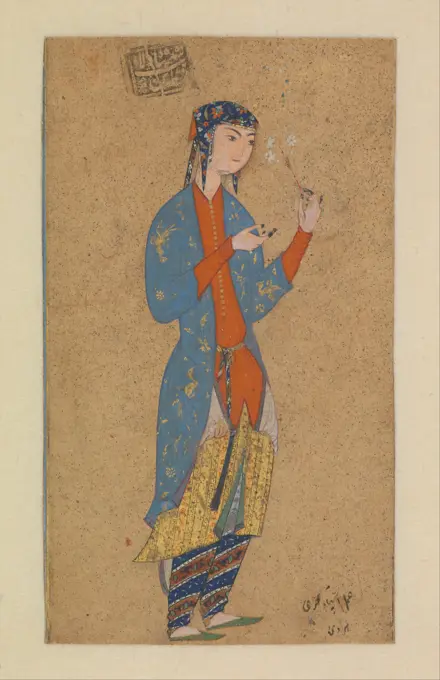
Portrait of a Lady Holding a Flower 1565-75 Painted by Muhammadi of Herat This charming portrait of a young woman holding daisies is by the well-known sixteenth-century Persian painter Muhammadi of Herat. It exhibits the hallmarks of his elegant style, seen especially in the delicate rendering of the facial features and the detailed attention to the womans garb. The page bears the stamp of the Safavid ruler Shah 'Abbas I (r. 1587-1629), indicating that it belonged to his collection.. Portrait of a Lady Holding a Flower 451323
6145-30174340
Dancer with a Maple Branch 175 CE-1795 Japan. Hanging scroll; Ink, color, and gold pigment on silk . Katsukawa Shunsho
6145-51828863
Moonlight View of Tsukuda with Lady on a Balcony, from the series Fashionable Genji Utagawa Hiroshige (Ando) (Japanese, 1797-1858). Moonlight View of Tsukuda with Lady on a Balcony, from the series Fashionable Genji, 1853, 11th month. Woodblock color print, Sheet of a: 14 1/2 x 10 1/8 in. (37.0 x 25.8 cm).   Asian Art 1853, 11th month
4409-17405526
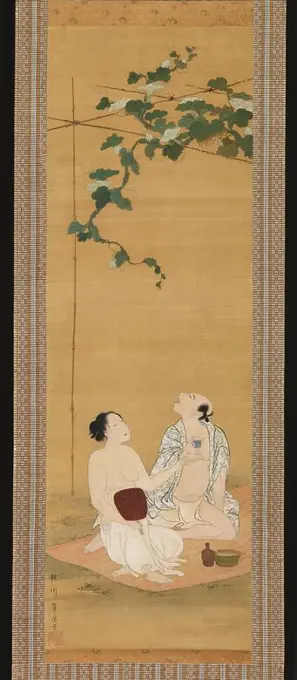
Enjoying the Evening Cool under a Gourd Trellis. Artist: Utagawa Toyohiro (Japanese, 1763-1828). Culture: Japan. Dimensions: Image: 33 1/4 x 11 in. (84.5 x 27.9 cm)Overall with knobs: 65 1/8 x 16 1/2 in. (165.4 x 41.9 cm). Date: early 19th century.Known for his creative and subtle depictions of world-weary beauties, Toyohiro here captures a moment in the lives of a couple enjoying a cool evening. Both look relaxed; the husband is about to sing, while his wife, fanning herself, appears to be asking for a sip of wine. Seemingly an exquisite example of pure genre painting, it actually manifests a deeply rooted Japanese tradition in which painting is intimately linked to poetry, in this case a popular verse by Kinoshita Choshoshi (1569-1649):Under a trellis of evening gourd blossoms,A man in a shirt and a woman in a petticoat,Enjoy the cool of evening. Museum: Metropolitan Museum of Art, New York, USA.
6145-51817547
17: Poem by Ariwara no Narihira Ason, from the series Pictorial Selection of One Hundred Poets, One Poem Each Utagawa Kunisada II (Japanese, 1823-1880). 17: Poem by Ariwara no Narihira Ason, from the series Pictorial Selection of One Hundred Poets, One Poem Each, 1844, 5th month. Color woodblock print on paper, 14 1/8 x 9 1/4 in. (35.9 x 23.5 cm).   Asian Art 1844, 5th month
4409-17563468
Chinese Man from Nanking Admiring a Fan (Shincho Nankinjin kansho Koshu ogi no zu), from the series "Foreigners Drawn from Life (Ikiutsushi ikoku jinbutsu)". Utagawa Sadahide; Japanese, 1807-1873. Date: 1860. Dimensions: . Color woodblock print; oban. Origin: Japan. Museum: The Chicago Art Institute, Chicago, USA.
4408-12423
Checking the Lanterns, Japanese Prints
1899-18793149
Kitagawa Utamaro (ca. 1753 - October 31, 1806) was a Japanese printmaker and painter, who is considered one of the greatest artists of woodblock prints (ukiyo-e). He is known especially for his masterfully composed studies of women, known as bijinga. He also produced nature studies, particularly illustrated books of insects.
6145-46835379
Presentation of the lucky new yearcalendar.  Artist: Utagawa Kunisada, Japanese, 1786-1865
6145-29136026
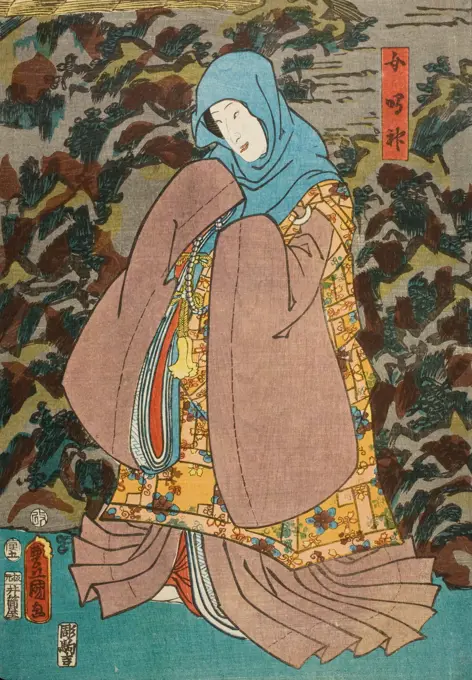
Actors Bandō Shūka I as Onna Narukami, Bandō Takesaburô I as Tōmanosuke, Asao Okuyama III as Kokuun-ni, and Ichikawa Dannosuke V as Hakuun-ni in the Play Kumo no Uwaki Onna Narukami. Utagawa Kunisada (Toyokuni III) (Japan, Edo, 1786-1865). 1854, 5th month. Prints; woodblocks. Triptych; color woodblock prints
6145-30153343
The Second Month (Ni gatsu), from the series Fashionable Twelve Months (Furyu junikagetsu) 1788-1798 Japan. Color woodblock print; chuban . Utagawa Toyokuni I
1746-21103126
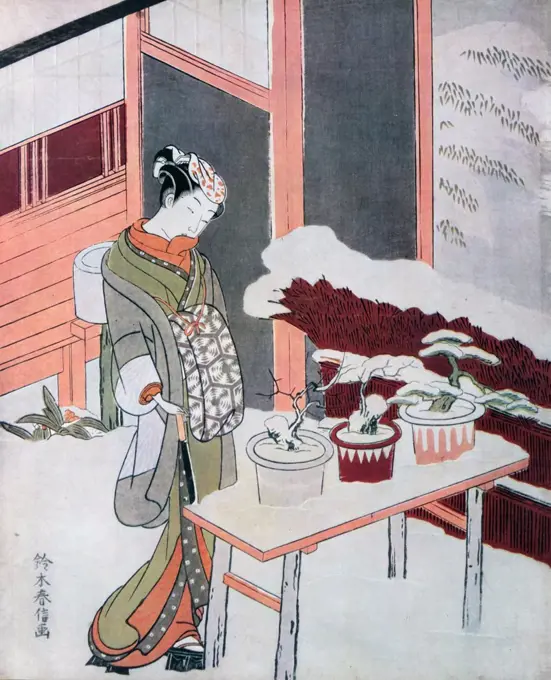
Harunobu: Young woman watches snow covered flowers 18th Century Japanese
6145-29734251
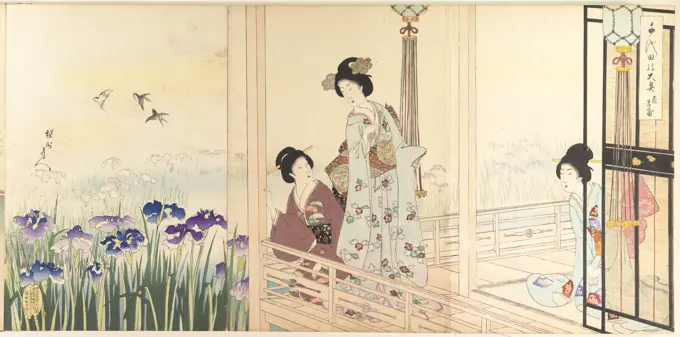
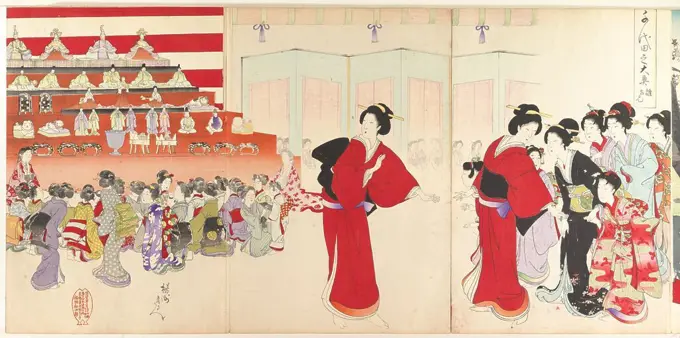
Chiyoda Castle (Album of Women) 1895 Ysh (Hashimoto) Chikanobu Japanese. Chiyoda Castle (Album of Women). Ysh (Hashimoto) Chikanobu (Japanese, 1838-1912). Japan. 1895. Triptych of woodblock prints; ink and color on paper. Meiji period (1868-1912). Prints
1899-18788966
Suzuki Harunobu (1724 July 7, 1770) was a Japanese woodblock print artist, one of the most famous in the Ukiyo-e style. He was an innovator, the first to produce full-color prints (nishiki-e) in 1765, rendering obsolete the former modes of two- and three-color prints. Harunobu used many special techniques, and depicted a wide variety of subjects, from classical poems to contemporary beauties (bijin, bijin-ga). Like many artists of his day, Harunobu also produced a number of shunga, or erotic images. During his lifetime and shortly afterwards, many artists imitated his style. A few, such as Harushige, even boasted of their ability to forge the work of the great master. Much about Harunobu's life is unknown.
4409-17548612
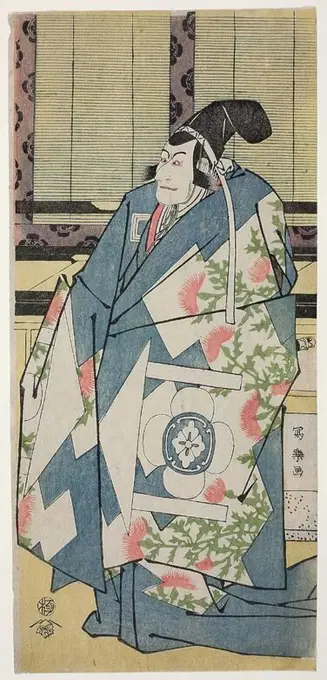
The Actor Ichikawa Ebizo as Kudo Saemon Suketsune (Ichikawa Ebizo no Kudo Saemon Suketsune). Toshusai Sharaku  ; Japanese, active 1794-95. Date: 1790-1800. Dimensions: 32.0 x 14.7 cm. Color woodblock print; hosoban,nishiki-e. Origin: Japan. Museum: The Chicago Art Institute, Chicago, USA.
4409-28962492
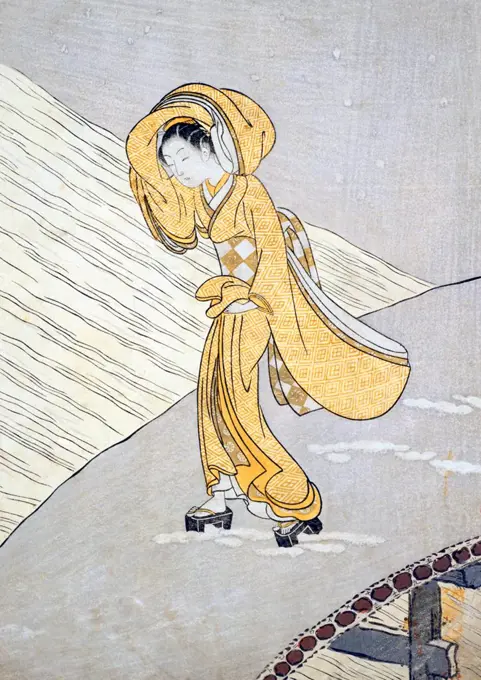
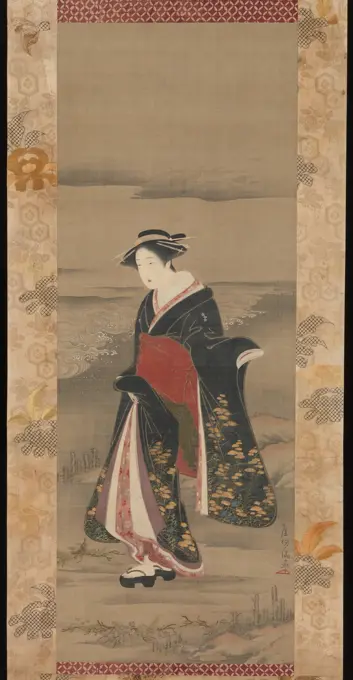
Woman walking in a breeze. Origin: Japan. Period: Edo period. Color and gold on silk. Date: 1735-1814. Museum: Freer Gallery of Art and Arthur M. Sackler Gallery.
6145-30190703
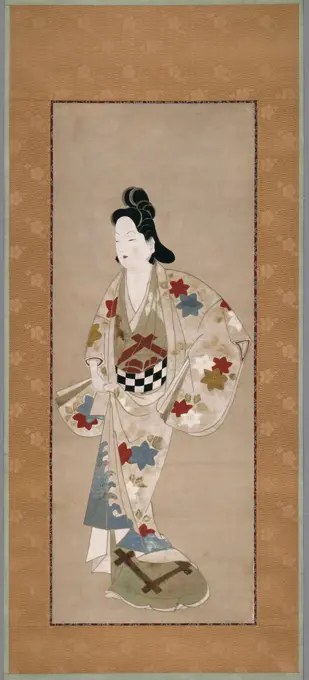
Standing Beauty 1656-1678 Japan. Hanging scroll; ink, color, and gold on paper .
4409-17399603
The Third Otani Hiroemon as an Outlaw Standing Near a Willow Tree. Artist: Katsukawa Shunsho (Japanese, 1726-1792). Culture: Japan. Dimensions: 11 15/16 x 5 5/8 in. (30.3 x 14.3 cm). Date: 3rd month, 1777. Museum: Metropolitan Museum of Art, New York, USA.
4409-17561803
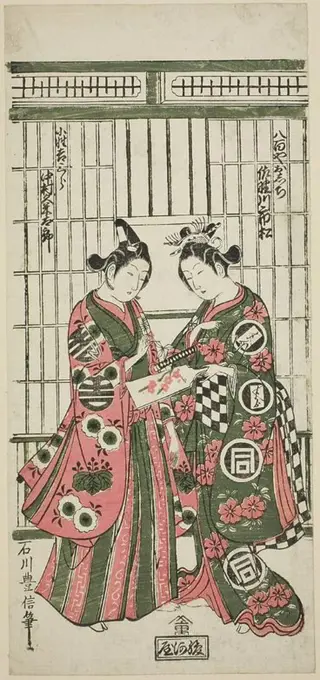
The Actors Sanogawa Ichimatsu I as Oshichi and Nakamura Kumetaro I as Kichisaburo in the play "Izu Kosode Shobai Kagami," performed at the Nakamura Theater in the second month, 1751. Ishikawa Toyonobu; Japanese, 1711-1785. Date: 1751. Dimensions: 12 1/2 x 5 5/8 in. Color woodblock print; hosoban, benizuri-e. Origin: Japan. Museum: The Chicago Art Institute, Chicago, USA.
4409-17355977
Chiyoda Castle (Album of Women). Artist: Yoshu (Hashimoto) Chikanobu (Japanese, 1838-1912). Culture: Japan. Dimensions: L. (page) 13 7/8 in. (35.2 cm); W. (page) 9 1/4 in. (23.4 cm). Date: 1895. Museum: Metropolitan Museum of Art, New York, USA. Author: Yoshu (Hashimoto) Chikanobu.
4409-17568670
Marching as to War. Helen Hyde; American, 1868-1919. Date: 1904. Dimensions: 152 x 101 mm (image/plate); 267 x 199 mm (sheet). Color etching on paper. Origin: United States. Museum: The Chicago Art Institute, Chicago, USA.
6145-45467425
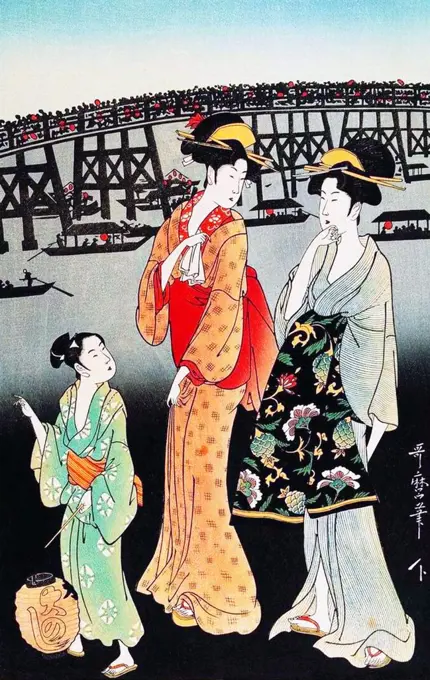
Three women and a child at the water, from the series: Sumidagawa Kunisada, UTAGAWA (1786 1864)
6145-29832041
Three Young Ladies by the Seashore Utagawa Toyokuni I Japanese. Three Young Ladies by the Seashore 56052
1899-18789555
Kitagawa Utamaro (ca. 1753 - October 31, 1806) was a Japanese printmaker and painter, who is considered one of the greatest artists of woodblock prints (ukiyo-e). He is known especially for his masterfully composed studies of women, known as bijinga. He also produced nature studies, particularly illustrated books of insects.
4409-17375667
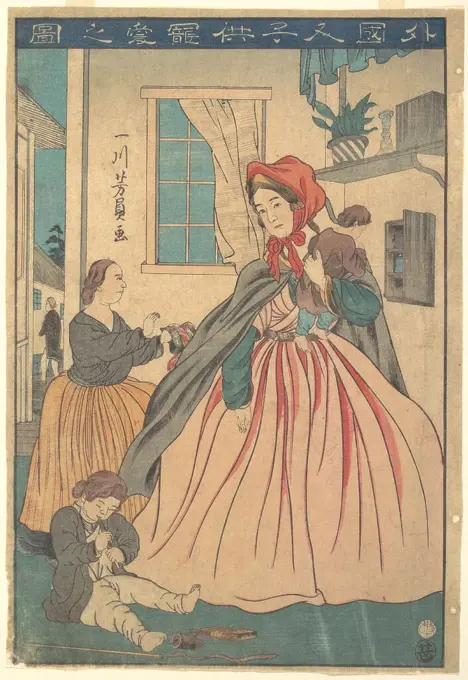
Gaikokujin kodomo choai no zuA Foreigner Enjoying Her Children. Artist: Utagawa Yoshikazu (Japanese, active ca. 1850-1870). Culture: Japan. Dimensions: 13 1/2 x 9 in. (34.3 x 22.9 cm). Date: 1860 (10th month). Museum: Metropolitan Museum of Art, New York, USA.
6145-29753468
The Demon Gold (Konjiki yasha) ca. 1903 Mizuno Toshikata Japanese. The Demon Gold (Konjiki yasha) 55187
6145-29783744
Beauty by the Shore 18th century Kubo Shunman Japanese Shunman, who was known primarily as a literary figure, studied painting under Kitao Shigemasa (1739-1820). He was also inspired by Torii Kiyonaga (1725-1815), a famed painter of beauties, or bijin. In addition to his nikuhitsu ukiyo-e, or painted images of the "floating world," Shunman is well known for his finely designed and produced surimono prints. This painting was produced before Shunman had formed his mature style, likely before the year 1785.. Beauty by the Shore 45799
6145-30187407
Scenting a kimono with incense Japan. Color woodblock print; shikishiban, surimono . Yanagawa Shigenobu I
1899-18789550
Kitagawa Utamaro (ca. 1753 - October 31, 1806) was a Japanese printmaker and painter, who is considered one of the greatest artists of woodblock prints (ukiyo-e). He is known especially for his masterfully composed studies of women, known as bijinga. He also produced nature studies, particularly illustrated books of insects.
6145-29290915
Empress and court ladies in traditional formal dress on an outing to Kameido plum tree gardens to the east of Tokyo, to view the plum blossoms and write poems about them. Colour woodcut by Chikashige, 1878.
6145-58979849
Bijin Junikagetsu (Beauties in the twelve months): March colour woodcuts, works on paper
4443-28727667
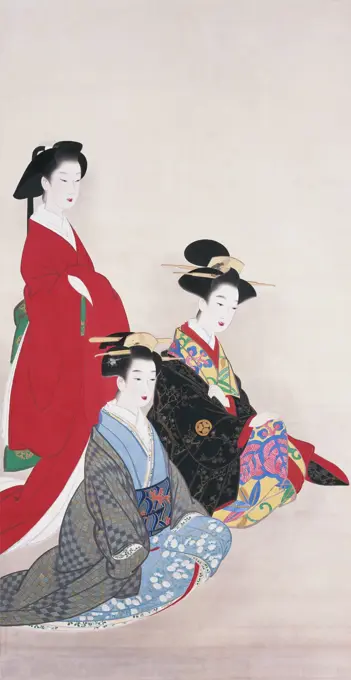
Ladies of the Warrior Class, first half 19th century, attr. Yamaguchi Soken, Japanese, 1759 - 1818, 70 1/2 × 36 5/8 in. (179.07 × 93.03 cm) (image)87 × 42 1/2 in. (220.98 × 107.95 cm) (mount), Ink and color on paper, Japan, Nikuhitsu ukiyo-e, In the Edo period, the material and design of kimono were strictly regulated by the government along class lines, such that class and occupation were identifiable by costumes and hairstyles. Here (from left to right) are ladies of the warrior class, wives of merchants, young maidens, working girls, and women in the demimonde. Sokens extraordinary brush control and use of pigments can be seen in the delicate hairlines and the texture of complexions and make-up. The son of a kimono merchant, he depicted magnificent kimono with delicate folds suggesting the body under the fabric.
1848-49414739
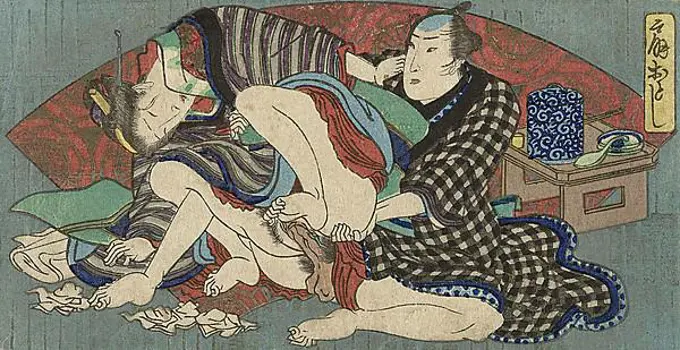
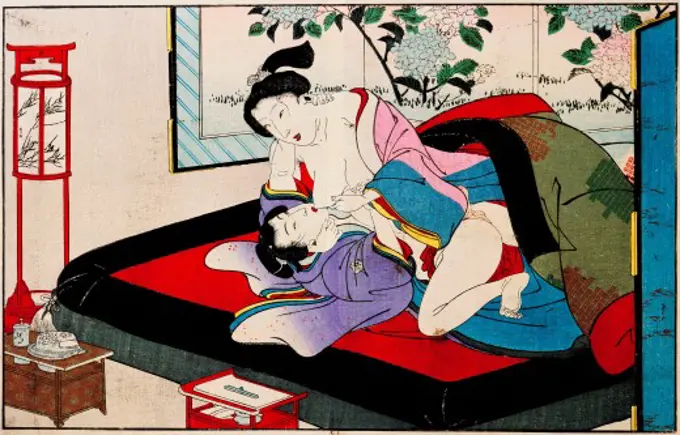
Ogiotoshi, the throwing fan, Kama Sutra, eroticism, sex, erotic depiction from 1850, Japan, Historical, digitally restored reproduction from a 19th century original, Asia
4443-21721906
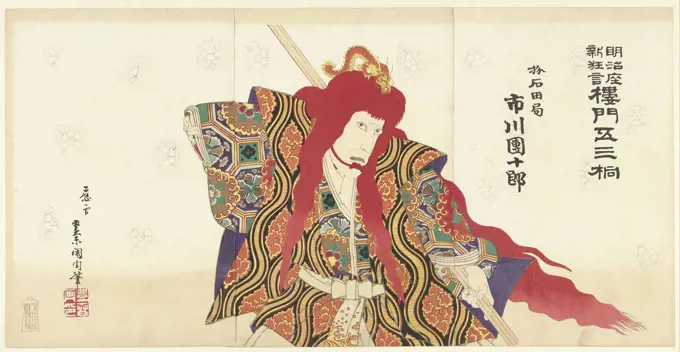
The actor Ichikawa Danjuro IX, half live, in the role of the court lady of the Ishida clan dressed as a Dragon King with long-haired red wig on which a dragon, The 53 paulownia trees at the Tower Gate Sanmon gosan no kiri, New plays in the Meiji theatre (series title) Meijiza shinkyogen (series title on object), print maker: Toyohara Kunichika, (mentioned on object), publisher: Akiyama Buemon, (mentioned on object), Tokyo, 11-Feb-1896, paper, colour woodcut, h 370 mm × w 728 mm
6145-51834196
Cherry Blossom Viewing Outing Kubo Shunman (Japanese, 1757-1820). Cherry Blossom Viewing Outing, late 18th century. Woodblock color print, .1: 12 9/16 x 8 9/16 in. (32.0 x 21.8 cm).   Asian Art late 18th century
4409-17585226
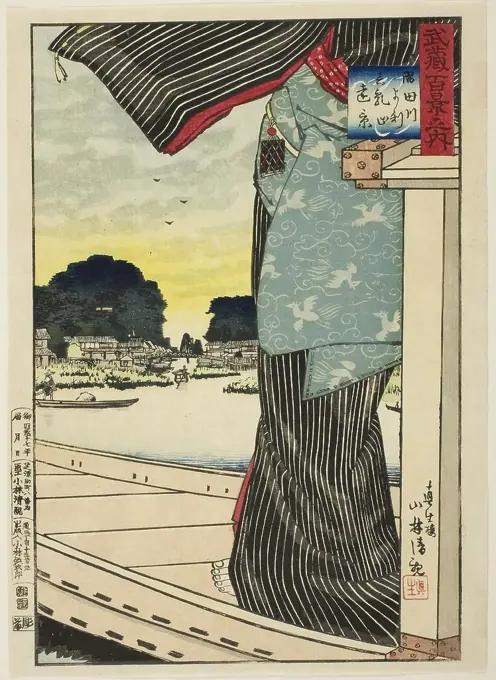
Distant View of Matsuchi Hill from the Sumida River (Sumidagawa yori Matsuchiyama enkei), from the series "One Hundred Views of Musashi Province (Musashi hyakkei no uchi)". Kobayashi Kiyochika; Japanese, 1847-1915. Date: 1884. Dimensions: 33.9 x 24.3 cm (13 3/8 x 9 9/16 in.). Color woodblock print; oban. Origin: Japan. Museum: The Chicago Art Institute, USA.
6145-48526209
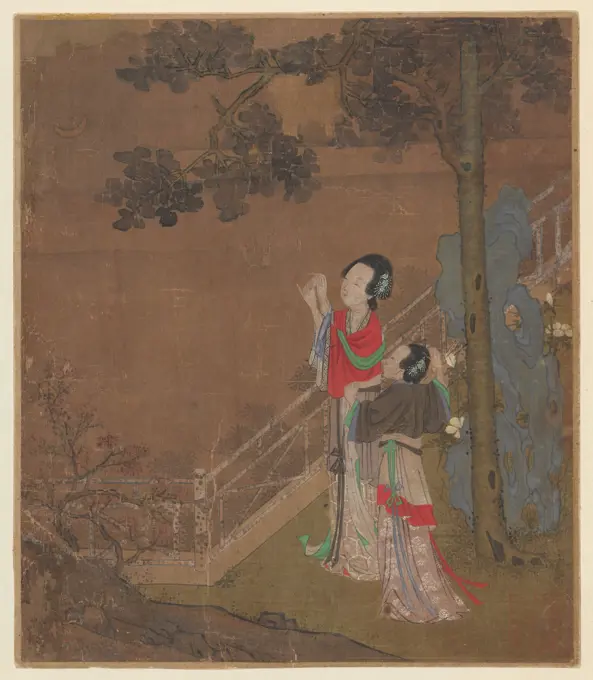
Two young ladies looking at the new moon. unknown, painter
6145-30187339
The Courtesan Umegawa and Chubei of the Courier Firm (Keisei Unegawa, Hikyakuya Chubei), from the series True Feelings Compared The Founts of Love (Jitsu kurabe iro no minakami) 1793-1804 Japan. Color woodblock print; oban . Kitagawa Utamaro
1746-21117634
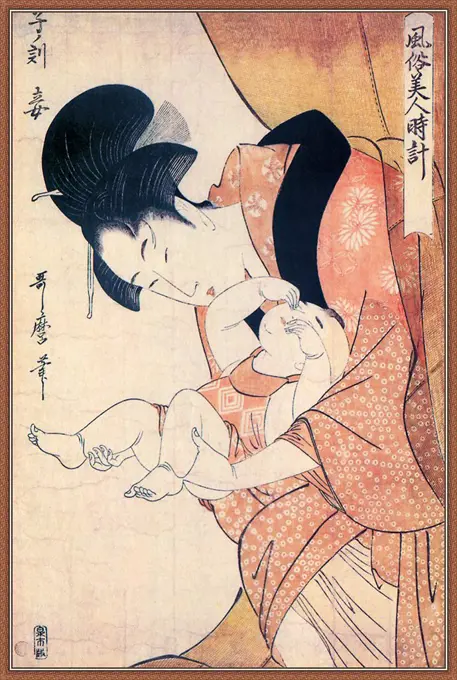
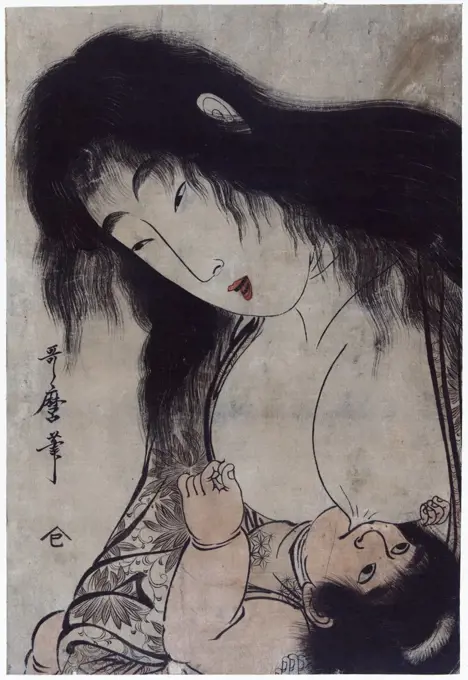
Yamauba breastfeeding Kintaro by Utamaro Kitagawa (1753 - 1806). Colour woodcut.
1899-19135382
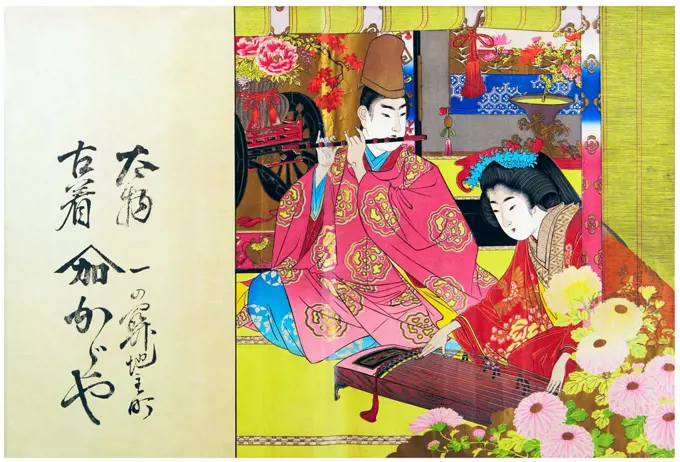
Japan: Hikifuda advertising poster depicting two musicians, a man playing the flute and a woman playing the koto. Late Meiji (1868-1912) period
4443-73180782
Kunisada, work, Actor Nakamura Shika in the play Yoshitsune sembonzakura (A Thousand Cherry Trees), 1829, colored woodblock print, graphics
6145-45622067
The plaster place Fujikawa; Fujikawa; The erotic road to the capital. Man and woman love to drive under window overlooking traveler on horseback and traveler with yoke.
4430-2872
fine arts, Kuniyoshi, Utagawa, (1798 - 1861), graphics, ""scene from the tales of the Ise"", circa 1847 / 1852, colour woodcut, 36,5 cm x 25,5 cm, Austrian Museum of Applied Arts, Vienna,
6145-51827353
Night View of the Matsuchiyama and Sam'ya Canal (Matsuchiyama San'yabori Yakei), No. 34 from One Hundred Famous Views of Edo Utagawa Hiroshige (Ando) (Japanese, 1797-1858). Night View of the Matsuchiyama and Sam'ya Canal (Matsuchiyama San'yabori Yakei), No. 34 from One Hundred Famous Views of Edo, 8th month of 1857. Woodblock print, Sheet: 14 3/16 x 9 1/4 in. (36 x 23.5 cm).  While some perceive this scene as sinister and strange, others see it as suggestive and romantic. In the dark background, at the foot of the hill Matsuchiyama and flanking the San'ya Canal and the pillars of the Imado Bridge, are the alluring lights of two restaurants. Stars glitter in the sky above and are reflected in the water below. In the foreground, a geisha follows the bright lantern of her attendant along the embankment. Hers is one of the few full portraits in the series. Perhaps returning from a banquet at one of the restaurants, she is an intriguing figure against the sultry backdrop. Asian Art 8th mont
6145-51817572
Hinazuru, a Yoshiwara Beauty of the Tea House Chojiya with Five Attendants Isoda Koryusai (Japanese, ca. 1766-1788). Hinazuru, a Yoshiwara Beauty of the Tea House Chojiya with Five Attendants, ca. 1777. Color woodblock print on paper, 15 1/2 x 10 1/2 in. (39.4 x 26.7 cm).   Asian Art ca. 1777
1899-19136823
Japan: 'Unconcerned', Yamamoto Shoun (1870-1965), 1906
1746-3887
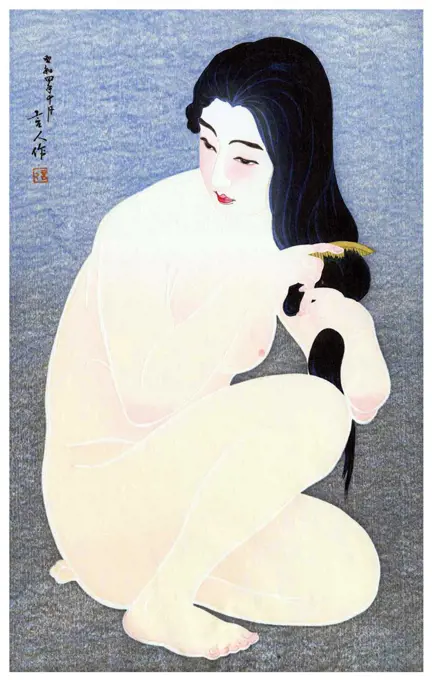
Woman after Bath, 1920. Hashiguchi Goyo (1880-1921) Japanese Ukiyo-e artist. Nude woman, half kneeling, squeezing blue and white cloth over bowl.
6145-59469265
Writing foreigners in a merchant house in Yokohama, Utagawa Sadahide, 1861 print Dutchman writing at the table and watching German; The nationalities are listed in the red cartouches. (Yokohama-e) print maker: Japanprint maker: Tokyopublisher: Tokyo paper color woodcut writing-table, writing-desk. adult man (+ two persons)
6145-45379525
Reklama Dywanów (Oriental House)  Album E. Maindron The illustrious programs of theaters and concert caves. Menus, invitation cards, small prints, etc. Grasset, Eugène (1845 1917), Maindron, Ernest (1838 1908)
1899-18789562
Kitagawa Utamaro (ca. 1753 - October 31, 1806) was a Japanese printmaker and painter, who is considered one of the greatest artists of woodblock prints (ukiyo-e). He is known especially for his masterfully composed studies of women, known as bijinga. He also produced nature studies, particularly illustrated books of insects.
6145-43511723
Print (France); Manufactured by Cooper Union Library
6145-45762487
Satyr and Nymph companies love; Willow storm; Yanagi No Arashi. Naked Satyr owns love with Nymph in red robe. Text in the left and right upstairs corner.
6145-29879620
Mary Cassatt, The Letter, 1890 1891 The Letter
6145-30163193
Americans on an Outing (Amerikajin yuko no zu) 1860 Japan. Color woodblock print; oban . Utagawa Yoshikazu
4409-17351795
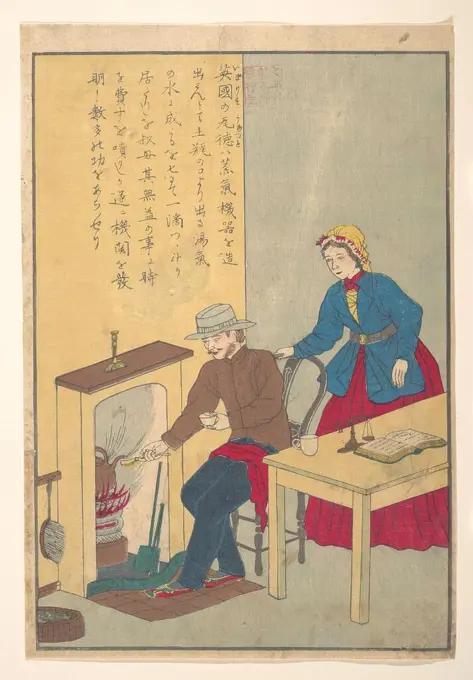
Lives of Great People of the Occident (Taisei ijin den): James Watt (1736-1819). Culture: Japan. Dimensions: Image: 13 1/4 x 9 1/2 in. (33.7 x 24.1 cm). Date: ca. 1870. Museum: Metropolitan Museum of Art, New York, USA.
4048-21183446
The Letter, by Mary Cassatt, 1990-91, American print, drypoint and aquatint. Following a landmark exhibition of Japanese color woodcuts in Paris in 1890, Cassatt made a series of drypoint engravings, colored with aquatint. She adapted the ukiyo-e theme (p (BSLOC_2016_5_175)
1899-18713446
The Night Revels of Han Xizai is a painted scroll depicting Han Xizai, a minister of the Southern Tang Emperor Li Yu (937-978). This narrative painting is split into five distinct sections: Han Xizai listens to the pipa, watches dancers, takes a rest, plays string instruments, and then sees guests off. The original, painted by Gu Hongzhong (937-975), is lost, but a 12th century copy, housed in the Palace Museum in Beijing, survives (pictured here).
1899-18789044
Suzuki Harunobu (1724 July 7, 1770) was a Japanese woodblock print artist, one of the most famous in the Ukiyo-e style. He was an innovator, the first to produce full-color prints (nishiki-e) in 1765, rendering obsolete the former modes of two- and three-color prints. Harunobu used many special techniques, and depicted a wide variety of subjects, from classical poems to contemporary beauties (bijin, bijin-ga). Like many artists of his day, Harunobu also produced a number of shunga, or erotic images. During his lifetime and shortly afterwards, many artists imitated his style. A few, such as Harushige, even boasted of their ability to forge the work of the great master. Much about Harunobu's life is unknown.
1899-18857132
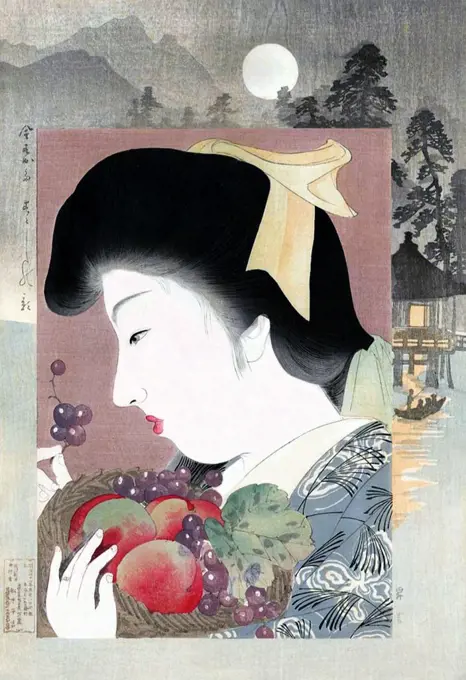
Torii Kotondo is known to have made only 21 prints - all of them images of bijin or beautiful women. They belong to the finest works of art of the Shin Hanga movement. Shin hanga ('new prints') was an art movement in early 20th-century Japan, during the Taisho and Showa periods, that revitalized traditional ukiyo-e art rooted in the Edo and Meiji periods (17th-19th century). The movement flourished from around 1915 to 1942, though it resumed briefly from 1946 through the 1950s. Inspired by European Impressionism, the artists incorporated Western elements such as the effects of light and the expression of individual moods, but focused on strictly traditional themes of landscapes (fukeiga), famous places (meisho), beautiful women (bijinga), kabuki actors (yakusha-e), and birds and flowers (kachoga).
6145-59048728
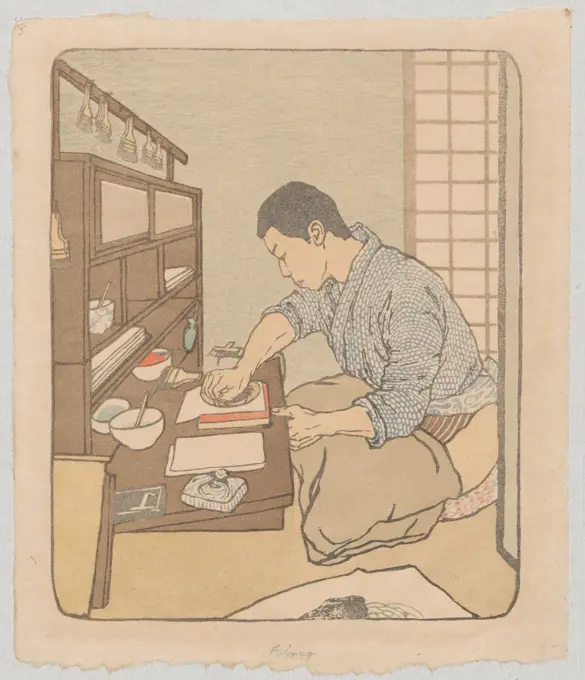
Japanischer Drucker; Orlik, Emil (1870-1932); 1901 (1900-00-00-1900-00-00);Japan, Orient, Partage Plus, Schlesisches Museum der Bildenden Künste (Wrocław - 1880-1945) - collection, printers, woodcuts, graphic designers, modernism (style), artist studios, art
6145-51836942
Robert Frederick Blum, Endo Morito's Remorse, 1890, watercolor and gouache over graphite on paper.
4430-3344
fine arts, Toyoharu, Utagawa (1735 - 1814), graphic, couple, colour woodcut, printed 1870, private collection,
6145-29065276
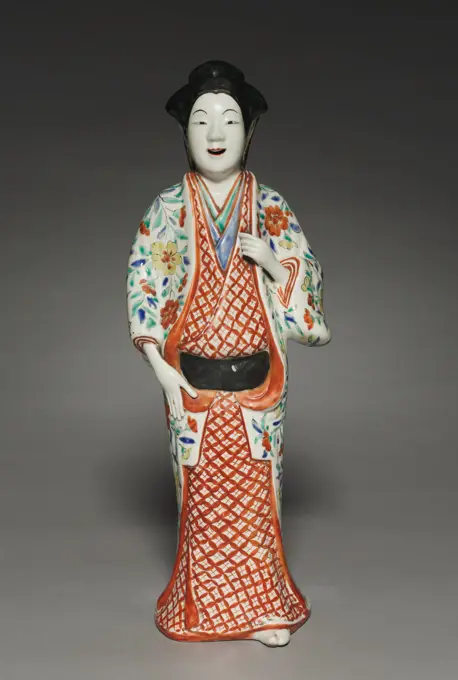
Standing Figure of a Beauty, c. 1690. Japan, Edo period (1615-1868). Porcelain with overglaze color enamels (Hizen ware, Kakiemon type); overall: 38 cm (14 15/16 in.).
4409-17356295
Watercolor of musician playing yunlo. Culture: Chinese. Dimensions: Overall: 43.2 x 35.6 x 1.3cm (17 x 14 x 1/2in.). Date: late 18th century. Museum: Metropolitan Museum of Art, New York, USA.
PREVIOUS
of 5
NEXT
2401 S. Ervay, Suite 206
Dallas, Texas 75215
United States
Get Started
Free ResearchMy BoardsMy Cart
For Creators
How To License Your ContentContributor PortalFrame of Mind
Resources
API accessPricing
Contact
+1 866 236 0087help@viewpictures.co.uk Contact form
©2026 View Pictures. All Rights Reserved. -A
This site is protected by reCAPTCHA and Google Privacy Policy and Terms of Service apply.