My Boards
View Pictures
  • My Boards

Japanese Historical Art

Artworks showcasing legendary figures and scenes from Japanese folklore and history, characterized by intricate designs, vibrant colors, and spiritual undertones.

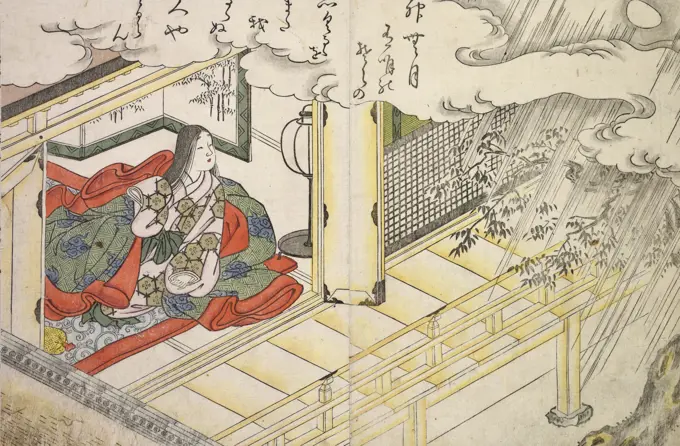
Court ladies in robes of state composing poetry., 1730, Woodcuts
181 assets in this story
1788-42158
Deities, detail from the Paradise of Amitabha Buddha, Light without limits, the fourth of five Buddhas of Contemplation, 1795, colour on silk, from the temple of Suguk-Sa, South Korea. Korean Civilisation, Joseon dynasty, 18th century.
6176-66097182
Heng O Flies to the Moon. Chang'e, orChang-o, originally known asHeng'e, is the Chinesegoddess of the Moon. She is the subject of several legends inChinese mythology, most of which incorporate several of the following elements:Houyithe archer, a benevolent or malevolentemperor, anelixir of life, and the Moon. She is married to the archerHouyi.
6145-29079815
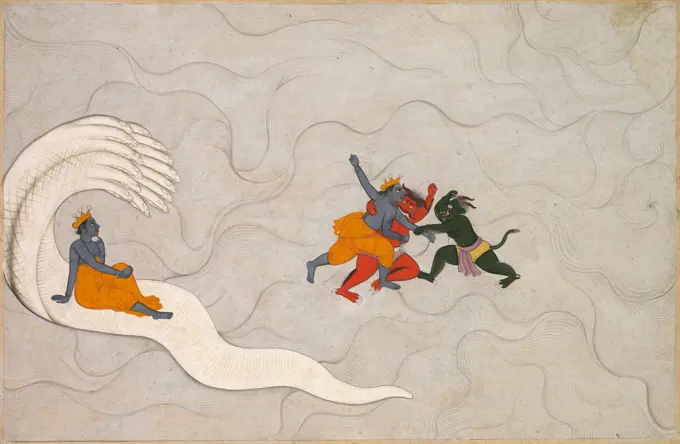
Vishnu Battles Madhu and Kaitabha, from a Markandeya Purana, c. 1760. Northern India, Himachal Pradesh, Guler, 18th century. Opaque watercolor on paper; image: 16.7 x 25.8 cm (6 9/16 x 10 3/16 in.); overall: 20.2 x 29.2 cm (7 15/16 x 11 1/2 in.). This scene from a Hindu text is set during the moments before the creation of the world. The four-armed god Vishnu has just awakened on his multiheaded serpent bed that floats on the cosmic ocean of milk. Two demons generated from his earwax, according to the text, have already begun a primordial battle between good and evil.
1899-18789444
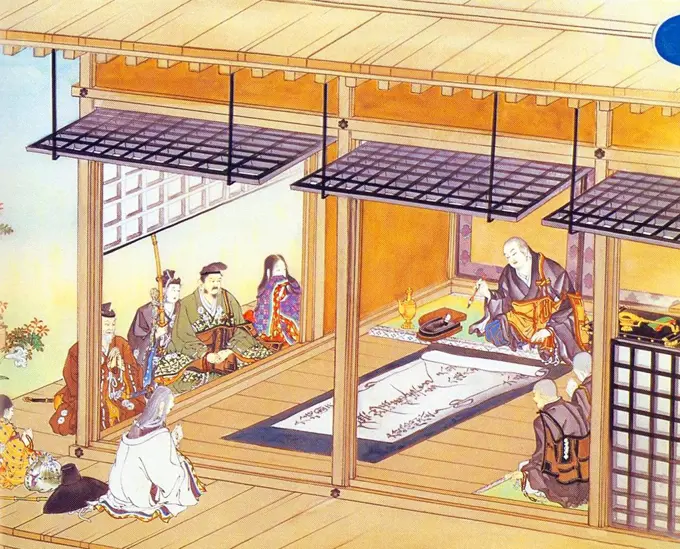
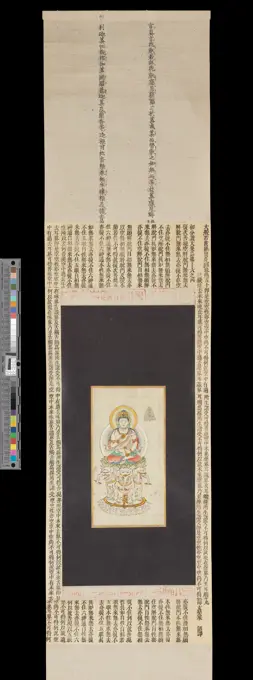
The Moji-mandala Gohonzon, or the 'Mandala Gohonzon', is the primary object of devotion in Nichiren Shu and some other Nichiren schools, and the exclusive object of veneration in the Nichiren Shi shu branch and formerly affiliated groups such as Si ka Gakkai. Nichiren (February 16, 1222 October 13, 1282) was a Buddhist monk who lived during the Kamakura period (1185-1333) in Japan. Nichiren taught devotion to the Lotus Sutra, entitled Myoho-Renge-Kyo in Japanese, as the exclusive means to attain enlightenment and the chanting of Namu-Myoho-Renge-Kyo as the essential practice of the teaching. Various schools with diverging interpretations of Nichiren's teachings comprise Nichiren Buddhism.
6145-29120283
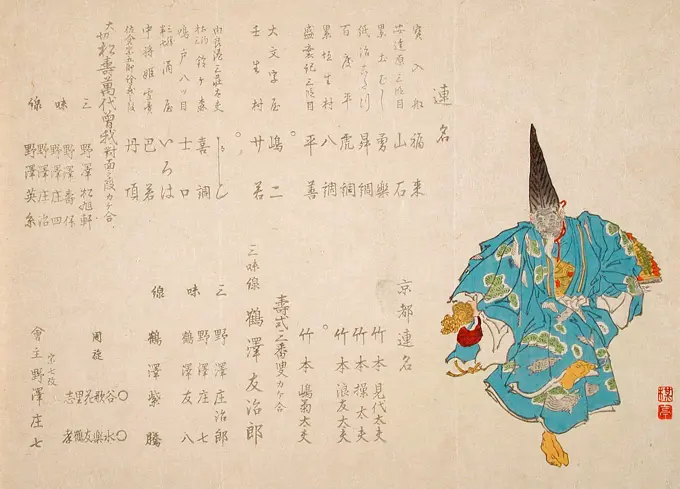
Okina Dancer at New Year. Ki Baitei (Japan, 1734-1810). Japan, 19th century. Prints; woodblocks. Color woodblock print
4220-21857329
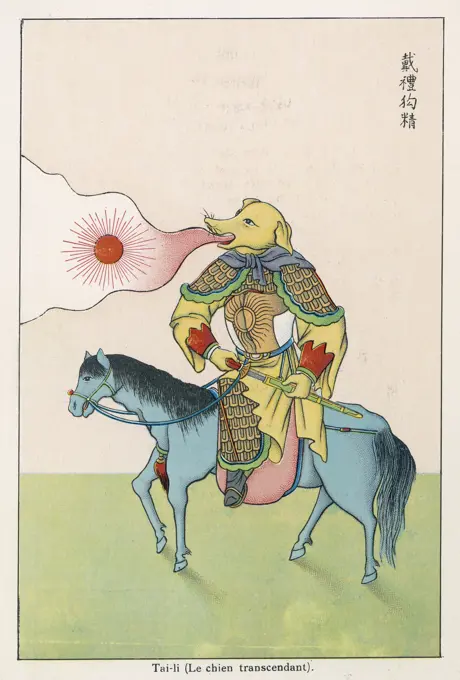
TAI-LI the transcendental dog, depicted expectorating a  projectile in the form of a  huge red pearl against an enemy     Date: 1918
4409-17502545
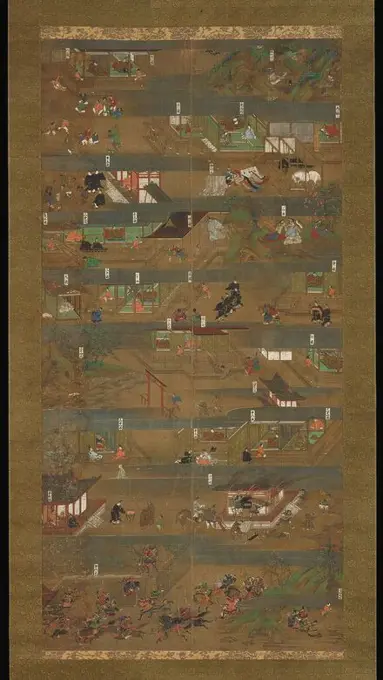
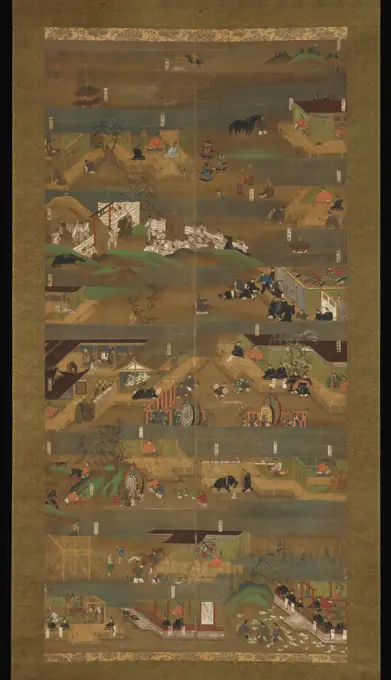
Illustrated Biography of Prince Shotoku. Culture: Japan. Dimensions: Overall: 67 5/8 x 33 1/4in. (171.8 x 84.4cm)Overall with mounting: 106 x 40 1/2 in. (269.2 x 102.9 cm)Overall with knobs: 106 x 43 1/4 in. (269.2 x 109.9 cm). Date: 14th century.Prince Shotoku (574-622), a fervent champion of Buddhism against the often fierce opposition of the hereditary clans in charge of Shinto ritual, was venerated within a century after his death as an incarnation of the historical (Shakyamuni) Buddha. Tales of his miraculous life, inspired by narratives of the life of the Buddha, were painted in temples and shrines and included among the parables told by priests. These tales played a major part in the spread of popular Buddhism in medieval Japan. As a paragon of Buddhist virtue from a time before sectarianism, Shotoku appealed to many practitioners of the faith.This pair of hanging scrolls depicts sixty-two episodes from Shotoku's life, drawing parallels between him and Shakyamuni Buddha. Fo
1899-18856182
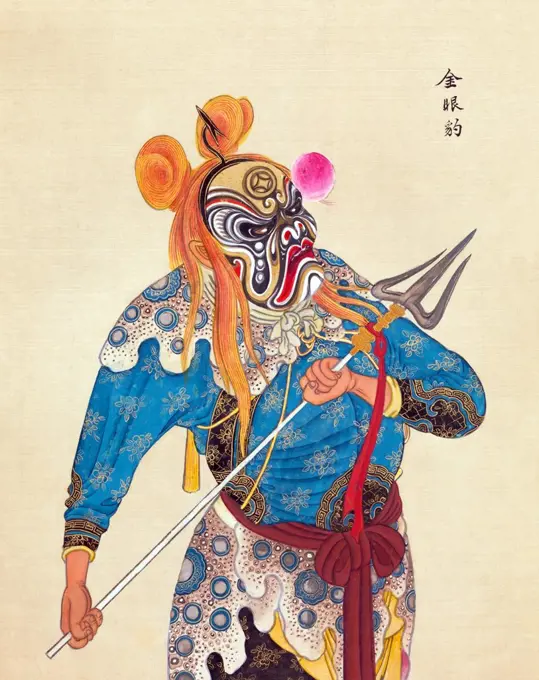
Peking opera or Beijing opera (剧; traditional Chinese: 劇; pinyin: Jīngjù) is a form of traditional Chinese theatre which combines music, vocal performance, mime, dance, and acrobatics. It arose in the late 18th century and became fully developed and recognized by the mid-19th century. The form was extremely popular in the Qing dynasty court and has come to be regarded as one of the cultural treasures of China. Major performance troupes are based in Beijing and Tianjin in the north, and Shanghai in the south.  The art form is also preserved in Taiwan, where it is known as Guoju (國劇; pinyin: Guójù). It has also spread to other countries such as the United States and Japan.
4215-20743262
Wall art of traditional Korean life, Insa-dong, Seoul, South Korea
6145-29199484
New Year Picture of Door God with Knife-mounted Pole early 20th century Unidentified. New Year Picture of Door God with Knife-mounted Pole. Unidentified artist(s), Chinese, early 20th century. China. early 20th century. Polychrome woodblock print; ink and color on paper. Republic period (191249. Prints
1746-19633354
Death of Buddha, Pari Nirvana. Episode from 18th century Japanese manuscript scroll.
1899-18711838
The Three Sovereigns and Five Emperors (Sanhuang wudi; Wade-Giles: San-huang wu-ti) are a blend of mythological rulers and cultural heroes from ancient China dating loosely from the period from c.3500-2000 BCE. This represents the earliest period of recorded Chinese history and is regarded as largely mythological. In chronological terms it precedes the Xia Dynasty (c.2070-1600 BCE). There are several variations as to who constitute the various Three Sovereigns and Seven Emperors. According to the Diwang Xishi or Record of Imperial Lineages, also called the 'Sovereign Series' in English, the Three Sovereigns were, in chronological sequence: Fuxi, Shennong and Huangdi. The same source lists the Five Emperors, again chronologically, as: Shaohao, Zhuanxu, Gaoxin, Yao and Shun.
1788-42236
Two maiko (geisha girls) at the Kiyomizu Temple, 1906-1909, by Yamamoto Shoun (1870-1965), woodcut from the Ima Sugata series. Japanese civilization, Meiji-Showa period.
1899-18713734
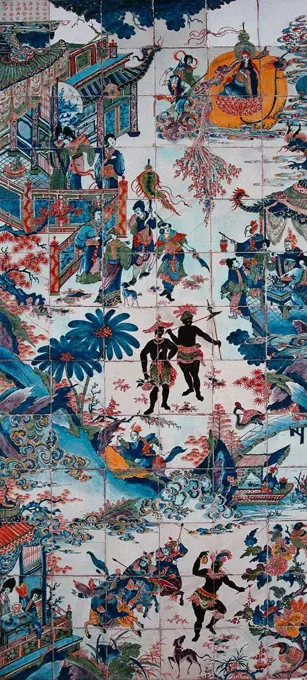
An almost entirely traditional Chinese scene revolves around two sturdy African villagers dressed in skirts and headdresses who are holding spears. The Africans seem to be amused, most probably curious at the sight of so many richly dressed Chinese men and women, pagodas, pavilions, Chinese lanterns, a bamboo bridge, a Chinese gondola and even a floating Buddha in the sky. In the lower half of the painting, an African woman dances while Chinese warriors charge around on horseback.
4443-21769686
Shiva sits on a tiger skin with a prayer cord in his left hand. He has a half-moon wreath behind his head. The river Ganges runs with a bow from his head down to the ground. A snake twists around his neck and a chain of skulls hangs around his neck. Against a tree stands his trident with pennant and drum attached to it. Parvati sits next to him with his hands in worship. On the left in the foreground is Shiva's mount, the bull Nandi. The image is applied to a transparent animal skin, Bhairava ragini., draughtsman: anonymous, India, 1750 - 1770, paper, brush, brush, h 153 mm × w 125 mm
4048-21183258
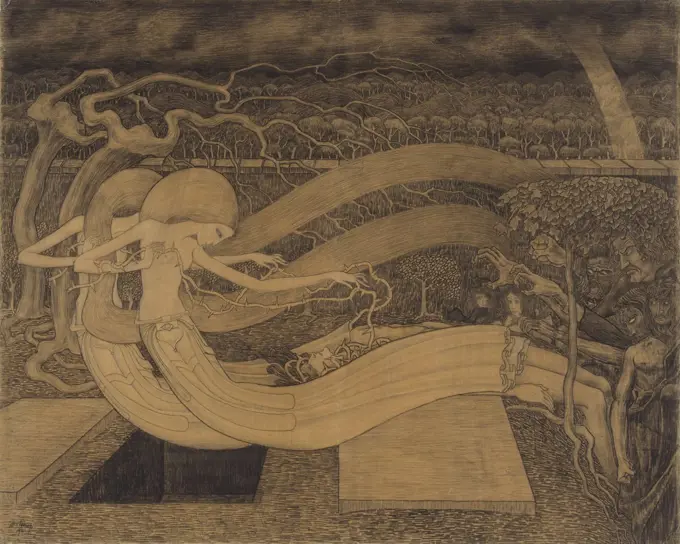
O Grave, Where is Thy Victory, but Jan Toorop, 1892, Dutch drawing, chalk on paper. Death, the monster with figures on left, look on at man entwined with thorny branches, the symbol of manís sorrowful earthly existence. Two seraphim (angels) float above the open grave and free the dead man from these branches. The title of this drawing is taken from a letter by the Apostle Paul concerning the victory of Faith over Death (BSLOC_2016_3_271)
1899-18713845
Seventh section of the Hungry Ghosts Scroll located at the Kyoto National Museum. The scroll depicts the world of the hungry ghosts, one of the six realms of Buddhism and contains tales of salvation of the hungry ghosts. This particular section tells how Ananda, a disciple of Shakyamuni, passed on the method of salvation which was recounted in the sixth section of the same scroll. It shows monks offering food and drink to the spirits of the dead. The whole scroll has been designated a National Treasure of Japan in the category paintings. It was possibly part of a set of scrolls depicting the six realms which was kept at Sanjūsangen-dō.
1899-19136769
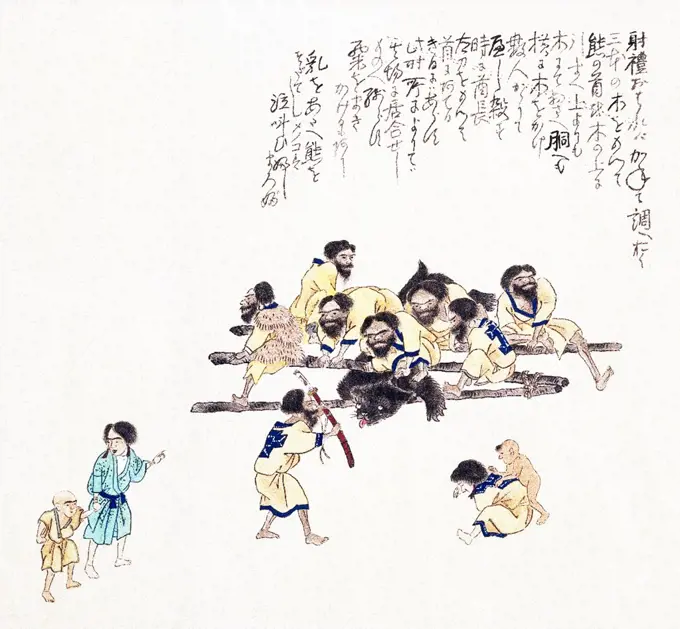
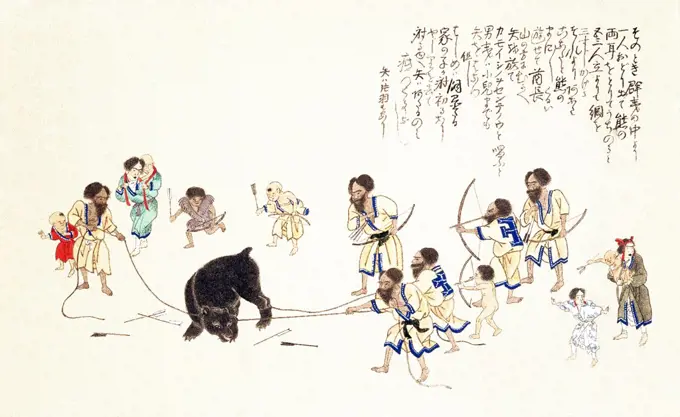
Japan: 'The Ainu Bear-Killing Ritual', from Ezo Shima Kikan ('Unusual Views of Ezo Hokkaido'), painted handscroll, Hata Awagimaro (1764-1808), c. 1840
7127-70532891
Taoist Gods Lantern City God Temple Yueyuan Shanghai, China Most famous Taoist temple in Shanghai
4443-73201872
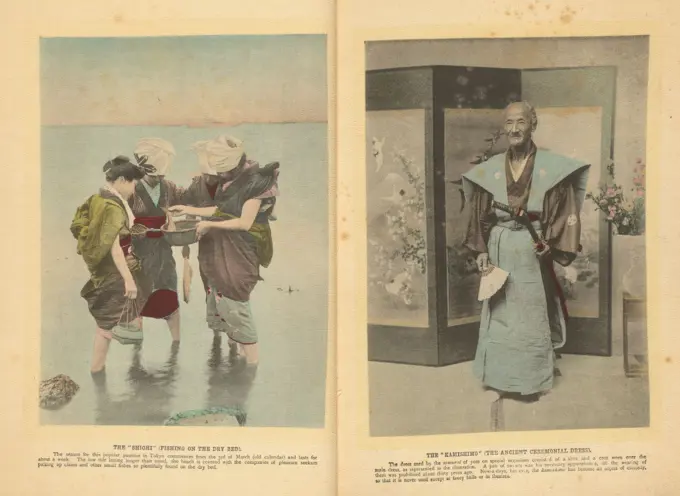
Japan, Ogawa, Kazumasa, The 'kamishimo' (the ancient ceremonial dress), Portrait of a man in a traditional robe (kamishimo), recto - printed, photomechanical print, page, photos, photographically illustrated books, The dress used or in theaters., height 181 mm, width 126 mm, photographer, 1886 - 1896, crepe paper, collotype, photoprint, hand coloring, Japanese, 1860-09-29 - 1929-09-06, cliché maker
6145-45337380
Arhat vajraputra unknown
7155-70376490
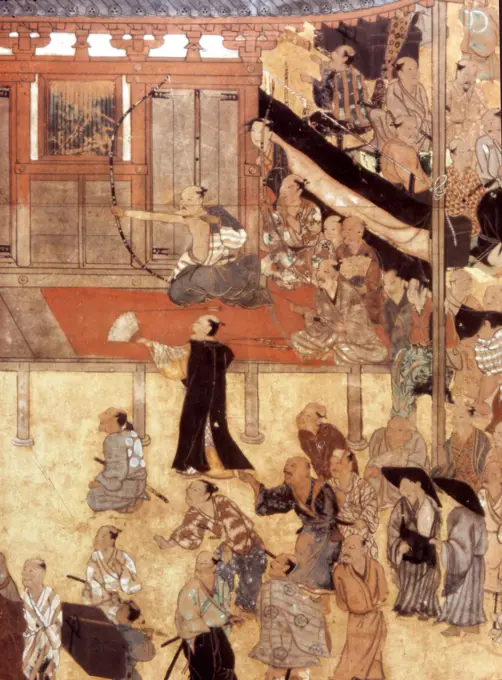
Samurai archery at sanju Sangendo temple. Monks and tiwnspeople, Momoyama, 16th cent. JAPAN.
1899-18789766
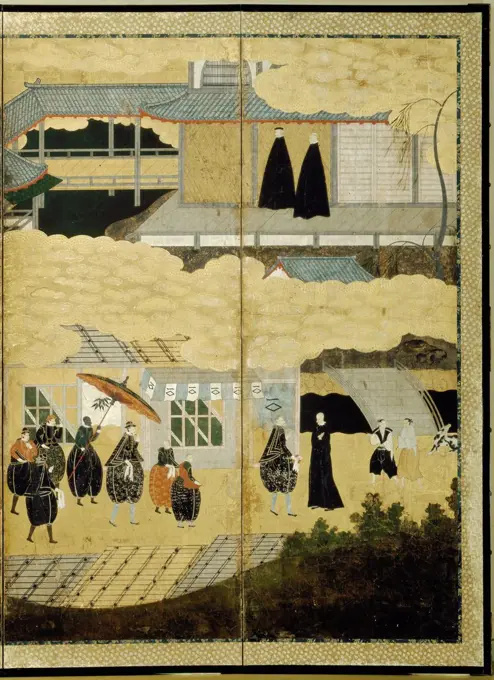
Kani Naizen (1570 - 1616) was a Japanese painter of the Kani school, particularly known for his screen paintings (byi bu) of Namban (Southern Barbarians, i.e. Europeans). The Nanban trade (Nanban bi eki, 'Southern barbarian trade') or the Nanban trade period (Nanban bi eki jidai, 'Southern barbarian trade period') in Japanese history extends from the arrival of the first Europeans - Portuguese explorers, missionaries and merchants - to Japan in 1543, to their near-total exclusion from the archipelago in 1614, under the promulgation of the 'Sakoku' Seclusion Edicts.
6145-29063527
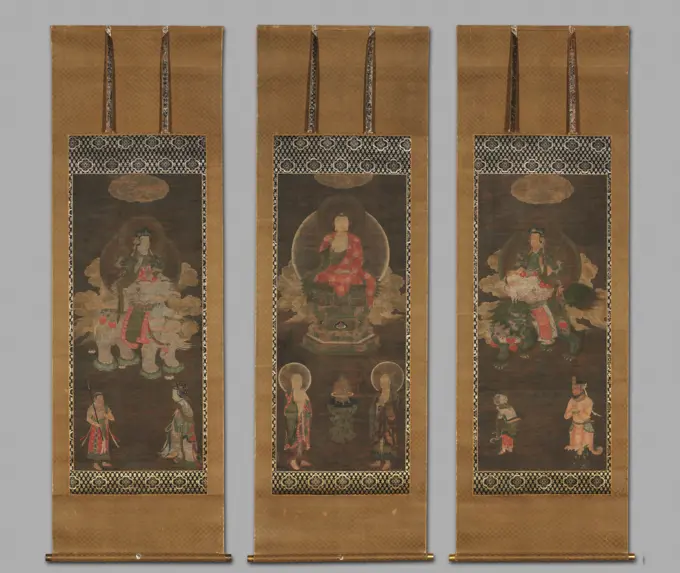
Shakyamuni Triad: Buddha Attended by Manjushri and Samantabhadra, late 1300s. China, Fuzhou, Fujian Province, Yuan dynasty (1271-1368). Set of three hanging scrolls, ink and color on silk; painting: 106.9 x 46.4 cm (42 1/16 x 18 1/4 in.); overall with knobs: 192 x 66.7 cm (75 9/16 x 26 1/4 in.). This triptych is a rare example of Yuan Buddhist painting. It depicts the historic Buddha Shakyamuni flanked by two attending bodhisattvas, Manjushri (the bodhisattva of wisdom, riding a lion) and Samantabhadra (the bodhisattva of universal virtue, riding an elephant). Included in the symmetrical configuration are also the two disciples of the Buddha, Ananada and Kasyapa, two foreigners who attend the bodhisattvas lion and elephant, and a youth and a female worshipper, all of whom seek enlightenment from the bohisattvas. The clouds above and around the divine beings form one scene that illustrates Shakyamunis sermon from the Lotus Sutra. This text became an important basis for Buddhist faith
6145-29744742
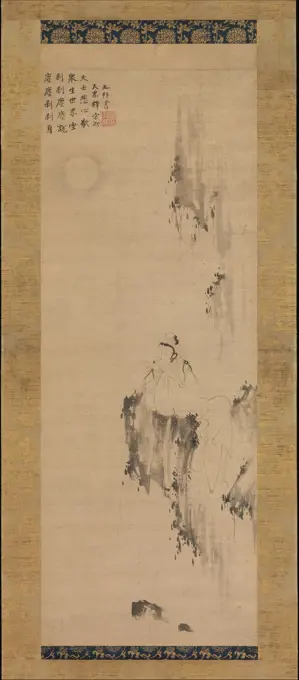
White-Robed Guanyin late 14th century Unidentified According to Buddhist belief, Guanyin (Avalokiteshvara, in Sanskrit), Bodhisattva of Infinite Compassion, reveals himself in many forms. In one such manifestation, known simply as the White-Robed Guanyin, the Bodhisattva sits on the rocky island of Putuo (Potalaka, in Sanskrit), believed by the Chinese to be located offshore from Ningbo, in Zhejiang Province.The poem was inscribed (from left to right) by Quanshi Zongle:The body is as small as specks of dust and as ephemeral,So is the doctrine ephemeral and small as specks of dust;The world of all living things is but emptiness,And so Guanyins compassionate heart is at rest.Quanshi Zongle, appointed by the first Ming emperor to the highest administrative position governing Chan institutions, served as abbot of the Tianjie temple, near Nanjing, first about 1375 and later from 1388 until his death in 1391. The painting, inscribed at the Tianjie temple, is datable to the end of the fourte
1746-19690390
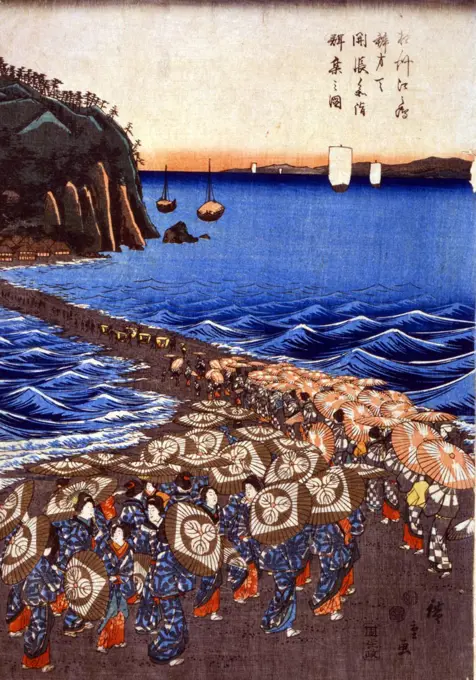
Soshu enoshima benzaiten kaicyo sankei gunshu no zu - Opening celebration of Benzaiten Shrine at Enoshima in Soshu. Japanese triptych print shows large groups of women pilgrims visiting Enoshima shrine to worship an image of Benzaiten, the Goddess of Good Fortune. They are walking towards an island on a causeway with sailboats and Mount Fuji in the background.
1899-19136767
Japan: 'The Ainu Bear-Killing Ritual', from Ezo Shima Kikan ('Unusual Views of Ezo Hokkaido'), painted handscroll, Hata Awagimaro (1764-1808), c. 1840
4266-21633678
Arrival of a Portuguese ship. Nanban screen. Detail: Japanese Christians, Anonymous
1899-18717588
A hand-drawn, hand-coloured watercolour from the late 19th century by an unknown Burmese artist. The name of the ethnic group featured appears near the top of the picture in Shan script (left), Burmese script (Centre) and Khun script (right). Khun script was formerly used in Kengtung / Kyaingtong in eastern Shan State and in Lan Na or Lanna, northern Thailand. The Shan, or Tai Yai (Large Tai) people are indigenous to Burma, but also have settlements in Thailand and China's Yunnan Province. Myanmar has a northern region called Shan State; its capital is Taunggyi. The Shan have an estimated population of some 6 million.
1899-18712292
Oeyo, Gō, or Satoko (1573 - September 15, 1626) was a prominently-placed female figure in the late Sengoku period. She married three times and her third and last husband Tokugawa Hidetada become the second Tokugawa shogun. She was also the mother of his successor Iemitsu, the third shogun. Oeyo, also known as Ogo, was the third and youngest daughter of the Sengoku period daimyo Azai Nagamasa. Her mother, Oichi was the younger sister of Oda Nobunaga. Toyotomi Hideyoshi became the adoptive father and protector of Oeyo in the period before her marriage. Oeyo's oldest sister, styled Yodo-dono, Cha-Chaby birth name, was a prominent concubine of Hideyoshi and gave birth to his heir, Toyotomi Hideyori. Oeyo's middle sister, Ohatsu was the wife of Kyōgoku Takatsugu and the mother of Kyōgoku Tadataka. After Hidetada resigned the government to his eldest son in 1623, Oeyo took a Buddhist name, Sūgen'in or Sogenin. Her mausoleum can be found at Zōjō-ji in the Shiba neighborhood of Tokyo.
6145-52356021
Maiko watching cormorant fisherman.. Postcards, Genre photographs. 1900 - 1909. The Miriam and Ira D. Wallach Division of Art, Prints and Photographs: Picture Collection. Japanese, Geishas, Excursion boats, Cormorants, Fishing, Spectators
6145-45450325
Priest Nichren walking in the snow on the island of Sado / Sasshu Tsukawara Setchu, from the series: from the life of the Great Saint / Kōso Goichidai Ryaku Zuak Utagawa, kuniyoshi (1797 1861)
1848-52016446
New year's meeting, Japan, Asia
1899-18712178
The Yongzheng Emperor (13 December 1678 - 8 October 1735), was the fifth emperor of the Manchu Qing Dynasty, and the third Qing emperor to rule over China proper, from 1722 to 1735. A hard-working ruler, Yongzheng's main goal was to create an effective government at minimum expense. Like his father, the Kangxi Emperor, Yongzheng used military force in order to preserve the dynasty's position. Suspected by historians to have usurped the throne, his reign was often called despotic, efficient, and vigorous. Although Yongzheng's reign was much shorter than the reigns of both his father, the Kangxi Emperor, and his son, the Qianlong Emperor, his sudden death was probably brought about by his workload. Yongzheng continued an era of continued peace and prosperity as he cracked down on corruption and waste, and reformed the financial administration.
6145-59077177
ARhat in a red opo Or sitting under the scale; Chen, Hongshou (1598-1652); 19th century (1801-00-00-1900-00-00);Arhat (iconogr.), Chinese Buddhism, Chinese (culture), ganglion painting, monks, Chinese art, ganglings, vertical ganglia
1899-18788721
The Japanese tea ceremony, also called the Way of Tea, is a Japanese cultural activity involving the ceremonial preparation and presentation of matcha, powdered green tea. In Japanese, it is called chanoyu or chadi, sadi. The manner in which it is performed, or the art of its performance, is called otemae. Zen Buddhism was a primary influence in the development of the tea ceremony. Tea gatherings are classified as chakai or chaji. A chakai is a relatively simple course of hospitality that includes confections, thin tea, and perhaps a light meal. A chaji is a much more formal gathering, usually including a full-course kaiseki meal followed by confections, thick tea, and thin tea. A chaji can last up to four hours.
6176-66912971
Yuki-Onna, the Lady of the Snow. Spirit in Japanese Folklore
1899-18717582
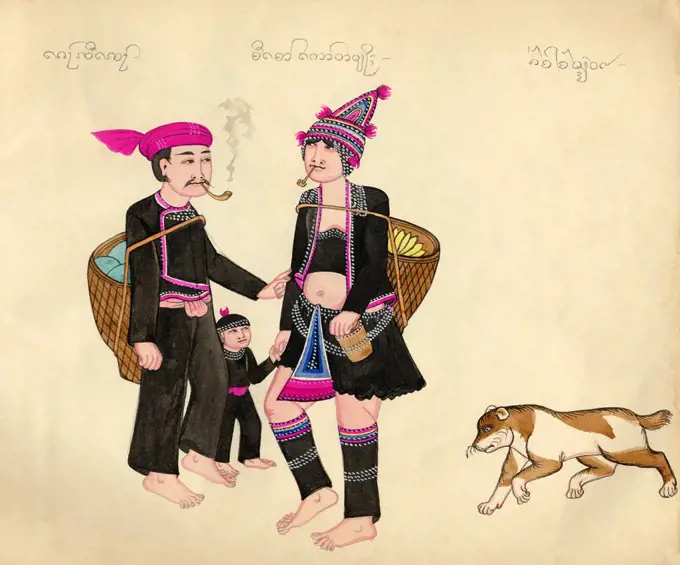
A hand-drawn, hand-coloured watercolour from the late 19th century by an unknown Burmese artist. The name of the ethnic group featured appears near the top of the picture in Shan script (left), Burmese script (Centre) and Khun script (right). Khun script was formerly used in Kengtung / Kyaingtong in eastern Shan State and in Lan Na or Lanna, northern Thailand. The Akha are an ethnic minority hilltribe that is indigenous to Burma, Thailand, Laos and China's Yunnan Province with a total population estimated to be about half a million.
6145-29772827
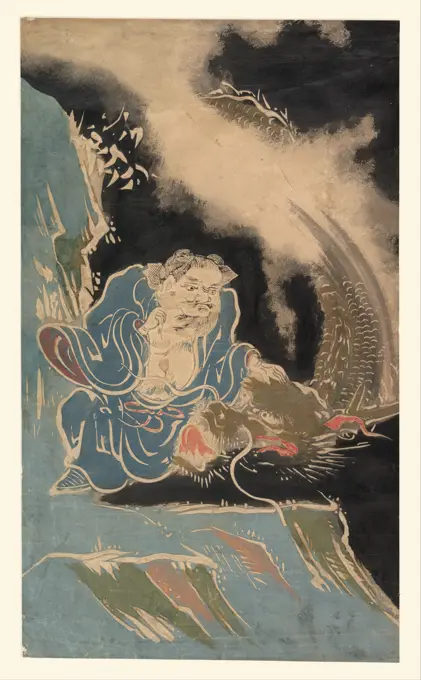
Daoist Immortal with Dragon probably 19th century Unidentified artist. Daoist Immortal with Dragon 55629
4220-21836625
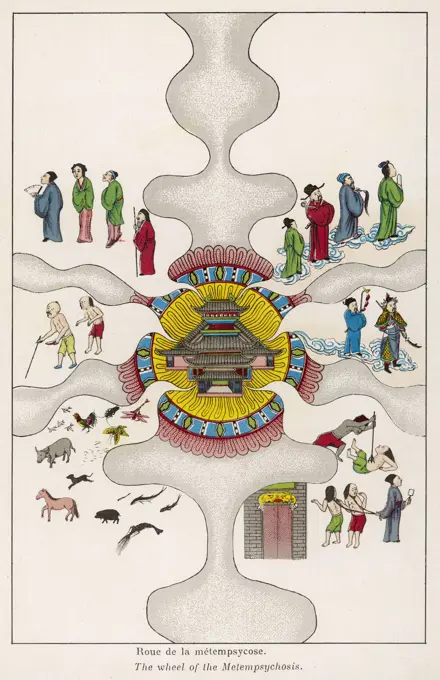
The Buddhist wheel of rebirth of the soul-the cycle of metempsychosis.     Date: 1914
1899-18717920
This painting, by an unknown Burmese artist, is from a watercolour sketch album dating from c.1897 that includes illustrations of Buddhist monks, the Buddha, monasteries, cremations and domestic scenes. Legend attributes the first Buddhist doctrine in Burma to 228 BCE when Sohn Uttar Sthavira, one of the royal monks to Emperor Ashoka the Great of India, came to the country with other monks and sacred texts. However, the era of Buddhism truly began in the 11th century after King Anawrahta of Pagan (Bagan) was converted to Theravada Buddhism. Today, 89% of the population of Burma is Theravada Buddhist.
6145-29883251
Patricio Toya, Long Haired Kachinas, 1930s Long-Haired Kachinas
6145-45668769
Fireworks in Ikenahata; Fireworks on the edge of the pond; Ikenohata Hanabi. Spectators, on the edge of the pond, under a pendulum of lanterns, looking at fireworks above the tents sanctuary, visible in the background; at night.
6145-46650321
. Interior of the wooden Kannon temple in Asakusa with visitors, pigeons and large lantern ceiling.
900-7532
Little Pagoda at Brook, Japanese Art
6145-29135456
The Banquet of Seowangmo (Xiwangmu), Queen Mother of the West. Korea, Korean, Joseon (1392-1910), 18th-19th century. Paintings; screens. Eight-panel screen, ink, color and gold on silk
6145-46645436
. One of a series of seven paintings that together present the miracles of Mazu.
6145-46645706
. The annual arrival of Portuguese ships in the harbour of Nagasaki was a familiar theme in art around 1600. On this pair of screens, produce is being unloaded while the captain and his crew disembark. A Jesuit priest and two Japanese Christians greet him, identifiable by the prayer beads they are holding.
6145-29158038
Illustrated Biography of Prince Shōtoku (Shōtoku Taishi e-den) 14th century Japan Prince Shōtoku (574-622), a preeminent champion of Buddhism against the hereditary clans in charge of Shinto ritual, was venerated within a century after his death as an incarnation of the historical Buddha, Shakyamuni. Monks told parables about him inspired by the life of the Buddha, and episodes from his life decorated temples and shrines, aiding the spread of popular Buddhism throughout medieval Japan. This hanging scroll and its pair depict sixty-two such scenes from the princes life, shown neither chronologically nor in an orderly spatial sequence but instead identified by accompanying inscriptions. Although Shōtoku lived during the early seventh century, when the capital was located in Asuka, these fourteenth-century paintings depict costumed figures, festive activities, and architectural settings inspired by the Kyoto imperial court during the Heian (794-1185) and Kamakura years. Listen to experts
1899-18792636
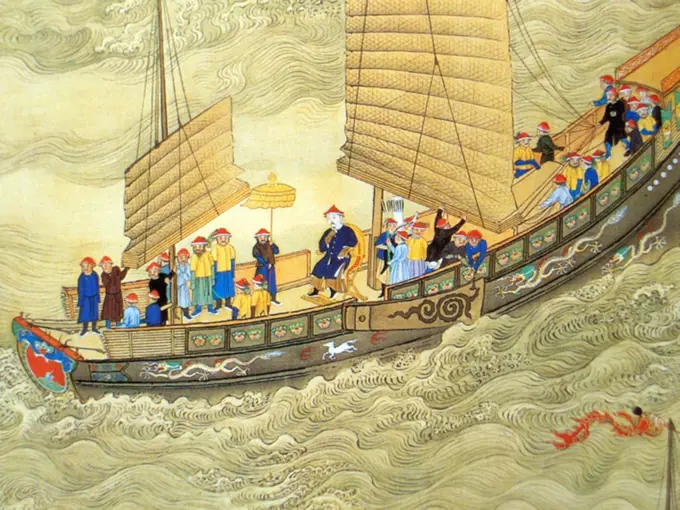
The Taiping Rebellion was a widespread civil war in southern China from 1850 to 1864, led by heterodox Christian convert Hong Xiuquan, who, having received visions, maintained that he was the younger brother of Jesus Christ, against the ruling Manchu-led Qing Dynasty. About 20 million people died, mainly civilians, in one of the deadliest military conflicts in history. Hong established the Taiping Heavenly Kingdom with its capital at Nanjing. The Kingdom's army controlled large parts of southern China, at its height containing about 30 million people. The rebels attempted social reforms believing in shared 'property in common' and the replacement of Confucianism, Buddhism and Chinese folk religion with a form of Christianity. The Taiping troops were nicknamed 'Longhairs' (simplified Chinese: 毛; traditional Chinese: 長毛; pinyin: Chángmáo) by the Qing government. The Taiping areas were besieged by Qing forces throughout most of the rebellion. The Qing government crushed the rebellion wit
7155-70375262
Buddhist monk. Uigur, Mingo-oi, Silk Road, 8th cent. China.
1899-19136204
China: The Daoist immortal Cao Guojiui, from the album of 18 Daoist Paintings by Zhang Lu (1464-1538), 16th century CE. Painting sprinkled with gold leaf, Shanghai Museum, Shanghai
1899-18791846
Hồ Xun Hương (1772-1822) was a Vietnamese poet born at the end of the Lê Dynasty. She grew up in an era of political and social turmoil - the time of the Ty Sơn Rebellion and a three-decade civil war that led to Nguyễn Ánh seizing power as Emperor Gia Long and founding the Nguyen Dynasty. Rather than using Chữ Hán or Chinese characters, Ho Xuan Hong wrote poetry using Chữ Nôm (Southern Script), which adapts Chinese characters for writing demotic Vietnamese. She is considered one of Vietnam's great classical poets and has been called 'The Queen of Nôm poetry'. She became famous and obtained a reputation for creating poems that were subtle and witty. She is believed to have married twice as her poems refer to two different husbands: Vinh Tuong (a local official) and Tong Coc (a slightly higher level official). She was the second-rank wife of Tong Coc, in Western terms, a concubine, a role that she was clearly not happy with ('like the maid/but without the pay'). However, her second mar
6145-59054732
Image of the deity of the guardian;  beginning of the 20th century (1901-00-00-1932-00-00);Jabłońska, Antonina (1901-1994), Jabłoński, Witold (1901-1957), Jabłoński, Witold (1901-1957)-collection, care deities (iconogr.), Chinese (culture), gift (provenance), Chinese art
6145-45691058
Sunrise in Futamigaura; Futamigaura Akbono No zu. The coast at Futami, during sunrise; On the beach the famous 'married rocks' (Moto-iwa), these two with a rope connected rocks symbolize the God Izanagi and the goddess Izanami, the mythological creators of Japan.
6145-29118329
Fugen Bosatsu. Japan, 1248. Paintings; scrolls. Section from a handscroll mounted as a hanging scroll; ink and colors on paper
6145-30162808
Picture of Men and Women from Many Countries (Bankoku danjo jinbutsu zue) 1861 Japan. Color woodblock print; oban triptych . Utagawa Yoshiiku
4220-21863561
Okawa, to save important  documents in a fire, opens his  stomach and places them  inside, dying but saving the  papers : an example of  Japanese devotion to duty     Date: 1908
6176-66913039
A Blind Beggar in Japan, circa 1900
1899-18791883
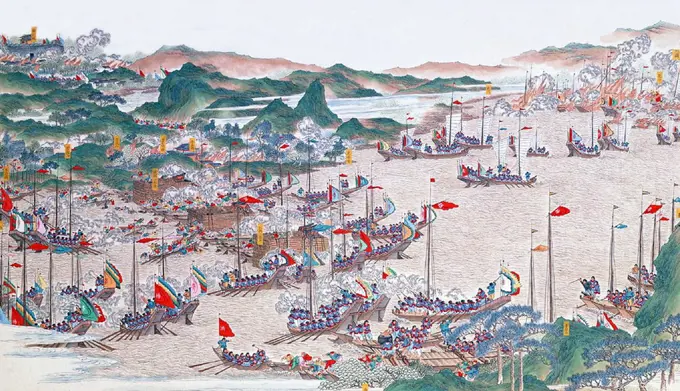
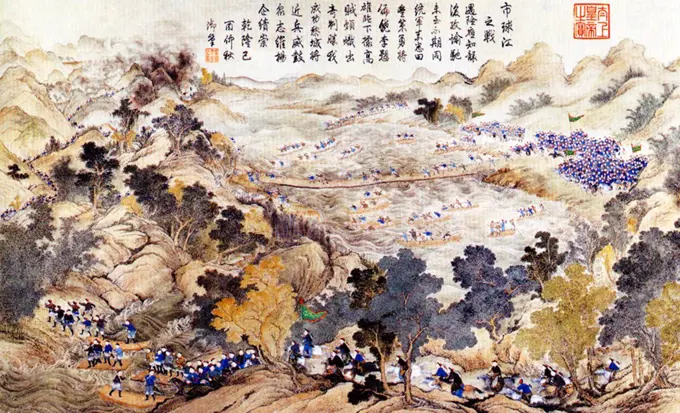
In 1788 a large Qing army was sent south to restore Lê Mẫn Đế (Lê Chiêu Thống) to the Vietnamese throne. They succeeded in taking Thăng Long (Hà Nội, Hanoi) and putting Emperor Lê Chiêu Thống back on the throne. This situation did not last long as the Ty Sơn leader, Nguyễn Huệ, launched an attack against the Qing forces while they were celebrating the Chinese New Year festival of the year 1789. The Chinese were completely defeated and Nguyễn Huệ was proclaimed Emperor Quang Trung of Vietnam, although he also agreed to pat tribute to the Qing court to avoid further invasions. The painting is from the 'Ten Great Campaigns' series produced by Jesuit missionaries at the Qing Court including Giuseppe Castiglione, Jean-Denis Attiret, Ignace Sichelbart and Jean Damascene. The engravings were executed in Paris under the direction of Charles-Nicolas Cochin of the Académie Royal at the Court of Louis XVI and the individual engravers include Le Bas, Aliamet, Prevot, Saint-Aubin, Masquelier, Chof
4409-157774
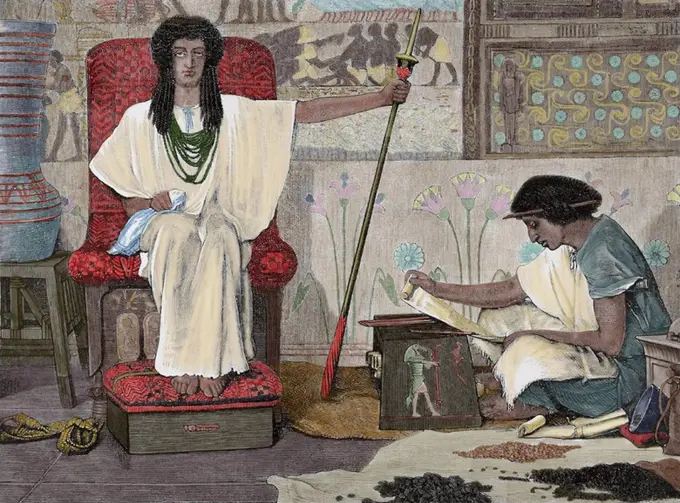
Joseph interpreting the Pharaoh's Dream. Dore Bible Illustration. Genesis 41:25-26. 19th century. Colored engraving.
1899-77936054
Wat Manorom Buddhist temple. Mahaparinirvana (Final Passing Away). At the age of 80, the Buddha passed away in Kushinagar.  Luang Prabang. Laos.
1746-57661823
Chamber of Elders (Genrōin) was a national assembly in early Meiji Japan, established after the Osaka Conference of 1875. It is also referred to as the Senate of Japan, Genrōin being the word used to describe the Roman Senate, and other western legislatures named after it
1890-124020
Painting of the Four Harmonious Friends in Buddhism, elephant, monkey, rabbit and partridge, inside Trongsa Dzong, Trongsa, Bhutan, Asia
1899-19136576
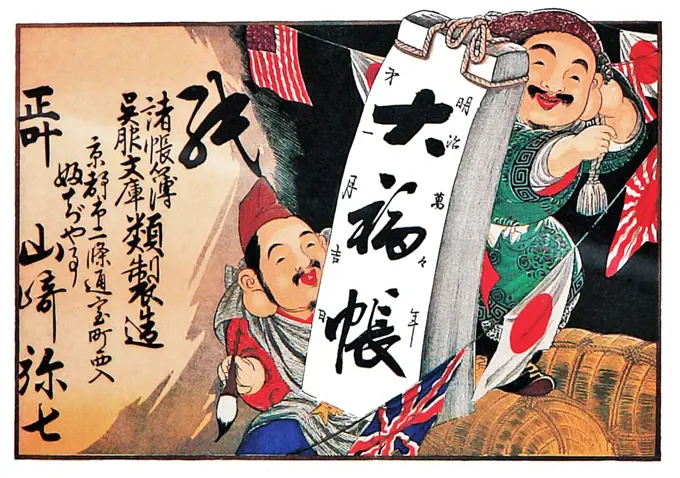
Japan: Hikifuda advertising poster featuring Fukurokuju, god of happiness, wealth and longevity, and Daikokuten (Daikoku), god of wealth, commerce and trade. Takejiro Furushima, 1906
1848-49514882
Wall art of traditional Korean life, Insa-dong, Seoul, South Korea, Asia
6145-29791831
Procession late 19th century Unidentified artist. Procession 51622
7155-70376513
Ten Ox Herding pictures by Seikyo. Stage 9: Ox disappears man is solitary. Zen Buddhism. Japan.
1899-18712186
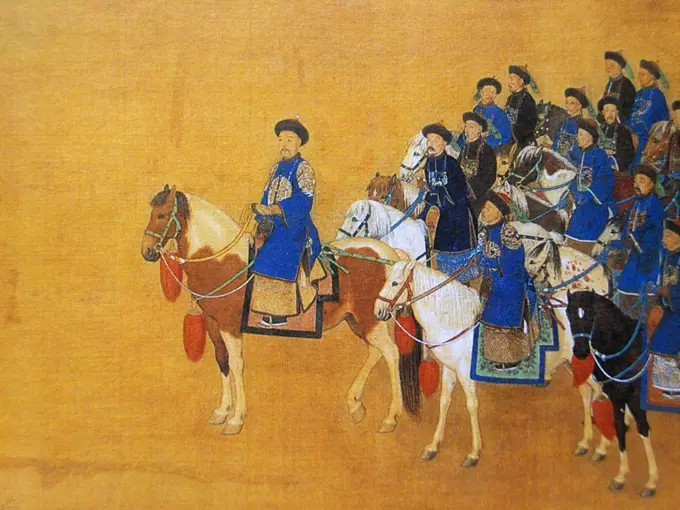
The Qianlong Emperor (Chinese pinyin: Qianlong Di; Wade-Giles: Chien-lung Ti) was the sixth emperor of the Manchu-led Qing Dynasty, and the fourth Qing emperor to rule over China proper. The fourth son of the Yongzheng Emperor, he reigned officially from 11 October 1736 to 7 February 1795. On 8 February (the first day of that lunar year), he abdicated in favor of his son, the Jiaqing Emperor - a filial act in order not to reign longer than his grandfather, the illustrious Kangxi Emperor. Despite his retirement, however, he retained ultimate power until his death in 1799. Although his early years saw the continuity of an era of prosperity in China, he held an unrelentingly conservative attitude. As a result, the Qing Dynasty's comparative decline began later in his reign.
1899-18712160
The Kangxi Emperor (4 May 1654 -20 December 1722) was the fourth emperor of the Qing Dynasty and the second Qing emperor to rule over China proper, from 1661 to 1722. Kangxi's reign of 61 years makes him the longest-reigning Chinese emperor in history (although his grandson, the Qianlong Emperor, had the longest period of de facto power) and one of the longest-reigning rulers in the world. However, having ascended to the throne at the age of seven, he was not the effective ruler until later, with that role temporarily fulfilled for six years by four regents and his grandmother, the Grand Empress Dowager Xiaozhuang.
1899-18713837
Hyakki Yako ('Night Parade of One Hundred Demons') is a Japanese folk belief. The belief holds that every year yokai, the Japanese supernatural beings, will take to the streets during summer nights. Anyone who comes across the procession will die, unless protected by some Buddhist sutra. It is a popular theme in Japanese visual art.
1899-19137068
China: Illustration of the creator goddess Nuwa. From the book 'Myths and Legends of China', by Edward Theodore Chalmers Warner (1864-1954), 1922
1899-18855672
The South Manchuria Railway was built as a part of the Chinese Eastern Railway in 1898-1903 by Imperial Russia according to the Russian-Chinese convention and the Convention of Peking 1860. The South Manchuria Railway Company (満州鉄道株式会社/満洲鉄道株式会社 Minami Manshū Tetsudō Kabushiki-gaisha, or 満鉄 Mantetsu) (Chinese: 满铁路) was a company founded in the Empire of Japan in 1906, taken over after the Russo-Japanese War (1904-1905), and operated within China in the Japanese-controlled South Manchuria Railway Zone. The railway itself ran from Lüshun Port at the southern tip of the Liaodong Peninsula to Harbin, where it connected to the Chinese Eastern Railway. In 1945, the Soviet Union invaded and liberated the Japanese puppet state of Manchukuo. Rolling stock and moveable equipment was looted, and taken back to the Soviet Union, some of which was returned when the Chinese Communist government came into power. The South Manchuria Railway Company or Mantetsu was dissolved by order of the American o
4220-21863602
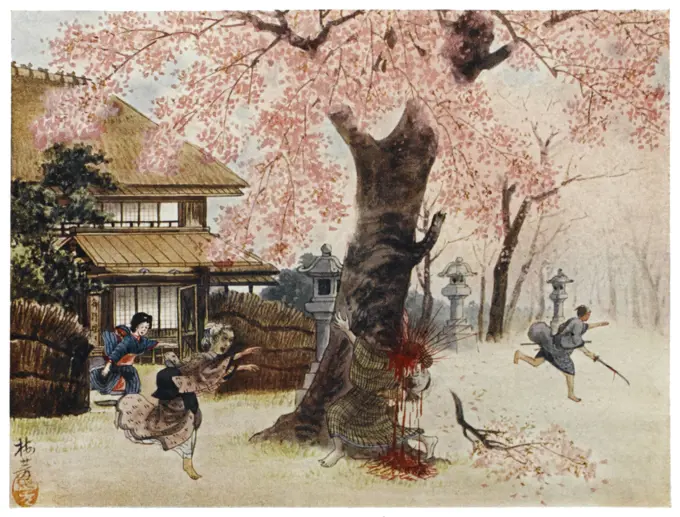
Jirohei is killed by a samurai  while defending the cherry  tree which has brought him  prosperity, and ever after his  ghost haunts the tree
1848-49514879
Wall art of traditional Korean life, Insa-dong, Seoul, South Korea, Asia
4408-17451
Swimmer, Chinese Communist Propaganda
1746-21117840
Woodcut illustration showing Raijin, the Japanese God of Thunder, intimidating Chinese Buddhist worshippers at a religious gathering. Dated 1895.
4409-17576566
'Icon: Resurrection of Christ. Reverse: Orthodox Church of the Resurrection of Christ in Tokyo'. Japan, Circa 1891. Dimensions: 32x26,5 cm. Museum: State Hermitage, St. Petersburg. Author: Rin Yamashita.
4409-28577520
Infographics describe political and social structure of the Chinese Empire with the emperor as the most representative. QuarkXPress (.qxp); 6188x3921.
6145-29263837
A man or deity. Watercolour attributed to a Chinese painter.
6145-29263295
A sacred Chinese figure, walking on water. Painting by a Chinese painter.
PREVIOUS
of 2
NEXT
2401 S. Ervay, Suite 206
Dallas, Texas 75215
United States
Get Started
Free ResearchMy BoardsMy Cart
For Creators
How To License Your ContentContributor PortalFrame of Mind
Resources
API accessPricing
Contact
+1 866 236 0087help@viewpictures.co.uk Contact form
©2026 View Pictures. All Rights Reserved. -B
This site is protected by reCAPTCHA and Google Privacy Policy and Terms of Service apply.