My Boards
View Pictures
  • My Boards

Japanese Ukiyo-e Art

Traditional Japanese woodblock prints demonstrate intricate designs of women and performers, showcasing cultural heritage and artistry.

Vesper Bell of the Temple of Great Buddha ca. 1778 Kitao Shigemasa Japanese. Vesper Bell of the Temple of Great Buddha 56833
151 assets in this story
6145-45666896
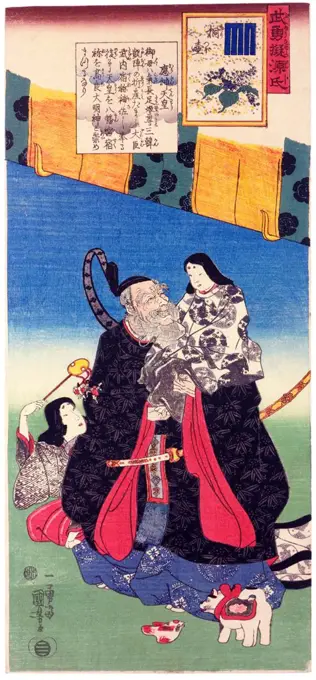
The poet Sumiyoshi myôjin; Sumiyoshi; The three gods of Japanese poetry. A seated man in court dress and with a pine branch in his hands. This is the classic poet Sumiyoshi myôjin, which is honored in the Sumiyoshi neighborhood in Osaka. With one poem.
6145-45643858
Twenty-Four Japanese examples or Philial Piety for the Honchôren. The soga brothers for the tent of Kudo Suketsume in Yoritomo yacht camp. The story of the Soga Brothers is about the revenge that the brothers take on the death of their father in 1193. With two poems.
6145-45643853
Tamamo no mae and miura kuranosuke. Against a black background is a warrior with bow, sitting on a rock pictured. Next to it a woman with long hair. The woman is tamamo no mae (the jewelry girl). She is possessed by a fox but is so beautiful that she became the loved one of Emperor Toba (1103-1156). When the emperor got sick, her debt was laid at her, after which she fled the palace. In the end she was shot by a hunter, after which she changed in a rock. With three poems.
6145-29808838
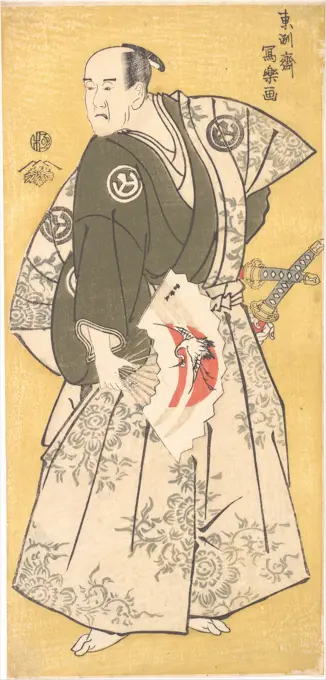
Yamashina Shirojuro in the Role of Nagoya Sanzaemon 1794-95 Tōshūsai Sharaku Japanese The samurai in this print wears an overvest (kataginu) with matching trousers (hakama), a less formal ensemble than the jacket (suo) and long trousers (nagabakama) shown in this case.The print, part of a triptych, presents the actor Yamashina Shirojuro in the role of the samurai Nagoya Sanzaemon from the kabuki play Keisei sanbon karakasa (The Courtesan and the Three Umbrellas). In the play, Nagoya Sanzaemon is killed and his son avenges his death.. Yamashina Shirojuro in the Role of Nagoya Sanzaemon 37329
6145-45734858
Egoyomi for the year of the rooster. A rooster and a chick, dressed as a teacher and student, face each other. On a table between them in a book in which the songs of long months are indicated. The chick has a similar book in hand.
6145-29809209
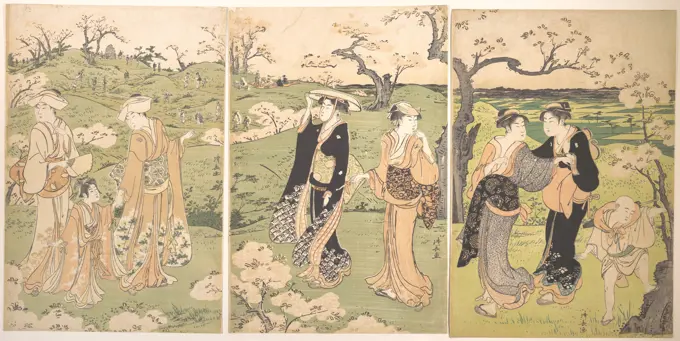
Young Ladies Viewing Cherry-blossoms at Asukayama Torii Kiyonaga Japanese. Young Ladies Viewing Cherry-blossoms at Asukayama 56044
4443-75474066
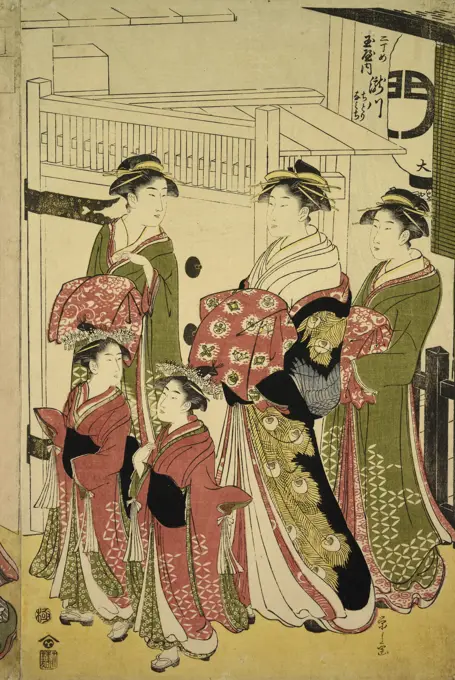
The oiran Takigawa of Tamaya and Shiratsuyu of Wakanaya, accompanied by their kamuro, are depicted parading in Nakano cho. The artwork, created by Eijudo in 1786, is a woodcut measuring 15 x 10 inches (38.1 x 25.4 cm)
6145-59469598
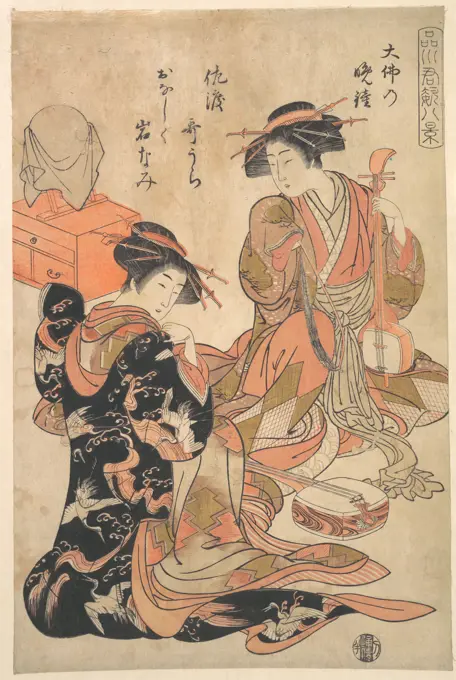
Courtisane Makino Uit Het Sansho Huis, Nagahide, 1810 - 1820 print Courtisane with pointed hat, a Shamisen (Japanese string instrument) playing during the Gion Festival in Kyoto. Kyoto paper  courtesan, hetaera
6145-46582004
. Prostitute in green kimono, kissing with a young man in purple robe. In the background left tissues, on the right a blanket shifted on the side. Second from thirteen prints from the Album Negai No Itoguchi (also translated with: The Prelude to Desire).
6145-45669025
Kintoki drives away a demon. Kintoki, also known as Kintarô, casts beans to expel a demon. Above his head there is a pendulum with paper New Year wishes. Traditionally, the house is cleaned on old year, beans are also thrown into all corners to get lucky and expel demons.
1899-18855121
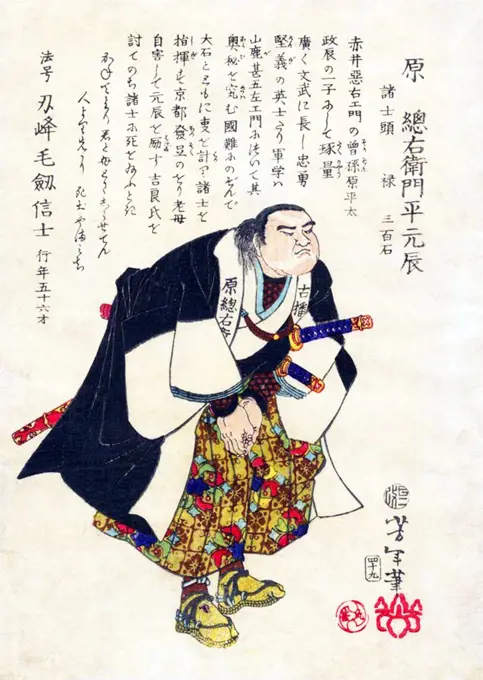
Samurai is the term for the military nobility of pre-industrial Japan. By the end of the 12th century, samurai became almost entirely synonymous with bushi, and the word was closely associated with the middle and upper echelons of the warrior class. The samurai followed a set of rules that came to be known as Bushidō. While they numbered less than ten percent of Japan's population, samurai teachings can still be found today in both everyday life and in martial arts such as Kendō, meaning the way of the sword.
6145-30149499
Act One Tsurugaoka Hachiman Shrine from the play Chushingura (Treasury of the Forty-seven Loyal Retainers) 1790-1800 Japan. Color woodblock print; koban . Katsukawa Shun'ei
6145-51831468
Yoshikado Visiting the Old temple at Soma Toyohara Kunichika (Japanese, 1835-1900). Yoshikado Visiting the Old temple at Soma, 1858, 8th month. Woodblock print (in color), Each sheet: 13 11/16 x 9 11/16 in. (34.8 x 24.6 cm).  This triptych captures a popular climatic scene from the kabuki stage. The warrior Taro Yoshikado appears at a temple before a frog sage to ask for supernatural powers to avenge the murder of a warlord. Princess Takiyasha, the daughter of the deceased warlord, lives in hiding at the temple, honing her powers for the same purpose. She appears at the center, releasing a ghost from a chest. In this early work by Kunichika, the influence of Kunisada is clearly evident, particularly in the stylized treatment of the faces. Asian Art 1858, 8th month
6145-51819751
The Chinese Buddhist Pilgrim Hsuan-Tsang The Chinese Buddhist Pilgrim Hsuan-Tsang, 19th century. Ink and color on paper, 23 x 12 1/2 in. (58.4 x 31.8 cm).   Asian Art 19th century
1899-18789349
The revenge of the Forty-seven Ronin (Shi-ju-shichi-shi), also known as the Forty-seven Samurai, the Aki vendetta, or the Genroku Aki incident (Genroku aki jiken) took place in Japan at the start of the 18th century. One noted Japanese scholar described the tale as the country's 'national legend'. It recounts the most famous case involving the samurai code of honor, bushidi. The story tells of a group of samurai who were left leaderless (becoming ronin) after their daimyo (feudal lord) Asano Naganori was forced to commit seppuku (ritual suicide) for assaulting a court official named Kira Yoshinaka, whose title was Ki zuke no suke. The ronin avenged their master's honor after patiently waiting and planning for two years to kill Kira. In turn, the ronin were themselves ordered to commit seppuku for committing the crime of murder. With much embellishment, this true story was popularized in Japanese culture as emblematic of the loyalty, sacrifice, persistence, and honor that all good peopl
6145-44313758
Instructions for silk balancing leaf 10.
6145-45302518
The actor Actor Segawa Kikunojo III in the role of a woman in a black kimono Katsukawa, shunsen (CA 1762 1830)
6145-30151338
A visit to a shrine, from the series Twelve Scenes of Popular Customs (Fuzoku juni tsui) 1781-1791 Japan. Color woodblock print; koban . Torii Kiyonaga
1899-18856178
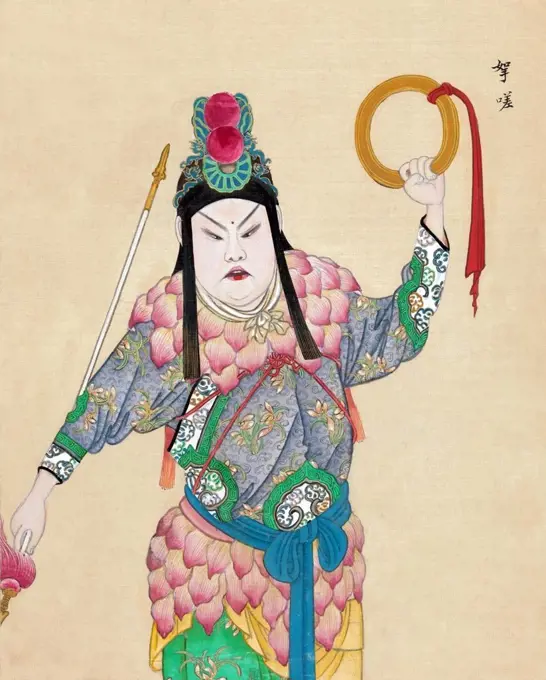
Peking opera or Beijing opera (剧; traditional Chinese: 劇; pinyin: Jīngjù) is a form of traditional Chinese theatre which combines music, vocal performance, mime, dance, and acrobatics. It arose in the late 18th century and became fully developed and recognized by the mid-19th century. The form was extremely popular in the Qing dynasty court and has come to be regarded as one of the cultural treasures of China. Major performance troupes are based in Beijing and Tianjin in the north, and Shanghai in the south. The art form is also preserved in Taiwan, where it is known as Guoju (國劇; pinyin: Guójù). It has also spread to other countries such as the United States and Japan.
6145-45732395
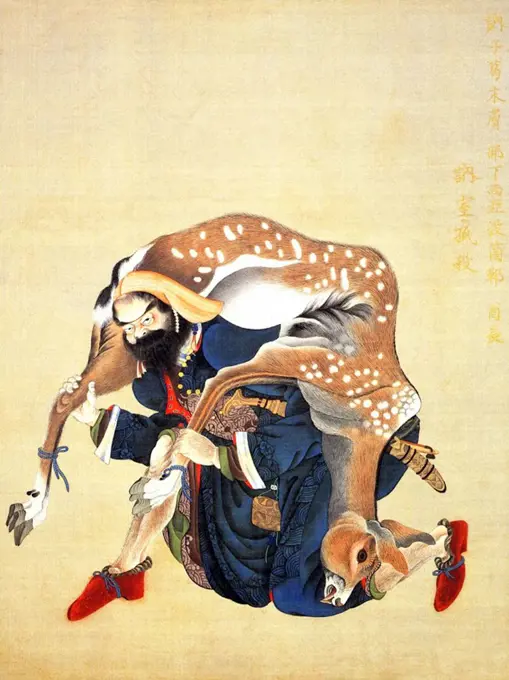
The call of the fox; Konkai; One hundred aspects of the moon; Tsuki hyakushi. Fox, disguised as the Hakuzosu priest with walking stick and rosary, between reeds, at sickle moon. The fox is halfway a transformation between fox (head, ears and supreme clothing by the tail) and man (hands).
1899-18855144
A ninja (者) or shinobi (び) was a covert agent or mercenary in feudal Japan who specialized in unorthodox warfare. The functions of the ninja included espionage, sabotage, infiltration, and assassination, and open combat in certain situations. Their covert methods of waging war contrasted the ninja with the samurai, who observed strict rules about honor and combat. The shinobi proper, a specially trained group of spies and mercenaries, appeared in the Sengoku or 'warring states' period, in the 15th century, but antecedents may have existed in the 14th century, and possibly even in the 12th century (Heian or early Kamakura era).
6145-29714026
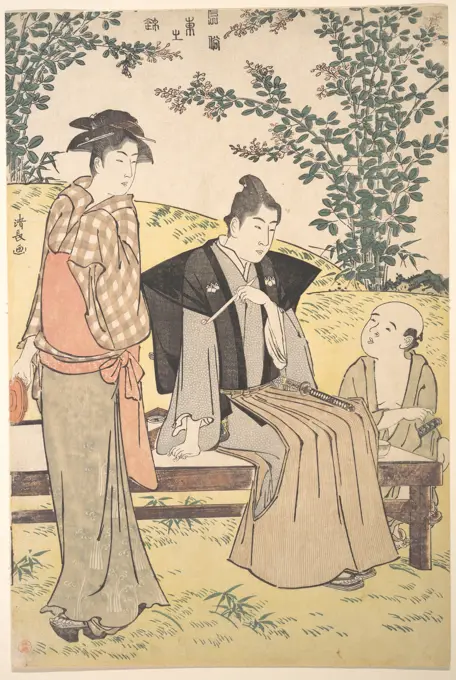
Viewing the Bush Clover at Hagidera 1785 Torii Kiyonaga Japanese. Viewing the Bush Clover at Hagidera 57088
6145-50635728
Knight with the head of the enemy and a man in a court outfit, from the album: Story of peace /Taihei ki jui unknown
6145-46583085
. A Shinto priest with a staff to which Gohhei and an EMA, with a fungus depicted, is next to a gate (Torii). With Japanese text.
1899-19188326
Yamato Takeru (c. 72-113), originally known as Prince Osu, was a legendary and mythical figure in Japan. He was a prince of the Yamato Dynasty, son of 12th emperor of Japan, Emperor Keiko. The life and death of Yamato are primarily chronicled in the tales 'Kojiki' (712 CE) and 'Nihon Shoki' (720 CE). For slaying his elder brother, Osu was sent to fight in Izumo Province by his father, who feared his brutal temperament. Instead of being killed however, Osu succeeded in defeating his enemies and was gifted the title 'Yamato Takeru' (The Brave of Yamato). His father was not convinced, still fearing him and wishing his death.  Next, Yamato was sent eastwards to deal with those who had disobeyed the imperial court, armed with the holy sword 'Kusanagi'. During a great storm, his wife sacrificed herself to appease the sea god, and in his anger he defeated many enemies. However, his blaspheming of a local god of Mount Ibuki led to him being cursed and dying. His soul turned into a great white
6145-29817842
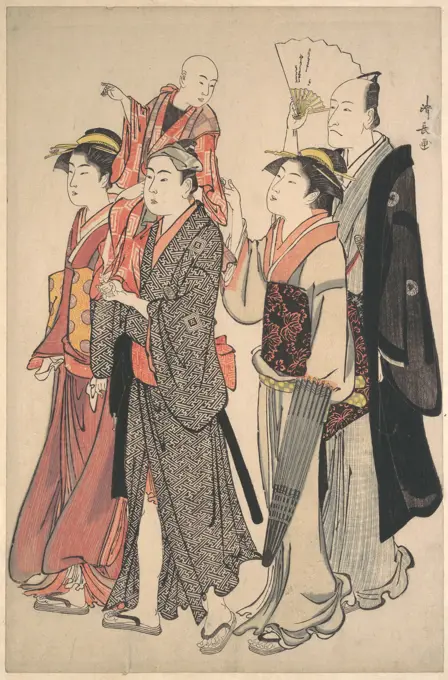
Ichikawa Danjuro V and His Family 1782 Torii Kiyonaga Japanese Kiyonaga depicts Danjūrō V and his family visiting a shrine. Danjūrō's son Ebizō, the future Danjūrō VI, is carried on the shoulder of Ichikawa Masugorō, Danjūrō's pupil. The characteristic Danjūrō family crest of three nested squares (mimasu) is scattered over the son's kimono and, combined with the character go (five), is superimposed on the ground pattern of Masugorō's kimono. The father wears a formal black jacket with another Danjūrō family crest depicting a carp rising in a waterfall.. Ichikawa Danjuro V and His Family 56752
6145-45913459
Parade of three men and a woman. Three men with bamboo sticks and large scale carrying, preceded by woman in kimono. Left part poem.
6145-30174504
Evening bell at Mii Temple 1760-1849 Japan. Color woodblock print . Katsushika Hokusai
1899-19136758
Japan: 'Nochikusa, Ainu chieftain of Shamokotan', Kakizaki Hakyo (1764-1826), 1790
6145-45302794
Heavenly procession in the clouds Gakutei, yashima (1786  1868)
6145-30153744
The Actors Segawa Kikunojo I as Ochiyo and Nakamura Shichisaburo II as Hanbei in the play Higashiyama Gojitsu Yaoya Hanbei, performed at the Nakamura Theater in the eighth month, 1744 1744 Japan. Hand-colored woodblock print; hosoban, urushi-e . Torii Kiyonobu II
1899-18855971
Takenouchi no Sukune () or Takeshiuchi no Sukune was a legendary Japanese hero-statesman, and is a Shinto kami. Takenouchi no Sukune was supposedly the son of Princess Kagehime, and is said to be grandson to Imperial Prince Hikofutdhimakoto no Mikoto. Also descended from Emperor Kgen, Takenouchi no Sukune served under five legendary emperors, Emperor Keik, Emperor Seimu, Emperor Chai, Emperor jin, and Emperor Nintoku, but was perhaps best known for his service as Grand Minister to the Regent Jingu, with whom he supposedly invaded Korea. While Jingu was regent to her son, Ojin, Takenouchi was accused of treason. In addition to his martial services to these emperors, he was reputedly also a saniwa, or spirit medium. Twenty-eight Japanese clans are said to be descended from Takenouchi no Sukune, including Takeuchi and Soga. He is a legendary figure, and is said to have drunk daily from a sacred well, and this helped him to live to be 280 years old. Further, he is enshrined
1848-49415292
Scenes in a brothel around 1840 in Japan, Historical, digitally restored reproduction from a 19th century original
6145-29719089
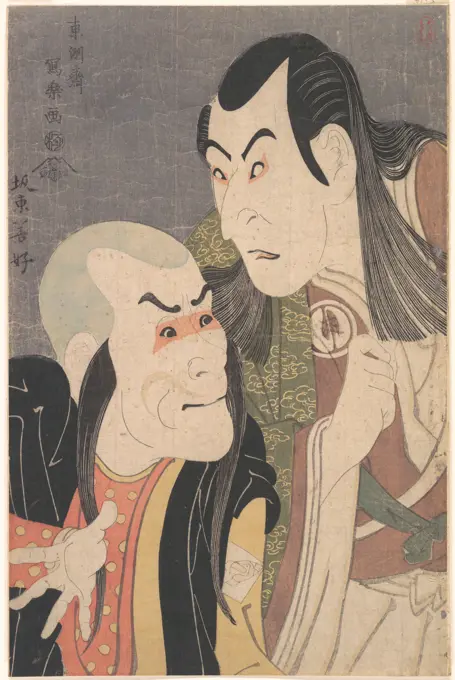
Sawamura Yodogorō II and Bandō Zenji as Kawatsura Hōgen and Onisadobō in the Play "Koinyōbō Somewake Tazuna" 1794 Tōshūsai Sharaku Japanese. Sawamura Yodogorō II and Bandō Zenji as Kawatsura Hōgen and Onisadobō in the Play "Koinyōbō Somewake Tazuna" 37369
1899-18718360
The Astana Graves are a series of underground tombs located 6km from the ancient city of Gaochang, and 42km from Turpan, in Xinjiang, China. The tombs were used by the inhabitants of Gaochang, both commoners and locals, for about 600 years from 200 CE - 800 CE. The complex covers 10 square kilometers and contains over 1,000 tombs. Different plots for separate castes and families are marked by gravel dividers. Due to the arid environment many important artifacts have been well preserved at the tombs, including natural mummies. A typical tomb is entered by a 10 meter sloping staircase. The tombs are not very large, usually only 2 meters high. Some tombs also have murals inside. The deceased were laid on a small raised platform in the back of the tomb, surrounded by possessions and even food. Their faces were covered by cloths, some of which have distinct Persian motifs. A small funeral brick was placed to next to each body, on which was written the person's name and other biographical in
6145-46512537
Sumoworstitch. Sumoworstitch Hiodoshi Rikiya from Hirado in the Ring
6145-45821170
Musashibô Benkei drags with a large temple clock. A fierce-looking man drags with a huge temple clock. The man is the famous warrior Musashibô Benkei, who, according to tradition, possessed enormous power at a young age. After he was banned from the Miidera temple, he tried to drag the temple clock from Miidera to the Enrykuji monastery on Mount Hiei.
6176-66910620
Nakamura Nakazo,  full-length, standing on the shore, facing slightly left, holding a rice coupon. circa 1785
6145-50505395
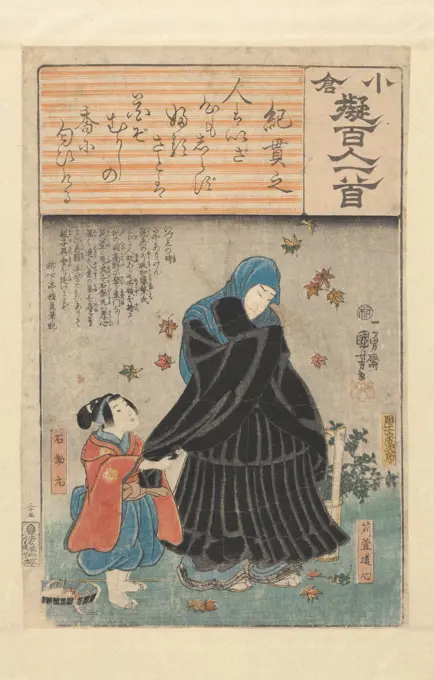
Monk Karukaya with his little son Ishidomaru; poem by Ki-no Tsurayuki; print 35 from the series: Ogura nazorae hyakunin isshu (Imitations of one hundred poems by one hundred poets). Utagawa, Kuniyoshi (1798-1861), graphic artist
1899-18855152
Samurai is the term for the military nobility of pre-industrial Japan. By the end of the 12th century, samurai became almost entirely synonymous with bushi, and the word was closely associated with the middle and upper echelons of the warrior class. The samurai followed a set of rules that came to be known as Bushido. While they numbered less than ten percent of Japan's population, samurai teachings can still be found today in both everyday life and in martial arts such as Kendo, meaning the way of the sword.
4408-10283
Burial, Chinese Prints
6145-29255445
Drug preparation, C16 Chinese painted book illustration
4220-21884754
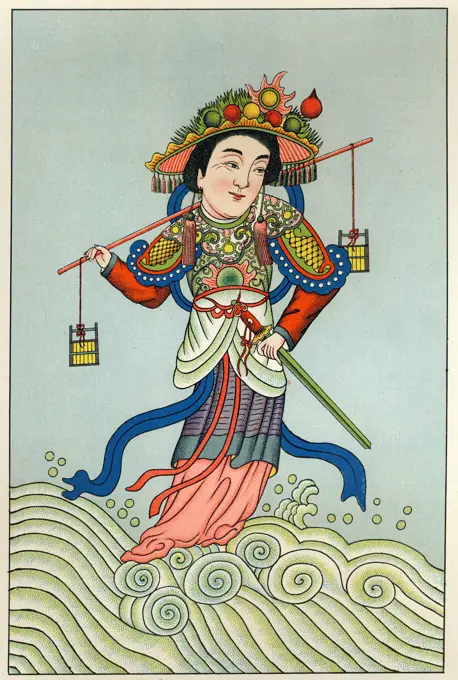
CHOEI-MOU-NIANG-NIANG goddess of water         Date: 1915
6145-46212190
Two Chinese with a abacus; Shinkoku Nankinjin No zu. Two chinese with a abacus. (Yokohama-e).
4443-73201915
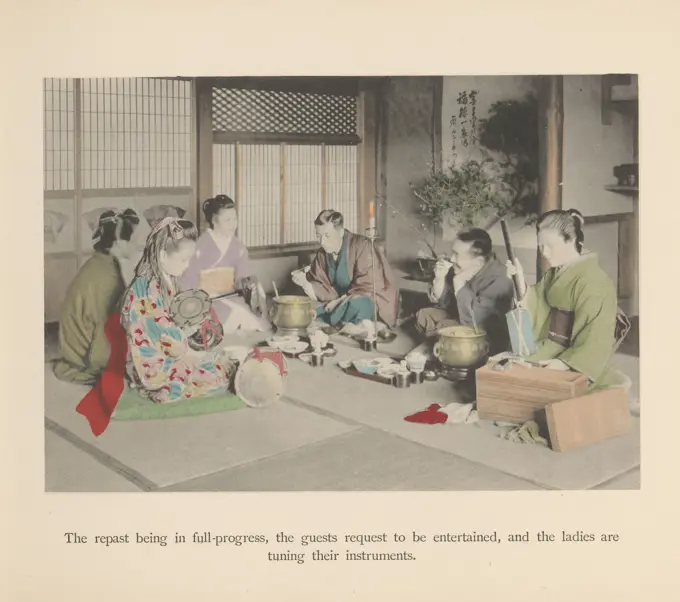
Japan, Tamamura, Kōzaburō, Four geishas tune their instruments for a performance for two men in a teahouse in Japan, recto - printed, photomechanical print, page, photographs, photographically illustrated books, The repast being in full-progress, the guest request to be entertained, and the ladies are tuning their instruments., height 105 mm, width 151 mm, 1856 - 1923, maker, manufacturer, 1896 - 1906, paper, collotype, photoprint
1899-18713847
Hyakki Yako ('Night Parade of One Hundred Demons') is a Japanese folk belief. The belief holds that every year yokai, the Japanese supernatural beings, will take to the streets during summer nights. Anyone who comes across the procession will die, unless protected by some Buddhist sutra. It is a popular theme in Japanese visual art.
6145-29767387
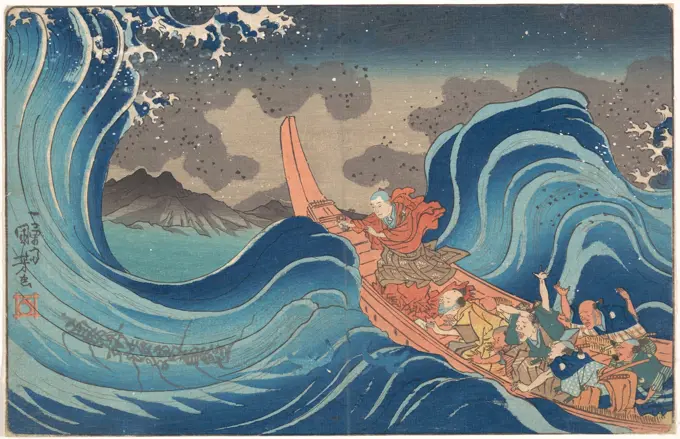
Monk Nichiren Calming the Stormy Sea ca. 1835 Utagawa Kuniyoshi Japanese The story of the life of Nichiren (1222-1282), the iconoclastic founder of the sect of Buddhism that bears his name, has inspired legions of his followers to the present day. Kuniyoshi's series of prints captures the dramatic moments of the priest's biography, including this scene of a vision of the sect's main devotion, the invocation "Praise to the Sutra of the Lotus Blossom of the Fine Dharma Namu Myoho Renge Kyo," in the ocean waves as Nichiren travels to exile on the island of Sado in 1272.. Monk Nichiren Calming the Stormy Sea 45287
1899-18718384
Foot binding (pinyin: chanzu, literally 'bound feet') was a custom practiced on young girls and women for approximately one thousand years in China, beginning in the 10th century and ending in the first half of 20th century. There is little evidence for the custom prior to the court of the Southern Tang dynasty in Nanjing, which celebrated the fame of its dancing girls, renowned for their tiny feet and beautiful bow shoes. What is clear is that foot binding was first practised among the elite and only in the wealthiest parts of China, which suggests that binding the feet of well-born girls represented their freedom from manual labor and, at the same time, the ability of their husbands to afford wives who did not need to work, who existed solely to serve their men and direct household servants while performing no labor themselves. Bound feet were considered intensely erotic in traditional Chinese culture. Qing Dynasty sex manuals listed 48 different ways of playing with women's bound fe
6145-51821991
Three Dancers , Kambun era (1661-1672). Hanging scroll, ink color and gofun on paper, Exclusive of mount: 11 1/4 x 12 1/2 in. (28.6 x 31.8 cm).   Asian Art Kambun era (1661-1672)
6145-29120336
Bōtarō's Nurse Otsuji Prays to the God of Konpira for His Success. Tsukioka Yoshitoshi (Japan, 1839-1892). Japan, 1892. Prints; woodblocks. Color woodblock print
4220-21884323
 A Japanese musician plays the  KOKYU, a string instrument  played with a bow.       Date: 1898
PREVIOUS
of 2
NEXT
2401 S. Ervay, Suite 206
Dallas, Texas 75215
United States
Get Started
Free ResearchMy BoardsMy Cart
For Creators
How To License Your ContentContributor PortalFrame of Mind
Resources
API accessPricing
Contact
+1 866 236 0087help@viewpictures.co.uk Contact form
©2026 View Pictures. All Rights Reserved. -B
This site is protected by reCAPTCHA and Google Privacy Policy and Terms of Service apply.