My Boards
View Pictures
  • My Boards
← Artworks

Japanese Woodblock Prints

A collection of colorful woodblock prints featuring famous Kabuki actors, scenic landscapes, and traditional Japanese themes, highlighting rich cultural elements and historical contexts.

Sandanme  | Library of Congress
Sandanme | Library of Congress
266 assets in this story
6145-29120354
The Demon Omatsu Kills Shirōsaburō in the Ford. Tsukioka Yoshitoshi (Japan, 1839-1892). Japan, 1886, March. Prints; woodblocks. Diptych; color woodblock print
6145-29128188
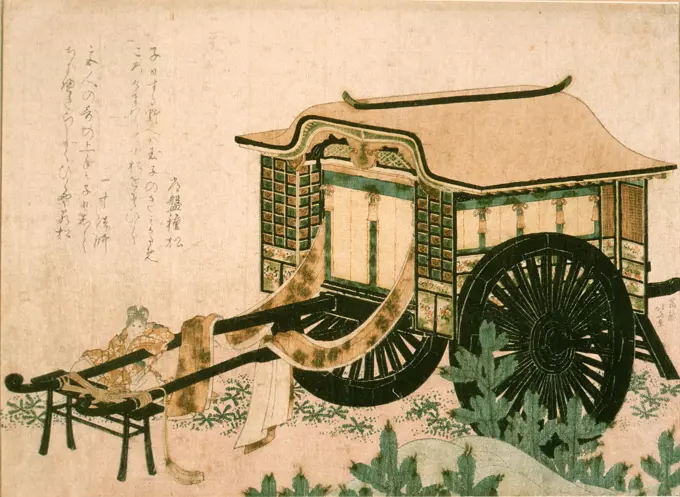
Court Carriage. Katsushika Hokusai (Japan, 1760-1849). Japan, c. 1800. Prints; woodblocks. Color woodblock print, brass filings
6145-59427409
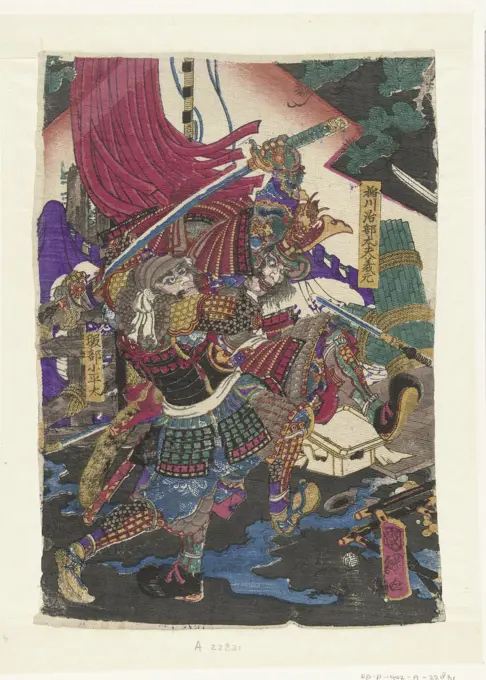
VECHTENDE MANNEN, UTAGAWA KUNITSUNA, 1865 print Two samurai, fighting with swords; Left and top right of pine branches. Japan crepe paper color woodcut hacking and thrusting weapons: sword (+ during the battle)
1899-18789122
Hishikawa Moronobu (1618 July 25, 1694) was a Japanese painter and printmaker known for his advancement of the ukiyo-e woodcut style starting in the 1670s. Moronobu was the son of a well-respected dyer and a gold and silver-thread brocade artisan in the village of Hodamura, Awa Province, near Edo Bay in present-day Kyonan, Chiba Prefecture. After moving to Edo, Moronobu, who had learned his father's craft, studied both Tosa and Kani -style painting. He thus had a solid grounding in both decorative crafts and academic painting, which served him well when he then turned to ukiyo-e.
6145-30174396
Dhanasri Ragini 1801-1900 India. Black ink and touches of watercolor on buff paper .
1746-4084
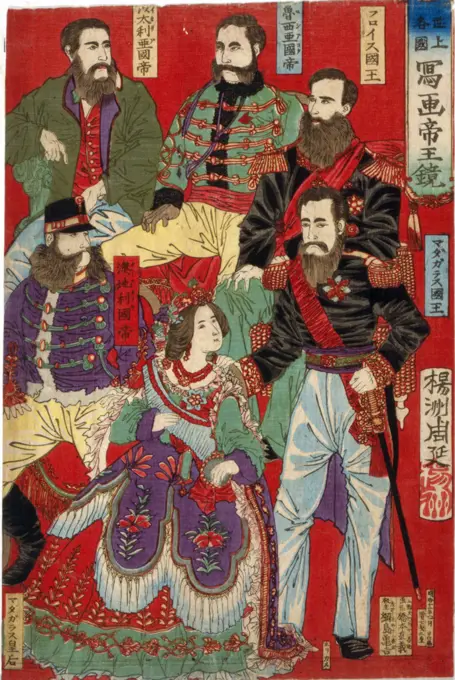
Section of triptych of world leaders with labels such as Emperor of Italy, Emperor of Austria, Queen of Madagarasu, King of Turkey, 1879.  Chikanobu Hashimoto (1838-1812) Japanese artist.
4409-17583425
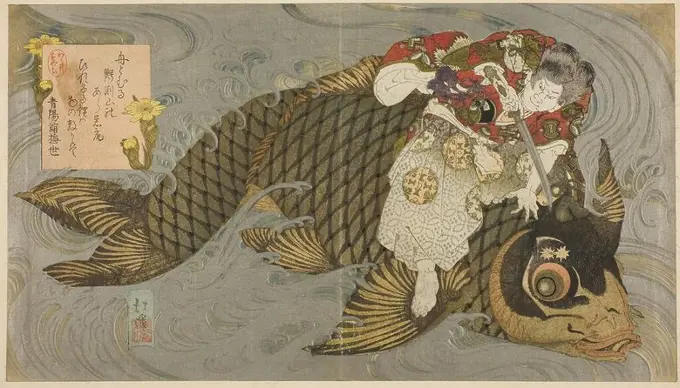
Oniwakamaru subduing the giant carp. Totoya Hokkei; Japanese, 1780-1850. Date: 1825-1840. Dimensions: 8 1/4 x 14 1/2 in. Color woodblock print; shikishiban diptych, surimono. Origin: Japan. Museum: The Chicago Art Institute, Chicago, USA.
6145-59605732
Minamoto NO TAMETOMO WAVINGK BLACK FAN, UTAGAWA KUNIYOSHI, 1852 print Minamoto No Tametomo keeps black fan behind his head. In the foreground a white sail.  paper color woodcut rowing-boat, canoe, etc.. fan. adult man
4409-17370413
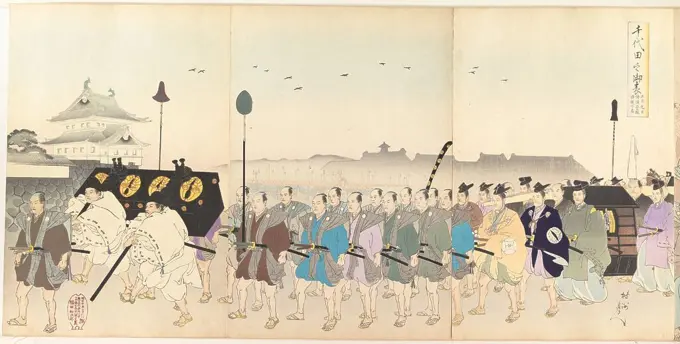
Chiyoda Castle (Album of Men). Artist: Yoshu (Hashimoto) Chikanobu (Japanese, 1838-1912). Culture: Japan. Dimensions: L. (page) 13 7/8 in. (35.2 cm); W. (page) 9 1/4 in. (23.4 cm); thickness of album 1 9/16 in. (4 cm). Date: 1897. Museum: Metropolitan Museum of Art, New York, USA.
1899-18717559
The Admonitions Scroll is a Chinese narrative painting on silk that is traditionally ascribed to Gu Kaizhi (c.345-c.406 CE), but which modern scholarship regards as a 5th to 8th century work that may be a copy of an original Jin Dynasty (265-420 CE) court painting by Gu Kaizhi. The full title of the painting is Admonitions of the Court Instructress (Chinese: Nushi Zhentu). It was painted to illustrate a poetic text written in 292 by the poet-official Zhang Hua (232-300). The text itself was composed to reprimand Empress Jia (257-300) and to provide advice to imperial wives and concubines on how to behave. The painting illustrates this text with scenes depicting anecdotes about exemplary behaviour of historical palace ladies, as well as with more general scenes showing aspects of life as a palace lady. The painting is reputed to be the earliest extant example of a Chinese handscroll painting.
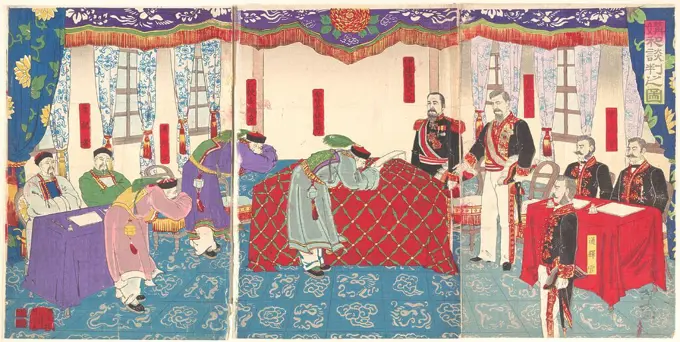
4409-17386607
Negotiations after the Sino-Japanese War. Artist: Keisai (Japanese, active ca. 1890-1900). Culture: Japan. Dimensions: 14 1/4 x 28 3/8 in. (36.2 x 72.1 cm). Date: March 1895. Museum: Metropolitan Museum of Art, New York, USA.
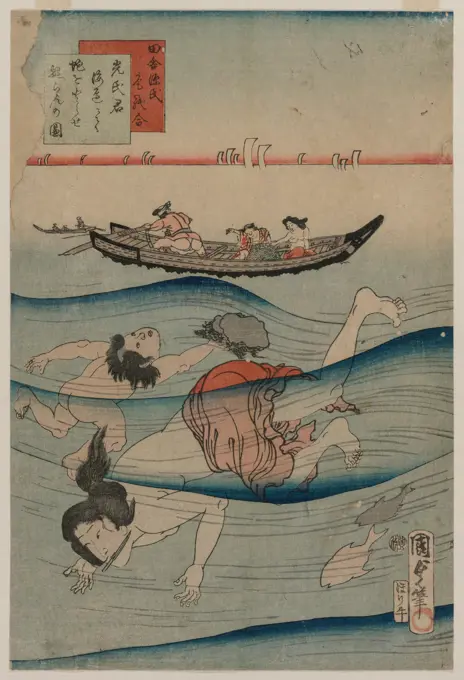
6145-29087701
Rustic Genji's Poetry Contest: Mitsuuji's Excursion to the Seaside to See Abalone Diving (Inaka Genji shikishi awase, Mitsuuji umibe ni te awabi o torase yūran no zu), 1865. Utagawa Kunisada II (Japanese, 1823-1880). One of a triptych of color woodblock prints; sheet: 24.2 x 36 cm (9 1/2 x 14 3/16 in.).
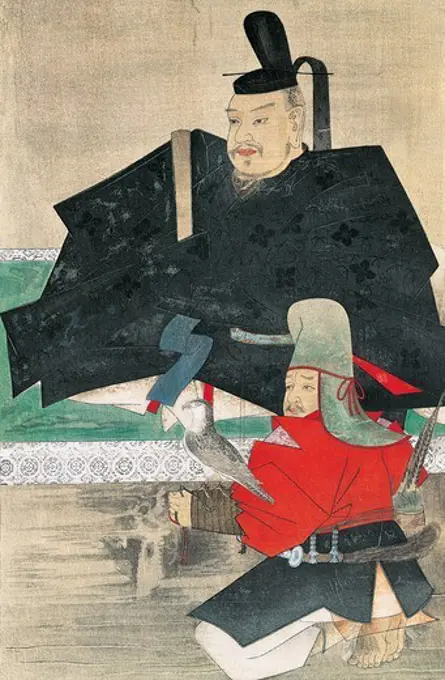
1788-41907
Portrait of Ariwara no Yukihira and his falconer, attributed to Fujiwara no Tametsugu, Japan. Japanese Civilisation, 13th century.
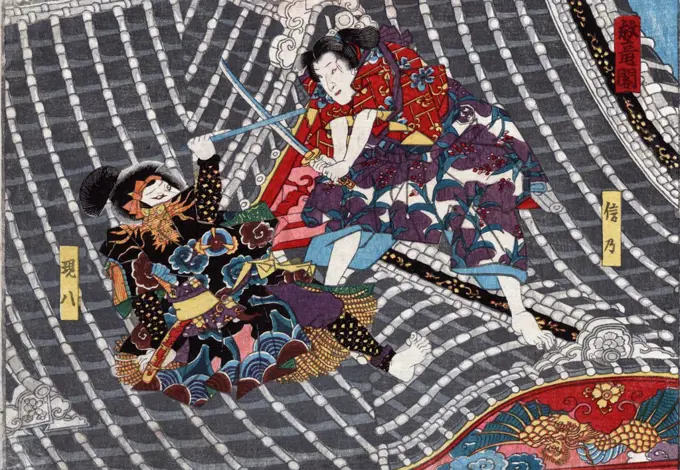
1746-21111000
Horyu Tower. Print shows two men fighting with swords on the roof of a tower.
4409-17407415
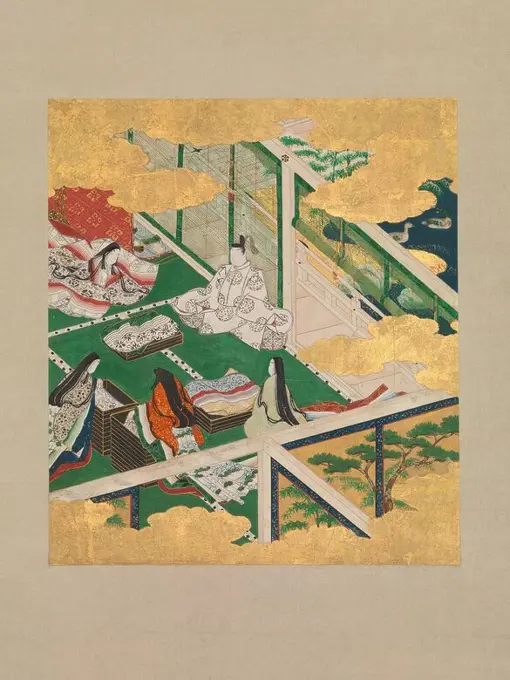
"The Jeweled Chaplet" ("Tamakazura"), from The Tale of Genji (Genji monogatari). Artist: Circle of Tosa Mitsuyoshi (Japanese, 1539-1613). Culture: Japan. Dimensions: Image (a): 9 5/8 × 8 3/8 in. (24.4 × 21.3 cm)Overall with mounting (a): 53 1/4 × 15 11/16 in. (135.3 × 39.8 cm)Overall with knobs (a): 53 1/4 × 17 3/8 in. (135.3 × 44.2 cm)Image (b): 9 7/16 × 8 3/8 in. (24 × 21.2 cm)Overall with mounting (b): 53 1/8 × 15 5/8 in. (135 × 39.7 cm)Overall with knobs (b): 53 1/8 × 17 3/8 in. (135 × 44.1 cm). Date: early 17th century.In this scene from an album of the eleventh-century novel, New Year's robes are distributed to ladies of Prince Genji's household. The prince sits near his favorite consort, Murasaki, while the women put garments into black lacquered boxes. In the garden a pair of mandarin ducks, symbolic of marital harmony, are visible. Interior details are exposed through the pictorial convention known as "blown-away roof" (fukinuki yatai). The corresponding page of text, or
6145-45431758
Goddess appearing to the warrior Utagawa, kuniyoshi (1797 1861)
6145-50636020
Man swimming under the water, holding a human head in his teeth YOSHIIKU, UTAGAWA (1833 1904)
6145-30157889
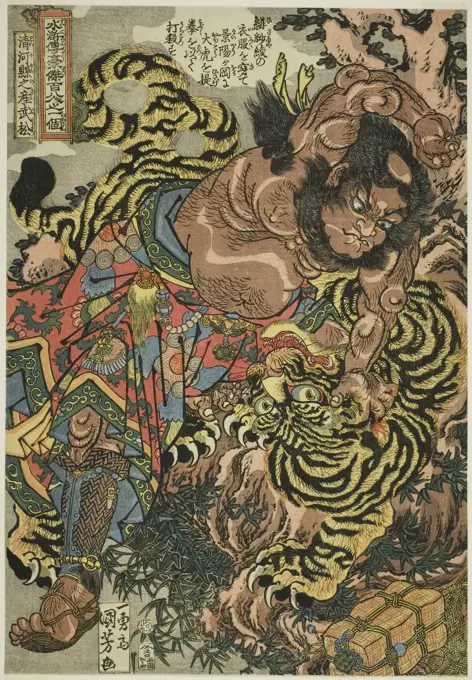
Wu Song (Seikaken no san Busho), from the series One Hundred and Eight Heroes of the Popular Water Margin (Tsuzoku Suikoden goketsu hyakuhachinin no hitori) 1822-1835 Japan. Color woodblock print; oban . Utagawa Kuniyoshi
4443-28728250
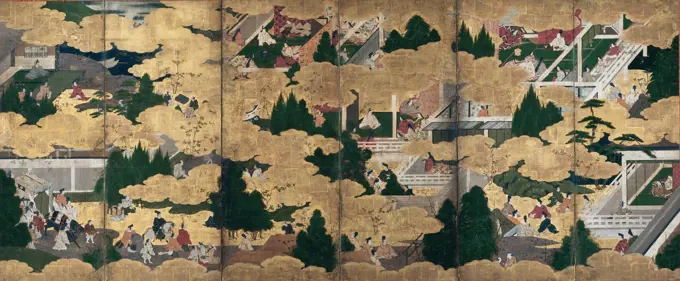
Scenes from the Tale of Genji left of a pair, 17th century, Unknown Japanese, 59 3/16 × 133 3/4 in. (150.34 × 339.73 cm) (image)65 3/4 × 140 3/4 × 3/4 in. (167.01 × 357.51 × 1.91 cm) (mount), ink, color, and gold on paper, Japan, 17th century, In some ways, this pair of screens is quite typical of Edo-period paintings of The Tale of Genji. The artist frames each individual scene with scalloped gold clouds. He also uses the fukinuki-yatai (literally, 'blown-off roof') method of depicting architectural spaces, so that viewers gain an unobstructed birds-eye view of buildings' interiors. This convention can be traced back to the earliest depictions of The Tale of Genji from the 1100s. The content of these screens, however, is anything but conventional. While many artists of Genji screens arranged scenes sequentially from right to left or in seasonal order from spring to fall, this artist developed a far more sophisticated organization in which the relationships between illustrated scenes
6145-59085344
Son of Generarian Yue Fei - Yue Yun is a teaching technician;  XVIII-XIX century (1700-00-00-1800-00-00);Chinese art, MNW collection, painting, purchase
6145-29067247
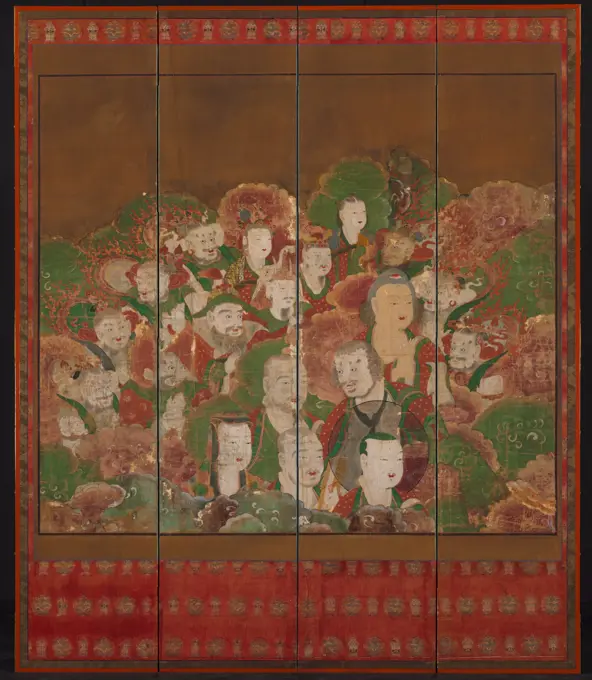
Buddhist Deities, 1700s-1800s. Korea, Joseon dynasty (1392-1910). Four-panel folding screen; ink and color on silk; painting only: 114 x 115.2 cm (44 7/8 x 45 3/8 in.); overall: 147.5 x 123.8 cm (58 1/16 x 48 3/4 in.).
4409-17489020
Shell Gathering. Date/Period: 1800/1849. Painting. Color on silk. Width: 86.3 cm. Height: 54.3 cm. Author: KATSUSHIKA HOKUSAI.
6145-59461110
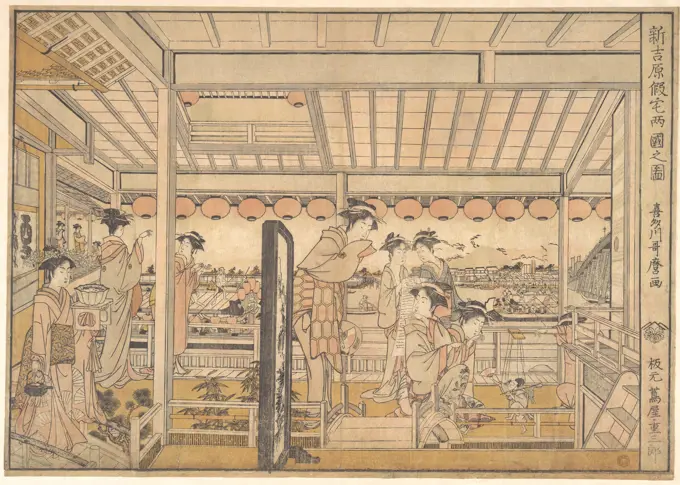
Feast in the Komeikan Teahouse, Torii Kiyonaga, 1787 - 1792 drawing Drawing for the print 'Party in the Komikan Tea house'. Group Courtisanes, standing and sitting, looking at dancing actor with umbrella and mask for face, assisted by man on a porch and musician sitting next to sliding door, for the entertainment of the young man on the far right with chopping stick by mouth. Japan paper
6145-55954216
Scroll 3, scene 25. 1650 - 1699. Illustrations, Manuscripts. Spencer Collection
1746-21103123
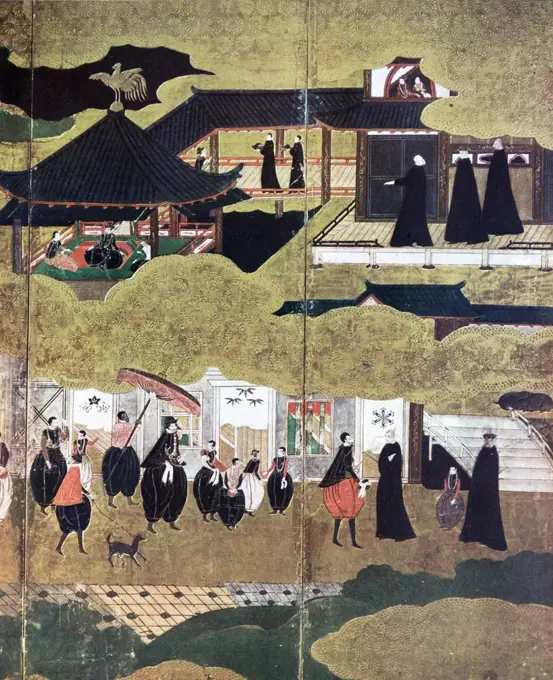
Arrival of the Portuguese in Japan. Detail of Japanese screen, Kano School (16th century)
4266-2451
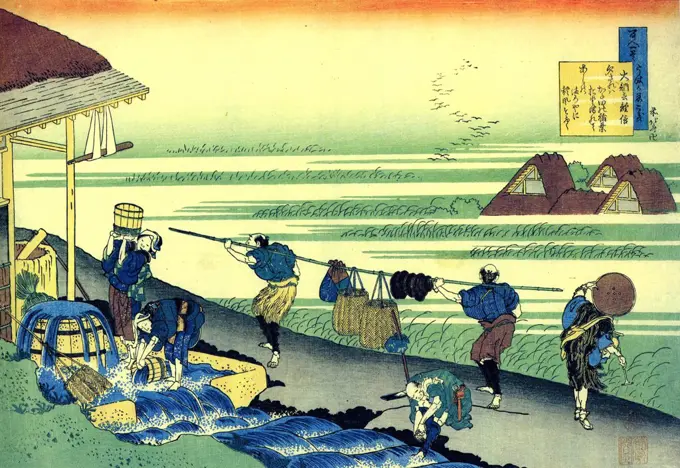
Working people by Katsushika Hokusai, color woodcut, circa 1830, 1760-1849, Russia, St. Petersburg, State Hermitage
4409-28962156
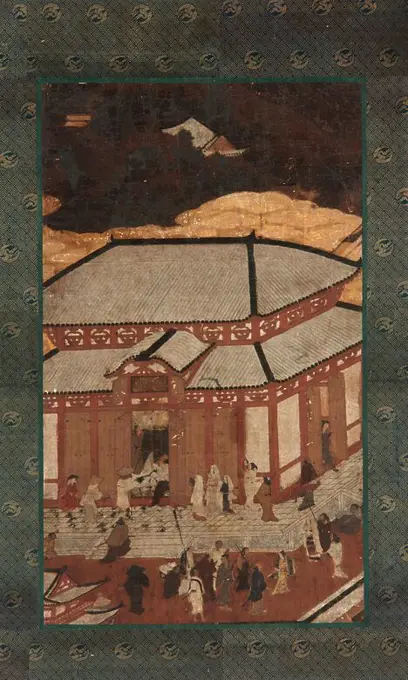
The Daibutsuden, Hoko-ji, Kyoto. Origin: Japan. Period: Edo period. Color, gold, and silver on paper. Date: 17th century. Museum: Freer Gallery of Art and Arthur M. Sackler Gallery.
6145-29117753
The Carpenter Hanshichi of Fukagawa Seizes His Daughter's Attacker. Tsukioka Yoshitoshi (Japan, 1839-1892). Japan, circa 1875. Prints; woodblocks. Color woodblock print
6145-30191555
Usuyuki The Kogo Scene (Usuyuki Kogo no dan), from the series Famous Scenes from Japanese Puppet Plays (Yamato irotake) 1700-1711 Japan. Woodblock print; oban, sumizuri-e . Okumura Masanobu
6145-29190991
Picture of the Temporary Lodgings of the New Yoshiwara Pleasure Quarter at Rygoku (Shin Yoshiwara Karitaku Ryogoku no zu) 1784 Kitagawa Utamaro Japanese. Picture of the Temporary Lodgings of the New Yoshiwara Pleasure Quarter at Rygoku (Shin Yoshiwara Karitaku Ryogoku no zu). Kitagawa Utamaro (Japanese, ca. 1754-1806). Japan. 1784. Woodblock print; ink and color on paper. Edo period (1615-1868). Prints
6145-52375025
Scene of beheading.. Paintings, Prints. 1850. The Miriam and Ira D. Wallach Division of Art, Prints and Photographs: Art & Architecture Collection. Painting, Chinese, Decapitations , China, Punishment & torture , China, Costumes , Chinese
6145-43578426
Album with the images of the sixteen Arhats. unknown, painter
6145-55954169
Scroll 2, scene 32. 1650 - 1699. Illustrations, Manuscripts. Spencer Collection
4430-2890
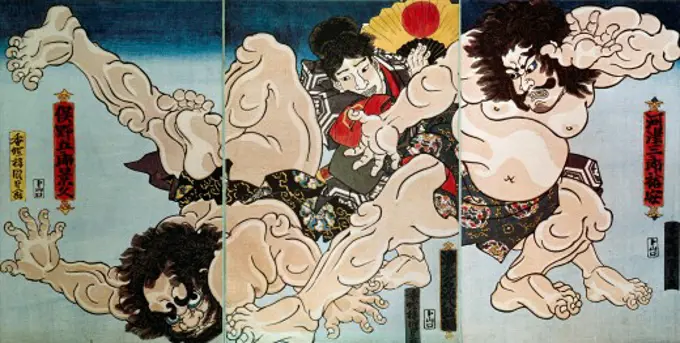
fine arts, Kunisada, Utagawa, (1786 - 1864), graphics, ""the legendary wrestling fight between Kawazu no Sahuro and Matano Goro Kagehisa"", circa 1840, colour woodcut, 38 cm x 76,5 cm, private collection,
4443-19368003
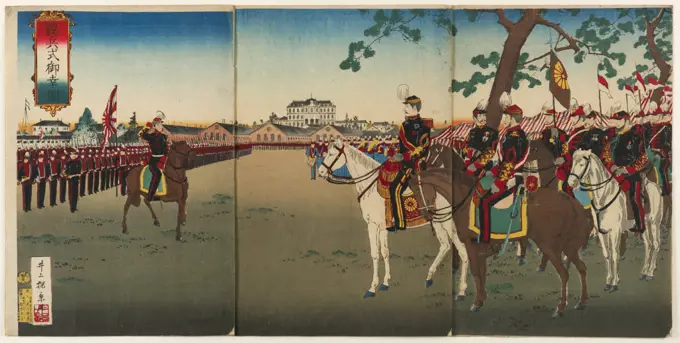
Military Review Attended by His Majesty the Emperor, Inoue Tankei, Japanese, 1864-1889, Meiji period, 1868-1912, Matsuki Heikichi V, Japanese, 1872-1931, 1885, Triptych of color woodblock prints, Made in Tokyo, Japan, Asia, Prints, triptych as mounted: 14 1/4 × 28 5/8 in. (36.2 × 72.7 cm)
6145-59118531
Events in ôedo held throughout the year: the first will sell in the second day New Year in Nihonbashi (ôedo nench gyôji no uchi shôgatsu furyuk nihonbashi hatsu uri)
1899-19188860
Japan: Zon Yuan or Shutsurinryu Suen, one of the 'One Hundred and Eight Heroes of the Water Margin', his helmet crested with long pheasant's feathers in a hand to hand struggle with an opponent. Woodblock print by Utagawa Kuniyoshi (1797-1863), 1827-1830. The Water Margin (known in Chinese as Shuihu Zhuan, sometimes abbreviated to Shuihu, known as Suikoden in Japanese, as well as Outlaws of the Marsh, Tale of the Marshes, All Men Are Brothers, Men of the Marshes, or The Marshes of Mount Liang in English, is a 14th century novel and one of the Four Great Classical Novels of Chinese literature. Attributed to Shi Nai'an and written in vernacular Chinese.
6145-29120650
Shinozuka Iganokami Sadatsuna Lifting a Giant Beam. Tsukioka Yoshitoshi (Japan, 1839-1892). Japan, 1886, January. Prints; woodblocks. Color woodblock print
1848-73128851
Interior view, China 1900 advertisement, Home of Carlsberg, Copenhagen, Capital Region, Denmark
6145-52337099
Soviet Repka Sovetskaia repka. Moor, Dmitri Stakhievich, 1883-1946. 1921. Posters. Manuscripts and Archives Division. Soviet Union , History , 1917-1936, Political posters, Russian
1848-54961817
Tsukioka Yoshitoshi (1839 - 9 June 1892) one of the last great masters of the classical Japanese colour woodcut, here the work Moon of Kintoki's Mountain
4443-75459186
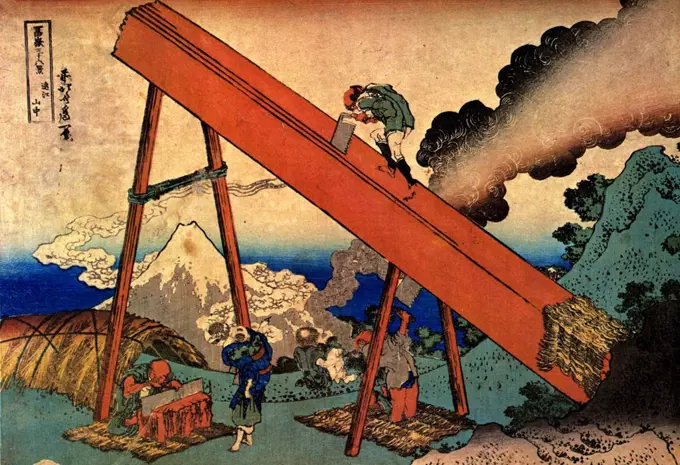
Hundred Views of Mount Fuji, 1835, Woodcuts
4443-20307812
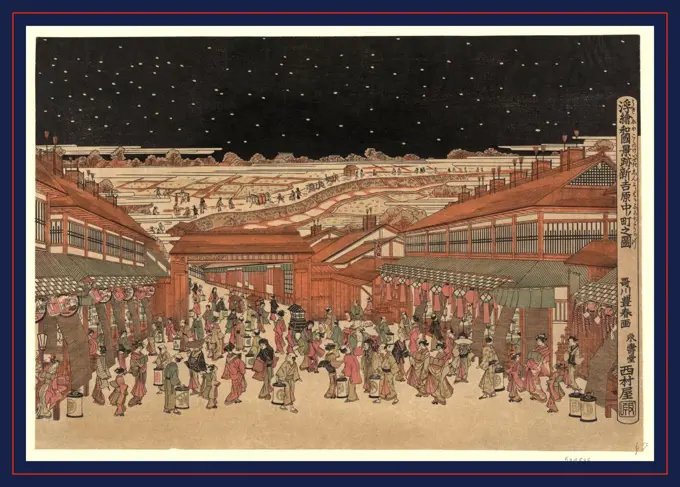
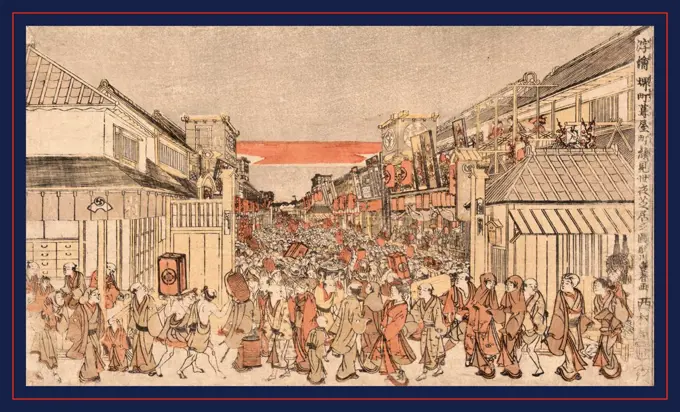
Ukie wakoku no keiseki shin-yoshiwara nakanocho no zu, Perspective picture of famous places of Japan: Nakanocho in Shin-Yoshiwara., Utagawa, Toyoharu, 1735-1814, artist, 1775, printed later, 1 print : woodcut, color., Print shows many people on the Nakanocho Boulevard at night near the gate to the Shin-Yoshiwara pleasure district of Tokyo, possibly during the lantern festival, with teahouses and shops lining the street.
4409-17564613
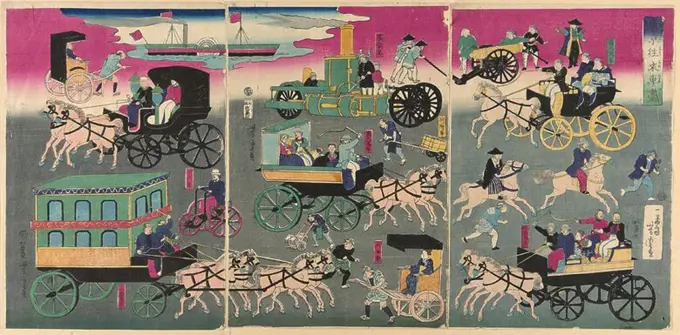
Vehicles on the Streets of Tokyo (Tokyo orai kuruma zukushi). Utagawa Yoshitora; Japanese, active c. 1836-87. Date: 1870. Dimensions: . Color woodblock print; oban triptych. Origin: Japan. Museum: The Chicago Art Institute, Chicago, USA.
1746-2347
The Buddhist Monk calms the storm', Utagawa Kuniyoshi, (c.1798-1861) Japanese artist
1899-18855466
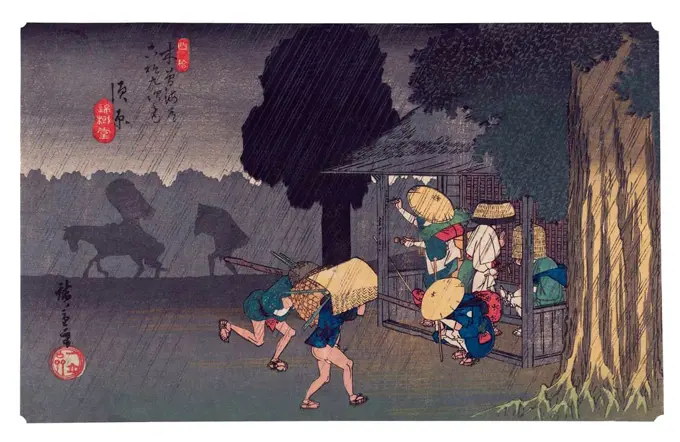
The Sixty-nine Stations of the Kiso Kaid ( Kiso Kaid Rokujky-tsugi) or Sixty-nine Stations of the Kiso Road, is a series of ukiyo-e works created by Utagawa Hiroshige (1797-1858) and Keisai Eisen (1790-1848). There are 71 total prints in the series (one for each of the 69 post stations and Nihonbashi; Nakatsugawa-juku has two prints). The common name for the Kiso Kaid is 'Nakasend' or 'Central Mountain Highway', so this series is salso commonly referred to as the Sixty-nine Stations of the Nakasend. The Nakasend was one of the Five Routes constructed under Tokugawa Ieyasu, a series of roads linking the historical capitol of Edo with the rest of Japan. The Nakasend connected Edo with the then-capital of Kyoto. It was an alternate route to the Tkaid and travelled through the central part of Honsh, thus giving rise to its name, which means 'Central Mountain Road'. Along this road, there were sixty-nine different post stations (-shuku or -juku), which prov
4443-20306556
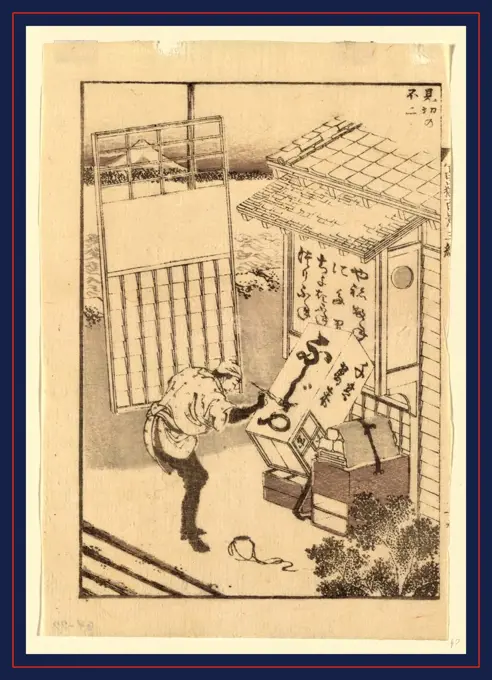
Mikiri no fuji, A limited view of Mount Fuji., Katsushika, Hokusai, 1760-1849, artist, ca. 1836, 1 print : woodcut ; 21.1 x 14.4 cm., Print shows a man writing in calligraphy on a large box in front of a building; on the left, in the background, is a view of Mount Fuji.
6145-46453110
Chinese drummer on plateau in landscape; New converted sinesen with great Moeyte signed and is given in it, by P. Schenk Jun (...), first part. A Chinese man beats a trom or gong on a plateau in landscape. With them a little boy with flowers. On the left two figures in under a shelter.
4409-17530593
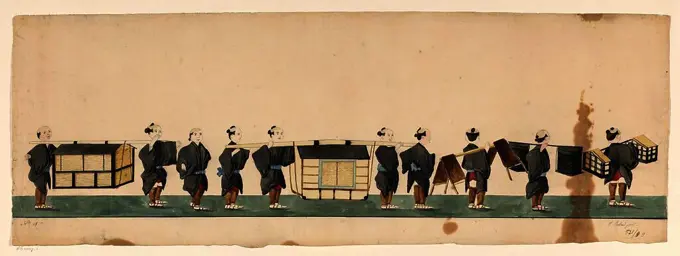
Drawing. Draughtsman: H. Rolland. Dating: c. 1775. Place: Japan. Measurements: h 27.2 cm × w 76.3 cm. Museum: Rijksmuseum, Amsterdam.
1899-18717563
The Admonitions Scroll is a Chinese narrative painting on silk that is traditionally ascribed to Gu Kaizhi (c.345-c.406 CE), but which modern scholarship regards as a 5th to 8th century work that may be a copy of an original Jin Dynasty (265-420 CE) court painting by Gu Kaizhi. The full title of the painting is Admonitions of the Court Instructress (Chinese: Nushi Zhentu). It was painted to illustrate a poetic text written in 292 by the poet-official Zhang Hua (232-300). The text itself was composed to reprimand Empress Jia (257-300) and to provide advice to imperial wives and concubines on how to behave. The painting illustrates this text with scenes depicting anecdotes about exemplary behaviour of historical palace ladies, as well as with more general scenes showing aspects of life as a palace lady. The painting is reputed to be the earliest extant example of a Chinese handscroll painting.
1899-18789769
Kani Naizen (1570 - 1616) was a Japanese painter of the Kani school, particularly known for his screen paintings (byi bu) of Namban (Southern Barbarians, i.e. Europeans). The Nanban trade (Nanban bi eki, 'Southern barbarian trade') or the Nanban trade period (Nanban bi eki jidai, 'Southern barbarian trade period') in Japanese history extends from the arrival of the first Europeans - Portuguese explorers, missionaries and merchants - to Japan in 1543, to their near-total exclusion from the archipelago in 1614, under the promulgation of the 'Sakoku' Seclusion Edicts.
6145-52820019
Black ink and lightly watercolored drawing on yellowish-white paper depicting knights playing a game from the triumphal procession of Emperor Maximilian I, showing figures, armor, and activity.
6145-46641020
. Fragment of a wall tension with Chinese genre-scenes. In the foreground a jank with crew. On the rocky shore, four men and two boys, to the left, dressed in dark overweight and cone-shaped white hat with red brush and followed by four men of which two on horseback. A terrace with a red gallery at the center plan, in which women with bazuines and lanterns go to the left, followed by women and children with pajengs and musical instruments. Three chinese on a wall. Background with flowering shrubs and with rocks, on which a kilin with thunder motives, on the left. A car building is driving and playing children with a ball (hedgehog). Venture with mountain peaks and houses. A bird in the air.
6145-50635406
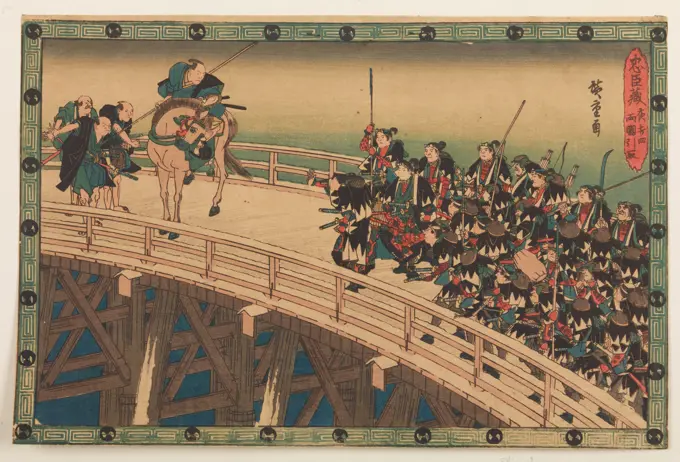
On the bridge, 4th episode of the 11th act of the drama: Treasury of fideIIty /Chishingura
1525-27911590
Turning round-shaped vases, vintage engraved illustration. Magasin Pittoresque 1857.
1746-21116106
Colour woodblock triptych titled 'The Eight Great Tengu subduing Benkei by Utagawa Kuniyoshi (1797-1861) a great master of the Japanese ukiyo-e style of woodblock prints and painting. He was a member of the Utagawa school. Dated 19th Century
1889-60412671
Archival postcard in graphic, Japanese print-style, Japan, circa 1910; Artwork
4443-28725394
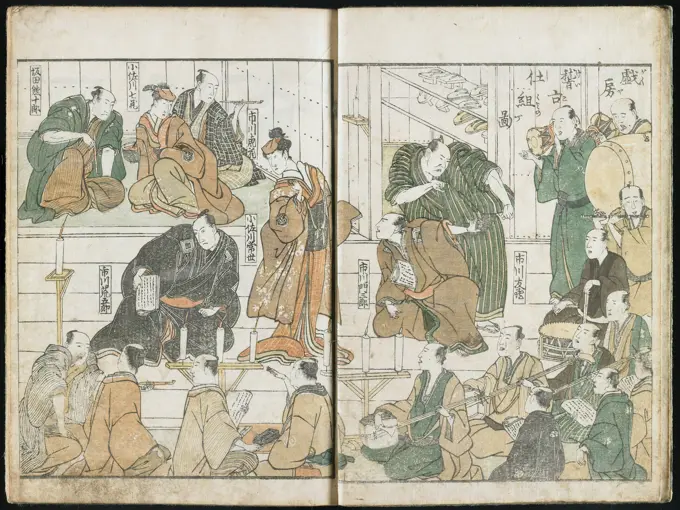
Picture Books of Amusements of Actors on all Three Floors (Gazu yakusha san-kai kyō), 1801, Utagawa Toyokuni; Author: Shikitei Sanba; Publisher: Nishinomiya Shinroku, Japanese, 1769 - 1825, 5/16 x 6 1/8 x 8 1/2 in. (0.8 x 15.5 x 21.6 cm), Woodblock printed book; ink and limited color on paper, Japan, 19th century, By the mid-18th century, Kabuki had become a major cultural force. In Edo alone, there were four (later, three) theaters that offered lengthy programs nearly every day. While images of actors in their costumed roles dominated earlier print production, by the late 18th century a new genre of ukiyo-e emerged that showed them offstage, in more intimate settings. For this book, from a two-volume set, the artist Utagawa Toyokuni supplied compositions featuring famous actors. The title, 'Sankaikyō' is a playful homonym of the name of a famous Buddhist sect, but also refers to the fact that typical dressing rooms in Kabuki theaters have three (san) floors (kai). This double page dep
4443-19523246
New Years in Yoshiwara, Katsushika Hokusai, 1760 - 1849, Woodblock print (ukiyo-e) on mulberry paper (washi), ink with color, Japan, 1760-1849, figures, Print, Print
1848-54961826
Tsukioka Yoshitoshi (1839 - 9 June 1892) one of the last great masters of the classical Japanese colour woodcut, here the work Chofu Village Moon
4443-20307929
Ukie sakaicho fukiyacho kaomise yorushibai no zu, Perspective picture of a night show of the opening-of-the-season performance at Fukiyacho and Sakaicho., Utagawa, Toyoharu, 1735-1814, artist, between 1764 and 1772, 1 print : woodcut, color ; 22 x 37.6 cm., Print shows crowded street between theater buildings.
1899-18855186
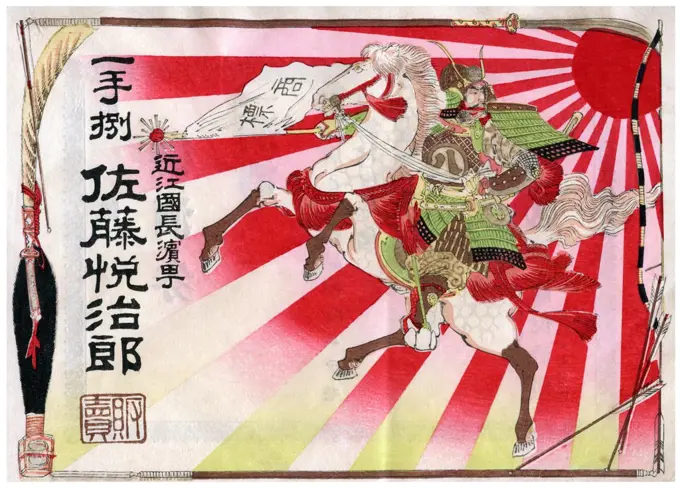
Taisho-era gift certificate, from a specific shop in Japan, for refined sake. Depicts a samurai on horseback, against a rayed, rising sun; framed by an array of samurai weapons  (including a naginata across the top, and a yari across the bottom). Japanese woodblock printing as commercial art, very early 20th century.
1899-18789779
Kani Naizen (1570 - 1616) was a Japanese painter of the Kani school, particularly known for his screen paintings (byi bu) of Namban (Southern Barbarians, i.e. Europeans). The Nanban trade (Nanban bi eki, 'Southern barbarian trade') or the Nanban trade period (Nanban bi eki jidai, 'Southern barbarian trade period') in Japanese history extends from the arrival of the first Europeans - Portuguese explorers, missionaries and merchants - to Japan in 1543, to their near-total exclusion from the archipelago in 1614, under the promulgation of the 'Sakoku' Seclusion Edicts.
4409-60290129
Escena ilustrada de la ópera de Richard Wagner, El anillo de los Nibelungos, editada por Ediciones Diana, de Barcelona. Sigfrido ayuda Gunther a vencer a Brunhilda. Grabado de 1926. Author: Joan Llaverias Labro.
4409-17579538
'Cooperative'. China, late 19th - early 20th century. Dimensions: 34,5x25 cm. Museum: State Hermitage, St. Petersburg.
4266-2474
Working men by Katsushika Hokusai, color woodcut, 1830-1833, 1760-1849, Russia, Moscow, State A. Pushkin Museum of Fine Arts, 25x37
PREVIOUS
of 3
NEXT
2401 S. Ervay, Suite 206
Dallas, Texas 75215
United States
Get Started
Free ResearchMy BoardsMy Cart
For Creators
How To License Your ContentContributor PortalFrame of Mind
Resources
API accessPricing
Contact
+1 866 236 0087help@viewpictures.co.uk Contact form
©2026 View Pictures. All Rights Reserved. -A
This site is protected by reCAPTCHA and Google Privacy Policy and Terms of Service apply.