My Boards
View Pictures
  • My Boards
← Artworks

Japanese Woodblock Prints

Charming illustrations showcasing traditional Japanese attire, landscapes, and cultural elements from the Edo period.
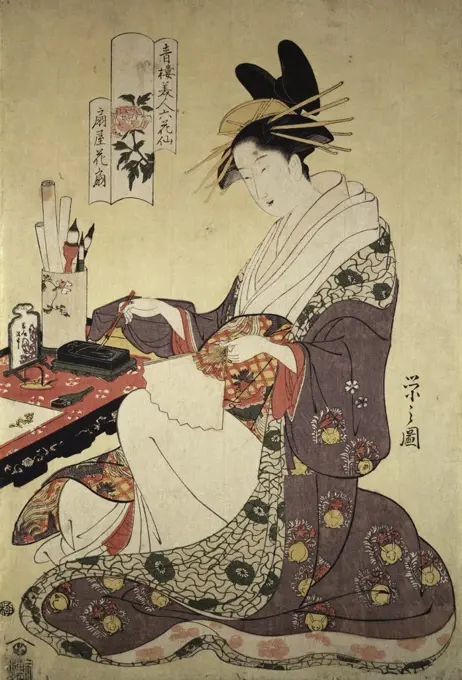
Woman Painting  Japanese Art Woodcut
Woman Painting Japanese Art Woodcut
210 assets in this story
6145-59569574
Badhuis servant and naked woman, 1815 - 1823 print Naked woman, overpowered by a servant of a bathhouse; A hairs in the foreground left.  paper color woodcut man and woman cohabiting. rape, violation
6145-51818371
Snow in the Garden, from the Chiyoda Inner Palace Chikanobu (Japanese). , 1897. Woodblock print, 13 7/8 x 9 1/4 in. (35.2 x 23.5 cm).   Asian Art 1897
1899-18857143
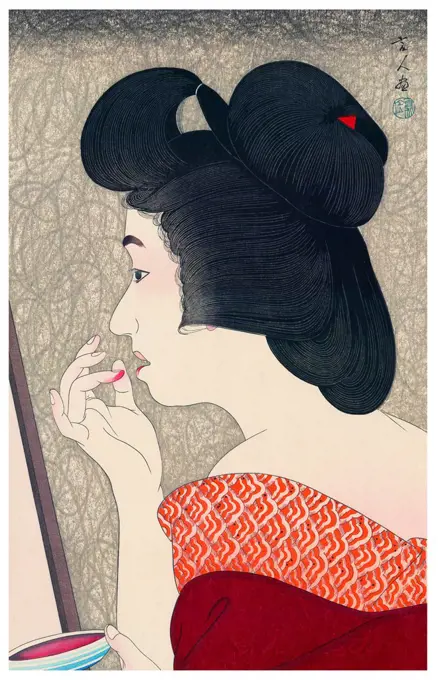
Torii Kotondo is known to have made only 21 prints - all of them images of bijin or beautiful women. They belong to the finest works of art of the Shin Hanga movement. Shin hanga ('new prints') was an art movement in early 20th-century Japan, during the Taisho and Showa periods, that revitalized traditional ukiyo-e art rooted in the Edo and Meiji periods (17th-19th century). The movement flourished from around 1915 to 1942, though it resumed briefly from 1946 through the 1950s. Inspired by European Impressionism, the artists incorporated Western elements such as the effects of light and the expression of individual moods, but focused on strictly traditional themes of landscapes (fukeiga), famous places (meisho), beautiful women (bijinga), kabuki actors (yakusha-e), and birds and flowers (kachoga).
1606-189670
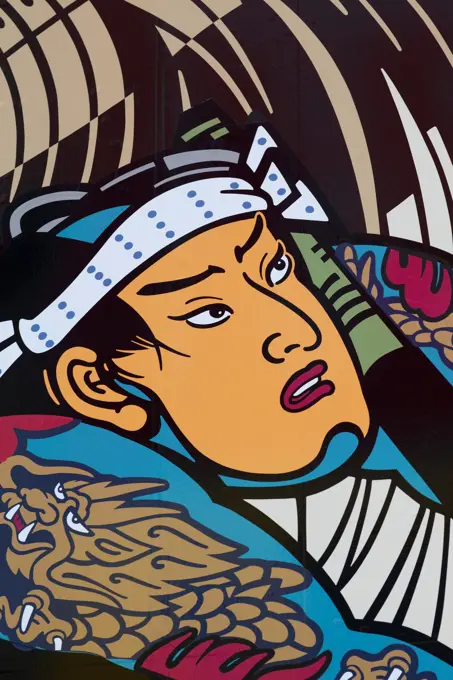
Japan, Tokyo, Ukiyo-e Style Artwork on Seafood Restaurant Facade
6145-51818710
Illustration of the Meeting with Taewongun at the Korean Royal Palace (Chosen ojo Tai-in-kun sanden no zu) Watanabe Nobukazu (Japanese, 1872-1944). , August, 1894. Color on paper, Each Panel: 14 5/8 x 9 3/4 in. (37.1 x 24.8 cm).   Asian Art August, 1894
6145-29087901
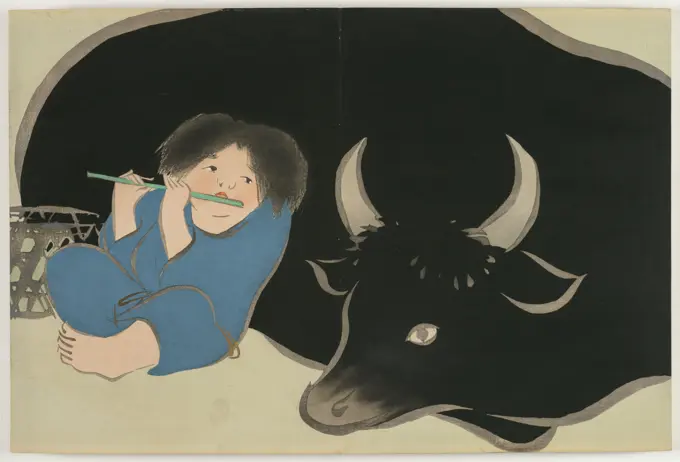
Flowers of a Hundred Worlds (Momoyogusa): Oxherd (Bokudo), 1909-10. Kamisaka Sekka (Japanese, 1866-1942). Color woodcuts with gold and silver; sheet: 29.9 x 22.1 cm (11 3/4 x 8 11/16 in.). This print from a set of three woodblock printed albums displays the graphic design prowess of Kamisaka Sekka. The images were first distributed one by one to subscribers to the series but later were reissued in bound form, like this book, for mass consumers. Each print features a vignette taken from nature or Japanese literature. Many of the scenes have a long history in Japan, originating in the 900s or 1000s and having been interpreted by all manner of artists since that time. Sekkas selections hew closely to precedents from the Rinpa style originated by painter Tawaraya S?tatsu (c. 1570-c. 1640) and calligrapher Honami K?etsu (1558-1637).
1899-18717974
International attention to Shanghai grew in the 19th century due to its economic and trade potential at the Yangtze River. During the First Opium War (1839-1842), British forces temporarily held the city. The war ended with the 1842 Treaty of Nanjing, opening Shanghai and other ports to international trade. In 1863, the British settlement, located to the south of Suzhou creek (Huangpu district), and the American settlement, to the north of Suzhou creek (Hongkou district), joined in order to form the International Settlement. The French opted out of the Shanghai Municipal Council, and maintained its own French Concession. Citizens of many countries and all continents came to Shanghai to live and work during the ensuing decades; those who stayed for long periods called themselves 'Shanghailanders'. In the 1920s and 30s, some 20,000 so-called White Russians and Russian Jews fled the newly established Soviet Union and took up residence in Shanghai. By 1932, Shanghai had become the world's
6145-29291458
A man or deity. Watercolour attributed to a Chinese painter.
6145-46832815
Shadow Puppet (Wayang Kulit) of Inyo, from the set KyaiNugroho.   Maker: Gendeng (Desa)  Maker: Ki Kertiwanda  Maker: Ki Bekel Prawirasucitra
1899-18711970
In 1926, Young Companion Pictorial (Liang You, literally 'good friend') was established in Shanghai as the first colored variety magazine. During the 1920s and 30s, when printed news was rare and precious, Companion was already a pioneer in providing pictorial reports to the public. It quickly became the publication that chronicled and provoked Chinas passion for decades to come. Throughout the epic of war and peace, readers could see and read from Companion the faces and thoughts of influential politicians such as Sun Zhongshan (Sun Yat-sen), Jiang Jieshi (Chiang Kai-shek), Feng Yuxiang, Zhang Xueliang, Mao Zedong, Zhu De and Zhou Enlai. Influential thinkers and writers such as Lu Xun, Lao She, Yu Dafu and Lin Yutang all contributed their works to Companion. In addition, Companion published a series of autobiographies, written exclusively for its readers by the celebrities themselves. They inspired many Chinese not only with their successful stories but also their wisdom and attitude
PREVIOUS
of 3
NEXT
2401 S. Ervay, Suite 206
Dallas, Texas 75215
United States
Get Started
Free ResearchMy BoardsMy Cart
For Creators
How To License Your ContentContributor PortalFrame of Mind
Resources
API accessPricing
Contact
+1 866 236 0087help@viewpictures.co.uk Contact form
©2026 View Pictures. All Rights Reserved. -B
This site is protected by reCAPTCHA and Google Privacy Policy and Terms of Service apply.