My Boards
View Pictures
  • My Boards
← Artworks

Japanese Woodblock Prints

This cluster features serene landscapes and cultural scenes from Japan, showcasing vibrant colors, detailed nature, and traditional figures from the 19th century.

Rokusozan in Kazusa Province, 1858, 4th month, Utagawa Hiroshige; Publisher: Tsutaya Kichizō, Japanese, 1797 - 1858, 13 1/4 × 8 11/16 in. (33.7 × 22.1 cm) (image, vertical ōban), Woodblock print (nishiki-e); ink and color on paper, Japan, 19th century
272 assets in this story
1899-18855404
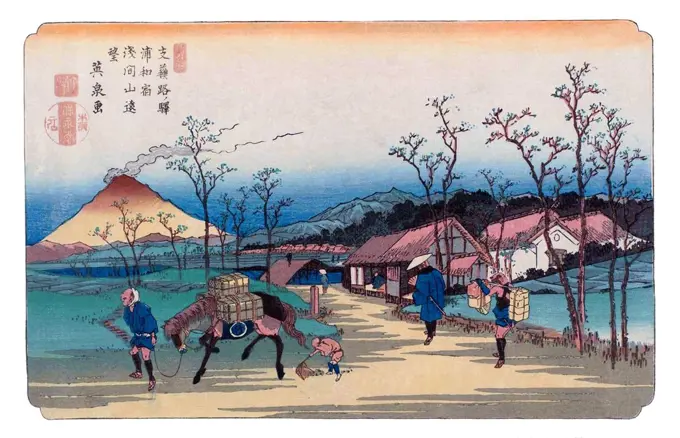
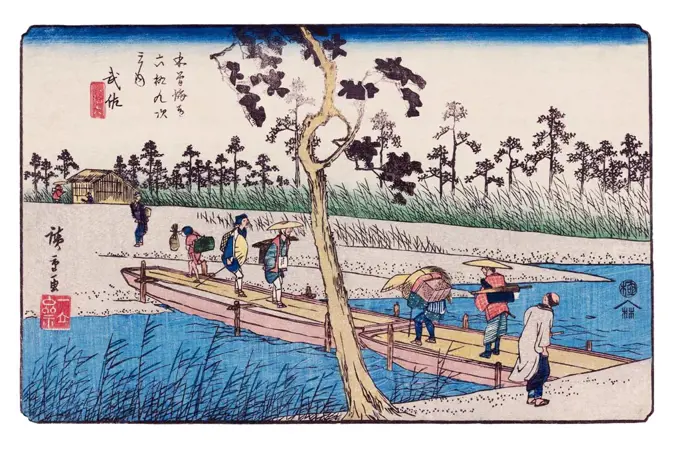
The Sixty-nine Stations of the Kiso Kaid ( Kiso Kaid Rokujky-tsugi) or Sixty-nine Stations of the Kiso Road, is a series of ukiyo-e works created by Utagawa Hiroshige (1797-1858) and Keisai Eisen (1790-1848). There are 71 total prints in the series (one for each of the 69 post stations and Nihonbashi; Nakatsugawa-juku has two prints). The common name for the Kiso Kaid is 'Nakasend' or 'Central Mountain Highway', so this series is also commonly referred to as the Sixty-nine Stations of the Nakasend. The Nakasend was one of the Five Routes constructed under Tokugawa Ieyasu, a series of roads linking the historical capitol of Edo with the rest of Japan. The Nakasend connected Edo with the then-capital of Kyoto. It was an alternate route to the Tkaid and travelled through the central part of Honsh, thus giving rise to its name, which means 'Central Mountain Road'. Along this road, there were sixty-nine different post stations (-shuku or -juku), which provi
4443-28728166
Scenes from the Tokaido, 19th century, possibly Hokei, 6 7/8 × 6 3/8 in. (17.46 × 16.19 cm) (image)7 11/16 × 7 1/16 in. (19.53 × 17.94 cm) (mount), Ink and color on silk, Japan, 19th century
6145-44315127
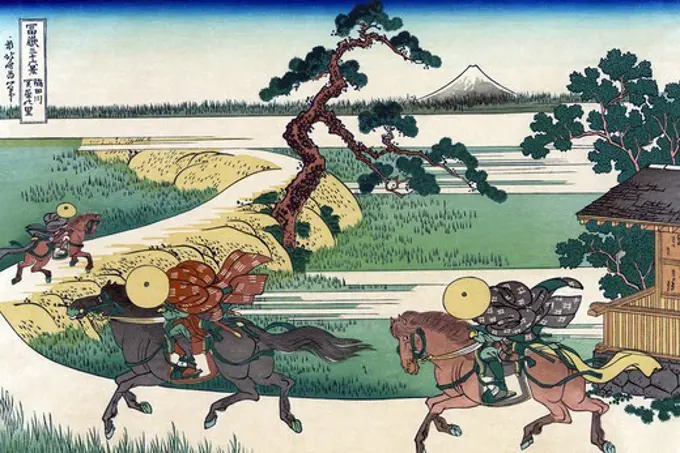
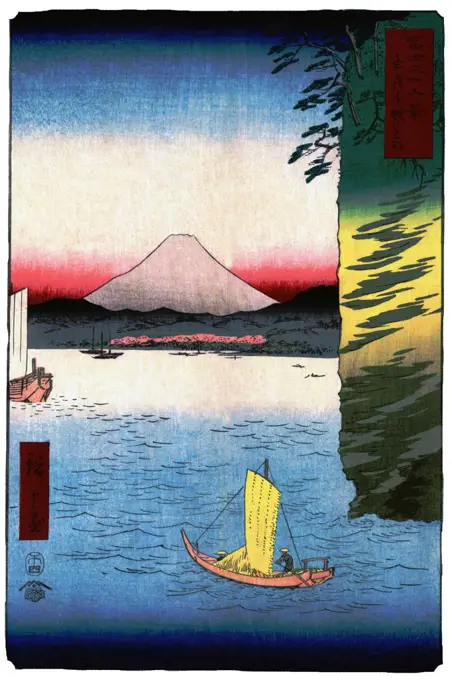
Evening view of the Fuji from the dam of the Sumida river, from the series: 36 views of the Fuji in the eastern capital. .
6145-29721178
The Monkey Bridge Utagawa Hiroshige Japanese. The Monkey Bridge 56803
4409-17383283
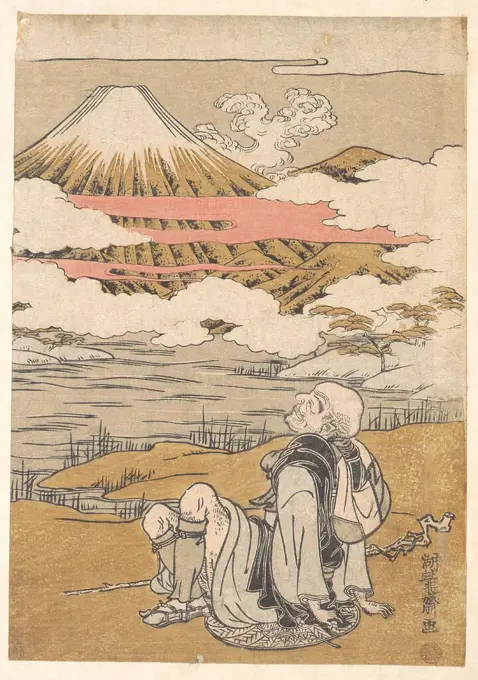
Fuji-mi Saigyo. Artist: Isoda Koryusai (Japanese, 1735-ca. 1790). Culture: Japan. Dimensions: H. 9 7/8 in. (25.1 cm); W. 7 in. (17.8 cm). Museum: Metropolitan Museum of Art, New York, USA.
4409-17563497
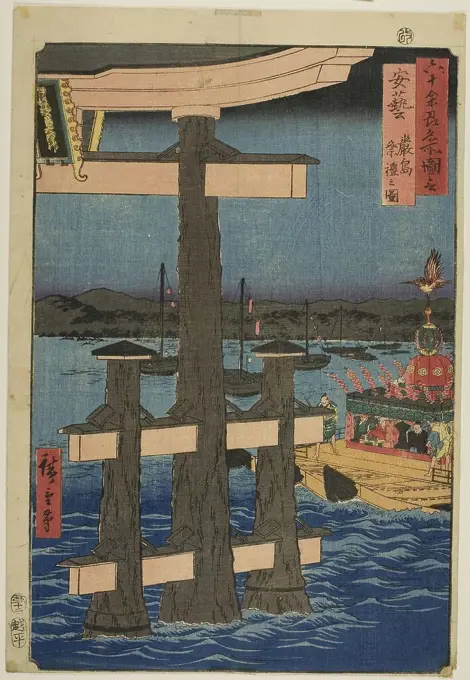
Aki Province: Festival at the Itsukushima Shrine (Aki, Itsukushima sairei no zu), from the series "Famous Views of the Sixty-odd Provinces (Rokujuyoshu meisho zue)". Utagawa Hiroshige  ; Japanese, 1797-1858. Date: 1853. Dimensions: 36.0 x 24.5 cm (14 3/16 x 9 5/8 in.). Color woodblock print; oban. Origin: Japan. Museum: The Chicago Art Institute, USA.
4266-27935
Nihon Embankment and Yoshiwara (One Hundred Famous Views of Edo) by Hiroshige, Utagawa (1797-1858) / State Hermitage, St. Petersburg / The Oriental Arts / 1856-1858 / Japan / Colour woodcut / Landscape /
1899-18855494
The Sixty-nine Stations of the Kiso Kaid ( Kiso Kaid Rokujky-tsugi) or Sixty-nine Stations of the Kiso Road, is a series of ukiyo-e works created by Utagawa Hiroshige (1797-1858) and Keisai Eisen (1790-1848). There are 71 total prints in the series (one for each of the 69 post stations and Nihonbashi; Nakatsugawa-juku has two prints). The common name for the Kiso Kaid is 'Nakasend' or 'Central Mountain Highway', so this series is salso commonly referred to as the Sixty-nine Stations of the Nakasend. The Nakasend was one of the Five Routes constructed under Tokugawa Ieyasu, a series of roads linking the historical capitol of Edo with the rest of Japan. The Nakasend connected Edo with the then-capital of Kyoto. It was an alternate route to the Tkaid and travelled through the central part of Honsh, thus giving rise to its name, which means 'Central Mountain Road'. Along this road, there were sixty-nine different post stations (-shuku or -juku), which prov
6145-51827465
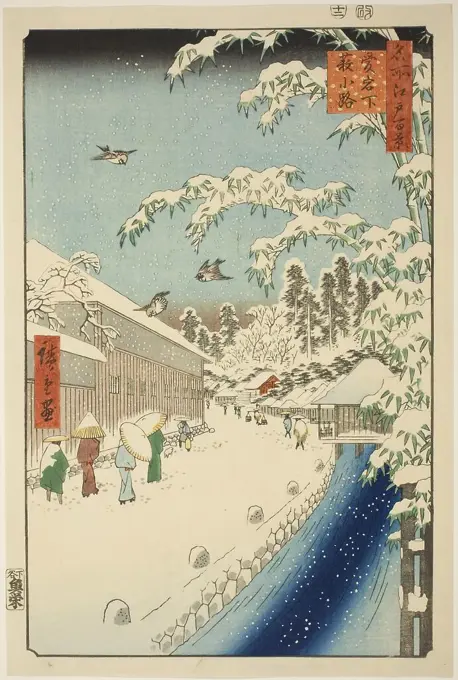
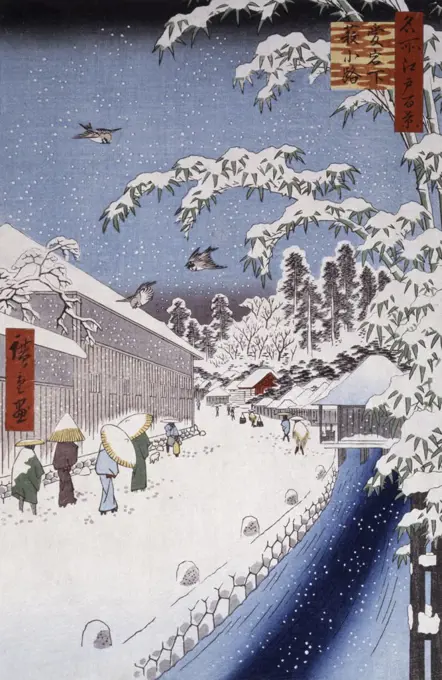
Atagoshita and Yabu Lane, No. 112 from One Hundred Famous Views of Edo Utagawa Hiroshige (Ando) (Japanese, 1797-1858). Atagoshita and Yabu Lane, No. 112 from One Hundred Famous Views of Edo, 12th month of 1857. Woodblock print, Sheet: 14 3/16 x 9 1/4 in. (36 x 23.5 cm).  This is the last of four famous snow scenes that feature bright colors against falling snow. In the distance is the district known as Atagoshita, after its location "beneath Mount Atago," the hill rising to the right. The clump of bamboo shown here was an established landmark recognizable to Edo residents. It lay just outside the northeast corner of the mansion of the daimyo of Minakuchi, and served to protect the site from the dangerous northeast, where the Kimon, the "devil's gate," lay. The bamboo gave its name to Yabu ("Thicket") Lane, an alley that ran along the back of the wall of the mansion. Although mentioned in the title, Yabu Lane is out of sight in this view, behind to the right. Asian Art 12th month of 185
4409-17551110
Inari Shrine at Oji (Oji Inari no yashiro), from the series "Famous Places in Edo (Koto meisho)". Utagawa Hiroshige  ; Japanese, 1797-1858. Date: 1827-1839. Dimensions: 25 x 38.3 cm (9 13/16 x 15 1/16 in.). Color woodblock print; oban. Origin: Japan. Museum: The Chicago Art Institute, USA.
4409-17580984
'Wonderful Snow - Rich Harvest'. China, City of Yanlyutsin, late 19th - early 20th century. Dimensions: 110x61 cm. Museum: State Hermitage, St. Petersburg.
4266-14581
Japanese illustration with ribbons by Utagawa Hiroshige, color woodcut, 1856-1858, 1797-1858, Russia, St. Petersburg, State Hermitage, 39x26
4409-17563059
Tsuchiyama: Spring Shower (Tsuchiyama, haru no ame), from the series "Fifty-three Stations of the Tokaido (Tokaido gojusan tsugi no uchi)," also known as the Hoeido Tokaido. Utagawa Hiroshige  ; Japanese, 1797-1858. Date: 1828-1839. Dimensions: 24.1 x 36.1 cm (9 1/2 x 14 3/16 in.). Color woodblock print; oban. Origin: Japan. Museum: The Chicago Art Institute, USA.
6145-29757547
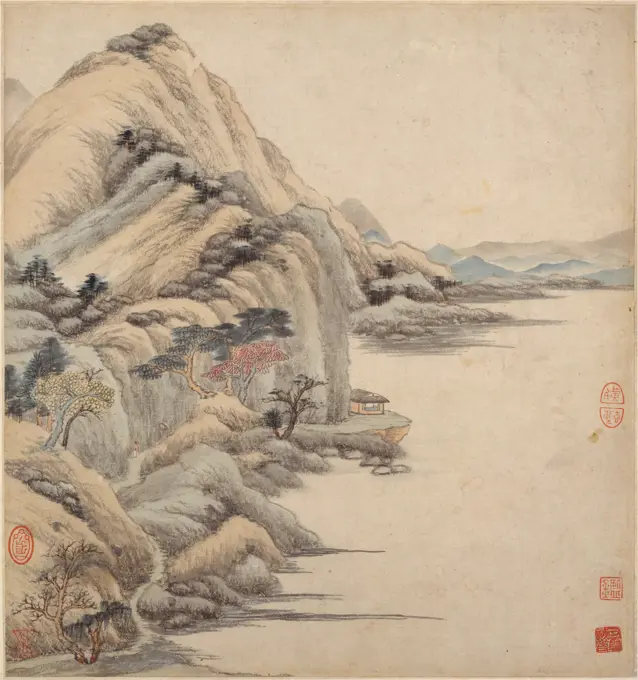
Landscapes in the styles of ancient masters 17th century Wang Jian Chinese Wang Jian's paintings exemplify the vision of a man steeped in tradition. A member of the educated elite, Wang enjoyed access to the region's numerous private collections as well as inheriting a rich assemblage of old masters from his grandfather Wang Shizhen (1526-1590). This firsthand knowledge of past masterpieces inspired Wang to follow the example of Dong Qichang (1555-1636) in seeking a personal artistic synthesis through the diligent study of "orthodox" models.This album is a virtuoso display of Wang Jian's command over his tradition. Each leaf recalls a specific past master, yet each presents a new solution in which the model is transformed by the smaller, album format as well as by Wang's distinctive brush mannerisms.. Landscapes in the styles of ancient masters 44591
4409-17584502
"No," from the series "Tales of Ise in Fashionable Brocade Pictures (Furyu nishiki-e Ise monogatari)". Katsukawa Shunsho  ; Japanese, 1726-1792. Date: 1767-1778. Dimensions: 9 x 6 3/16 in. Color woodblock print; koban. Origin: Japan. Museum: The Chicago Art Institute, USA.
1899-19188703
China: 'Landscapes in the Styles of Old Masters'. Album of ten paintings by Wang Jian (1598-1677), 1668. Wang Jian (1598-1677), style name Xuanzhao and pseudonyms Xiangbi and Ranxiang Anzhu, was a Chinese painter born in Taicang. He lived during the end of the Ming Dynasty and the first decades of the Qing Dynasty. His style of painting was influenced by that of notorious painter Dong Yuan, and he would become famous enough himself to be considered one of the Four Wangs and Six Masters of the early Qing period.
4409-17409378
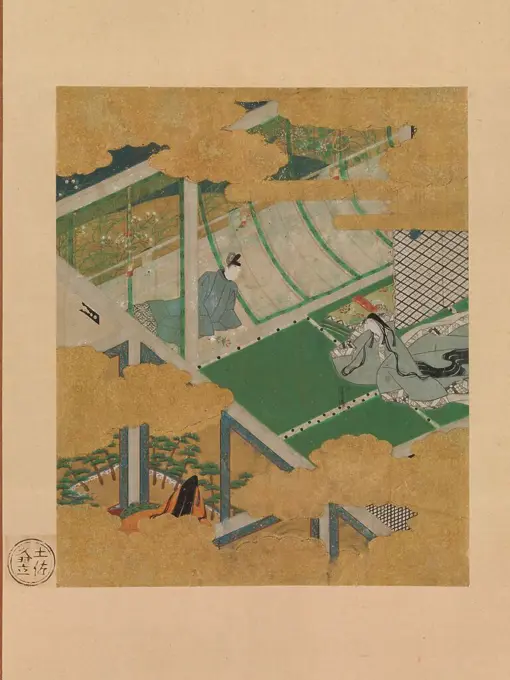
Scene from "Purple Trousers" ("Fujibakama"), from The Tale of Genji (Genji monogatari). Artist: Tosa Mitsuyoshi (Japanese, 1539-1613). Culture: Japan. Dimensions: Image: 10 1/8 × 8 3/8 in. (25.7 × 21.2 cm)Overall with mounting: 54 5/8 × 15 1/4 in. (138.7 × 38.7 cm)Overall with knobs: 54 5/8 × 17 3/16 in. (138.7 × 43.6 cm).In this scene Yugiri, Prince Genji's son, visits the court to deliver a letter of condolence. Having learned that the young lady Tamakazura is not his sister, as he had thought, he also brings her a love poem accompanied by a bouquet of purple autumn flowers (fujibakama). Mitsuyoshi was the head of the Tosa school of the time. A round seal reading "Tosa Kyuyoku" (the artist's name as a priest) that was originally stamped on the back of the painting has been removed and reattached on the side. The refined style and rich colors of this composition (and the related scene on view nearby) match that of the Tale of Genji album by Mitsuyoshi, in the collection of Kyoto Natio
6145-51817268
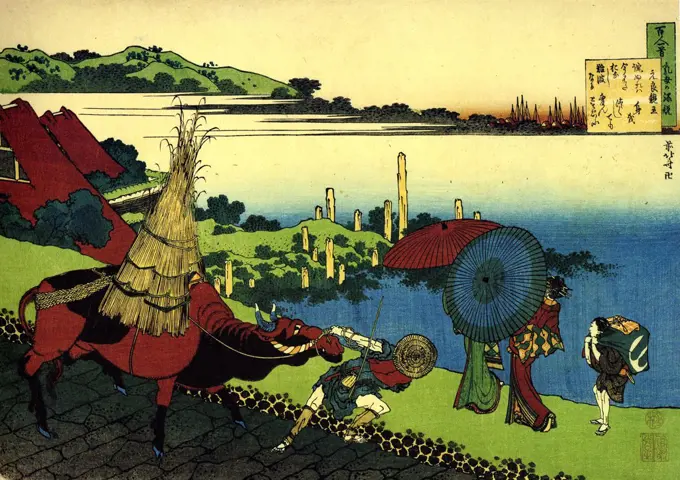
Poem by Ariwara Narihira, from the series One Hundred Poems Explained by the Nurse Katsushika Hokusai (Japanese, 1760-1849). Poem by Ariwara Narihira, from the series One Hundred Poems Explained by the Nurse, ca. 1835-1836. Color woodblock print on paper, 10 3/16 x 15 1/16 in. (25.8 x 38.2 cm).   Asian Art ca. 1835-1836
4409-17562944
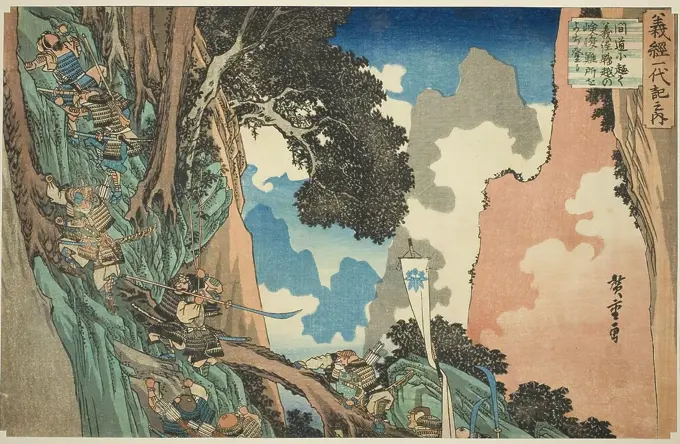
No. 5: Yoshitsune Takes a Shortcut and Scales the Steep and Dangerous Precipice at Hiyodori Pass (Gokai, Kando ni omomuku Yoshitsune Hiyodori goe no kenshun nansho o yojinoboru), from the series "The Life of Yoshitsune (Yoshitsune ichidaiki no uchi)". Utagawa Hiroshige  ; Japanese, 1797-1858. Date: 1827-1839. Dimensions: 25.7 x 38.4 cm (10 1/8 x 15 1/8 in.). Color woodblock print; oban. Origin: Japan. Museum: The Chicago Art Institute, USA.
1848-54961797
Tsukioka Yoshitoshi (1839 - 9 June 1892) one of the last great masters of the classical Japanese colour woodcut, here the work Joganden Moon
6145-29196881
Chinese Junk 2nd month, 1862 Utagawa Yoshitora Japanese. Chinese Junk. Utagawa Yoshitora (Japanese, active ca. 1850-80). Japan. 2nd month, 1862. Woodblock print; ink and color on paper. Edo period (1615-1868). Prints
6145-51817242
No. 27, Ashida, from the series The Sixty-nine Stations of the Kisokaidō Road Utagawa Hiroshige (Ando) (Japanese, 1797-1858). No. 27, Ashida, from the series The Sixty-nine Stations of the Kisokaidō Road, ca. 1835-1838. Color woodblock print on paper, Sheet: 9 5/8 x 14 3/8 in. (24.4 x 36.5 cm).   Asian Art ca. 1835-1838
4409-17584885
Yabu Street at the foot of Atago Hill (Atagoshita yabukoji), from the series "One Hundred Famous Views of Edo (Meisho Edo hyakkei)". Utagawa Hiroshige  ; Japanese, 1797-1858. Date: 1857. Dimensions: 35.7 x 23.9 cm (14 1/16 x 9 3/8 in.). Color woodblock print; oban. Origin: Japan. Museum: The Chicago Art Institute, USA.
6145-30165777
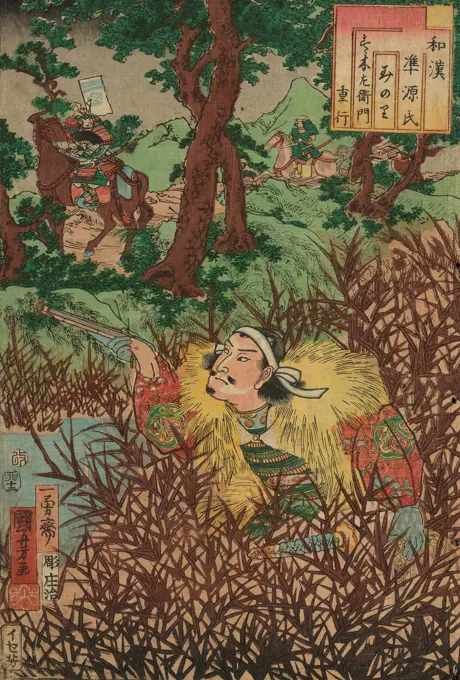
Minori Suzuki Saemon Shigeyuki, from the series Japanese and Chinese Comparisons for the Chapters of Genji (Wakan nazorae Genji) 1855 Japan. Color woodblock print; oban . Utagawa Kuniyoshi
4443-28742956
Full Moon over Takanawa, mid 19th century, Utagawa Hiroshige, Japanese, 1797 - 1858, 8 5/16 × 13 9/16 in. (21.1 × 34.5 cm) (image, horizontal ōban), Woodblock print (nishiki-e); ink and color on paper, Japan, 19th century, Later edition that has the original publisher information removed.
4443-20307772
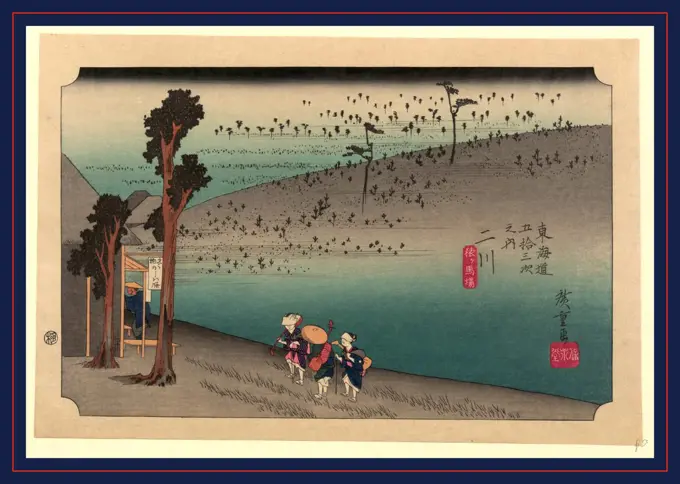
Futagawa, Ando, Hiroshige, 1797-1858, artist, between 1833 and 1836, printed later, 1 print : woodcut, color., Print shows three traveling musicians with their shamisens approaching a rest stop near the Futagawa station on the Tokaido Road.
4443-20306860
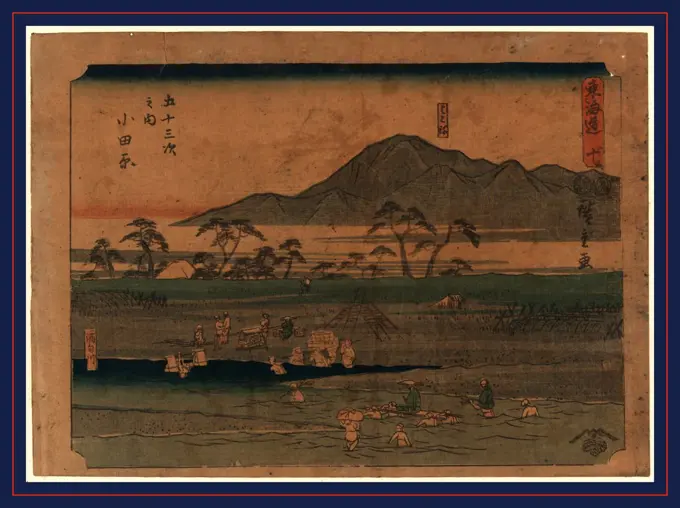
Odawara, Ando, Hiroshige, 1797-1858, artist, between 1848 and 1854, 1 print : woodcut, color ; 18.4 x 25.4 cm., Print shows many travelers fording a stream at the Odawara station on the Tokaido Road.
6145-30159758
Evening Rain at Koizumi (Koizumi yau), from the series Eight Views of Kanazawa (Kanazawa hakkei) 1830-1841 Japan. Color woodblock print; oban . Utagawa Hiroshige
4409-28962124
The Battle of Yashima. Date: 17th century. Origin: Japan. Gold, and silver on paper. Period: Early Edo period. Museum: Freer Gallery of Art and Arthur M. Sackler Gallery.
4443-28740669
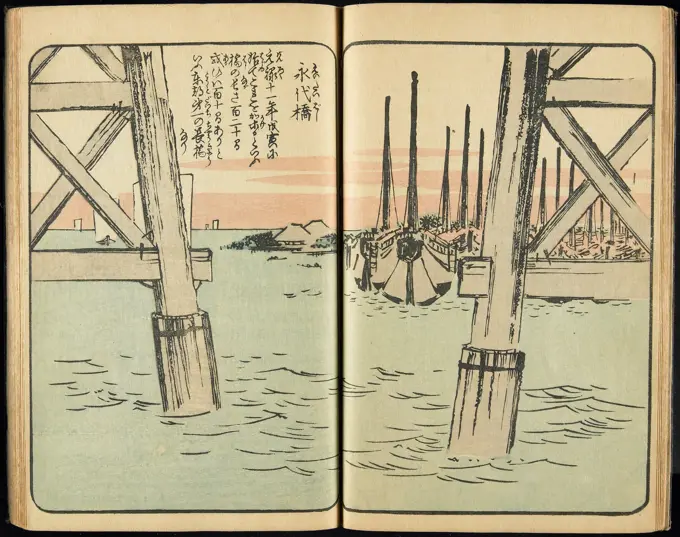
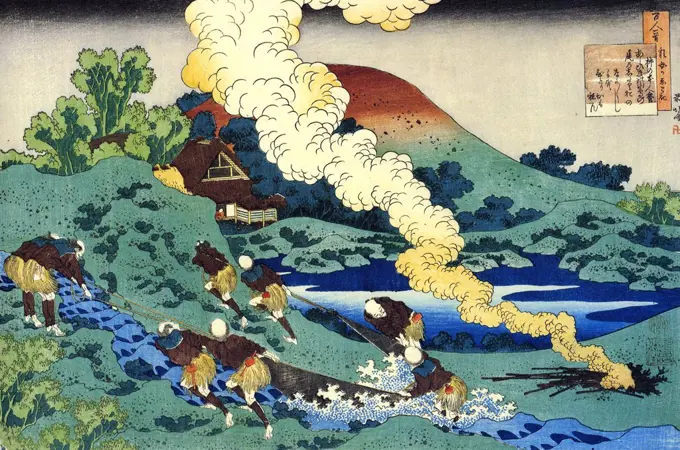
Illustrated Book 'Souvenir of Edo' vol. 3(south), 1850, Utagawa Hiroshige; Publisher: Kikuya Kōzaburō, Japanese, 1797 - 1858, 7 1/16 x 4 13/16 x 3/16 in. (18 x 12.3 x 0.5 cm) (outer frame), Woodblock printed book; ink on paper, with hand-applied color, Japan, 19th century
4409-17551107
Takada Riding Grounds (Takada baba), from the series "Thirteen Views of the Environs of Edo". Utagawa Hiroshige  ; Japanese, 1797-1858. Date: 1832-1849. Dimensions: 9 3/8 x 20 3/8 in. Color woodblock print; ebangire, surimono. Origin: Japan. Museum: The Chicago Art Institute, USA.
6145-50636627
View from The Ferry in Haneda on venten Temple /Haneda No Watashi NO YASHIRO HIROSHIGE, Ichiryusai (1797 1858)
6145-45621819
Rice planters. Landscape with rice fields and a river with blooming irises. In the foreground a man drives a water wheel to irrigation. Along the waterfront three women, one with a rice plants. On the bridge a man walks with a yoke with more rice plants.
4443-28740365
Line-fishing in the Miyato River, c. 1833, Katsushika Hokusai; Publisher: Moriya Jihei, Japanese, 1760 - 1849, 7 5/16 × 10 1/16 in. (18.5 × 25.5 cm) (image, sheet, horizontal chūban), Woodblock print (nishiki-e); ink and color on paper, Japan, 19th century
4443-19375279
In the snow at Tsukahara on Sado Island, Snow landscape with in the foreground Nichiren, founder of the Buddhist Lotus sect, in red robe, climbing a snowy slope, at the bottom of the mountain a village by the sea, with a gray sky with swirling snowflakes., Utagawa Kuniyoshi (mentioned on object), Japan, 1833 - 1837, paper, colour woodcut, h 255 mm × w 370 mm
4443-28739796
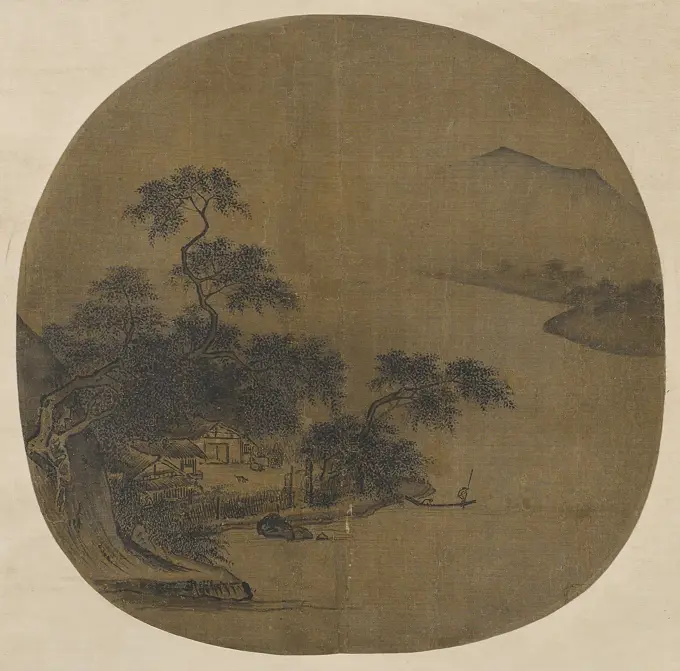
Riverside Retreat, c. 1250, Xia Sen, Chinese, active 13th century, 9 13/16 x 10 in. (24.92 x 25.4 cm) (image), Ink and color on silk, China, 13th century, This fan painting is signed Xia Sen on the earthen bank just below and to the right of the roots of the large tree extending from the left margin of the picture. Born the son of the famous academy painter Xia Gui (c. early 1200s), Xia Sen continued his fathers innovative style. The intimate, focused view of nature, clearly rendered motifs, low-angle perspective, and evocation of a coherent space are all characteristics of the painting circle of Xia Gui. The compositional emphasis of one side of the picture over the other creates pictorial tension and interest. This so-called 'one-corner' composition, in which the subjects of the painting are pushed to a corner or a side, attributed to Ma Yuan (late 12th-early 13th century) and Xia Gui, came to characterize Southern Song academy painting, and the device was practiced by a wide variet
4266-2421
Fishing men by Katsushika Hokusai, Color woodcut, circa 1830, 1760-1849, Russia, St. Petersburg, State Hermitage,
4408-4248
Festival, Japanese Prints - Hiroshige
849-11514
Japanese Print (Crossing The Bridge)  Japanese Art(- ) David David Gallery, Philadelphia,Pennsylvania USA
4409-17377525
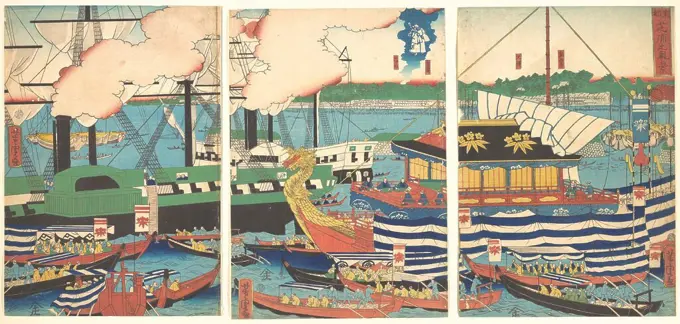
View of Shibaura, from the series Eastern Capital (Toto, Shibaura no fukei). Artist: Utagawa Yoshitora (Japanese, active ca. 1850-80). Culture: Japan. Dimensions: 13 x 28 1/8 in. (33 x 71.4 cm). Date: 6th month, 1863. Museum: Metropolitan Museum of Art, New York, USA.
6145-51827418
Inari Bridge and Minato Shrine, Teppozu, No. 77 from One Hundred Famous Views of Edo Utagawa Hiroshige (Ando) (Japanese, 1797-1858). Inari Bridge and Minato Shrine, Teppozu, No. 77 from One Hundred Famous Views of Edo, 2nd month of 1857. Woodblock print, Sheet: 14 3/16 x 9 1/4 in. (36 x 23.5 cm).  This particular place near Minato Shrine (half-hidden behind the red fence) was a critical junction in the waterways of Edo. It marked the point where large ships from western Japan were anchored and their cargoes transferred into small lighters, or flat-bottomed barges, for distribution to the many storehouses that lined the city's canals. Hiroshige detailed the masts of two cargo ships in the foreground to frame the background view of lighters heading into the canal beyond Imari Bridge. This system, dictated by the shallow waters of Edo Bay, meant that there were none of the piers that are commonly used in Western cities for unloading large ships. Asian Art 2nd month of 1857
4409-17562975
View of Hashiba in the Eastern Capital (Toto Hashiba no zu), from the series "Views of the Eastern Capital (Toto no zu)". Utagawa Kuniyoshi; Japanese, 1797-1861. Date: 1830-1834. Dimensions: 24.8 x 36.4 cm (9 3/4 x 14 5/16 in.). Color woodblock print; oban. Origin: Japan. Museum: The Chicago Art Institute, Chicago, USA.
4409-17355040
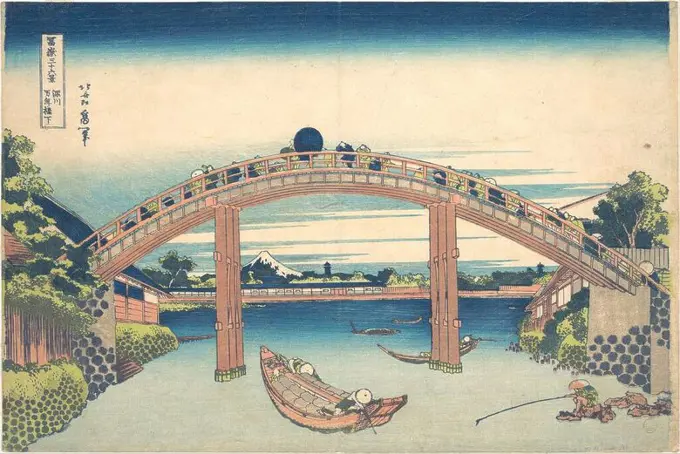
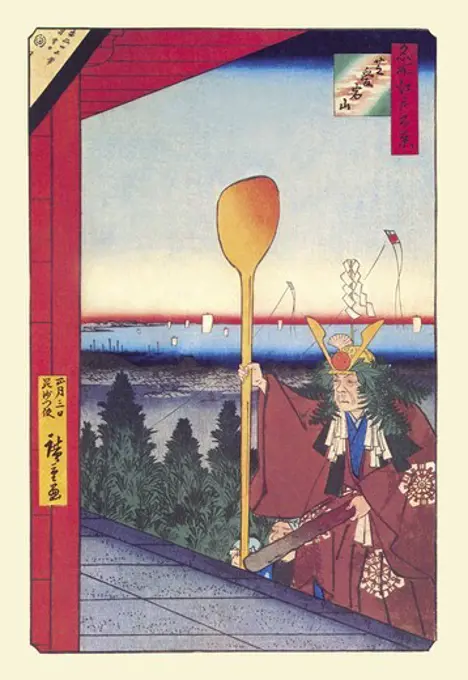
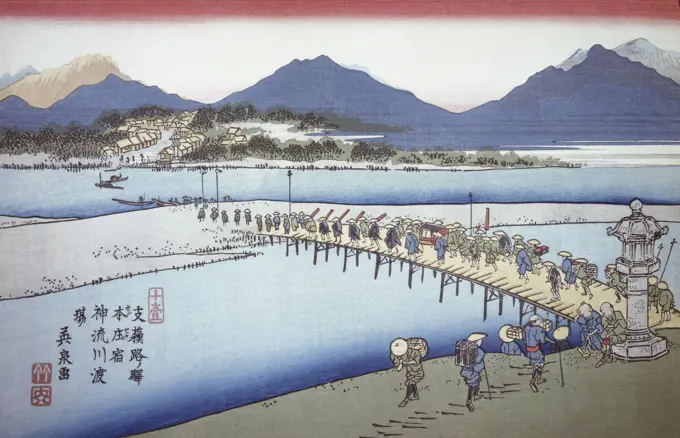
Under the Mannen Bridge at Fukagawa (Fukagawa Mannenbashi shita), from the series Thirty-six Views of Mount Fuji (Fugaku sanjurokkei). Artist: Katsushika Hokusai (Japanese, Tokyo (Edo) 1760-1849 Tokyo (Edo)). Culture: Japan. Dimensions: 10 1/8 x 15 3/16 in. (25.7 x 38.6 cm). Date: ca. 1830-32.This simple frontal view of the Mannen Bridge admirably expresses the grand monumental character of the bridge. Indeed, as though it were the subject of a portrait, the bridge commands our attention with an impressive sense of dignity. Museum: Metropolitan Museum of Art, New York, USA.
1899-18789184
Hiroshige's One Hundred Famous Views of Edo, actually composed of 118 woodblock landscape and genre scenes of mid-19th century Tokyo, is one of the greatest achievements of Japanese art. The series includes many of Hiroshige's most famous prints. It irepresents a celebration of the style and world of Japan's finest cultural flowering at the end of the Tokugawa Shogunate. The series continues with summer. Summer amusements of the Fourth, Fifth, and Sixth Months are represented in numbers 43 through 72. Evening outings in pleasure boats on the Sumida River were taken along the many famous bridges of Edo, where endless varieties of entertainment were offered. Utagawa Hiroshige (1797 October 12, 1858) was a Japanese ukiyo-e artist, and one of the last great artists in that tradition. He was also referred to as Andi Hiroshige (an irregular combination of family name and art name) and by the art name of Ichiyusai Hiroshige.
4409-20919616
GRABADO JAPONES - SIGLO XIX. Author: UTAGAWA HIROSHIGE O ANDO TOKUTARO. Location: PRIVATE COLLECTION. France.
1746-3921
Travellers at Hodogaya on the Tokaido Road, Mount Fuji in background.  From 'Thirty-six Views of Mount Fuji', c1831. Katsushika Hokusai (1760-1849) Japanese Ukiyo-e artist.  Transport Horse Sedan Chair Pedestrian Tree Pine Landscape
6145-29820495
Bow Moon 1832 Utagawa Hiroshige Japanese. Bow Moon. Utagawa Hiroshige (Japanese, Tokyo (Edo) 1797-1858 Tokyo (Edo)). Japan. 1832. Woodblock print; ink and color on paper. Edo period (1615-1868). Prints
6145-58825164
De Bergen in de Provincie Totomi, Katsushika Hokusai, 1829-1833 Two lumberjacks sagging a huge woodblock, one third grinding a sawing; Mount Fuji in the background. print maker: Japanpublisher: Tokyo paper color woodcut / nishiki-e  Fuji Two lumberjacks sagging a huge woodblock, one third grinding a sawing; Mount Fuji in the background. print maker: Japanpublisher: Tokyo paper color woodcut / nishiki-e  Fuji
6145-29817554
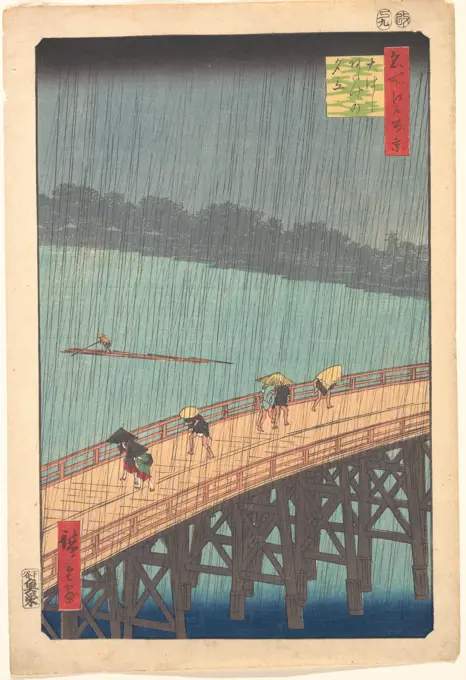
Sudden Shower over Shin-Ōhashi Bridge and Atake (Ōhashi Atake no yūdachi), from the series One Hundred Famous Views of Edo (Meisho Edo hyakkei) 1857 Utagawa Hiroshige Japanese The heavens open. The sudden shower, a favorite subject of Edo haiku poets and ukiyo-e artists, is often depicted with a crisscrossing pattern of fine lines of raina difficult woodblock technique. Here, the netlike pattern is superimposed over an intensely focused image of Ōhashi (the Great Bridge), which crosses the Sumida River. Utagawa Hiroshige, one of Japan's foremost landscapists, designed two extremely popular series: Fifty-three Stations of the Tōkaidō and One Hundred Famous Views of Edo.. Sudden Shower over Shin-Ōhashi Bridge and Atake (Ōhashi Atake no yūdachi), from the series One Hundred Famous Views of Edo (Meisho Edo hyakkei) 55433
6145-29779332
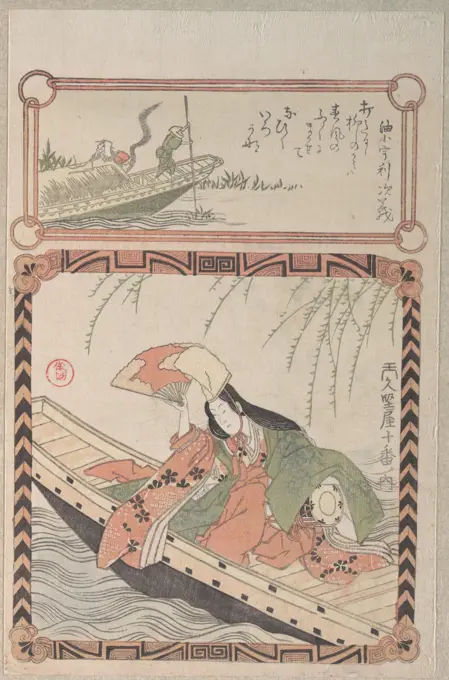
Courtesan in Ancient Costume Seated in a Boat 19th century Kubo Shunman Japanese. Courtesan in Ancient Costume Seated in a Boat 54019
4408-13910
Village of Sekiya at Sumida River, Japanese Prints - Hokusai
6145-30158264
Nihon Bridge in Snow (Nihonbashi setchu), from the series Famous Places in the Eastern Capital (Toto meisho) 1837-1849 Japan. Color woodblock print; oban . Utagawa Hiroshige
6145-51827480
New Year's Eve Foxfires at the Changing Tree, Oji, No. 118 from One Hundred Famous Views of Edo Utagawa Hiroshige (Ando) (Japanese, 1797-1858). New Year's Eve Foxfires at the Changing Tree, Oji, No. 118 from One Hundred Famous Views of Edo, 9th month of 1857. Woodblock print, sheet: 14 3/16 x 9 1/4 in. (36.0 x 23.5 cm);.  In the late 1850s, while Japanese color prints were dominated by themes of the fantastic, Hiroshige emphasized the realities of the observed world in his work. However, here he has ventured into the world of spirits. It was believed that on New Year's Eve all the foxes of the surrounding provinces would gather at a particular tree near Oji Inari Shrine, the headquarters of the regional cult of the god Inari. There the foxes would change their dress for a visit to the shrine, where they would be given orders for the coming year. On the way, the animals would emit distinctive flames by which local farmers were able to predict the crops of the coming year. Asian Art 9th
4443-28733626
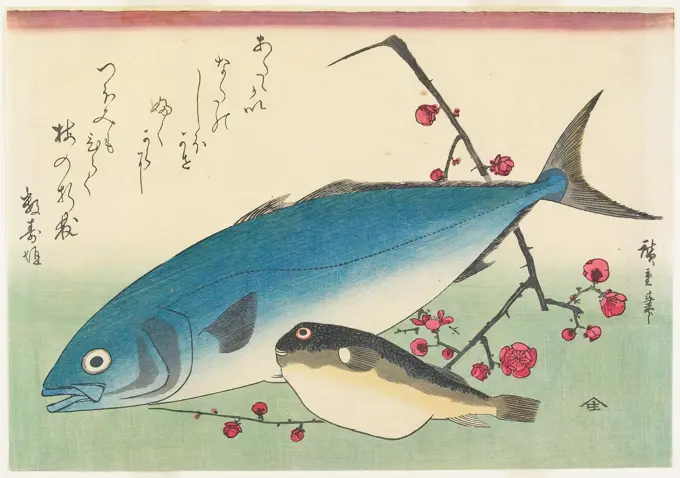
Yellowtail, Blowfish, and Plum Blossoms, c. 1840-1842, Utagawa Hiroshige; Publisher: Yamadaya Shōjirō, Japanese, 1797 - 1858, 9 7/8 × 14 in. (25.1 × 35.6 cm) (image, horizontal ōban), Woodblock print (nishiki-e); ink and color on paper, Japan, 19th century
6145-52354382
Kaishien gaden = The mustard seed garden painting manual.. Wang, Gai, active 1677-1705. Prints, Illustrations. 1753. Spencer Collection
4409-17584970
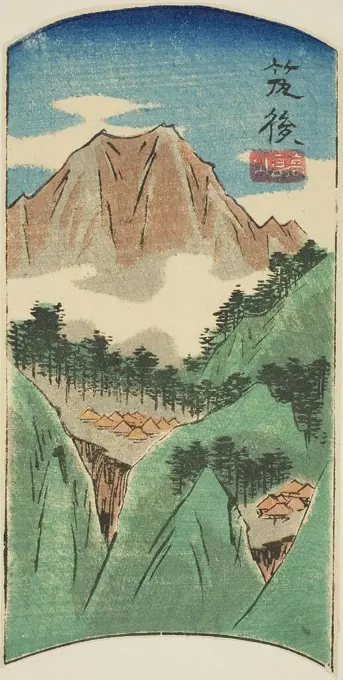
Chikugo, section of sheet no. 17 from the series "Cutout Pictures of the Provinces (Kunizukushi harimaze zue)". Utagawa Hiroshige  ; Japanese, 1797-1858. Date: 1852. Dimensions: 16.2 x 8.2 cm (6 1/4 x 3 1/8 in.). Color woodblock print; section of harimaze sheet. Origin: Japan. Museum: The Chicago Art Institute, USA.
1899-18789131
Hiroshige's One Hundred Famous Views of Edo, actually composed of 118 woodblock landscape and genre scenes of mid-19th century Tokyo, is one of the greatest achievements of Japanese art. The series includes many of Hiroshige's most famous prints. It represents a celebration of the style and world of Japan's finest cultural flowering at the end of the Tokugawa Shogunate. The series opens with spring. Scenes 1 though 42 represent the First to the Third Months, which are considered in Japan to be the spring season. Typically, early spring is marked by the festivities celebrated at the New Year, which begins the season. Blossoming plum trees are associated with the middle of spring, signifying the end of the cold weather and the beginning of the warm season. Utagawa Hiroshige (1797 October 12, 1858) was a Japanese ukiyo-e artist, and one of the last great artists in that tradition. He was also referred to as Andi Hiroshige (an irregular combination of family name and art name) and by the a
6145-29885277
Rachael Robinson Elmer, The Hudson from Riverside Drive, 1914 The Hudson from Riverside Drive
4443-20307647
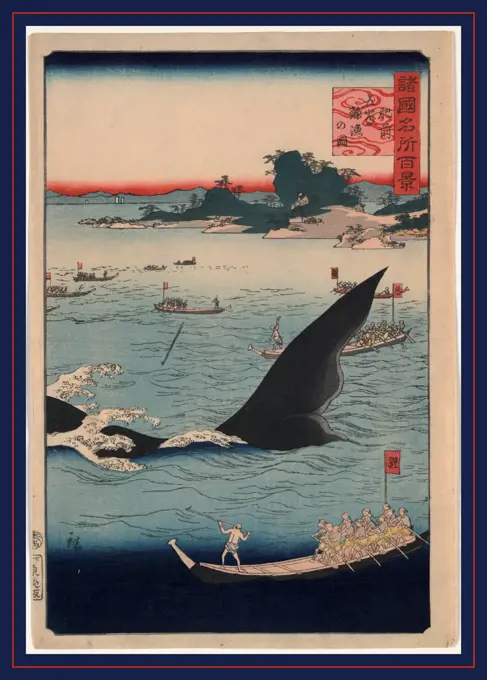
Hizen goto kujiraryo no zu, Whale hunting at the island of Goto in Hizen., Utagawa, Hiroshige, 1826-1869, artist, 1859., 1 print : woodcut, color ; 35.4 x 24.1 cm., Whalers armed with harpoons hunting whales.
4443-28741070
Tōeizan Temple Seen from Shinobazu Benten Shrine in Edo, early 1830s, Eisen; Publisher: Ezakiya Kichibei, Japanese, 1790 - 1848, 9 1/8 x 14 3/16 in. (23.2 x 36.1 cm) (image), Woodblock print (nishiki-e); ink and color on paper, Japan, 19th century
1899-18789200
Hiroshige's One Hundred Famous Views of Edo, actually composed of 118 woodblock landscape and genre scenes of mid-19th century Tokyo, is one of the greatest achievements of Japanese art. The series includes many of Hiroshige's most famous prints. It represents a celebration of the style and world of Japan's finest cultural flowering at the end of the Tokugawa Shogunate. The people of Edo marked the autumn season with excursions to scenic attractions and harvest festivals, and viewing fall foliage at its peak. The prints numbered 73 through 98 suggest the activities of this season in Japan, the Seventh, Eighth, and Ninth Months. Utagawa Hiroshige (1797 October 12, 1858) was a Japanese ukiyo-e artist, and one of the last great artists in that tradition. He was also referred to as Andi Hiroshige (an irregular combination of family name and art name) and by the art name of Ichiyusai Hiroshige.
1899-18853771
Thirty-six Views of Mount Fuji (Japanese: 士三十六景; Fuji Sanjū-Rokkei) is the title of two series of woodblock prints by the Japanese ukiyo-e artist Andō Hiroshige, depicting Mount Fuji in differing seasons and weather conditions from a variety of different places and distances. The 1852 series are in landscape orientation; the 1858 series are in portrait orientation. Utagawa Hiroshige (歌川 広重, 1797 - October 12, 1858) was a Japanese ukiyo-e artist, and one of the last great artists in that tradition. He was also referred to as Andō Hiroshige (安藤 広重) (an irregular combination of family name and art name) and by the art name of Ichiyūsai Hiroshige (一幽斎廣重).
4266-2434
Man pulling bull by Katsushika Hokusai, color woodcut, circa 1830, 1760-1849, Russia, St. Petersburg, State Hermitage
6145-30157446
Twilight Moon at the Ryogoku Bridge (Ryogoku no yoizuki), from the series Famous Views of the Eastern Capital (Toto meisho) 1826-1836 Japan. The early impressions of this design, like the print seen here, were printed almost entirely in shades of blue, with a subtle gradation (bokashi) from blue to white in the water. Only the pink clouds prevent the impression on the left from being an ìall blueî (aizuri-e) print. Later impressions use several other colors and now, the water is a solid blue.The design was printed with a decorative border which was has been entirely trimmed in this print and partially trimmed in the other print.. Color woodblock print; oban . Utagawa Hiroshige
4408-4251
Floating World Showers, Japanese Prints - Hiroshige
4409-17584559
Under the Wave off Kanagawa (Kanagawa oki nami ura), also known as the Great Wave, from the series "Thirty-six Views of Mount Fuji (Fugaku sanjurokkei)". Katsushika Hokusai  ; Japanese, 1760-1849. Date: 1825-1838. Dimensions: 5.7 x 7.2 cm (10 1/8 x 14 5/8 in.). Color woodblock print; oban. Origin: Japan. Museum: The Chicago Art Institute, Chicago, USA.
4443-20306899
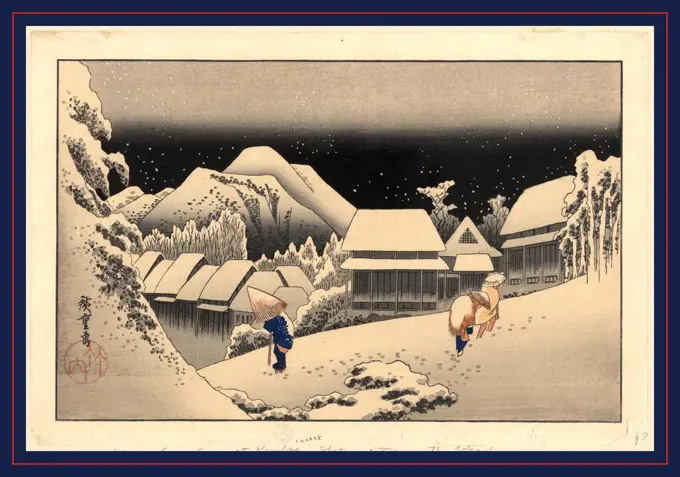
Kanbara, Ando, Hiroshige, 1797-1858, artist, between 1833 and 1836, printed later, 1 print : woodcut, color ; 25.6 x 37.9 cm., Print shows travelers walking in the snow at night at the Kanbara station on the Tokaido Road.
866-5069
Yabu Street Below Atago Ando Hiroshige (1797-1858 Japanese) Christie's Images
1899-18853371
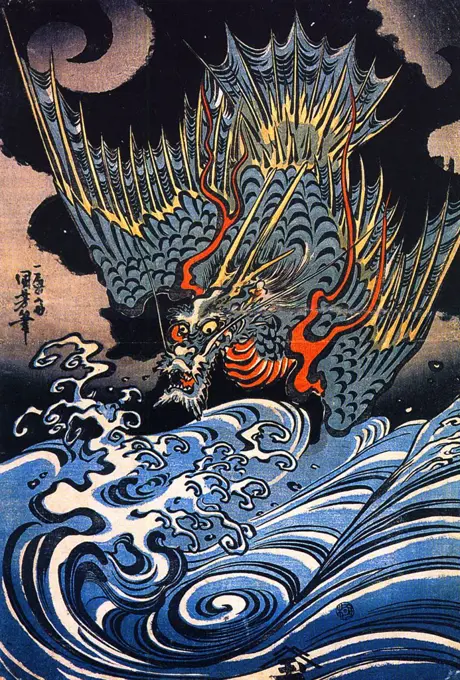
Utagawa Kuniyoshi (川 国芳, January 1, 1797 - April 14, 1862) was one of the last great masters of the Japanese ukiyo-e style of woodblock prints and painting. He is associated with the Utagawa school. The range of Kuniyoshi's preferred subjects included many genres: landscapes, beautiful women, Kabuki actors, cats, and mythical animals. He is known for depictions of the battles of samurai and legendary heroes. His artwork was affected by Western influences in landscape painting and caricature.
6145-52850247
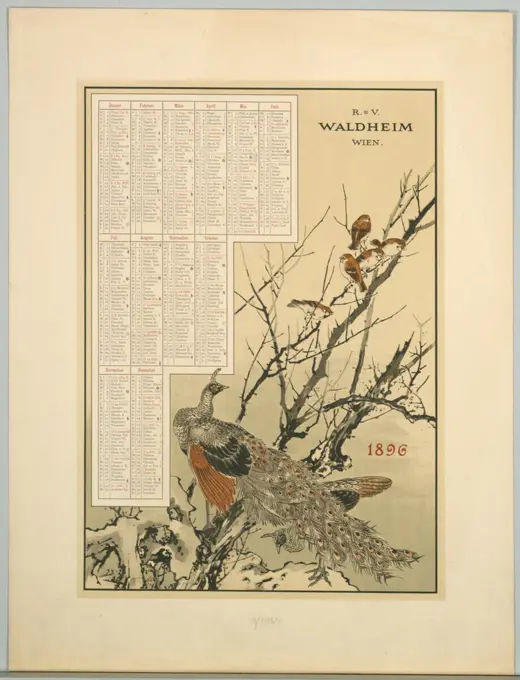
Color poster by an anonymous artist, created in 1896, depicting R. v. Waldheim in Vienna with text and decorative elements.
1899-18305461
Water, Hiroshige, Utagawa, 1846
6145-59559215
Ochtend in Beppu, Kawase Hasui, 1928 print Sailing ships in a harbor near moonlight, mountains in the background.  paper color woodcut harbour
PREVIOUS
of 3
NEXT
2401 S. Ervay, Suite 206
Dallas, Texas 75215
United States
Get Started
Free ResearchMy BoardsMy Cart
For Creators
How To License Your ContentContributor PortalFrame of Mind
Resources
API accessPricing
Contact
+1 866 236 0087help@viewpictures.co.uk Contact form
©2026 View Pictures. All Rights Reserved. -A
This site is protected by reCAPTCHA and Google Privacy Policy and Terms of Service apply.