My Boards
View Pictures
  • My Boards
← Artworks

Japanese Woodblock Prints

Colorful woodblock prints depicting actors in traditional attire, showcasing Japanese theater and elaborate costumes from the Edo period.
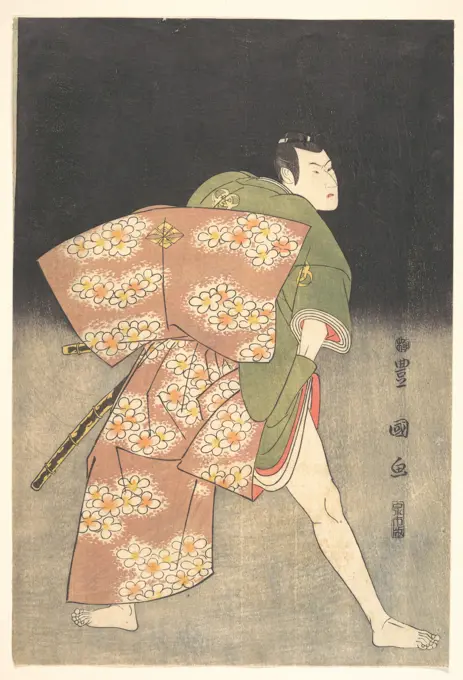
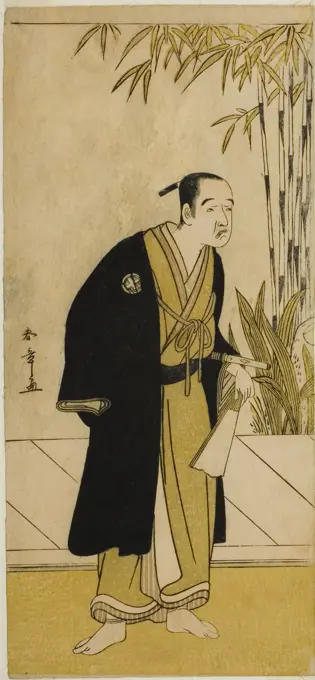
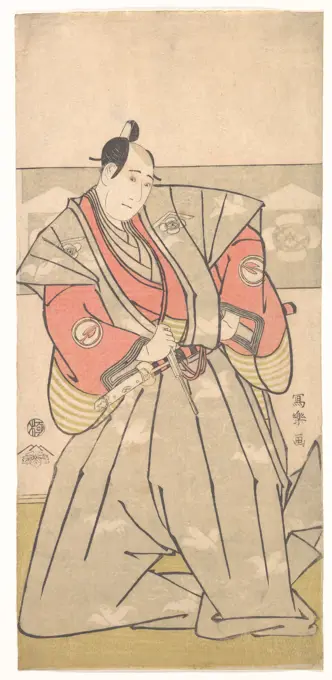
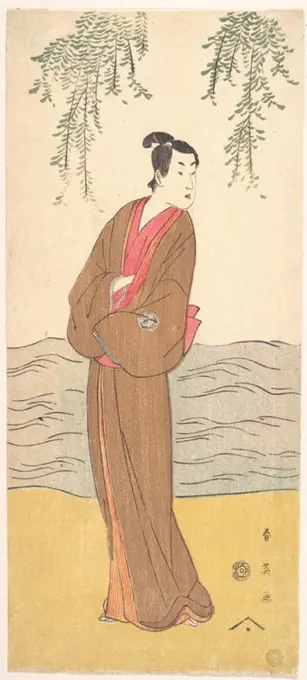
Bandō Minosuke (Mitsugorō III) in the Role of a Young Samurai 1796 Utagawa Toyokuni I Japanese. Bandō Minosuke (Mitsugorō III) in the Role of a Young Samurai 56993
264 assets in this story
6145-29135998
Osaka Actor Nakamura Shikan in the Role of the Daimyō Fujiwara no Tokihira Kyō. Utagawa Kunisada (Toyokuni III) (Japan, Edo, 1786-1865). 1833, 9th month. Prints; woodblocks. Color woodblock print
1899-19136825
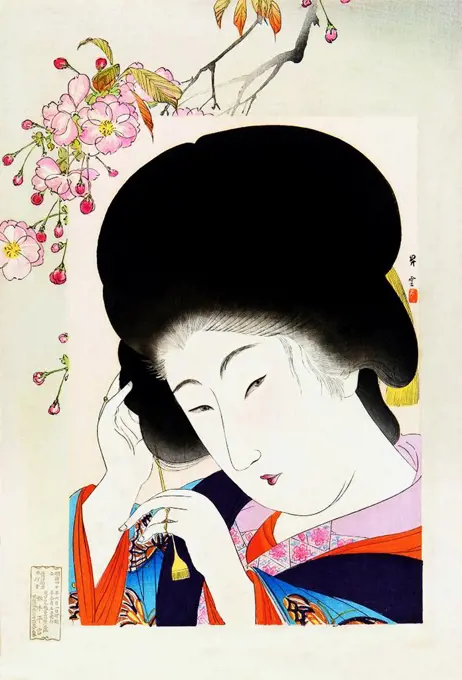
Japan: 'Sweetness of Flowers', Yamamoto Shoun (1870-1965), c. 1910
6145-30151709
The Actor Otani Tomoemon I as Kajino Choan ( ) in the Play Hono Nitta Daimyojin ( ), Performed at the Morita Theater ( ) in the Seventh Month, 1777 1772-1782 Japan. Color woodblock print; hosoban; left sheet of diptych . Katsukawa Shunsho
6145-29711456
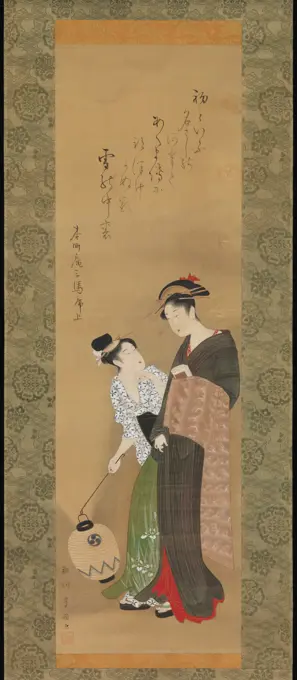
Woman and Attendant ca. 1795 Utagawa Toyokuni I Japanese Toyokuni was one of the most prolific artists of the late Edo period. During his early career, he portrayed women with particularly graceful necks, as exemplified by this image of a courtesan on her way to see her first customer of the evening by the light of a lantern held by an attendant. She is neatly dressed, with every hair in place. Red color applied here and there reveals her youth and vibrancy. On the upper section of the scroll, a poem by Shikiteri Sanba (1776-1822), a noted author of popular literature, is inscribed:Chosen for the first time,Before becoming accustomed,It is difficult to make footsteps in the snow.. Woman and Attendant. Utagawa Toyokuni I (Japanese, 1769-1825). Japan. ca. 1795. Hanging scroll; ink and color on silk. Edo period (1615-1868). Paintings
4409-17584245
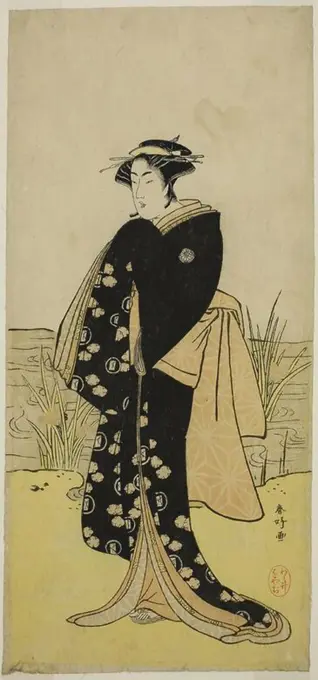
The Actor Segawa Kikunojo III as Oshichi in the Play Junshoku Edo Murasaki, Performed at the Ichimura Theater in the First Month, 1779. Katsukawa Shunko I; Japanese, 1743-1812. Date: 1774-1784. Dimensions: 32.6 x 14.9 cm (12 13/16 x 5 7/8 in.). Color woodblock print; hosoban; right sheet of diptych (). Origin: Japan. Museum: The Chicago Art Institute, Chicago, USA.
6145-29795700
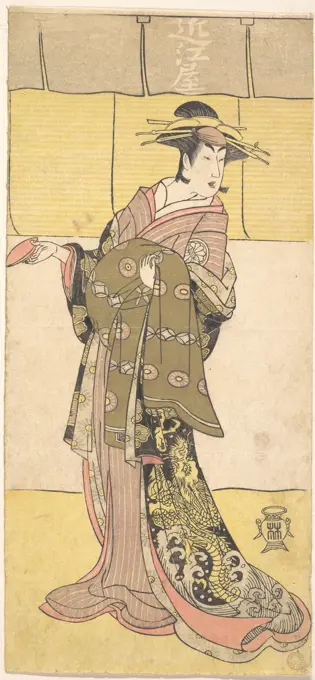
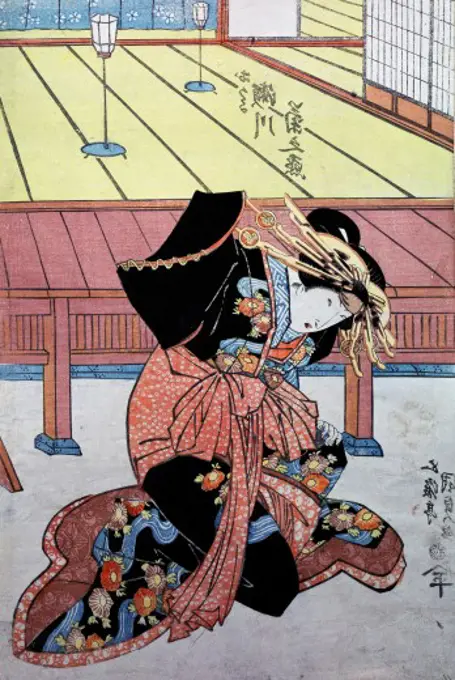
The Actor Segawa Kikunojō as a Courtesan of the Ōmiya Brothel ca. 1786 (Tenmei 6) Katsukawa Shunshō 川春章 Segawa Kikunojō III (1751-1810) was one of the top actors of his time in both male and female roles, but it was for his performances as an onnagata—especially in roles as courtesans and ingénues—that earned him the most acclaim. Here the character is bedecked in dramatic dragon robes, appropriate for a high-ranked courtesan. Here we have not yet been able to identify the play, but the entrance curtain behind the actor reads “Ōmiya,” recalling the name of the Naka-Ōmiya Brothel in the Yoshiwara pleasure quarters.. The Actor Segawa Kikunojō as a Courtesan of the Ōmiya Brothel 36750
6145-59565341
Full moon and pine, 1896 print Woman, seen on the back, walking with pine and stone lantern, looking at full moon.  paper color woodcut landscapes (+ landscape with figures, staffage). trees: pine
6145-46048990
JITSUKAWA Enzaburô I ALS KANEMARI DAISUKE.
4443-73255017
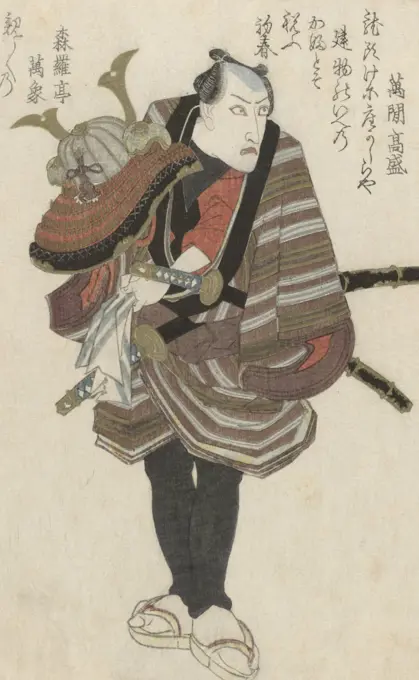
Japan, Manzô, Shinratei, Takamori, Mankan, Sononari, Matsunoya, Kunisada (I), Utagawa, Samurai with helmet in hand, A samurai in a striped kimono (actor Ichikawa Danjûrô VII (1791-1859)), holding his helmet in his hand. With three poems, of which the poem by Shinratei Manzô about the new year goes., print, surimono, prints, Japan (collection), height 205 mm, width 176 mm, Japanese, 1786 - 1865, print maker, printmaker, 1821 - 1821, second quarter 19th century, paper, colour woodcut, blind printing, polishing, poet, 1762 - 1831
6145-59575349
Nakamura SHIKAN III ALS FUKUMASUYA MONBEI, SADANOBU (I), HaseGawa, 1841 print NAKAMURA SHIKAN III ALS FUKUMASUA MONBEI in HET TONEELSTUK 'KEISEI Yanagizakura', Naka Theater, Januari 1841.  paper  portrait of actor, actress
1899-18788949
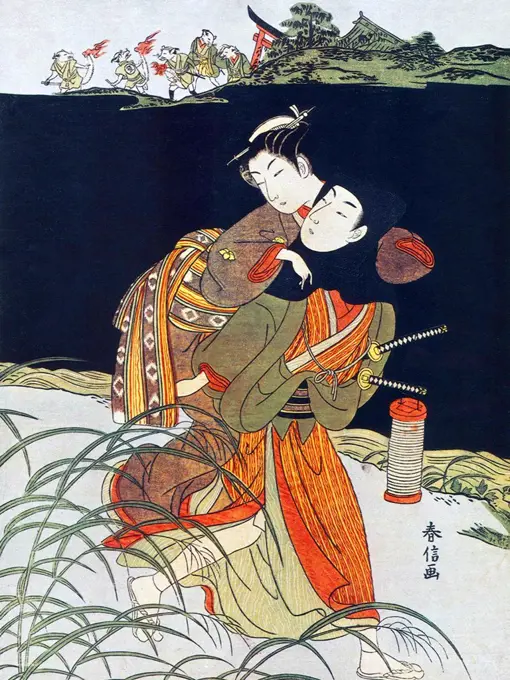
Suzuki Harunobu (1724 July 7, 1770) was a Japanese woodblock print artist, one of the most famous in the Ukiyo-e style. He was an innovator, the first to produce full-color prints (nishiki-e) in 1765, rendering obsolete the former modes of two- and three-color prints. Harunobu used many special techniques, and depicted a wide variety of subjects, from classical poems to contemporary beauties (bijin, bijin-ga). Like many artists of his day, Harunobu also produced a number of shunga, or erotic images. During his lifetime and shortly afterwards, many artists imitated his style. A few, such as Harushige, even boasted of their ability to forge the work of the great master. Much about Harunobu's life is unknown.
4430-2849
fine arts, Japan, graphics, ""courtesan in festive dress in front of terrace of tea house"", first half 19th century, colour woodcut, Gutenberg Museum, Mainz,
4409-17562579
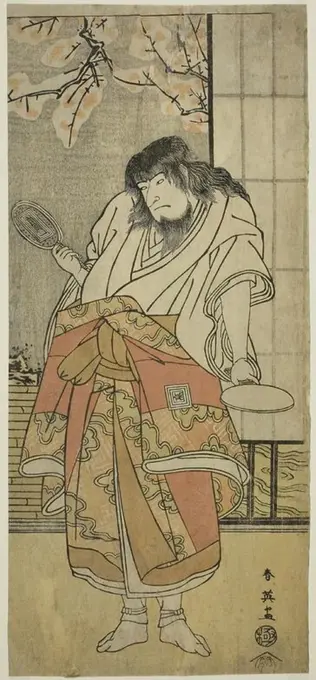
The Actor Ichikawa Komazo II as the monk Shunkan in the play "Shunkan Shima Monogatari," performed at the Kawarazaki Theater in the ninth month, 1791. Katsukawa Shun'ei; Japanese, 1762-1819. Date: 1786-1796. Dimensions: 30.8 x 13.9 cm (12 1/8 x 5 1/2 in.). Color woodblock print; from a multisheet hosoban composition. Origin: Japan. Museum: The Chicago Art Institute, Chicago, USA.
6145-30149148
Girl Riding a Crane (parody of Hi Chobo Chinese Fei Zhangfang) 1761-1770 Japan. Color woodblock print; chuban . Suzuki Harunobu
4443-20306372
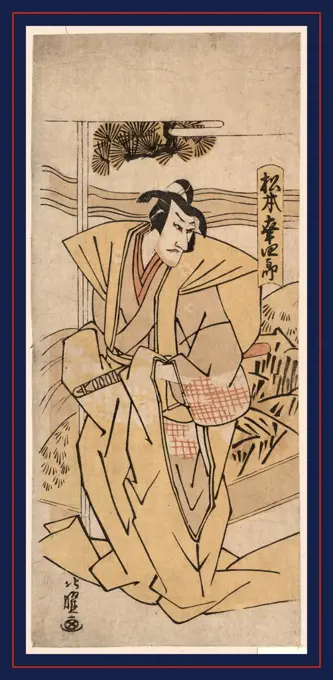
Matsumoto koshiro, The actor Matsumoto Koshiro., between 1804 and 1808, 1 print : woodcut, color ; 31.9 x 14.1 cm., Print shows the actor Matsumoto Koshiro, full-length portrait, standing, facing slightly right, possibly wearing a mask.
6145-51828443
Young Woman Carries Adorned Pole for a Procession Utagawa Toyohiro (Japanese, 1773-1829). , ca. 1805-6. Woodblock print, narrow koban tate-e surimono-style printing, 9 1/4 x 3 3/8 in. (23.5 x 8.6 cm).  Processions of the daimyos, or feudal lords, who frequently traveled with elaborate retinues from their home states to make appearances at the court of the shogun, provided popular spectacles for the people of Edo. Toyohiro often treated the theme of the daimyo procession, sometimes replacing members of a retinue with beautiful women who bear flags or other emblems of authority, such as the pole carried by this figure. This image comes from a series that included at least fifteen different designs. Asian Art ca. 1805-6
1746-21103134
The actor Morika Kanya (kabuki Theartre), by Tshsai Sharaku (1794ñ1795); Japanese ukiyo-e print artist
6145-29738992
The Actor Sawamura Sojuro III 1794-95 Tōshūsai Sharaku Japanese. The Actor Sawamura Sojuro III 37348
6145-45447992
Portrait of the Old Wrestler Sumō Doshiyori Raign Daiyū Porulent Strength Utagawa, kuniyoshi (1797 1861)
6145-29715388
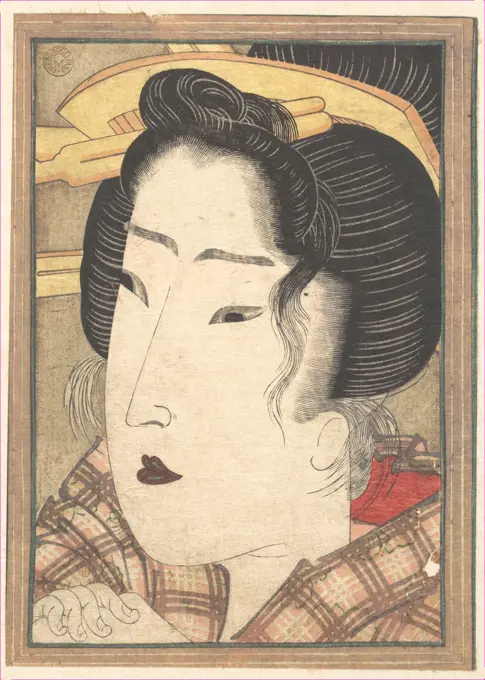
Head of a Beauty ca. 1825 Keisai Eisen Japanese. Head of a Beauty 55017
4409-28962589
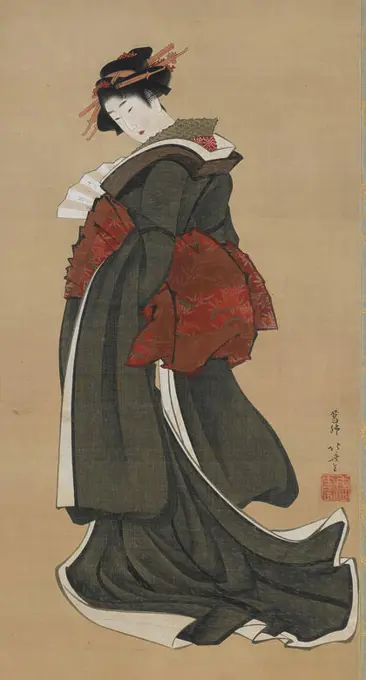
Woman Holding a Fan. Origin: Japan. Period: Edo period. Ink and color on silk. Date: ca. 1810-1811. Museum: Freer Gallery of Art and Arthur M. Sackler Gallery.
1746-111328368
Yogoto ni au koi. Translation: Nightly love. by Utamaro Kitagawa, 1753-1806, artist. Published 1793, printed between 1918 and 1923. Print shows head-and-shoulders portrait of a woman, facing right, reading from a scroll.
4443-20307248
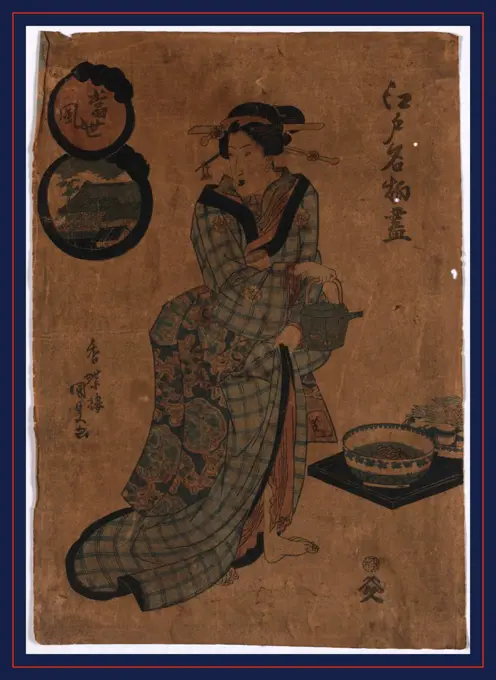
Tosei fu, Today's trends., Utagawa, Toyokuni, 1786-1865, artist, between 1830 and 1844, 1 print : woodcut, color ; 37.6 x 26.5 cm., Print shows a woman, full-length portrait, standing, facing left, holding a teapot.
4443-75478393
Courtesan of the Genroku Era, 1814, Woodcuts, Surimono
6145-29827325
Print Keisai Eisen Japanese. Print 55372
6145-59468386
Liefdesgedicht VOOR ICHIKAWA TOMOZO, UTAGAWA KUNIMASA, 1799 print BostePortret of the actor Ichikawa Tomozo with a right hand on sword, depicted under a love poem addressed to him; In the left margin the page number nine. Leaf from the Japanese book Yakusha Gakuya TSU. Or paper color woodcut portrait of actor, actress
4443-20306273
Hiogi, Hiogi: Japanese cypress folding fan., Katsushika, Hokusai, 1760-1849, artist, between 1820 and 1822, 1 print : woodcut, color ; 20.7 x 18.7 cm., Print shows a woman examining a garment; a wooden fan is on the ground at her feet.
6145-48530242
Adorant - female founder with daughter, two sons and lady-in-waiting; copy of a fresco from Dunhuang. Rong Bao Zhai (1672- ), publishing house
1746-21103135
The courtesan Annamurasaki by Yeishi early 19th century, japanese 1805
4409-17555770
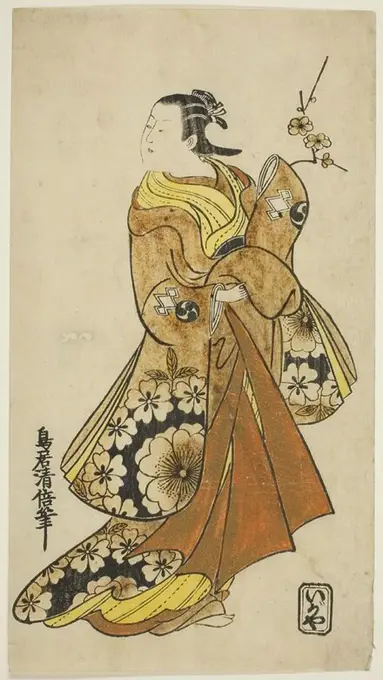
The Actor Nakamura Takesaburo I in a female role. Torii Kiyomasu II; Japanese, 1706 ()-1763 (). Date: 1713-1723. Dimensions: 29.2 x 16.2 cm (11 1/2 x 6 3/8 in.). Hand-colored woodblock print; hosoban, urushi-e. Origin: Japan. Museum: The Chicago Art Institute, Chicago, USA.
6145-59460698
Busteportret Van de Actor Ichikawa Monnosuke II in de Rol Van Soga NO GORO., Katsukawa Shunko, 1789 print  Japan paper color woodcut portrait of actor, actress
6145-30166124
Memorial Portrait of the Actor Ichikawa Danjuro VIII 1854 Japan. Color woodblock print; oban . Utagawa School
6145-45580966
Peonies from Shakkyo; Shakkyo No Botan, Fukisaburo; Contemporaine references to the 36 poets.; Tosei Mitate Sanjurocases .. Portrait of the actor Ichimura Kakitsu IV in the role of Fukisaburo, dressed in purple and green costume with stylized peony pattern, red wig on which headpiece with peony and green leaf; against blue background; Pink and yellow peonies around cartouche top left.
4409-17349470
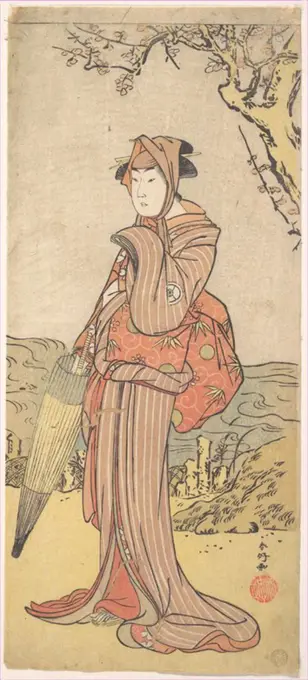
Iwai Kiyotaro as a Woman Standing under a Plum Tree. Artist: Katsukawa Shunko (Japanese, 1743-1812). Culture: Japan. Dimensions: 12 5/8 x 5 5/8 in. (32.1 x 14.3 cm). Date: ca. 1788. Museum: Metropolitan Museum of Art, New York, USA.
6145-59465421
Dansers, Yanagawa SHIGENOBU (i), C. 1823  Dancer in a kimono with a chrysanthemum pattern, performs the butterfly dance. In her right hand she holds a range. With one poem by Mochizuki Kagenari. Japan paper color woodcut ballet group; dancers on the stage
6145-30163884
Memorial portrait of Utagawa Hiroshige 1858 Japan. Color woodblock print; oban . Utagawa Kunisada I (Toyokuni III)
1899-19137090
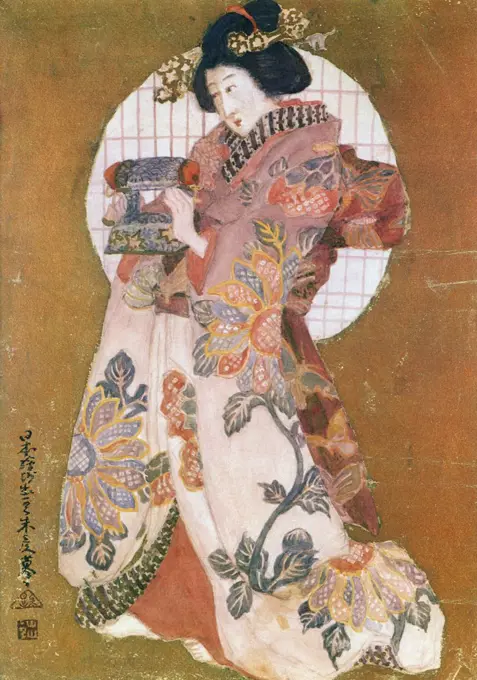
Japan: 'Nishiki-e', watercolour painting in the manner of Ukiyo-e (woodblock prints) by Shigeru Aoki (1882-1911), c. 1905
4409-17376710
The Third Segawa Kikunojo as Hisamatsu Standing on the Bank. Artist: Katsukawa Shun'ei (Japanese, 1762-1819). Culture: Japan. Dimensions: 12 3/4 x 5 5/8 in. (32.4 x 14.3 cm). Date: ca. 1795. Museum: Metropolitan Museum of Art, New York, USA.
1899-18856881
Tsukioka Yoshitoshi (30 April 1839 - 9 June 1892) was a Japanese artist and Ukiyo-e woodblock print master. Yukimori (1543-76), a samurai known for his great strength and loyalty, served the Amako warlord during a time in Japanese history referred to as 'Sengoku', or 'the country at war'. He wears a suit of armor called 'tosei gusoku' ('modern equipment') that was designed in the 16th century to be worn by a foot soldier.
6145-51787950
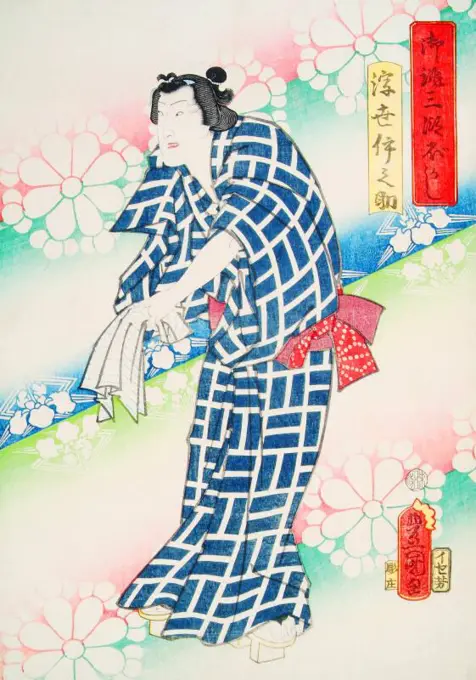
Actor In a Blue And White Patterned Robe, Utagawa Kunisada (Tokyo, Japan, 1786 - 1865) 1859
4266-2533
Woman by Keisai Eisen, Colour woodcut, 1852, 1790-1848, Private Collection
4409-17426385
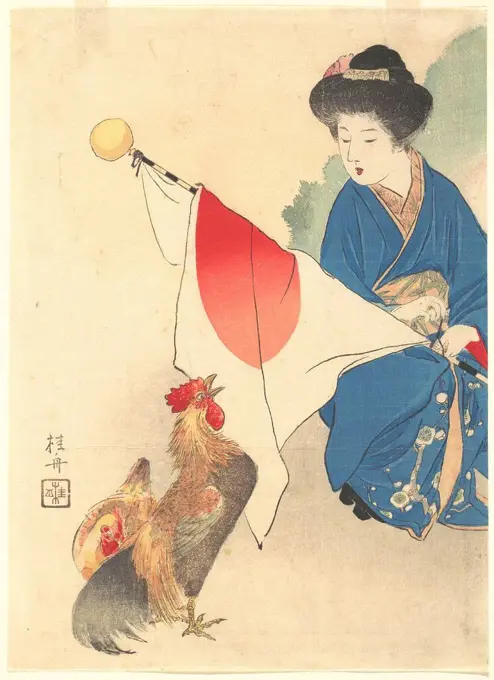
A Cock Crows. Artist: Takeuchi Keishu (Japanese, 1861-1943). Culture: Japan. Dimensions: 11 3/4 x 8 1/2 in. (29.8 x 21.6 cm). Date: ca. 1906. Museum: Metropolitan Museum of Art, New York, USA.
6176-67069161
A Japanese waitress with a tray, 1920 (1930).Artist: Hashiguchi Goyo
6145-59027946
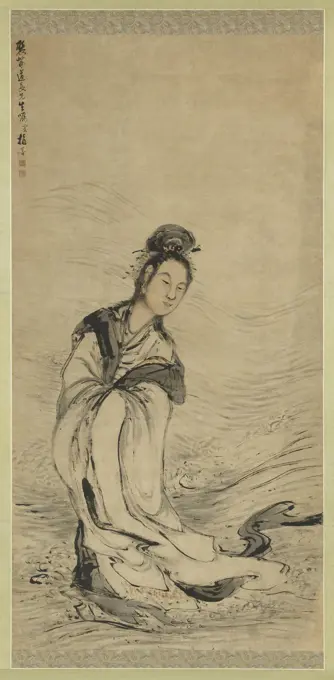
FU WEN (active around the middle of the 18th century). "Nymph of the Luo River". Ink and colors on paper. Paris, Cernuschi museum. Color, ink, woman, waves, ink, walking, nymph, nymphe, paper, river luo, river luo, walk, water, waves, colur, paper, woman
1899-18857141
Torii Kotondo is known to have made only 21 prints - all of them images of bijin or beautiful women. They belong to the finest works of art of the Shin Hanga movement. Shin hanga ('new prints') was an art movement in early 20th-century Japan, during the Taisho and Showa periods, that revitalized traditional ukiyo-e art rooted in the Edo and Meiji periods (17th-19th century). The movement flourished from around 1915 to 1942, though it resumed briefly from 1946 through the 1950s. Inspired by European Impressionism, the artists incorporated Western elements such as the effects of light and the expression of individual moods, but focused on strictly traditional themes of landscapes (fukeiga), famous places (meisho), beautiful women (bijinga), kabuki actors (yakusha-e), and birds and flowers (kachoga).
6145-51818349
Kabuki Actor Utagawa Kunisada (Toyokuni III) (Japanese, 1786-1865). Kabuki Actor, ca. 1850. Color woodblock print, 14 x 9 1/2 in. (35.6 x 24.1 cm).   Asian Art ca. 1850
4443-20307076
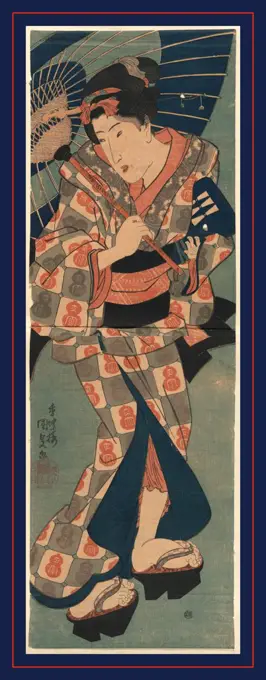
Nagauta no keiko ni kayou musume, Young lady going to her Nagauta music lessons., Utagawa, Kunisada, 1823-1880, artist, between 1830 and 1844, 1 print : woodcut, color ; 36.3 x 24.4 cm (top print), 36.6 x 24.1 cm (bottom print)
4409-17502493
Amerika nyojinAmerican Woman with Her Child on Stilts. Artist: Utagawa Yoshitora (Japanese, active ca. 1850-80). Culture: Japan. Dimensions: Image: 14 5/8 x 9 7/8 in. (37.1 x 25.1 cm). Date: 1st month, 1861. Museum: Metropolitan Museum of Art, New York, USA.
1899-18793140
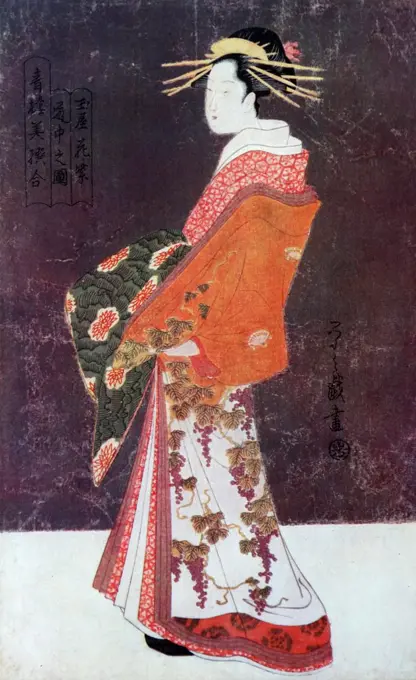
Oiran (魁) were the courtesans of Edo period Japan. The oiran were considered a type of yūjo (遊女) 'woman of pleasure' or prostitute. However, they were distinguished from the yūjo in that they were entertainers, and many became celebrities of their times outside the pleasure districts. Their art and fashions often set trends among the wealthy and, because of this, cultural aspects of oiran traditions continue to be preserved to this day. The oiran arose in the Edo period (1600-1868). At this time, laws were passed restricting brothels to walled districts set some distance from the city center. In the major cities these were the Shimabara in Kyoto, the Shinmachi in Osaka, and the Yoshiwara in Edo (present-day Tokyo). These rapidly grew into large, self-contained 'pleasure quarters' offering all manner of entertainments. Within, a courtesan’s birth rank held no distinction, which was fortunate considering many of the courtesans originated as the daughters of impoverished families who wer
6145-30161255
Courtesan sitting on a veranda next to a lantern 1814 Japan. Color woodblock print; shikishiban, surimono . Totoya Hokkei
6145-29269743
Acupuncture chart with a series of points indicated on the figure of a standing Chinese man. Watercolour, China, 17--.
4408-10201
At Work, Japanese Prints
1899-19134791
Japan: Advertising poster for Martini featuring a 'moga' or 'modern girl', 1920s
4409-17456918
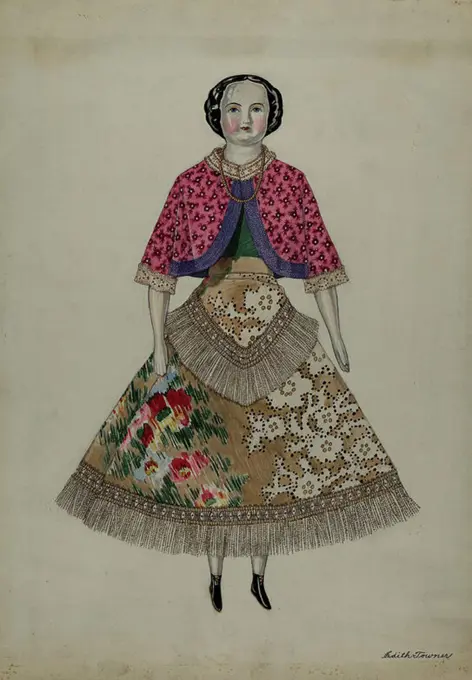
Doll - "Hattie". Dated: c. 1937. Dimensions: overall: 35.6 x 24.9 cm (14 x 9 13/16 in.) Original IAD Object: 12 1/2" high. Medium: watercolor, graphite, and pen and ink on paper. Museum: National Gallery of Art, Washington DC. Author: Edith Towner.
6176-67069014
Shanghai advertising poster, c1930s. Artist: Unknown
6145-29819184
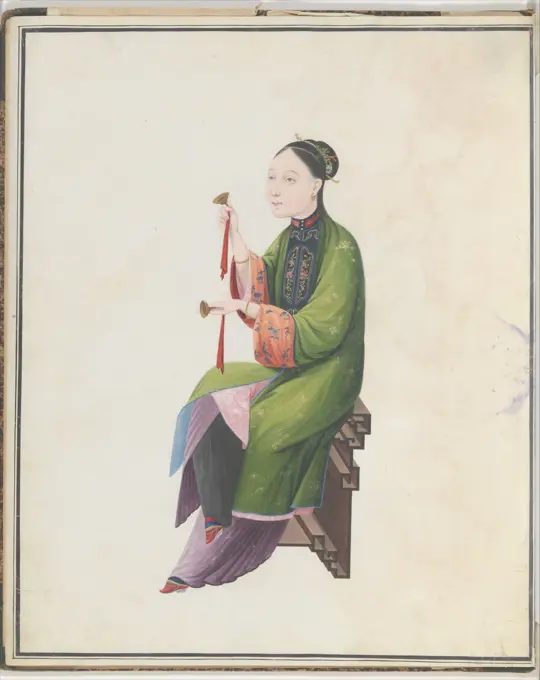
Watercolor of musician playing bo late 18th century Chinese. Watercolor of musician playing bo 506089
4409-17437497
Florist. Artist: Suzuki Shin'ichi (Japanese, 1835-1919). Dimensions: 25.1 x 20.3 cm (9 7/8 x 8 in.). Date: 1870s. Museum: Metropolitan Museum of Art, New York, USA.
6145-29833002
Watercolor of musician playing yangqin late 18th century Chinese. Watercolor of musician playing yangqin 506086
4409-28962622
Seated figure of a woman. Origin: Japan. Period: Edo period. Date: 1760-1849. Ink and color on paper. Museum: Freer Gallery of Art and Arthur M. Sackler Gallery.
4409-17405855
Comprador. Artist: Unknown. Dimensions: 19.2 x 23.7 cm (7 9/16 x 9 5/16 in.). Date: 1870s. Museum: Metropolitan Museum of Art, New York, USA.
1899-19135011
Japan: Vintage Art Deco magazine cover featuring a 'moga' or 'modern girl', 1930
1899-18712712
Exposition poster art in Japan between approximately 1925 and 1941 mirrors the rapid militarisation of society and the growth of militarism, statism and fascism during the Showa Era. In the 1920s expo poster art features elements of modern art and even Art Deco. Themes are whimsical and outward looking, representing Japan's growing importance and influence in the world of international commerce and art. By the 1930s this kind of poster art had grown much more bleak, less concerned with human themes and more directed towards statism and social control. Feminine imagery disappears to be replaced by wheels of industry, with distinct similarities to contemporary Nazi art in Fascist Germany. From the outbreak of full scale hostilities with China through to Pearl Harbour and Japan's entry into World War II, ponderous, heavy machinery, marching soldiers, menacing guns and above all bomber aircraft combine to give the posters a crushing, inhuman, Orwellian aspect. This epitomises Japanese fasc
6145-52845583
Color artwork depicting scenes from Japan and India, showing landscapes, figures, and cultural elements, created by Gyula Tornai around 1900.
442-36537
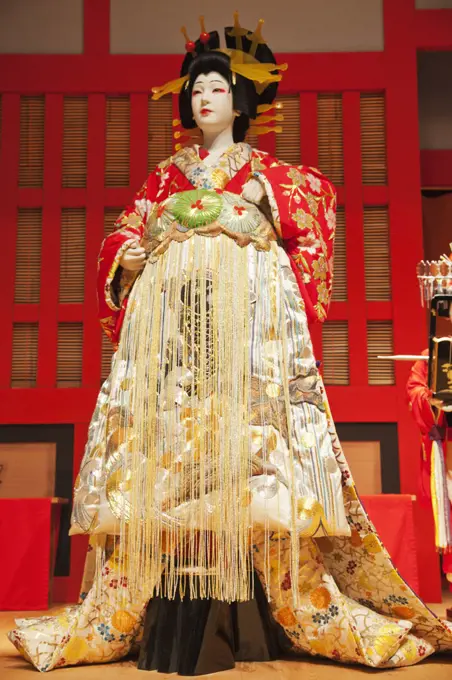
Sculpture of Geisha in a museum, Edo-Tokyo Museum, Ryogoku, Sumida, Tokyo, Japan
PREVIOUS
of 3
NEXT
2401 S. Ervay, Suite 206
Dallas, Texas 75215
United States
Get Started
Free ResearchMy BoardsMy Cart
For Creators
How To License Your ContentContributor PortalFrame of Mind
Resources
API accessPricing
Contact
+1 866 236 0087help@viewpictures.co.uk Contact form
©2026 View Pictures. All Rights Reserved. -A
This site is protected by reCAPTCHA and Google Privacy Policy and Terms of Service apply.