My Boards
View Pictures
  • My Boards
← Artworks

Japanese Woodblock Prints

Colorful woodblock prints illustrating traditional scenes, featuring women, mythology, and nature, with meticulous details and dynamic compositions.

Bishamon dreaming, 1830, Woodcuts, Surimono
253 assets in this story
6145-29706520
Landscape 19th century Nakabayashi Chikkei Japanese. Landscape. Nakabayashi Chikkei (Japanese, 1816-1867). Japan. 19th century. Hanging scroll; ink and color on silk. Edo period (1615-1868). Paintings
4443-28727726
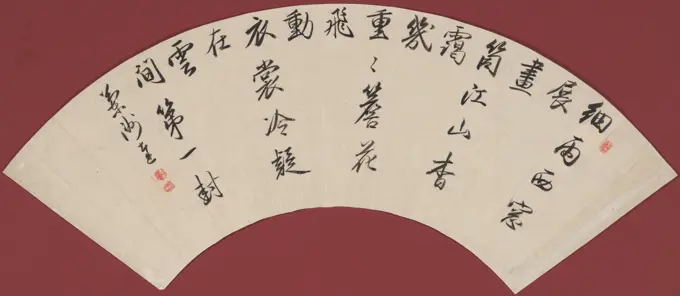
Misty Rain, second half 19th century, Tamate Kikushū, Japanese, born 1839, 8 3/8 × 19 1/2 in. (21.27 × 49.53 cm) (sheet)12 5/16 × 22 in. (31.27 × 55.88 cm) (mount), Ink on mica paper, Japan, 19th century
1899-19135397
Japan: Hikifuda advertising poster depicting a young, kimono-clad woman and a motor car. Late Meiji (1868-1912) period
6145-29174871
Bunpō Picture Album, First Series 1807 Kawamura Bunpō Japanese. Bunpō Picture Album, First Series. Kawamura Bunpō (Japanese, 1779-1821). Japan. 1807. Set of three woodblock printed books; ink and color on paper. Edo period (1615-1868). Illustrated Books
6145-29136298
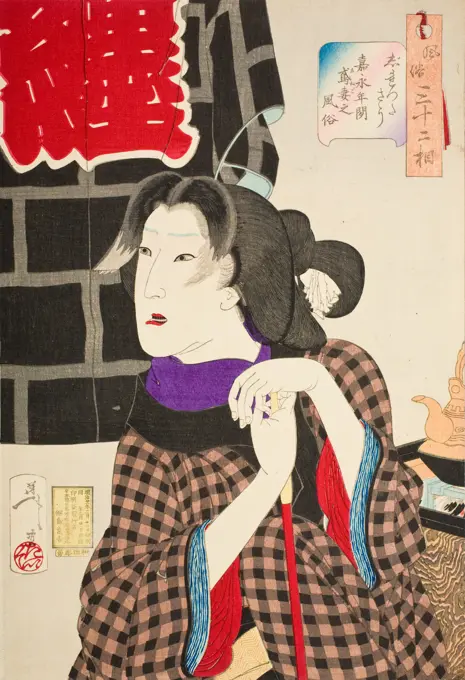
Expectant: The Appearance of a Fireman's Wife in the Kaei Era. Tsukioka Yoshitoshi (Japan, 1839-1892). 1888, February. Prints; woodblocks. Color woodblock print
6145-43619953
Two Mongols with horses. Zhao, Mengfu (1254-1322), painter
6145-29243946
Carp undated Gong Gu A massive carp leads its eight children through thick aquatic grasses below the waters surface. It was said that examination success was as difficult as the mythical carp leaping over the waterfalls of the Yellow Rivers Dragon Gate, so carp were a frequently used symbol of wishes for examination success. This painting might have been hung in the home of an examination candidate either to inspire or celebrate a successful result. The painter Gong Gu is otherwise unknown, but the splashy brushwork and broad washes suggest that the painting may be Cantonese, from the mid to late nineteenth century.. Carp. Gong Gu (Chinese, active 19th century) ?. China. undated. Set of four hanging scrolls, ink and color on paper. Paintings
6145-30187394
Sanjo Bridge (Sanjo Ohashi), from the series Famous Places in Kyoto (Miyako meisho) 1844-1855 Japan. Color woodblock print; uchiwa-e . Utagawa Hiroshige
1899-17834951
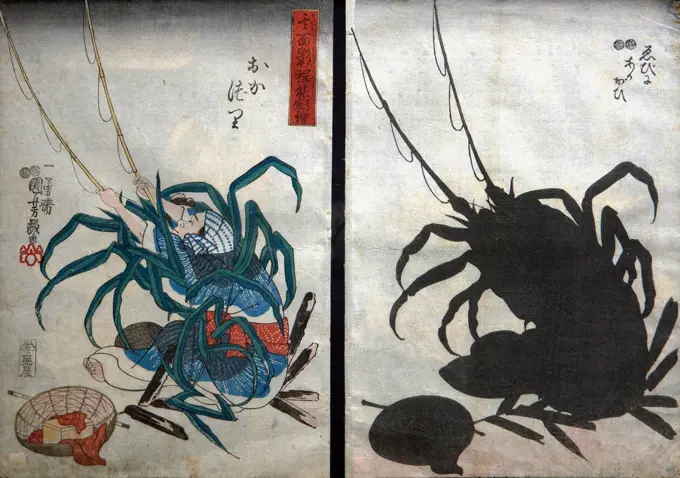
Utagawa Kuniyoshi 1798-1861. Angler; Lobster and Ark Shell (Okazuri / Ebi ni akagai) Series Witty Shadow Pictures (Sono omokage hodo utsuhie). about 1848.  couple of  Oban.
1899-19188832
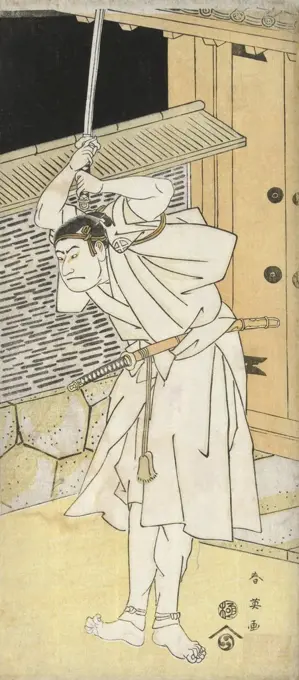
Japan: 'The Actor Otani Onji with Raised Sword, Standing by a Gate; by Night'. Ukiyo-e woodblock print by Katsukawa Shun'ei (1762-1819), c. 1793-1797. Katsukawa Shun'ei (1762 - 13 December 1819), real name Isoda Shun'ei, was a Japanese ukiyo-e artist from Tokyo. He joined the Katsukawa school of ukiyo-e artists, and mainly designed yakusha-e kabuki portraits, though he also dabbled in musha-e warrior prints and prints of sumo wrestlers. He became head of the Katsukawa school in 1800.
4266-21936
From the series 'A Parent's Moralising Spectacles' by Utamaro, Kitagawa (1753-1806)/ Honolulu Academy of Arts/ 1802/ Japan/ Colour linocut/ The Oriental Arts/ 36,7x23,5/ Genre
6145-29791481
Man and Young Woman with a Ball Kitagawa Utamaro Japanese. Man and Young Woman with a Ball 55910
6145-46127557
Landscape. Album with twelve landscapes, finger painting. All magazines have a caption of the painter Gao Qipei (1662-1731 ()).
442-39407
Fresco on the wall of a temple, Sulamani Temple, Bagan, Myanmar
6145-29089658
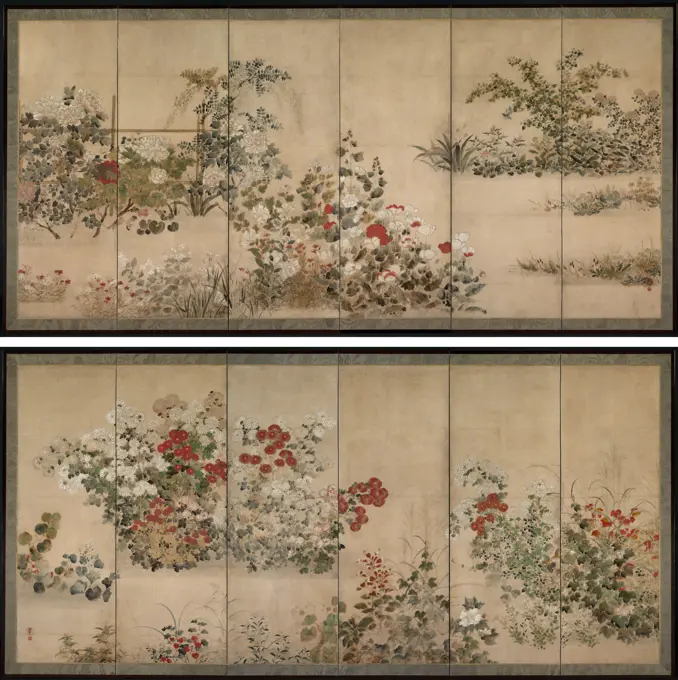
Flowers and Grasses, mid-1600s. Kitagawa Sōsetsu (Japanese, active 1639-50). Pair of six-panel folding screens; ink and color on paper; image: 153.7 x 329.2 cm (60 1/2 x 129 5/8 in.). Kitagawa Ssetsu painted for the Maeda family, powerful rulers of what is present-day Ishikawa Prefecture on the central northern coast of Honsh, Japan’s main island. Screens served as room dividers and backdrops in Maeda grand residences. This composition is considered one of the artist’s masterpieces. Kitagawa Ssetsu is thought to have been a student of Tawaraya Ssetsu, who was in turn the student of Tawaraya Statsu the Kyoto-based master painter regarded as the creator of the style that came to be known as Rinpa. By selecting a painter of this lineage, the Maeda family consciously connected their aesthetics to those of the imperial capital as a means of proclaiming their elevated status.
6145-30170651
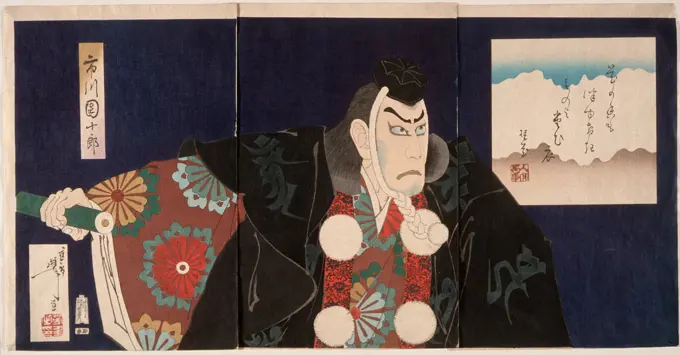
The actor Ichikawa Udanji I as Sugawara no Michizane in the play Shinrei Sugawara Jikki, performed at the Haruki Theater in the fourth month, 1883 1883 Japan. Color woodblock print; oban triptych . Toyohara Kunichika
6145-59567331
The 53 stations of the Tokaido and the Japanese Binnenzee, 1920 book Hard cover with silhouette of two people at Mount Fuji; Orange back on which title; Dek- en Schutblad, two travelers in twilight; Title page, the 53 stations of the Tokaido; one leaf, preface; 1-5, table of contents; 57 unnumbered sheets with illustrations, of which 18 in color; 1-137, text; Title page, the Japanese inland Sea; 1-2, table of contents; 20 unnumbered magazines with illustrations, Waavan 10 in color; 139-251, text; one leaf, colophon; Four magazines, advertisements from the publisher. In original cassette with images of different stations of the Tokaido.  paper letterpress printing / color woodcut
4409-17436544
Marine bull, detail (recto) blank (verso). Dimensions: sheet: 8 3/8 x 10 7/8 in. (21.2 x 27.6 cm). Draftsman: Drawn by Anonymous, French, 16th century. Series/Portfolio: Goldschmidt Scrapbook. Date: early to mid-16th century. Museum: Metropolitan Museum of Art, New York, USA.
6145-29752725
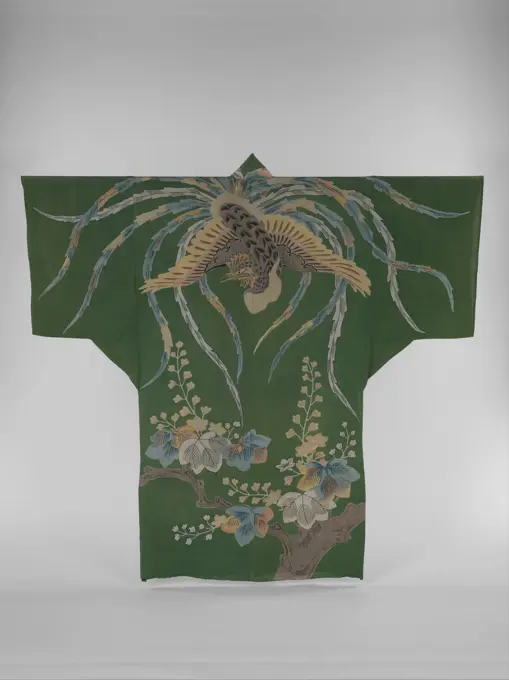
Yogi Coverlet 19th century Japan. Yogi Coverlet. Japan. 19th century. Silk, resist-dyed and handpainted. Textiles-Costumes
6145-29761949
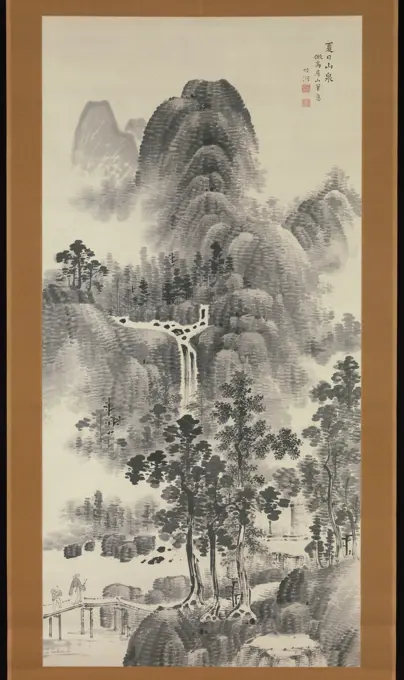
Mountain Stream on a Summer Day first half of the19th century Nakabayashi Chikut Japanese Born in Nagoya, the son of a doctor, Nakabayashi Chikut moved to Kyoto in 1803 with fellow artist and friend Yamamoto Baiitsu (1783-1856) to join the circle of the philosopher-artist-poet Rai San’y (1780-1832). After studying Chinese literati theory and technique, he developed a personal style that incorporated elements derived from the work of Chinese scholar-artists. In his inscription following the title of this painting, he notes that he modeled the work after the paintings of the Yuan-dynasty Chinese master Gao Kegong (1248-1310). Here, within a solid, centralized composition Chikut created a sense of drama using intricate details that form lively patterns of dashlike brushwork. During the final years of his career, Chikut withdrew to a studio on the outskirts of Kyoto, where he led a reclusive existence.. Mountain Stream on a Summer Day. Nakabayashi Chikut (Japanese, 1776-1853). Japan.
4408-19599
Ibaraki; The Demon, Japanese Prints
4409-17553523
Flowering Cherry and Autumn Maples with Poem Slips. Tosa Mitsuoki; Japanese, 1617-1691. Date: 1649-1686. Dimensions: Each 144 x 286 cm. Pair of six-panel screens; ink, color, gold and silver on silk. Origin: Japan. Museum: The Chicago Art Institute, USA.
6145-29087909
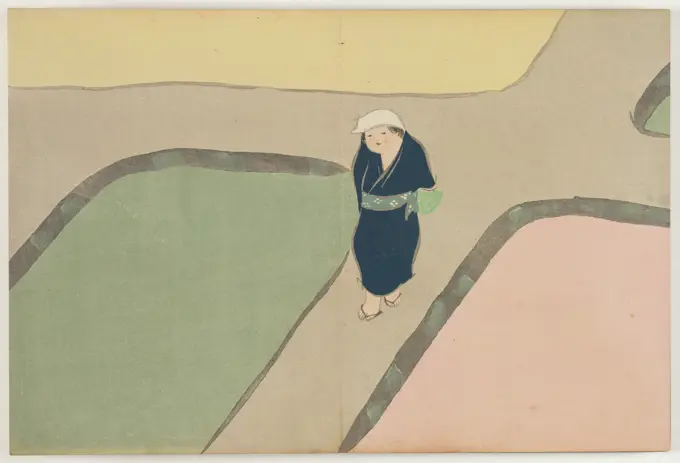
Flowers of a Hundred Worlds (Momoyogusa): Spring Field (Haru no tanomo), 1909-10. Kamisaka Sekka (Japanese, 1866-1942). Color woodcuts with gold and silver; sheet: 29.9 x 22.1 cm (11 3/4 x 8 11/16 in.). This print from a set of three woodblock printed albums displays the graphic design prowess of Kamisaka Sekka. The images were first distributed one by one to subscribers to the series but later were reissued in bound form, like this book, for mass consumers. Each print features a vignette taken from nature or Japanese literature. Many of the scenes have a long history in Japan, originating in the 900s or 1000s and having been interpreted by all manner of artists since that time. Sekkas selections hew closely to precedents from the Rinpa style originated by painter Tawaraya S?tatsu (c. 1570-c. 1640) and calligrapher Honami K?etsu (1558-1637).
6145-59070045
Dusty gnoma; copy of the Fresku from Dunhuang; Shi, Weixiang (Fl. Ca 1900-1950), Rong Bao Zhai (1672-); 1952 (1952-00-00-1952-00-00);Sobecka, Chinese (culture), gift (provenance), graphic prints, Chinese art, Lucia (1919-1993), Łucja (1919-1993)-collection
4409-17352671
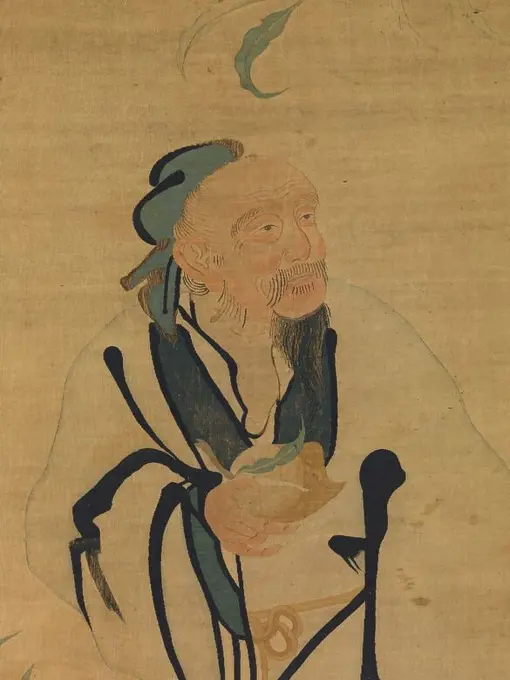
Immortal Holding a Peach. Culture: China. Dimensions: Overall: 46 x 24 in. (116.8 x 61 cm). Date: 16th century.The figure on this silk tapestry panel is Dongfang Shuo who symbolizes wisdom and longevity. As a historical person, Dongfang (154-93 B.C.) was famed for his immense erudition and humorous speeches. In later legend, as seen here, he steals the magical peaches from the orchard of the Queen Mother of the West (Xiwangmu) and becomes a famous immortal. The layout and powerful outlines, also present in sixteenth-century painting, help date this tapestry. Found on both sides of the panel, the red seals state that it had once been stored in the imperial study of the Qianlong Emperor (r. 1736-95), one of the greatest art collectors in Chinese history. Museum: Metropolitan Museum of Art, New York, USA.
4220-21876690
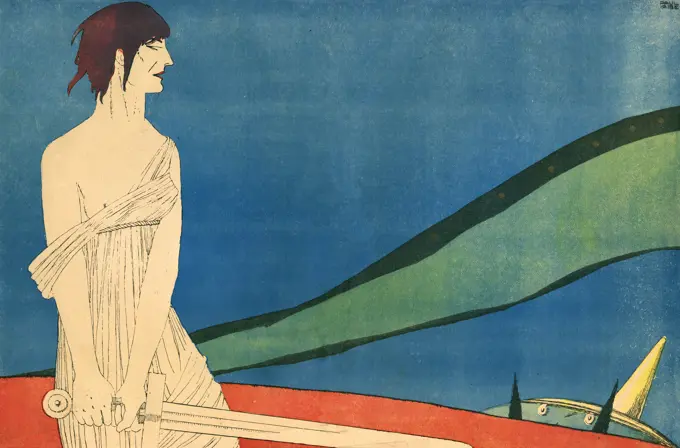
Cartoon: You forced your war on us, we shall force our peace on you!  An allegorical female figure with a sword (France) confronts the German invaders, represented by a pointed helmet and the two tips of the Kaiser's moustache.      Date: 1917
4409-21519511
Rokkasen., Kamisaka, Sekka, (Artist), Date Issued: 1909, Momoyogusa = Flowers of a Hundred Generations.
6145-59106539
A album with photographs;  nineteenth century (1890-00-00-1900-00-00);
1899-18712224
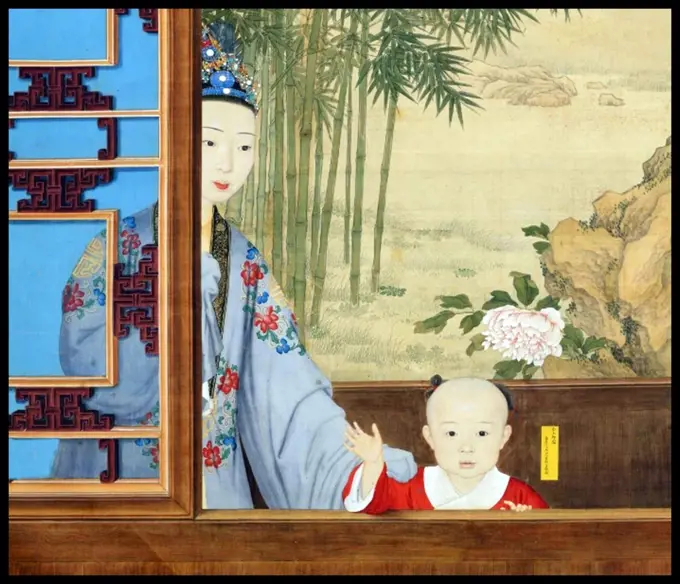
Detail of a Qing Dynasty painting showing the future Emperor Jiaqing (1760-1820) with his mother Empress Xiao Yi Chun (1727-1775) in the palace of his father Qing Emperor Qianlong (1711-1799).
4443-28727913
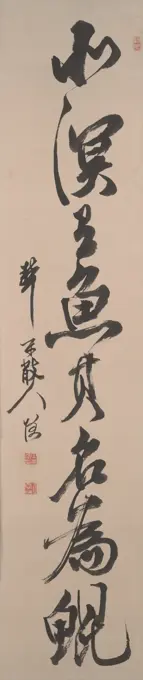
Single Line from Zhuangzi, second half 19th century, Doi Gōga, Japanese, 1817 - 1881, 51 3/4 × 11 in. (131.45 × 27.94 cm) (image)73 3/8 × 15 5/8 in. (186.37 × 39.69 cm) (mount, without roller), Ink on paper, Japan, 19th century, Zhuang Zhou, commonly known as Zhuangzi, lived in the fourth century BCE and is considered one of the greatest Chinese philosophers and an important figure in Daoism. In a very expressive and energetic style Doi Gōga wrote the very beginning of his book Zhuangzi, a collection of what is believed to be Zhuang Zhous own writings and those of his students and other thinkers in relation to him. The first chapter Xiao yao you ('Enjoyment in Untroubled Ease' or 'Free and Easy Wandering') expresses that we leave behind everything familiar and explore the unfamiliarity of the world when we wander beyond. Leaving behind what we have been taught, we learn to respond spontaneously and immediately. The text continues to describe the transformation of the fish Kun, from th
6145-29125699
Snow on Willow Bridge. Ohara Shōson (Japan, 1877-1945). Japan, 1931. Prints; woodblocks. Color woodblock print
1899-19188667
Chen Hongshou (1598-1652), courtesy name Zhanghou and pseudonym Laolian, was a Chinese painter from Zhuji who lived during the late Ming Dynasty era. Chen trained under the famed artist Lan Ying, and developed a plump and profound brushwork style that lent itself to illustrations and tapestry portraits.
6145-29118258
Flowers and Plants of the Four Seasons. Yamaguchi Soken (Japan, 1759-1818). Japan, late 18th-early 19th century. Paintings; screens. One from a pair of six-panel screens; ink and color on gold leaf paper
4443-28728254
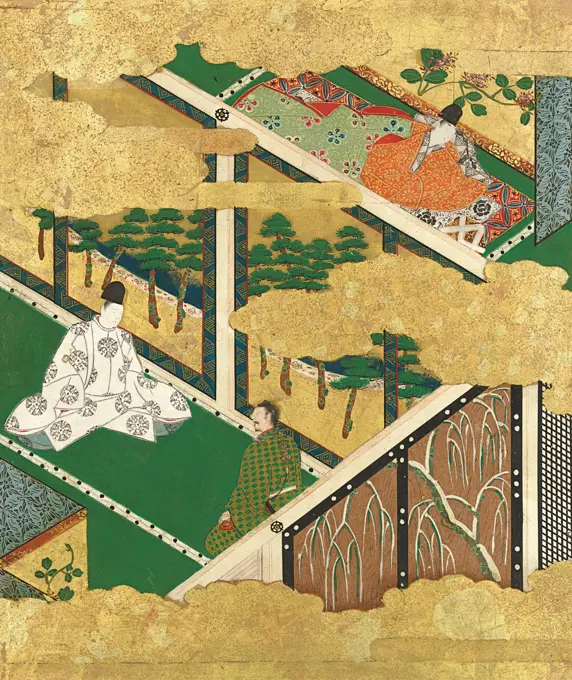
Monkey Hanging from a Branch, Spring 1770, Maruyama Ōkyo, Japanese, Shijō, 1733 - 1795, 34 1/2 × 12 1/8 in. (87.63 × 30.8 cm) (image)71 1/2 × 18 3/8 in. (181.61 × 46.67 cm) (mount), ink and light color on silk, Japan, 18th century, Maruyama Ōkyo founded the Maruyama school of art and based his works on direct observation of nature, giving them a distinct realism. Ōkyos keen eye is obvious in the firm grip of the monkeys paws and the wrinkles around the monkeys eyes, which gives an intensity to its gaze.
1788-42190
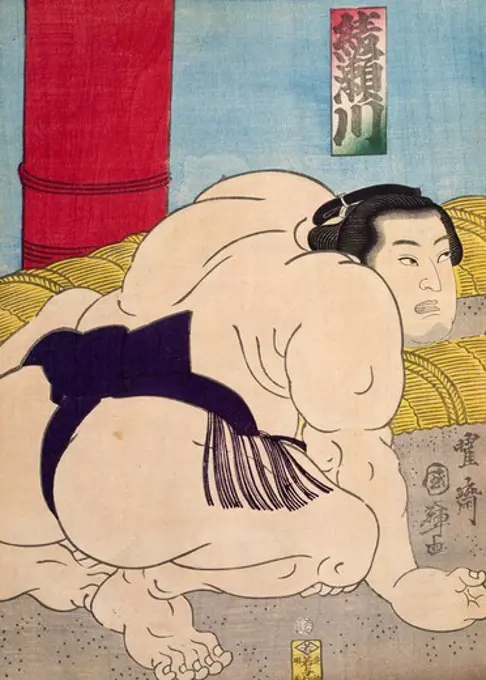
Sumo wrestler, by Utagawa Toyokuni (1769-1825), woodcut, Japan. Japanese Civilisation, 19th century.
6145-30184689
Maize and Cockscombs 1625-1675 Japan. During the Edo period, the prosperity and political unification of Japan under the ruling Tokugawa shoguns led to the emergence of a magnificent Japanese decorative style characterized by a love of bold patterns and bright colors. This new style was supported by the military class, a disenfranchised aristocracy, and a thriving class of merchants and entrepreneurs. The surviving half of an original pair, this splendid screen elegantly embodies both the techniques of ancient court painters and the curiosity and confidence so prevalent in the Edo period. Bursting with sensual fullness, the maize and cockscombs are rendered with the accuracy of a botanical drawing, a testimony to the eraís interest in natural science. The appearance of maize, a grain not native to Japan, indicates a willingness to assimilate new subject matter on the part of Edo artists and patrons.. Six-panel screen; ink, color, and gold on paper . Tawaraya Sôtatsu
6145-29799830
The Oak Tree” late 16th-early 17th century Tosa Mitsuyoshi This scene from Chapter 36 of The Tale of Genji shows Tō no Chūjō conferring with an ascetic summoned to heal his ailing son, Kashiwagi, lying in the adjacent room. Unbeknownst to them, Kashiwagi’s illness derives from remorse over his illicit affair with Genji’s wife, the Third Princess. This delicate image bears hallmarks of works by Tosa Mitsuyoshi. Many of the small-scale Genji paintings from the Muromachi period (1392-1573) through the early Edo period (1615-1868) were executed by painters of the hereditary Tosa school, who monopolized the court-sanctioned position of painting bureau director. In the late sixteenth century, Tosa artists transformed Genji pictures from intimate paintings to large-scale works. In the Momoyama period, maki-e artists also used Tosa and Kano paintings to draw inspiration for their compositions depicted on export lacquers.. The Oak Tree” 670972
6145-58825532
Chamber screens early spring, unkoku (school of), c. 1630 - c. 1660 Six -leaf folding screen with a spring show of stylized water, Camelia, willows and two birds, against a background of gold leaf. Japan paper. wood (plant material). gold leaf Six -leaf folding screen with a spring show of stylized water, Camelia, willows and two birds, against a background of gold leaf. Japan paper. wood (plant material). gold leaf
6145-29761634
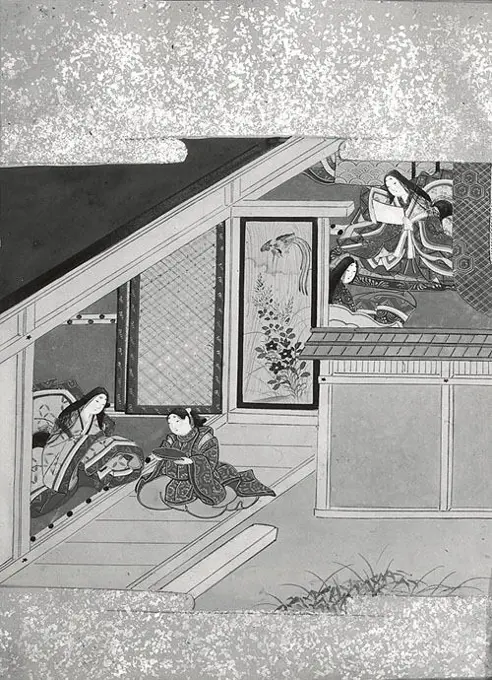
Tales of Ise (Ise monogatari) 18th century Japan The Tales of Ise (Ise Monogatari) is a tenth-century collection of some 125 brief tales in which poems are the central element. Together with the Kokinshū, the first imperial compilation of poetry (ca. 905), it was a requisite part of a literate person's education for over eight centuries until the modern ear. Sumptuously illustrated manuscripts such as this set of three books would have been a prized part of a dowry and a proud possession of an upper-class family. In this example, forty-nine jewel-like miniatures rendered in brilliant mineral colors and framed in stylized cloud bands of sprinkled gold foil follow widely used conventions of the Tosa-school artists.. Tales of Ise (Ise monogatari) 45362
1899-19188905
Japan: 'Mimasu Tokujiro in the role of San'. Woodblock print by Katsukawa Shunko (1743-1812), c. 1780s. Katsukawa Shunko I was a Japanese artist who designed ukiyo-e-style woodblock prints and paintings in Edo (modern Tokyo). He was a student of Katsukawa Shunsho, and is generally credited with designing the first large-head actor portraits (okubi-e). At 45, the right-handed Shunko became partially paralyzed and ceased designing prints, although he continued producing paintings with his left hand.
6145-58874462
Fire screen painted with flowers and birds, anonymous, c. 1750 - c. 1850 Fire screen for two sheets, painted with flowers and birds, from the West Indian House in Amsterdam. painter: Japan (possibly)Netherlands (possibly) wood (plant material). textile materials. paper. zinc. brass (alloy) Fire screen for two sheets, painted with flowers and birds, from the West Indian House in Amsterdam. painter: Japan (possibly)Netherlands (possibly) wood (plant material). textile materials. paper. zinc. brass (alloy)
4443-19568607
The Fifteenth Arhat, Ajita (Ajita) from a set of Sixteen Arhat (JûrokuRakan), late 18th-early 19thcentury, Hanging scroll, ink and color on silk, without mounting: 38 3/8 × 13 in. (97.5 × 33cm), Japan, Japanese, Edo period(1615-1868), Paintings
1525-22162451
Korean Painting
7012-69862819
Thailand, Bangkok. The Grand Palace, established in 1782. The Galleries of the Royal Monastery, detail of wall mural with hand painted historic scenes from the story of Ramakien.
6176-66909439
Riquet with the Tuft appeared to be the finest Prince on Earth from Riquet with the Tuft  by Charles Perrault
4443-28727908
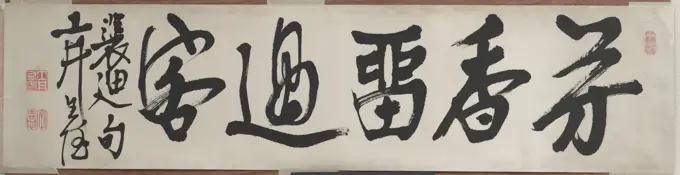
Scented Fragrance, second half 19th century, Doi Gōga, Japanese, 1817 - 1881, 13 1/8 × 52 3/4 in. (33.34 × 133.99 cm) (image)13 1/8 × 53 5/8 in. (33.34 × 136.21 cm) (mount), Ink on paper, Japan, 19th century
1525-24899408
Shop curtain
6145-29251012
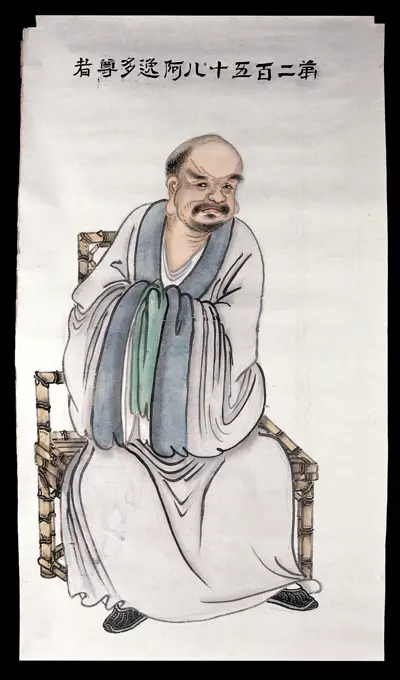
A man or deity. Watercolour attributed to a Chinese painter.
1899-18713455
Homosexuality as a theme in traditional Chinese art is not common and almost always representative of male homosexualty (the 'Way of the Cut Sleeve' or the 'Bitten Peach'. Lesbians and Lesbianism as a theme is still more unusual, and this painting was probably done to titillate men. Today (21st century) Chinese lesbians usually call themselves lazi (lāzi) or lala (lālā). These two terms are abbreviations of the transliteration of the English term lesbian. These slang terms are also commonly used in Mainland China.
6145-29119859
Ichikawa Danjūrō IX as Masashibō Benkei in Kanjinchō. Tsukioka Yoshitoshi (Japan, 1839-1892). Japan, 1890. Prints; woodblocks. Triptych; color woodblock prints
1899-18713249
T. Enami (Enami Nobukuni, 1859 - 1929) was the trade name of a celebrated Meiji period photographer. The T. of his trade name is thought to have stood for Toshi, though he never spelled it out on any personal or business document. Born in Edo (now Tokyo) during the Bakumatsu era, Enami was first a student of, and then an assistant to the well known photographer and collotypist, Ogawa Kazumasa. Enami relocated to Yokohama, and opened a studio on Benten-dori (Benten Street) in 1892. Just a few doors away from him was the studio of the already well known Tamamura Kozaburo. He and Enami would work together on at least three related projects over the years. Enami became quietly unique as the only photographer of that period known to work in all popular formats, including the production of large-format photographs compiled into what are commonly called 'Yokohama Albums'. Enami went on to become Japan's most prolific photographer of small-format images such as the stereoview and glass lantern
4409-17220932
Santiago Estrany i Castany / 'Tokyo', 1991. Museum: PRIVATE COLLECTION.
1899-18713111
T. Enami (Enami Nobukuni, 1859 - 1929) was the trade name of a celebrated Meiji period photographer. The T. of his trade name is thought to have stood for Toshi, though he never spelled it out on any personal or business document. Born in Edo (now Tokyo) during the Bakumatsu era, Enami was first a student of, and then an assistant to the well known photographer and collotypist, Ogawa Kazumasa. Enami relocated to Yokohama, and opened a studio on Benten-dori (Benten Street) in 1892. Just a few doors away from him was the studio of the already well known Tamamura Kozaburo. He and Enami would work together on at least three related projects over the years. Enami became quietly unique as the only photographer of that period known to work in all popular formats, including the production of large-format photographs compiled into what are commonly called 'Yokohama Albums'. Enami went on to become Japan's most prolific photographer of small-format images such as the stereoview and glass lantern
PREVIOUS
of 3
NEXT
2401 S. Ervay, Suite 206
Dallas, Texas 75215
United States
Get Started
Free ResearchMy BoardsMy Cart
For Creators
How To License Your ContentContributor PortalFrame of Mind
Resources
API accessPricing
Contact
+1 866 236 0087help@viewpictures.co.uk Contact form
©2026 View Pictures. All Rights Reserved. -B
This site is protected by reCAPTCHA and Google Privacy Policy and Terms of Service apply.