My Boards
View Pictures
  • My Boards

Laboratory and Research Work

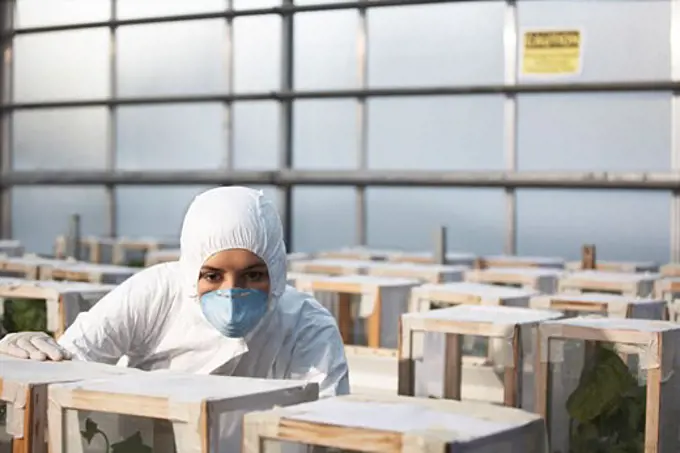
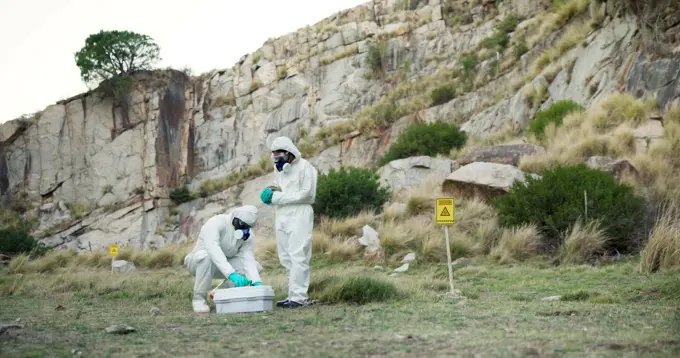
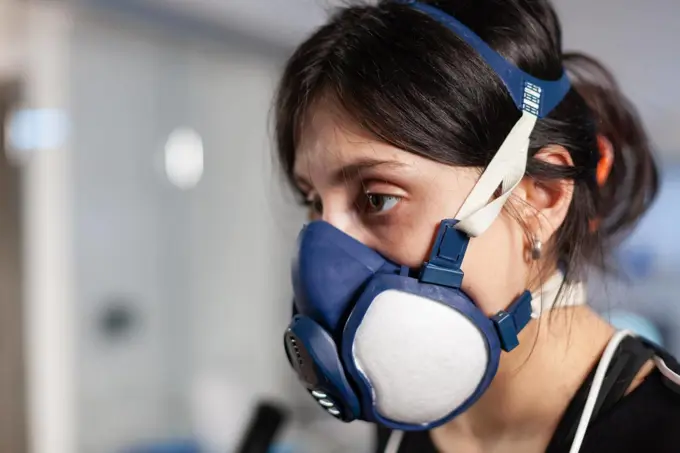
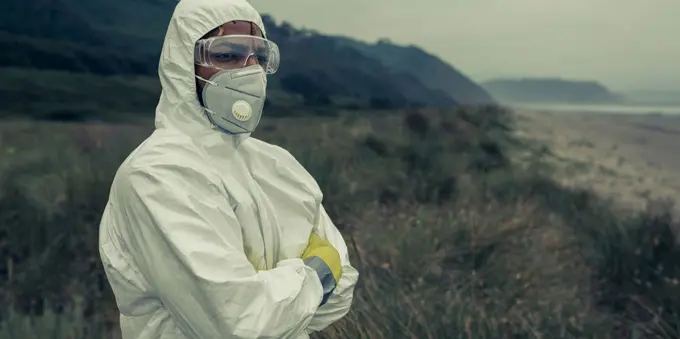
Images depicting individuals in protective suits engaged in scientific procedures, including handling equipment and performing tests in controlled environments.

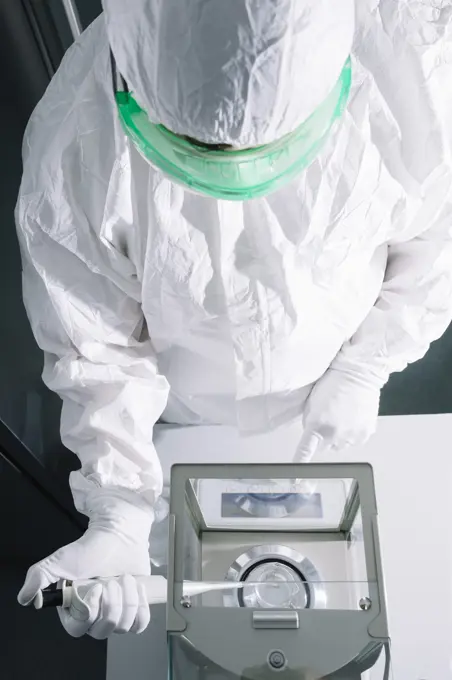
Scientist using pipette and scales
175 assets in this story
6145-58962532
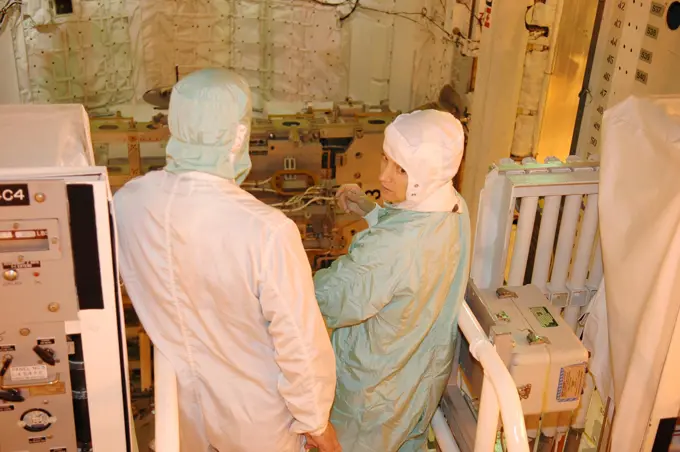
KENNEDY SPACE CENTER, FLA. - At Launch Pad 39B, STS-114 Commander Eileen Collins (right) takes a final look at the payloads in Space Shuttle Discovery's cargo bay before launch. During its 12-day mission, Discoverys seven-person crew will test new hardware and techniques to improve Shuttle safety, as well as deliver supplies to the International Space Station. Discoverys payloads include the Multi-Purpose Logistics Module Raffaello, the Lightweight Multi-Purpose Experiment Support Structure Carrier (LMC), and the External Stowage Platform-2 (ESP-2). Raffaello will deliver supplies to the International Space Station including food, clothing and research equipment. The LMC will carry a replacement Control Moment Gyroscope and a tile repair sample box. The ESP-2 is outfitted with replacement parts. Launch of Discovery on its Return to Flight mission STS-114 is set for July 13.
6145-29548102
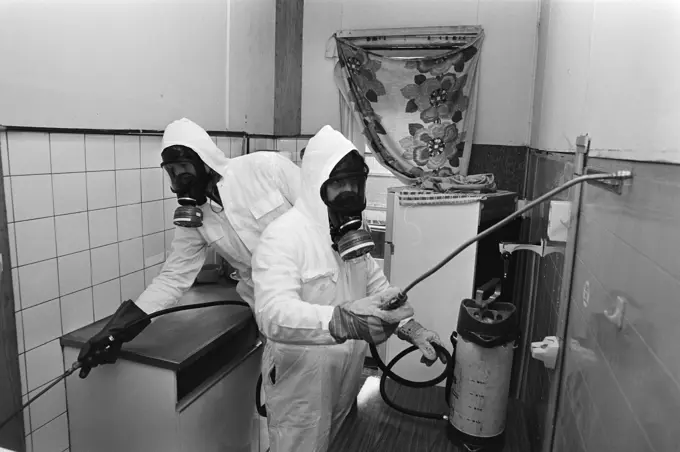
Anefo photo collection. Men in protective clothing spray a kitchen to combat cockroaches. January 16, 1981
1815-15860197
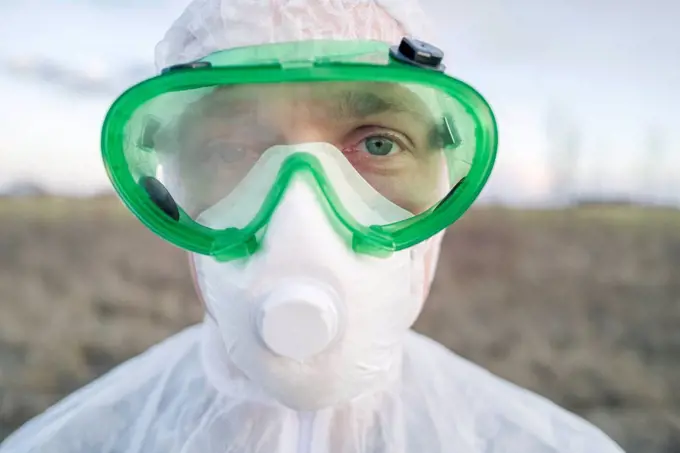
Portrait of man wearing protective suit and goggles
1828R-35387
Scientist in Lab
6145-55971701
Artemis I Orion Post-Flight Payload Processing - Campos/Moonikin. Commander Moonikin Campos, a sensored stand-in for humans from NASAs Artemis I mission, is packed within its transport crate inside the Space Station Processing Facility at Kennedy Space Center in Florida on Jan. 10, 2023, for its trip back to NASAs Johnson Space Center in Houston. Moonikin Campos was secured inside the Orion spacecraft for the mission beyond the Moon and back to Earth. Artemis I Orion launched atop the Space Launch System (SLS) rocket from Kennedys Launch Complex 39B on Nov. 16, 2022, at 1:47 a.m. EST for a 25-day trip beyond the Moon and back. During the flight, Orion flew farther than any human-rated spacecraft has ever flown, paving the way for human deep space exploration and demonstrating NASAs commitment and capability to extend human presence to the Moon and beyond. The primary goal of Artemis I was to thoroughly test the SLS and Orion spacecrafts integrated systems before crewed missions. Under
6145-44578352
KENNEDY SPACE CENTER, FLA. - Workers on Launch Complex 17-A, Cape Canaveral Air Force Station, keep watch as the Comet Nucleus Tour (CONTOUR) spacecraft is lifted off the transporter. CONTOUR will be lifted up the gantry for encapsulation and mating with the launch vehicle. CONTOUR will provide the first detailed look into the heart of a comet -- the nucleus. Flying as close as 60 miles (100 kilometers) to at least two comets, the spacecraft will take the sharpest pictures yet of a nucleus while analyzing the gas and dust that surround these rocky, icy building blocks of the solar system.  Launch of CONTOUR aboard a Boeing Delta II rocket is scheduled for July 1, 2002
6145-44575961
KENNEDY SPACE CENTER, FLA. -- Technicians install the replacement wrist joint for the Space Station Remote Manipulator System into Space Shuttle Endeavour's payload bay. The new wrist joint, called an Orbital Replacement Unit (ORU), will be installed next to the arm's Latching End Effector during the final of three planned spacewalks. Mission STS-111 is designated UF-2, the 14th assembly flight to the International Space Station. Endeavour's payload includes the Multi-Purpose Logistics Module Leonardo and Mobile Base System. The mission also will swap resident crews on the Station, carrying the Expedition 5 crew and returning to Earth Expedition 4. Liftoff of Endeavour is scheduled between 4 and 8 p.m. May 30, 2002
1848-50832683
Quick tests
1525-57489665
beekeeper
4197-V69993671
4197-66726586
Evidence, forensic scientist and investigation for clues, team and observation of proof, nature and analysis. Crime scene, professional and people in woods, inspection and detective for mystery
6145-44593924
KENNEDY SPACE CENTER, FLA. -  Tom Shain, the MER ATLO logistics manager, holds a computer chip with about 35,000 laser-engraved signatures of visitors to the Mars Exploration Rovers at the Jet Propulsion Laboratory.  He and Jim Lloyd, also with the program,  will place the chip on the second rover to be launched to Mars (MER-1/MER-B); the first rover already has one.   The signatures include those of senators, artists, and John Glenn. The identical Mars rovers are scheduled to launch June 5 and June 25 from Cape Canaveral Air Force Station.
1525-21255441
Scientist in protective wear, glasses and respirator
6145-44619400
KENNEDY SPACE CENTER, FLA. -  In the mobile service tower at Launch Complex 17-B, Cape Canaveral Air Force Station, workers place an environmental curtain around the MESSENGER (Mercury Surface, Space Environment, Geochemistry and Ranging) spacecraft, which is still wrapped from its journey to the pad.  Scheduled to launch Aug. 2, MESSENGER will return to Earth for a gravity boost in July 2005, then fly past Venus twice, in October 2006 and June 2007. It is expected to enter Mercury orbit in March 2011.  MESSENGER was built for NASA by the Johns Hopkins University Applied Physics Laboratory in Laurel, Md.  Processing is being done at Astrotech Space Operations in Titusville, Fla.
6145-44513486
KENNEDY SPACE CENTER, FLA. -- Lowered into the payload bay of the orbiter Atlantis, some of the STS-98 crew look over part of the payload. At center is Mission Specialist Robert Curbeam; at right are Mission Specialists Marsha Ivins (standing) and Tom Jones (kneeling). They and the rest of the crew are at KSC for Crew Equipment Interface Test activities. Launch on mission STS-98 is scheduled for Jan. 18, 2001. It will be transporting the U.S. Lab, Destiny, to the International Space Station with five system racks already installed inside of the module. After delivery of electronics in the lab, electrically powered attitude control for Control Moment Gyroscopes will be activated
6145-58970468
jsc2020e017117 - Expedition 63 Preflight - Expedition 63 crewmember Anatoly Ivanishin walks to board the Soyuz rocket prior to launch with Ivan Vagner of Roscosmos and Chris Cassidy of NASA, Thursday, April 9, 2020 at the Baikonur Cosmodrome in Kazakhstan. A few hours later, the trio lifted off on a Soyuz rocket for a six-and-a-half month mission on the International Space Station.
6145-44578080
KENNEDY SPACE CENTER, FLA. --  A worker in the Space Assembly and Encapsulation Facility 2 (SAEF-2) checks the base of the Comet Nucleus Tour (CONTOUR) spacecraft before it is moved for mating with the upper stage of a Boeing Delta II rocket. CONTOUR will provide the first detailed look into the heart of a comet -- the nucleus. Flying as close as 60 miles (100 kilometers) to at least two comets, the spacecraft will take the sharpest pictures yet of a nucleus while analyzing the gas and dust that surround these rocky, icy building blocks of the solar system.  Launch of CONTOUR aboard the Delta II is scheduled for July 1, 2002, from Launch Complex 17-A, Cape Canaveral Air Force Station
1525-25706170
Forensic specialist in protective suit taking photos on white
5507-47433691
Close up of performance athlete with max in research lab
6145-44531256
KENNEDY SPACE CENTER, FLA. --  Members of the Expedition 6 crew look over equipment they will be handling during their residency on the International Space Station.  Holding equipment (center) is Commander Ken Bowersox.  Other crew members are Nikolai Budarin and Donald Thomas.  The Expedition 6 crew is attached to mission STS-113, scheduled to launch in September 2002
1525-23893676
Forensic Science. Forensics Investigator Collecting Evidence.
1848-49316672
Fraunhofer Institute for Cell Therapy and Immunology IZI
6145-44643822
KENNEDY SPACE CENTER, FLA.  -  At NASA Kennedy Space Center's Shuttle Landing Facility, emergency personnel carry an "injured astronaut" to a rescue vehicle during a simulated emergency landing of a shuttle crew.  Known as a Mode VI exercise, the operation uses volunteer workers from the Center to pose as astronauts. The purpose of the simulation is to exercise emergency preparedness personnel, equipment and facilities in rescuing astronauts from a downed orbiter and providing immediate medical attention.
6145-51986958
Chemical/Biological - Anniston, Ala. , August 4, 2011   Todd Jones, superintendent of the Center for Domestic Preparedness (CDP), simulates decontamination of a survivor during an exercise at the center. The CDP, in Anniston, Ala. instructs responders to determine their response tactics, select required equipment, personal protective levels, and decontamination procedures. The CDP specializes in providing advanced, hands-on, all-hazards training for state, local, and tribal emergency responders. Learn more about the CDP at http://cdp. dhs. gov.. Photographs Relating to Disasters and Emergency Management Programs, Activities, and Officials
1525-26859514
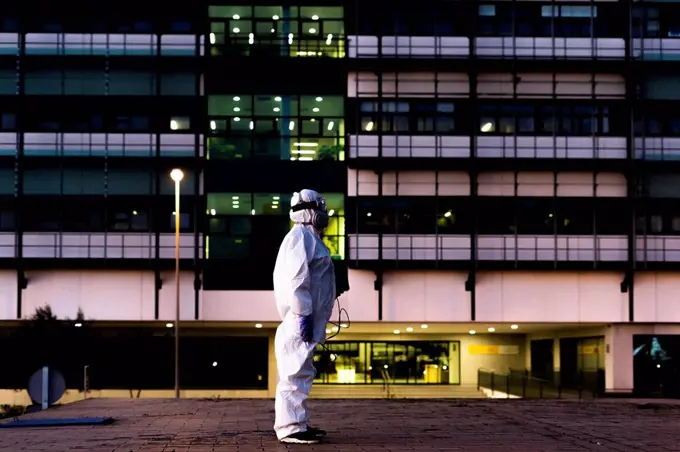
Man in bacteriological protective suit watching to the sea. Man in bacteriological protective suit watching the sea
6145-44654810
KENNEDY SPACE CENTER, FLA. -    In the payload changeout room on Launch Pad 39B, STS-115 crew members look over the mission payload one more time before launch. From left are mission specialists Heidemarie Stefanyshyn-Piper and Steven MacLean, who represents the Canadian Space Agency. The mission crew has been at KSC to take part in Terminal Countdown Demonstration Test activities, which include emergency egress training, a simulated launch countdown and the payload familiarization. The TCDT is a prelaunch preparation for the mission that is scheduled to lift off in a window opening Aug. 27. During their 11-day mission to the International Space Station, the STS-115 crew will continue construction of the station and attach the payload elements, the Port 3/4 truss segment with its two large solar arrays.
6145-44592865
Expedition 7 Commander Yuri I. Malenchenko waits for his turn to enter the Soyuz TMA-2 capsule for inspection and seat liner check in the Soyuz Integration Facility at the Baikonur Cosmodrome, in Baikonur, Kazakhstan, Thursday, April 10, 2003.
1525-56400916
Forensic Science. Police investigator looking for fingerprints.
6145-44572304
In the Payload Hazardous Servicing Facility, media representatives, dressed in protective suits, are updated by Project Manager Richard Grammier (center, top), with the Jet Propulsion Laboratory, about the Stardust spacecraft (in the background). Stardust is targeted for launch on Feb. 6 aboard a Boeing Delta II rocket from Launch Pad 17-A, Cape Canaveral Air Station. The spacecraft is destined for a close encounter with the comet Wild 2 in January 2004. Using a silicon-based substance called aerogel, Stardust will capture comet particles flying off the nucleus of the comet. The spacecraft also will bring back samples of interstellar dust. These materials consist of ancient pre-solar interstellar grains and other remnants left over from the formation of the solar system. Scientists expect their analysis to provide important insights into the evolution of the sun and planets and possibly into the origin of life itself. The collected samples will return to Earth in a sample return capsul
4389-1814
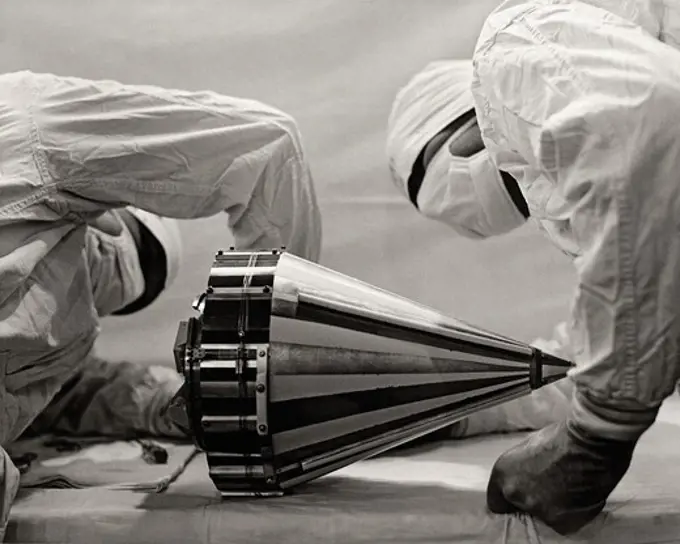
Pioneer III Probe
1815-15867801
Female scientist wearing protective suit and mask and standing in front of a laboratory
1525-20467703
 Illegal drug laboratory
4282-29649
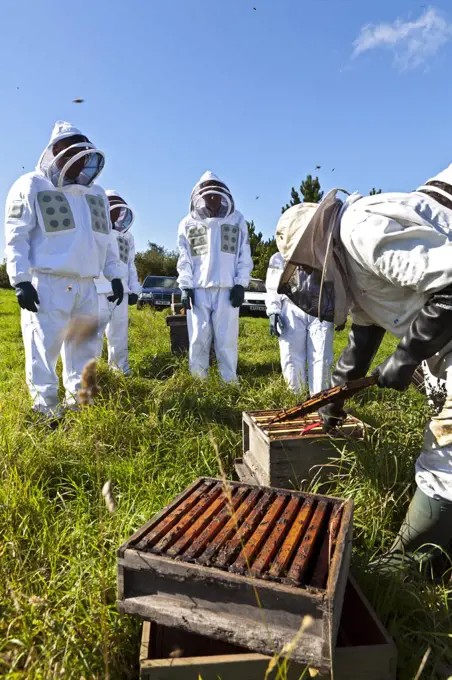
England, Kent, Folkestone. A Beekeeper demonstrating the art of apiculture to a group of people all wearing protective clothing.
6145-54426839
MASTER SGT. James Holcomb, wearing nuclear biological chemical (NBC) protection gear, monitors for Alpha radiation using a PDR-56 detection device, during a Nuclear Emergency Team exercise at the Nuclear Weapons School. Base: Kirtland Air Force Base State: New Mexico (NM) Country: United States Of America (USA)
6145-44704367
Fully Packaged Silicon Carbide Piezoresistive Pressure Transducer that measures pressures at temperature as high as 600 degrees Celsius
6177-V53548821
6145-44643799
KENNEDY SPACE CENTER, FLA.  -  In a simulated emergency landing of a shuttle crew at NASA Kennedy Space Center's Shuttle Landing Facility, emergency rescue personnel place an "injured astronaut" onto a stretcher.  Known as a Mode VI exercise, the operation uses volunteer workers from the Center to pose as astronauts. The purpose of the simulation is to exercise emergency preparedness personnel, equipment and facilities in rescuing astronauts from a downed orbiter and providing immediate medical attention.
6145-44526060
KENNEDY SPACE CENTER, Fla. -- At Launch Pad 39B, STS-104 crew members check out the payload in Atlantiss payload bay. In front of them is the high pressure gas assembly that will support future spacewalk operations from the International Space Station and augment the Service Module gas resupply system. The crew is taking part in Terminal Countdown Demonstration Test activities, which include emergency exit training from the orbiter, opportunities to inspect their mission payloads in the orbiters payload bay and simulated countdown exercises. The launch of Atlantis on mission STS-104 is scheduled July 12 from Launch Pad 39B. The mission is the 10th flight to the International Space Station and also carries the Joint Airlock Module
6145-45283432
Izeal Battle, ASRC technician, is shown in the foreground with the Orion spacecraft for the Artemis I mission on Oct. 28, 2020, inside the Neil Armstrong Operations and Checkout Building (O&C) at NASAs Kennedy Space Center in Florida. Attached below Orion (not in view) are the crew module adapter and the European Service Module (ESM) with spacecraft adapter jettison fairings installed. Recently, teams from across the globe installed the four solar array wings, which are housed inside the protective covering of the fairings. The fairing panels will encapsulate the ESM to protect it from harsh environments such as heat, wind, and acoustics as the spacecraft is propelled out of Earths atmosphere atop the Space Launch System rocket during NASAs Artemis I mission.
6145-58965439
KENNEDY SPACE CENTER, FLA. -- Workers inside the Multi-Purpose Logistics Module Leonardo check connections while installing a laboratory rack. Leonardo is the first of three such pressurized modules that will serve as the International Space Station's moving vans, carrying laboratory racks filled with equipment, experiments and supplies to and from the Space Station aboard the Space Shuttle. Approximately 21 feet long and 15 feet in diameter, Leonardo will be launched on Shuttle mission STS-102 March 1, 2001. On that flight, Leonardo will be filled with equipment and supplies to outfit the U.S. laboratory module, being carried to the ISS on the Jan. 19, 2001, launch of STS-98
6145-44601127
KENNEDY SPACE CENTER, FLA. -  Astronaut Soichi Noguchi, with the National Space Development Agency of Japan (NASDA), signals success during a Multi-Element Integrated Test (MEIT ) of the Japanese Experiment Module (JEM) in the Space Station Processing Facility.  Noguchi is assigned to mission STS-114 as a mission specialist.   Node 2 attaches to the end of the U.S. Lab on the ISS and provides attach locations for the Japanese laboratory, European laboratory, the Centrifuge Accommodation Module and, eventually, Multipurpose Logistics Modules. It will provide the primary docking location for the Shuttle when a pressurized mating adapter is attached to Node 2.  Installation of the module will complete the U.S. Core of the ISS.   The JEM, developed by NASDA,  is Japan's primary contribution to the Station. It will enhance the unique research capabilities of the orbiting complex by providing an additional environment for astronauts to conduct science experiments.
1570R-133441
A child stealing a space helmet while an astronaut repairs his broken car
6145-58965741
KENNEDY SPACE CENTER, FLA. - Apollo 15 Lunar Module Pilot James B. Irwin deploys the Suprathermal Ion Detector Experiment during a training exercise at the Kennedy Space Center. Mission Commander David R. Scott is working in the background on the simulated lunar surface, a replica of the Moon's Hadley-Apennine region. They will be launched to the Moon no earlier than July 26, 1971, along with Command Module Pilot Alfred M. Worden.
1815-18273826
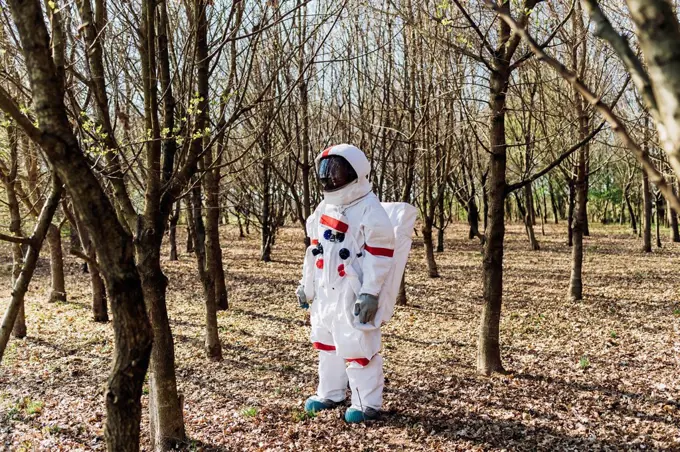
Astronaut wearing space suit and helmet looking away in forest
1525-56400935
Forensic Science. Forensics Expert Collecting Clues from a Crime Scene.
1525-27675959
Forensic science specialist. Crime scene investigator.
6145-55974552
OSIRIS-REx Sample Return Training. Recovery teams participate in field rehearsals in preparation for the retrieval of the sample return capsule from NASA's OSIRIS-REx mission, Tuesday, Aug. 29, 2023, at the Department of Defense's Utah Test and Training Range. The sample was collected from the asteroid Bennu in October 2020 by NASAs OSIRIS-REx spacecraft and will return to Earth on September 24th, landing under parachute at the Utah Test and Training Range.
6145-48821851
A900796 U12P DISTANT ZENITH FAC H.E. WRAP GEORGE STALLER (Project Engineer) NOV 20 90 EG&G/NTS PHOTO LAB Publication Date: 11/20/1990  DISTANT ZENITH; EDGERTON, GERMESHAUSEN & GRIER; EG&G; EQUIPMENT; EQUIPMENT & INSTRUMENTS; FAC; FAC H.E. WRAP; H.E. WRAP; INSTRUMENTS & EQUIPMENT; INSTRUMENTS AND EQUIPMENT; MALE; MALES; MEN; MEN (ADD MALE MODIFIER); NEVADA; NEVADA TEST SITE; NTS; NUCLEAR ENERGY TECHNOLOGY; P-TUNNEL; TEST SITES; TUNNELS; UGT; UNDERGROUND TESTING; WEAPONS EFFECTS  historical images. 1972 - 2012. Department of Energy. National Nuclear Security Administration. Photographs Related to Nuclear Weapons Testing at the Nevada Test Site.
1848-54915233
Dummy with the equipment of a mine rescuer
1773R-95446
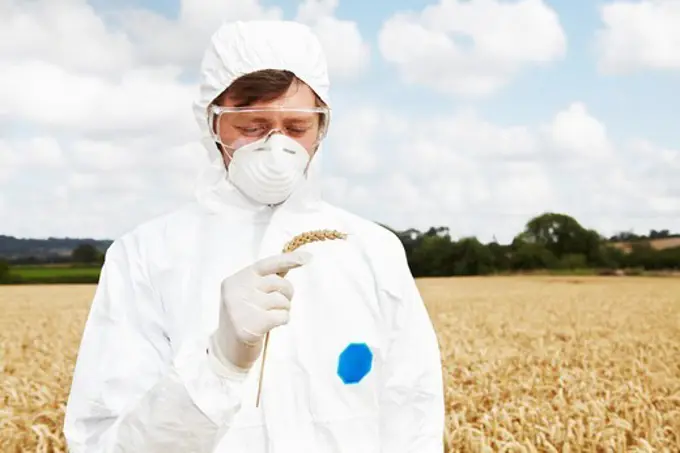
Scientist examining grains in crop field
1746-21104385
Centres for Disease Control microbiologists in biohazard suits before entering the Biosafety Level-4 laboratory at the Centre for Disease Control in Atlanta, Georgia 2007
1812-111557781
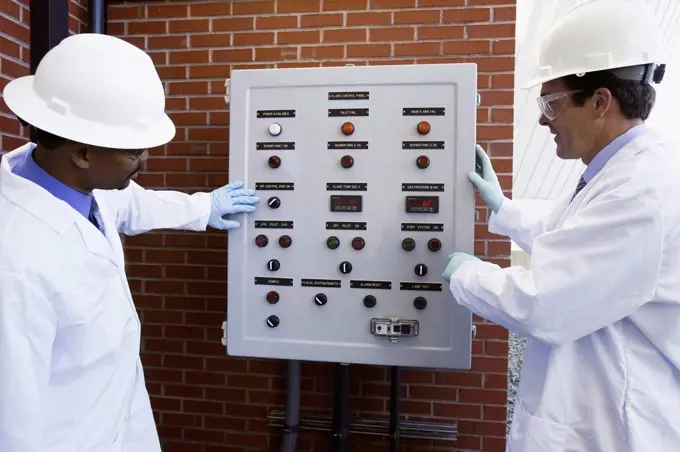
Two scientists examining a control panel
6145-45213981
Teams from NASA and SpaceX practice procedures for medical emergency evacuation onboard the GO Searcher ship, Friday, August 15, 2019 in the Atlantic Ocean off the coast of Cape Canaveral, Florida. SpaceX will use the GO Searcher ship during the Demo-2 mission to recover NASA astronauts returning from the International Space Station in their Crew Dragon spacecraft.
5507-62711883
Man in protective uniform showing sign of radiation. Male in suit and respirator warning about chemical or radioactive hazard. Vector illustration.
6188-64702063
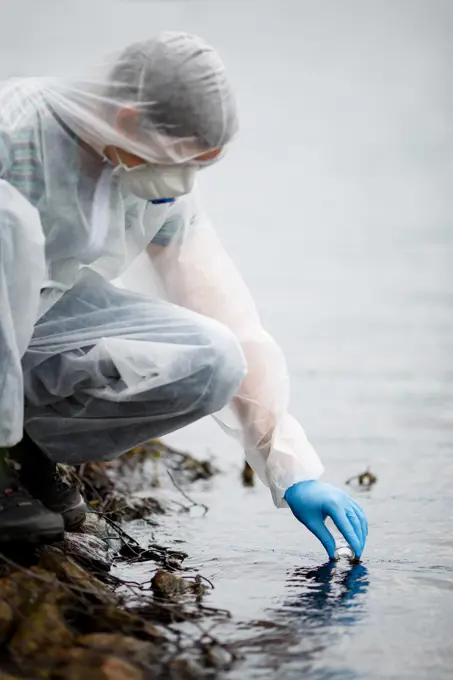
Lab assistant with test tube Lab assistant with test tube takes water samples on river bank Copyright: xZoonar.com/SergeyxMironov/xSergeymironov.cox 10965122
6145-52096366
Bio-environmental personnel, equipped with special suits provided by NASA, move in to check for toxic vapors durimg a space shuttle emergency landing exercise. Base: Hickam Air Force Base State: Hawaii (HI) Country: United States Of America (USA)
6145-50600436
A772157 U12N DIABLO HAWK PRESSURE GAUGE INSTALLATION CHARLES GULICK JR(Project Engineer) NOV 23 77EG&G/NTS PHOTO LAB Publication Date: 11/23/1977  DIABLO HAWK; EDGERTON, GERMESHAUSEN & GRIER; EG&G; GULICK, CHARLES, JR.; INSTRUMENTS & EQUIPMENT; N-TUNNEL; NEVADA; NEVADA TEST SITE; NTS; NUCLEAR ENERGY TECHNOLOGY; PRESSURE GAUGE INSTALLATION; PRESSURE GAUGES; TEST SITES; TUNNELS; TUNNELS BY USAGE; UGT; UNDERGROUND TESTING; WEAPONS EFFECTS  historical images. 1972 - 2012. Department of Energy. National Nuclear Security Administration. Photographs Related to Nuclear Weapons Testing at the Nevada Test Site.
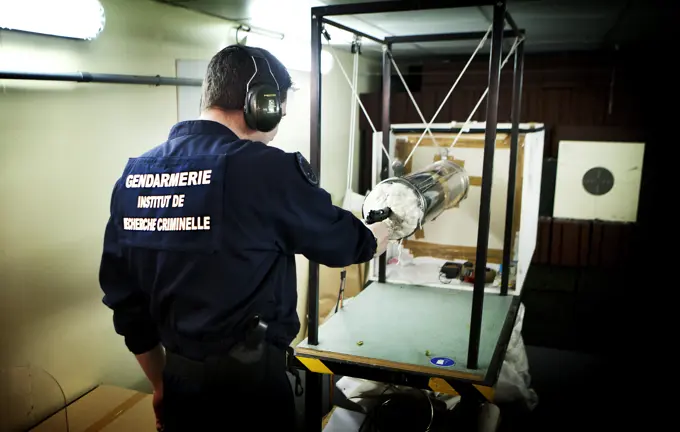
824-63181410
Reportage in the French National Police's Criminal Research Institute in Rosny-sous-Bois, France. Ballistics Department. This system allows the marks left on a bullet by a firearm to be studied without damaging it.
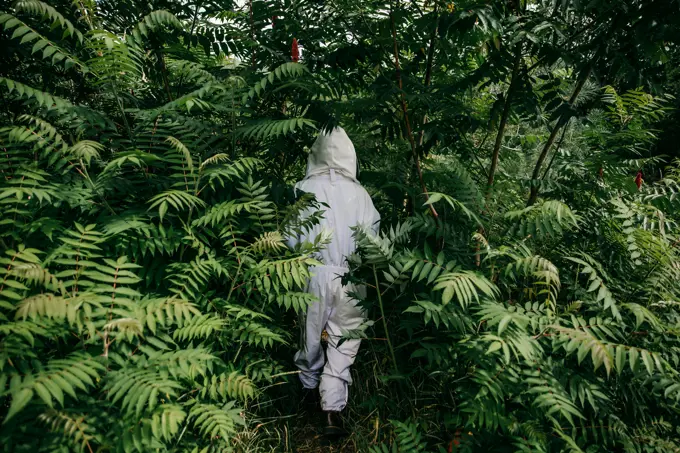
5514-29990413
beekeeper going in the directions of the hives
1525-28143580
Crime scene investigator at work
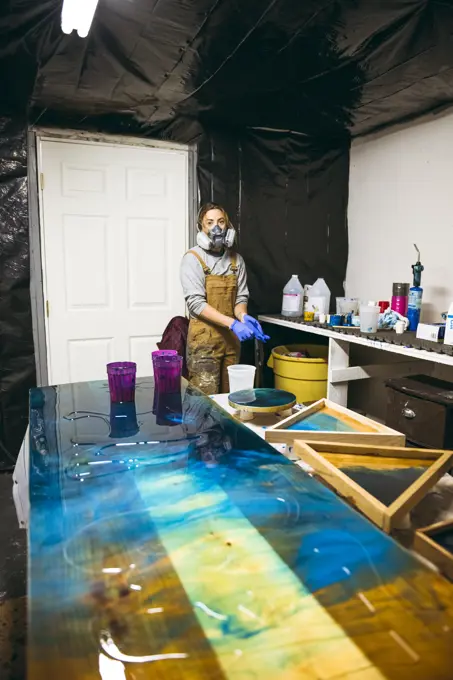
5514-29989667
Female resin artist mixing and pouring with respirator mask
1525-23893677
Forensic Science Expert. Crime Scene Investigation
6145-50599528
A781060 U12G EARTH PENETRATOR BEN BENJAMIN (Project Engineer) AUG 24 78 EG&G/NTS PHOTO LAB Publication Date: 8/24/1978  BARRELS, GUN; BENJAMIN, BENJAMIN CODY; CANNONS; EARTH PENETRATOR CANNON; EDGERTON, GERMESHAUSEN & GRIER; EG&G; EQUIPMENT & INSTRUMENTS; EQUIPMENT (SNL); HEAD LAMPS; INSTRUMENTS & EQUIPMENT; LADDERS; MALE; MEN (ADD MALE MODIFIER); NEVADA; NEVADA TEST SITE; NTS; NUCLEAR TESTING; PENETRATORS; PIPES; ROCKS & MINERALS (MISC); ROCKS (MISCELLANEOUS); TEST SITES; TUNNELS; UGT; UNDERGROUND; UNDERGROUND TESTING; EARTH PENETRATOR  historical images. 1972 - 2012. Department of Energy. National Nuclear Security Administration. Photographs Related to Nuclear Weapons Testing at the Nevada Test Site.
6145-58962512
KENNEDY SPACE CENTER, FLA. - In the Vehicle Assembly Building, workers prepare these two bolt catchers for installation on orbiter Discoverys External Tank. A bolt catcher is a vertical bolt mechanism at the forward end of the External Tank that attaches each booster to the tank. At approximately two minutes into launch, SRB separation begins when pyrotechnic devices fire to break the 25-inch, 62-pound steel bolts. One half of the bolt is caught in canister-like 'bolt catchers' located on the tank; the other half remains with the boosters. Discovery is flying with a modified bolt catcher, which was upgraded from a two-piece welded design to a one-piece, machine-made design as part of NASA's effort to return to safe, reliable spaceflight. Eliminating the weld makes a structurally stronger bolt catcher design. Though the bolt catcher is mounted on the External Tank, it is considered part of the Solid Rocket Booster element design. It is built by Summa Technologies, Inc. in Huntsville, Al
1525-25582381
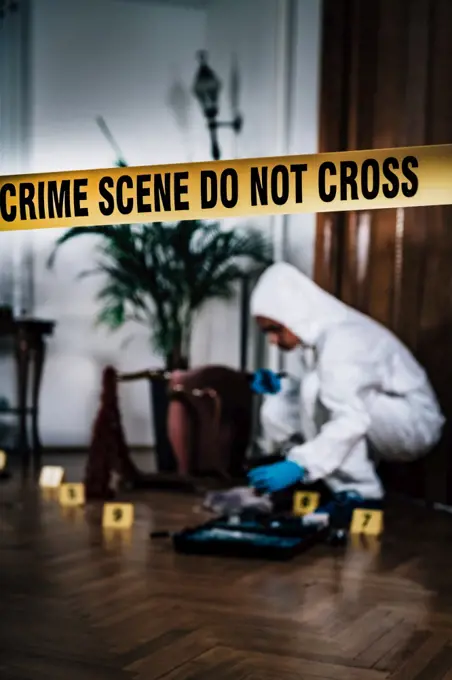
investigation and forensic examination concept - criminalist collecting evidence of murder of man at crime scene fenced by police tape (staged photo). criminalist collecting evidence at crime scene
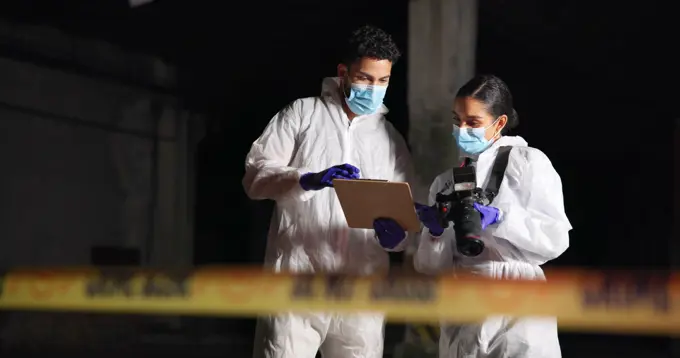
4197-66728207
Forensics team, report and crime scene investigation with clipboard, talking or show evidence at night. Investigators, man and woman with police outdoor for murder case, planning or clues for mystery
1570R-139716
A diorama of a miniature forensics team collecting evidence at a murder scene
6145-44514781
KENNEDY SPACE CENTER, FLA. -  Apollo 11 crew "suiting up" for Countdown Demonstration Test.
6145-45282466
Expedition 64 NASA astronaut Kate Rubins is seen in quarantine, behind glass, during a press conference, Tuesday, Oct. 13, 2020, at the Cosmonaut Hotel in Baikonur, Kazakhstan.  Rubins, and Russian cosmonauts Sergey Ryzhikov and Sergey Kud-Sverchkov of Roscosmos are scheduled to launch to the International Space Station aboard the Soyuz MS-17 spacecraft on October 14.
1815-18259257
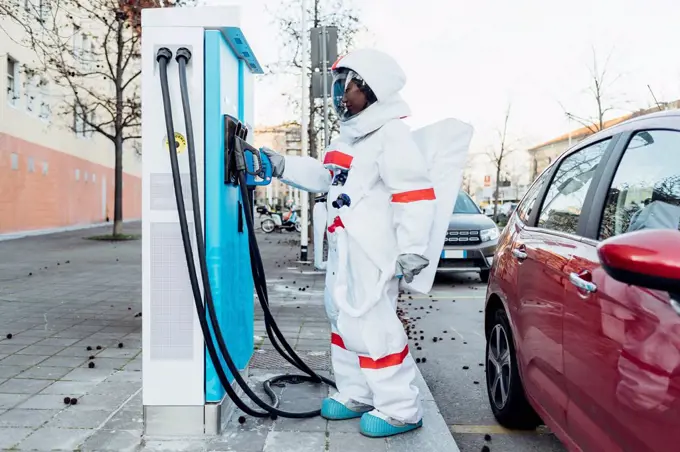
Female astronaut standing at fuel station in city
6145-45157119
jsc2018e025556 - At the Cosmonaut Hotel crew quarters in Baikonur, Kazakhstan, Expedition 55 crewmembers Drew Feustel of NASA (top) and Ricky Arnold of NASA (bottom) conduct tests of their vestibular systems on tilt tables March 15 as part of pre-launch activities. Along with Oleg Artemyev of Roscosmos, they will launch March 21 on the Soyuz MS-08 spacecraft from the Baikonur Cosmodrome on a five-month mission to the International Space Station...NASA/Victor Zelentsov.
1525-75630487
Coronavirus protection advices concept
6145-45282475
Expedition 64 NASA astronaut Kate Rubins performs the traditional door signing at the Cosmonaut Hotel prior to departing the hotel for launch on a Soyuz rocket with fellow crewmates Sergey Ryzhikov and Sergey Kud-Sverchkov of Roscosmos, Wednesday, Oct. 14, 2020, in Baikonur, Kazakhstan.  Ryzhikov, Kud-Sverchkov, and Rubins launched in their Soyuz MS-17 spacecraft at 1:45 a.m. EDT to begin a six-month mission onboard the International Space Station.
6145-44655848
KENNEDY SPACE CENTER, FLA. -  At SPACEHAB in Cape Canaveral, Fla., the STS-116 crew  takes a break from equipment familiarization in the SPACEHAB module to pose for a group photo.  From left are Mission Specialists Sunita Williams, Nicholas Patrick and Joan Higginbotham.   Mission crews make frequent trips to the Space Coast to become familiar with the equipment and payloads they will be using.  STS-116 will be mission number 20 to the International Space Station and construction flight 12A.1.  The mission payload is the SPACEHAB module, the P5 integrated truss structure and other key components.   Launch is scheduled for no earlier than Dec. 7.
6145-44743821
CAPE CANAVERAL, Fla. -- In the Orbiter Processing Facility at NASA's Kennedy Space Center in Florida, STS-119 Commander Lee Archambault checks the cockpit window of space shuttle Discovery.  He and other crew members are at Kennedy for a Crew Equipment Interface Test that provides experience handling tools, equipment and hardware they will use on the mission. On the STS-119 mission, space shuttle Discovery will carry the S6 truss segment to complete the 361-foot-long backbone of the International Space Station. The truss includes the fourth pair of solar array wings and electronics that convert sunlight to power for the orbiting laboratory.  Discovery is targeted for launch on Feb. 12, 2009.
PREVIOUS
of 2
NEXT
2401 S. Ervay, Suite 206
Dallas, Texas 75215
United States
Get Started
Free ResearchMy BoardsMy Cart
For Creators
How To License Your ContentContributor PortalFrame of Mind
Resources
API accessPricing
Contact
+1 866 236 0087help@viewpictures.co.uk Contact form
©2026 View Pictures. All Rights Reserved. -A
This site is protected by reCAPTCHA and Google Privacy Policy and Terms of Service apply.