My Boards
View Pictures
  • My Boards
← Science

Laboratory Investigations and Equipment Testing

Images of scientists in protective gear examining space mission equipment and conducting inspections in a high-tech laboratory setting with sterilized conditions.

Two scientists working in laboratory
464 assets in this story
6145-44542262
Low-boom Model Mach II in Unitary Tunnel with Christine Darden
6145-44817612
PHOTO DATE:  05-04-10LOCATION:NBL TOPSIDESUBJECT:  Satoshi Furukawa and Aki Hoshide during their EVA Skills for training at the NBLWORK ORDER:1327-NBLJAXA-05-04-10
6145-45291463
Expedition 65 prime crew member NASA astronaut Mark Vande Hei, signs his name to a wall mural bearing the picture of a Soyuz launch at the Baikonur Cosmodrome Museum, Sunday, April 4, 2021 at the Baikonur Cosmodrome in Kazakhstan. Vande Hei, Oleg Novitskiy and Pyotr Dubrov of Roscosmos are scheduled to launch to the International Space Station aboard the Soyuz MS-18 spacecraft on April 9.
6145-45203696
jsc2019e029997 (05-22-19) --- 2017 NASA astronaut candidate Jessica Watkins is helped into a spacesuit prior to underwater spacewalk training at NASA Johnson Space Centers Neutral Buoyancy Laboratory in Houston.
6145-44502688
KENNEDY SPACE CENTER, FLA. -- Members of the STS-101 crew take part in Crew Equipment Interface Test (CEIT) activities at SPACEHAB, in Cape Canaveral, Fla., where they are learning about some of the equipment they will be working with on their mission to the International Space Station. Mission Specialist Susan Helms holds one component while Commander James Halsell and Mission Specialist Yuri Usachev look on, and Mission Specialists Mary Ellen Weber and Jeffrey Williams discuss another. Also taking part in the CEIT are Pilot Scott Horowitz and Mission Specialist James Voss. The green component on the table is an air duct to be installed in the Russian module Zarya to improve ventilation. The STS-101 crew will be responsible for preparing the Space Station for the arrival of the Zvezda Service Module, expected to be launched by Russia in July 2000. Also, the crew will conduct one space walk to perform maintenance on the Space Station and deliver logistics and supplies. This will be the
6145-44824959
PHOTO DATE:  07-13-10LOCATION: Bldg 9NW, US Lab MockupSUBJECT:  Expedition 28 crew membersMike Fossum, Satoshi Furukawa, Sergei Volkov during ACLS MEG I training.
6145-44834026
PHOTO DATE: 29 September 2010, LOCATION: Bldg. 9NW, FFT Space Shuttle Mockup and ISS Airlock Mockup. SUBJECT:  STS-133 crew members Nicole Stott, Mike Barratt, Tim Kopra and Benjamin Drew during STS-133 SMTF ISS EVA P/P 33105 with Instructors Jonnie Lynn R. Yaptengco, Ernie Bell.
6145-45127721
Engineers working with Boeing's CST-100 Starliner test the spacecraft's seat design in Mesa, Arizona, focusing on how the spacecraft seats would protect an astronaut's head, neck and spine during the 240-mile descent from the International Space Station. The company incorporated test dummies for a detailed analysis of impacts on a crew returning to earth. The human-sized dummies were equipped with sensitive instrumentation and secured in the seats for 30 drop tests at varying heights, angles, velocities and seat orientations in order to mimic actual landing conditions. High-speed cameras captured the footage for further analysis. The Starliner spacecraft is being developed in partnership with NASA's Commercial Crew Program.
6145-44512440
JSC2000-E-27080 (20 October 2000) ---In background, from left, Vladimir N. Dezhurov, Mikhail Turin, Kenneth D. Bowersox, Yuri P. Gidzenko, Sergei K. Krikalev and William M. (Bill) Shepherd, the backup and prime crew members for Expedition One, during conference prior to simulation at Baikonur complex in Kazakhstan.
6145-44587207
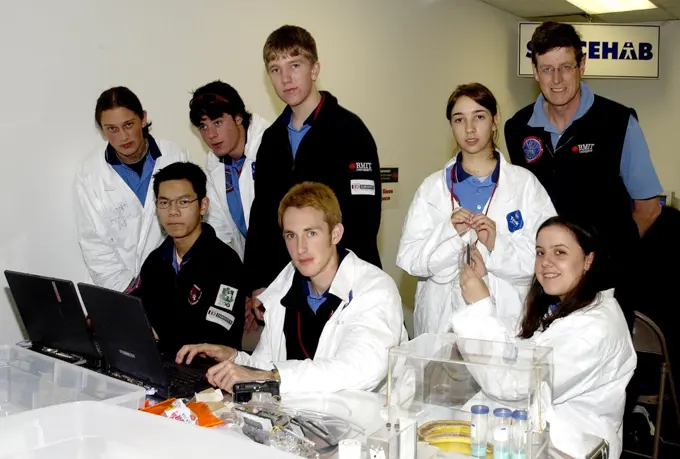
KENNEDY SPACE CENTER, FLA. -  Students pause during their work on their experiments that will fly in SPACEHAB on Space Shuttle Columbia on mission STS-107. SPACEHAB's complement of commercial experiments includes six educational experiments designed and developed by students in six different countries under the auspices of Space Technology and Research Students (STARS), a global education program managed by SPACEHAB subsidiary Space Media. The countries represented are Australia, China, Israel, Japan, Liechtenstein and the United States. The student investigators who conceived these experiments will monitor their operations in space. The experiments will be housed in BioServe Space Technologies' Isothermal Containment Module (ICM --a small temperature-controlled facility that provides experiment support such as physical containment, lighting, and video imaging) and stowed in a middeck-size locker aboard the SPACEHAB Research Double Module.
6145-44587045
KENNEDY SPACE CENTER, FLA. - STS-118 Commander Scott Kelly is seen during Crew Equipment Interface Test activities in the Space Station Processing Facility. The mission to the International Space Station will be delivering the third starboard truss segment, the ITS S5, which will be attached to the station, and a SPACEHAB Single Cargo Module with supplies and equipment.  Launch aboard Space Shuttle Columbia is scheduled for Nov. 13, 2003.
6145-45248241
The high-tech art of digital signal processing (DSP) was pioneered at NASA's Jet Propulsion Laboratory (JPL) in the mid-1960s for use in the Apollo Lunar Landing Program. Designed to computer enhance pictures of the Moon, this technology became the basis for the Landsat Earth resources satellites and subsequently has been incorporated into a broad range of Earthbound medical and diagnostic tools. DSP is employed in advanced body imaging techniques including Computer-Aided Tomography, also known as CT and CATScan, and Magnetic Resonance Imaging (MRI). CT images are collected by irradiating a thin slice of the body with a fan-shaped x-ray beam from a number of directions around the body's perimeter. A tomographic (slice-like) picture is reconstructed from these multiple views by a computer. MRI employs a magnetic field and radio waves, rather than x-rays, to create images.
1890-75511827
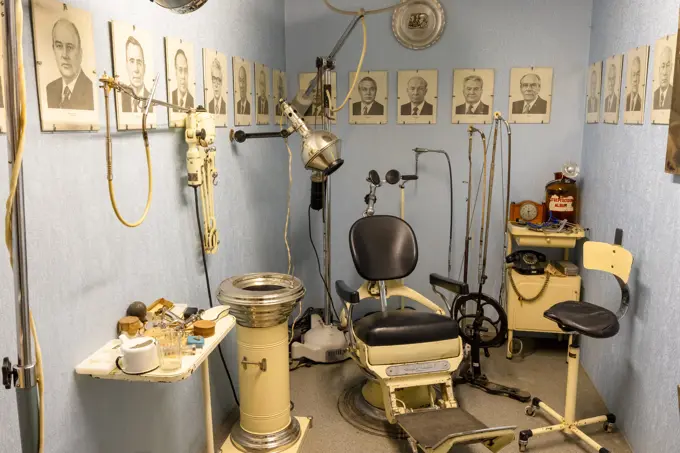
Atomic KGB Bunker Museum, Kaunas, Lithuania
6145-44903951
University of Washington Applied Physics Laboratory Senior Oceanographer Andrey Shcherbina, left, and University of Washington Applied Physics Laboratory Senior Principal Oceanographer Jason Gobat carry one of their instruments onboard the Woods Hole Oceanographic Institution's research vessel Knorr on Tuesday, Sept. 4, 2012, in Woods Hole, Mass.  Knorr is scheduled to depart on Sept. 6 to take part in the Salinity Processes in the Upper Ocean Regional Study (SPURS).  The NASA-sponsored expedition will sail to the North Atlantic's saltiest spot to get a detailed, 3-D picture of how salt content fluctuates in the ocean's upper layers and how these variations are related to shifts in rainfall patterns around the planet.
6177-V68163081
6145-45054660
TRACT 2 Frame Drop Test AT NASA Langley Research Center's Landing and Impact Research (LandIR) Facility
1848-49350896
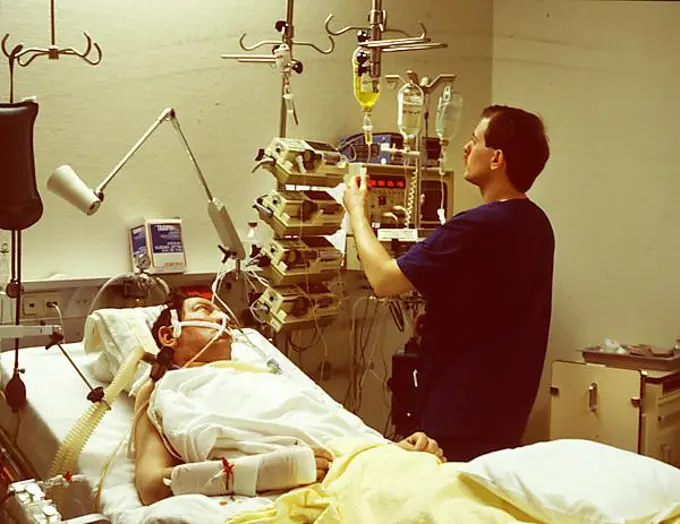
DEU, Germany: The historical slides from the times 80-90s events and persons from politics, culture, working life, medicine a.o. Iserlohn. Computer tomograph 80s MR=Yes
6145-44527894
S73-26047 (18 May 1973) --- A sail-like sunshade for possible use as a sunscreen for the Skylab orbital workshop (OWS) is shown being fabricated in the GE Building across the street from the Johnson Space Center. Three persons assist the seamstress feed the material through the sewing machine. The three-layered shade will be composed of a top layer of aluminum Mylar, a middle layer of laminated nylon rip stop, and a bottom layer of thin nylon. Working on the sunshade, from left to right, are Dale Gentry, Elizabeth Gauldin, Alyene Baker and James H. Barnett Jr. Mrs. Baker, a GE employee, operates the double-needle sewing machine. Barnett is head of the Crew Equipment Development Section of JSC's Crew Systems Division. Mrs. Gauldin is also with the Crew Systems Division. Gentry works for GE. The work shown here is part of the crash program underway to prepare a protection device for Skylab to replace the original shield which was lost when the unmanned Skylab 1 launch took place on May 1
6188-63913016
Young male researcher carrying out scientific experiment. Young male researcher carrying out scientific researcher, working at laboratory. ,model released, Symbolfoto Copyright: xZoonar.com/OleksiixHrecheniukx 15201630 ,model released, Symbolfoto ,property released
1812-111542052
Engineering student wearing protective equipment and smiling while working on chemistry experiment in fume hood
4351-638
Image showing solar eclipse projected through telescope onto piece of paper
6145-44769340
Astronaut Norman E. Thagard, mission specialist for the silver team, rests on the middeck while the gold team is on duty in the science module. Don L. Lind, left, gold team member, meanwhile participates in autogenic feedback training (AFT), designed to help flight crewmembers overcome the effects of zero-gravity adaptation.
6145-52303625
LAR 5 oxygen thick device in use with amphibious exploration playton for Kikvorsman operations. Closed diving device: reuse of oxygen and no calling during diving that makes invisible dives possible. Maximum 3 hour dive and maximum depth 7 mtr and briefly to deviate shipping, depth of 14 mTR is permitted.
6145-44565894
KENNEDY SPACE CENTER, FLA. -- STS-88 Mission Specialist Jerry L. Ross (center) removes the cover from the Unity connecting module, part of the International Space Station, so that he and Boeing Technician Doug Adams (left) can inspect it. Training Technician Glenda Laws (right) watches the procedure. The STS-88 crew is participating in the Crew Equipment Interface Test (CEIT) held in the Space Station Processing Facility. The CEIT gives astronauts an opportunity for a hands-on look at the payloads on which they will be working while on orbit. STS-88 will be the first Space Shuttle launch for the International Space Station. Launch is scheduled for December 1998
6145-45090571
Gagarin Cosmonaut Training Center (GCTC) Chief Epidemiologist Sergei Savin stands in the Cosmonaut Hotel lobby and instructs the media on how their access to the Expedition 43 prime and backup crews will be organized during media day, Saturday, March 21, 2015, Baikonur, Kazakhstan. Expedition 43 NASA Astronaut Scott Kelly, and Russian Cosmonauts Gennady Padalka, and Mikhail Kornienko of the Russian Federal Space Agency (Roscosmos) are scheduled to launch to the International Space Station in the Soyuz TMA-16M spacecraft from the Baikonur Cosmodrome in Kazakhstan March 28, Kazakh time (March 27 Eastern time.) As the one-year crew, Kelly and Kornienko will return to Earth on Soyuz TMA-18M in March 2016.
6145-44514758
KENNEDY SPACE CENTER, FLA. -- A film crew gather around Steve Thomas (kneeling) as they shoot inside a mockup of the U.S. Lab, located in the International Space Station Center, a tour facility. Thomas and Norm Abram, host and master carpenter, respectively, of televisions  "This Old House," are at KSC to film an episode of the series
6145-45184545
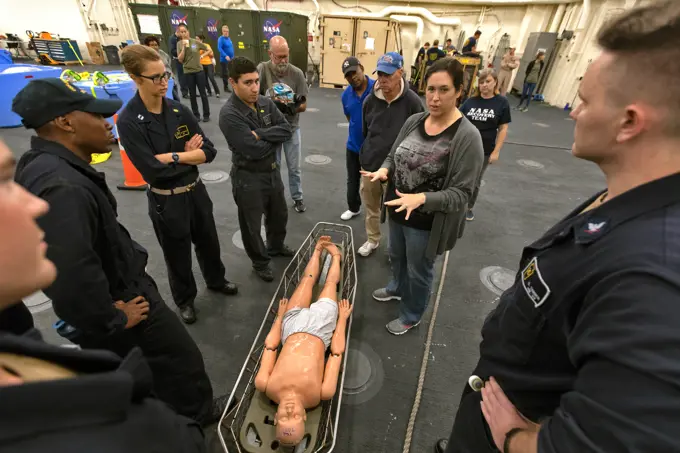
NASA and U.S. Navy recovery team members go over procedures for bringing an astronaut aboard, using a dummy, during Underway Recovery Test 7 aboard the USS John P. Murtha on Nov. 5, 2018. The Recovery Team is practicing recovery of the Orion capsule as part of URT-7 in the Pacific Ocean. URT-7 is one in a series of tests to verify and validate procedures and hardware that will be used to recover the Orion spacecraft after it splashes down in the Pacific Ocean following deep space exploration missions. Orion will have emergency abort capability, sustain the crew during space travel and provide safe re-entry from deep space return velocities.
6145-44501905
In the Operations and Checkout Building's suitup room, STS-99 Mission Specialist Janice Voss is helped with pre-pack and fit check by Santos Medina, with United Space Alliance. Voss and other crew members Commander Kevin Kregel, Pilot Dominic Gorie and Mission Specialists Janet Kavandi, Gerhard Thiele of Germany and Mamoru Mohri of Japan are preparing for launch of their mission on Feb. 11 at 12:30 p.m. EST aboard Space Shuttle Endeavour. STS-99 is the Shuttle Radar Topography Mission, which will produce unrivaled 3-D images of the Earth's surface. The result of the Shuttle Radar Topography Mission could be close to 1 trillion measurements of the Earth's topography. Landing is expected at KSC on Feb. 22 at 4:36 p.m. EST
6145-44590515
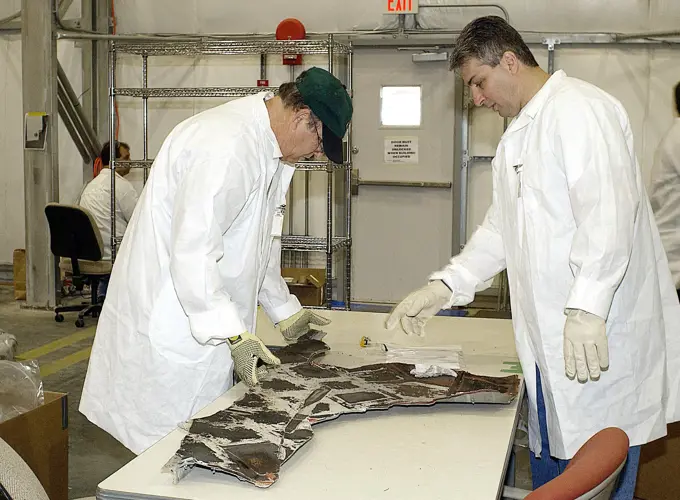
KENNEDY SPACE CENTER, FLA. - Members of the Columbia Reconstruction Project Team check out a piece of Columbia debris. The team is identifying pieces and placing them on a floor grid in a configuration of the orbiter. The team will attempt to reconstruct the orbiter as part of the investigation into the accident that caused the destruction of Columbia and loss of its crew as it returned to Earth on mission STS-107.
6145-45096966
Astronaut Scott Kelly initiated VEG-01 B, the second crop of lettuce, on July, 8, 2015, and both Kelly and Astronaut Kjell Lindgren cared for the plants. The crop grew for 33 days. VEG-01 B included one set of six plant pillows planted with red romaine lettuce seeds. On Aug. 10, 2015, the crew harvested and consumed leaves from each plant. This was the first crop grown and consumed in NASA hardware. They harvested the rest of the plant tissue and froze it in the stations Minus Eighty-Degree Laboratory Freezer for ISS (MELFI) for return to Earth for further study including microbial analysis, antioxidant capacity, mineral analysis and anthocyanin concentration.
6145-44833483
Expedition 24 Flight Engineer Mikhail Kornienko is helped out of the Soyuz TMA-18 spacecraft shortly after landing with fellow crew members Commander Alexander Skvortsov and Tracy Caldwell Dyson near the town of Arkalyk, Kazakhstan on Saturday, Sept. 25, 2010.  Russian Cosmonauts Skvortsov and Kornienko and NASA Astronaut Caldwell Dyson, are returning from six months onboard the International Space Station where they served as members of the Expedition 23 and 24 crews.
6145-44514778
KENNEDY SPACE CENTER, FLA. --  Astronaut John Herrington (left) shows tools and equipment used in space to Norm Abram, master carpenter of televisions "This Old House" and "The New Yankee Workshop."  At right are two of the film crew with Abram. Abram is at KSC to film an episode of "This Old House.
6145-44573624
In the Orbiter Processing Facility bay 1, STS-96 Mission Specialist Julie Payette, with the Canadian Space Agency, poses next to the Canadian arm in the payload bay of the orbiter Discovery. The STS-96 crew is at KSC for a Crew Equipment Interface Test. Other crew members are Commander Kent V. Rominger, Pilot Rick Douglas Husband, and Mission Specialists Ellen Ochoa (Ph.D), Tamara E. Jernigan (Ph.D.), Daniel Barry (M.D., Ph.D.), and Valery Ivanovich Tokarev, who represents the Russian Space Agency. The primary payload of STS-96 is the SPACEHAB Double Module. In addition, the Space Shuttle will carry unpressurized cargo such as the external Russian cargo crane known as STRELA; the Spacehab Oceaneering Space System Box (SHOSS), which is a logistics items carrier; and an ORU Transfer Device (OTD), a U.S.-built crane that will be stowed on the station for use during future ISS assembly missions. These cargo items will be stowed on the International Cargo Carrier, fitted inside the payload
6145-48825044
A871562 U12P MISSION CYBER BUTTON UP B-69 KECK/JAMES METCALF (PROJECT ENGINEER) NOV 30 87 EG&G/NTS PHOTO LAB Publication Date: 11/30/1987  B-69; COMPUTERS; COMPUTERS & COMPUTATIONAL EQUI; EDGERTON, GERMESHAUSEN & GRIER; EG&G; EQUIPMENT; EQUIPMENT & INSTRUMENTS; INSTRUMENTS; INSTRUMENTS & EQUIPMENT; MISSION CYBER BUTTON UP; NEVADA; NEVADA TEST SITE; NTS; NUCLEAR ENERGY TECHNOLOGY; NUCLEAR TESTING; NUCLEAR TESTS; PRINTERS; PRINTERS (COMPUTER); TEST SITES; UGT; UNDERGROUND TESTING; U12P MISSION CYBER BUTTON UP  historical images. 1972 - 2012. Department of Energy. National Nuclear Security Administration. Photographs Related to Nuclear Weapons Testing at the Nevada Test Site.
6145-44794798
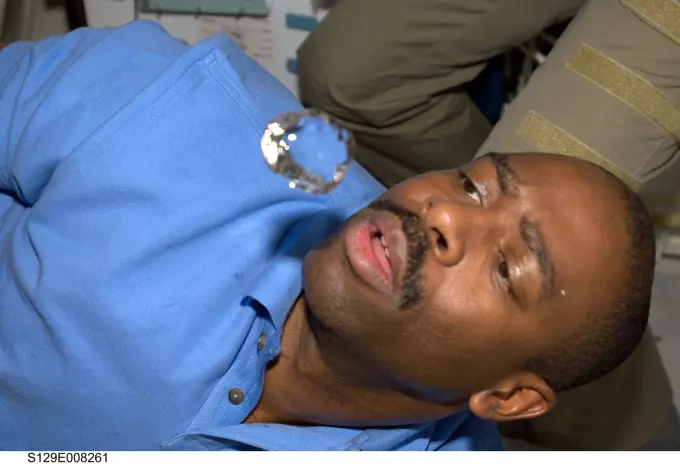
S129-E-008261 (24 Nov. 2009) --- Astronaut Leland Melvin, STS-129 mission specialist, watches a bubble float freely, after having squeezed it from his beverage container, on the middeck of space shuttle Atlantis.
6145-44656596
LCROSS (Lunar Crater Observation Sensing Satellite) Near InfraRed Spectrometer shake test in Ames N-244 high bay EEL Lab - with Lynn Hofland, Ames EEL lab) and Kimberly Ennico, LCROSS payload scientist
1899-76348267
Waco, Texas, Forensic scientist Dr. Lori Baker and her students at Baylor University work to identify the remains of unidentified migrants who died trying to enter the United States without legal documents. Most perished in a long, hot walk as they tried to evade a Border Patrol checkpoint 70 miles north of the border.
6145-45125761
iss050e036324 (1/29/2017) --- Photographic documentation of Small Plant Pilllow (Cabbage) - Veggie-03. Organisms grow differently in space, from single-celled bacteria to plants and humans. But future long-duration space missions will require crew members to grow their own food, so understanding how plants respond to microgravity is an important step toward that goal. Veg-03 uses the Veggie plant growth facility to cultivate a type of cabbage, which is harvested in orbit with samples returned to Earth for testing.
7003-69683646
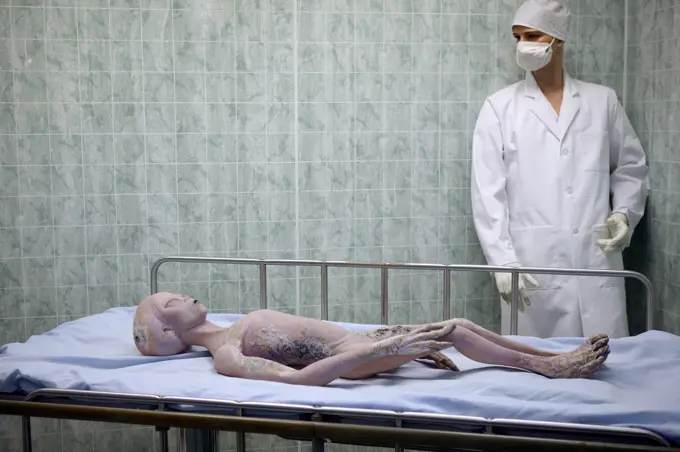
USA, New Mexico, Roswell: Space Alien Abductions UFO Museum, Space Alien Examination Diorama
6145-44624042
Expedition 10 Commander Leroy Chiao undergoes physical testing on a mechanized tilt table at crew quarters in Baikonur, Kazakhstan, Friday, October 8, 2004, in preparation for launch with Flight Engineer and Soyuz Commander Salizhan Sharipov and Russian Space Forces Agency cosmonaut Yuri Shargin to the International Space Station on October 14. The tilt table is used to condition the crewmembers' cardiovascular system against the effects of weightlessness once on orbit.
6145-45275552
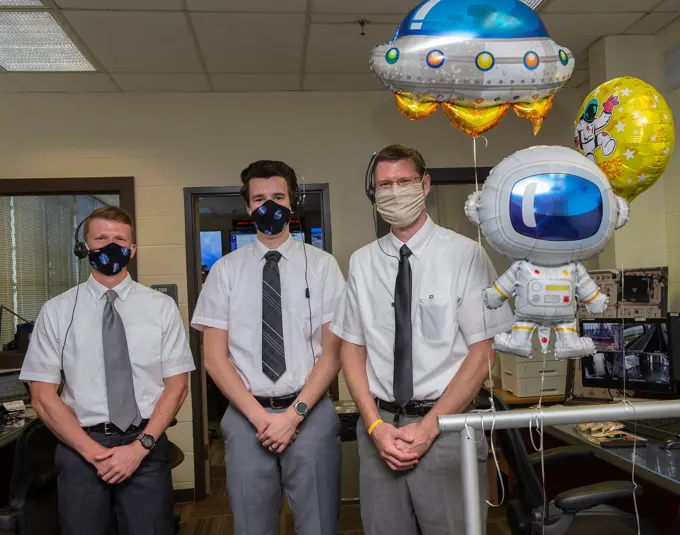
Patrick Mills, Stewart Whaley, Cameron Muelling and teams at NASAs Marshall Space Flight Center help monitor launch conditions for the Demo-2 mission from the Huntsville Operations Support Center, HOSC.
5514-17876056
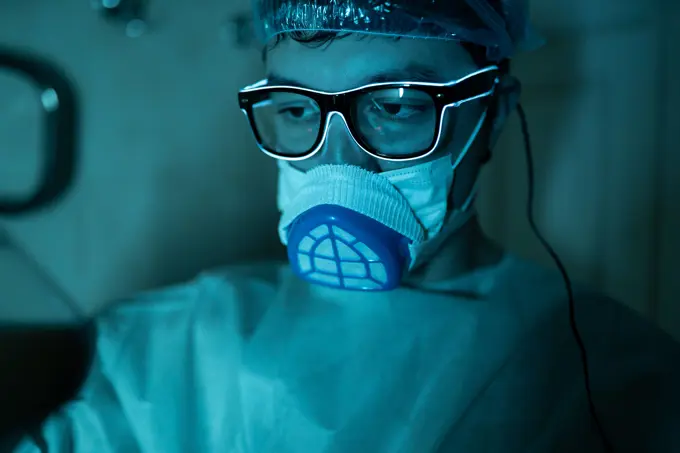
view of a scanner room bathed in blue light
6145-44829363
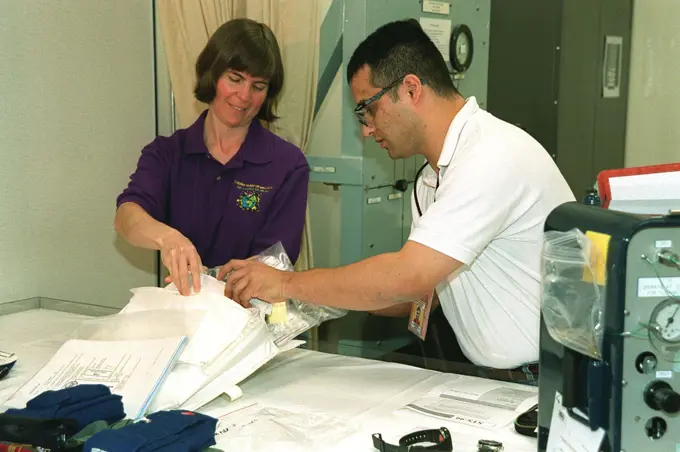
S93-45370 (29 Sept 1993) --- Blood samples from crew members are critical to several Spacelab Life Sciences (SLS-2) investigations. Amalour Veloso (left) and Sandra Prow draw blood from David A. Wolf, mission specialist. Wolf was participating with five other NASA astronauts and a payload specialist on data collection and training in preparation for the two week SLS-2 mission.
6145-44903941
University of Washington Graduate Student Jesse Anderson tries to find her cabin onboard the Woods Hole Oceanographic Institution research vessel Knorr on Tuesday, Sept. 4, 2012, in Woods Hole, Mass.  Anderson will work with the Argo Floats instruments in the Atlantic Ocean as part of the Salinity Processes in the Upper Ocean Regional Study (SPURS) which is set to sail on Sept. 6.  The NASA-sponsored expedition will sail to the North Atlantic's saltiest spot to get a detailed, 3-D picture of how salt content fluctuates in the ocean's upper layers and how these variations are related to shifts in rainfall patterns around the planet.
6145-45090787
Media wait to be escorted to the next event during the Expedition 43 prime and backup crew media day on Saturday, March 21, 2015 at the Cosmonaut Hotel in Baikonur, Kazakhstan. Expedition 43 NASA Astronaut Scott Kelly, and Russian Cosmonauts Gennady Padalka, and Mikhail Kornienko of the Russian Federal Space Agency (Roscosmos) are scheduled to launch to the International Space Station in the Soyuz TMA-16M spacecraft from the Baikonur Cosmodrome in Kazakhstan March 28, Kazakh time (March 27 Eastern time.) As the one-year crew, Kelly and Kornienko will return to Earth on Soyuz TMA-18M in March 2016.
1848-49826652
Places and events in 1987 8, People
6145-45184549
U.S. Navy recovery team members practice bringing an astronaut aboard the USS John P. Murtha, using a dummy, during Underway Recovery Test-7 (URT-7) on Nov. 5, 2018. NASA astronaut Don Pettit, in tan coveralls, looks on and discusses plans for moving the astronauts after returning from deep space. At left is Melissa Jones, NASA Landing and Recovery director. NASA's Recovery Team, along with the U.S. Navy, are practicing recovery of a test version of the Orion in the Pacific Ocean. URT-7 is one in a series of tests to verify and validate procedures and hardware that will be used to recover the Orion spacecraft after it splashes down in the Pacific Ocean following deep space exploration missions. Orion will have emergency abort capability, sustain the crew during space travel and provide safe re-entry from deep space return velocities.
6145-44798947
Debbie Thomas (left) and Tukufu Zuberi of the PBS's series  History Detectives during filming at a NASA Goddard Space Flight Center lab.
6145-52165119
010417-F-0929W-005. Subject Operation/Series: NEW HORIZONS Base: Cerro Membre Country: Paraguay (PRY)
6145-45044689
CAPE CANAVERAL, Fla. - Inside the Space Station Processing Facility at NASAs Kennedy Space Center in Florida, cold storage team members cart an International Space Station experiment cryogenic freezer called a Glacier unit, for transport to Space Launch Complex-40 at Cape Canaveral Air Force Station. The unit is for an experiment late-load demonstration test with Space Exploration Technologies Corp. SpaceX Falcon 9 rocket and Dragon capsule.SpaceX is one of two companies under contract with NASA to take cargo to the International Space Station. NASA is working with SpaceX to combine its last two demonstration flights, and if approved, the Falcon 9 would launch the Dragon capsule to the orbiting laboratory for a docking within the next several months.
6177-V53849808
4409-20804838
ELISABETH SHUE in HOLLOW MAN (2000), directed by PAUL VERHOEVEN.
1606-175037
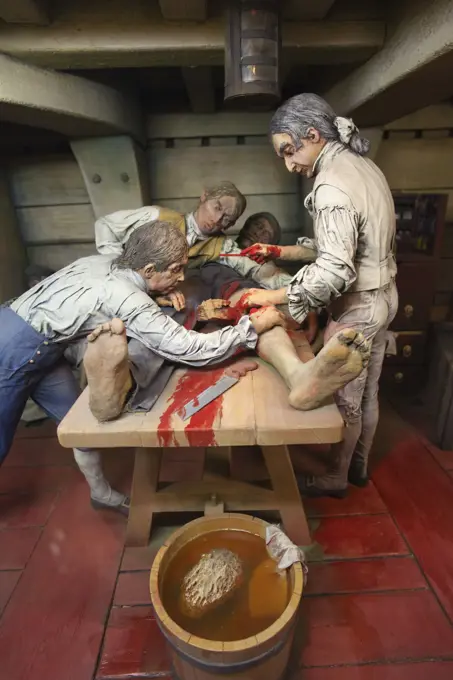
England,London,Science Museum,Exhibit of Naval Surgery in 1800
6145-44824005
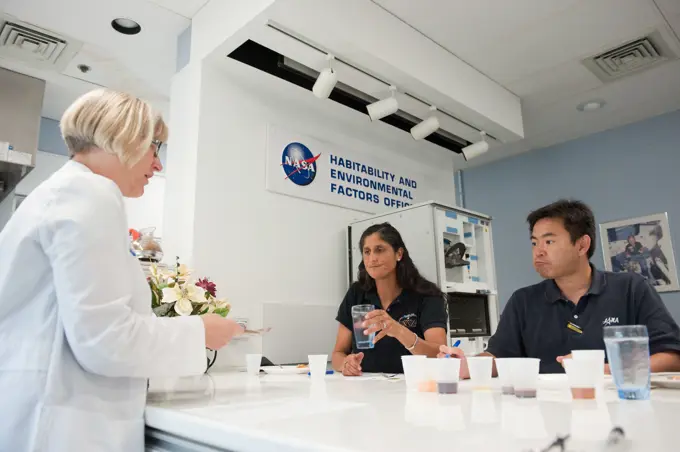
PHOTO DATE:  07-01-10LOCATION: Bld g 17,  Food LabSUBJECT:  Expedition 32 crew members Sunita Williams and Akihiko Hoshide (JAXA) with Expedition 31 crew member Joe Acaba during their missions food tasting
1848-62129159
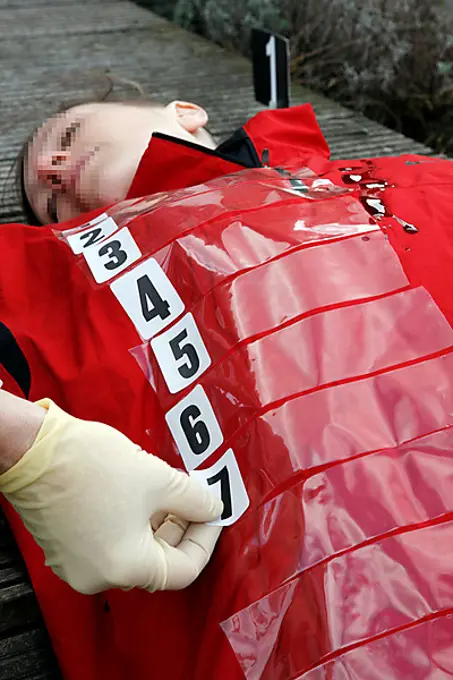
Securing of evidence at a crime scene after a capital offence, murder, homicide, scene of crime officers, crime scene department of the police, securing of fibres and microscopic evidence with adhesive film, recreated event, Germany, Europe
6096-20080200
France, Bruz on 16/09/202. Richard Ferrand, President of the French National Assembly at the SPACE, international animal production exhibition, at the Rennes exhibition centre. Photograph by Martin Bertrand.France, Bruz le 16/09/202. Richard Ferrand, President de l Assemblee Nationale au SPACE, Salon Internationales des Productions Animales, au Parc des Expositions de Rennes. Photographie de Martin Bertrand.
6145-44836103
ISS025-E-007584 (17 Oct. 2010) --- NASA astronaut Shannon Walker, Expedition 25 flight engineer, is pictured with a bag of candy floating freely in the Unity node of the International Space Station.
6145-44577836
The group of Japanese researchers of the Spacelab-J (SL-J) were thumbs-up in the Payload Operations Control Center (POCC) at the Marshall Space Flight Center after the successful launch of Space Shuttle Orbiter Endeavour that carried their experiments. The SL-J was a joint mission of NASA and the National Space Development Agency of Japan (NASDA) utilizing a marned Spacelab module. The mission conducted microgravity investigations in materials and life sciences. Materials science investigations covered such fields as biotechnology, electronic materials, fluid dynamics and transport phenomena, glasses and ceramics, metals and alloys, and acceleration measurements. Life sciences included experiments on human health, cell separation and biology, developmental biology, animal and human physiology and behavior, space radiation, and biological rhythms. Test subjects included the crew, Japanese koi fish (carp), cultured animal and plant cells, chicken embryos, fruit flies, fungi and plant see
6145-58966031
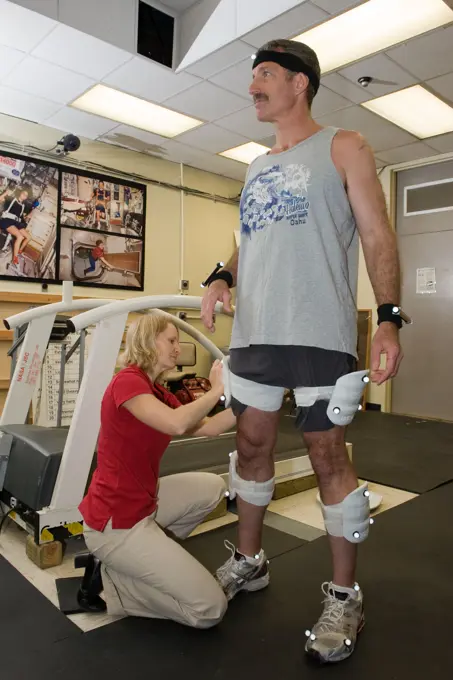
PHOTO DATE: 5-12-11LOCATION: Building 261 - Room 138SUBJECT: Expedition 29 Preflight Training with Dan Burbank during Treadmill Kinematics Baseline Data Collection.WORK ORDER: 2011-1214
4428-67371051
Instructor assisting boy using virtual reality simulator in science center
6145-44903942
University of Washington Graduate Student Jesse Anderson settles into her cabin onboard the Woods Hole Oceanographic Institution research vessel Knorr on Tuesday, Sept. 4, 2012, in Woods Hole, Mass.  Anderson will work with the Argo Floats instruments in the Atlantic Ocean as part of the Salinity Processes in the Upper Ocean Regional Study (SPURS) which is set to sail on Sept. 6.  The NASA-sponsored expedition will sail to the North Atlantic's saltiest spot to get a detailed, 3-D picture of how salt content fluctuates in the ocean's upper layers and how these variations are related to shifts in rainfall patterns around the planet.
6188-66494591
Human cells for transplantation Human cells for transplantation Copyright: xZoonar.com/J.xSandvikx 2083118
6145-44577894
The first United States Microgravity Laboratory (USML-1) flew in orbit inside the Spacelab science module for extended periods, providing scientists and researchers greater opportunities for research in materials science, fluid dynamics, biotechnology (crystal growth), and combustion science. This photograph shows Astronaut Larry De Lucas wearing a stocking plethysmograph during the mission. Muscle size in the legs changes with exposure to microgravity. A stocking plethysmograph, a device for measuring the volume of a limb, was used to help determine these changes. Several times over the course of the mission, an astronaut will put on the plethysmograph, pull the tapes tight and mark them. By comparing the marks, changes in muscle volume can be measured. The USML-1 was launched aboard the Space Shuttle Orbiter Columbia (STS-50) on June 25, 1992.
6145-44587111
KENNEDY SPACE CENTER, FLA. - Students look over their experiments that will fly in SPACEHAB on Space Shuttle Columbia on mission STS-107. SPACEHAB's complement of commercial experiments includes six educational experiments designed and developed by students in six different countries under the auspices of Space Technology and Research Students (STARS), a global education program managed by SPACEHAB subsidiary Space Media.  The countries represented are Australia, China, Israel, Japan, Liechtenstein and the United States.  The student investigators who conceived these experiments will monitor their operations in space. The experiments will be housed in BioServe Space Technologies' Isothermal Containment Module (ICM --a small temperature-controlled facility that provides experiment support such as physical containment, lighting, and video imaging) and stowed in a middeck-size locker aboard the SPACEHAB Research Double Module.
PREVIOUS
of 5
NEXT
2401 S. Ervay, Suite 206
Dallas, Texas 75215
United States
Get Started
Free ResearchMy BoardsMy Cart
For Creators
How To License Your ContentContributor PortalFrame of Mind
Resources
API accessPricing
Contact
+1 866 236 0087help@viewpictures.co.uk Contact form
©2026 View Pictures. All Rights Reserved. -A
This site is protected by reCAPTCHA and Google Privacy Policy and Terms of Service apply.