My Boards
View Pictures
  • My Boards
← Science

Laboratory Research in Clean Rooms

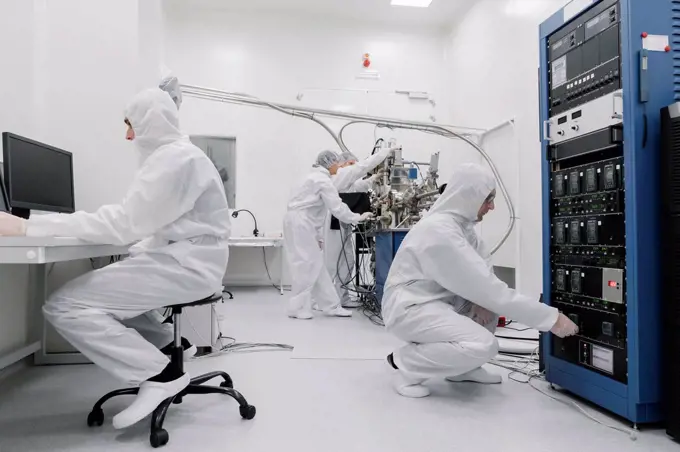
Images depict scientists in clean room environments, engaging with high-tech equipment, such as microscopes and fluid experiment racks, showcasing a focused research atmosphere.

Scientists working in laboratory of science center
245 assets in this story
6145-44750183
CAPE CANAVERAL, Fla. -  In the Space Station Processing Facility, STS-130 Mission Specialist Kathryn Hire (second from right) gets a close look at hardware associated with the Cupola, part of the payload on the mission to the International Space Station. Next to her are (left) Pilot Terry Virts Jr. and (right) Commander George Zamka.  The seven-windowed module will be used as a control room for robotics on the station. Endeavour will also deliver the final connecting node, Node 3.
6145-44590007
KENNEDY SPACE CENTER, FLA. -- Members of the Columbia Reconstruction Project Team move a piece of Columbia debris across the grid in the RLV Hangar.  The team is examining Columbia materials and will attempt to reconstruct the orbiter as part of the investigation into the accident that caused the destruction of Columbia and loss of its crew as it returned to Earth on mission STS-107.
6145-44608052
KENNEDY SPACE CENTER, FLA. - Astronaut Tim Kopra (second from right) talks with workers in the Space Station Processing Facility about the Intravehicular Activity (IVA) constraints testing on the Italian-built Node 2, a future element of the International Space Station.  .  The second of three Station connecting modules, the Node 2 attaches to the end of the U.S. Lab and provides attach locations for several other elements.  Kopra is currently assigned technical duties in the Space Station Branch of the Astronaut Office, where his primary focus involves the testing of crew interfaces for two future ISS modules as well as the implementation of support computers and operational Local Area Network on ISS.   Node 2 is scheduled to launch on mission STS-120, Station assembly flight 10A.
6145-44496834
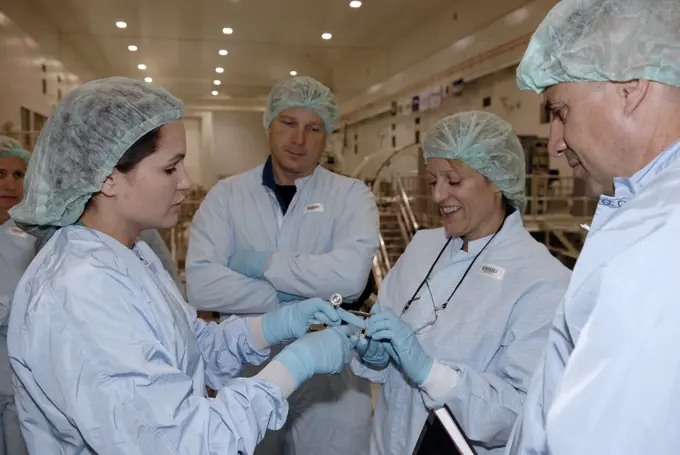
S99-09470 (11 August 1999) --- Three mission specialists participate in a STS-99 flight crew equipment (FCE) bench review.  From the left (in the blue lab coats), astronauts Mamoru Mohri, Janice Voss and Janet L. Kavandi look over equipment and supplies for their assigned mission aboard the Space Shuttle Endeavour later this year. Mohri represents Japan's National Space Development Agency (NASDA). Such bench reviews are routine procedure for crews preparing for shuttle missions.
6145-44890715
CAPE CANAVERAL, Fla. - A team of competitors works with its machine during NASA's Lunabotics Mining Competition at the Kennedy Space Center Visitor Complex in Florida. The competition challenges university students to build machines that can collect soil such as the material found on the moon. Working inside the Caterpillar LunArena, the robotic craft dig soil that simulates lunar material. The event is judged by a machine's abilities to collect the soil, its design and operation, size, dust tolerance and its level of autonomy.
6145-55974273
Artemis II Crew with EGS. Artemis II crew members inspect their Orion crew module inside the high bay of the Neil A. Armstrong Operations and Checkout Building at NASAs Kennedy Space Center in Florida, on Aug. 7, 2023. From left are: Victor Glover, pilot; Reid Wiseman, commander; Christina Hammock Koch, mission specialist; and Jeremy Hansen, mission specialist. The crew module is undergoing acoustic testing ahead of integration with the European Service Module. Artemis II is the first crewed mission on NASAs path to establishing a long-term lunar presence for science and exploration under Artemis.
6145-44676490
KENNEDY SPACE CENTER, FLA. -- After their arrival at KSC, STS-117 crew members take part in a payload bay walkdown on Launch Pad 39A to look at the cargo in Space Shuttle Atlantis. In the bucket are Mission Specialists Patrick Forrester (with camera) and Steven Swanson (far right). The payload includes the S3/S4 integrated truss structure for the International Space Station. STS-117 is scheduled to launch at 7:38 p.m. June 8.  During the 11-day mission and three spacewalks, the crew will work with flight controllers at NASA's Johnson Space Center in Houston to install the 17-ton segment on the station's girder-like truss and deploy the set of solar arrays, S3/S4. The mission will increase the space station's power capability in preparation for the arrival of new science modules from the European and Japanese space agencies.
6145-45140462
NASA interns Jessica Scotten, left, and Ayla Grandpre water plants in the Veggie hardware in NASA Kennedy Space Center's ISS environment simulator chamber. Mizuna mustard, Outredgeous lettuce and Waldmann's green lettuce are growing in Veggie. Growth in the chamber mimics the growth of plant experiments in the Veggie plant growth system on the International Space Station.
1589R-13331495
Middle Eastern scientist in clean suit in laboratory
6145-44949119
PHOTO DATE:  03-28-13LOCATION:  NBL - Pool Topside SUBJECT:  Expedition 39 (Soyuz 37) crew members Rick Mastracchio and Koichi Wakata during pre-dive briefing, preparations and suitup, then lowering into the water.
6145-58970363
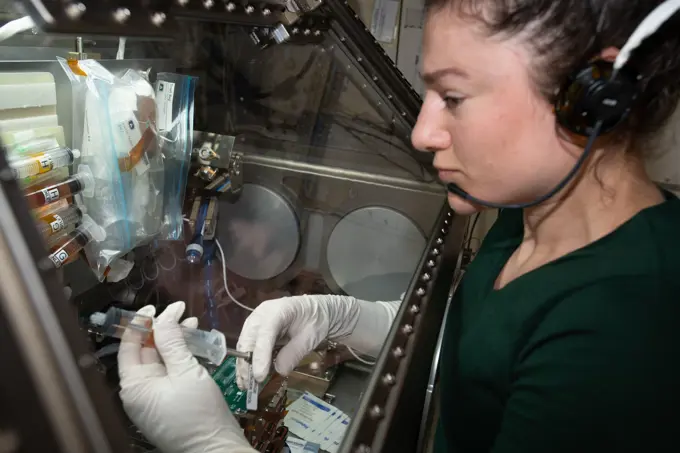
iss062e115355 (March 26, 2020) --- NASA astronaut and Expedition 62 Flight Engineer Jessica Meir conducts cardiac research inside the Life Sciences Glovebox, a biology research facility located in Japan's Kibo laboratory module. The Engineered Heart Tissues investigation is exploring cardiac function in weightlessness that may provide new drug developments for astronauts and Earthlings.
4491R-22147399
Scientist with papers standing in closet and doing revision in lab.
6145-44539451
S83-32823 (26 May 1983) --- Astronauts Sally K. Ride and John M. Fabian, attired in clean suits, participate in a STS-7 crew mission test in the Kennedy Space Center's vertical processing facility (VPF). They are two of three STS-7 mission specialists preparing for the June mission.
6145-45097439
Astronaut Scott Kelly initiated VEG-01 B, the second crop of lettuce, on July, 8, 2015, and both Kelly and Astronaut Kjell Lindgren cared for the plants. The crop grew for 33 days. VEG-01 B included one set of six plant pillows planted with red romaine lettuce seeds. On Aug. 10, 2015, the crew harvested and consumed leaves from each plant. This was the first crop grown and consumed in NASA hardware. They harvested the rest of the plant tissue and froze it in the stations Minus Eighty-Degree Laboratory Freezer for ISS (MELFI) for return to Earth for further study including microbial analysis, antioxidant capacity, mineral analysis and anthocyanin concentration.
6145-29614669
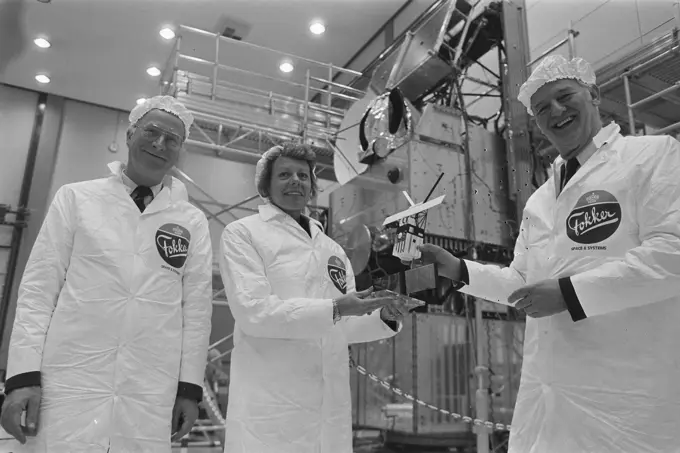
Anefo photo collection. Minister Smit Kroes Cleanroom 16 Foker Space Systems; Smit Kroes model offered Lehman. February 19, 1987
6145-58965379
KENNEDY SPACE CENTER, FLA. - During training at KSC, STS-114 Mission Specialist Stephen Robinson and Commander Eileen Collins (both unmasked) look at equipment that will be part of their mission. STS-114 is a utilization and logistics flight that will carry Multi-Purpose Logistics Module Raffaello and the External Stowage Platform (ESP-2), plus the Expedition 7 crew to the International Space Station. Launch of STS-114 is currently scheduled for January 2003
6145-58965208
KENNEDY SPACE CENTER, Fla. -- From inside the payload bay of orbiter Endeavour, Phyllis Moore, co-director of Project Starshine, gives her final approval to flight of the Starshine-2 satellite. The deployable experiment is being carried on mission STS-108. Starshine-2's 800 aluminum mirrors were polished by more than 25,000 students from 26 countries. Top priorities for the STS-108 (UF-1) mission of Endeavour are rotation of the International Space Station Expedition Three and Expedition Four crews, bringing water, equipment and supplies to the station in the Multi-Purpose Logistics Module Raffaello, and completion of robotics tasks and a spacewalk to install thermal blankets over two pieces of equipment at the bases of the Space Station's solar wings. Liftoff of Endeavour on mission STS-108 is scheduled for 7 41 p.m. EST Nov. 29
6145-44704156
SILICON CARBIDE GROWTH FACILITY - CLEAN ROOM FACILITY AND SURFACE ANALYTICAL LABS
6145-44799754
JSC2010-E-014775 (15 Jan. 2010) --- Seen at Marshall Space Center building 4708 in the high-bay clean room, astronauts Nicholas Patrick (right) and Robert Behnken, both STS-130 mission specialists, accompanied by Eric Howell, Boeing Huntsville Chief Engineer for ISS, handle ammonia hoses to be installed during mission STS-130. The hoses are at 500 pounds per square inch pressure (psi) to give them a feel for how stiff the hoses would be at 500 psi if they had to handle them under pressure on orbit.
1916-111278805
Scientist conducting an experiment on chicks in a laboratory
6145-51872193
220511-N-YX844-2129 PACIFIC OCEAN (May 11, 2022) Machinists Mate Fireman David Navarro, from San Antonio, left, and Machinists Mate 3rd Class Magdalena Ramos, from Morristown, Tennessee, take a sample of oxygen in the O2N2 fill room aboard the U.S. Navys only forward deployed aircraft carrier, USS Ronald Reagan (CVN 76). The oxygen is stored as a liquid and used by squadron pilots and Ronald Reagans medical team. Samples are routinely tested aboard to ensure its purity. Ronald Reagan, the flagship of Carrier Strike Group 5, provides a combat-ready force that protects and defends the United States, and supports alliances, partnerships and collective maritime interests in the Indo-Pacific region.
6145-44531277
KENNEDY SPACE CENTER, FLA. -- During training at KSC, STS-114 crew members get instructions from a KSC worker.  In the center are Commander Eileen Collins, and Mission Specialists Stephen Robinson and Soichi Noguchi, who is with the National Space and Development Agency of Japan. STS-114 is a utilization and logistics flight that will carry Multi-Purpose Logistics Module Raffaello and the External Stowage Platform (ESP-2), plus the Expedition 7 crew to the International Space Station.  Launch of STS-114 is currently scheduled for January 2003
6145-44721626
Weightless testing of the MSFC Materials Processing in Space Experiment onboard the KC-135, NASA 930, 10/26/1983.
6145-45110069
The R/V Atlantis houses sophisticated science laboratories, including rooms for computer use, wet” work, chemical analysis and more. --- The b a href= http //naames.larc.nasa.gov/ rel= nofollow North Atlantic Aerosols and Marine Ecosystems Study /a /b (NAAMES) is a five year investigation to resolve key processes controlling ocean system function, their influences on atmospheric aerosols and clouds and their implications for climate. Michael Starobin joined the NAAMES field campaign on behalf of Earth Expeditions and NASA Goddard Space Flight Center’s Office of Communications. He presented stories about the important, multi-disciplinary research being conducted by the NAAMES team, with an eye towards future missions on the NASA drawing board. This is a NAAMES photo essay put together by Starobin, a collection of 49 photographs and captions.
6145-44791426
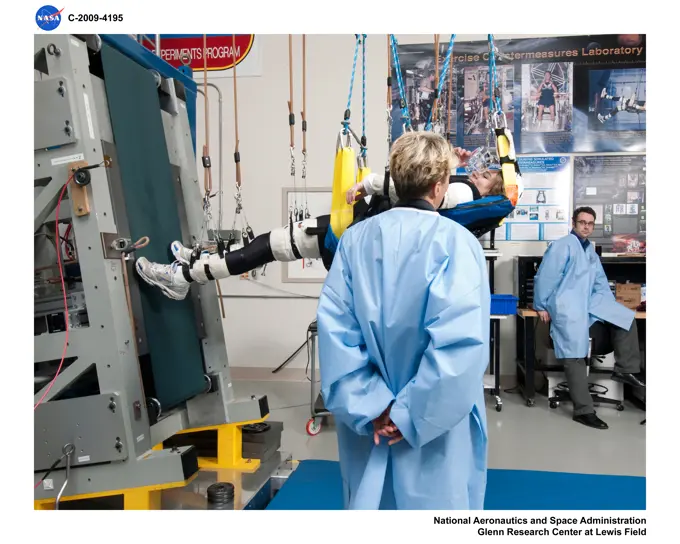
Enhanced Zero-gravity Locomotion Simulator, eZLS in the Lunar Configuration
6145-44565598
In the Space Station Processing Facility, Cosmonauts Sergei Krikalev (left), Vladimir Dezhurov (second from left), and Yuri Gidzenko (right) look over equipment for the International Space Station (ISS). All three are scheduled to take part in missions to construct the ISS in 1999 and later
6145-44667357
KENNEDY SPACE CENTER, FLA. --  In the Space Station Processing Facility, members of the STS-118 crew look at a mockup of the control moment gyro (CMG) and the insulating cover. The CMG is part of the payload on their mission.   At the far left is Mission Specialist Tracy Caldwell; at right are Mission Specialists Clayton Anderson and Richard Mastracchio (holding the cover). Anderson will be flying on STS-118 to join the Expedition 15 crew as flight engineer on the International Space Station.  The CMG will replace a faulty one on the International Space Station.  The payload also includes the SPACEHAB single cargo module, the third starboard truss segment (ITS S5) and the external stowage platform 3 (ESP3).  STS-118 is targeted to launch June 28 from Launch Pad 39A.
6145-44573097
An ORU Transfer Device (OTD) on top of the International Cargo Carrier (ICC) is checked by Manfred Nordhoff, with Daimler-Chrysler Aerospace (DASA); Ben Greene, with Lockheed Martin; Robert Wilkes (behind arm number two), with Lockheed Martin; Lora Laurence and Charles Franca, with Johnson Space Center. The OTD is a U.S.-built crane that will be stowed on the International Space Station's Unity module for use during future ISS assembly missions. The nonpressurized ICC fits inside the payload bay of the orbiter. The ICC will also carry the SPACEHAB Oceaneering Space System Box (SHOSS), a logistics items carrier. SHOSS can hold a maximum of 400 pounds of equipment and will carry items to be used during STS-96 and future ISS assembly flights. The ICC will fly on mission STS-96, targeted for launch on May 20
6145-44834310
ISS025-E-005731 (1 Oct. 2010) --- NASA astronaut Shannon Walker, Expedition 25 flight engineer, services the Minus Eighty Laboratory Freezer for ISS-2 (MELFI-2) in the Destiny laboratory of the International Space Station.
6145-58961636
KENNEDY SPACE CENTER, FLA. - Members of the Space Shuttle Discoverys Return to Flight STS-114 crew are conducting a payload Crew Equipment Interface Test (CEIT) in the Space Station Processing Facility at NASAs Kennedy Space Center, Fla. Seen here are Commander Eileen Collins (left) and Mission Specialist Soichi Noguchi (right), who is with the Japanese Aerospace Exploration Agency. The launch window for STS-114 is May 15 to June 3, 2005. During CEIT, the crew is inspecting the resupply stowage racks installed in the Italian-built Multi-Purpose Logistics Module Raffaello and performing tool and equipment interface checks with the Thermal Protection System (TPS) repair sample box, the Control Moment Gyroscope (CMG) and the External Stowage Platform-2 in preparation for the missions three scheduled spacewalks. The seven-member crew will fly to the International Space Station primarily to evaluate procedures for flight safety, including Shuttle inspection and repair techniques. The TPS re
6145-44594780
KENNEDY SPACE CENTER, FLA. -  John Cassanto of ITA looks at the Growth of Bacterial Biofilm on Surfaces during Spaceflight (GOBBSS) experiment that was carried on mission STS-107 as part of the Commercial ITA Biomedical Experiments payload.  He is part of a recovery team transferring experiments to alternate containers.  GOBBSS was a Planetary Society-sponsored astrobiology experiment developed by the Israeli Aerospace Medical Institute and the Johnson Space Center Astrobiology Center, with joint participation of an Israeli and a Palestinian student.  The recovery team also includes Eran Schenker of the Israeli Aerospace Medical Institute; David Warmflash of JSC, and Louis Friedman, executive director of the Planetary Society.  The GOBBSS material will be sent to JSC where the science team will analyze the samples, studying the effects of spaceflight on bacterial growth.
6145-44577566
KENNEDY SPACE CENTER, FLA. -- STS-107 Mission Specialists Ilan Ramon, with the Israeli Space Agency, holds a light wand while he and Laurel Clark check out data for equipment in the SHI Research Double Module (SHI/RDM), part of the payload on the mission.  They are taking part in Crew Equipment Interface Test activities, which include equipment and payload familiarization.  A research mission, STS-107 also will carry the Fast Reaction Experiments Enabling Science, Technology, Applications and Research (FREESTAR) that incorporates eight high priority secondary attached shuttle experiments.  STS-107 is scheduled to launch July 19, 2002
442-41437
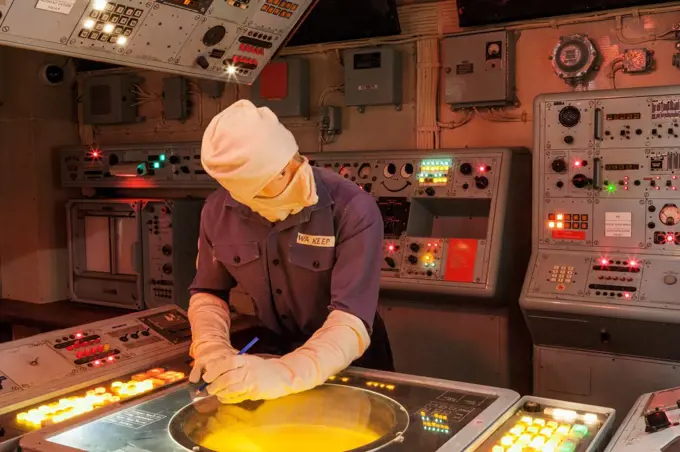
Exhibition of flight control room ina museum, Fleet Air Arm Museum, Royal Naval Air Station Yeovilton, Yeovil, Somerset, England
6145-58964787
KENNEDY SPACE CENTER, FLA. -- In the Space Station Processing Facility, Multi-Purpose Logistics Module Leonardo has the attention of workers and some of the STS-102 crew. The MPLM, part of the payload on the STS-102 mission, is the first of three pressurized modules that will serve as the International Space Stations moving vans, carrying laboratory racks filled with equipment, experiments and supplies to and from the Space Station aboard the Space Shuttle. Leonardo is scheduled to be launched in early March. On that flight, Leonardo will be filled with equipment and supplies to outfit the U.S. laboratory module Destiny. The mission will also be carrying the Expedition Two crew to the Space Station, replacing the Expedition One crew who will return on Shuttle Discovery
6145-44649541
KENNEDY SPACE CENTER, FLA. -   KENNEDY SPACE CENTER, FLA. - In the Space Station Processing Facility at NASA's Kennedy Space Center, STS-115  Mission Specialist Joseph Tanner is practicing folding a sequential shunt unit launch to activation multilayer installation blanket. He and other crew members are at the center for Crew Equipment Interface Test activities.  Equipment familiarization is a routine part of astronaut training and launch preparations.  The mission will deliver the second port truss segment, the P3/P4 Truss, to attach to the first port truss segment, the P1 Truss, as well as deploy solar array set 2A and 4A.  Launch on Space Shuttle Atlantis is scheduled for late August.
6145-45243329
PHASE II WAVE ROTOR
6145-44558888
Mission Specialist Jerry Ross participates in the Crew Equipment Interface Test (CEIT) for STS-88 in KSC's Space Station Processing Facility. The CEIT gives astronauts an opportunity to get a hands-on look at the payloads with which they will be working on-orbit. STS-88, the first International Space Station assembly flight, is targeted for launch in July 1998 aboard Space Shuttle Endeavour
6145-45223239
Visit by Dr. Harrison H. Schmitt, Apollo 17 Astronaut
6145-44565604
Ursula Stockdale (left), Mod Cargo Operations, and STS-98 Mission Specialist Marsha Ivins, take a break from equipment check in the Space Station Processing Facility. STS-98 is scheduled to carry the U.S. laboratory module, the centerpiece ISS, where unprecedented science experiments will be performed in the near zero gravity of space. The launch is targeted for October 1999 aboard the Space Shuttle Endeavour
1812-111557662
Two scientists experimenting with a water sample
6145-45144967
John Culberson, U.S. Congressman, 7th District Texas & Chairman, House Appropriations CJS Committee signs his name on the Orion Stage Adapter while touring MSFC on October 6, 2017.
6145-45097221
Astronaut Scott Kelly initiated VEG-01 B, the second crop of lettuce, on July, 8, 2015, and both Kelly and Astronaut Kjell Lindgren cared for the plants. The crop grew for 33 days. VEG-01 B included one set of six plant pillows planted with red romaine lettuce seeds. On Aug. 10, 2015, the crew harvested and consumed leaves from each plant. This was the first crop grown and consumed in NASA hardware. They harvested the rest of the plant tissue and froze it in the stations Minus Eighty-Degree Laboratory Freezer for ISS (MELFI) for return to Earth for further study including microbial analysis, antioxidant capacity, mineral analysis and anthocyanin concentration.
6145-45160846
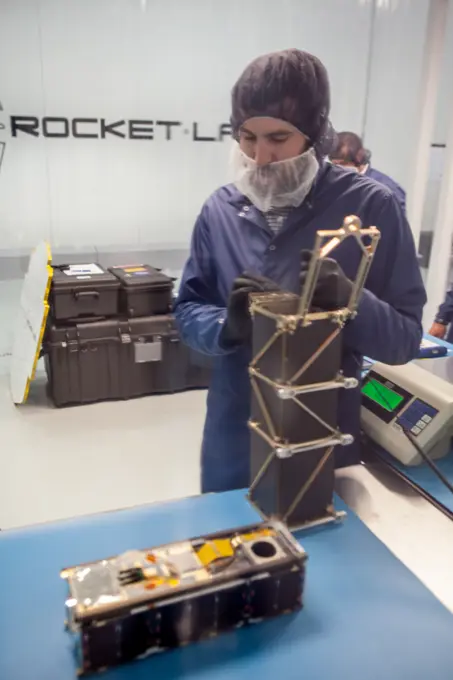
The CubeSat CeREs  short for Compact Radiation Belt Explorer. Its final destination: Earth’s radiation belts. Our planet is nestled in the center of two immense doughnut-shaped rings of radiation that swell and shrink in response to solar activity. This is a dynamic region of near-Earth space through which spacecraft and astronauts travel; understanding the belts’ behavior is crucial for ensuring their safety. From its high inclination, low-Earth orbit, the CubeSat  no larger than a loaf of bread  will face the tumultuous storms of the radiation belts. In particular, CeREs will examine how radiation belt electrons are energized and lost, particularly during events called microbursts  when sudden swarms of electrons stream into the atmosphere. CeREs will also inspect and characterize the high-energy particles that arrive at near-Earth space by way of the solar wind, the constant flow of charged particles from the Sun, 93 million miles away. The CubeSat was designed and built at NASA
6145-58961172
KENNEDY SPACE CENTER, FLA. - During Crew Equipment Interface Test (CEIT) at SPACEHAB in Cape Canaveral, Fla., STS-114 Mission Specialists Stephen Robinson, Soichi Noguchi and Andrew Thomas check out the External Stowage Platform-2 (ESP2). Noguchi is with the Japanese Aerospace Exploration Agency. As payload on Space Shuttle Discoverys Return to Flight mission, the ESP2 will carry replacement parts, known as orbital replacement units (ORU) to the International Space Station. The platform will be deployed and attached to the Stations airlock and will be used as a permanent spare parts facility. The launch window for STS-114 is May 15 to June 3, 2005. Earlier, during CEIT in the Space Station Processing Facility, the crew also inspected the resupply stowage racks installed in the Italian-built Multi-Purpose Logistics Module Raffaello and performed tool and equipment interface checks with the Thermal Protection System (TPS) repair sample box, and the Control Moment Gyroscope (CMG) in prepa
6145-45127003
Ed and Betty Rosenthal, founders of Florikan Fertilizer Corp., left, and Gioia Massa, NASA payload scientist for Veggie, observe ground control experiments in the Veggie Lab at NASA's Kennedy Space Center on Feb. 16.
PREVIOUS
of 3
NEXT
2401 S. Ervay, Suite 206
Dallas, Texas 75215
United States
Get Started
Free ResearchMy BoardsMy Cart
For Creators
How To License Your ContentContributor PortalFrame of Mind
Resources
API accessPricing
Contact
+1 866 236 0087help@viewpictures.co.uk Contact form
©2026 View Pictures. All Rights Reserved. -A
This site is protected by reCAPTCHA and Google Privacy Policy and Terms of Service apply.