Lace Fragments

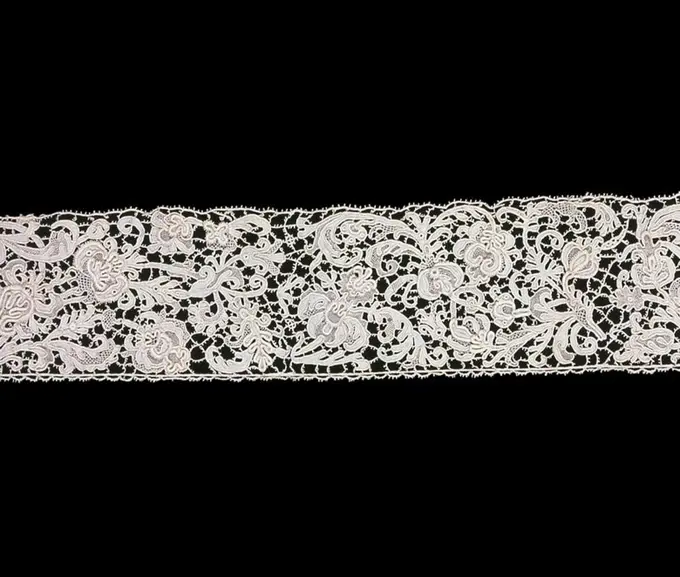
Delicate lace strips and fragments from different eras, featuring intricate floral patterns and historical craftsmanship.

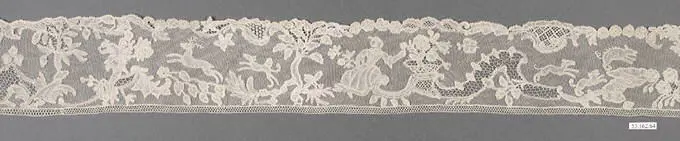
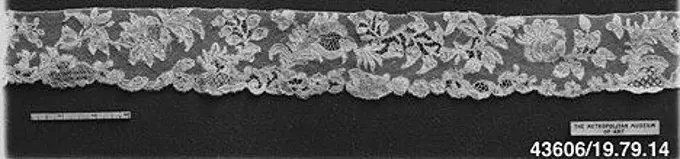
Band, Medium: cotton Technique: bobbin lace (late Valenciennes ground), Curving stem with leaves and flowers., 19th century, lace, Band
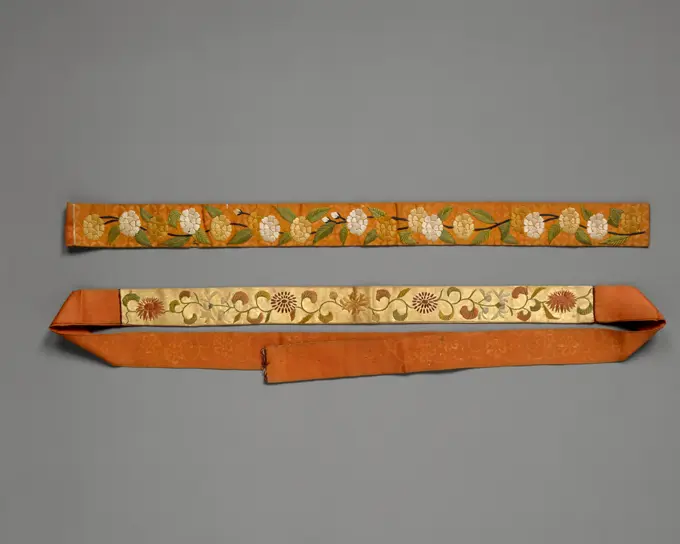
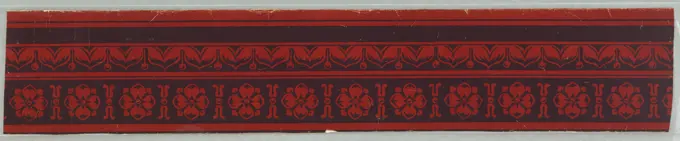
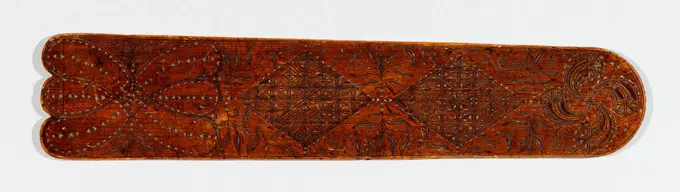
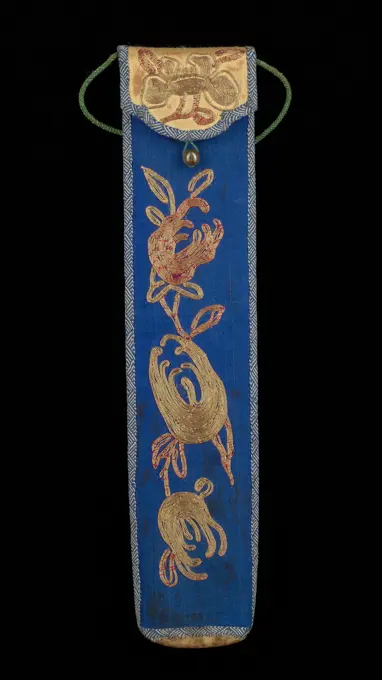
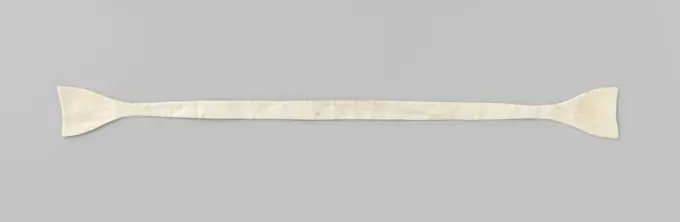
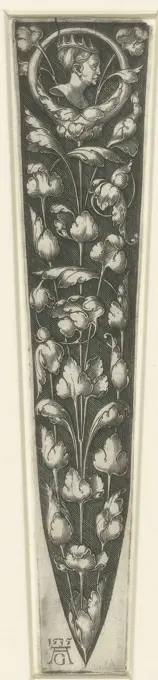
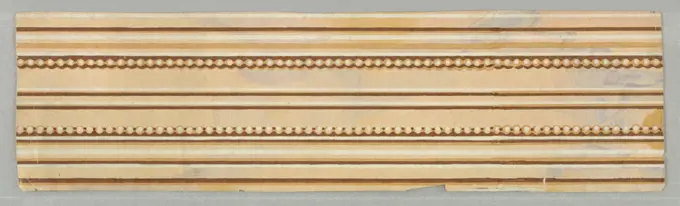
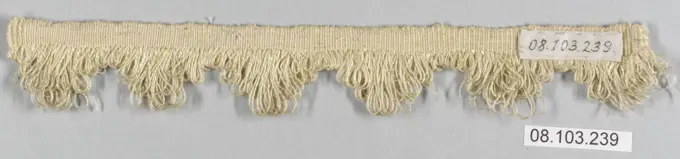
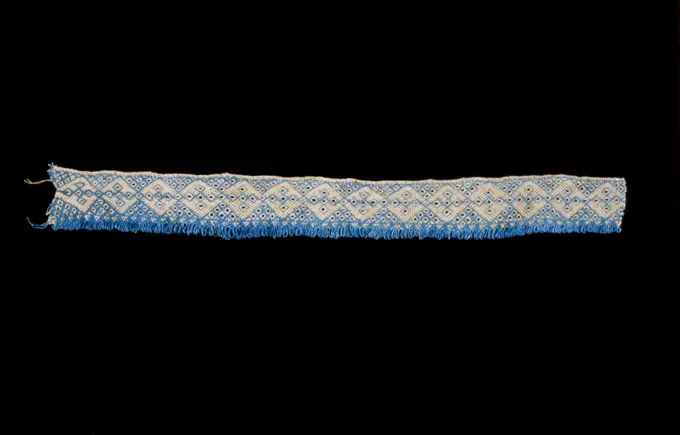
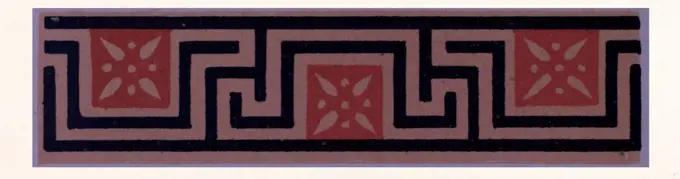
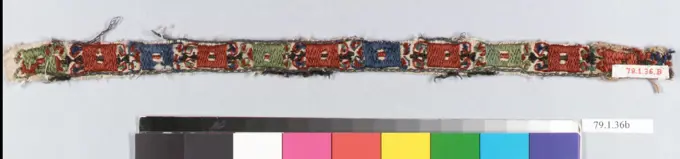
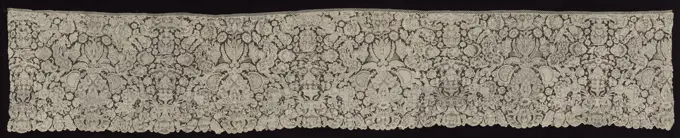
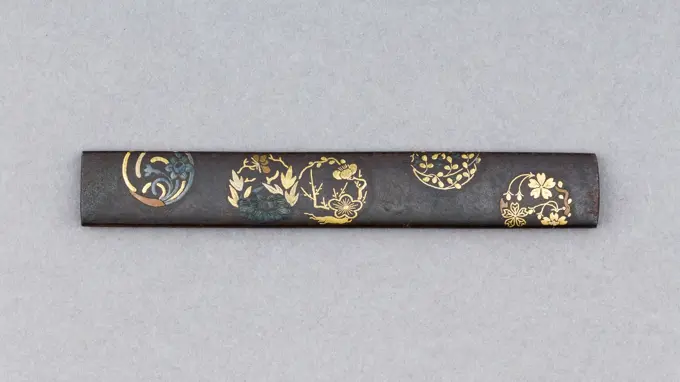
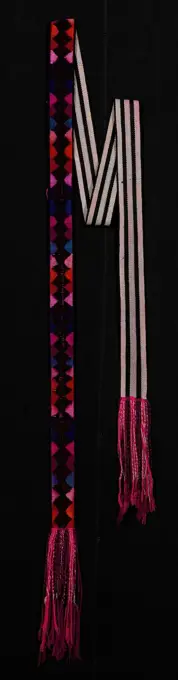
Border 18th century Flemish. Border 227710Lace, 1800s , maker unknown. Bequest of Mrs Alice Bakewell, 1965.Barbed Point 3rd century B.C.-A.D. 2nd century Vicús. Barbed Point 315501Border, Roller printed on machine-made paper, a) Narrow border with strung beads, printed on black background. Narrow dentil or rope twist band along either edge., France, 1850-80, Wallcoverings, BorderGallon;  1744 (1744-00-00-1744-00-00);Object ID #18705617; silver; L x W x D (case): 15 x 2.7 x 2.9 cm (5 7/8 x 1 1/16 x 1 1/8 in.) L x W x D (cap): 6.1 x 4.1 x 2.7 cm (2 3/8 x 1 5/8 x 1 1/16 in.); The Robert L. Metzenberg Collection, gift of Eleanor L. Metzenberg; 1985-103-43-a,bEnd of a Noh wig band late 18th century Japan This band, lacking red in the embroidery is used for middle-aged or elderly female roles.. End of a Noh wig band 44879Trimming, Medium: silk Technique: uncut supplementary warp pile on satin ground, Trimming fragment in a design of an angular stem with leaves in uncut red velvet on a yellow satin ground. One border is yellow, and the other is red., France, 19th century, trimmings, TrimmingCutslip from Brussels bobbin and four birds in the pattern, anonymous, c. 1750 Capslip from Brussels bobbin and four birds in the pattern. The barbe has a round end and a scalloped edge with picots. In addition to the birds, the decoration consists of flowers and foliage. Brussels linen (material) Brussels bobbin lace Capslip from Brussels bobbin and four birds in the pattern. The barbe has a round end and a scalloped edge with picots. In addition to the birds, the decoration consists of flowers and foliage. Brussels linen (material) Brussels bobbin laceBorder (USA); machine-printed paper; 87.5 x 17 cm (34 7/16 x 6 11/16 in.)Sleeve band, Medium: cotton, silk Technique: cut and drawn work with satin and cross stitch embroidery on plain weave, Rectangular panel with small stylized buds alternating with S-shapes in blue, green and black on a predominantly orange embroidered ground. Unfinished., Balkans, 18th-19th century, embroidery & stitching, Sleeve bandBusk c 1800 PennsylvaniaAncient Egyptian, Scribe's palette, for writing with reeds, from the tomb of Tutankhamen 1323 BC. New KingdomToilet tablecloth, strip, mechanical side and finished with Belgian () Bobbin, c. 1890 - c. 1920 Strip from a toilet table covering, from lace. The strip (lambijn) is sewn in pleats on a cotton strap with copper and rings in the middle. The pattern has windows that are filled in vertical and horizontal direction. Netherlands (possibly) . bobbin lace Strip from a toilet table covering, from lace. The strip (lambijn) is sewn in pleats on a cotton strap with copper and rings in the middle. The pattern has windows that are filled in vertical and horizontal direction. Netherlands (possibly) . bobbin lacePiece 18th century () European. Piece 225160Piece early 18th century French. Piece 214131Fringe 18th century British. Fringe 224883Bobbin Lace Lappet, 18th century. Flanders, 18th century. Lace, bobbin: linen; average: 94.6 x 10.2 cm (37 1/4 x 4 in.).Strip early 18th century Flemish. Strip 220061'The Baton of Marshal Jourdan, 1798-1809', c19th century. Artist: Unknown.Galloon 18th century German, Silesia. Galloon 215676Piece 16th or 17th century Japan. Piece. Japan. 16th or 17th century. Silk / Compound weave. Textiles-WovenTrimming, Medium: gold metallic foil, gold metallic foil wound onto yellow silk, and green silk chenille Technique: bobbin lace, Wide ribbons densely placed in a serpentine pattern., Spain, 18th century, lace, TrimmingBorder fragment, Medium: silk, vegetable fiber Technique: uncut supplementary warp pile (velvet), Fragment of a band for a border. Design of flower and branch in white, blue, black, and green loose pile on yellow silk ground. Weft of coarse vegetable fiber., Spain, 17th-18th century, woven textiles, Border fragmentNeck piece for a chyrpy, 1890-1900, 65 5/16 x 4 7/8 in. (165.89 x 12.38 cm), Cotton, silk; embroidery, 19th centuryInsertion 16th century Italian, Venice. Insertion. Italian, Venice. 16th century. Bobbin lace. Textiles-LacesFan case, early 19th century, 9 × 2 1/16 × 3/4 in. (22.86 × 5.24 × 1.91 cm) (without cord), Silk, metallic threads, metal button, cardboard, China, 19th centuryTrimming (France); linen, silk, wireFringe probably European 19th centuryFragment, 1600s. Iran, 17th century. Velvet (cut, voided, and brocaded); silk and gilded silver strips; overall: 10.2 x 55.3 cm (4 x 21 3/4 in.).Border (France); block-printed and flocked with gilt on machine-made paper; 45 x 6.5 cm (17 11/16 x 2 9/16 in.)Witte Strik, Unknown, 1920 - 1980  Europe textile materials  Europe textile materialsSash, from a three-piece set, 20th century, 35 x 7 3/8 in. (88.9 x 18.73 cm) (without tassels), Cotton, beads, wool; needlework, Vietnam, 20th centuryBorder, Block-printed on handmade paper, Horizontal rectangle. Border paper with two and one-half repeats of a floral spray. Plain bands of color along upper edge, and plain and figured bands along lower edge. Flowers printed in white with blue centers, and blue leaves, on black ground., France, ca. 1805, Wallcoverings, BorderA rising rinceau with leaves. Pen and brown ink, brush and brown wash on off-white laid paper, lined. Date: 1700-1800. Museum: Cooper Hewitt, Smithsonian Design Museum.Border, Technique: bobbin lace, Bobbin lace border, floral borders; late 18th century Point de Lille, late 18th century, lace, BorderBorder. Italy, probably Venice. Date: 1650-1675. Dimensions: 10.7 x 117 cm (4 1/4 x 46 1/8 in.)Width repeat: 38.8 cm (15 1/8 in.). Linen, mixed lace of bobbin part lace and needle lace. Origin: Italy. Museum: The Chicago Art Institute, Chicago, USA.Strip of needle side with moes and star -shaped flowers, anonymous, c. 1810 - c. 1830 Strip of natural-colored needle side: Alençon side. Spread motif with three rows of a star -shaped flower alternated with a muse, on a fine hexagonal mesh ground. The pattern on the underside of the strip consists of arcs with a lancet leaf below, filled with a decorative land. The lancet leaves are connected to each other with a star -shaped flower. A bunch -shaped flower raises between the arcs. The underside is finished with a bow edge through a succession of four circular cordons with a Raderpicot in it. Always between the four circles a horizontal curl filled with a decorative soil. The top is trimmed with a border bobbin. Alençon linen (material) Alençon Lace Strip of natural-colored needle side: Alençon side. Spread motif with three rows of a star -shaped flower alternated with a muse, on a fine hexagonal mesh ground. The pattern on the underside of the strip consists of arcs with a lancet leafTrim, looped braid, 18th-19th century, 18 x 2 in. (45.72 x 5.08 cm), Passementerie, 18th-19th centuryFringe probably European 19th centuryAldegrever, Heinrich, Germany, Design for a scabbard with the head of a woman with a crown at the top, Design for a dagger scabbard, decorated with foliate tendrils. At the top is a wreath with the head of a woman with a crown in it., print, ornament print, prints, height 143 mm, width 31 mm, width 18 mm, German, 1502 - 1561, print maker, printmaker, 1535 - 1535, second quarter 16th century, paper, engraving, engraving (printing process), Work conception, after own design byFragment of lace. unknown, authorTrimming (France); silkBorder, Borders, polished colors. All with beading, some marbleized., France, 1860-1900, Wallcoverings, BorderGimp probably European 19th centuryPiece 18th century Japan. Piece 71897Piece 18th-19th century Japan. Piece. Japan. 18th-19th century. Silk. Edo period (1615-1868). Textiles-WovenFringe Spanish or Italian 18th-19th centuryBorder, Block-printed on handmade paper, A band of egg motifs enframed in ovals of simplified foliage. At the bottom runs a band of elongated lozenges end-to-end. Printed in grisaille and tan on black ground., H#364, France, 1790-1820, Wallcoverings, BorderBelt -Ceintuur ribbon of silver brocade, decorated with purple 'Egyptian' motifs from Hieroglyphen, Anonymous, c. 1920 - c. 1930 Ceintuur ribbon of silver brocade, decorated with purple 'Egyptian' motifs from Hieroglyphen. France (possibly) . Ceintuur ribbon of silver brocade, decorated with purple 'Egyptian' motifs from Hieroglyphen. France (possibly) .Engageante, 1700s, maker unknown. Acquisition history unknown.Strip of bobbin with narrow volute vines and blunt buttons, anonymous, c. 1685 - c. 1699 Strip of natural -colored bobbin: Milanese side. The strip is slightly bent and has rounded corners at the bottom. The pattern consists of narrow volutes with blunt buttons. The tendrils are made with double ribbons in line with openwork edges, with a very open braiding ground of double and branched braids with picots. The ribbons make a loop in various places, as is applied to Occhiolini (side). The top is finished with a separate strap. The sides and the bottom are continuously finished with another cloaked strap with picots. Malib linen (material) bobbin lace / Milan lace Strip of natural -colored bobbin: Milanese side. The strip is slightly bent and has rounded corners at the bottom. The pattern consists of narrow volutes with blunt buttons. The tendrils are made with double ribbons in line with openwork edges, with a very open braiding ground of double and branched braids with picots. The ribbOpenwork basket. Ćmielów (fabryka fajansu i porcelany ; 1804-), factoryTrimming (France); silkBlue band, H.2 x L.20 in., lace, Russia ()Panel Made 1801-1900 China. cut velvet .Greek OrnamentFragment early 19th century Balkan, Bulgaria or Macedonia. Fragment 212262Piece 18th century Japan. Piece 72095Strip of lace tissue with triangles and triangular frills, anonymous, c. 1500 - c. 1649 Strip of natural lace tissue: open tissue in linen binding. The repeating and geometric pattern consists of an equilateral triangle between two slugged rectangular blocks. The successive triangles are alternately with the point up and down. Schulpenrand with triangular frills. Top right. Southern Netherlands (possibly) linen (material) Strip of natural lace tissue: open tissue in linen binding. The repeating and geometric pattern consists of an equilateral triangle between two slugged rectangular blocks. The successive triangles are alternately with the point up and down. Schulpenrand with triangular frills. Top right. Southern Netherlands (possibly) linen (material)Fringe 1750 British. Fringe 225061Bliżej Kultury unknownPlaster cast, Anglo-Saxon. Cross-shaft, in stone, in Irton churchyard Cumbria, first half of the 9th century.Wedding Banner (), 120 x 46 in. (304.8 x 116.84 cm), Cotton, silk, metallic thread; needlework, ChinaOrnament with leaves, Bernard Willem Wierink, c. 1910 print   paper  foliage, tendrils, branches ~ ornament. fable of Reynard the FoxFringe European 19th centuryCap Streamer Or Tie (Belgium); linenFringe (Italy); silk, metallic thread (gold strips on silk core)Copper Animal Plaque 3rd century B.C.-A.D. 2nd century Vicús. Copper Animal Plaque 315428Set of Bed Hangings - curtain section, 17th century. Embroidered wool on linen. Maker unknownNeedlepoint Lace Flounce, 1740-1750. France, 18th century. Lace, needlepoint; average: 320 x 58.5 cm (126 x 23 1/16 in.).Sotck exchange. Mid -19th. GAL1987.98.3Knife Handle (Kozuka) ca. 1615-1868 Japanese A kozuka is a handle of a by-knife that is part of a sword mounting. It is kept in a slot on the reverse of a katana scabbard, often with a matching kōgai (hairdressing tool).. Knife Handle (Kozuka) 34565Strook passement met gouddraad.Strip passing of gold thread.Sofa (Kang) China. Sofa (Kang) 56359Elongated wooden box with lid, black painted with upwards painted with purple flowers and metal closure of nickel on the side. Inside is lined with side of a purple color.Rebozo; cottonU-shaped gold strip and horse's head from the Staffordshire Hoard. Dated 6th CenturyBorder Made 1801-1900 England. Cotton, plain weave; roller printed; glazed .Turkey map on old linen - Map of Turkey on Old Linen Map of Turkey on old linen - Map of Turkey on Old LinenBorder, Block-printed and flocked, Shades of maroon and red and black flock, scalloped border with scrollwork,to be cut out., 1850-75, Wallcoverings, BorderFrill of gold and red silk.frill of gold and red silk.Border (France); block-printed on satin ground, continuous paper; 92.5 x 16 cm (36 7/16 x 6 5/16 in.)Scarf isolated on the white background2020 New year concept : 2020 wood number on table background.Piece 18th century French. Piece 214127Fringe (France); silkGallon;  19th century (1801-00-00-1900-00-00);Koto () 19th century Japanese. Koto (). Japanese. 19th century. Wood, ivory, metal, silk. Japan. Chordophone-Zither-plucked-long zitherSuspenders 19th century European. Suspenders. European. 19th century. silkSash (faja), c. 1965, 101 x 2 in. (256.54 x 5.08 cm), Silk, cotton; needlework, Guatemala, 20th century, Huipiles from Chichicastenango exhibit a wider range of imagery than those from other villages; however, they are also among the most instantly recognizable. As evidenced in this example, they are characterized by the boldly appliquéd or embroidered sunbursts that encircle the neck opening. When worn, the sunburst surrounds a woman's head, positioning her at the center of her universe.Border (Italy); linenTrim, fringe, 18th-19th century, 8 1/2 x 35 in. (21.59 x 88.9 cm), Passementerie, 18th-19th centuryNameplate Horend with the 'Officers and other shooters of Wijk VIII in Amsterdam led by Captain Roelof Bicker and Lieutenant Jan Michielsz Blaeuw' by Bartholomeus van der Helst, 1643 The nameplate is a rectangular plate made of black painted wood framed by acanthus leaves emvoting to C-Voluten, and here and there an olive branch. On the board were the names of the portrayed people in the Painting 'Officers and other shooters of district VIII in Amsterdam, led by Captain Roelof Bicker and lieutenant Jan Michielsz Blaeuw' by Bartholomeus van der Helst.  wood (plant material) The nameplate is a rectangular plate made of black painted wood framed by acanthus leaves emvoting to C-Voluten, and here and there an olive branch. On the board were the names of the portrayed people in the Painting 'Officers and other shooters of district VIII in Amsterdam, led by Captain Roelof Bicker and lieutenant Jan Michielsz Blaeuw' by Bartholomeus van der Helst.  wood (plant material)Border (possibly USA); block-printed; Overall: 30 x 45 cm (11 13/16 x 17 11/16 in.)Gem flexible bracelets in pearl, diamond, enamel, sapphire and ruby. Chromolithograph from Edwin Streeter's Gems Catalog, Bond Street, London, circa 1895.Fringe, Medium: silk Technique: woven, Yellow fringe with a plain-woven heading and a skirt of very fine yellow threads., Spain, 17th century, trimmings, FringeWord Viet Nam. Hand-painted art design. Illustration for t -shirt design, for coloring, tattoo and other decorationsBorder 18th century French. Border 221805