Lace Fragments

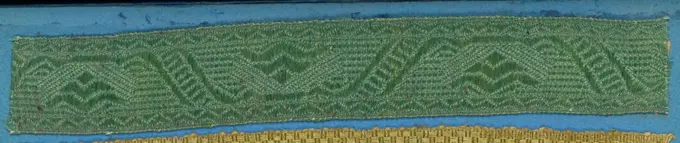
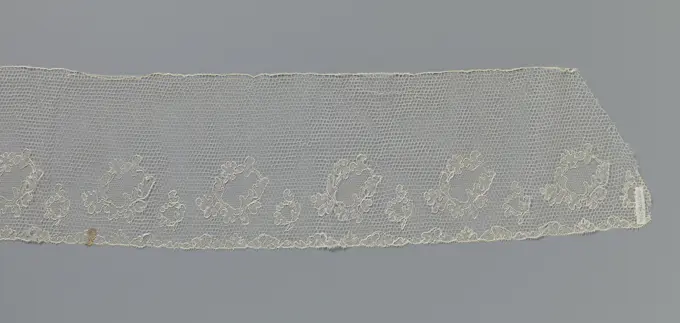
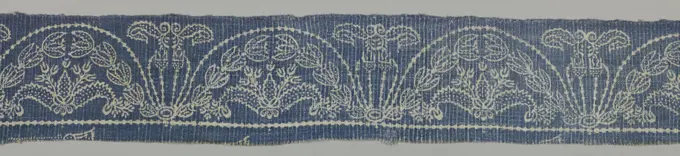
Delicate lace strips and fragments from different eras, featuring intricate floral patterns and historical craftsmanship.


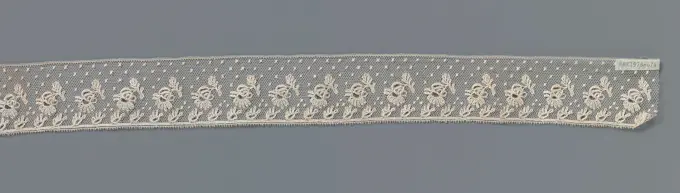
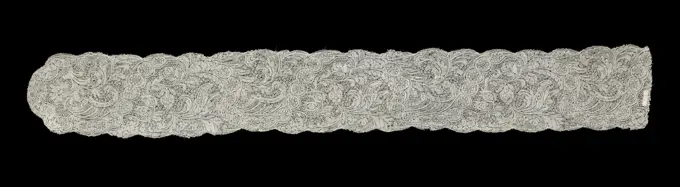
Band, Medium: cotton Technique: bobbin lace (late Valenciennes ground), Curving stem with leaves and flowers., 19th century, lace, Band
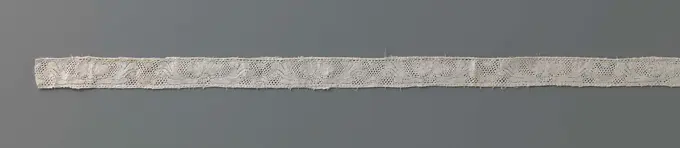
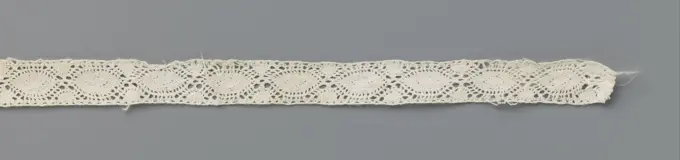
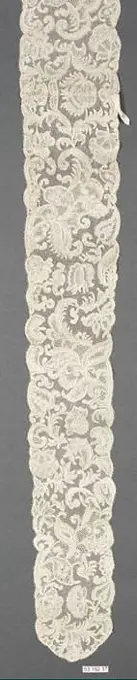
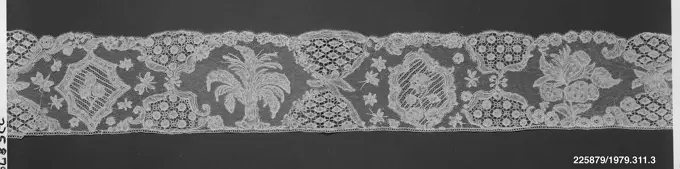
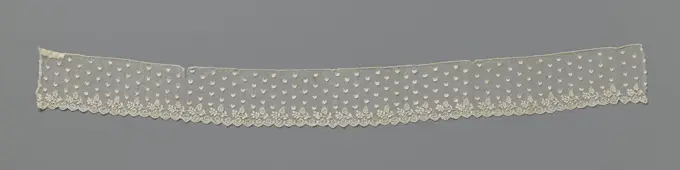
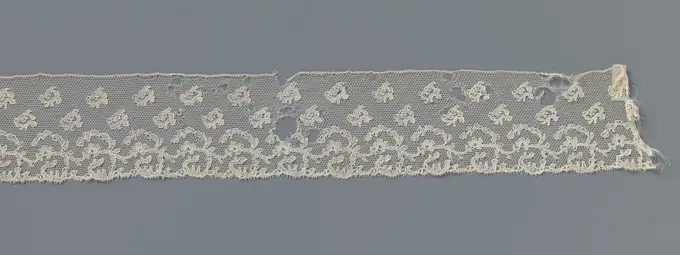
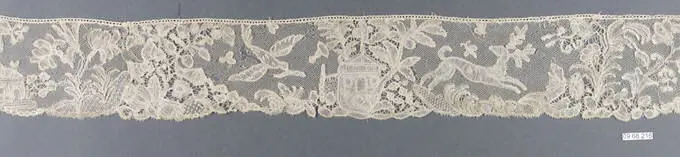
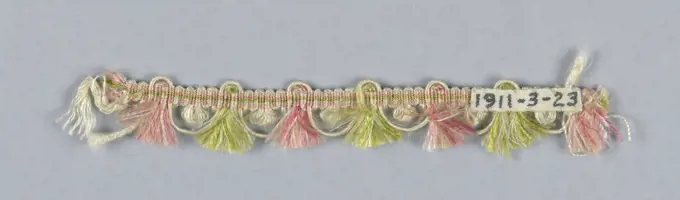
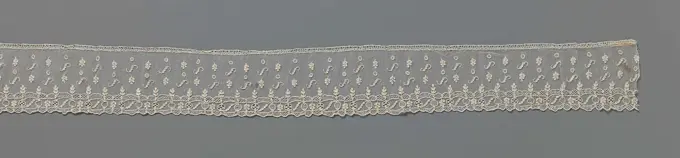
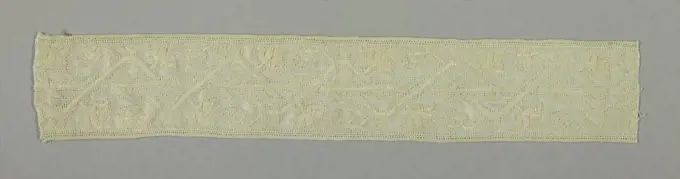
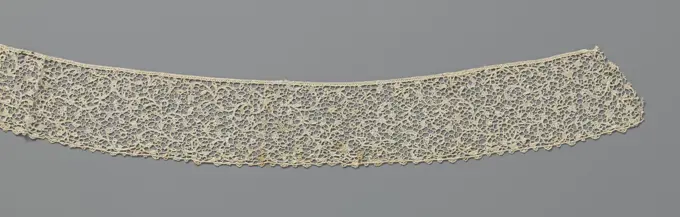
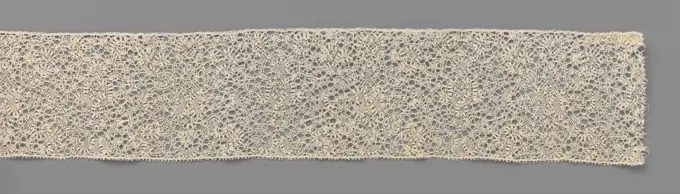
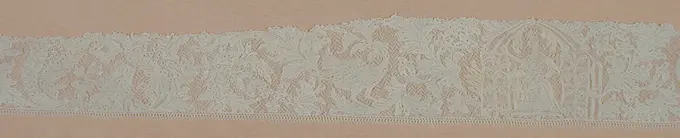
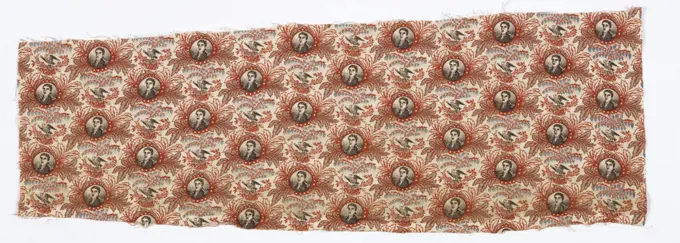
Strip 17th century Flemish. Strip 218230Fragment of the lace;  End of the 19th century (1891-00-00-1900-00-00);Kloskant intermediate mate with flour between elongated volute leaves, anonymous, c. 1650 Intermediate springs of natural -colored Dutch bobbin side. The pattern consists of a repeating symmetrical motif of a flower between elongated volute leaves. The motifs are made in linen battle with openwork edges and are connected by a more or less round grid with braid strokes. The top and bottom are straight. Antwerp linen (material) bobbin lace Intermediate springs of natural -colored Dutch bobbin side. The pattern consists of a repeating symmetrical motif of a flower between elongated volute leaves. The motifs are made in linen battle with openwork edges and are connected by a more or less round grid with braid strokes. The top and bottom are straight. Antwerp linen (material) bobbin laceTussenzetsel van kloskant met bloem tussen langgerekte voluutbladeren.Interesting of natural Dutch clamping side. The pattern consists of a repeating symmetrical motif of a flower between elongated voltull leaves. The motifs are made in linen stroke with openwork edges and are connected by a more or less round table ground with braid. The top and bottom are straight finished.Galloon 18th century French. Galloon 213990Band, Medium: cotton Technique: bobbin lace (late Valenciennes ground), Curving stem with leaves and flowers., 19th century, lace, BandStrip of bobbin with bold branches, anonymous, c. 1775 - c. 1799 On the traly land, a Mechelen soil (also known as ice soil), there are two symmetrical, soaked and slanted branches, the side branches of which cut an oval that is filled with grid. Smaller ovals in the faintly scalloped edge. Halved cross flowers and rosettes are on the straight inside. Mechelen side. Southern Netherlands linen (material) bobbin lace / Mechlin (lace) On the traly land, a Mechelen soil (also known as ice soil), there are two symmetrical, soaked and slanted branches, the side branches of which cut an oval that is filled with grid. Smaller ovals in the faintly scalloped edge. Halved cross flowers and rosettes are on the straight inside. Mechelen side. Southern Netherlands linen (material) bobbin lace / Mechlin (lace)Galloon 18th century French. Galloon. French. 18th century. Silk and metal thread. Textiles-TrimmingsTrimming; metallic strips wrapped around linen coreHats strip Van Kloskant with Zigzag Rivière, Anonymous, c. 1750 - c. 1760 Strip of natural -colored Brussels bobbin. A rivière in Zigzaglijn is crossed by spiral ranks, which enclose fan -shaped medallions. The motives are connected by a drachel soil. A coarser hexagonal soil has been used in the Rivières. On the fields that are bordered by the Rivière, there are twigs on which flowers in the form of pomegranates, pears or winged insects. The strip was probably used or made for a hat. Brussels linen (material) bobbin lace / Brussels bobbin lace Strip of natural -colored Brussels bobbin. A rivière in Zigzaglijn is crossed by spiral ranks, which enclose fan -shaped medallions. The motives are connected by a drachel soil. A coarser hexagonal soil has been used in the Rivières. On the fields that are bordered by the Rivière, there are twigs on which flowers in the form of pomegranates, pears or winged insects. The strip was probably used or made for a hat. Brussels linen (material) bobbin Edging mid-18th century Flemish, Brussels. Edging 222797Collar of needle side, anonymous, c. 1775 - c. 1800 Collar of needle side. The scalloped edge consists of an edge of leaves and medallions with various fillings. Sprinkling flowers are spread over the Maas soil. France . Alençon Lace Collar of needle side. The scalloped edge consists of an edge of leaves and medallions with various fillings. Sprinkling flowers are spread over the Maas soil. France . Alençon LaceBand; silk, linen, metallicScarf of tambouring on machine tulle with relief flowers, anonymous, c. 1840 - c. 1850 Scarf of natural -colored lace: Machinal tulle with tambouring work. Elongated rectangular model. Pattern: in midfield is a spray pattern of twigs with three serrated leaves. There are flower branches along the edges with one flower. The branches are faint s-shaped and are partly over each other, achieving a wavy effect. Along both short sides, the last branches come from the edge with a large curled arch with extra flowers and form a symmetrical pattern that is crowned with one flower from which three branches with each flower bud. The relief in the Bloemharten is made with tamboured edges along strips of woven cotton that are attached to the tulle. The scrap edge with lobed scoops stems from the wavy branches with serrated leaves. Netherlands whole:. Tamboering work: Cotton (Textile) Scarf of natural -colored lace: Machinal tulle with tambouring work. Elongated rectangular model. Pattern: in midfieKloskant's intermediate facility with a center line of Spitsovalen, Anonymous, c. 1600 - c. 1624 Piles of natural -colored bobbin side. The pattern consists of a center line of Spitsovalen between which always placed in one and upper edge, a small Spitsovaaltje. The motives are connected by a sparingly applied Maas soil. The motifs are made in linen battle with recesses and openwork edges. Top and bottom of the strip are straight. The intermediate facility comes from or intended for bedding. Friesland (possibly) linen (material) bobbin lace Piles of natural -colored bobbin side. The pattern consists of a center line of Spitsovalen between which always placed in one and upper edge, a small Spitsovaaltje. The motives are connected by a sparingly applied Maas soil. The motifs are made in linen battle with recesses and openwork edges. Top and bottom of the strip are straight. The intermediate facility comes from or intended for bedding. Friesland (possibly) linen (material) bobbin laceCap streamers, Medium: linen Technique: needle lace, Cap streamers in a design showing an intricate pattern of floral and foliated forms in complex garland design., France, 1700-1750, lace, Cap streamersBobbin Lace Edging, late 18th century. Belgium, Mechelen, late 18th century. Lace, bobbin: silk; average: 5.8 x 62.2 cm (2 5/16 x 24 1/2 in.).Border, Medium: muslin Technique: deflected element work (drawnwork and embroidery), Border with a dense pattern of ribbons, bows and cartouche forms., Tønder, Denmark, early 18th century, embroidery & stitching, BorderJoined pair of lappets 18th century Flemish, Brussels. Joined pair of lappets 227666Edging 18th century Flemish The Metropolitan Museum's great lace collection was started when the Museum became the first among American museums to organize a permanent collection of lace with the acceptance of the McCallum Collection in 1879 and the bequests of Mrs. John Jacob Astor, Mrs. Robert L. Stuart, Mrs. Augustus Cleveland, and Mrs. A. W. Winters shortly thereafter. In 1893 a loan collection of antique laces shown at the World's Columbian Exposition in Chicago was assembled by a committee of New York women headed by Catharine Augusta Newbold. About 1900 Miss Newbold arranged and labeled an exhibition of laces and linenworks lent to the Metropolitan Museum by Mrs. James Boorman Johnstone and the Misses Johnstone. "Her scholarly knowledge of lace technique enabled the Museum for the first time to offer a comprehensive display of lace illustrating its historical development," wrote Miss Frances Morris, then curator of the textile department. Miss Newbold's name occurs again in connPiece 17th century Japan. Piece 71139Strip of needle side with hearts, anonymous, c. 1790 - c. 1799 Strip Eco -colored needle side decorated with a regular pattern of heart -shaped mosques on a fine hexagonal mesh ground. The lower edge consists of arches with alternating one loose flower and the same flower connected to a lying flower branch. The row lying flower branches forms the transition from the mushroom pattern to the bottom edge. The top is finished with a straight edge. Alençon side. France linen (material) Alençon Lace Strip Eco -colored needle side decorated with a regular pattern of heart -shaped mosques on a fine hexagonal mesh ground. The lower edge consists of arches with alternating one loose flower and the same flower connected to a lying flower branch. The row lying flower branches forms the transition from the mushroom pattern to the bottom edge. The top is finished with a straight edge. Alençon side. France linen (material) Alençon LaceStrook kloskant met hangend madeliefje onder strooipatroon van vierkante moesjes.Strip natural colosside: Lille side. Under a scattering pattern of square moes, it consists of a repeating pattern from a curved twig with a hanging daisy. Along every flower lie along the underside two shouted ovals or flower hearts with a few narrow petals on the top. The motifs are connected by a fine grille, a tulet. The sparse fullwork is made in linen stroke, where the thicker and shiny contour wires dominate. Upper and bottom are straight finished, with the underside with picots.Strook kloskant met grillige strooimotieven en rank.Strip natural colosside: Lille side. Among two rows of whimsical motifs, a wavy rank runs with a rosette flower to any wave top. A whimsical bow runs over each rosette flower, formed by an elongated leaf. Similar reverse arcs, interspersed by ovals, form the slight shelters along the bottom of the strip. The motifs are connected by a fine grille, a tulet. The energy-saving fireworks is made in linen stroke, with thicker and shiny contour wires. A mole has been placed alternately in the ovals, made in shape stroke. The top and bottom of the strip are straight finished, the underside with picots.Border. Switzerland or Germany. Date: 1601-1650. Dimensions: 11.8 × 72.6 cm (4 5/8 × 28 1/2 in.). Linen, plain weave; embroidered with silk in back, double running, overcast, running, and split stitches; couching and French knots; edged with silk and linen, bobbin lace. Origin: Switzerland. Museum: The Chicago Art Institute, Chicago, USA.Strip 18th century Flemish, Brussels. Strip 218155Strook kloskant met drieblad.On a fine mesh network there is a stiff row of three-part leaves in the outer half, which are unilaterally directed. A straight edge shows smaller, oppositely directed flower branches. Valenciennes side.Upholstery trimming, Medium: silk Technique: woven, Woven heading with a cord carried through as scallops and tufts of pink and green silk placed between the scallops., France, 19th century, trimmings, Upholstery trimmingStrook naaldkant met s-vorm in strooimotief.Strip natural-colored coniferous side with a regular spreading dotty from downwardly hanging flour branches, circles and S shapes, on a fine hexagonal maas soil. The pattern at the bottom consists of two double rows with arches that are filled with different ornamental grounds. A repetitive motif can be seen between these two double rows: an oval-filled oval; An S-shape and a flour branch down. The top is trimmed with a border clamping side. A very finely picoted sloping edge is the finish on the bottom. Alençon side.Trimming; linenBand, Medium: linen Technique: plain weave embroidered with deflected element work, Woven linen band with all white design of a twisting geometric floral vine with embroidered details., Italy or Spain, 17th century, embroidery & stitching, BandTrimming, Medium: silk Technique: supplementary warp pile (velvet), Design of a curving stem with flowers and leaves between straight borders. In red and white velvet on a white ground., Italy, 16th century, trimmings, TrimmingBorder, Medium: linen Technique: bobbin lace, Brussels style, A shaped border with initials contained within wreathed medallion and surmounted by a crown and flanked by symmetrically-placed fountains, putti, stylized foliated forms and rocaille decoration., Belgium, early 18th century, lace, BorderGalloon 17th-18th century Unknown. Galloon 213845Dress Trimming (France); silkBand (Italy); linen; Repeat: 17 and 1/4 inchesFragment early 19th century Flemish. Fragment 212792Strip of needle side with a fine rank ornament, anonymous, c. 1690 - c. 1710 Strip of natural -colored needle side: Point de France. Pattern with a fine rank ornament on a hexagonal bar with picots. The top is trimmed with a border bobbin. The underside is finished with a straight picot edge with arcs. France linen (material) Strip of natural -colored needle side: Point de France. Pattern with a fine rank ornament on a hexagonal bar with picots. The top is trimmed with a border bobbin. The underside is finished with a straight picot edge with arcs. France linen (material)Needlepoint (Reticella) Lace Band, 19th century. Italy, 19th century. Lace, needlepoint: linen; average: 11.8 x 73.7 cm (4 5/8 x 29 in.).Samples, Orinoka Mills, (Philadelphia, Pennsylvania, USA), a. rust color warp and gold color weft, b. rust color warp and gold color weft, c. rust color warp and blue weft, USA, ca. 1910, woven textiles, SamplesGalloon 18th century French. Galloon 214045Strip early 18th century Flemish. Strip 213030Lace Flounce Made 1720-1740 Flanders. Wide edgings or flounces made of lace ornamented secular clothing, religious dress, and furniture. This length of lace might have adorned a wealthy womanís skirt hem or dressing table. Such a large piece of lace would have been the work of many women, with each creating a part of the whole that was then skillfully and invisibly assembled.. Linen, bobbin part-lace of a type known as Brussels with a plaited bar ground .Trimming, Medium: silk, metallic thread Technique: woven, Conventionalized design of flowers and leaves., Italy, 16th century, trimmings, TrimmingBand. Date/Period: Late 16th-early 17th century. Band. Medium: linen. Technique: grid of withdrawn element with needle lace (reticella style). Author: UNKNOWN.Galloon 18th century Italian. Galloon 213936Edge, Medium: straw, silk Technique: bobbin lace, Peasant-style, Switzerland, Appenzell , 19th century, lace, EdgeBobbin Lace Lappet, 18th century. Belgium, Binche, 18th century. Lace, bobbin: linen; average: 61.6 x 9 cm (24 1/4 x 3 9/16 in.).Cuff of needle side with tongued flower, anonymous, c. 1890 - c. 1899 Cuff of natural -colored needle side: Venetian relief side. Against an open bar of land is an ongoing pattern of tendrils with pomegranates and a tongened flower. A list of doubled arches along three sides. Belgium linen (material) Venetian raised work Cuff of natural -colored needle side: Venetian relief side. Against an open bar of land is an ongoing pattern of tendrils with pomegranates and a tongened flower. A list of doubled arches along three sides. Belgium linen (material) Venetian raised workFragment of the lace;  1. PO. 19th century (1801-00-00-1850-00-00);Fragment, Medium: linen Technique: bobbin lace (Lille style with heavy outlining thread), Border fragment of Lille-style lace with a serpentine conventionalized flowering vine design. Quatrefoils near top edge., France, 19th century, lace, FragmentBorder 17th-18th century French. Border 219513Fragmentary Strigil. UnknownColonnette from a Reliquary Shrine ca. 1175-1200 German. Colonnette from a Reliquary Shrine 467717Fragment 17th century Italian. Fragment 214995Strip bobbin with people similar to people made of narrow decorative straps with rectangular shapes, anonymous, c. 1700 Strip of natural-colored bobbin, binche side. The repeating pattern consists of a maze of small motifs made with different decorative land, including veter godslag-rod and mains fillings. The outlets of this are partially emphasized with narrow decorative straps made in form. At a regular distance from each other, the decorative straps on people form similar figures. The motifs are connected by an irregular decorative land, a snowflake land. The top and bottom of the strip are straight finished, with the bottom with picots. Binche linen (material) Bobbi Lace / Binche Lace Strip of natural-colored bobbin, binche side. The repeating pattern consists of a maze of small motifs made with different decorative land, including veter godslag-rod and mains fillings. The outlets of this are partially emphasized with narrow decorative straps made in form. At a regular distance frTrimming, Medium: silk, gilt foil on a silk core Technique: woven, Heading of brown silk thread with an overlay of gold threads. Gold and silk threads form a very narrow looped fringe on one border., Italy, 16th century, trimmings, TrimmingLength of Lace. probably France, 1700-1710. Costumes; Accessories. Linen point d'Alençon needle laceBelt, 20th century, 1 3/16 x 33 7/16 x 1 in. (3.02 x 84.93 x 2.54 cm), Silver, enamel, vinyl, 20th centuryGalloon 18th century French. Galloon. French. 18th century. Silk and cotton. Textiles-TrimmingsTextile (England); cottonBusk 17th century French Engraved with flowers and trophies of love is the poem (front): "Nymphs, drawn to the chase and to the shadows of these forests searching some secret places far from the ambush of the satyr." The second stanza (back) reads, "Nearby, jealous desire, frantic by a torment of love, has caused the death of a young lover who himself still sighs.". Busk. French. 17th century. metalSilver side strip with narrow pointed shells, anonymous, c. 1900  Strip bobbin, silver side. The pattern consists of narrow pointed shells, which come from a narrow edge made in the lace-hole stroke-grid. From a mesh right above each shell, an silver wire walks up and down, which fills the shell. The top of the strip is straight finished. Bush silver thread bobbin laceTrimming, Medium: silk Technique: woven, Yellow trimming fragment in a design of zigzag lines., France, 19th century, trimmings, TrimmingFragment (Japan)Trimming (France); silkTrimming, Medium: silk, gilt foil on a silk core, Heading of dull red silk with an overlay of gold threads. Gold and silk threads form a very narrow looped fringe on one border., Italy, 16th century, trimmings, TrimmingTextile (France); Designed by Paul Follot (French, 1877-1941); silk, cottonStole (Italy); silk ribbons, glass beads, metal thread, and paillettes; Overall: 76.5 x 9.5 cm (30 1/8 x 3 3/4 in.)Bobbin Lace (Needlepoint Design) Insertion, late 16th century. Italy, Genoa, late 16th century. Lace, bobbin; average: 4.5 x 31.1 cm (1 3/4 x 12 1/4 in.).Strip bobbin oval formed by whimsical leaf motifs, anonymous, c. 1800 - c. 1810 Strip of natural -colored bobbin, blonde. The repeating pattern consists of alternately a small and a large shape under the center line, which is made up of whimsically shaped leaf motifs that lie around a center of a fine tulip land like a ring. Along the bottom runs a border with a succession of such motifs. The motifs are connected by a Maas soil, a Parisian soil. The motifs are made in Ovenlag, with the thick and shiny contour threads having a strong accentuating effect. The top of the strip is straight finished. The very faintly scalloped underside is finished with fine picots. France silk bobbin lace / blonde (lace) Strip of natural -colored bobbin, blonde. The repeating pattern consists of alternately a small and a large shape under the center line, which is made up of whimsically shaped leaf motifs that lie around a center of a fine tulip land like a ring. Along the bottom runs a border with a succeTextile (France); silk, metallic thread; Anonymous bequest in memory of Albert and Rebecca Elsberg; 1938-82-42-eCeintuur ribbon of plain linden green rips side, anonymous, c. 1820 - c. 1830 Ceintuur ribbon of plain linden green ripszijde, possibly women's clothing. Netherlands (possibly) whole: Silk. whole: Ceintuur ribbon of plain linden green ripszijde, possibly women's clothing. Netherlands (possibly) whole: Silk. whole:Trim for Hem of Tunic or Skirt (Tablet WovenBand)Fragment 17th century Italian. Fragment 214998Indian Trade Cloth(Patolu)Border 17th century Italian. Border 214825Band; embroidery using colored silk on linen plain weavePiece 18th century Japan. Piece 72109Border, Medium: linen Technique: block printed using resist, then indigo dyed on plain weave (the fabric was woven with every third weft twice the thickness of the other weft so that the fabric has a ribbed surface), Border design of swags with tassels between them. In white on blue., France, 1750-99, printed, dyed & painted textiles, BorderPiece 18th century Japan. Piece 71218Embroidery Sample, 13 3/4 x 75 1/2 in. (34.93 x 191.77 cm), Cotton; needlework, ChinaEdging, Medium: linen Technique: bobbin lace, peasant style, Northern Italy, 19th century, lace, EdgingRibbon 18th century French. Ribbon 219867Fringe early 19th century British. Fringe 225108Printing block, Medium: wood, metal and felt, Narrow block in the form of a band with flowers bordered by small squares., late 18th century, appliances & tools, Printing blockStole (France); silk ribbons, glass beads, metal thread, and paillettes; Overall: 16.9 x 10.3 cm (6 5/8 x 4 1/16 in.)Bobbin Lace Band, 19th century. Spain, 19th century. Lace, bobbin; average: 10.2 x 68 cm (4 x 26 3/4 in.).Bobbin Lace (Tape Design) Edging, 17th-18th century. Italy, Genoa, 17th-18th century. Lace, bobbin; average: 15.3 x 303.5 cm (6 x 119 1/2 in.).Border, Block-printed and flocked paper, Central wide gray stripe; above and below, blue flock stripes containing regularly spaced neutral yellow bosses., England, ca. 1850, Wallcoverings, BorderTrimming (France); silkBorder sections with flowers. unknown c. 1560-1600 Tapestry Dimensions: H 11'7" x W 1'3" (a) Tapestry Materials/Techniques: unknown Culture: Flemish Weaving Center: unknown Ownership History: French & Co. purchased from Mrs. G. Tremaine, received 5/10/1946; sold to Prof. Federico Zeri 4/23/1965.Band (Italy); linen, silkTrimming, Medium: silk, metallic thread Technique: bobbin lace, metallic, Gold lace border with one scalloped edge formed by fan-shaped pieces extending beyond semi-circles. In yellow silk and metallic thread., Italy, 17th century, lace, TrimmingPieces (2) second quarter 15th century Italian, Venice. Pieces (2) 221819Textile, American Print Works, founded 1835, Medium: cotton Technique: block and roller printed on plain weave, Small medallion repeat of a portrait bust in a frame of foliage and small stars alternates with an eagle holding a flowering bough in its beak. In black, rust, blue and brown on white foundation. Possibly a commemorative textile printed for the Philadelphia Centennial. Portrait depicts either General Lafayette, Andrew Jackson or Simón Bolívar, the Liberator of South America., Fall River, Massachusetts, USA, 1876, printed, dyed & painted textiles, TextileTrimming; silk thread, metallic threadRibbon (USA); silkBorder Made 1801-1900 England. Cotton, plain weave; block printed; glazed .Border, Medium: linen Technique: bobbin lace, Brussels style, A scalloped border with a serpentine arrangement of flowers and fruits., Belgium, 1700-1750, lace, Border