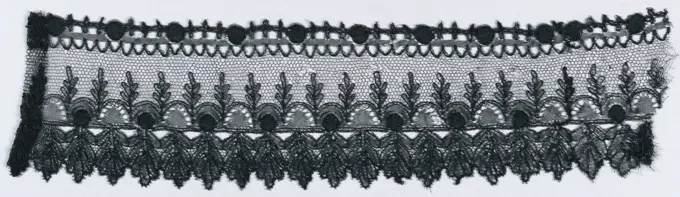
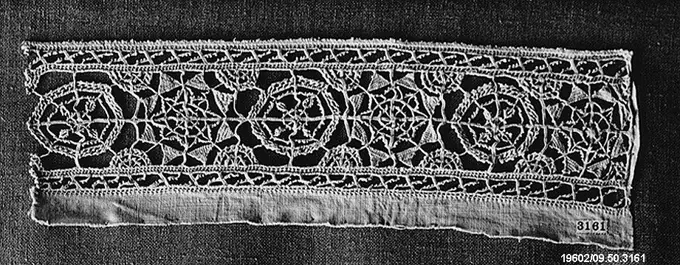
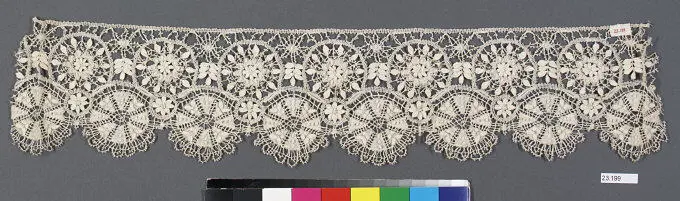
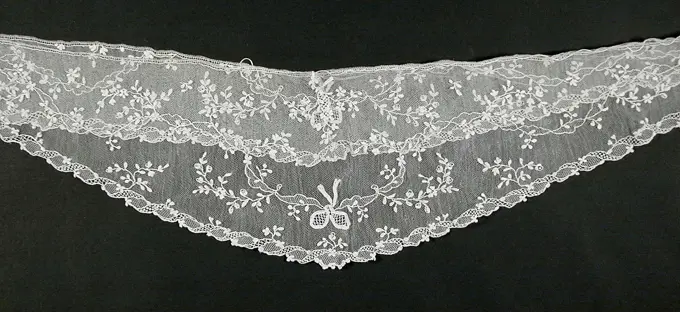
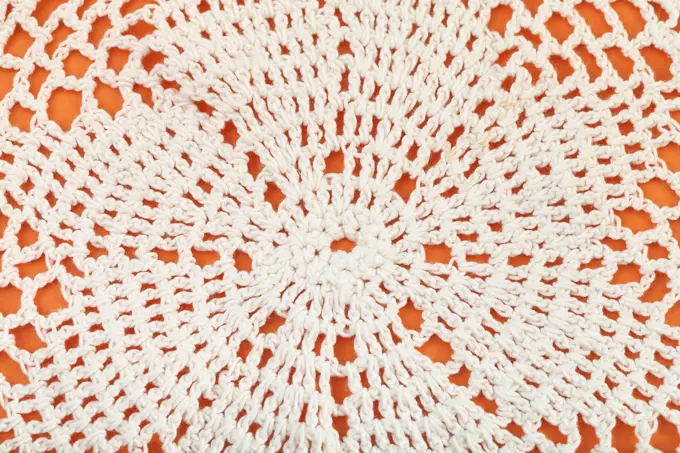
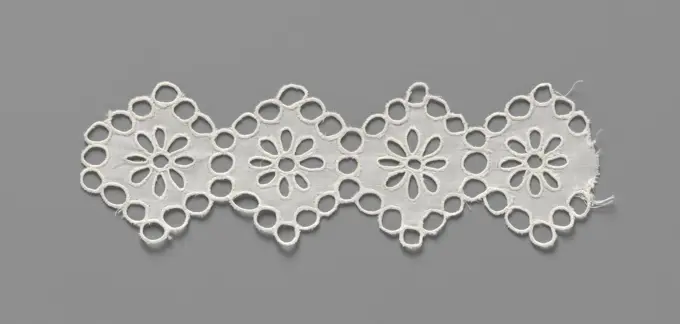
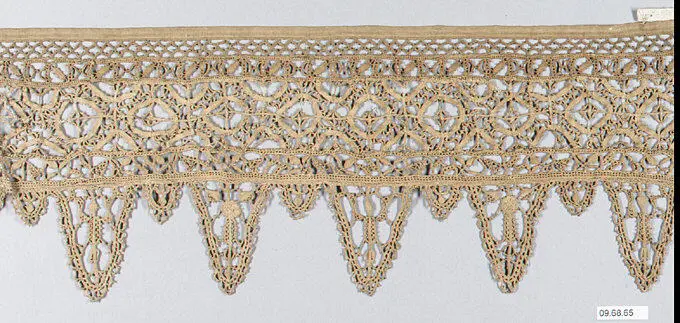
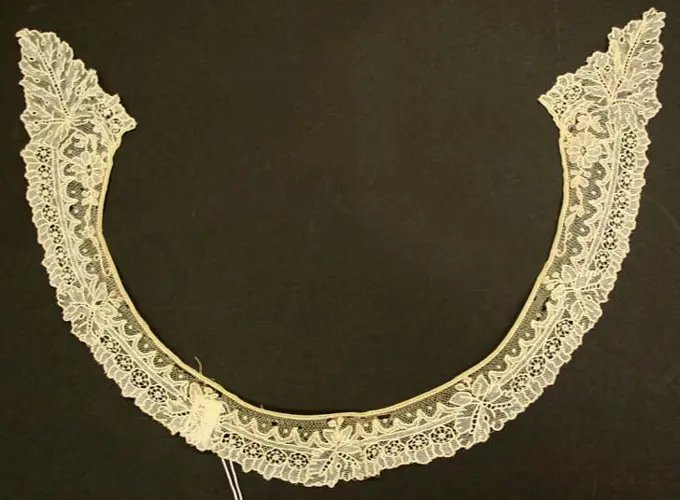
Lace Textile Fragments

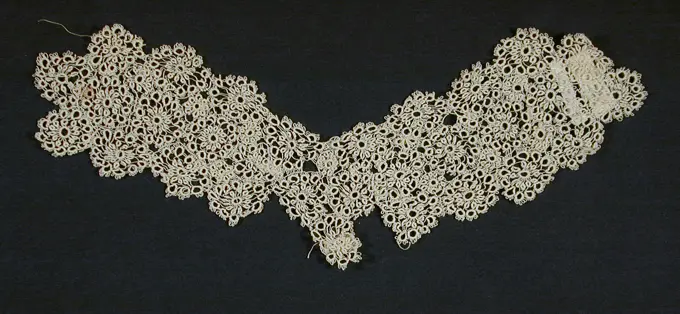
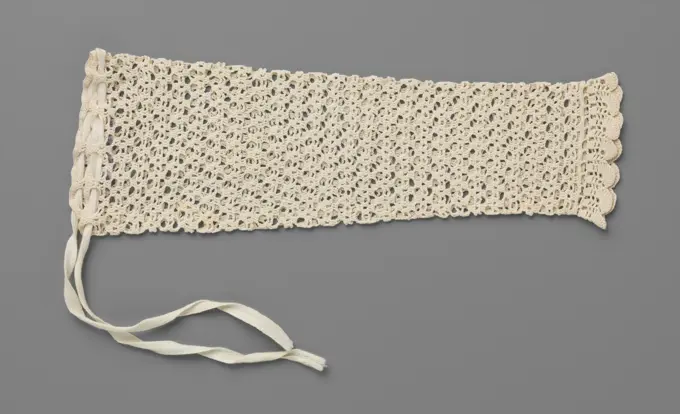
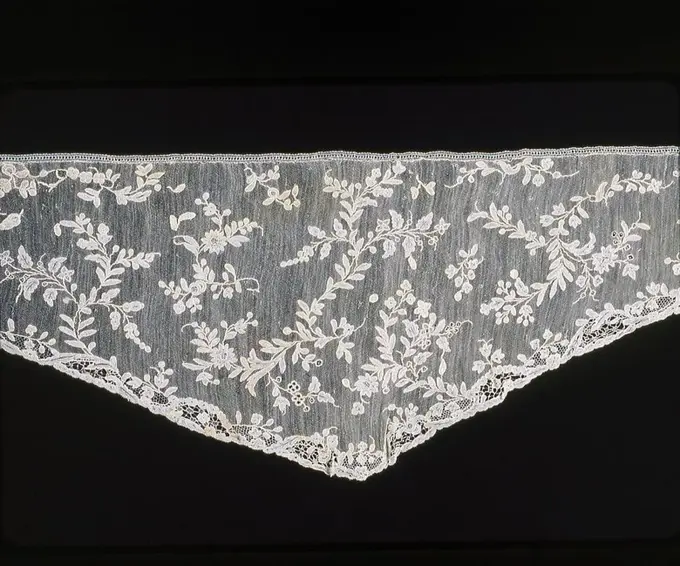
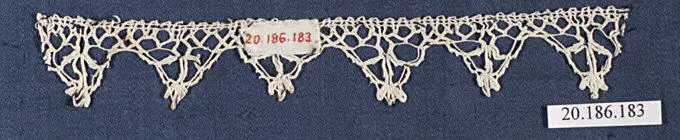
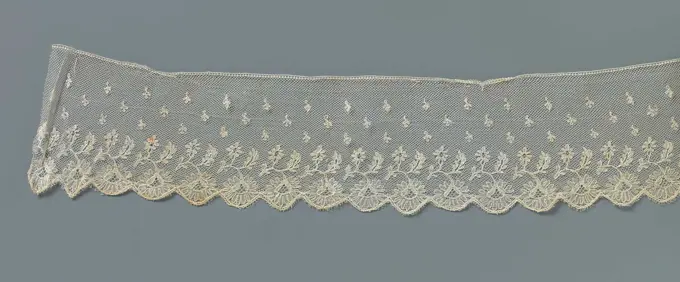
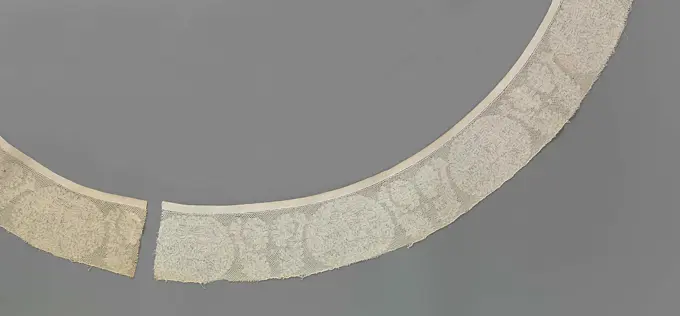
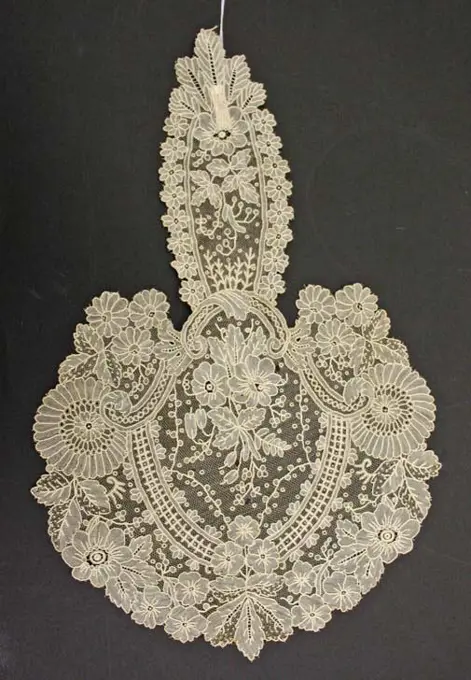
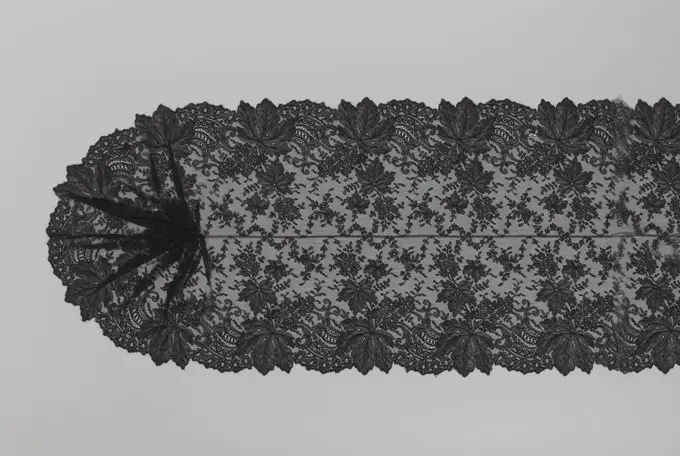
Delicate lace strips featuring intricate patterns and techniques, highlighting traditional craftsmanship from different historical periods.

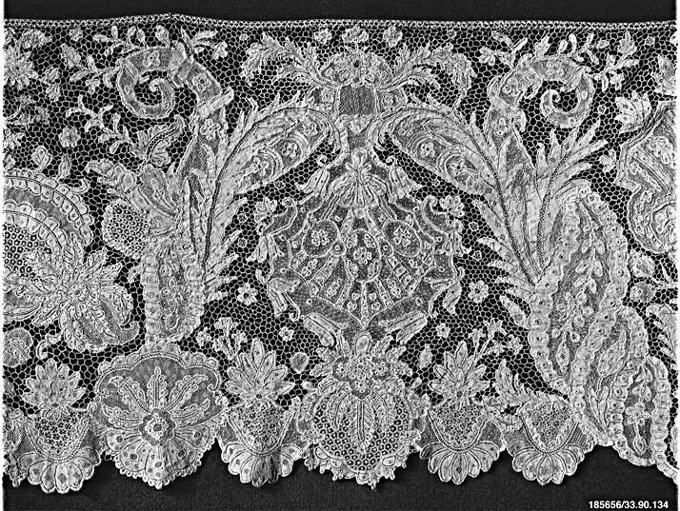
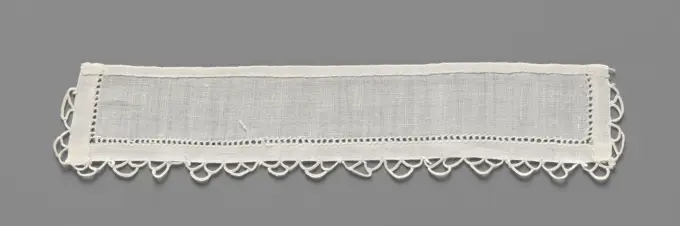
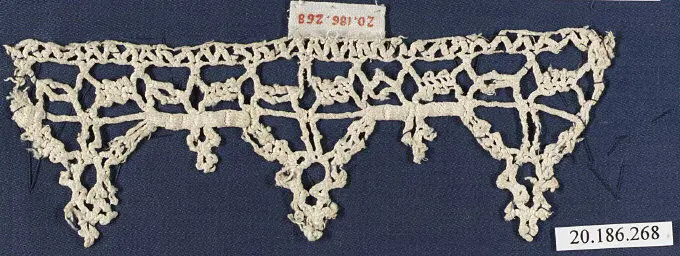
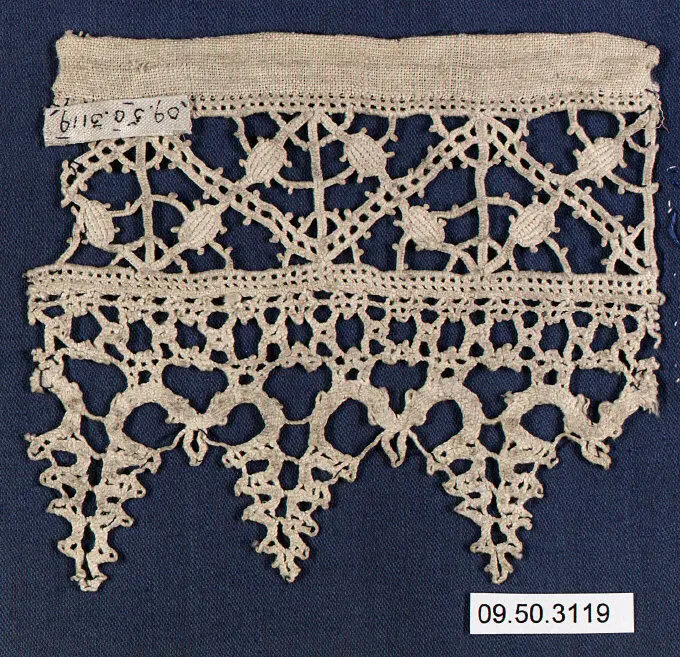
Border; linen
Border; linen
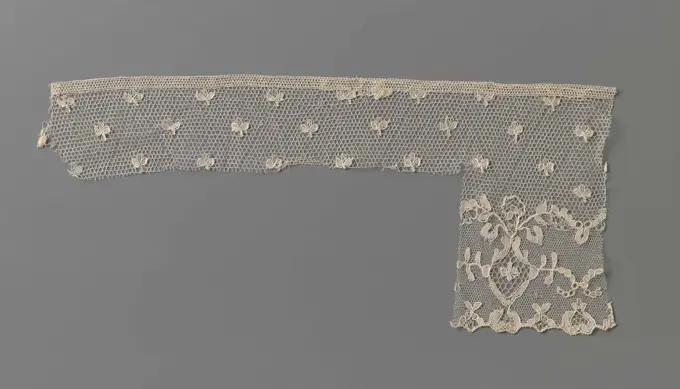
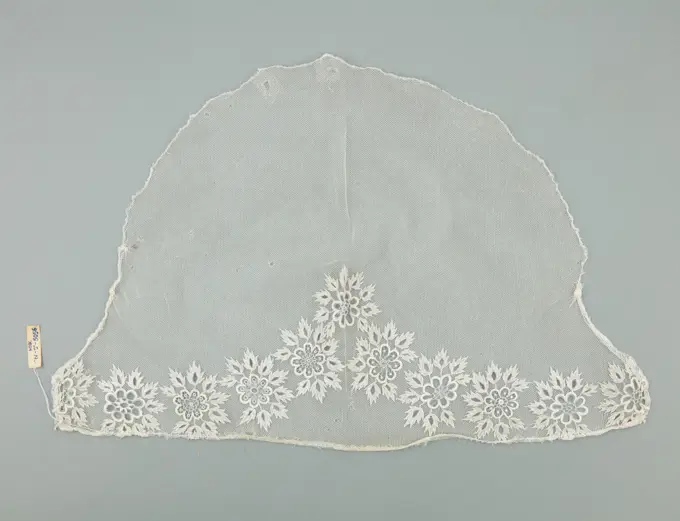
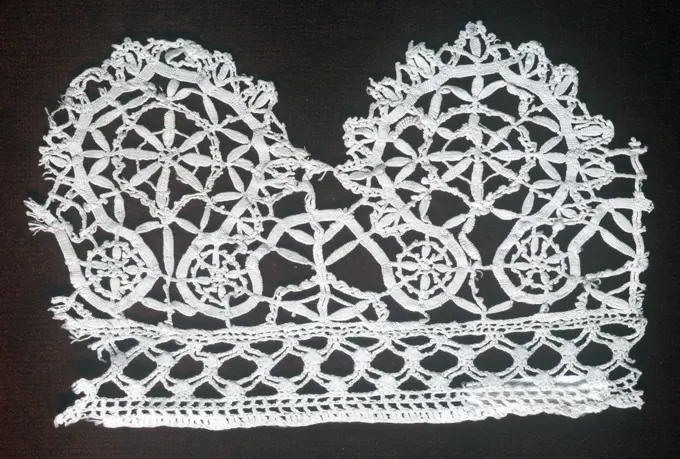
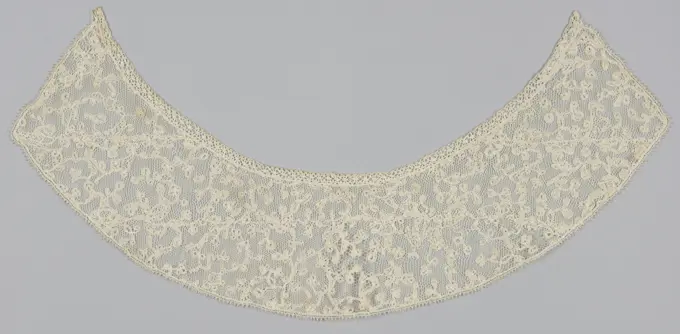
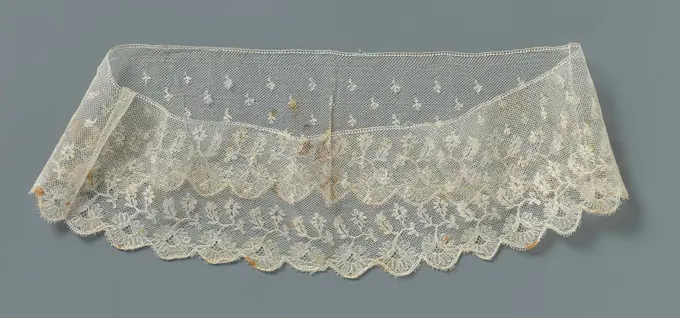
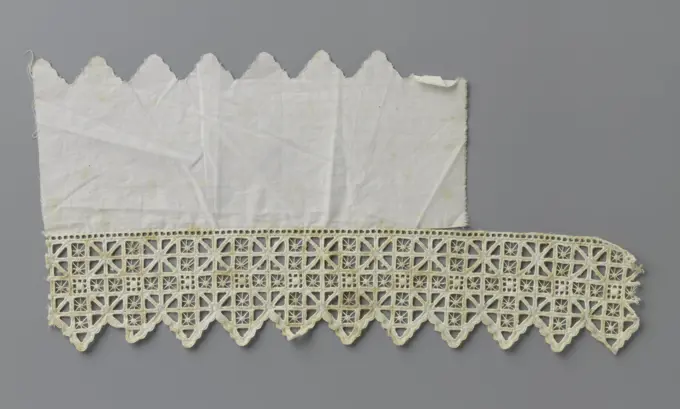
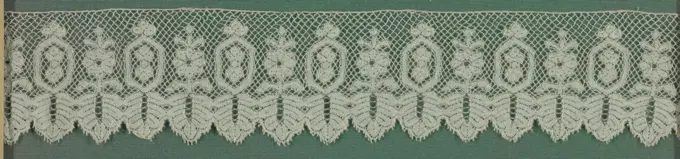
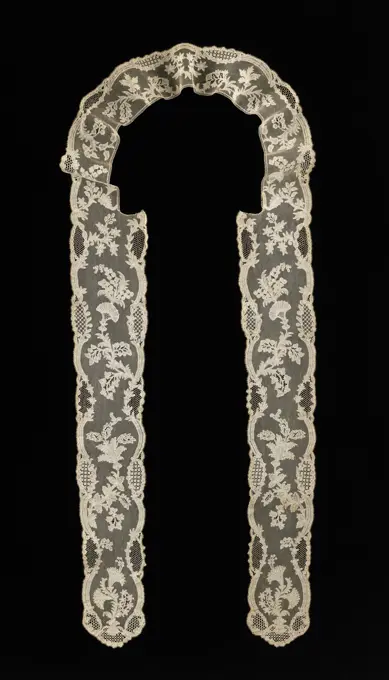
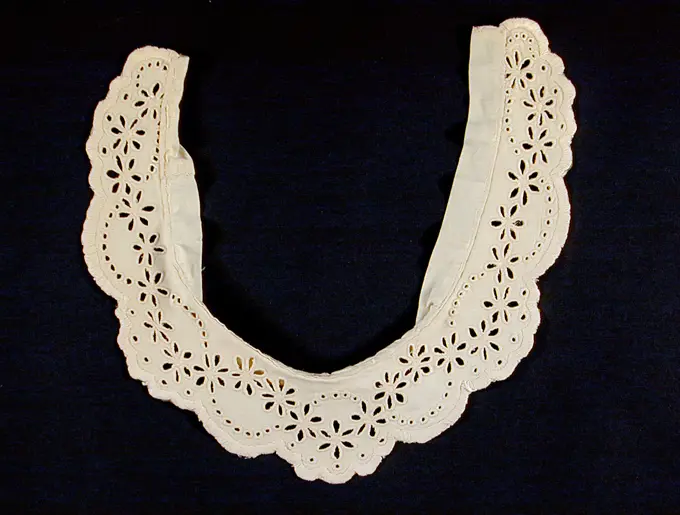
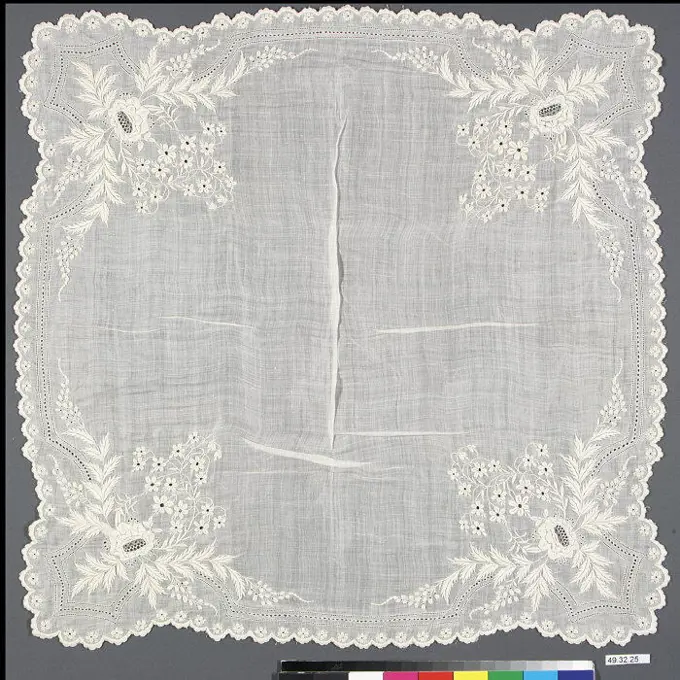
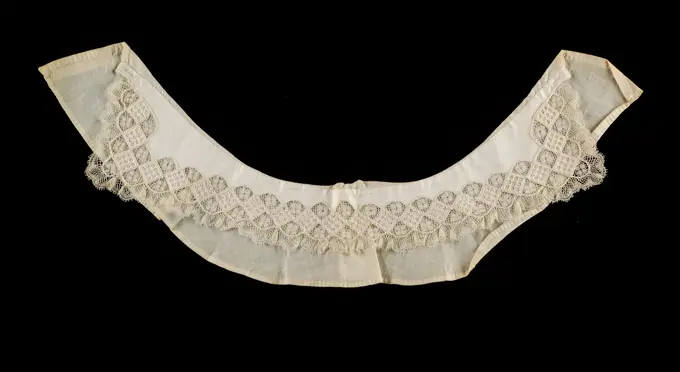
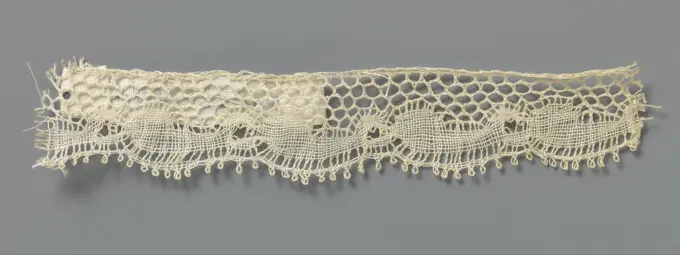
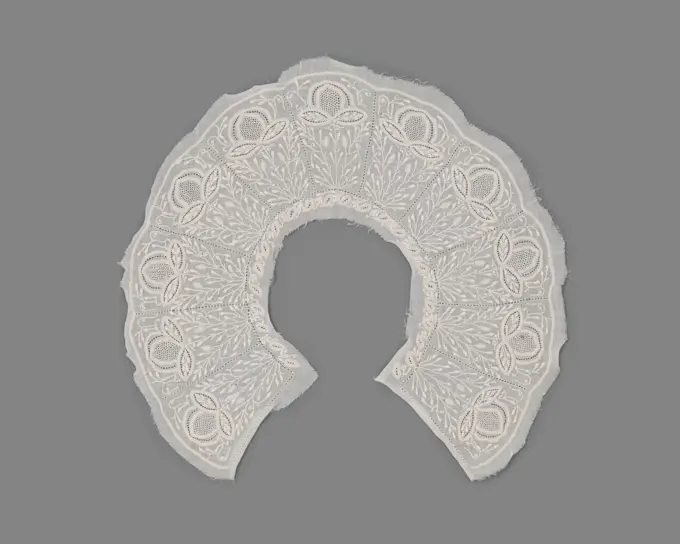
Lace laceVolant van kloskant met ruitvormige medaillons.Volant of natural colosside: Parisian side. The ground has been shared in two in a paris soil with clover leaves at the top and a tulet below. In the last one is a symmetrical pattern of diamond-shaped openwork medallions with sidewalks crowned by a flower between two leaves. The leaves, the side drinks and a series of flowers and ranks in the sculpture are released in three closed garlands. The motifs are made in linen stroke and equipped with contour wires. A rose soil has been applied as ornamental ground. The top edge is shortened and finished with a narrow-sewing band from side. A large rectangle has been cut out of the strip, thereby remaining one diamond-shaped medallion in the bottom edge.Strip bobbin with diamond -shaped field between mirrored fans, anonymous, c. 1840 - c. 1860 Strip of natural -colored bobbin, blonde. The repeating pattern consists of a fan mirrored over the length axis, which forms on the upper and bottom of the strip. In between the mirrored fans, an open -shaped field is formed in which a decorative land is used. The windows are equipped with continuous contour threads that cross each other on the length axis. unknown silk bobbin lace / blonde (lace) Strip of natural -colored bobbin, blonde. The repeating pattern consists of a fan mirrored over the length axis, which forms on the upper and bottom of the strip. In between the mirrored fans, an open -shaped field is formed in which a decorative land is used. The windows are equipped with continuous contour threads that cross each other on the length axis. unknown silk bobbin lace / blonde (lace)Sampler 19th century German. Sampler 228605Kraag van machinale kant met zeven bloemschulpen.Collar of natural machine side, etc. Hemisphere model with a symmetrical pattern of seven large flower shuts. In midfield are four rosette flowers on the imitation bars ground between two fan-shaped flowers. The semicircular faint scalloped inner edge is formed by C-volt and circles.Scarf mid-19th century French. Scarf 102688Border Made 1801-1900 Italy. Linen, knotted thread ground known as filet with darned in patterning .Collar ca. 1861 probably European. Collar 108664Fragment 17th century Italian. Fragment 218786Bliżej Kultury unknownFragment; linen; Bequest of Marian Hague; 1971-50-349Shawl late 18th or early 19th century British. Shawl 120960Collar (Italy); linenBorder; 1974-52-58Bobbin Lace (Needlepoint Design) Edging of Points, second half of 16th century. Italy, Genoa, second half of 16th century. Lace, bobbin; average: 5.8 x 39.1 cm (2 5/16 x 15 3/8 in.).Border late 18th century French. Border 220643Strip of batist with rows of open worked circles and at the bottom a horizontal straight line with two leaves above a sculpes edge, c. 1850 - c. 1899 Strip natural -colored batist with lace bobbins: English embroidery. Pattern with eleven staggered rows of openwork circles where the circles are closer to each other in the bottom row and are larger in size. Below is a continuous straight line with two more or less heart -shaped leaves on both sides. The underside of the strip is finished with a scrap edge with an open -up circle in each shell. The top of the strip is not finished. West-Europa cotton (textile). linen (material). batiste Strip natural -colored batist with lace bobbins: English embroidery. Pattern with eleven staggered rows of openwork circles where the circles are closer to each other in the bottom row and are larger in size. Below is a continuous straight line with two more or less heart -shaped leaves on both sides. The underside of the strip is finished with a scrap edFragment 17th century German or Spanish. Fragment 218093Strook machinale kant met een rij hangende madeliefjes langs de onderzijde.Strip natural-colored mechanical side: Machine Malinois. Under a scattering pattern of three rows of leaves, it consists of a repeating pattern along the underside of the strip from a row of curved stems to which one daisy always hangs down. Two smaller flowers or leaves on the stem are focused up. The motifs are fitted with thicker and shiny contour wires and are connected to each other by a fine machining of Mechelen soil. An ornamental ground has been applied in the flower hearts, mechanical rose land. The top of the strip is straight finished. The slip edge along the underside is finished with picots.Flounce early 18th century French. Flounce 222821Fragment last quarter 18th century French. Fragment 214635Strip of needle side with spiders in squares and a zigza edge, anonymous, c. 1910 - c. 1915 Strip of natural needle side, cut work. Pattern with squares that are alternately crossed with diagonals or horizontal lines, creating stars or fine square grid. Spiders hang in other squares. A zigzag edge at the bottom. The top is finished with a narrow row continuous and opened small squares. At the top, a piece of cotton is sewn at two -thirds of the length. Belgium linen (material). cotton (textile) Strip of natural needle side, cut work. Pattern with squares that are alternately crossed with diagonals or horizontal lines, creating stars or fine square grid. Spiders hang in other squares. A zigzag edge at the bottom. The top is finished with a narrow row continuous and opened small squares. At the top, a piece of cotton is sewn at two -thirds of the length. Belgium linen (material). cotton (textile)Border; linen; 1933-1-227Red or DOILY Van Kloskant with C-Volute and Rosette Flower, Anonymous, c. 1900 - c. 1924  Red or doily of natural -colored bobbin: Bruges flower arrangements. Round model with around the middle piece of Batist. The repeating pattern consists alternately of a C-Volut and Rosette Flower. The motifs have been hit in mains and linen battle with openwork edges. The motives are accentuated by contour threads. A decorative soil has been used in the Bloemharten, a closed pin stroke ground. Between the motifs, some connections were made with double braids with picots, which form three -pointed stars. The scrap edge comes from the pattern and is finished with picots. Used linen (material) bobbin laceCorporal Made 1601-1625 Italy. Linen, plain weave; embroidered in chain and overcast stitches; edged with bobbin straight lace .Collar 19th century British. Collar 79076Strip of needle side with curly tendrils and multifaceted flowers, anonymous, c. 1700 Strip of natural needle side, venise flat. Pattern with richly branched curly tendrils with small multifaceted flowers on an irregular open ground with one -sided potented bars. Volwerk with twisted feston stitches with various motifs in it through recesses. The top is trimmed with a border bobbin. The underside is finished with a straight picot edge with arcs. Venice linen (material) flat Venetian (needle point) Strip of natural needle side, venise flat. Pattern with richly branched curly tendrils with small multifaceted flowers on an irregular open ground with one -sided potented bars. Volwerk with twisted feston stitches with various motifs in it through recesses. The top is trimmed with a border bobbin. The underside is finished with a straight picot edge with arcs. Venice linen (material) flat Venetian (needle point)Border, Medium: linen Technique: bobbin lace (late Valencienne ground), Valenciennes band in design that shows alternating conventionalized motifs placed on pointed leaves which form the border., France, 19th century, lace, BorderBand (Italy); linen; Bequest of Marian Hague; 1971-50-365Border; silkCantal collar with contour threads decorated with two rows of wheels, c. 1850 - c. 1920 Cantal collar with contour threads decorated with two rows of wheels. Round model, scalloped and potented. West-Europa . Cantal collar with contour threads decorated with two rows of wheels. Round model, scalloped and potented. West-Europa .Band, Technique: bobbin lace, Edge of bobbin lace, standing floral scrolls; early 19th century, early 19th century, lace, BandStrip 17th century German. Strip 217752Strip bobbin with fan flower in trapezoidal vase, anonymous, c. 1630 - c. 1640 Strip of natural -colored bobbin, Old Flemish side. Pattern of connected and symmetrical scales that consist of a fan flower hanging downwards with an open flower heart, in a trapezoidal vase. This flower forms the center of the shell and is surrounded by an edge of fan -shaped flowers, which also form the edge of the shell. A larger fan -shaped flour forms the connection between the scallops. The motifs are connected by a braid ground. The motifs are made in linen battle with few recesses, but with openwork edges. The top is trimmed with a border bobbin. Flanders linen (material) bobbin lace / old Flemish lace Strip of natural -colored bobbin, Old Flemish side. Pattern of connected and symmetrical scales that consist of a fan flower hanging downwards with an open flower heart, in a trapezoidal vase. This flower forms the center of the shell and is surrounded by an edge of fan -shaped flowers, which also forGalloon 17th-18th century Italian or French. Galloon 214083Insertion. Italy. Date: 1575-1600. Dimensions: 7.9 x 39.7 cm (3 1/8 x 15 5/8 in.)Width repeat: 10.9 cm (4 1/4 in.). Linen, needle lace worked on a laid and plaited thread grid. Origin: Italy. Museum: The Chicago Art Institute, Chicago, USA.Edging with fringe 16th century Italian, Venice. Edging with fringe 220961Collar 17th century Italian. Collar 102571Pick with needle side pattern on green colored parchment for a needle lane, anonymous, c. 1920 Pick with needle side pattern on green colored parchment for a needle lane. The incentive is strung on a double layer of linen and a start has been made with the incentive and the bottom layer of the tracing lines and filling in parts with needle side stitches. Netherlands parchment (animal material). linen (material) drawing / basting / sewing Pick with needle side pattern on green colored parchment for a needle lane. The incentive is strung on a double layer of linen and a start has been made with the incentive and the bottom layer of the tracing lines and filling in parts with needle side stitches. Netherlands parchment (animal material). linen (material) drawing / basting / sewingEdging ca. 1850 French, Cluny. Edging 221488Pair of Engageantes. France, circa 1770. Costumes. Linen needle lace (point d'Alençon)Lappet 1740-70 European This represents the fine workmanship of 19th century Brussels bobbin lace. Brussels was a major lace making center in this period. The lyrical design of fanciful imaginary flowers set within the delicate reseau (ground) is beautifully rendered. The lace is a continuous piece and designed as lappets, as the mirror image symmetry of the motifs on each side demonstrates. It is rare to find lappets with their original connecting ruffle, as often the lappets are cut from it in later periods.. Lappet 156841Flounce. Italy. Date: 1775-1800. Dimensions: 22.6 x 243.2 cm (8 7/8 x 135 1/8 in.)Width repeat: 42.1 cm (16 1/2 in.). Linen, bobbin part lace (made of continuous clothwork tapes). Origin: Italy. Museum: The Chicago Art Institute, Chicago, USA.Fragment; linenWoman's Collar and Pair of Cuffs. United States, mid to late 19th century. Costumes; ensembles. Linen plain weave, cotton embroideryBorder (Belgium); linenRound collar of clamping side with C volutes. Natural collar collar: Duchesse-side. Flatting around model, which almost forms a closed circle. Within an edge of triple leaves stand pairs of degree of c-volutes and twigs with daisies.Fragment early 17th century Italian, Genoa. Fragment 215488Bonnet Veil; silkDoily. Europe, mid-19th century. Textiles; doilies. Knitted mercerized cottonHandkerchief 1840-50 French. Handkerchief 227428Collar ca. 1860 American. Collar 170398Strip of a climbing side with windows between zigzag lines of openwork circles. Strip natural colosside, sling. The pattern consists of a row of windows between zigzag lines of concerted and openworked circles. Along the underside of DEST smoke hangs a fan-shaped motif under each top in the zigzag line. Along the top, the zigzag line is connected to a maas soil, a tulet. The windows are made in scroll. The open-worked circles are made with an ornamental soil where four wires as an ornamental thread emphasize the contours of the circlesBerthe van Naaldant with spiral ranks, anonymous, c. 1675 - c. 1699 Berthe of natural -colored needle side: flat Venetian side. Pattern: Symmetrical thin terres with large spirals are branched and provided with many flower buds and a few, moderately large, palm flowers. The motifs are made with strongly connected feston stitches, with different patterns in flowers and leaves being realized with recesses. The motifs are connected by relatively long, single and double bars with one or a few composite picots. If the bars are interconnected, a wheel of Picots is applied to the nodes, a so -called Raderpicot. All sides are finished with Raderpicots. Venice linen (material) flat Venetian (needle point) Berthe of natural -colored needle side: flat Venetian side. Pattern: Symmetrical thin terres with large spirals are branched and provided with many flower buds and a few, moderately large, palm flowers. The motifs are made with strongly connected feston stitches, with different patterns in floCap (Belgium); linenLappet (one of a pair) 18th century French or Danish. Lappet (one of a pair) 223022Zakdoek van batist met plumetis borduurwerk en een rand kloskant.Handkerchief of batist with plunity embroidery and a border of the climbing: Valenciennes-side. Square model with rounded corners. The embroidery is exclusively along the edge of the tissue. The pattern consists of a chain of diamonds, alternately worked up and equipped with a star flour, a rosette flower with four leaves and a flower with six round petals. Small leaf packs escaped between the diamonds. The side is slightly wrinkled to the textile and has a repeating pattern of a one-sided direction leaf with a mole with a mole with cutout. The blade emphasizes the pattern along the bottom edge that consists of a chain of lying arcs that form the slip edge. The sloping edge is finished with picots. The motifs are made in linen battle with openwork edges and recesses. The motifs are connected by a grille: a square valenciennes ground.Négligé hat of machine lace strips, anonymous, c. 1905 Négligé hat of machine lace strips. A large sphere has been wrinkled on a tight headband, a lace strip was slightly wrinkled on it. The bulb is composed of two wide lace strips, the scalloped sides of which form the main seam. The pattern consists of single roses per shell, the latter subdivided into sharp points, each of leaves formed. Belgium (possibly) . Négligé hat of machine lace strips. A large sphere has been wrinkled on a tight headband, a lace strip was slightly wrinkled on it. The bulb is composed of two wide lace strips, the scalloped sides of which form the main seam. The pattern consists of single roses per shell, the latter subdivided into sharp points, each of leaves formed. Belgium (possibly) .Maltese lace handkerchief, circa 1900, Malta, maker unknown. Gift of Margaret Hunt, 2010.Fragment (England); white horsehair; Bequest of Marian Hague; 1971-50-455Kerchief. unknown, authorBillfold, Needlepoint, 1761. 1761. Costumes. NeedlepointMachine Lace Collar, 19th century. Flanders, 19th century. Appliqué on machine net: linen; overall: 62.5 x 60.5 cm (24 5/8 x 23 13/16 in.).Fragment; linenFragment, Medium: linen Technique: bobbin lace (provincial style), Fragment with small clothstitch diamond shapes that surround a smaller diamond-shaped frameworks., Europe, 19th century, lace, FragmentChildren's mitaine from crocheted side, anonymous, c. 1800 - c. 1899 Children's mitaine of natural -colored crocheted side. Network of rows of openwork circles and narrow straight tracks with cubes and semi -circles. Something tapered rectangular model. The Mitaine can be tied up above by means of a ribbon. West-Europa cotton (textile) Children's mitaine of natural -colored crocheted side. Network of rows of openwork circles and narrow straight tracks with cubes and semi -circles. Something tapered rectangular model. The Mitaine can be tied up above by means of a ribbon. West-Europa cotton (textile)Border; medium:Mouwstrook van kloskant met losse roosjes.On a fond of square mesh, above small smooth scoops, alternately loose roses and twigs in the form of question marks. Valenciennes side.Handkerchief Made 1801-1900 France. .Shaped Sleeve Ruffle (Engageanté). Italy, Burano. Date: 1760-1769. Dimensions: 17.2 × 90.3 cm (6 3/4 × 35 1/2 in.)Heading height: .4 cm (1/8 in.). Linen, needle lacer. Origin: Burano. Museum: The Chicago Art Institute, Chicago, USA.Edging 17th century Italian. Edging 220993ornament of lace placemat embroidered by crochet vintage knitting craftsmanship - ornament of lace placemat embroidered by crochet ,property released Copyright: xZoonar.com/ValeryxVoennyyx 6641614 ,model released, Symbolfoto ,property releasedCap crown early 19th century Southern German. Cap crown. Southern German. early 19th century. Metal thread. Textiles-EmbroideredExcerpt English embroidery, originating from a blouse, C.I. Bosch Reitz-Teding van Berkhout, c. 1870 Strip natural -colored batist with lace bobbins: English embroidery. The pattern consists of a row of continuous hexagons made with openwork circles, with an open work Margriet in each hexagon. The strip consists of four hex corners, the textile is cut away on the outside, creating a sculpy strip that follows the pattern with the hexagons. The strip is a fragment of a blouse. Amsterdam cotton (textile). batiste Strip natural -colored batist with lace bobbins: English embroidery. The pattern consists of a row of continuous hexagons made with openwork circles, with an open work Margriet in each hexagon. The strip consists of four hex corners, the textile is cut away on the outside, creating a sculpy strip that follows the pattern with the hexagons. The strip is a fragment of a blouse. Amsterdam cotton (textile). batisteFragment; linenBorder ca. 1600 Italian Punto in arialiterally, "stitches in the air"is one of the earliest styles of needle lace, which is itself developed from cutwork of primarily geometric design. When lacemakers transitioned to using a foundation of threads laid out according to a pattern drawn on parchment, they were able to incorporate more fluid lines and curves into their designs.. Border 218003Collar ca. 1861 probably European. Collar 108662Strook machinale kant met een rij hangende madeliefjes langs de onderzijde.Strip natural-colored mechanical side: Machine Malinois. Under a scattering pattern of three rows of leaves, it consists of a repeating pattern along the underside of the strip from a row of curved stems to which one daisy always hangs down. Two smaller flowers or leaves on the stem are focused up. The motifs are fitted with thicker and shiny contour wires and are connected to each other by a fine machining of Mechelen soil. An ornamental ground has been applied in the flower hearts, mechanical rose land. The top of the strip is straight finished. The slip edge along the underside is finished with picots.Strook kloskant met ovale cartouches met links en rechts een pioenroos.Strip natural-colored Dutch clamping side. The strip is bent in such a way that it forms a circle when you put the short sides together. The pattern consists of a repeating symmetrical motif of an oval cartouche from which a large leaf comes down to the left and right, with a relatively small peony. In the cartouche, a symmetrical drawing can be seen from complexing curly leaves, flowers and shapes. The oval cartouches with peonies are connected by a round table ground with braid. The motifs are made in linen stroke with openwork edges. The underside is rightly finished with picots. A woven linen strap has been sewn along the top edge.Cap 1860-80 Belgian. Cap 102550Stola of black mechanical side with volutes between branches and a thin sling.stola or machining Black Silk Side, Imitation Chantilly Side. Pattern With Volutes Between Branches and a Thin Garland.Bobbin Lace Insertion and Edging, mid 16th century. Italy, Venice, mid 16th century. Lace, bobbin; average: 6.4 x 67.4 cm (2 1/2 x 26 9/16 in.).Collar, Medium: linen Technique: bobbin lace, Mechlin-style collar with an ornamental border and compartments enclosing various grounds., England, 19th century, lace, CollarFragment ca. 1810 British, Buckinghamshire. Fragment 212755Cuff of linen batist finished on three sides with open hems and an arc of crocheted side, anonymous, c. 1900 - c. 1910 Cuff of natural -colored batist finished on three sides with a narrow edge of open sewing along the homen: work with pulled out threads. Along one long and two short sides, a scrap edge is made with arcs: crocheted side. Amsterdam linen (material). batiste Cuff of natural -colored batist finished on three sides with a narrow edge of open sewing along the homen: work with pulled out threads. Along one long and two short sides, a scrap edge is made with arcs: crocheted side. Amsterdam linen (material). batisteMail Standard (Collar) 1450-1500 Germany. Iron and brass .Bobbin Lace Edging, 18th century. Italy, Abruzzi, 18th century. Lace, bobbin; average: 1.6 x 22.9 cm (5/8 x 9 in.).Strip bobbin with circles and commas on the bottom, anonymous, c. 1900  Strip of natural-colored bobbin, Valenciennes side. The continuous pattern consists of a succession of a circle and a horizontal comma along the underside of the strip. Above the strip consists of a mesh ground, a round Valenciennes ground. The motifs are made in separate linen battle with openwork edges. The top of the strip is straight finished. The scums along the bottom are finished with picots. Belgium (possibly) cotton (textile) Bobbi Lace / Valenciennes LaceCollar 1825-30 British. Collar 98048Turkish needle work embroidery Ornamental with lace patterns, details, flowersEdging 16th-17th century Italian, Venice. Edging 221078Round lying collar of embroidered batist with a scalloped circumference; The collar is still unfinished, anonymous (manner of), c. 1800 - c. 1860 Round lying collar of embroidered batist with a scalloped circumference. The collar is divided into sectors, which are decorated with different embroidery stitches. The collar is still unfinished. Netherlands cotton (textile) Round lying collar of embroidered batist with a scalloped circumference. The collar is divided into sectors, which are decorated with different embroidery stitches. The collar is still unfinished. Netherlands cotton (textile)Fragment (Italy); linen, black glass beads for eyesTrimming, Medium: silk, Trimming fragment in a design of flowers, leaves and tendrils on scrolling stems in red on a white satin ground with an appliqué of red cord. Narrow red cord (gimp) on both edges., France, 19th century, trimmings, TrimmingBorder (Probably for Table Cloth) Made 1601-1625 Italy. Linen, plain weave; cut and drawn thread work in needle lace fillings; embroidered in bullion, buttonhole, double hem, eyelet, overcast, and satin stitches; couching; edged with macramÈ .Hand-drawn floral wreaths laurels vector imageChildren's hat of Tulle with seven medallions from Valenciennes Kant and embroidered batist with floral motifs, anonymous, c. 1900 - c. 1910 A baby hat of Tulle with oval medallions from Valenciennes side and embroidered batist. Belle Époque. Netherlands batiste. Valenciennes lace A baby hat of Tulle with oval medallions from Valenciennes side and embroidered batist. Belle Époque. Netherlands batiste. Valenciennes laceCooper Union Museum Lace Study Card, Medium: linen Technique: needle lace, Fragment of Argentan lace showing a group of three ornamental leaves or feathers., France, 18th century, lace, Fragment, FragmentCollar. Culture: American. Date: ca. 1860. Museum: Metropolitan Museum of Art, New York, USA.Strip 16th-17th century Italian. Strip 217711