My Boards
View Pictures
  • My Boards

Lunar and Planetary Terrain

Images of lunar and planetary surfaces captured by NASA, showing features like grabens, scarps, and cratered terrains on the Moon and Mercury.

Long Scarps on Mercury Tell of the Planet's Unique History
386 assets in this story
6145-44695647
On January 14, 2008, NASA's MESSENGER flew by Mercury and snapped images of a large portion of the surface that had not been previously seen by spacecraft including numerous craters.
6145-45237736
AS10-32-4845 (18-26 May 1969) --- An Apollo 10 southwest oblique view of the crater Censorinus which is located in the highland terrain bordering the Sea of Tranquility. HOLD PICUTRE WITH WINDOW FRAME AT LOWER LEFT. Censorinus is the bright crater in the lower left of the photograph. Censorinus is about 5 kilometers (about 3 statute miles) in diameter. Immediately to the left of Censorinus is the larger crater Censorinus A. The Sea of Tranquility is to the lower right of the photograph, which was taken from the Command and Service Modules. Censorinus is one of the brighter craters on the lunar surface.
6145-44608053
Large Bright Ripples
6145-58967713
These images from NASA's Dawn spacecraft show Lucaria Tholus on asteroid Vesta, after which Lucaria quadrangle is named. Lucaria Tholus is the large, roughly elliptically shaped hill in the center of the image.
6145-44728466
A Close-Up View of Previously Unseen Terrain
6145-44913174
A Little Perspective
6145-44878143
A Fresh Sight
6145-44564364
Copernicus is 93 km wide and is located within the Mare Imbrium Basin, northern nearside of the Moon (10 degrees N., 20 degrees W.). This image from NASA's Lunar Orbiter shows crater floor, floor mounds, rim, and rayed ejecta.
6145-44788852
The same crater, as seen by NASA's Lunar Reconnaissance Orbiter, under very different lighting. On the left the Sun was midway to the horizon and on the right the Sun was high, approaching noon.
6145-44966455
I'll Be Back!
6145-45059665
This image captured by NASA's 2001 Mars Odyssey spacecraft shows the same crater as yesterday's IR image.
6145-44558121
Valley and Surrounding Terrain Adjacent to Schiaparelli Crater
6145-44868205
Bright and Dark Craters
6145-45021533
It's Complicated
6145-44807896
This image from NASA's Mars Reconnaissance Orbiter shows a swath of a debris apron east of Hellas Basin. Features like this are often found surrounding isolated mountains in this area. Original release date March 3, 2010.
6145-44799512
This daytime infrared image of Kaiser Crater, taken by NASA's 2001 Mars Odyssey spacecraft, shows the majority of the dune field located on the floor of the crater.
6145-44628792
Ascraeus Mons Summit
6145-44625869
Bouldery Impact Ejecta
6145-44780326
This is a synthetic perspective view looking south from the Apollo 16 landing area, topography is rendered naturally as seen by NASA's Lunar Reconnaissance Orbiter.
6145-44881305
This still from an animation made from data obtained by NASA's Dawn spacecraft shows the topography of a portion of the wall and interior of the Rheasilvia impact basin in asteroid Vesta's south-polar region.
6145-44836863
Small Crater at the Southern Rim of Menelaus
6145-44600623
Crumbled Mesa
6145-45235448
AS10-27-3908 (18-26 May 1969) --- An Apollo 10 photograph of the lunar nearside looking westward across Apollo Landing Site 3 in Central Bay. Bruce, the prominent crater in the lower right corner, is about 3.7 statute miles in diameter. Topographic features on the surface of Central Bay are accentuated by the low sun angle.
6145-44682488
This view covers an area within the planned landing area for NASA's Phoenix Mars Lander. It was taken by the Context Camera on NASA's Mars Reconnaissance Orbiter.
6145-44942494
Theophanes the Greek
6145-45259413
NASA's 2001 Mars Odyssey spies what looks like someone smiling back at the spacecraft. Orbit Number 56966 Latitude -26.7035 Longitude 314.5 Instrument IR Captured 2014-10-17 07 05
6145-45031291
This image of a bright-rayed crater on giant asteroid Vesta was taken by the framing camera aboard NASA's Dawn spacecraft. The crater is about 2 miles (3.5 kilometers) in diameter and impacted on the rim of an older crater, named Tuccia.
6145-44880249
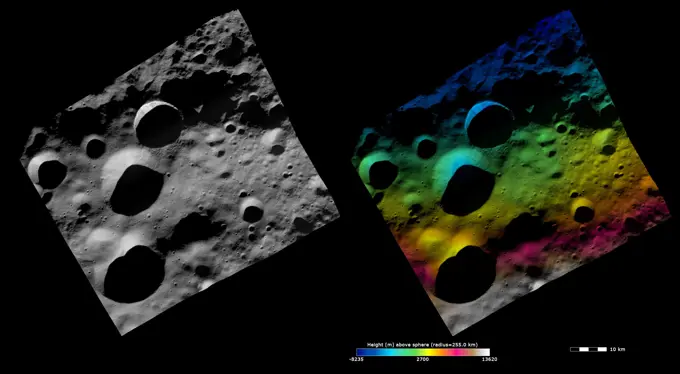
The left-hand image from NASA's Dawn spacecraft shows the apparent brightness of asteroid Vesta's surface. The right-hand image is based on this apparent brightness image, with a color-coded height representation of the topography overlain onto it.
6145-44625126
Crater in Arabia
6145-44505313
Moon Lunar Orbiter-Lunar Orbiter II:  Display Transparencies Lunar Orbiter II from Washington Press Conference. Lunar Orbiter II's telephoto lens took this picture of the floor of the crater Copernicus. -- Photograph published in Winds of Change, 75th Anniversary NASA publication (page 94), by James Schultz.
6145-44842315
This global digital map of Saturn's moon Rhea was created using data obtained by NASA's Cassini and Voyager spacecraft.
6145-44619912
DCS in Hesperia Planum
6145-44978747
New Maps of Mercury!
6145-45065126
Peak-a-boo Eminescu. Images from NASA's MESSENGER spacecraft.
6145-45040149
To Strive, To Seek, To Find, and Not To Yield
6145-44807648
Searching for Evidence of Extension on Mercury
6145-58959271
This series of images shows the area where NASA's Deep Impact probe collided with the surface of comet Tempel 1 in 2005. The view zooms in as the images progress from top left to right, and then bottom left to right.
6145-45031556
These images from NASA's Dawn spacecraft show Gegania crater on asteroid Vesta, after which Gegania quadrangle is named. The image at left shows the albedo (brightness/darkness) of the surface.
6145-45237961
AS17-145-22285 (7-19 Dec. 1972) --- This is a view of the Eratosthenes Crater, taken looking southward from the Command and Service Module (CSM), being piloted by astronaut Ronald E. Evans. Copernicus is on the horizon. The other astronauts are Eugene A. Cernan, commander; and Harrison H. Schmitt, lunar module pilot.
6145-45020670
This anaglyph image from NASA's Dawn spacecraft shows the topography of the mountain-central complex in asteroid Vesta's south polar region. You need 3D glasses to view this image.
6145-45013478
NASA's Dawn spacecraft obtained these images of asteroid Vesta on Aug. 28 (left) and Sept. 9, 2011. These images of the south polar region were taken at a distance of 1,700 miles (2,740 kilometers) with a resolution of about 260 and 130 meters per pixel.
6145-45040666
These images from NASA's Dawn spacecraft show Caparronia crater on asteroid Vesta.
6145-45297206
AS16-120-19242 (16-27 April 1972) --- This 70mm handheld camera's view of the moon, photographed during the Apollo 16 mission's lunar orbit, features Crater Bullialdus, located at approximately 20 degrees south latitude and 20.8 west longitude.
6145-44896306
These images from NASA's Dawn spacecraft are located in asteroid Vesta's Gegania quadrangle, just south of Vesta's equator. Rubria, with dark and bright material is above Divalia Fossa, and Occia, with bright and dark material is below.
6145-44647971
This MOC image shows a pedestal crater superposed on the floor of the much larger Mellish Crater. When an impact crater of this type forms, material is thrown onto the adjacent terrain to form portions of the ejecta blanket
6145-44686184
Seven Possible Cave Skylights on Mars
6145-44620962
Scylla Scopulus
6145-44897339
These apparent brightness and topography images from NASA's Dawn spacecraft are located in asteroid Vesta's Sextilia quadrangle, in Vesta's southern hemisphere.
6145-45067499
MESSENGER Flyover Movie. This frame from a movie consists of 214 images acquired by NASA's MESSENGER's Narrow Angle Camera (NAC) on June 8, 2014.
6145-45292200
The High Resolution Imaging Experiment (HiRISE) camera aboard NASA's Mars Reconnaissance Orbiter (MRO) was able to capture this image of the final location of the heat shield that helped protect NASA's Perseverance rover during its landing on the surface of Mars. The image was taken on Feb. 19, 2021. It is a close-up version of a larger image showing several parts of the Mars 2020 mission landing system that got the rover safely on the ground. These close-ups of Mars 2020 hardware were processed to make them easier to see. A key objective for Perseverance's mission on Mars is astrobiology, including the search for signs of ancient microbial life. The rover will characterize the planet's geology and past climate, pave the way for human exploration of the Red Planet, and be the first mission to collect and cache Martian rock and regolith (broken rock and dust). Subsequent NASA missions, in cooperation with ESA (European Space Agency), would send spacecraft to Mars to collect these sealed
6145-44950314
Mercury, Mercury!
6145-44632698
Eroding Lava Flows
6145-44512961
Atlantis Region on Mars - Mariner 4
6145-45089325
This map shows the single area under continuing evaluation as the InSight mission's Mars landing site, as of a year before the mission's May 2016 launch of flat-lying Elysium Planitia.
6145-44600112
Peridier Crater
6145-44918328
This image shows a close-up of long, narrow, sinuous gullies that scientists on NASA's Dawn mission have found on the giant asteroid Vesta. The crater shown here is called Cornelia.
6145-44894973
A Crater with a Blueberry Center
6145-44976724
256 Shades of Grey
6145-44484711
NASA's Mars Reconnaissance Orbiter captured this image of a meteoroid impact that was later associated with a seismic event detected by the agency's InSight lander using its seismometer. This crater was formed on May 27, 2020. MRO's Context Camera originally located the impact. Then, the spacecraft's High Resolution Imaging Science Experiment (HiRISE) camera captured this scene in color. The ground is not actually blue; this enhanced-color image highlights certain hues in the scene to make details more visible to the human eye - in this case, dust and soil disturbed by the impact.
6145-44606746
Map of Hills on the Horizon
6145-44631910
MOC's 200,001st Image
6145-45031475
These images from NASA's Dawn spacecraft show the 12km diameter Floronia crater on asteroid Vesta, after which Floronia quadrangle is named. Floronia crater is the middle crater in the vertical column of 3 craters.
6145-45031333
These images from NASA's Dawn spacecraft are dominated by the 45km diameter Domitia crater on asteroid Vesta, after which Domitia quadrangle is named.
6145-44731355
A Color Movie of Mercury's Surface
6145-45235463
AS17-137-20989 (12 Dec. 1972) --- A close-up view of the much-publicized orange soil which the Apollo 17 crewmen found at Station 4 (Shorty Crater) during the second Apollo 17 extravehicular activity (EVA) at the Taurus-Littrow landing site. The orange soil was first spotted by scientist-astronaut Harrison H. Schmitt. While astronauts Schmitt and Eugene A. Cernan descended in the Lunar Module (LM) Challenger to explore the lunar surface, astronaut Ronald E. Evans remained with the Apollo 17 Command and Service Modules (CSM) in lunar orbit. The orange soil was never seen by the crewmen of the other lunar landing missions - Apollo 11 (Sea of Tranquility); Apollo 12 (Ocean of Storms); Apollo 14 (Fra Mauro); Apollo 15 (Hadley-Apennines); and Apollo 16 (Descartes).
6145-44844457
MESSENGER Explores Mercury - In Color
6145-44701779
Appreciating Mozart in a New Light
6145-44865306
Goethe - Then and Now
6145-44900065
The four main pieces of hardware that arrived on Mars with NASA's Curiosity rover were spotted by NASA's Mars Reconnaissance Orbiter (MRO) which captured this image about 24 hours after landing.
6145-45062522
Bright and Dark
6145-44723206
As NASA's Phoenix Mars Lander excavates trenches, it also builds piles with most of the material scooped from the holes. The piles, like this one called 'Caterpillar,' provide researchers some information about the soil. 3D glasses are necessary.
6145-29876744
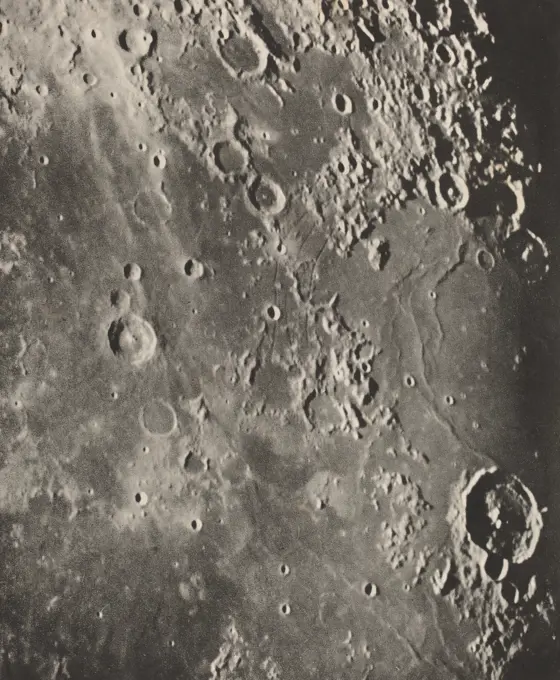
Loewy et Puiseux, Photographie Lunaire Capuanus  Bouillaud  Gassendi, 1896 Photographie Lunaire Capuanus - Bouillaud - Gassendi
6145-44717787
S71-44672 (30 July 1971) --- A near vertical view of the crater Paracelsus (formerly called I.A.U. Crater 365) on the lunar farside, as photographed by the Fairchild metric camera in the Scientific Instrumentation Module (SIM) bay of the Apollo 15 Command and Service Modules (CSM) in lunar orbit. Note mountain peak in center of Paracelsus. The coordinates of the center of Paracelsus are 163 degrees east longitude and 23 degrees south latitude. The second largest crater in the picture is identified as number 364 by the I.A.U. North will be at the top of the picture if held with Paracelsus at top center. The three-inch mapping camera was one of eight lunar orbital science experiments mounted in the SIM bay.
6145-58958817
Rimae Bürg
6145-45027509
These images from NASA's Dawn spacecraft show part of Lucaria Tholus quadrangle in asteroid Vesta's northern hemisphere. Lucaria Tholus quadrangle is in Vesta's heavily cratered northern hemisphere.
6145-44972762
The Colorfield
6145-44509444
Regional Topographic Views of Mars from MOLA
4389-242
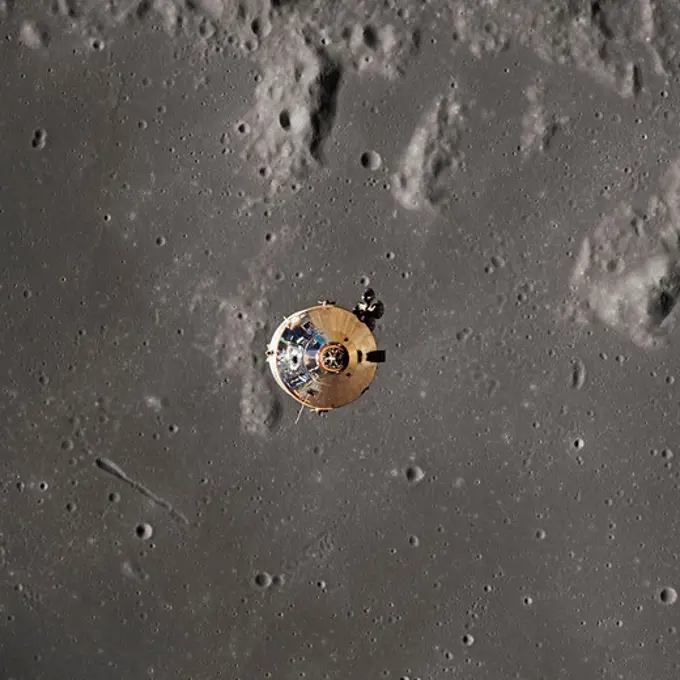
Apollo 11 - The Command Module Framed by the Moon
1746-19670905
View of the Marius Hills pit.
6145-44784665
Rays of Water and Hydroxyl
6145-45112178
NASA's Curiosity Mars rover autonomously selects some of the targets for the laser and telescopic camera of the rover's Chemistry and Camera (ChemCam) instrument.
6145-44495170
MOLA TOPOGRAPHIC MAP
6145-45250514
Released 24 June 2004 This pair of images shows a crater and its ejecta. Day/Night Infrared Pairs The image pairs presented focus on a single surface feature as seen in both the daytime and nighttime by the infrared THEMIS camera. The nighttime image (right) has been rotated 180 degrees to place north at the top. Infrared image interpretation Daytime Infrared images taken during the daytime exhibit both the morphological and thermophysical properties of the surface of Mars. Morphologic details are visible due to the effect of sun-facing slopes receiving more energy than antisun-facing slopes. This creates a warm (bright) slope and cool (dark) slope appearance that mimics the light and shadows of a visible wavelength image. Thermophysical properties are seen in that dust heats up more quickly than rocks. Thus dusty areas are bright and rocky areas are dark. Nighttime Infrared images taken during the nighttime exhibit only the thermophysical properties of the surface of Mars. The effect
6145-44714990
S69-38670 (July 1969) --- A photographic illustration comparing the size of Apollo Landing Site 2 with that of the metropolitan Los Angeles, California area. Site 2 is one of three Apollo 11 lunar landing sites. This will be the landing site if Apollo 11 is launched on July 16, 1969, as scheduled. Site 2 is located at 23 degrees 42 minutes 28 seconds east longitude and 0 degrees 42 minutes 50 seconds north latitude in southwestern Mare Tranquillitatis (Sea of Tranquility). (The white overlay is printed over a lunar surface photograph taken from Apollo 10 during its lunar orbit mission and is numbered AS10-31-4537.)
6145-44617602
Gusev Crater by Day and Night
6145-44714991
S69-38671 (July 1969) --- A photographic illustration comparing the size of Apollo Landing Site 2 with that of the metropolitan Houston, Texas area. Site 2 is one of three Apollo 11 lunar landing sites. This will be the landing site if Apollo 11 is launched on July 16, 1969, as scheduled. Site 2 is located at 23 degrees 42 minutes 28 seconds east longitude and 0 degrees 42 minutes 50 seconds north latitude in southwestern Mare Tranquillitatis (Sea of Tranquility). (The white overlay is printed over a lunar surface photograph taken from Apollo 10 during its lunar orbit mission and is numbered AS10-31-4537.)
PREVIOUS
of 4
NEXT
2401 S. Ervay, Suite 206
Dallas, Texas 75215
United States
Get Started
Free ResearchMy BoardsMy Cart
For Creators
How To License Your ContentContributor PortalFrame of Mind
Resources
API accessPricing
Contact
+1 866 236 0087help@viewpictures.co.uk Contact form
©2026 View Pictures. All Rights Reserved. -A
This site is protected by reCAPTCHA and Google Privacy Policy and Terms of Service apply.