My Boards
View Pictures
  • My Boards

Lunar Exploration Activities

Images of astronauts conducting experiments and driving lunar rovers on the Moon's surface, showcasing science and exploration in a rugged, stark environment.

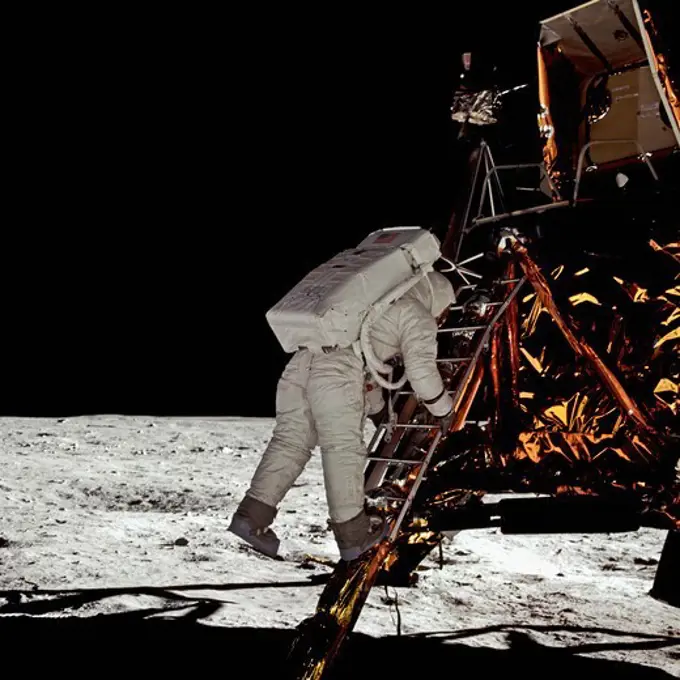
Buzz Aldrin Descends the Ladder to a New World During Apollo 11 Mission
145 assets in this story
4048-8585
Apollo 11 Moon view. Crater Daedalus on the lunar, has a diameter of about 50 miles and is a typical of the rugged terrain on the far side of the Moon.
4389-274
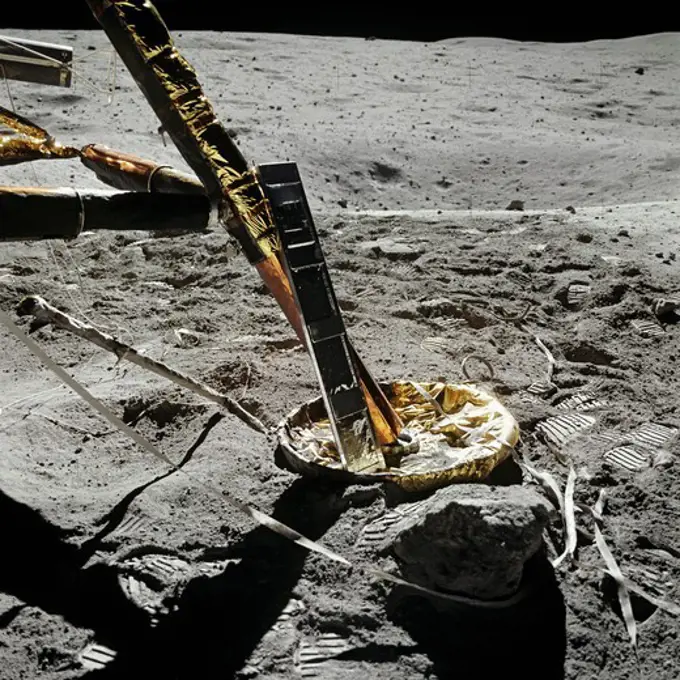
Landing Gear of Apollo 16 Lunar Module Orion
6145-44519522
AS12-46-6795 (19-20 Nov. 1969) --- A view of the lunar surface in the vicinity of the Apollo 12 lunar landing site, photographed during the extravehicular activity (EVA) of astronauts Charles Conrad Jr., commander, and Alan L. Bean, lunar module pilot. Conrad and Bean encountered the odd, anthill-shaped mound during their lunar traverse. The two descended in the Apollo 12 Lunar Module (LM) to explore the moon, while astronaut Richard F. Gordon Jr., command module pilot, remained with the Command and Service Modules (CSM) in lunar orbit.
4239-57495551
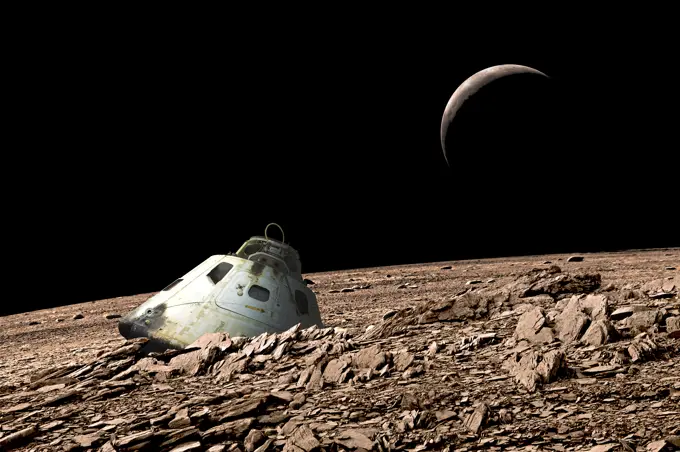
A scorched space capsule lies abandoned on a barren and airless moon.
5507-49029736
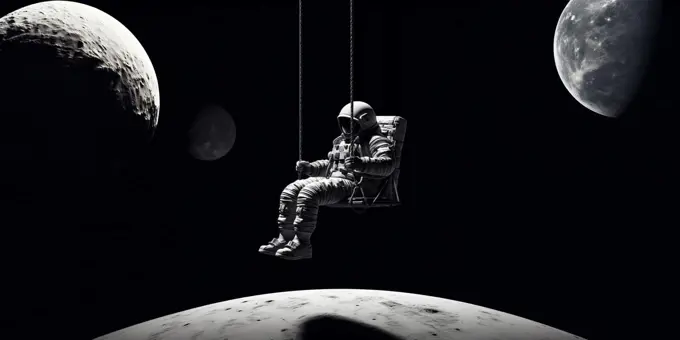
Cosmonaut on a swing in space
1815-65068224
Cute astronaut floating in space between Earth and a moon cartoon illustration.
4128-20039555
Astronaut meeting an alien, illustration
6145-44717526
S71-19500 (6 Feb. 1971) --- The Apollo 14 Lunar Module (LM) ascent stage lifts off the lunar surface and the powerful LM engine causes a brief force of wind which scatters gold-colored foil, covering the LM, and disturbs the U.S. flag. This picture was taken from film exposed by the 16mm data acquisition camera - which was mounted inside the LM.
6145-44716609
S70-46157 (July 1970) --- Astronaut Alan B. Shepard Jr., commander of the Apollo 14 lunar landing mission, participates in lunar surface simulation training at the Kennedy Space Center (KSC). The modular equipment transporter (MET) is in the left background, in the center foreground is a gnomon. The MET, nicknamed the Rickshaw , will serve as a portable work bench with a place for the Apollo lunar hand tools and their carrier, three cameras, two sample container bags, a special environment sample container, spare magazines, and a lunar surface Penetrometer. Shepard is wearing an Extravehicular Mobility Unit (EMU).
6145-29474232
Anefo photo collection. Space exhibition "Lunaart 1969" in RAI. Dolls in space suits are placed. October 7, 1969. Amsterdam, Noord-Holland
4239-57495612
A rover explores a rocky, barren moon.
1525-27319892
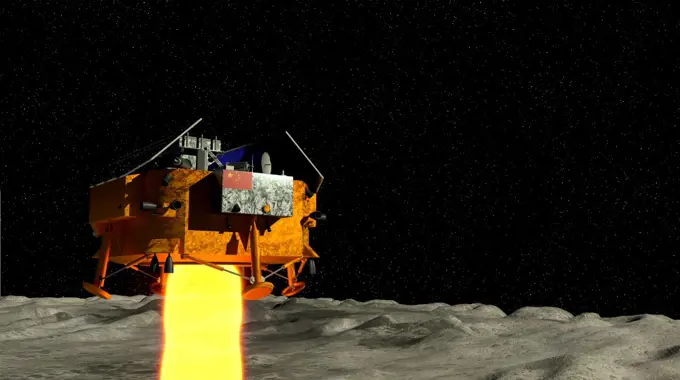
China`s Chang e 4 lunar probe and Yutu 2 Lunar rover landing on surface of moon on January 3, 2019 with the outer space in the background. 3D illustration
6145-44684887
AS14-67-9367 (5 Feb. 1971) --- The Apollo 14 Lunar Module (LM) as seen by the two moon-exploring crewmen of the Apollo 14 lunar landing mission, photographed against a brilliant sun glare during the first extravehicular activity (EVA). A bright trail left in the lunar soil by the two-wheeled modularized equipment transporter (MET) leads from the LM. While astronauts Alan B. Shepard Jr., commander, and Edgar D. Mitchell, lunar module pilot, were exploring the moon, astronaut Stuart A. Roosa, command module pilot, was maneuvering the Command and Service Modules (CSM) in lunar orbit.
6145-45238987
AS12-48-7121 (20 Nov. 1969) --- An excellent view of the unmanned Surveyor 3 spacecraft which was photographed during the Apollo 12 second extravehicular activity (EVA) on the surface of the moon. The Apollo 12 Lunar Module (LM), with astronauts Charles Conrad Jr., commander, and Alan L. Bean, lunar module pilot, aboard landed within 600 feet of Surveyor 3 in the Ocean of Storms. The television camera and several other pieces were taken from Surveyor 3 and brought back to Earth for scientific examination. Surveyor 3 landed on the side of this small crater in the Ocean of Storms on April 19, 1967. Astronaut Richard F. Gordon Jr., command module pilot, remained with the Apollo 12 Command and Service Modules (CSM) in lunar orbit while Conrad and Bean descended to explore the moon.
6145-44526832
S72-55167 (12 Dec. 1972) --- The two moon-exploring Apollo 17 crew men are seen facing the TV camera during the second extravehicular activity (EVA) at the Taurus -Littrow landing site, in this black and white reproduction taken from a color television transmission made by the color TV camera mounted on the Lunar Roving Vehicle (LRV). They are astronauts Eugene A Cernan, on left , commander, and scientist-astronaut Harrison H. Schmitt, lunar module pilot. Astronaut Ronald E. Evans, command module pilot, remained with the Apollo 17 Command and Service Modules (CSM) in lunar orbit.
1525-27039847
One astronaut in the universe near an asteroid to explore it. Astronaut exploring asteroid - 3D render
4389-327
Apollo 14 - The Ultimate Test of Hitting the Bullseye
1899-19513141
(21 April 1972) --- A close-up view of Buster Crater, which was visited by the two moon-exploring crew men of the Apollo 16 lunar landing mission, during the first extravehicular activity (EVA), April 21, 1972.
4239R-3408
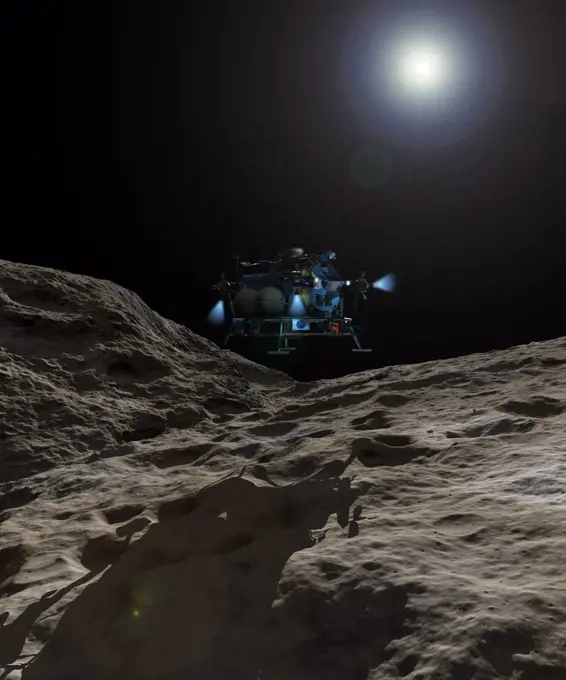
A manned Asteroid Lander approaches the desolate surface of an asteroid in preparation for landing. Thrusts from reaction control units illuminates the dark side of the lander with a ghostly blue light.
6145-52961106
. art001e000263 (Nov. 21, 2022) - A portion of the far side of the Moon looms large just beyond the Orion spacecraft in this image taken on the sixth day of the Artemis I mission by a camera on the tip of one of Orions solar arrays. The spacecraft entered the lunar sphere of influence Sunday, Nov. 20, making the Moon, instead of Earth, the main gravitational force acting on the spacecraft. On Monday, Nov. 21, it came within 80 miles of the lunar surface, the closest approach of the uncrewed Artemis I mission, before moving into a distant retrograde orbit around the Moon. The darkest spot visible near the middle of the image is Mare Orientale.
4186-14309
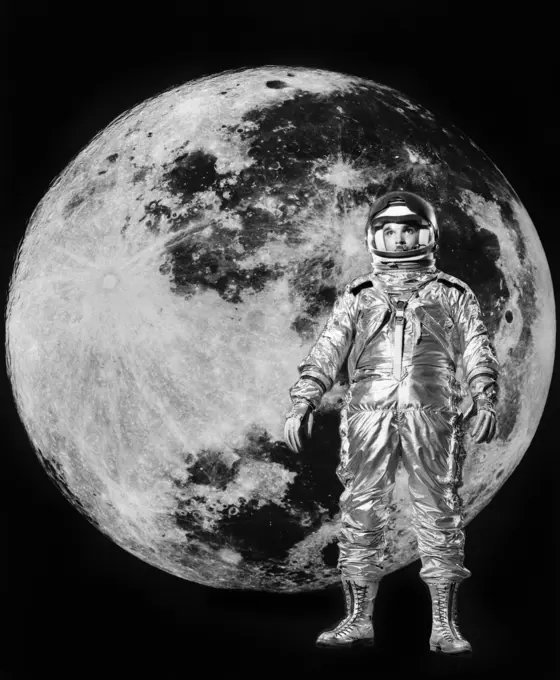
1960S Man In Silver Astronaut Suit With Moon In Background
4389-1802
Apollo 13 EVA Walk-Through
6145-29730652
Buzz Aldrin's Footprint on the Surface of the Moon 1969 National Aeronautics and Space Administration (NASA) American. Buzz Aldrin's Footprint on the Surface of the Moon. National Aeronautics and Space Administration (NASA). 1969. Chromogenic print. Photographs
6145-29217833
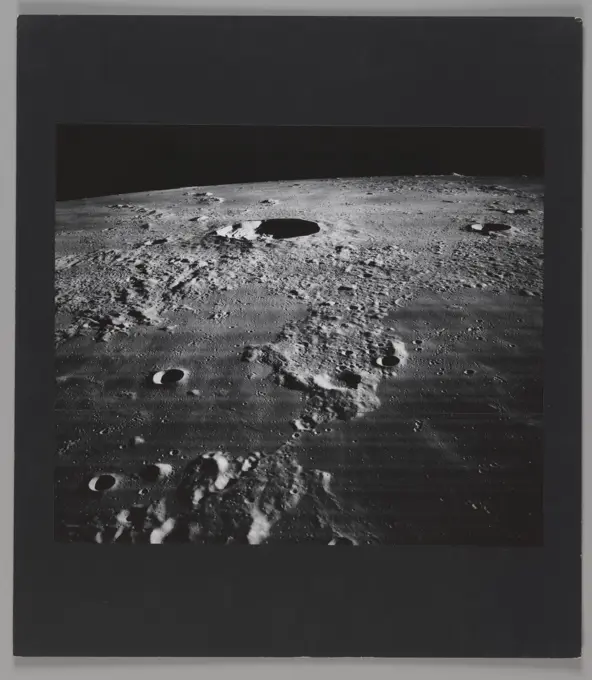
Crater Kepler and Vicinity 1967 National Aeronautics and Space Administration (NASA) This photograph was made as part of the Lunar Orbiter program, a series of five unmanned spacecraft launched into orbit around the Moon in 1966 and 1967. Each spacecraft was equipped with a sophisticated imaging system provided by Eastman Kodak, which consisted of a dual-lens camera, film processing and handling units, and a readout scanner for transmitting the images back to Earth. The main purpose of the program was to select lunar landing sites for NASAs manned Apollo Missions. Over the course of one year, the Lunar Orbiters photographed 99 percent of the Moons surface, producing more than 2,000 images of unprecedented clarity and precision. After the film was processed on board the spacecraft, it was scanned in strips and transmitted to Earth via radio. Technicians at Eastman Kodak in Rochester, New York, created the final images by transferring the strips onto sheets of large-format film, from w
6145-44680192
NASA's Viking Project found a place in history when it became the first U.S. mission to land a spacecraft successfully on the surface of Mars.
6145-44755760
AS16-107-17573 (22 April 1972) --- A close-up view of a block (about 1/2 meter long) found by the two moon-exploring crewmembers of the Apollo 16 lunar landing mission. The block had been rolled over only moments earlier during this Apollo 16 second extravehicular activity (EVA) near South Ray Crater. Astronaut John W. Young, commander, said at the post-mission press conference, The block has been sitting there evidently since South Ray Crater was formed. While astronauts Young and Charles M. Duke Jr., lunar module pilot; descended in the Apollo 16 Lunar Module (LM) Orion to explore the Descartes highlands landing site on the moon, astronaut Thomas K. Mattingly II, command module pilot, remained with the Command and Service Modules (CSM) Casper in lunar orbit.
6145-44718265
S72-33898 (22 March 1972) --- Astronaut Charles M. Duke Jr., Apollo 16 lunar module pilot, trains on a simulated lunar surface area at Kennedy Space Center (KSC), with a core tube with a hammer. Astronauts Duke and John W. Young, commander, will take part in three extravehicular activities on the moon while astronaut Thomas K. Mattingly II, command module pilot, remains with the Command and Service Modules (CSM) in lunar orbit.
6145-45234419
AS17-137-20979 (12 Dec. 1972) --- A close-up view of the lunar roving vehicle (LRV) at the Taurus-Littrow landing site photographed during Apollo 17 lunar surface extravehicular activity. Note the makeshift repair arrangement on the right rear fender of the LRV. During EVA-1 a hammer got underneath the fender and a part of it was knocked off. Astronauts Eugene A. Cernan and Harrison H. Schmitt were reporting a problem with lunar dust because of the damage fender. Following a suggestion from astronaut John W. Young in the Mission Control Center at Houston the crewmen repaired the fender early in EVA-2 using lunar maps and clamps from the optical alignment telescope lamp. Schmitt is seated in the rover. Cernan took this picture.
4128R-9499
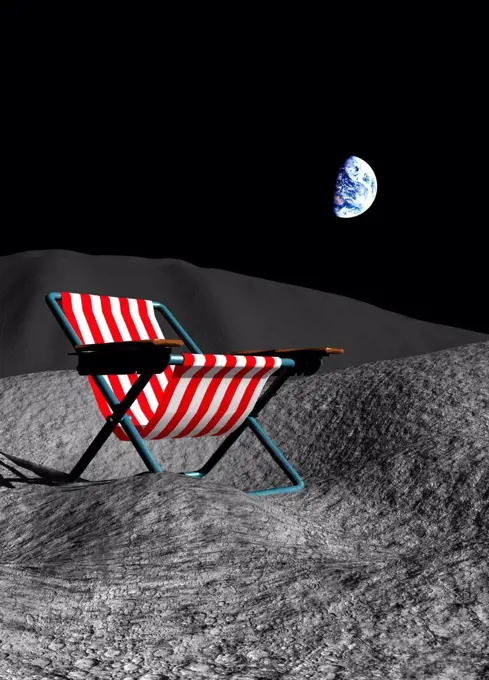
Space tourism, conceptual artwork
1746-111906591
Photograph of the Atlas-Agena booster which would later lift a Ranger capsule into space and land it on the moon. Dated 20th century
6145-45239315
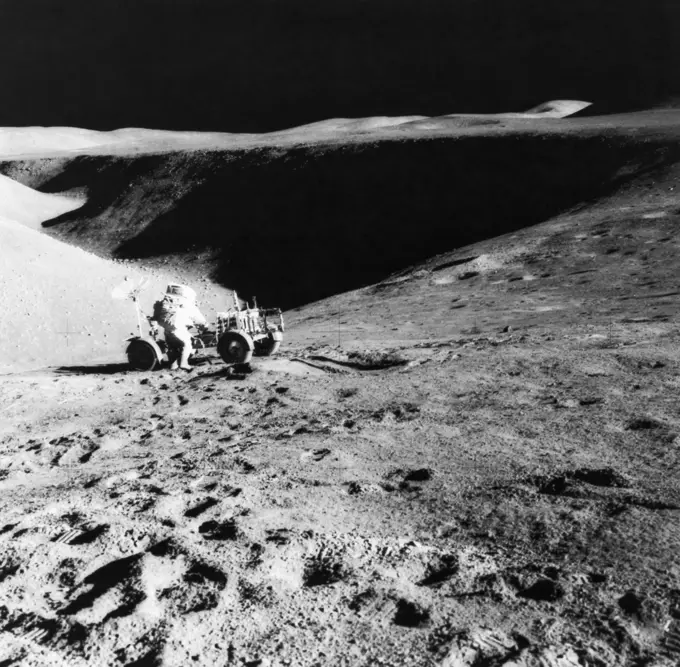
This photograph was taken during the Apollo 15 mission on the lunar surface. Astronaut David R. Scott waits in the Lunar Roving Vehicle (LRV) for astronaut James Irwin for the return trip to the Lunar Module, Falcon, with rocks and soil collected near the Hadley-Apernine landing site. The Apollo 15 was the first mission to use the LRV. Powered by battery, the lightweight electric car greatly increased the range of mobility and productivity on the scientific traverses for astronauts. It weighed 462 pounds (77 pounds on the Moon) and could carry two suited astronauts, their gear and cameras, and several hundred pounds of bagged samples. The LRV's mobility was quite high. It could climb and descend slopes of about 25 degrees. The LRV was designed and developed by the Marshall Space Flight Center and built by the Boeing Company.
4128-20043287
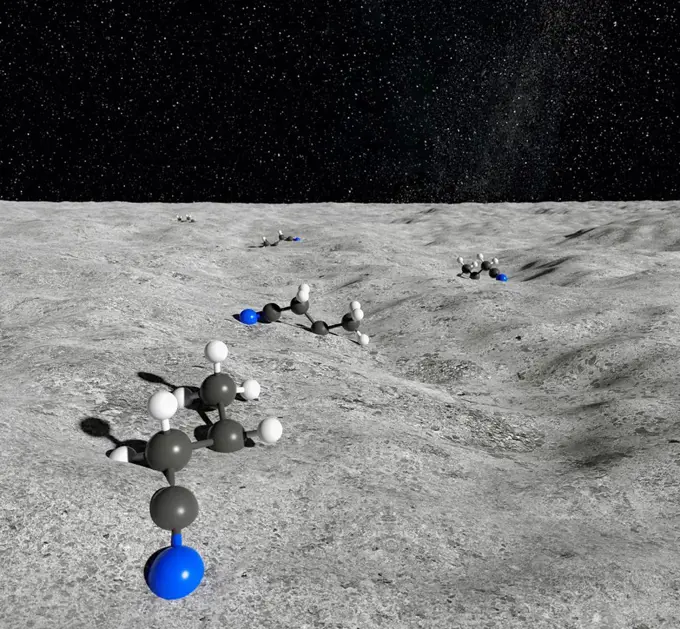
Organic molecules on a lifeless planet, illustration
6145-45236721
AS16-113-18334 (21 April 1972) --- View of the Lunar Module (LM) Orion parked on the lunar surface. During their post mission press conference, the Apollo 16 crewmembers called attention to the steerable S-band antenna, which was frozen in a yaw axis during much of the flight. This view of the LM was photographed by astronaut Charles M. Duke Jr., the lunar module pilot, during the mission's first extravehicular activity (EVA). Astronauts John W. Young, commander, and Duke had earlier descended in the LM to explore the Descartes region of the moon, while astronaut Thomas K. Mattingly II, command module pilot, remained with the Command and Service Modules (CSM) Casper in lunar orbit.
255-22868
Astronaut David Scott and Lunar Roving Vehicle, Apollo 15, 1971
6145-52087635
The squiggly line, produced by a computer using radar signals bounced off Skylab, top, represents the capability of a new facility established in the Space Defense Center last year. ADC satellite watchers use the space object identification techniques to deduce the size, shape, and type of motion of a particular satellite in orbit. Country: Unknown
255-23151
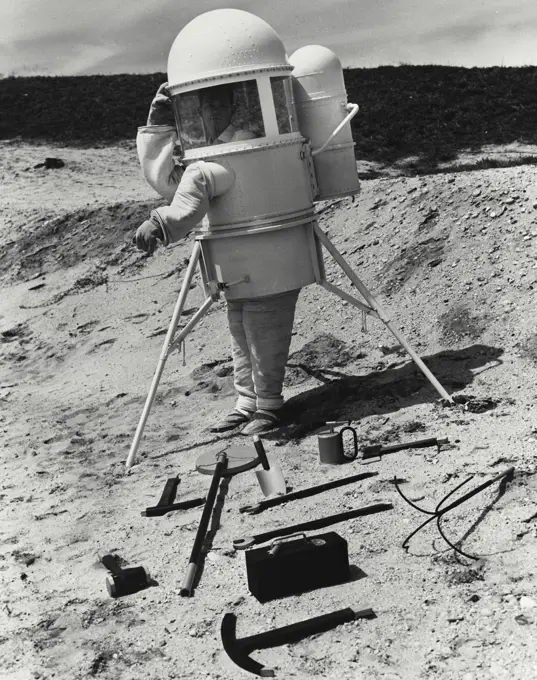
Side profile of a male astronaut wearing an experimental space suit
6145-44521074
CAPE CANAVERAL, Fla. -- Backup Commander John Young, left, and Lunar Module Pilot Charlie Duke are going through a practice exercise for the Apollo 13 mission at a field site at the Kennedy Space Center.
6145-58965746
CAPE CANAVERAL, Fla. -- The Apollo 17 crew took time out from training to pose for the press after the Space Vehicle for their Manned Lunar Landing Mission was moved to Pad A, Complex 39 today. Apollo 17 Commander Eugene A Cernan sits at the controls of the One-G Lunar Roving Vehicle Simulator used to simulate operations on the Moons surface. With Cernan are Lunar Module Pilot Dr. Harrison H. Jack Schmitt, left and Command Module Plot Ronald A. Evans. The Apollo 17 Space Vehicle, scheduled for launch from KSC on the sixth U.S. Manned Lunar Landing Mission on December 6, 1972 is in the background.
7050-76395836
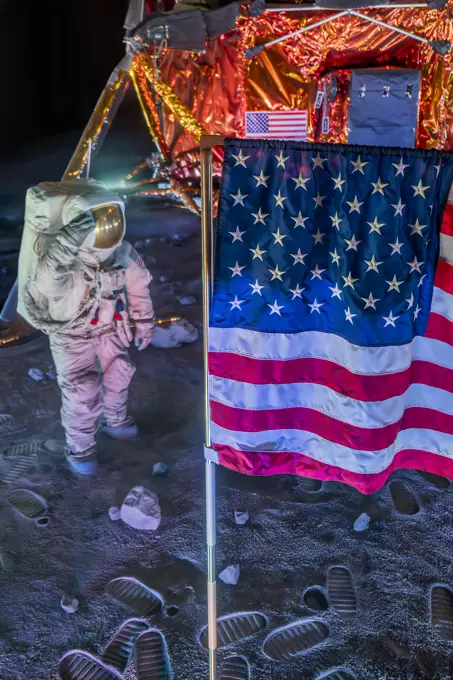
Astronaut on the Moon Display: Inspiring Space Exploration and American Achievement, Florida, Merritt Island, NASA, USA
6188-63904520
Art Culture Museum 25 10 2024 Autostadt Art Museum Exhibition Leandro Erlich Arg Weightless from the Outside, The Artwork Look a Moon Inside, there is a Dome on Which Images of Space, Cities and Street Can be Wolfsburg Lower Saxony GER
6145-44723226
S64-20199 (10 Sept. 1964) --- View of the Gemini-4 prime crew and backup crew in pressure suits. They are standing around a model of the Gemini spacecraft. From left to right are astronauts Edward H. White II, pilot; James A. McDivitt, command pilot; Frank Borman and James A. Lovell Jr., backup crew.
6145-58965772
CAPE CANAVERAL, Fla. -- Apollo 17 Astronauts, Eugene A. Cernan, left, and Harrison H. Schmitt conduct simulated lunar surface activity in preparation for their launch to the moon with Ronald E. Evans. The three space pilots will be launched to the moon aboard an Apollo_Saturn V space vehicle no earlier than December 6, 1972.
6145-45167219
NASA's 60th Anniversary exhibits are seen at the Kennedy Center, Thursday, May 31, 2018 in Washington.
6145-44626303
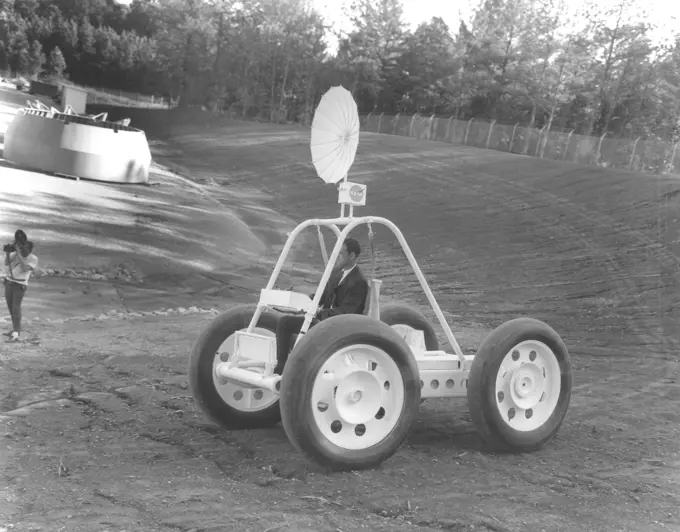
Built by Brown Engineering company of Huntsville, Alabama, a motorized mockup of a small Lunar Roving Vehicle (LRV) is being demonstrated at the Marshall Space Flight Center (MSFC). This particular vehicle weighed about 1200 pounds and is almost 10 feet long, 7-feet and 2-inches wide, and 7-feet and 8-inches high. The LRV was developed under the direction of MSFC to provide astronauts with greater mobility on the lunar surface.
6145-29545917
Anefo photo collection. Pieter van Vollenhoven received a Dutch flag on Paleis Lange Voorhout from American Astronaut Jim Irwin, who had been on the moon 5 days. Flag and photo framed. September 26, 1980
PREVIOUS
of 2
NEXT
2401 S. Ervay, Suite 206
Dallas, Texas 75215
United States
Get Started
Free ResearchMy BoardsMy Cart
For Creators
How To License Your ContentContributor PortalFrame of Mind
Resources
API accessPricing
Contact
+1 866 236 0087help@viewpictures.co.uk Contact form
©2026 View Pictures. All Rights Reserved. -A
This site is protected by reCAPTCHA and Google Privacy Policy and Terms of Service apply.