My Boards
View Pictures
  • My Boards

Lunar Exploration Views

Diverse views of the lunar surface from Apollo missions, showcasing craters, lunar modules, astronauts, and the harsh, rocky landscape under a black sky.

Apollo 15 Astronaut Saluting on the Moon With the Lunar Lander Falcon and Rover
143 assets in this story
4389-302
Apollo 17 - The Moon Craters Eratosthenes and Copernicus
6145-44503497
S65-30273 (3 June 1965) --- Astronaut Edward H. White II, pilot on the Gemini-Titan IV (GT-4) spaceflight, floats in the zero gravity of space outside the Gemini IV spacecraft. His face is covered by a shaded visor to protect him from the unfiltered rays of the sun. White became the first American astronaut to walk in space. He remained outside the spacecraft for 21 minutes during the third revolution of the Gemini IV mission. He wears a specially designed spacesuit for the EVA. His right hand is holding the Hand-Held Self-Maneuvering Unit (HHSMU), with which he controlled his movements while in space, and a camera is attached to the HHSMU. He was attached to the spacecraft by a 25-feet umbilical line and a 23-feet tether line, both wrapped together with gold tape to form one cord. He wears an emergency oxygen supply check pack. Astronaut James A. McDivitt is command pilot for the GT-4 mission. The mission was a four-day, 62-revolution flight, during which McDivitt and White performed
6177-V53837474
6145-44520055
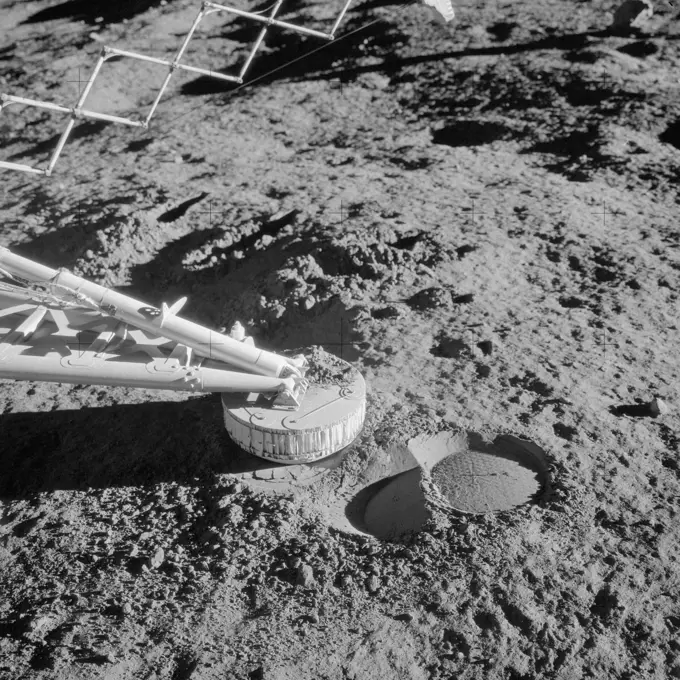
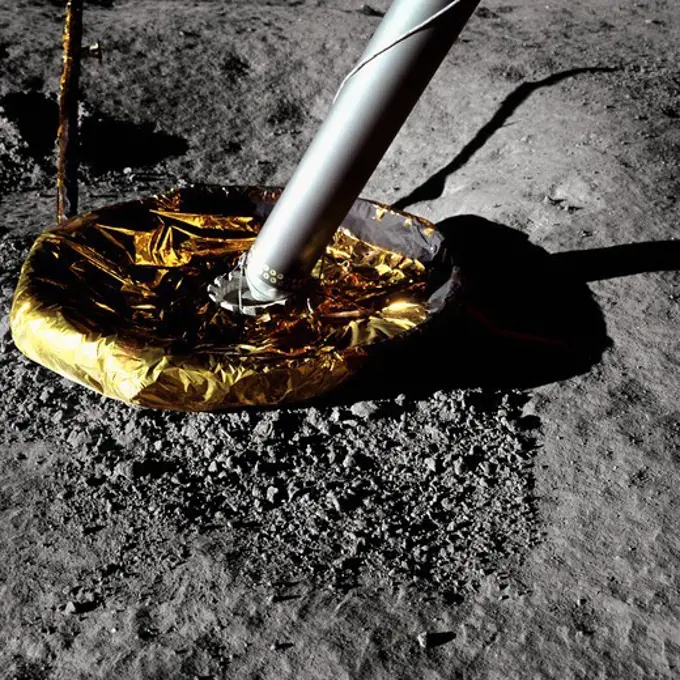
AS12-48-7110 (20 Nov. 1969) --- A close-up view of a footpad and surface sampler with scoop (arm, out of frame) on the Surveyor 3 spacecraft which was photographed by the Apollo 12 astronauts during their second extravehicular activity (EVA) on the moon. The Apollo 12 Lunar Module (LM), with astronauts Charles Conrad Jr. and Alan L. Bean aboard, touched down in the Ocean of Storms only 600 feet from Surveyor 3. The television camera and several other pieces were taken from Surveyor 3 and brought back to Earth for scientific examination. The unmanned spacecraft soft-landed on the moon on April 19, 1967. Note the imprint in the lunar soil which was caused when the Surveyor 3 bounced upon landing.
6145-45172115
LOLA Cockpit and LOLA Gimbal
6145-45237746
AS11-37-5545 (20 July 1969) --- The flag of the United States, deployed on the surface of the moon, dominates this photograph taken from inside the Lunar Module (LM). The footprints of astronauts Neil A. Armstrong and Edwin E. Aldrin Jr. stand out very clearly. In the far background is the deployed black and white lunar surface television camera which televised the Apollo 11 lunar surface extravehicular activity (EVA). While astronauts Armstrong, commander, and Aldrin, lunar module pilot, descended in the Lunar Module (LM) Eagle to explore the Sea of Tranquility region of the moon, astronaut Michael Collins, command module pilot, remained with the Command and Service Modules (CSM) Columbia in lunar orbit.
6145-44684052
The first manned lunar landing mission, Apollo 11, launched from the Kennedy Space Flight Center (KSC) in Florida via the Marshall Space Flight Center (MSFC) developed Saturn V launch vehicle on July 16, 1969 and safely returned to Earth on July 24, 1969. Astronauts onboard included Neil A. Armstrong, commander; Michael Collins, Command Module (CM) pilot; and Edwin E. Aldrin, Jr., Lunar Module (LM) pilot. The CM, Columbia”, piloted by Collins, remained in a parking orbit around the Moon while the LM, Eagle'', carrying astronauts Armstrong and Aldrin, landed on the Moon in the Sea of Tranquility. On July 20, 1969, Armstrong was the first human to ever stand on the lunar surface, followed by Aldrin. During 2½ hours of surface exploration, the crew set up experiments, collected 47 pounds of lunar surface material for analysis back on Earth, planted the U.S Flag, and left a message for all mankind. In this photograph, Armstrong is removing scientific equipment from a storage bay of the L
6145-44716275
S70-31774 (March 1970) --- An artist's concept by Teledyne Ryan Aeronautical, San Diego, California, showing two Apollo 13 astronauts exploring the surface of the moon. In the center background is the Lunar Module (LM). Apollo 13 will land in the rugged highlands just north of Fra Mauro. The crew of the Apollo 13 lunar landing mission will be astronauts James A. Lovell Jr., commander; Thomas K. Mattingly II, command module pilot; and Fred W. Haise Jr., lunar module pilot. Lovell and Haise are represented by the two men in this picture.
1570R-130654
An American flag on the moon
1899-61092
Man On The Moon, Apollo 17, Eugene A. Cernan, 12/72
1525-27319888
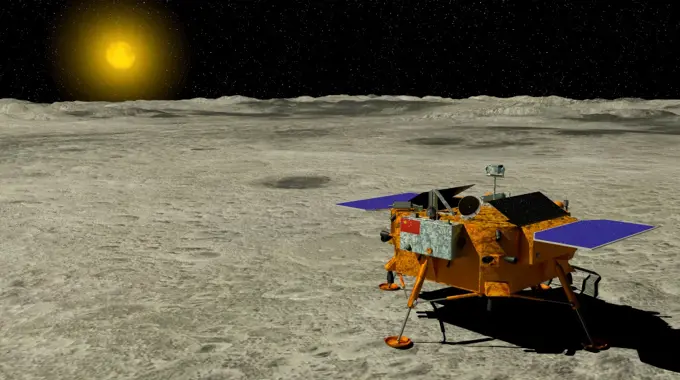
China`s Chang e 4 lunar probe landed on the surface of the moon on January 3, 2019 with the sun in the background. 3D illustration
4239-57497147
Astronaut on moon surface
4239-57495578
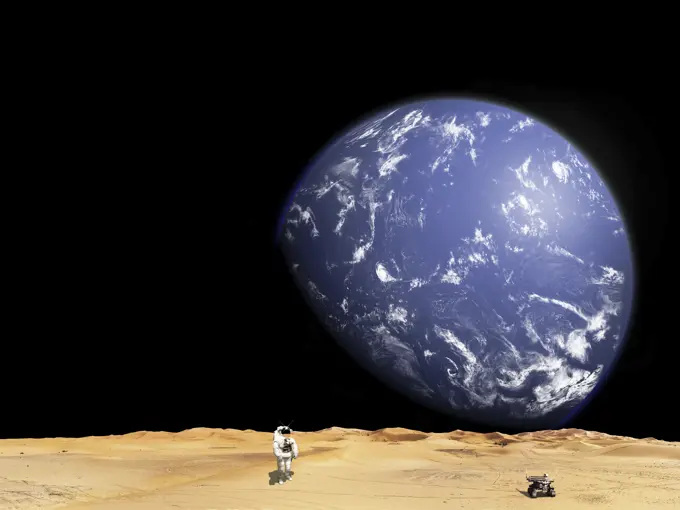
An astronaut works with his rover while exploring a barren moon.
4093-20542
Astronaut John W. Young  Commander of the Apollo 16 mission  replaces tools in the hand tool carrier at the aft end of the Rover Lunar Roving Vehicle (LRV) during the second Apollo 16 extravehicular activity (EVA-2) at the Descartes landing site.
4389-237
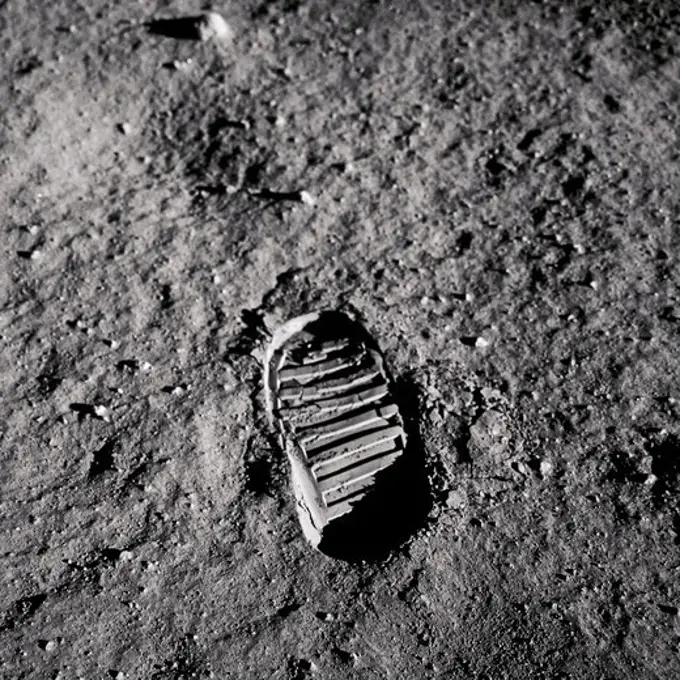
Apollo 11 - Footprint on an Alien World
4239R-8760
First astronaut on the moon floating next to American flag with Earth in the background.
6145-45230266
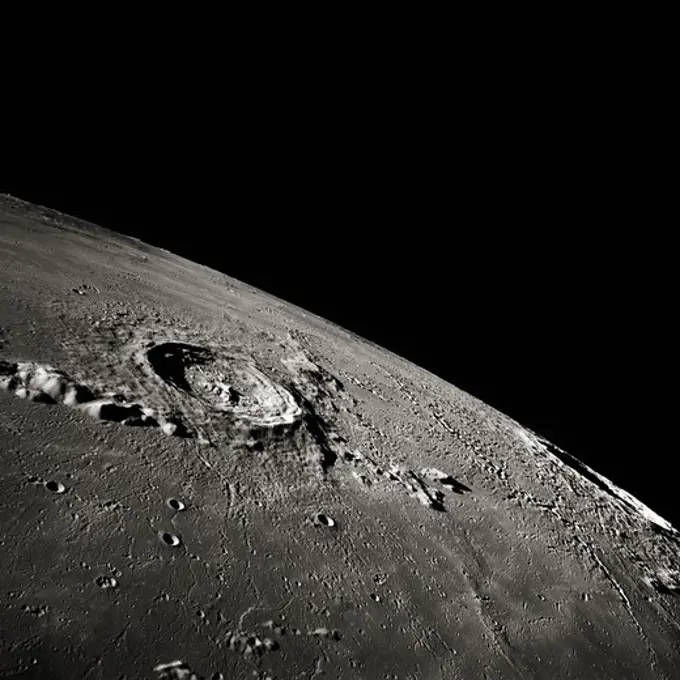
Lunar Orbiter 2 oblique northward view towards Copernicus crater on the Moon shows crater wall slumping caused by soil liquefaction following the impact that formed the crater. The crater is about 100 km in diameter. The central peaks are visible towards the top of the image, rising about 400 m above the crater floor, and stretching for about 15 km. The northern wall of the crater is in the background. Sand and soil grains have faces that can cause friction as they roll and slide against each other, or even cause sticking and form small voids between grains. This complex behavior can cause soil to behave like a liquid under certain conditions such as earthquakes or when powders are handled in industrial processes. MGM experiments aboard the Space Shuttle use the microgravity of space to simulate this behavior under conditions that carnot be achieved in laboratory tests on Earth. MGM is shedding light on the behavior of fine-grain materials under low effective stresses. Applications inc
6145-29890342
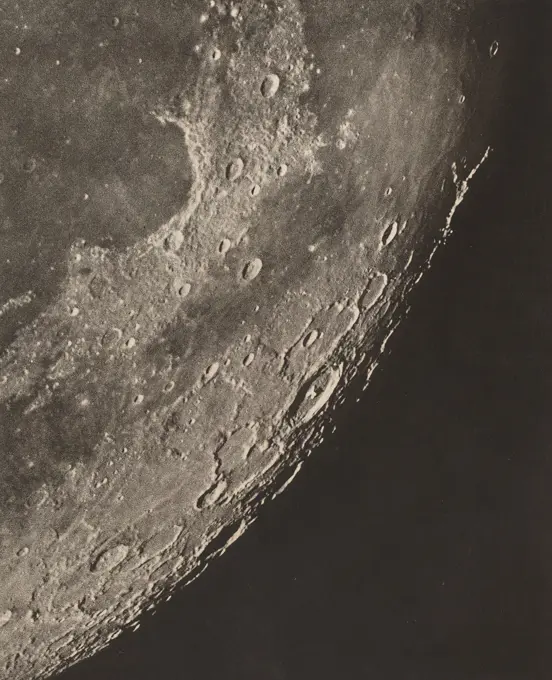
Charles le Morvan, Carte photographique de la lune, 1904 Carte photographique de la lune
4220-21916965
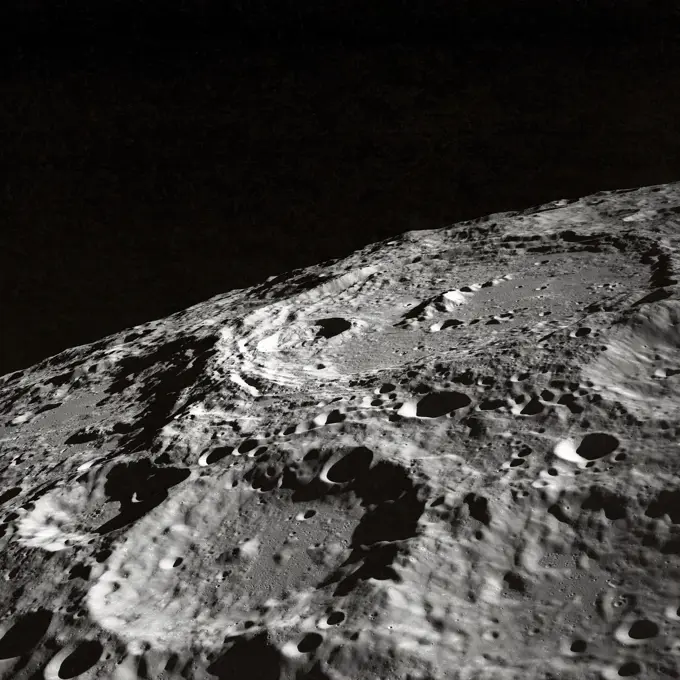
Oblique view of the surface of  the moon photographed by  Apollo 10 astronauts who aimed  a 70mm camera at the surface  from lunar orbit      Date: 1 May 1969
4128R-11289022
Moon, computer artwork.
6145-44569925
Test subject sitting at the controls: Project LOLA or Lunar Orbit and Landing Approach was a simulator built at Langley to study problems related to landing on the lunar surface. It was a complex project that cost nearly $2 million dollars. James Hansen wrote: "This simulator was designed to provide a pilot with a detailed visual encounter with the lunar surface; the machine consisted primarily of a cockpit, a closed-circuit TV system, and four large murals or scale models representing portions of the lunar surface as seen from various altitudes. The pilot in the cockpit moved along a track past these murals which would accustom him to the visual cues for controlling a spacecraft in the vicinity of the moon. Unfortunately, such a simulation--although great fun and quite aesthetic--was not helpful because flight in lunar orbit posed no special problems other than the rendezvous with the LEM, which the device did not simulate. Not long after the end of Apollo, the expensive machine was d
1746-111906436
Satellite image of Earth with cumulonimbus cloud formations. Dated 20th century
4220-21916956
The world's first view of  Earth taken by a spacecraft  from the vicinity of the moon.  Photo transmitted to Earth by  United States Lunar Orbiter I  on its 16th orbit     Date: 23 August 1966
4093R-1876
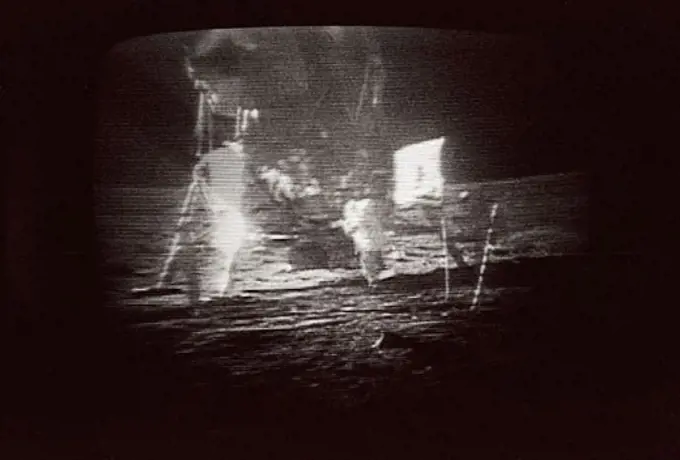
Aviat lunar landing moon space television
1570R-130661
An American flag and footprint on the moon
1570R-130650
A footprint on the moon
6145-54410651
Project 30-65 - Operation Plumbob (Nevada Test Site) Test Activities. Project 8.3B, view of hole-post-PRISCILLA, Series of 3 photos (1 of 3). Photographs of Atmospheric Nuclear Testing at Pacific Island and Nevada Test Sites.
6145-44514509
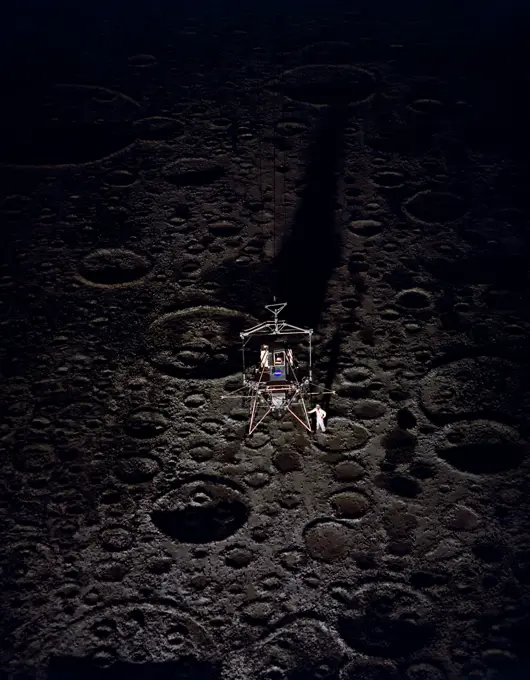
Lunar Landing Module photographed at night at the Lunar Landing Research Facility. Gantry facility 1297. Upright cockpit design lander over  moonscape  pavement at LLRF. 69-4872 was published in Winds of Change, 75th Anniversary Publication of NASA, P.88, by James Schultz.
4239R-20480091
This oblique view of the Moon's surface was photographed by the Apollo 10 astronauts in May of 1969.
6145-44516892
JOHNSON SPACE CENTER, HOUSTON, TEXAS  - Surrounded by Man's footprints on the lunar surface, Apollo 11 Lunar Module Pilot Edwin E. Aldrin Jr. erects a solar wind experiment near the Tranquility Base established by the Lunar Module, Eagle.
6145-45236718
AS14-68-9452 (5-6 Feb. 1971) --- A hammer and a small collection bag lie atop a lunar boulder to give some indication of size in this view of several boulders clustered together. This is one of the white rocks from which samples were taken by the two moon-exploring crew men of the Apollo 14 lunar landing mission. While astronauts Alan B. Shepard Jr., commander, and Edgar D. Mitchell, lunar module pilot, were exploring the moon, astronaut Stuart A. Roosa, command module pilot, remained with the Command and Service Modules (CSM) in lunar orbit.
1899-19513206
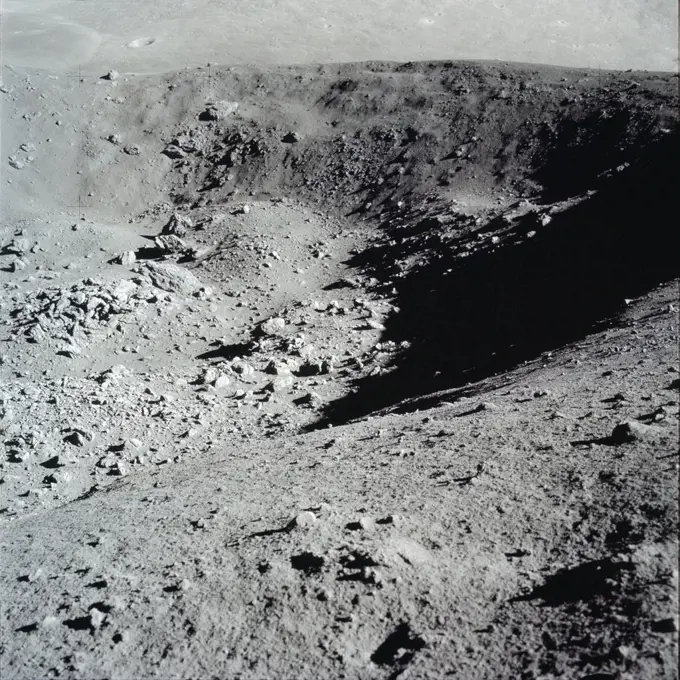
(12 Dec. 1972) --- A view looking into Shorty Crater, taken at Station 4, showing the orange soil. Astronaut Harrison H. Schmitt found the orange soil on the moon during the second Apollo 17 extravehicular activity (EVA) at the Taurus-Littrow landing site.
4239-69155130
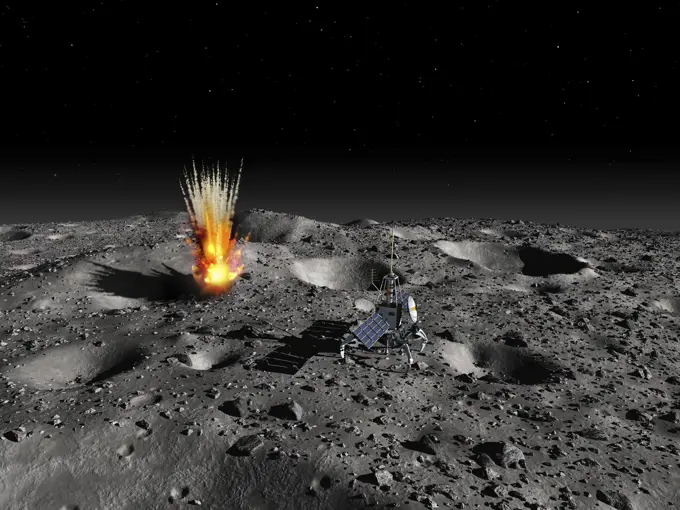
A robotic probe drills into the surface of an asteroid as a meteorite strikes nearby.
4389-324
Landing Gear of Apollo 14 Lunar Module Antares
255-29058489
Vintage Photograph. Photomosaic of 1/6 of the earths surface.
6145-45239477
This photograph taken during the Apollo 17 mission (the last mission of the Apollo Program), depicts stiff plasticized maps being taped together and fastened by clamps to patch a broken fender of the Lunar Roving Vehicle (LRV). Powered by battery, the lightweight electric car greatly increased the range of mobility and productivity on the scientific traverses for astronauts. It weighed 462 pounds (77 pounds on the Moon) and could carry two suited astronauts, their gear and cameras, and several hundred pounds of bagged samples. The LRV's mobility was quite high. It could climb and descend slopes of about 25 degrees. The LRV was designed and developed by the Marshall Space Flight Center and built by the Boeing Company.
6145-45244594
Dr. William R. Lucas, Marshall's fourth Center Director (1974-1986), delivers a speech in front of a picture of the lunar landscape with Earth looming in the background while attending a Huntsville Chamber of Commerce reception honoring his achievements as Director of Marshall Space Flight Center (MSFC).
6188-63904519
Kunst Kultur Museum 25.10.2024 Wolfsburg Autostadt Kunstmuseum Ausstellung Leandro Erlich ARG-schwerelos- Von außen sieht das Kunstwerk aus wie ein Mond. Innen gibt es eine Kuppel auf der Bilder vom Weltraum, Städten und Straßen zu sehen sind.. Wolfsburg Niedersachsen GER *** Art Culture Museum 25 10 2024 Wolfsburg Autostadt Art Museum Exhibition Leandro Erlich ARG weightless From the outside, the artwork looks like a moon Inside, there is a dome on which images of space, cities and streets can be seen Wolfsburg Lower Saxony GER
4389-264
Apollo 16 - Photo of a Family Photo on the Surface of the Moon
4389-1825
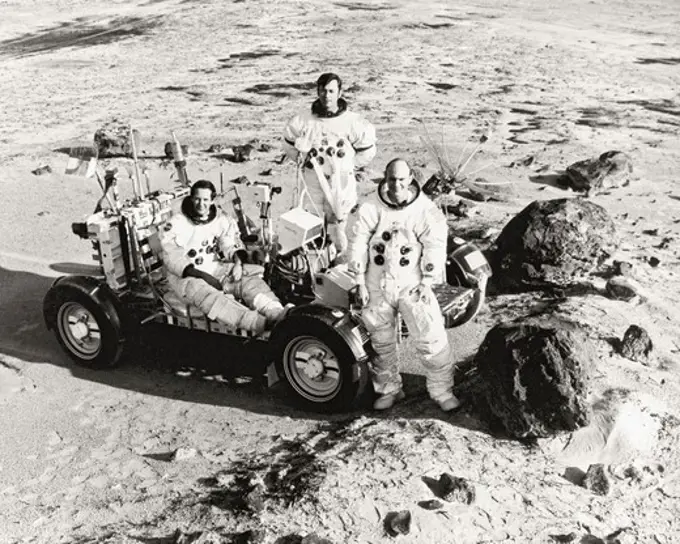
Apollo 16 Astronauts Train for Lunar Landing Mission
6145-55943995
Apollo 16, 1972, Charles Duke, Family Photograph on Lunar Surface, #76 Apollo 16 mission. 1972. Photographs. The Miriam and Ira D. Wallach Division of Art, Prints and Photographs: Photography Collection. Astronomy, Astronomical photography, Apollo 16 (Spacecraft)
6145-58965911
MESSENGER puts its Stamp on History
6145-44620976
This is a photo of the Apollo 15 Lunar Module, Falcon, on the lunar surface. Apollo 15 launched from Kennedy Space Center (KSC) on July 26, 1971 via a Saturn V launch vehicle. Aboard was a crew of three astronauts including David R. Scott, Mission Commander; James B. Irwin, Lunar Module Pilot; and Alfred M. Worden, Command Module Pilot. The first mission designed to explore the Moon over longer periods, greater ranges and with more instruments for the collection of scientific data than on previous missions, the mission included the introduction of a $40,000,000 lunar roving vehicle (LRV) that reached a top speed of 16 kph (10 mph) across the Moon's surface. The successful Apollo 15 lunar landing mission was the first in a series of three advanced missions planned for the Apollo program. The primary scientific objectives were to observe the lunar surface, survey and sample material and surface features in a preselected area of the Hadley-Apennine region, setup and activation of surface
PREVIOUS
of 2
NEXT
2401 S. Ervay, Suite 206
Dallas, Texas 75215
United States
Get Started
Free ResearchMy BoardsMy Cart
For Creators
How To License Your ContentContributor PortalFrame of Mind
Resources
API accessPricing
Contact
+1 866 236 0087help@viewpictures.co.uk Contact form
©2026 View Pictures. All Rights Reserved. -A
This site is protected by reCAPTCHA and Google Privacy Policy and Terms of Service apply.