My Boards
View Pictures
  • My Boards

Mars and Planetary Imagery

Black and white images from Mars Odyssey showing various Martian terrains, emphasizing geological features and polar caps.

Detail of an Impact Crater, Acidalia Planitia
236 assets in this story
1746-19670887
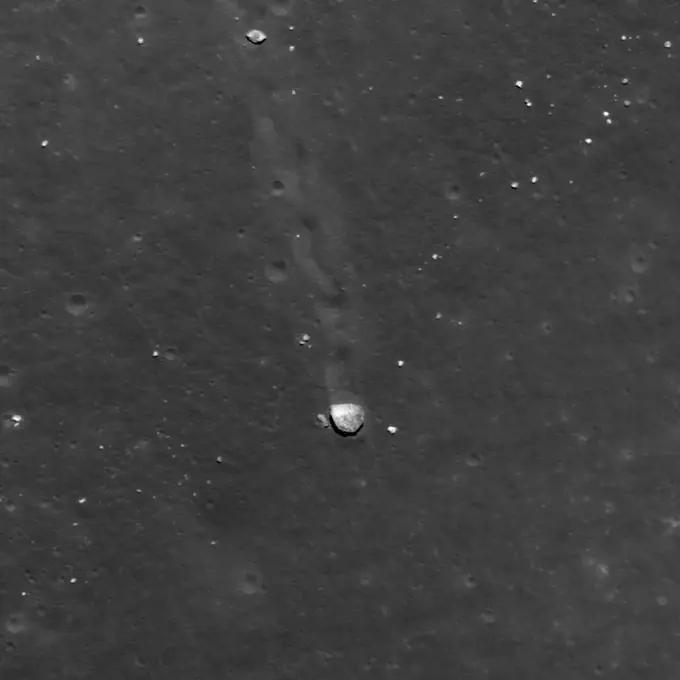
Close up of a boulder on the central peak of crater Gassendi.
6145-58971916
The complex dune forms in this VIS image are located on the floor of Russell Crater. The large ridge dune is unique to Russell Crater. Russell Crater is located in Noachis Terra and is 135km (83miles) in diameter. Orbit Number 83200 Latitude -54.3721 Longitude 12.9113 Instrument VIS Captured 2020-09-15 23 24
6145-44554460
Portions of the lander's deflated airbags and a petal are at lower left in this image from NASA's Mars Pathfinder. 3D glasses are necessary to identify surface detail.
6145-45103694
A protected area within the Nasca World Heritage Site in Peru that has experienced apparent disturbance between two different observations by NASA's Uninhabited Aerial Vehicle Synthetic Aperture Radar (UAVSAR).
6145-44607268
Spirit's Hardware Up Close on Mars
6145-52301541
Aerial view of a part of the area affected during the flood disaster of 1953. Note: The description of this photo is not yet complete and will be supplemented on the basis of the data available at a later stage. However, of many photos of the flood disaster 1953, the location is unknown.
6145-45262786
The THEMIS VIS camera contains 5 filters. The data from different filters can be combined in multiple ways to create a false color image. These false color images may reveal subtle variations of the surface not easily identified in a single band image. Today's false color image shows several craters and plains of Terra Cimmeria. Orbit Number 59979 Latitude -39.2993 Longitude 159.815 Instrument VIS Captured 2015-06-22 09 17
6145-44809948
Saturn's moon Atlas, just below the center of this image taken by NASA's Cassini spacecraft, orbits in the Roche Division between the A ring and thin F ring.
6145-52961072
. Proctor Crater Dunes - False Color. The THEMIS VIS camera contains 5 filters. The data from different filters can be combined in multiple ways to create a false color image. These false color images may reveal subtle variations of the surface not easily identified in a single band image. Today's false color image shows Proctor Crater and the large dune field on the crater floor. These dunes are composed of basaltic sand that has collected in the bottom of the crater. The topographic depression of the crater forms a sand trap that prevents the sand from escaping. Dune fields are common in the bottoms of craters on Mars and appear as dark splotches that lean up against the downwind walls of the craters. Dunes are useful for studying both the geology and meteorology of Mars. The sand forms by erosion of larger rocks, but it is unclear when and where this erosion took place on Mars or how such large volumes of sand could be formed. The dunes also indicate the local wind directions by the
6145-44614669
'Blueberry' Exposed
6145-45261237
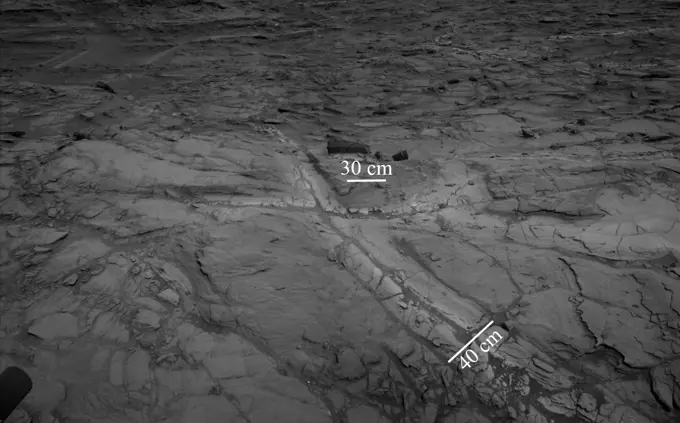
Pale zones called halos border bedrock fractures visible in this 2015 image from NASA's Curiosity Mars rover which has been darkened (a previously released image can be seen at PIA20268). Measurements overlaid on the image offer a sense of scale for the size of these fractures. The rover team determined that the halos are rich in silica, a clue to the duration of wet environmental conditions long ago. The location is on the lower slope of Mars' Mount Sharp. Curiosity's Navigation Camera (Navcam) acquired the component images of this mosaic on Aug. 23, 2015, during the 1.083rd Martian day, or sol, of the mission. The location is along the rover's path between Marias Pass and Bridger Basin. In this region, the rover has found fracture zones to be associated with rock compositions enriched in silica, relative to surrounding bedrock.
6145-44608584
Third MOC View of Opportunity Landing Site
6145-44693583
Cryptic Terrain on Mars
6145-44615749
This 3-D cylindrical-perspective mosaic was created from navigation camera images that NASA's Mars Exploration Rover Spirit captured on on sol 121. 3D glasses are necessary to view this image.
6177-V54994004
6145-44629055
On Mar. 8, 2005, NASA's Mars Exploration Rover Opportunity drove 95 meters (312 feet) toward 'Vostok Crater' that sol before taking images. 3D glasses are necessary to view this image.
6145-45128493
NASA's Cassini spacecraft captured these remarkable views of a propeller feature in Saturn's A ring on Feb. 21, 2017. These are the sharpest images taken of a propeller (nickedname 'Santos-Dumond') so far.
6145-44917365
NASA acquired July 15, 2012 On July 15, 2012, the Visible Infrared Imaging Radiometer Suite (VIIRS) on the Suomi NPP satellite captured this nighttime view of the aurora australis, or southern lights,” over Antartica’s Queen Maud Land and the Princess Ragnhild Coast.The image was captured by the VIIRS day-night band,” which detects light in a range of wavelengths from green to near-infrared and uses filtering techniques to observe signals such as city lights, auroras, wildfires, and reflected moonlight. In the case of the image above, the sensor detected the visible auroral light emissions as energetic particles rained down from Earth’s magnetosphere and into the gases of the upper atmosphere. The slightly jagged appearance of the auroral lines is a function of the rapid dance of the energetic particles at the same time that the satellite is moving and the VIIRS sensor is scanning.The yellow box in the top image depicts the area shown in the lower close-up image. Light from the
6145-44498247
This image of Neptune shows the discovery of shadows in Neptune's atmosphere, shadows cast onto a deep cloud band by small elevated clouds. They are the first cloud shadows ever seen by NASA's Voyager on any planet.
6145-44712126
Rasped Soil Sample in Phoenix Scoop
6145-45252842
This image shows one of the closest views of Xanadu Regio, a large bright region on Titan's surface, which also can be seen in a more distant view taken earlier (see PIA06185). In this close-up view, brightness variations can be seen within Xanadu. The bright material on Titan is thought to be more water-ice rich, while darker regions may indicate areas where more hydrocarbon-rich material has collected. It is not clear from the patterns seen here what processes caused them. However, this image is just a single piece of a larger 5 by 5-frame mosaic that covers the western part of Xanadu and the dark area that lies farther to the west. When the complete mosaic is assembled, larger-scale patterns may be identified that will help to reveal the processes that have shaped Titan's surface. The area shown here is approximately 700 kilometers (435 miles) across, centered at roughly 16 south, 133 west on Titan. Three narrow-angle camera images taken with the Cassini spacecraft in wavelengths of
6145-44817335
This image uses a view from the navigation camera on NASA's Mars Exploration Rover Opportunity to show context for a horizon shot by the rover's narrower-angle panoramic camera of the rim of Endeavour crater.
6145-44718049
S72-01716 (July 1972) --- An oblique view of the Taurus-Littrow area on the lunar nearside, as photographed from the Apollo 15 spacecraft in lunar orbit. This is an enlarged view. The X marks the landing site of the scheduled Apollo 17 lunar landing mission. The overlay points out several features in the photograph. The coordinates of the Apollo 17 touchdown point are 30 degrees 44 minutes 58 seconds east longitude and 20 degrees 9 minutes 50 seconds north latitude.
6145-52961057
. Terra Sirenum - False Color. The THEMIS VIS camera contains 5 filters. The data from different filters can be combined in multiple ways to create a false color image. These false color images may reveal subtle variations of the surface not easily identified in a single band image. Today's false color image shows part of Terra Sirenum. The linear features at the bottom of the image are tectonic features called graben. These graben are part of Sirenum Fossae. Graben are formed by extension of the crust and faulting. When large amounts of pressure or tension are applied to rocks on timescales that are fast enough that the rock cannot respond by deforming, the rock breaks along faults. In the case of a graben, two parallel faults are formed by extension of the crust and the rock in between the faults drops downward into the space created by the extension.The graben in this image are trending from north-northeast to south-southwest. Because the faults defining the graben are formed perpen
6145-44506134
Pele, one of Io's best-known volcanoes, was observed by NASA's Galileo spacecraft, during the flyby of Jupiter's moon Io on February 22, 2000.
6145-44987720
During its close flyby of Earth, NASA's Jupiter-bound Juno spacecraft listened for a coordinated, global transmission from amateur radio operators using its radio and plasma wave science instrument, known as Waves.
6145-44624831
This anaglyph from NASA's Mars Exploration Rover Opportunity shows an unusual, lumpy rock informally named 'Wopmay' on the lower slopes of 'Endurance Crater.' 3D glasses are necessary to view this image.
1848-66773091
Map of Samoa made of smoke, Air pollution, ecology
6145-44554462
Portions of the lander's deflated airbags and a petal are at lower left in this image from NASA's Mars Pathfinder. 3D glasses are necessary to identify surface detail.
6145-44898739
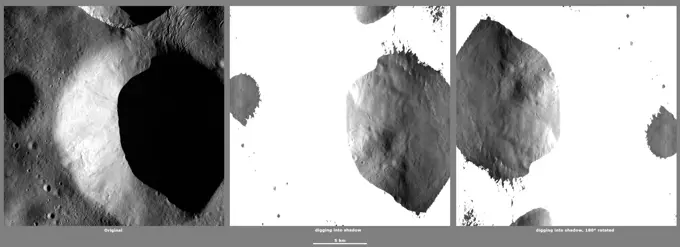
These images from NASA's Dawn spacecraft, located in asteroid Vesta'sFloronia quadrangle, in Vesta's northern hemisphere, demonstrate a special analytical technique, which results in shadowed areas of Vesta's surface becoming illuminated.
6145-44900068
This image comparison shows a view through a Hazard-Avoidance camera on NASA's Curiosity rover before and after the clear dust cover was removed. Both images were taken by a camera at the front of the rover. Mount Sharp, looms ahead.
4413-37385
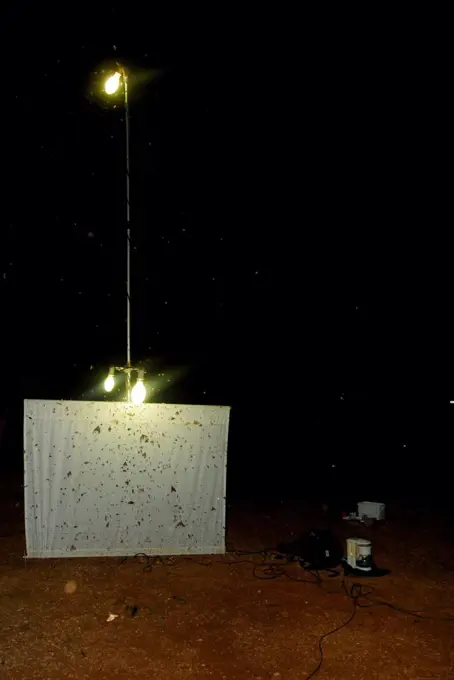
Light trap to catch insects French Guiana
6145-52286121
Aerial view of a part of the area affected during the flood disaster of 1953. Note: The description of this photo is not yet complete and will be supplemented on the basis of the data available at a later stage. However, of many photos of the flood disaster 1953, the location is unknown.
1525-28067849
Photograph of a violent thunderbolt, vintage engraved illustration. From the Universe and Humanity, 1910.
6145-44508408
This image from NASA's Terra spacecraft shows Mount Oyama, an 820-meter-high (2,700 feet) volcano on the island of Miyake-Jima, Japan.
6145-44651613
KENNEDY SPACE CENTER, FLA. -  Following the launch of Space Shuttle Discovery on mission STS-121 on July 4, images from onboard cameras capture very small pieces of external tank foam that were liberated during the ascent phase. Engineers are continuing to conduct analysis of these and other photos.
PREVIOUS
of 3
NEXT
2401 S. Ervay, Suite 206
Dallas, Texas 75215
United States
Get Started
Free ResearchMy BoardsMy Cart
For Creators
How To License Your ContentContributor PortalFrame of Mind
Resources
API accessPricing
Contact
+1 866 236 0087help@viewpictures.co.uk Contact form
©2026 View Pictures. All Rights Reserved. -B
This site is protected by reCAPTCHA and Google Privacy Policy and Terms of Service apply.