Model Ship Components

Detailed models including a lock gate, an anchor, and a ship's galley, illustrating various maritime tools and their intricate designs.
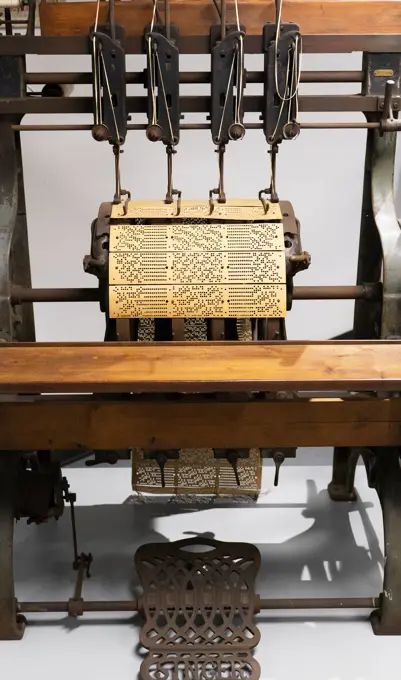
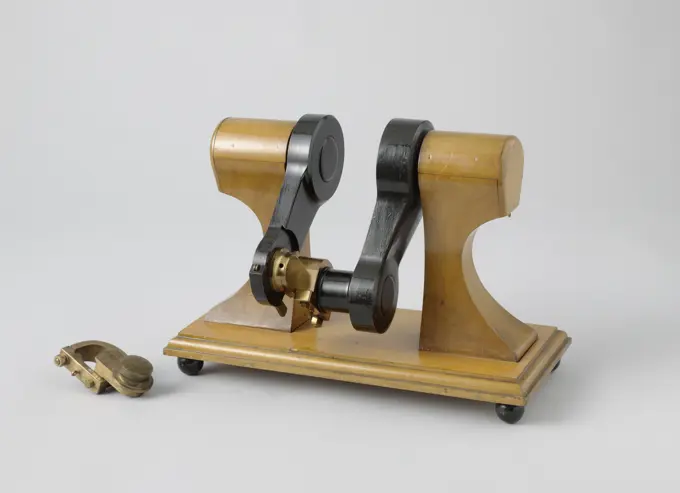
Bindemaschine. Zum Zusammennähen von gelochten Karten für den Jacquard-Webstuhl. Binding machine. Used to sew together perforated cards for the Jacquard loom. LicenseRF Copyright: xZoonar.com/DmitrixMarutax 23286526
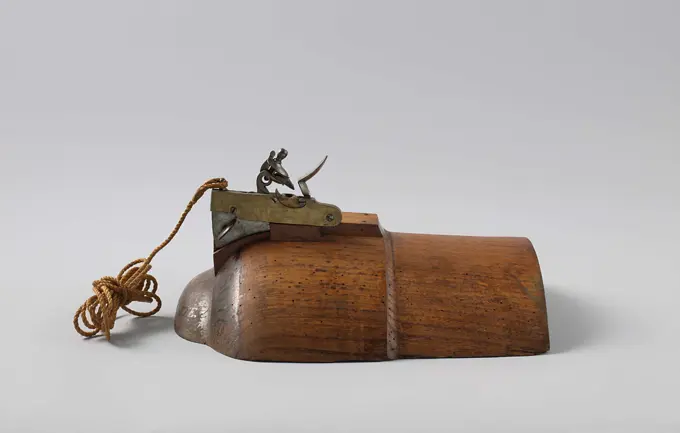
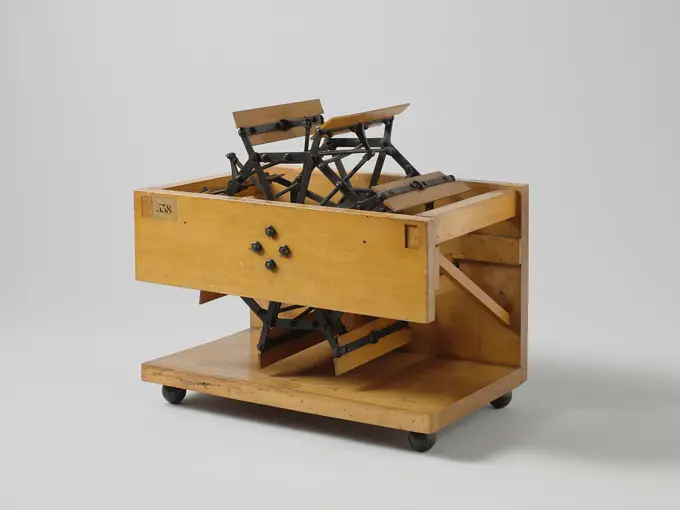
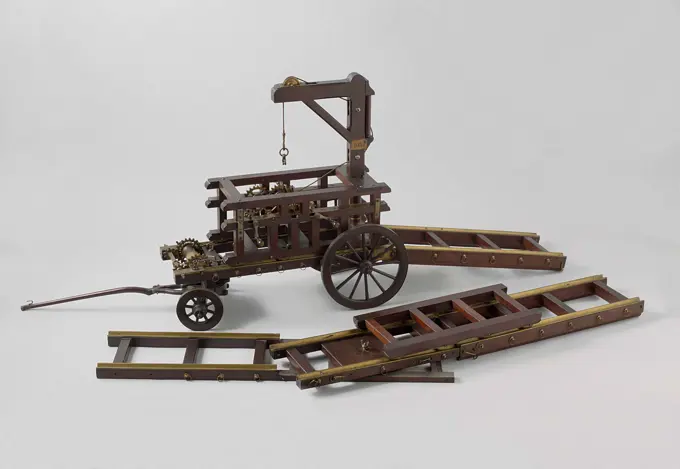
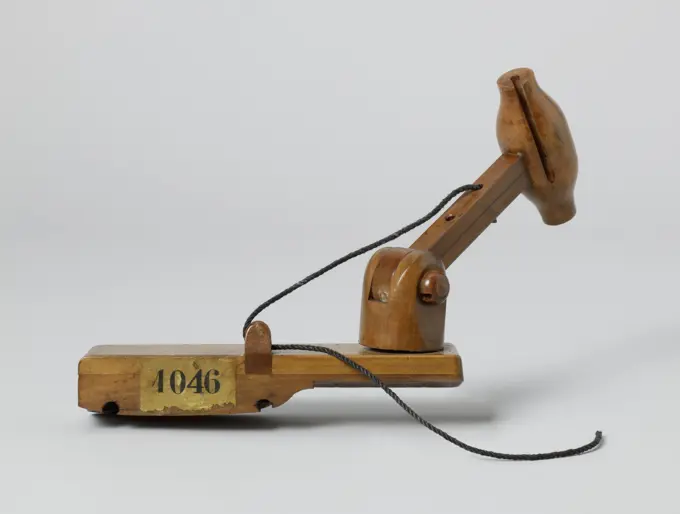
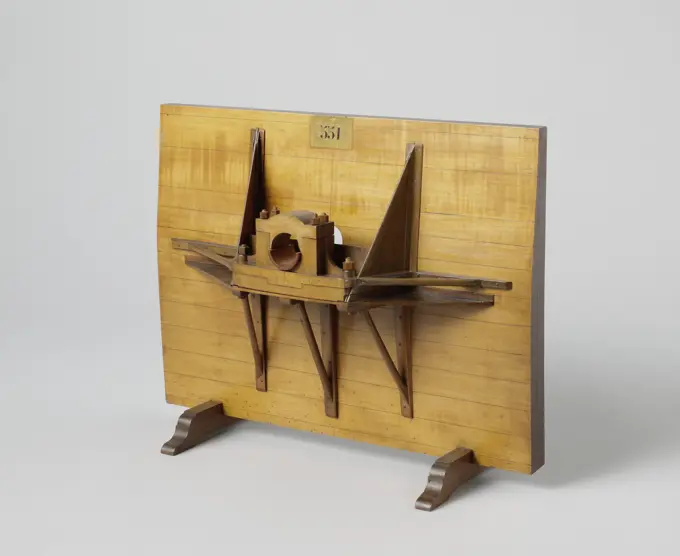
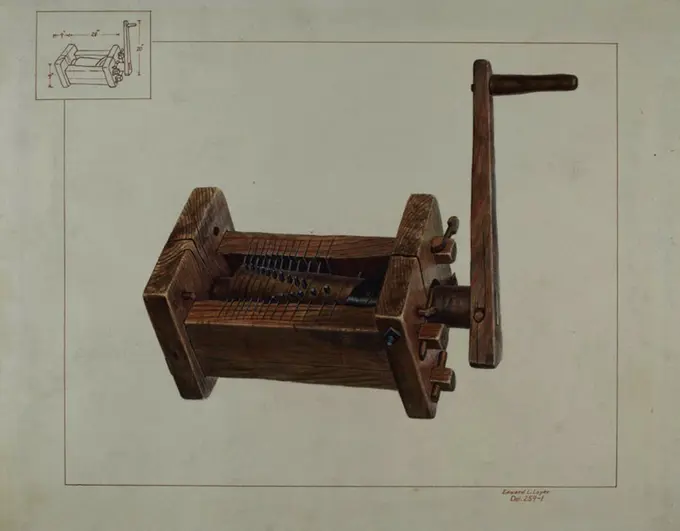
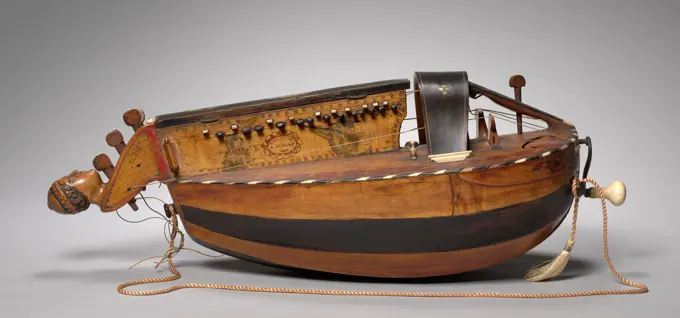
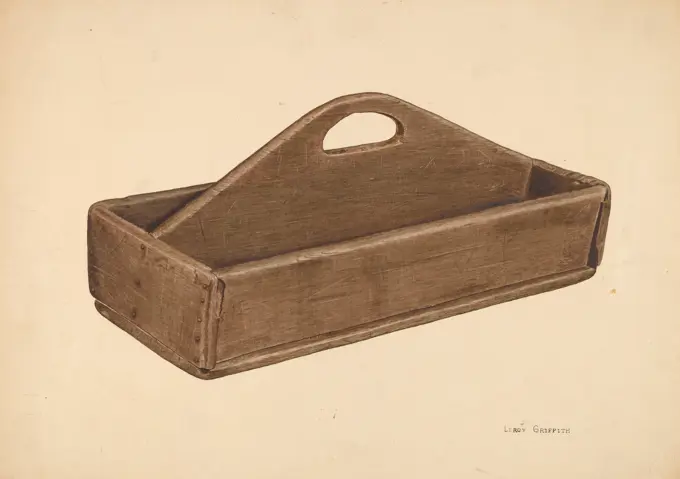
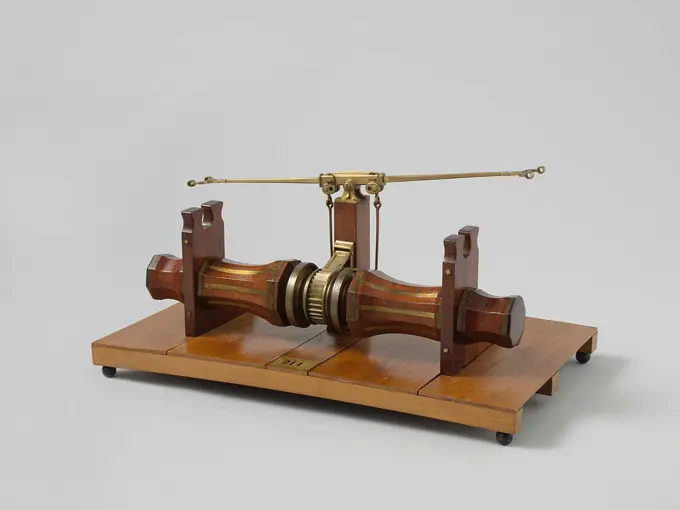
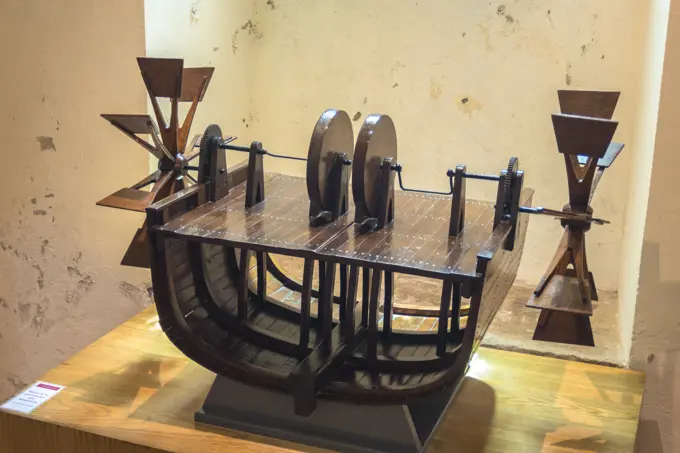
Model of An installation for tarring rope yarn. Model of a device for tearing cable yarns. The functioning of the model remains unclear. In the middle, a tar reservoir has been lowered in the floor. Two transverse slurters hold a set of metal plates upright straight: one of them has a slot, the opening of which is controlled by leaving the other. On each side of the tar reservoir is a frame with two coils each; At the top of one frame also two tubular conductors for the yarns. On both ends there is a large framework, connected by a crossbar. On the one hand, two coils with yarns and a crank are applied to the other three empty flushes on one side, one with a drum and crank. On one side a tripod stool with a pin or vertical axis is on top.Model of A Lock Gate. Model of a lock gate on a henifold, on a base plank. The lock gate has two doors, each consisting of a few doors that are connected to each other in a corner of ninety degrees. One door closes the lock input, the other runs into a compartment next to the lock entrance. With the Spui in this last door and the SPUI of the compartment, this door can be moved by the pressure of the water; The other door then rotates with him.Iron. The object made of plate has a wall that has been cut at tripod locations. The lid can be folded up and secured with a hook.Model of a Ship's Galley, G. Kollaard, J. Kollaard, 1836 demonstration model Model of a shipy butter on a deck between two betting. The deck is covered with brass at the location of the galley; The chimney sticks through a part of the deck, which is indicated in the width of three shelves and is on cover stabs that run straight through the beting beams. The galley itself, with hooks secured in the Betingknies, is entirely copper; Indoor edges of pans and the like are tarted. It is a special detailed model and can be taken apart. At the front on the left is a large oven with a layer of rectangular stove pans above it: the stove can be adjusted for five or six pans. To the right of this is a high part with a water tank with a tap under a fire, above it, another fireplace and completely above a hob for normal tiles or rectangular hobs. A low bread oven has been applied to both sides. There are two huge rectangular barrels on the back above firms. Scale 1:10 (Obreen). Rijkswerf (HellevoetsModel of an Anchor. Wooden model of a composed anchor, which can be exploited. The shaft and arms consist of six layers, which are kept together by brass brackets. The model has no anchor stick. Scale 1:10 (estimation).Gunlock (Flintlock) on a Dummy Breech of a 30-Pounder Carronade.Flint lock on wooden model of a carronade of a 30 pound carronade. The lock has a brass house with iron lock mechanism, rooster and Pandekel. The lock is mounted on the right side of the zund hole with a pin in the lock support and a bolt through it. Pan and Pandekel are short; The pan has a hole that led the flame to the zundhole. The retraction rope is original.Model of Steering Gear, anonymous, 1820 - 1858 demonstration model Technical model of a stern with won -up mirror and hollow wulf and two decks; The model is balanced with a lead weight. Straight stirring with a toothed quadrant mounted on the square Roerkop on the back. The steering wheel has an axle that is fixed with the end in the mirror beam; A small gear on this axis grabs in the quadrant of the rudder. Netherlands (possibly) wood (plant material). brass (alloy). lead (metal). Model of a canon of 30 pounds on rolling horse on a ship part. The wooden loop, long 55 cm and with a 32 mm caliber, is painted black; It has a visor on the tap band, the grape is flat from behind and has a pierce ring. The rolling horse, narrower at the front than behind, consists of two cheeks with four stages, connected by a slant calf, a breastpage with breast valve and the axis, which are connected to the sole plate; The Stelwig is missing. The wooden wheels are double and all of the same diameter. The ship's part represents a piece of deck with a gun port; The ship's wall has diagonal bandage and brass knees. A beam with ring can be pulled out of the base to the rear, on which the retrieval caliper can be attached. Five bullets and four cartons belong to the loose parts. Scale 1: 5 (according to Obeen).Model of a 30-pounder carronade on a career and slide, Rijkswerf Vlissingen, 1839 gunmodel. demonstration model Model of a carronade of 30 pounds on afuit on ship's part, incomplete. The loop is 34.5 cm long and has a caliber of 37 mm; It is equipped with a brush ring, an eleve screw through the flat grape with rain cap, a visor on the tap band and an experimental percussion slot with pierced hammer to prevent recoil through the flame from the Zundgat. The role horse consists of two narrow cheeks, connected by a calf in the middle, the rear axle and the front axle, which is also the tapas. For the front axle, a third axle has been applied, to which the Breijkel chain, a kind of breeding chain, is attached, which is attached to the pivot bolt in the gate bullshit on the other side. The rear axle body has a trench for the Eleveers screw; This can be raised with a block also with slot. The sledge is a frame consisting of two wooden shelves connected by brass beams front and rear; The fronOld Cooper Iron Isolated with Clipping PathModel of an Optical Telegraph, anonymous, c. 1798 - c. 1803 demonstration model Model of an optical telegraph on ground board, incomplete. It consists of a studited mast short gallows at the top. Sports were installed between two of the four braces to climb the mast. With hoists by discs in the struts of the gallows, two wooden wings are moved halfway through the mast; Two other signals that are now missing, probably balls, are hoisted up and down with hoists over discs in the gallows. The wings are motivated on a metal ring, which can freely turn around the mast: by means of a rod you can rotate with the ring with wings, so that they will be placed in another communication line. Traces of a missing component, possibly the flagpin, can be observed at the top of the gallows. Scale 1:45 (scale on model). Netherlands wood (plant material). brass (alloy). ivory. ropeModel of A Paddle Wheel. Model of a scoop wheel (port) with eight moving plates. The shaft does not run through until the outside of the wheel; Of the extreme suspension, on the other hand, a curved arm runs inside, to which the axis of the eccentric is attached. This eccentric, which is therefore mounted in the wheel, moves the plates with spokes, which are each provided with its own axis. The model can be moved with a crank. Scale 1:10 (derived).Bindemaschine. Zum Zusammennähen von gelochten Karten für den Jacquard-Webstuhl. Binding machine. Used to sew together perforated cards for the Jacquard loom. LicenseRF Copyright: xZoonar.com/DmitrixMarutax 23286526Model of A Dry Dock, Rijkswerf Willemsoord, 1866 demonstration model Model of the dry dock of Willemsoord, on a ground board. The ground board shows the composition of the wooden raft on which the dock was built. The dock has an elongated oval shape and a metal ship door with a keel. At the entrance four pipes of the bottom run up through one of the sides; As a result, the water was drained with pumps when the dock was pumped empty. The ship door has a double skin up to two -thirds of the height; The inner caisson is divided into four compartments. Each compartment has a mechanical pump, a sp been and two sheaves that connect it to the neighboring compartments. There are two hand pumps for the space between double skin. The mechanical pumps are connected to a single drive mechanism, which must be driven by a steam engine; They all connect to two pipes, which lead on reflections outside the ship door. Two square channels run right through the ship door, which are sealed in the middle ofModel of An Artillery Crane On Tracks. Model of a heavy tap on eight wheels, a slide and a loading platform, walking in traces, and a cart. The hoist has two winches, with booms on either side; By resisting the drums with sprockets, the winches can be combined, but the mechanism is now defective. The arm of the crane is about its axis; The rope runs over a disc through the king to the back, between two vertical rollers and over a disc back to the front and over a disc at the end of the arm. A ring and double hook are attached to the end. There are three rail pieces, one of which is a turntable with ball bearing. One carriage is a window with eight wheels such as the tap; The other is a loading platform with traces, which must be placed upside down on the other rail pieces with bullets in the tracks, which function as ball bearings. The rail pieces and the loading platform have rings on the sides for dragging and fixing with rope. One track can be attached to the cart, which has a winchScouring Board. Dated: c. 1940. Dimensions: overall: 27.8 x 36.9 cm (10 15/16 x 14 1/2 in.) Original IAD Object: 13 5/8" high; 9" wide; 3 3/8" deep. Medium: watercolor and graphite on paperboard. Museum: National Gallery of Art, Washington DC. Author: M. Rosenshield-von-Paulin.Stool, 13 3/4 x 24 x 8 1/4 in. (34.93 x 60.96 x 20.96 cm), WoodModel of a Gun Lock (Percussion), anonymous, 1835 - 1865 demonstration model. gunmodel Model of a percussion slot for cannon Slotplaat. The hammer can turn 180 ° and hit with both sides: the head is egg-curled with flattened ends, in which a groove is saved to let the flame that comes out of the Zundgat when firing, so that the hammer is not knocked back. A disc before the deduction is applied to the lock plate. Netherlands (possibly) wood (plant material)Model of A Lifting Screw, Nederlandsche Stoomboot Maatschappij Fijenoord, c. 1857 demonstration model Model of a screw cooker between rear stern and stirring, with a part of the keel and the rear postles. The screw light device consists of a loose frame with a screw that can be hoisted up and down in the tube on a rope, which runs over a disc at the top of the screw cooker and a disc in the screw window. The screw is a Mangin screw, a four-leaf propellor, composed of two two-blade screws that can be put in parallel position for lighting. The screw is disconnected by withdrawing the axle into the ship. The vertical rails against the stern and the screw stitch over which the screw window moves are provided with teeth; This includes piles of the screw window that prevent the slip. The piles can be retained so that the screw window can drop. Beams against the Stevens keep the screw window down and must be removed before lighting. Scale 1:10 (estimate). Rotterdam wood (plant material). brasModel of a Paddle Shaft Support, anonymous, 1840 demonstration model Model of a part of the ship's skin with an outdoor question for the Rader axis. The cushion block for the ash rests on a platform, which is supported by three knees. Two triangular side panels protect the block against splashing water. The cushion block consists of a sled, kegge and the ash lining. Netherlands wood (plant material). Folding chair from walnut. Each of the two sides consists of eleven slightly curved slats, which are rotatably connected by a wooden pen. Sleeves connect these slats to the feet, the armrests, with a twisted button at the top. The seat consists of twenty movable slats, over and around a wooden pen between one of the two rows of side rats and connected in the middle. The front slats are insured. The flat backrest, with incised rosette, is topical.Old iron flatBronze gunpowder trial mortar. Bronze gun powder testing mortar on base of djatihout with slurry, mouth lid, wiper and spoon. No 339. With inscription.Gunlock (percussion) on a Dummy Breech of a 12-pounder Cannon. Percussion lock on wooden kulas of a 12 pound gun. The lock plate is mounted against the rear of the kulas with four screws. The hammer revolves straight forward. The head of the hammer has a slot for the flame from the Zundgat when fired. The retraction rope is attached to and injured to a disk on the shaft of the hammer. The wooden kulas is that of a short iron cannon of 12 pounds, Swedish model.Sausage Grinder. Dated: c. 1937. Dimensions: overall: 24.4 x 31 cm (9 5/8 x 12 3/16 in.). Medium: watercolor, gouache, and pen and ink on paper. Museum: National Gallery of Art, Washington DC. Author: Edward L. Loper.Churn; 2nd quarter of the 19th century (1825-00-00-1850-00-00);Vielle à Roue (Hurdy-Gurdy), 1865-70. Jacques Decante (French, 1808-1884). Wood; mother-of-pearl inlay; In France, the hurdy-gurdy is known as the vielle à roue (wheel fiddle). This six-stringed musical instrument produces sound by a hand crank-turned wheel that rubs against the strings. The wheel functions much like a violin bow, and single notes sound similar to those of a violin. Melodies are played on a keyboard that presses small wedges against the strings to change their pitch.Half Model of A Screw Steamer, Rijkswerf Amsterdam, 1857 - 1860 ship model. half model. builder's model Polychromed and fully plants Mallen model (starboard) of a three -mast screw steam ship. The Schegbeeld is a gilded curl. Elliptical fence with government weapons, above which an unknown weapon; Stir with round stirring king (American rudder) and rounded Roerblad; The model has a screw cooker for a screw light device. Zeeh virtually flat, a reehout. V-shaped underwater ship with round kimmen. The model is equipped with all rest and puts. Scale 1:50 (scale on model). Amsterdam wood (plant material). brass (alloy)LeRoy Griffith, Knife Box, c 1940 Knife BoxHalf Model of an 80-Gun Ship of the Line, anonymous, c. 1790 - c. 1820 ship model. half model. builder's model Polychromed mold model (starboard) of a three -mast. Nine and thirty gun gates spread over three decks; Halfdek, Bovenkampanje and baking deck can also be distinguished by Gillingen; Fairly low lice pile. Gewlen mirror, hollow wulf, no fence or side gallery. Straight with long square roser king, probably for two stir pins. The Zeeg rises on both ends, two mountain wood and one reehout. Round underwater ship. Netherlands (possibly) wood (plant material)Half model of the stern of a 74-gun ship of the line. This half model represents the ship Staten Generaal, a naval vessel built in Amsterdam in 1795. The ship - which had 74 guns on board - was renamed the Washington in 1798 and the Princesse of Orange in 1799, after she was captured by the British Royal Navy. The ornamentation of the railings with angels blowing horns, trophies of weap-ons and stylized leaves is typical of the late 18th century.Model of a Disengaging Gear for Paddle Wheels, D. van den Bosch, 1842 demonstration model Model of the disconnection of the crankshaft of a scoop wheel, on a ground board. Crankshaft and Rader axis are connected by a connecting piece, a so-called tug or rotation, which allows some impurity in the alignment of the axes. The tug can be taken apart and the piece on the Rader axis turned a quarter turn, so that stools are released and the stool with the stool pen can turn unhindered. A loose tug is attached separately. Scale 1:10 (derived). Netherlands wood (plant material). brass (alloy). paint (coating)Half Model of a Merchantman, anonymous, c. 1780 - c. 1820 ship model. half model. builder's model Polychromed mold model (starboard) of a three -mast. No decks or gun ports are indicated. Get mirror, Hol Wulf, no details of fence or side gallery; Straight with square stirring king. Seeping forwards and backwards, two barkhouts and one reehout. Peaked around. Scale approx. 1:44 (derived). Netherlands (possibly) wood (plant material)Gun Lock (Percussion).Iron percussion lock with retraction rope, on wooden board. The hammer has two quadrants at the shaft, which is mounted between two cheeks. A double retrieval rope is attached to the quadrants, which, if drawn, the hammer moves. There is a support for the hammer when he returns. The lock plate is mounted on a wooden board, which represents the lock hardening, with a bolt through it.Cosmetic set of Kohl Tube and Applicator, Razor, Tweezers, Whetstone, and Mirror ca. 1550-1458 B.C. New Kingdom In 1908-1914, Howard Carter and the Earl of Carnarvon excavated in a section of the Theban necropolis known as lower Asasif. This area contained a Middle Kingdom tomb with a huge courtyard that was reused as a cemetery for about a century between late Dynasty 17 and the early joint reign of Hatshepsut and Thutmose III in Dynasty 18 (ca. 1575-1475 B.C.). Carter and Carnarvon excavated half of the cemetery before moving on the Valley of the Kings. In 1915-1916, the Museums Egyptian Expedition excavated the other half. The objects displayed in gallery 114 come from both of these excavations.This toiletry set includes a tube for the eye cosmetic kohl, a razor, tweezers, a whetstone, and a mirror. The objects were in a rush basket found during the Carter/Carnarvon excavations.. Cosmetic set of Kohl Tube and Applicator, Razor, Tweezers, Whetstone, and Mirror. ca. 1550-1458 B.C.. BFour-string biwa, 19th century, Unknown Japanese, 34 1/2 x 12 3/4 x 2in. (87.6 x 32.4 x 5.1cm), Wood with lacquer and gold, Japan, 19th century, Though its strings are now missing, this lute originally had four strings, making it a biwa, a plucked, stringed instrument with origins in Persia. It was transmitted to China (where it is known as pipa) around 2,000 years ago and to Japan by the 700s The oldest illustrations of The Tale of Genji that survive today, which were created around 1130, include a picture of one of the novels main characters, Prince Niou, playing a similar lute next to his pregnant wife, Nakanokimi.Model of a Two-Blade Propeller, Petrus van der Loo, 1847 instruction model Model of a normal two -blade screw in a frame on a ground board; Two-leaf version of NG-MC-557. The blades are flat. The screw can be turned around with a crank. The model has a 210 mm urgency, a diameter of 195 mm, the hub is 40 mm long and has a diameter of 23 mm. Scale 1:10 (derived). The Hague wood (plant material)Lluís Ventos / 'Makemake', 2003, Mash wood, bolondo, iroko, ebony and wenge, 36,5 x 102 x 40 cm.Model or a Pump Windlass. Model of a roasting pill on a floor plank. The octagonal drum, hung between two cheeks that form the roasting wave with two servants each, is also equipped with small drums outside the cheeks. The roasting spindle is served with two wind trees on a yoke on the sturth in the middle: around the drum two rails running on which brake mechanisms running that block at an upward movement and are free when they fall, and they each on one side of it Juk are connected. The connecting rods between yoke and brake mechanics can be set in two positions for two forces. The sturth in the middle also has five metal palls that grab in the gear portion of the drum to prevent the fallback. The cheeks can each be explored in two halves. Scale 1:10 (estimation).Bronze model offering table and ritual vessels of the lector-priest Idy. From Abydos. Dated 2300 BCBronze chariot inlaid with ivory. Culture: Etruscan. Dimensions: total H. 51 9/16 in. (130.9 cm)length of pole 82 1/4 in. (209 cm). Date: 2nd quarter of the 6th century B.C..Scenes from the life of the Greek hero AchillesThe AcquisitionIn 1902, a landowner working on his property accidentally discovered a subterranean built tomb covered by a tumulus (mound). His investigations revealed the remains of a parade chariot as well as bronze, ceramic, and iron utensils together with other grave goods. Following the discovery, the finds passed through the hands of several Italian owners and dealers who were responsible for the appearance of the chariot and related material on the Paris art market. There they were purchased in 1903 by General Luigi Palma di Cesnola, the first director of The Metropolitan Museum of Art. The Monteleone chariot is the best preserved example of its kind from ancient Italy before the Roman period. The relatively good condition of its major parts--the panels of the cModel of Two Congreve Rockets with Launching Gear, Rijkswerf Rotterdam, 1818 demonstration model Model of two fire missiles to a design of congreve on a launch device or chair, for land use. The rockets themselves consist of a pointed cylinder, the point of which is the fire bomb and the rear part the rocket engine; A long stabilization stick is attached outside the cylinder. The chair consists of a ladder -shaped frame that forms a tripod together with two legs; For the frame, a running ring has been installed that can be beaten around the front of a sloop and led the movement of the frame for aiming and losing it for aiming and loading. A beam with a metal room and flint lock with a set of brackets is mounted on each leg of the frame. The flint locks have tractors with holes for a tractor rope. The head of the rocket is placed in the room under two brackets. The spark of the flint lock is tackled in the room by a plate to get back in the rocket. This model is equipped with two wick sPaddle Wheel invention by da Vinci, Leonardo da Vinci Park, Amboise, FranceBetty Lamp. Dimensions: H. 4 1/2 in. (11.4 cm). Date: 1700-1800. Museum: Metropolitan Museum of Art, New York, USA.Time Fuse in a Box and a Model of a Torpedo, 1810 demonstration model Time infection mechanism in a round brass house, closed on one side with a blind flange with leather gasket on which an inscription. The time infection mechanism itself consists of a flint lock with timepiece. De Haan, which is constantly kept under tension by the Slagveer on the tumbler in the foot, is retained by a lever (the rod) forged in a hook at the head of the rooster; Tumbler and rod are separated. The rod is held in place with an extension that rests on a disc with a notch. This disk is mounted on a levernon and runs under the influence of the timepiece: if the notch reaches the extension of the rod, it tilts and the rooster is released. A blocking mechanism has been applied to the house: a pen that sticks through the side presses a feather against a gear at the foot of the Verton and thus blocks the timepiece. The pen is pushed out through the spring, but can be held in place by a rod by two eyes applied oAlter Türklopfer Alter Türklopfer LicenseRF Copyright: xZoonar.com/GabrielexSitnik-Schmachx 23200609Model of a Figurehead, anonymous, c. 1800 - c. 1850 scale model Model of a sheg image on Scheg, on a ground board, incomplete. The figure is a running man in Roman clothing and armor, his right arm lifted, a bundle of arrows in the left; The object he holds in his right hand is missing. Scheg and floor board are decorated with with leaf work in relief. The figure proposes Mars. Netherlands wood (plant material)  (story of) Mars (Ares)Part of a window frame. Profiled cornice of gilded wood., Anonymous, 1500 - 1550 Gilded wooden profiled cornice. Forms a window frame together with two pilasters. See also: BK-16892-A & -B. Coming from the garden room of the Villa van Mannheimer (current desk). Spain wood (plant material). gilding (material) gilding Gilded wooden profiled cornice. Forms a window frame together with two pilasters. See also: BK-16892-A & -B. Coming from the garden room of the Villa van Mannheimer (current desk). Spain wood (plant material). gilding (material) gildingMirror or Light Reflector 15th-16th century German. Mirror or Light Reflector 471727sewing machine sewing-machine ,model released, Symbolfoto ,property released Copyright: xZoonar.com/SergeyxxKozoderovx 2138512 ,model released, Symbolfoto ,property releasedSongye Prestige Stool, England, London, Christie's Images, Primitive Art"Wooden travel camera measuring 13 x 18 cm, manufactured by Julius Wachtl around 1900, featuring lens, folding body, and viewfinder for portable photographic use."West european art presenting ship , emeralds, gold, enamel, 16th century, Russia, St. Petersburg, State Hermitage, L. 10Clock and gunpowder horn. This clock was originally intended as merchandise for sale or as a gift. It was hung up in the Save House’ as the only means of providing a sense of time during the long, polar nights. On 3 December 1596, it froze. Barentsz and Van Heemskerck shoved a parting letter into the gunpowder horn when they left. Three centuries later, the horn was rediscovered with the letter still inside. The letter cannot be exhibited due to its fragility.Model of a Caisson, anonymous, c. 1802 scale model. test model Model of a ship door with double keel, painted white with depth indications in black. Coarse model without details, a square hole at the top, probably to fill it with water. The deck can be removed and is weighted at the bottom with four plates of metal. Netherlands wood (plant material). metal. paint (coating)Half model or a 68-gun ship of the line.Polychromed mold model (starboard) of a three-master. No gunpaints and no decks indicated except semi-deck and top campanut. Wrecked mirror, hollow wulf, no fence or side gallery; Stir straight with square roofing. Pretty flat sea, two mountain wooden and one Reehout. Round underwater ship. Scale 1:44 (Scale by model).Old coffee grinderRustic wooden cutting board on rusty stone background. empty copy space for text, design elementModel of a 16-pounder Stone HoWitzer on a Ship's Carriage. Model of a HOUWITSER on rolling horse. The HOUWITSER is 19.6 cm long and has a 33 mm caliber. Inscriptions are engraved on the course, along with crossed anchors and palm branches. The loop has two ears. The very short rolling horse consists of two parallel cheeks with two stages connected by a vertical calf, a crossbar and the axis; The soleplate is on the axles. The guide block can be pushed back and forth on the sole plate and secured in different positions by means of pins in a border on the inside of the cheeks. The axles are attached to the cheeks with brackets that can be removed. The double wooden wheels are all of equal dimensions. Scale 1: 6 (Scale on model).Tower clock from the broken water gate in Gorinchem, Anonymous, c. 1585 - c. 1615 Clockwork with loose hammer, belonging to a bronze clock from the tower of the broken water gate in Gorinchem. The clock is dated: 1581. The calculation on the ground wheel of the going work had to set the timepiece on time. These numbers had to be in accordance with the position of the pointer. Compared to a marking, or possibly the intervention of the small gear on the top, one could put in the correct position within the pointer. The hour guide could not be read so accurately, but it had to be accurate for the percussion. By sliding the anchor out of the gang wheel, the gears can run freely and the wiser can be set on time. The small gear on the outside of the going work has 12 teeth and goes around once every 2 hours, this can be seen in the calculation on the ground wheel of the going work, which gives twice 60 minutes. There are 2 cams on the ground wheel that get the percussion. So he hits twice evAntique Braunschweig brass survey equipment from Germany, CSMVS Museum, Mumbai, Maharashtra, India, Asia India Copyright: xDuttagupta/DinodiaxPhotox -3d rendering of a market stall isolated in white background 3d rendering of a ancient market stall isolated in white studio background Copyright: xZoonar.com/HugoxKurkx 14126995Staircase Model, Planed, carved, veneered, and turned cherry, Double staircase model joining at the top and base with opening at center., France, late 19th century, models and prototypes, Decorative Arts, Staircase ModelHalf Model of a 32-Gun Frigate, anonymous, c. 1796 ship model. half model. builder's model Mallen model (starboard) of a three -mast. Twelve gun gates on one deck. Get mirror, Hol Wulf, no details of fence or side gallery; Straight with square roser king and keel with heel. The Zeeg rises slightly on both ends, one barkwood and one reehout. Peaked around. Scale approx. 1:55 (derived). Netherlands wood (plant material)Half Model of a 14-Gun Cutter.Polychromed mold model (starboard) of a single master. Wrecked mirror, hollow wulf, closed fence, falling stern; Stir straight with square roofing. The Zeeg runs forward to a strong one, one bark wood and one Reehout. Peaked round trip, sharp underwater ship, very much steering burden. Strong sloping mast.Skeleton Clock in the Form of the Scott Memorial, Edinburgh. 1851. Made by W F Evans. The Scott Memorial in Edinburgh is a tribute to Scottish author Sir Walter Scott.Swift. Shaker Colony; American, 19th century. Date: 1841-1850. Dimensions: Folded: 21 1/4 × 4 1/2 × 3 in. Maple, birch, iron, and cotton twine. Origin: Enfield. Museum: The Chicago Art Institute, Chicago, USA.Viking. Sledge replica. Osebera.Half Model of a 54-Gun Ship of the Line, anonymous, c. 1782 ship model. half model. builder's model Polychromed mold model (port) on a small back plate. The skin above the mountain wood is closed. Twenty -five gun gates on two decks; Bakdek and Bovenkampanje indicated by Gillingen. The Schegbeeld is a crowned lion. Gewrolded mirror, Hol Wulf, Hek and side gallery of two floors, with gilded carpet of weapon trophies and praise. Under the fence an empty rectangular cartouche. Straight with square roser king in large round hennegat with a decorated edge. Seeping backwards, two mountain wood and one reehout. Peaked around. Netherlands wood (plant material)   ZeelandHalf Model of a Cutter, anonymous, c. 1750 - c. 1800 ship model. half model. builder's model Mallen model (starboard) of a single -master. The skin above the barkwood is closed. Closed deck, detailed with an oven on the fore ship, further shutters, a ship pump, a cuckoo and a roef. Get mirror, hollow wulf, no details of the fence; Straight with square stirring king. The Zeeg runs back and forward, one barkhout. Peaked around, sharp underwater ship, a lot of steering burden. Scale 1:40 (scale on model). Netherlands wood (plant material)Outer coffin of the Child Myt ca. 2051-2030 B.C. Middle Kingdom This is the outer coffin of the child, Myt. She was buried in a set of two wooden coffins that were laid one inside the other and placed in a limestone sarcophagus.The mummy of Myt showed that she died as a little girl, probably not more than five years old. The embalmers added substantial padding to her feet and her head, which made the mummy much longer so that it looked like that of an adult. Myts tomb was robbed in antiquity, but her sarcophagus was not opened, and five precious necklaces were still in among the wrappings (see the five necklaces 22.3.320-.324). Myt is the ancient Egyptian word for a female cat, and Myts name is therefore written with a seated cat hieroglyph (see the left end of the inscription on the front of the coffin). Her coffin also features the so called wedjat eyes that were painted on the side of the coffin and correspond to the position of the mummys head. In the Middle Kingdom, the mummy wHand crafted wooden canoe boat, internal partHalf model or an admiralty yacht. Exterior decorated, detailed and polychromed block model (starboard) of a flat bottom of a mast yacht. The model has a deck with cabin behind, whose floor floats to let the tiller go under it, and a campan vank on the cabin. In the side, six small round guns, on the booisel fittings for a sword and five putting irons. On the deck from front to a roasting pill, a chimney, a servant behind the mast, a round roef, a rise, a large oval roef and a small round. Galleon with shoeboard of crowned lion with coat of arms with crossed anchors, a mermaid and sea horse under the crane beam, further allegorical figures and dolphins. Flat mirror with a gate; Flat wulf decorated with praise, dolphins, a putto blowing on a shell and a coat of arms with climbing lion with sword and arrows beam; Heifter with three decorated windows, corner figure, putto, praise and draperies and a lantern; The side of the cabin is decorated with a Neptune and multi-months on sea horses, Half Model of A Screw Steamer, Nederlandsche Stoomboot Maatschappij Fijenoord, 1878 ship model. half model. builder's model Stacking model (starboard) of a three -mast screw steam ship. Closed deck with behind a small upper campain; Midscheeps are indicated. Clipper; Elliptical fence, screw window and stir with rounded stirring leaf. The chimney is missing. De Zeeg rises to both ends, stretch around. Scale 1:40 (derived). Rotterdam wood (plant material). brass (alloy)Romania, Trajana, Ulpia, Nine candle lamp, terracottaClose-up of an antique cameraSundial cannon -Reed Organ (Physharmonika). Culture: French. Dimensions: Width of chest: 56 cm (22-1/8 in.)Height of chest: 17.6 cm (7 in.)Depth of chest: 11 cm (4-3/8 in.). Maker: Alexander-François Debain (French, Paris, 1809-1877 Paris); Claire Vanderplank Samstag. Date: early 19th century. Museum: Metropolitan Museum of Art, New York, USA.Sewing machine Very old vintage style sewing machine Copyright: xZoonar.com/NikolaxObradovicx 12500092Clock and Gunpowder Horn. Dated 16th Century3D rendering of a sheet metal bending machine engineering machine computer model isolated on white background 3D rendering of a sheet metal bending machine engineering machine computer model isolated on a white background. Copyright: xZoonar.com/HugoxKurkx 18146521'Czech glass harmonica from the first half of the nineteenth century', 1948. Artist: Unknown.Vintage turntable with a wooden base and transparent cover on a wooden surface.Game of Hounds and Jackals ca. 1814-1805 B.C. Middle Kingdom The board rests on four bulls' legs; one is completely restored and another only partially. There is a drawer with a bolt to store the playing pieces: five pins with hounds' heads and five with jackals' heads. The board is shaped like an axe-blade, and there are 58 holes in the upper surface with an incised palm tree topped by a shen sign in the center. Howard Carter and the Earl of Carnarvon reconstructed the game as follows in their publication of the find (Five Years of Explorations at Thebes, A Record of Work Done 1907-1911, London, Oxford, New York, 1912, p. 58): "Presuming the 'Shen' sign ... to be the goal, we find on either side twenty-nine holes, or including the goal, thirty aside. Among these holes, on either side, two are marked ..nefer, 'good'; and four others are linked together by curved lines. Assuming that the holes marked 'good' incur a gain, it would appear that the others, connected by lines, incur a loss.Vintage background with old paper and compassDreidel (top), c. 1900, 2 x 1 x 1in. (5.1 x 2.5 x 2.5cm), Brass, nickel alloy, 19th-20th centuryLisbon, Portugal. Antique Chinese instruments. (Editorial Use Only)Subdecast. Oval dish with scalloped, engraved edge. The dish is marked: STK. = Amsterdam, JRL. = B (1809), MT. H. Duller, the sign & and the number 10 (Reterper). The dish is under a terrine (BK-NM-11177-151-A).Bamboo, Chiang Ting, 1832 Passe-partout for painting Bamboo representation. Note: see AK-MAK-97-A. China ink. paper Passe-partout for painting Bamboo representation. Note: see AK-MAK-97-A. China ink. paperWooden rowing boat Wooden rowing boat with oars isolated over white background Copyright: xZoonar.com/IvonnexWierinkx 11851878Burma, White Karen States, Drum, bronzeknife rudder letter. 3d knife rudder letter. 3d Copyright: xZoonar.com/sad444i.uax 1922749TELAR MANUAL (s. XVIII-XIX). Museu d'Història de Sabadell. Provincia de Barcelona. Cataluña.Antique throne of weapons from Maputo, Mozambique, CSMVS Museum, Mumbai, Maharashtra, India, Asia India Copyright: xDuttagupta/DinodiaxPhotox -Swords from Hungary or Romania. Stensgard and Torupgarde, Lolland. C. 1600 BC. National Museum of Denmark. Copenhagen. Denmark.'Arrangement of a Defined Space. Hyperspatial Control', 1957, Iron, 34 x 57 x 22,5 cm, AS08109. Author: JORGE DE OTEIZA (1908-2003). Location: MUSEO REINA SOFIA-ESCULTURA. MADRID. SPAIN.Stand for Baptismal Font. Dated: 1935/1942. Dimensions: overall: 35.9 x 23.9 cm (14 1/8 x 9 7/16 in.) Original IAD Object: 26" high; 30 1/8" wide. Medium: watercolor and graphite on paper. Museum: National Gallery of Art, Washington DC. Author: Raymond E. Noble.sewing machine sewing-machine ,model released, Symbolfoto ,property released Copyright: xZoonar.com/SergeyxxKozoderovx 2138484 ,model released, Symbolfoto ,property releasedModel of a Timber Wagon, 's Lands Werf Amsterdam (possibly), 1797 - 1801 demonstration model Model of a car with two wheels without a floor, equipped with a winch. The winch consists of a screw-without-end that drives the gear from a Windas. The shaft of the screw runs through the frame from the front, where the crank is located, back. There is a wooden roller on the front and back of the frame. model maker: Amsterdam (possibly)after design by: France wood (plant material). brass (alloy)Loop.