My Boards
View Pictures
  • My Boards

Moon Over Earth From Space

Views of the full moon captured from the International Space Station, showing Earth's curvature and atmospheric layers in a backdrop of darkness.
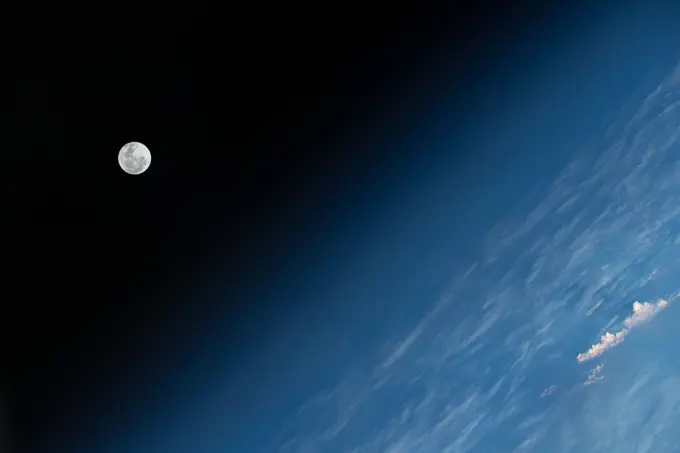
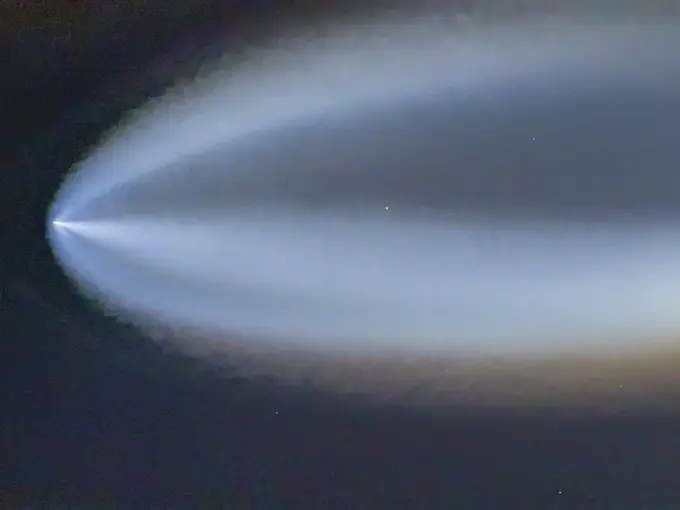
iss057e106068 (Nov. 23, 2018) --- The Full Moon is pictured by an Expedition 57 crew member as the International Space Station orbited 251 miles above the Andaman and Nicobar Islands, territories of India, in the bay of Bengal.
158 assets in this story
1525-20405155
Black and white Astronomical telescope. Astronomical telescope over dark sky with the moon - selective focus on telescope in black and white
6188-61003878
SpaceX Starlink Falcon 9 rocket launch as seen from the National Geographic Venture in the Sea of Cortez, Mexico, North America Copyright: MichaelxNolan 1112-8932
6145-44549693
STS079-379-022 (16-26 Sept. 1996) --- If this moonlit picture is held with the Space Shuttle Atlantis' Orbital Maneuvering System (OMS) pods at top, a greenish aurora appears at left edge.  Thanks to a time exposure on a 35mm camera, a crew member was able to capture the phenomenon visually experienced frequently by Shuttle crews.  Several stars can be seen in the picture.  Many of them appear closer to the camera than Earth because they are seen through the thin line of atmosphere above Earth's horizon.
1848-64912394
Planet earth from the space at night Some elements of this image are furnished by NASA
4239R-20480789
January 8, 2012 - The moon and Earth's atmosphere as seen from the International Space Station over a period of time that covered a number of orbits by the orbital outpost.
4413-22232359
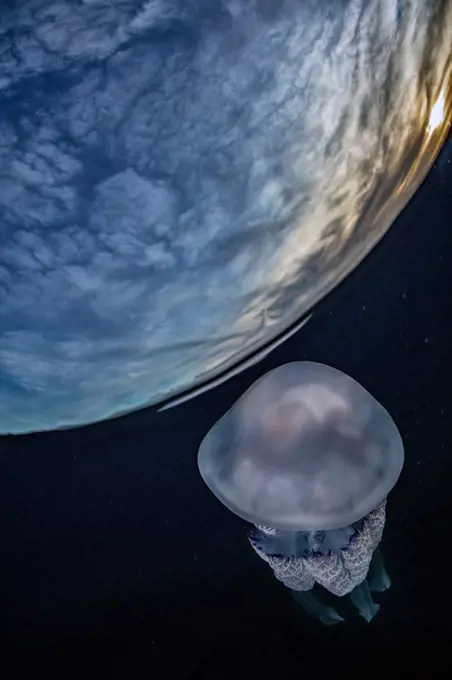
Barrel Jellyfish (Rhizostoma pulmo), Gulf of Naples, Mediterranean Sea
6145-44625123
Titan's Complex Surface
6145-44730079
The Cassini spacecraft looks toward Rhea's cratered, icy landscape with the dark line of Saturn's ringplane and the planet's murky atmosphere as a background. Rhea is Saturn's second-largest moon, at 1,528 kilometers (949 miles) across.
1525-22951220
Astronaut in space over Earth planet. Elements of this image furnished by NASA. Exploring outer space. Mixed media
4128-V58567672
6145-44551818
STS082-763-015 (11-21 Feb. 1997) --- Moving further and further away from the Space Shuttle Discovery, the Hubble Space Telescope (HST) is backdropped over clouds on Earth. This is the fifth in a series of post-release views recorded on 70mm film by the STS-82 crewmembers.  Five space walks were performed by two pairs of astronauts who alternated days of Extravehicular Activity (EVA) to service the giant orbiting observatory.
6145-44618645
The second manned lunar landing mission, Apollo 12, launched from launch pad 39-A at Kennedy Space Center in Florida on November 14, 1969 via a Saturn V launch vehicle. The Saturn V vehicle was developed by the Marshall Space Flight Center (MSFC) under the direction of Dr. Wernher von Braun. Aboard Apollo 12 was a crew of three astronauts Alan L. Bean, pilot of the Lunar Module (LM), Intrepid; Richard Gordon, pilot of the Command Module (CM), Yankee Clipper; and Spacecraft Commander Charles Conrad. The LM, Intrepid, landed astronauts Conrad and Bean on the lunar surface in whats known as the Ocean of Storms while astronaut Richard Gordon piloted the CM, Yankee Clipper, in a parking orbit around the Moon. Lunar soil activities included the deployment of the Apollo Lunar Surface Experiments Package (ALSEP), finding the unmanned Surveyor 3 that landed on the Moon on April 19, 1967, and collecting 75 pounds (34 kilograms) of rock samples. This is the twenty-first of 25 images captured by
6177-V54005111
4201-12151
Zooplankton, Admiralty Inlet, Baffin Island, Canada
6145-52086555
Artist's concept of an MX missile in flight after launch. Country: Unknown
6145-44879219
CAPE CANAVERAL, Fla. -- At Space Launch Complex 17B on Cape Canaveral Air Force Station, evening showers create the right conditions for the United Launch Alliance Delta II rocket that will launch NASA's Gravity Recovery and Interior Laboratory mission to be reflected on the surface of the pad.  Preparations are under way to roll the mobile service tower away from the rocket.GRAIL will fly twin spacecraft in tandem around the moon to precisely measure and map variations in the moon's gravitational field. The mission will provide the most accurate global gravity field to date for any planet, including Earth. This detailed information will reveal differences in the density of the moon's crust and mantle and will help answer fundamental questions about the moon's internal structure, thermal evolution, and history of collisions with asteroids. The aim is to map the moon's gravity field so completely that future lunar vehicles can safely navigate anywhere on the moons surface.  Launch is
6177-V70810078
6145-44968471
Looking Back at Us
4239-57494263
Neptune and Triton.
6145-45084863
GMT356_22_53_Terry Virts_night views stars africa coast_123
6145-45070628
Earth Observation taken during a night pass by the Expedition 40 crew aboard the International Space Station (ISS). Folder lists this as Phenomenal Aurora. Part of the Space Station Remote Manipulator System (SSRMS) arm is also visible.
6145-45209969
iss060e008812 (July 15, 2019) --- A portion of the International Space Station's main solar arrays drape the foreground as the orbiting lab flew 257 miles above Mongolia and across China. The Sun's rays light up Earth's thin atmosphere during a period between night and day.
6145-45194853
The Soyuz MS-12 spacecraft is launched with Expedition 59 crewmembers Nick Hague and Christina Koch of NASA, along with Alexey Ovchinin of Roscosmos, Friday March 15, 2019, Kazakh time (March 14 Eastern time) at the Baikonur Cosmodrome in Kazakhstan. Hague, Koch, and Ovchinin will spend six-and-a-half months living and working aboard the International Space Station.
6145-44736139
Composite Pioneer 10 imagery Excitement rose as the PICS displayed images of Jupiter of ever-increasing size as Pioneer 10 plunged at high speed toward its closest approach to the planet. The most dramatic moment was perhaps after closest approach and after the spacecraft has been hidden behind Jupiter. PICS (Pioneer Image Converter System) began to show a few spots on the screens, which gradually built up into a very distorted crescent-shaped Jupiter. 'Sunrise on Jupiter,' exclaimed an experimenter excitedly. 'We've made it safely through periapsis.' Subsequent PICS images were of a crescent Jupiter gradually decreasing in size as the spacecraft sped away out of the Jovian system. Note used in NASA SP-349 'Pioneer Odyssey - Encounter with a Giant' fig. 5-15 and SP-446 ' Pioneer - First to Jupiter, Saturn, and Beyond' fig. 5-16.
4201-29639
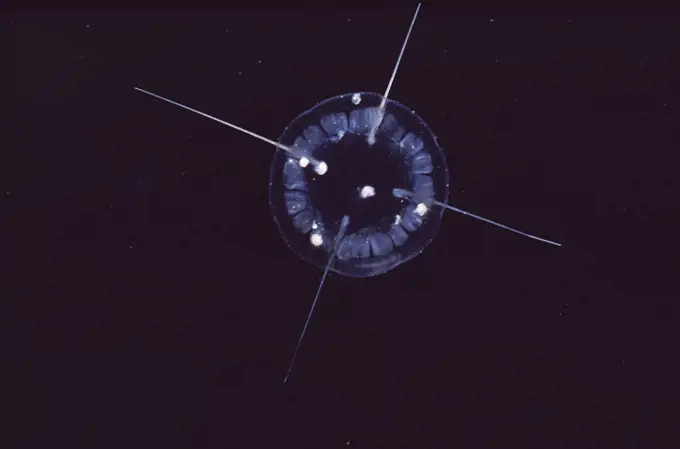
Sea Gooseberry (Pleurobrachia pileus) comb jelly with tentacles extended for feeding, Nova Scotia, Canada
6145-29241228
Apollo 11 Command and Service Modules Photographed from the Lunar Module in Orbit 1969 National Aeronautics and Space Administration (NASA). Apollo 11 Command and Service Modules Photographed from the Lunar Module in Orbit. 1969. Chromogenic print. National Aeronautics and Space Administration (NASA). Photographs
6145-44974512
HEROES PAYLOAD AWAITS LAUNCH AS HELIUM BALLOON INFLATES IN BACKGROUND, FORT SUMNER, NEW MEXICO, SEPTEMBER 21, 2013
4128-28515037
Comet
6145-44676750
The Apollo 11 mission, the first manned lunar mission, launched from the Kennedy Space Center, Florida via the Saturn V launch vehicle on July 16, 1969 and safely returned to Earth on July 24, 1969. Leaving a wide plume of flame as it climbed into the thin atmosphere of high altitude, the 363 foot tall, 6,400,000 pound Saturn V rocket hurled the spacecraft into Earth parking orbit and then placed it on the trajectory to the moon. The Saturn V was developed by the Marshall Space Flight Center (MSFC) under the direction of Dr. Wernher von Braun. Aboard the spacecraft were astronauts Neil A. Armstrong, commander; Michael Collins, Command Module (CM) pilot; and Edwin E. Aldrin Jr., Lunar Module (LM) pilot. With the success of Apollo 11, the national objective to land men on the Moon and return them safely to Earth had been accomplished.
6145-44803971
ISS022-E-062674 (9 Feb. 2010) --- Though astronauts and cosmonauts often encounter striking scenes of Earth's limb, this very unique image, part of a series over Earth's colorful horizon, has the added feature of a silhouette of the space shuttle Endeavour. The image was photographed by an Expedition 22 crew member prior to STS-130 rendezvous and docking operations with the International Space Station. Docking occurred at 11:06 p.m. (CST) on Feb. 9, 2010. The orbital outpost was at 46.9 south latitude and 80.5 west longitude, over the South Pacific Ocean off the coast of southern Chile with an altitude of 183 nautical miles when the image was recorded. The orange layer is the troposphere, where all of the weather and clouds which we typically watch and experience are generated and contained. This orange layer gives way to the whitish Stratosphere and then into the Mesosphere. In some frames the black color is part of a window frame rather than the blackness of space.
6145-44727680
European Space Agency's 'Jules Verne' Automated Transfer Vehicle ATV-1 re-entry in Earth's atmosphere over Pacific Ocean. The breakup ad fragmentation of the ESA's ATV-1 was captured in dramatic fashion by scientists aboard NASA's DC-8 airborne laboratory and a Gulfstream V aircraft as it re-entered the atmosphere early Monday morning over the South Pacific.
6145-45110849
NASA's New Horizons spacecraft took this stunning image of Pluto only a few minutes after closest approach on July 14, 2015. The image was obtained at a high phase angle, that is, with the sun on the other side of Pluto.
1889-60423946
Acorn worm larva or Tornaria larva of a hemichordate worm, photographed during a blackwater dive a mile off the island of Yap, Micronesia; Yap, Federated States of Micronesia
6145-54410377
Project 26 - Operation Dominic (Johnston Island/Christmas Island/Maui, Hawaii) Detonation. Starfish detonation and debris expansion from Mauna Loa (3 of 4). Photographs of Atmospheric Nuclear Testing at Pacific Island and Nevada Test Sites.
6145-44769906
STS030-71-070 (4 May 1989) --- This scene is one of two released by NASA showing the process of solar array panel deployment on the Magellan spacecraft. Though partially blended into the backdrop of the blackness of space, it appears the two panels are fully extended in this frame. The spacecraft had earlier been released by the STS-30 crewmembers to begin its long journey to the planet Venus for an extensive radar mapping mission. The frame was photographed through Atlantis' aft flight deck windows with a handheld 70mm camera. The complementary photograph is STS030-71-063.
6145-44736945
P-21749 C Range 6 million kilometers (4 million miles) This photograph of Ganymede, the largest satellite of Jupiter, is shown at approximately the same distance as that photographed at close range by Voyager 1 in March. This picture, taken by Voyager 2, illustrates well the light, bluish regions near the north and south poles. It is known that there is exposed water ice on the surface of Ganymede, and pehaps these polar caps are composed of a light covering of water ice or frost. Voyager 2 will pass within 63,000 kilometers (39,000 miles) of Ganymede.
6145-45286208
iss064e022835 (Jan. 13, 2021) --- This view from one of seven windows on the cupola shows an orbital sunrise as the International Space Station orbited 260 miles above the Pacific Ocean.
6145-44965097
ISS036-E-007131 (11 June 2013) --- The Russian Progress 51 cargo spacecraft separates from the International Space Station at 9:58 a.m. EDT, June 11, 2013.
6145-45064870
The full Moon rises in the sky to the right of the Orbital Sciences Corporation Antares rocket, with the Cygnus spacecraft onboard, Saturday, July 12, 2014, launch Pad-0A, NASA's Wallops Flight Facility in Virginia. The Antares is scheduled to launch Sunday, July 13, 2014 with the Cygnus spacecraft filled with over 3,000 pounds of supplies for the International Space Station, including science experiments, experiment hardware, spare parts, and crew provisions. The Orbital-2 mission is Orbital Sciences' second contracted cargo delivery flight to the space station for NASA.
4186-15619
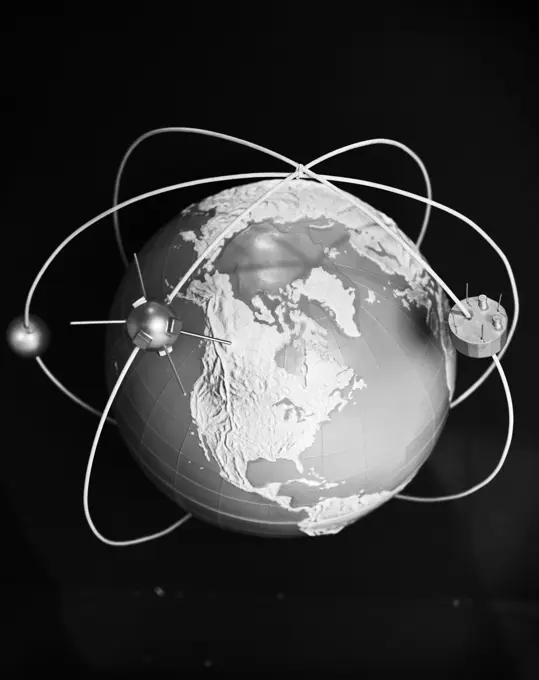
1960S Model Of Earth With Three Satellites In Orbit
6145-44841800
LEED Propellant Project Building
6145-44898488
ISS032-E-011287 (30 July 2012) --- The unpiloted Russian Progress 47 supply vehicle departs from the International Space Station on July 30, 2012. The trash-filled Progress will orbit Earth for several weeks of engineering tests before re-entering the Earths atmosphere over the Pacific Ocean. The departure of Progress 47 clears the way for the next unpiloted supply ship, Progress 48, which is set to launch at 3:35 p.m. (EDT) on Aug. 1 from the Baikonur Cosmodrome in Kazakhstan. Docking is targeted less than six hours later at 9:24 p.m. to the stations Pirs Docking Compartment.
1815-70733877
Cartoon 3d astronaut sitting on planet among stars and planets in space
1848-61272525
Marshall Space Flight Center, rotated logo, black background
1848-63400826
NASA, rotated logo, black background
6177-V54005561
4197-65961635
UFO, alien and camcorder viewfinder with a spaceship flying in the sky over area 51 for an invasion. Camera, spacecraft and conspiracy theory with a saucer on a display to record a sighting of aliens
6145-44730577
ISS018-E-005010 (23 Oct. 2008) --- Backdropped by the blackness of space, the Soyuz TMA-12 spacecraft departs from the International Space Station carrying cosmonauts Sergei Volkov and Oleg Kononenko, Expedition 17 commander and flight engineer, respectively; and American spaceflight participant Richard Garriott. Undocking occurred at 7:16 p.m. (CDT) on Oct. 23, 2008.
6145-44625611
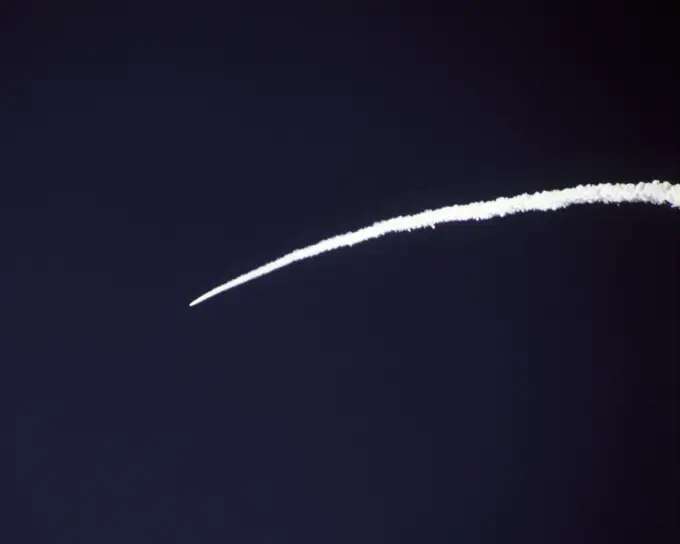
The Pegasus rocket that powered NASA's X-43A scramjet to almost Mach 10 test conditions leaves a bright arc in the Pacific sky during the boost phase.
4201-86590
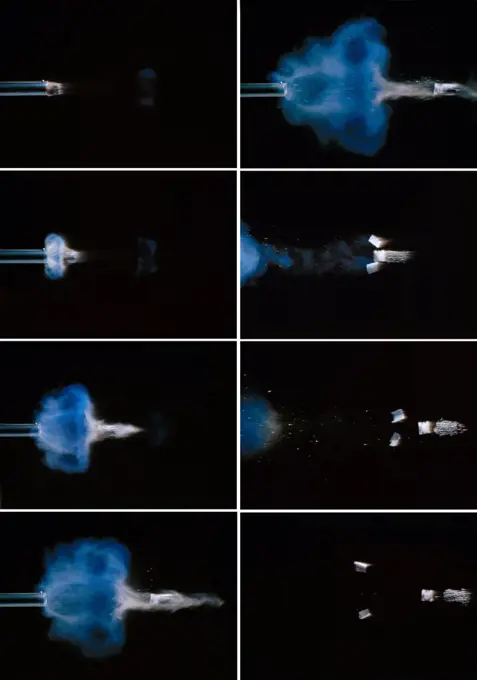
Shotgun discharge sequence
6145-45251833
SOLID ROCKET BOOSTER SHOTS
6145-44916782
ISS034-E-005037 (18 Nov. 2012) --- Soyuz TMA-05M (descent module) beginning to re-enter the Earth's atmosphere on Nov. 19 (real time, Nov. 18, U.S. time) leaving a plasma trail as the Expedition 33 crew streaked toward a pre-dawn landing on the steppe of Kazakhstan northeast of Arkalyk.
6177-V60458326
6243-72452506
Children's watercolor painting of a space rocket and the 'Man-in-the-Moon'.
6177-V53463540
6145-44812575
CAPE CANAVERAL, Fla. - Wispy contrails from the launch of space shuttle Discovery on the STS-131 mission hover over the Vehicle Assembly Building at NASA's Kennedy Space Center in Florida. Shuttle Discovery lifted off at 6:21 a.m. EDT on April 5, 2010. The seven-member STS-131 crew will deliver the multi-purpose logistics module Leonardo, filled with supplies, a new crew sleeping quarters and science racks that will be transferred to the International Space Station's laboratories. The crew also will switch out a gyroscope on the stations truss, install a spare ammonia storage tank and retrieve a Japanese experiment from the stations exterior. STS-131 is the 33rd shuttle mission to the station and the 131st shuttle mission overall.
6188-64777153
Lichtelement Planet Mars auf dem Reformer Planetenlehrpfad in Magdeburg am 20.11.2024 *** Light element Planet Mars at the Reformer Planetary nature trail in Magdeburg on 20 11 2024 1089915018
6188-62389846
space shuttle character coloring book Cartoon Illustration of Funny Space Shuttle in Cosmos Coloring Book Activity Copyright: xZoonar.com/IgorxZakowskix 13384456
PREVIOUS
of 2
NEXT
2401 S. Ervay, Suite 206
Dallas, Texas 75215
United States
Get Started
Free ResearchMy BoardsMy Cart
For Creators
How To License Your ContentContributor PortalFrame of Mind
Resources
API accessPricing
Contact
+1 866 236 0087help@viewpictures.co.uk Contact form
©2026 View Pictures. All Rights Reserved. -A
This site is protected by reCAPTCHA and Google Privacy Policy and Terms of Service apply.