My Boards
View Pictures
  • My Boards

Mughal Miniature Paintings

Colorful Mughal court scenes depicting royal marriages, battles, and tales featuring kings, sages, and mythical elements in vibrant hues and intricate designs.

Vintage Persian Miniature art. Miniature of a guilty man who pleads before a king and is forgiven 1550
176 assets in this story
6145-29789158
Tuhfat al-Ahrar (The Gift to the Noble) 1485-90 Maulana Nur al-Din `Abd al-Rahman Jami. Tuhfat al-Ahrar (The Gift to the Noble) 450739
1788-34245
The hall of the large sofa, where the court dignitaries used to meet, high up on the wall was a grate for spying and eavesdropping in the meetings below, miniature from Turkish Memories, Arabic manuscript, Cicogna Codex, Turkey 17th Century.
1746-21103174
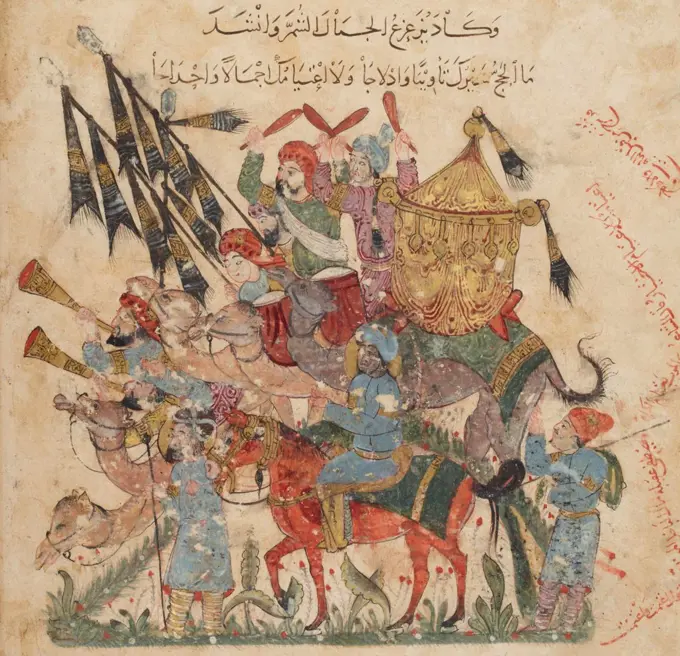
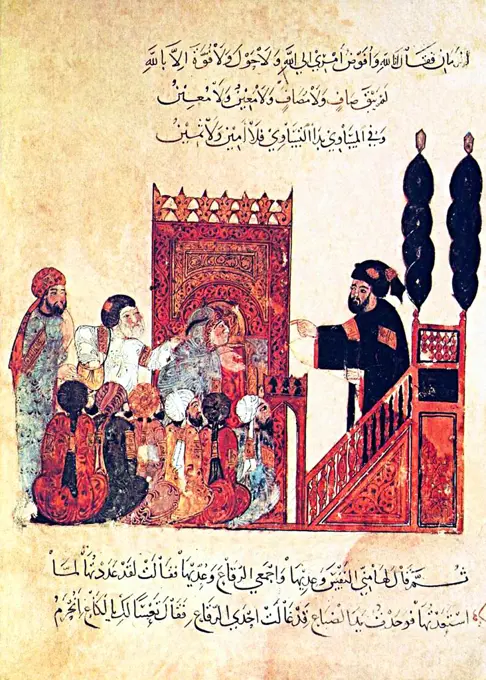
Procession at the end of Ramadan. Maqamat of al-Hariri, Bibliothèque nationale de France, manuscript Arabe 5847, 1237AD. Folio 19 Recto: maqama 07. Procession at the end of Ramadan. The Assemblies of al-Hariri recounts in the words of the narrator, al-Harith ibn Hammam and al-Hariri's several encounters with artist Abu Zayd al-Saruji
6145-46809459
Emperor ShahYu wan, from a manuscript of Hafiz-i Abrus Majma al-tawarikh
1899-18711627
A Prince visiting a Dervish who has abandoned his Way of Life', lacquerware miniature from Sadi's Gulistan painted c. 1610 for the Mughal Emperor Jahangir (r. 1605-1627). Nur-ud-din Salim Jahangir (20 September 1569 - 8 November 1627 was the ruler of the Mughal Empire from 1605 until his death. The name Jahangir is from Persian meaning 'Conqueror of the World'. Nur-ud-din or Nur al-Din is an Arabic name which means; 'Light of the Faith'. Born as Prince Muhammad Salim; he was the third and eldest surviving son of Mogul Emperor Akbar.
4266-26310
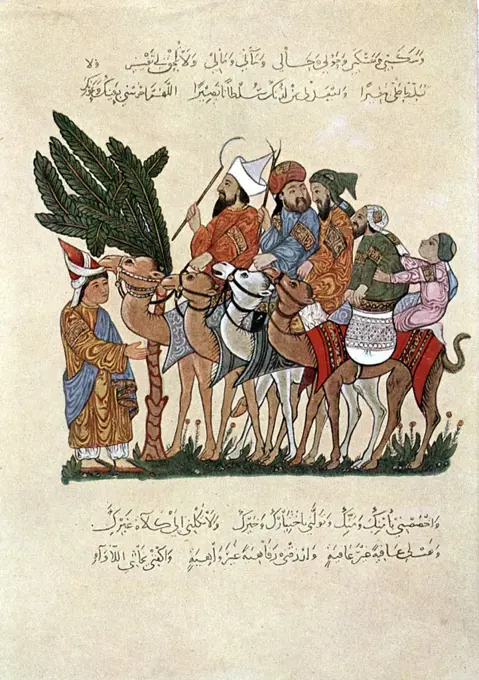
Caravan of pilgrims in Ramleh (from a manuscript of Maqamat of al-Hariri) by Al-Wasiti, Yahya ibn Mahmud (active early 13th cen.)  Bibliotheque Nationale de France  1237  Iraq  Watercolour on parchment  Book Art  Genre
6145-29168762
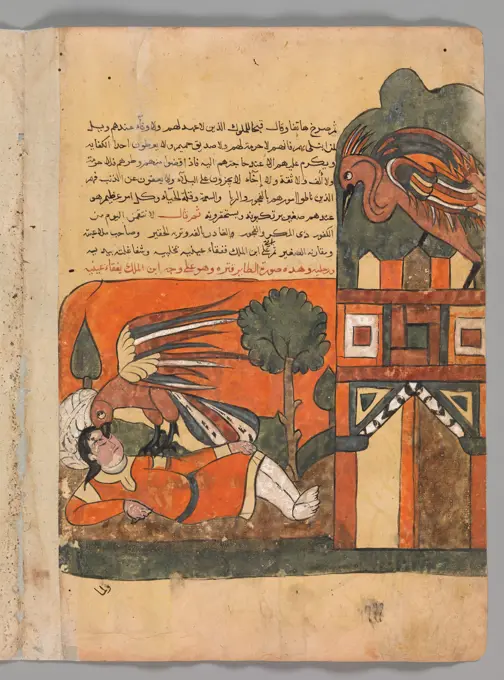
"The Parent Bird Blinds the Prince in Revenge for the Death of her Young One", Folio from a Kalila wa Dimna second quarter 16th century This manuscript contains seventy-eight paintings and many text folios telling the famous tales of the jackals Kalila and Dimna. Based on the book of ancient Indian animal fables, the Panchatantra written by Vidyapati (Bidpai), the stories spread all over the Middle East where they became wildly popular. This manuscript has a strong flavor of Mamluk Egypt in the figure styles and bold drawings, with hints of Ottoman tulips and Safavid turbans. However, the burnt orange palette and darkly-inked lines have led to an attribution to Sultanate Gujarat where it is suggested this manuscript was copied from an Egyptian original. Its life in India is also attested by a Devanagari inscription at the end, although the rest of the Arabic text is written in a strong, left-leaning naskh-like script.. "The Parent Bird Blinds the Prince in Revenge for the Death of her
4409-17283350
ARCANGEL GABRIEL CON TURBANTE Y TROMPETA - Nº INV 1963-420-9 - MANUSCRITO ARABE - S VII AL XV. Location: BRITISH MUSEUM. LONDON. ENGLAND.
4409-17374781
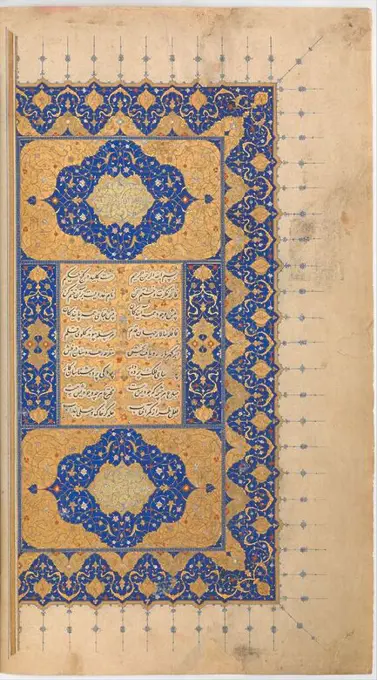
Khamsa (Quintet) of Nizami. Author: Nizami (Ilyas Abu Muhammad Nizam al-Din of Ganja) (probably 1141-1217). Dimensions: 11 1/2 x 7 in. (29.2 x 17.8 cm). Date: 1509-10.Manuscripts from the Safavid capital, such as this copy of Nizami's Khamsa, are notable for their high-quality illumination and bindings. Characteristic of Persian doublures of this period is the contrasting colors of this example: the burgundy of the leather, the blue of the center and corner-pieces, and the gold gilding. Venetian Renaissance gilded leather bindings were particularly influenced by Safavid and Ottoman examples. Museum: Metropolitan Museum of Art, New York, USA.
1899-18853368
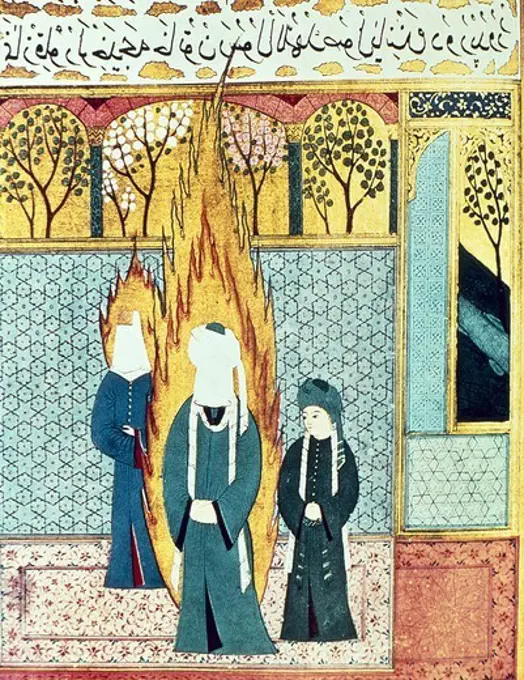
Representations of the Prophet Muhammad are controversial, and generally forbidden in Sunni Islam (especially Hanafiyya, Wahabi, Salafiyya). Shia Islam and some other branches of Sunni Islam (Hanbali, Maliki, Shafi'i) are generally more tolerant of such representational images, but even so the Prophet's features are generally veiled or concealed by flames as a mark of deep respect.
6145-51818072
The Story of the Ghurid King and the Peasant, Page from an illustrated manuscript of the Bustan (Orchard) of Sa'di The Story of the Ghurid King and the Peasant, Page from an illustrated manuscript of the Bustan (Orchard) of Sa'di, early 16th century. Ink, opaque watercolor, and gold on paper, Whole page: 26.5 x 16 cm.   Arts of the Islamic World early 16th century
1899-18712960
A painting on paper in color and gold leaf from al-Jazari's ' Kitab fi marifat al-hiyal al-handasiyya' (The Book of Knowledge of Ingenious Mechanical Devices). Abu al-'Iz Ibn Isma'il ibn al-Razaz al-Jazari (1136-1206) was a polymath: a scholar, inventor, mechanical engineer, craftsman, artist, mathematician and astronomer from Al-Jazira, Mesopotamia, who worked in service of the Artuqid dynasty in Diyarbakir, Asia Minor. He is best known for writing the Kitáb fí ma'rifat al-hiyal al-handasiyya (Book of Knowledge of Ingenious Mechanical Devices) in 1206, where he described fifty mechanical devices along with instructions on how to construct them.
6145-55951938
Zâl before the palace of Rûdâbah.. 1616. Firdawsî. text. illuminated manuscripts, Illuminations, Manuscripts. Spencer Collection. Manuscripts, Persian
6145-52334380
If an Indian wants to kill himself and get permission to do so, he is carried through the town on a chair... Here a young man stabs himself in the flames top; An Indian is shown immolating himself in the presence of a golden idol bottom, f. 246v. 1540 - 1545. Qazwīnī, Zakarīyā ibn Muḥammad, approximately 1203-1283. text. Illuminations, Manuscripts, Miniatures (Illuminations). Spencer Collection. Mountains, Birds, Animals, Manuscripts, Persian
1899-18788095
The Jamia al-tawarikh, ('Compendium of Chronicles') or Universal History is an Iranian work of literature and history written by Rashid-al-Din Hamadani at the start of the 14th century.
1788-33644
Manuscript, 13th century Turkey Miniature depicting Socrates discussing philosophy with his disciples
6145-29061312
Illuminated page, from a Mirror of Holiness (Mirat al-quds) of Father Jerome Xavier, 1602. Mughal India, Allahabad, made for Prince Salim (1569-1627). Opaque watercolor and gold on paper; page: 26.1 x 15.4 cm (10 1/4 x 6 1/16 in.).
1899-18716965
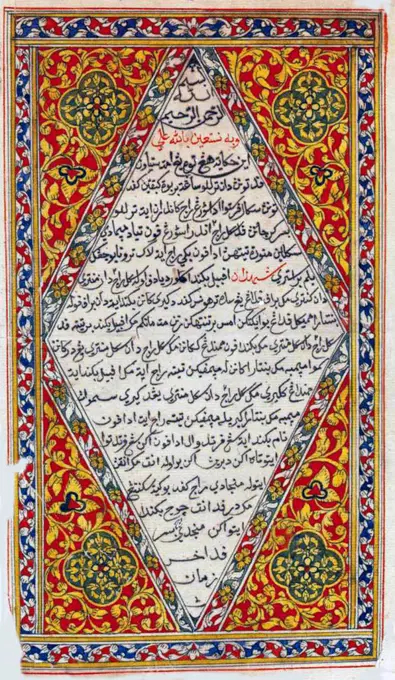
Jawi is an adapted Arabic alphabet for writing the Malay language. It developed in and around Malaya from about 1300 CE about the same time as Islam arrived. Jawi is one of the two official scripts in Brunei and Malaysia for the Malay language. However, nowadays it has all but been replaced by a Roman script called Rumi; Jawi is usually only seen as a script for religious and cultural purposes. Day-to-day usage of Jawi is maintained in more conservative Malay-populated areas such as Sulu in the Philippines, Pattani in Thailand and Kelantan in Malaysia.
6145-55951914
Shâhnâmah = The Book of Kings. p. 253v.. 1616. Firdawsî. text. illuminated manuscripts, Illuminations, Manuscripts. Spencer Collection. Manuscripts, Persian
6145-55951948
Suhrâb removes Gurdâfrîd's helmet and discovers his adversary is a woman.. 1616. Firdawsî. text. illuminated manuscripts, Illuminations, Manuscripts. Spencer Collection. Manuscripts, Persian
1788-33320
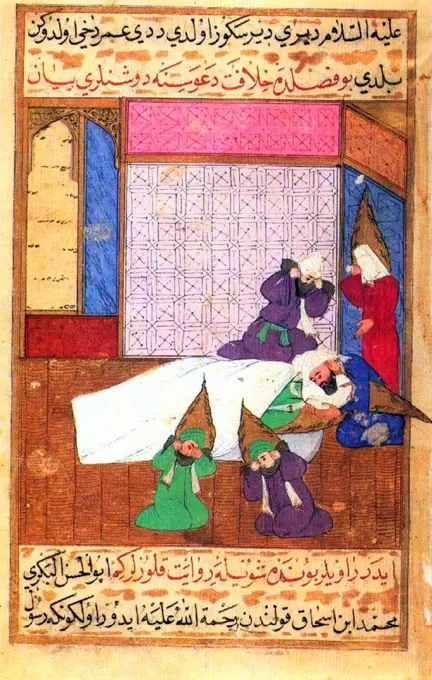
Genghis Khan's funeral: Mongols in mourning clothes, miniature from a Persian manuscript.
1899-18792053
Yahy ibn Mahmûd al-Wsitî was a 13th-century Arab Islamic artist. Al-Wasiti was born in Wasit in southern Iraq. He was noted for his illustrations of the Maqam of al-Hariri. Maqama (literally 'assemblies') are an (originally) Arabic literary genre of rhymed prose with intervals of poetry in which rhetorical extravagance is conspicuous. The 10th century author Badi' al-Zaman al-Hamadhani is said to have invented the form, which was extended by al-Hariri of Basra in the next century. Both authors' maqamat center on trickster figures whose wanderings and exploits in speaking to assemblies of the powerful are conveyed by a narrator. Manuscripts of al-Hariri's Maqamat, anecdotes of a roguish wanderer Abu Zayd from Saruj, were frequently illustrated with miniatures.
6145-51831254
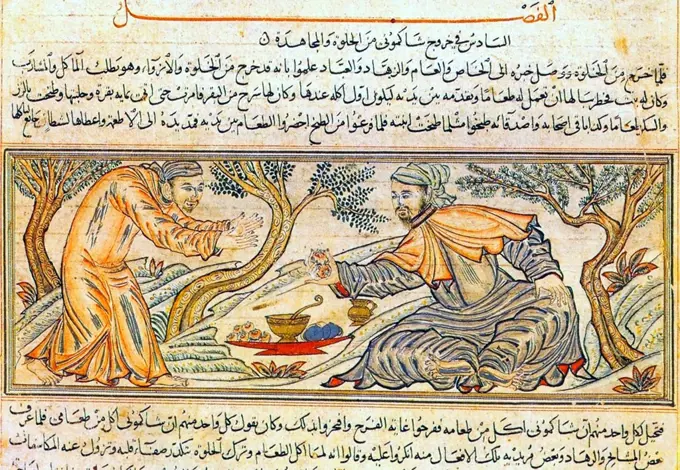
"Job Lying Under a Tree," Page from an Illustrated Manuscript of the Majma` al-tavarikh (Collection of Chronicles) of Hafiz Abru (d. 1430) "Job Lying Under a Tree," Page from an Illustrated Manuscript of the Majma` al-tavarikh (Collection of Chronicles) of Hafiz Abru (d. 1430), ca. 1425. Ink, opaque watercolor, and gold on paper, Sheet: 13 x 16 15/16 in. (33 x 43 cm).   Arts of the Islamic World ca. 1425
6145-55950546
Lote tree (nabq), f. 177v. 1540 - 1545. Qazwīnī, Zakarīyā ibn Muammad, approximately 1203-1283. text. Illuminations, Manuscripts, Miniatures (Illuminations). Spencer Collection. Mountains, Birds, Animals, Manuscripts, Persian
4443-75478682
Ayyûb leads Râfi ibn Wadîghah, one of the hypocrites, out of the mosque for creating a disturbance., 1594 - 1595, Istanbul, Manuscripts, Turkish, 19.8 x 17.5 cm
6145-29128227
Sultan Mehmet III (reigned 1595-1603) Enthroned, Attended by Two Janissaries. Turkey, about 1600. Manuscripts; folios. Ink, opaque watercolor, and gold on paper
6145-55942186
Iskandar, disguised as a merchant, meets Nūshābah, Queen of Burda, fol. 284 Iskandar, disguised as a merchant, is recognized by Queen Nûshâbah, the ruler of Burda' (Armenia), who shows Iskandar a portrait of himself.. 1515. Niāmī Ganjavī, 1140 or 41-1202 or 3. Manuscripts, Miniatures (Illuminations). Spencer Collection. Manuscripts, Persian
1899-19135206
Turkey: An unhappy wife (left, with members of her family) is complaining to the qadi or judge (seated, centre), that her husband (right, disconsolate) is impotent. The evidence is a zibik or dildo held by the judge. Hamse-i Atai, Nevizade Atai (1583-1634), 1723
1899-18787908
Yahya ibn Mahmod al-Wasiti was a 13th-century Arab Islamic artist. Al-Wasiti was born in Wasit in southern Iraq. He was noted for his illustrations of the Maqam of al-Hariri. Maqama (literally 'assemblies') are an (originally) Arabic literary genre of rhymed prose with intervals of poetry in which rhetorical extravagance is conspicuous. The 10th century author Badi' al-Zaman al-Hamadhani is said to have invented the form, which was extended by al-Hariri of Basra in the next century. Both authors' maqamat center on trickster figures whose wanderings and exploits in speaking to assemblies of the powerful are conveyed by a narrator. Manuscripts of al-Hariri's Maqamat, anecdotes of a roguish wanderer Abu Zayd from Saruj, were frequently illustrated with miniatures.
6145-55950535
Hazelnut tree (funduq) top; Boxthorn (fîl zahra; misspeled fil-zahraj) bottom, f. 170v. 1540 - 1545. Qazwīnī, Zakarīyā ibn Muammad, approximately 1203-1283. text. Illuminations, Manuscripts, Miniatures (Illuminations). Spencer Collection. Mountains, Birds, Animals, Manuscripts, Persian
6176-67052376
Muslim warrior mounted on a camel, 13th century. Artist: Unknown
1746-19628660
Travellers on camels, greeted at end of their journey. After 13th century Arab manuscript
4443-75458773
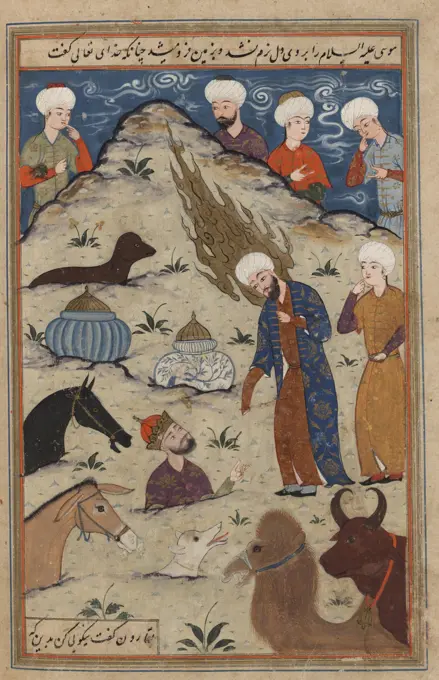
God causes King Qârûn (Korah) and his palace to be swallowed by the earth, fol. 98v., 1580 ., Qazvin., 19.1 x 12.7 cm
6145-55950463
A serpent with one head and five snake bodies (mukhammas), f. 97v. 1540 - 1545. Qazwīnī, Zakarīyā ibn Muammad, approximately 1203-1283. text. Illuminations, Manuscripts, Miniatures (Illuminations). Spencer Collection. Mountains, Birds, Animals, Manuscripts, Persian
1899-18787925
Yahya ibn Mahmod al-Wasiti was a 13th-century Arab Islamic artist. Al-Wasiti was born in Wasit in southern Iraq. He was noted for his illustrations of the Maqam of al-Hariri. Maqama (literally 'assemblies') are an (originally) Arabic literary genre of rhymed prose with intervals of poetry in which rhetorical extravagance is conspicuous. The 10th century author Badi' al-Zaman al-Hamadhani is said to have invented the form, which was extended by al-Hariri of Basra in the next century. Both authors' maqamat center on trickster figures whose wanderings and exploits in speaking to assemblies of the powerful are conveyed by a narrator. Manuscripts of al-Hariri's Maqamat, anecdotes of a roguish wanderer Abu Zayd from Saruj, were frequently illustrated with miniatures.
1899-18714226
Miniature from Hafiz-i Abrus Majma al-tawarikh. “Noahs Ark” Iran (Afghanistan), Herat; c. 1425. Timurs son Shah Rukh (1405-1447) ordered the historian Hafiz-i Abru to write a continuation of Rashid al-Dins famous history of the world, Jami al-tawarikh. Like the Il-Khanids, the Timurids were concerned with legitimizing their right to rule, and Hafiz-i Abrus “A Collection of Histories” covers a period that included the time of Shah Rukh himself.
6145-29773061
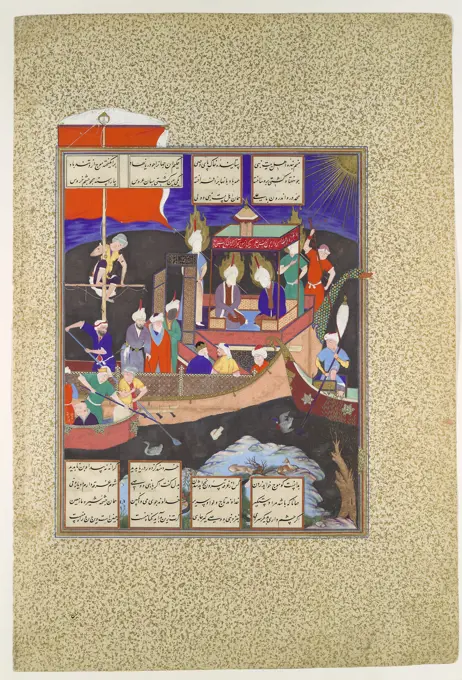
"Firdausi's Parable of the Ship of Shi'ism", Folio 18v from the Shahnama (Book of Kings) of Shah Tahmasp ca. 1530-35 Abu'l Qasim Firdausi In the introduction to the Shahnama, God launched seventy ships, bearing adherents to the religions of mankind, into a stormy sea. Clearly depicted on the central ship are the Prophet and his soninlaw and successor 'Ali sitting beneath the red canopy, while 'Ali’s sons, Hasan and Husain, stand nearby. Details such as the inlaid stars and figures with very small elliptical pupils are characteristic of works attributed to Mirza 'Ali, the son of the master painter Sultan Muhammad.. "Firdausi's Parable of the Ship of Shi'ism", Folio 18v from the Shahnama (Book of Kings) of Shah Tahmasp 452110
6145-29090102
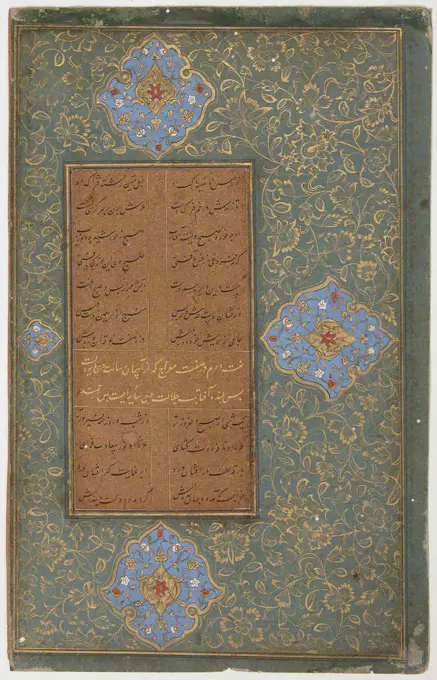
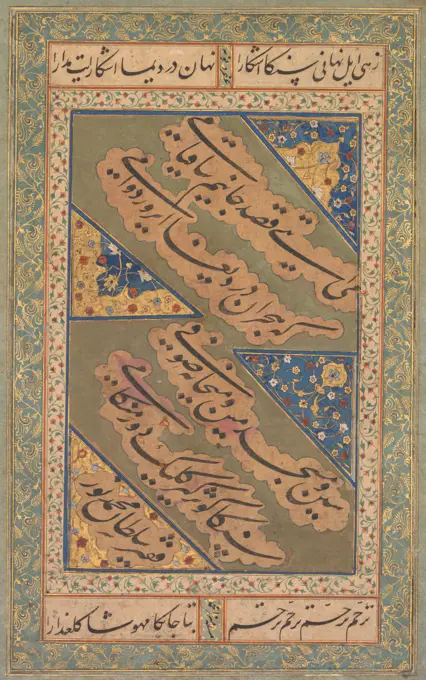
Calligraphy of Chaghatai Turkish Poems in Praise of Wine (verso), c. 1500-20. Mirza Muhammad (probably Persian, active c. 1520s), and Sultan Muhammad Nur (Persian, c. 1472-1536). Ink on paper (verso); page: 36.2 x 24.3 cm (14 1/4 x 9 9/16 in.). This page of delicately illuminated calligraphy from the pre-Mughal period was mounted into a Mughal album. The poems are written in the native language of the Mughals, a form of Turkish called Chaghatai, using a flowing form of Arabic script called nastaliq. The Mughals self-consciously adopted Persian as their official court language, so few Chaghatai books or works of calligraphy were made for them. The quatrain in the center reads: The wine has made an attempt on my life, Since it is the wine that can wear down the pain of separation. O Sufi! Let the mosque be for you, and the tavern for me, Since you need to arrive at the Spring of Kowsar, while I am in need of wine! The Spring of Kowsar is where the righteous quench their thirst in the a
6145-29168704
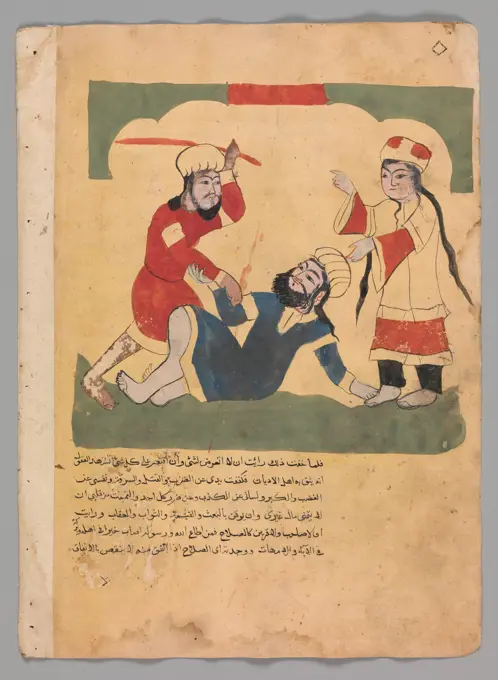
"The Husband Beats his Wife's Lover", Folio from a Kalila wa Dimna second quarter 16th century This manuscript contains seventy-eight paintings and many text folios telling the famous tales of the jackals Kalila and Dimna. Based on the book of ancient Indian animal fables, the Panchatantra written by Vidyapati (Bidpai), the stories spread all over the Middle East where they became wildly popular. This manuscript has a strong flavor of Mamluk Egypt in the figure styles and bold drawings, with hints of Ottoman tulips and Safavid turbans. However, the burnt orange palette and darkly-inked lines have led to an attribution to Sultanate Gujarat where it is suggested this manuscript was copied from an Egyptian original. Its life in India is also attested by a Devanagari inscription at the end, although the rest of the Arabic text is written in a strong, left-leaning naskh-like script.. "The Husband Beats his Wife's Lover", Folio from a Kalila wa Dimna 453073
1746-21108672
Firdausi's Parable of the Ship of Faith, produced for Shah Tahmasp I. Author Miza Ali. 1535
1899-18787903
Yahya ibn Mahmod al-Wasiti was a 13th-century Arab Islamic artist. Al-Wasiti was born in Wasit in southern Iraq. He was noted for his illustrations of the Maqam of al-Hariri. Maqama (literally 'assemblies') are an (originally) Arabic literary genre of rhymed prose with intervals of poetry in which rhetorical extravagance is conspicuous. The 10th century author Badi' al-Zaman al-Hamadhani is said to have invented the form, which was extended by al-Hariri of Basra in the next century. Both authors' maqamat center on trickster figures whose wanderings and exploits in speaking to assemblies of the powerful are conveyed by a narrator. Manuscripts of al-Hariri's Maqamat, anecdotes of a roguish wanderer Abu Zayd from Saruj, were frequently illustrated with miniatures.
1899-18719036
Abu 'I-Fath Muhammad, known in later centuries as Shaybani Khan (c. 1451 - 2 December 1510), was a khan of the Uzbeks (from 1500) who continued consolidating various Uzbek tribes and laid foundations for their ascendance in Transoxiana. He was a descendant of Genghis Khan through his grandson Shayban and considered the Timurids as usurpers of the Genghisid heritage in Central Asia. His native Turkic name was Shabaq/Shebaq (wormwood, whence Shaibak, thence Shaybani--a pseudo-authentication of a common Turkic name into a more prestigious Arabic tribal name of Shayban).
6145-55951953
The dying Bahrâm places a crown on the head of his successor Shâpûr.. 1616. Firdawsî. text. illuminated manuscripts, Illuminations, Manuscripts. Spencer Collection. Manuscripts, Persian
1899-18792517
Al-Ghafiqi, according to a thirteenth-century historian of Arab medicine, Ibn Abi `Usyabi`ah, was the greatest savant of medicinal plants, their names and their properties, and his work had no equal in this field. This view was later confirmed by Max Meyerhof (d. 1945), the eminent historian of Islamic medicine, who stated that al-Ghafiqi was undoubtedly the greatest botanist and pharmacologist of the Islamic period. In his work, originally composed as an aide-mémoire, al-Ghafiqi relied heavily on his illustrious Greek predecessors, such as Dioscorides (1st century CE) and Galen (2nd century CE), and his fellow Muslims, such as, Abu Hanifah al-Dinawari (d. 895), Abu Bakr Muhammad ibn Zakariya al-Razi (d. 925), and Ibn Samajun (d. 1001). His important contribution, however, lies in the additional information that he supplies, his knowledge of the plants of southern Spain and Morocco, as well as an astonishing understanding of the synonyms of plants in such languages as Greek, Syriac, La
6145-29295005
A Persian princess and her attendant
6145-29116552
The Appearance of Shakyamuni (the Buddha) after His Death, Page from a Manuscript of the Majma' al-Tawarikh (Collection of Chronicles) of Hafiz-Abru. Afghanistan, Herat, circa 1425. Manuscripts; folios. Ink, opaque watercolor on paper
1899-18792826
Abu Yahya Zakariya' ibn Muhammad al-Qazwini (     ) (born 1203 - died 1283), was a Persian physician, astronomer, geographer and proto-science fiction writer. Born in the Persian town of Qazvin, he was descended from Anas ibn Malik, Zakariya' ibn Muhammad al-Qazwini served as legal expert and judge (qadhi) in several localities in Persia and at Baghdad. He travelled around in Mesopotamia and Syria, and finally entered the circle patronized by the governor of Baghdad, ‘Ata-Malik Juwayni (d. 1283 CE). It was to the latter that al-Qazwini dedicated his famous Arabic-language cosmography titled 'Aja'ib al-makhluqat wa-ghara'ib al-mawjudat      ('Marvels of Creatures and Strange Things Existing'). This treatise, frequently illustrated, was immensely popular and is preserved today in many copies. It was translated into Persian and Turkish. Qazwini was also well-known for his geographical dictionary, Athar al-bilad wa-akhbar al-‘ibad
6145-29819853
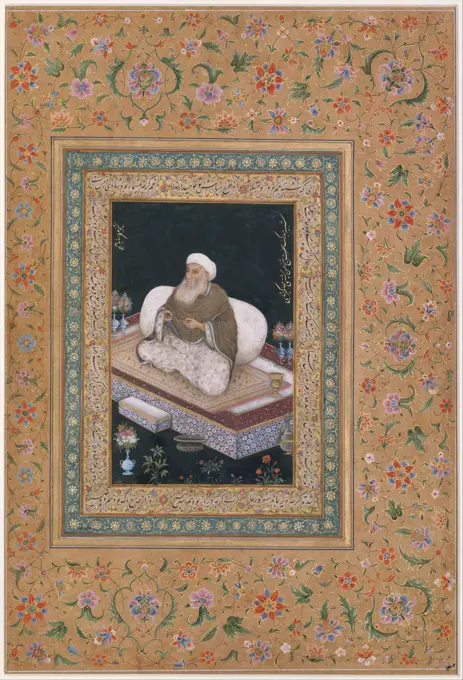
"Portrait of Shaikh Mu'in al-Din Hasan Chishti", Folio from the Shah Jahan Album recto and verso: early 19th century This portrait of a sufi is identified along the right border as being the likeness of Shaikh Mu`in al-Din Hasan Chishti (1141-1230), an important member of the Chishtiyya sufi order. Founded in Chisht, a small town near Herat, Afghanistan in 930, the Chishtiyya Sufi Order expanded to India when Mu'in al-Din Hasan Chishti traveled there in 1193. His presence in India led to an expansion of the Chishti order in the Indian subcontinent, which continued to flourish long after his death in 1230. The tomb of Shaikh Mu`in al-Din Hasan Chishti in Ajmer is to this day a popular destination for pilgrims wishing to venerate this respected saint.. "Portrait of Shaikh Mu'in al-Din Hasan Chishti", Folio from the Shah Jahan Album 451272
6145-55950518
Palma Christi (khirva') top; Willow tree (khalâf) bottom, f. 161. 1540 - 1545. Qazwīnī, Zakarīyā ibn Muammad, approximately 1203-1283. text. Illuminations, Manuscripts, Miniatures (Illuminations). Spencer Collection. Mountains, Birds, Animals, Manuscripts, Persian
4220-21857453
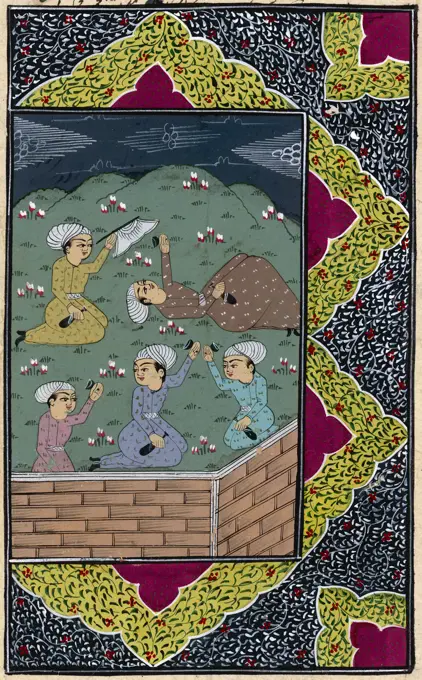
 A drinking party - five  revellers enjoy a partie  de campagne       Date: circa 16th century
1899-18787951
Yahya ibn Mahmod al-Wasiti was a 13th-century Arab Islamic artist. Al-Wasiti was born in Wasit in southern Iraq. He was noted for his illustrations of the Maqam of al-Hariri. Maqama (literally 'assemblies') are an (originally) Arabic literary genre of rhymed prose with intervals of poetry in which rhetorical extravagance is conspicuous. The 10th century author Badi' al-Zaman al-Hamadhani is said to have invented the form, which was extended by al-Hariri of Basra in the next century. Both authors' maqamat center on trickster figures whose wanderings and exploits in speaking to assemblies of the powerful are conveyed by a narrator. Manuscripts of al-Hariri's Maqamat, anecdotes of a roguish wanderer Abu Zayd from Saruj, were frequently illustrated with miniatures.
6145-29269272
Persian couple copulating
6145-51829135
Manuscript of the Hadiqat al-Su`ada (Garden of the Blessed) of Fuzuli Muhammad bin Sulayman, known as Fuzuli (ca. 1483-1556). Manuscript of the Hadiqat al-Su`ada (Garden of the Blessed) of Fuzuli, AH 1011 / 1602-3 C.E. Opaque watercolor, ink and gold on paper; leather binding, 5 1/2 x 9 3/4 in. (14 x 24.8 cm).  This manuscript is a copy of the sixteenth-century Hadiqat al-Sucada (Garden of the Blessed), written in Baghdad by the Ottoman mystic Muhammad bin Sulayman, known as Fuzuli (circa 1483-1556). It is a text on the Prophets family and belongs to a group of illustrated devotional manuscripts executed in a provincial style in Baghdad under the patronage of the Ottoman sultan Mehmet III (r. 1595-1603). Here, the Prophet is shown veiled and seated on a pulpit, accompanied by his cousin and son-in-law, cAli, and his grandchildren, Hasan and Husayn, all distinguished by haloes of fire. According to the Ottoman Turkish text, Muhammad is conversing with the angel Gabriel and the Angel of
1899-18718692
This fable by Luqman, well-known in Arabic and Turkish folk literature, is the moral story of a conceited stag that is very proud of his great antlers but ashamed of his skinny legs. One day, hunters chase him and he escapes thanks to his speed and his spindly legs, but runs between some trees. He becomes trapped in the branches of the trees due to his large antlers and is killed by the hunters.
4435-5303
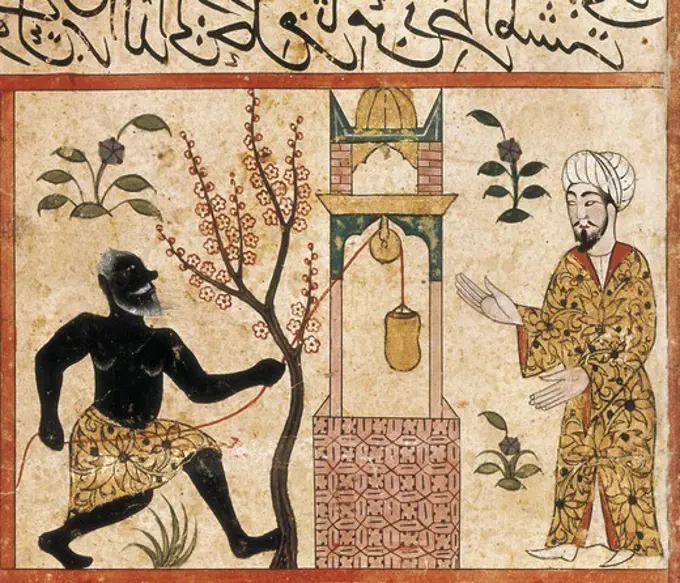
Arabic illuminated manuscript with a black slave taking out water from the well in front of his lord. Islamic art. Miniature Painting. FRANCE. ëLE-DE-FRANCE. Paris. National Library.
6176-66903708
Dancing dervishes, by Kamal ud-Din Behzad (c. 1480/1490)
4409-3995
DETALLE DEL ESTANDARTE ARABE DE LA BATALLA DEL SALADO OCURRIDA EN EL AÑO 1340. Location: CATEDRAL-INTERIOR. Toledo. SPAIN.
6176-66902617
Mughal Emperor Akbar (r. 1556-1605) holds a religious assembly in the Ibadat Khana (House of Worship) in Fatehpur Sikri; the two men dressed in black are the Jesuit missionaries Rodolfo Acquaviva and Francisco Henriques, circa 1605
1899-18787597
Socrates (c. 469 399 BCE) was a classical Greek Athenian philosopher. Credited as one of the founders of Western philosophy, he is an enigmatic figure known chiefly through the accounts of later classical writers, especially the writings of his students Plato and Xenophon, and the plays of his contemporary Aristophanes. Many would claim that Plato's dialogues are the most comprehensive accounts of Socrates to survive from antiquity. Through his portrayal in Plato's dialogues, Socrates has become renowned for his contribution to the field of ethics, and it is this Platonic Socrates who also lends his name to the concepts of Socratic irony and the Socratic method, or elenchus. The latter remains a commonly used tool in a wide range of discussions, and is a type of pedagogy in which a series of questions are asked not only to draw individual answers, but also to encourage fundamental insight into the issue at hand. It is Plato's Socrates that also made important and lasting contributions
1788-32786
Sitting of the chapter of the Order of the Golden Fleece, miniature from the Story of the Golden Fleece by Guillaume Fillastre, Bishop of Tournai, France 15th Century.
1899-18792701
Pedanius Dioscorides (Greek: ed sd; circa 40—90 AD) was a Greek physician, pharmacologist and botanist, the author of a 5-volume encyclopedia about herbal medicine and related medicinal substances (a pharmacopeia), that was widely read for well more than a thousand years. A native of Anazarbus, Cilicia, Asia Minor, Dioscorides practiced in Rome at the time of Nero. He was a surgeon with the army of the emperor, so he had the opportunity to travel extensively, seeking medicinal substances (plants and minerals) from all over the Roman and Greek world. This miniature painting is from a 13th century Arabic edition of Disocorides' work. <br/><br/>.
6145-55942238
Heading omitted, qasab al-dharîrâ top; Balsam tree (Commiphora spp.), al-balasân bottom, fol. 26v. Mîrzâ Bâqir (fl. 19th c.). 1889 - 1890. Dioscorides Pedanius, of Anazarbos. text. Manuscripts, Illustrations, Botanical illustrations. Spencer Collection. Medicine, Arab, Medicinal plants, Botany, Medical, Medicine, Greek and Roman
1899-18792828
Abu Yahya Zakariya' ibn Muhammad al-Qazwini (     ) (born 1203 - died 1283), was a Persian physician, astronomer, geographer and proto-science fiction writer. Born in the Persian town of Qazvin, he was descended from Anas ibn Malik, Zakariya' ibn Muhammad al-Qazwini served as legal expert and judge (qadhi) in several localities in Persia and at Baghdad. He travelled around in Mesopotamia and Syria, and finally entered the circle patronized by the governor of Baghdad, ‘Ata-Malik Juwayni (d. 1283 CE). It was to the latter that al-Qazwini dedicated his famous Arabic-language cosmography titled 'Aja'ib al-makhluqat wa-ghara'ib al-mawjudat      ('Marvels of Creatures and Strange Things Existing'). This treatise, frequently illustrated, was immensely popular and is preserved today in many copies. It was translated into Persian and Turkish. Qazwini was also well-known for his geographical dictionary, Athar al-bilad wa-akhbar al-‘ibad
4443-75476014
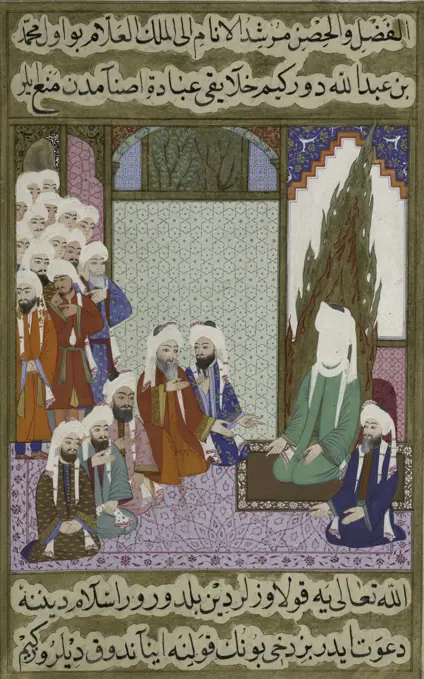
Muhammad discusses Islam with leaders of the Banî Sa'sa'ah tribe, including 'mir ibn Sa'sa'ah., 1594 - 1595 (Inferred)., Istanbul. Manuscripts, Turkish., 26.3 x 17.2 cm
4435-5327
Muhammad prays with Ali and Khadijah. Islamic art. Miniature Painting. TURKEY. THRACE. Istanbul. Topkapi Saray Museum Istanbul.
1899-18792524
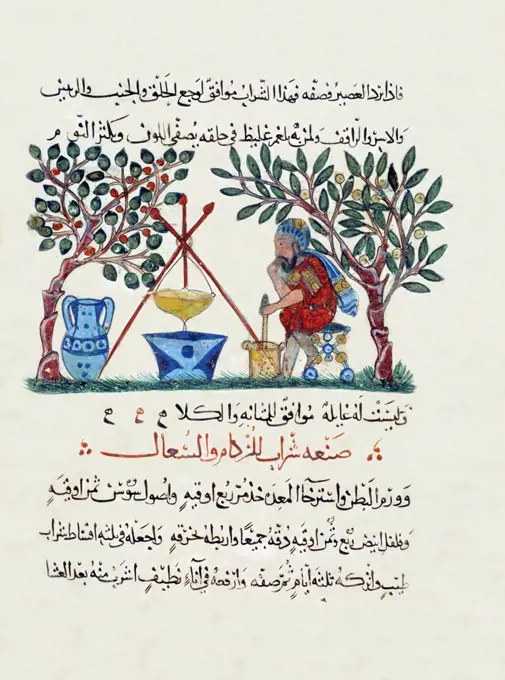
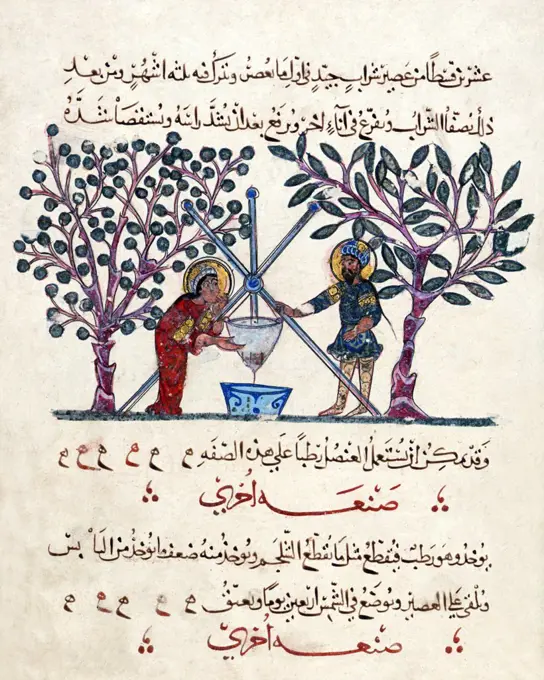
Illustration leaf from a dispersed manuscript (Aya Sofya 3703, later Top Kapi Seray 2147) of the Arabic version of De materia medica by Dioscorides (fl. ca. 65 CE) that was copied in 621 AH / 1224 CE in Baghdad. Two doctors are preparing medicine. A funnel is set on a tripod over a vessel. The two physicians preparing the medicinal draught stand on either side of the tripod beside two fruit trees. The text is written in Arabic naskhi script in brownish-black and red ink.
4443-75476318
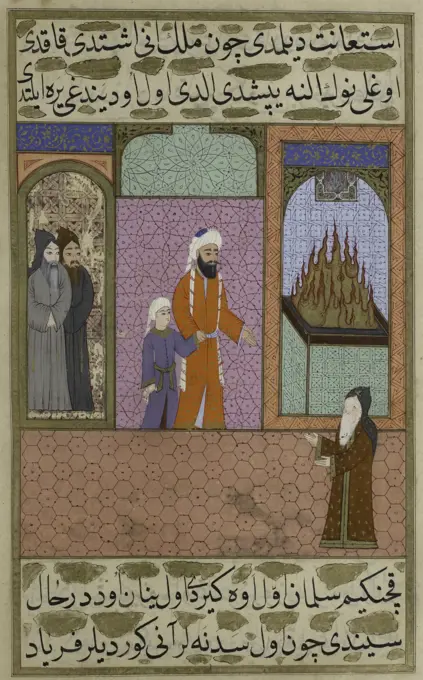
A Persian king, who practices Zoroastrianism, and his young son, Salmân al-Fârisî, are depicted entering a fire temple overseen by three priests. They are informed that the sacred flame has been diminishing. The artwork was created between 1594 and 1595 in Istanbul and is part of Turkish manuscripts, measuring 19 x 17 cm
1746-21104950
Colour illustration from 'The illuminated manuscript Khamsa of Nizami' a 12th Century a lavishly illustrated manuscript of the Khamsa or 'five poems' of Nizami Ganjavi (1141-1209) a Persian poet.
1899-18717808
A mihrab, or' maharib, is a niche in the wall of a mosque that indicates the qibla the direction of the Kaaba in Mecca, which is the direction that Muslims should face when praying. The wall in which a mihrab is located is called the 'qibla wall'.
1746-21105411
Two types of palm trees, from ëAjíib al-makhlqt wa-gharíib al-mawjdt (Marvels of Things Created and Miraculous Aspects of Things Existing) by al-Qazwn (d. 1283/682). The copy was made in 1537/944, probably in western India. Neither the copyist nor illustrator is named.
6145-51818549
Single Page from a Shah-Namah Single Page from a Shah-Namah, 17th century. Ink, opaque watercolor on paper, Image: 12 15/16 x 6 11/16 in. (32.8 x 17 cm).   Arts of the Islamic World 17th century
6145-29257945
Muhammad Mugham Al-Dīn Shāhzadeh. Gouache painting by an Indian artist, ca. 1850 ().
1746-21105951
Illustration depicting Coconut and palm trees, from 1538 edition, of 'Kitb-I ajyb al-makhlqt va gharib al-mawjdt'. (Marvels of Things Created and Miraculous Aspects of Things Existing) a 12th century, Islamic, Persian scientific book by Zakary ibn Muammad Qazwn
1899-18792821
Abu Yahya Zakariya' ibn Muhammad al-Qazwini (     ) (born 1203 - died 1283), was a Persian physician, astronomer, geographer and proto-science fiction writer. Born in the Persian town of Qazvin, he was descended from Anas ibn Malik, Zakariya' ibn Muhammad al-Qazwini served as legal expert and judge (qadhi) in several localities in Persia and at Baghdad. He travelled around in Mesopotamia and Syria, and finally entered the circle patronized by the governor of Baghdad, ‘Ata-Malik Juwayni (d. 1283 CE). It was to the latter that al-Qazwini dedicated his famous Arabic-language cosmography titled 'Aja'ib al-makhluqat wa-ghara'ib al-mawjudat      ('Marvels of Creatures and Strange Things Existing'). This treatise, frequently illustrated, was immensely popular and is preserved today in many copies. It was translated into Persian and Turkish. Qazwini was also well-known for his geographical dictionary, Athar al-bilad wa-akhbar al-‘ibad
1899-18792809
Abu Yahya Zakariya' ibn Muhammad al-Qazwini (     ) (born 1203 - died 1283), was a Persian physician, astronomer, geographer and proto-science fiction writer. Born in the Persian town of Qazvin, he was descended from Anas ibn Malik, Zakariya' ibn Muhammad al-Qazwini served as legal expert and judge (qadhi) in several localities in Persia and at Baghdad. He travelled around in Mesopotamia and Syria, and finally entered the circle patronized by the governor of Baghdad, ‘Ata-Malik Juwayni (d. 1283 CE). It was to the latter that al-Qazwini dedicated his famous Arabic-language cosmography titled 'Aja'ib al-makhluqat wa-ghara'ib al-mawjudat      ('Marvels of Creatures and Strange Things Existing'). This treatise, frequently illustrated, was immensely popular and is preserved today in many copies. It was translated into Persian and Turkish. Qazwini was also well-known for his geographical dictionary, Athar al-bilad wa-akhbar al-‘ibad
1848-50669282
Court Life, Ulugbek Observatory Museum, Astronomical Wonders of Medieval Uzbekistan, Samarkand, Uzbekistan, Samarkand, Uzbekistan, Asia
PREVIOUS
of 2
NEXT
2401 S. Ervay, Suite 206
Dallas, Texas 75215
United States
Get Started
Free ResearchMy BoardsMy Cart
For Creators
How To License Your ContentContributor PortalFrame of Mind
Resources
API accessPricing
Contact
+1 866 236 0087help@viewpictures.co.uk Contact form
©2026 View Pictures. All Rights Reserved. -B
This site is protected by reCAPTCHA and Google Privacy Policy and Terms of Service apply.