My Boards
View Pictures
  • My Boards

NASA Panel Discussions

Images of various NASA panel discussions featuring representatives from NASA and space industry leaders discussing missions, technology, and space programs. The setting is formal with screens displayi
1969 - At a post-flight Apollo 11 press conference, Neil Armstrong talks about collecting lunar rock samples.
152 assets in this story
6145-44704131
All Hands Meeting with STS-122 Crew Members
6145-45275386
Joshua Santora, with NASA Communications, moderates a NASA Social Facebook Live briefing inside the Press Site auditorium on May 26, 2020, at the agencys Kennedy Space Center in Florida ahead of NASAs SpaceX Demo-2 launch, slated for Wednesday, May 27. A SpaceX Falcon 9 rocket and Crew Dragon spacecraft are scheduled to lift off from Kennedys Launch Complex 39A, carrying NASA astronauts Robert Behnken and Douglas Hurley to the International Space Station. This will mark the first launch of astronauts from U.S. soil to the space station since the conclusion of the Space Shuttle Program in 2011. Part of the agencys Commercial Crew Program, this will be SpaceXs final flight test, paving the way for NASA to certify the crew transportation system for regular, crewed flights to the orbiting laboratory. Liftoff is scheduled for 4:33 p.m. EDT.
6145-45063059
VANDENBERG AIR FORCE BASE, Calif. - From left, George Diller, NASA Public Affairs Ken Jucks, Orbiting Carbon Observatory-2, or OCO-2, project executive at NASA Headquarters David Crisp, OCO-2 science team leader at NASA's Jet Propulsion Laboratory, or JPL and Annmarie Eldering, OCO-2 deputy project scientist at JPL, participate in a mission science briefing at Vandenberg Air Force Base in California prior to the launch of the observatory.Launch aboard a United Launch Alliance Delta II rocket from Space Launch Complex 2 is scheduled for 5:56 a.m. EDT on July 1.  OCO-2 is NASAs first mission dedicated to studying atmospheric carbon dioxide, the leading human-produced greenhouse gas driving changes in Earths climate. OCO-2 will provide a new tool for understanding the human and natural sources of carbon dioxide emissions and the natural "sinks" that absorb carbon dioxide and help control its buildup. The observatory will measure the global geographic distribution of these sources and
6145-44476905
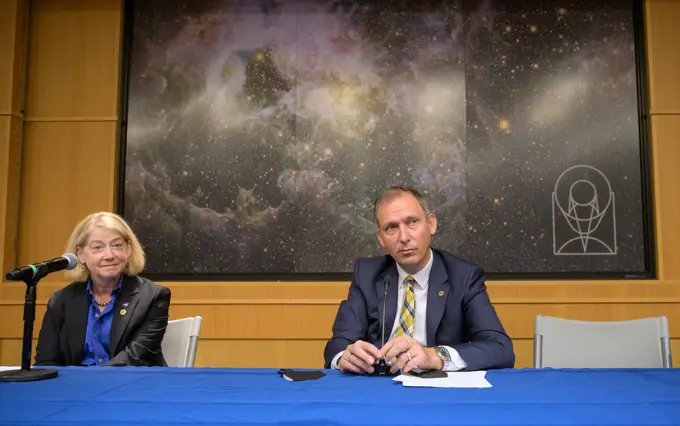
NASA Deputy Administrator Pam Melroy, left, and NASA Associate Administrator for the Science Mission Directorate Thomas Zurbuchen give remarks during a briefing, Wednesday, June 29, 2022, at the Space Telescope Science Institute (STScI) in Baltimore. The briefing focused on the status of NASAs James Webb Space Telescope in its final weeks of preparing for its science mission, as well as overviews of planned science for Webbs first year of operations.
6145-44900077
CAPE CANAVERAL, Fla. -- Ed Mango, program manager for NASA's Commercial Crew Program CCP, left, and Brent Jett, CCP's deputy program manager, host a forum for the commercial spaceflight industry to introduce the agency's plans for certifying commercially developed spacecraft and launch systems in support of crewed missions to the International Space Station around the middle of the decade.
6145-45200869
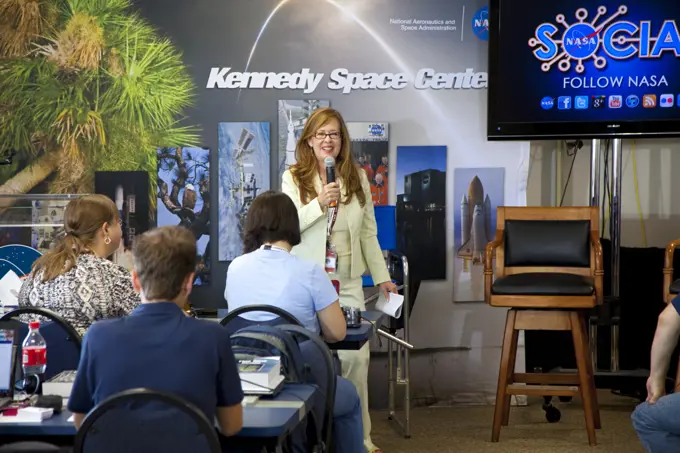
Annemarie Eldering, project scientist for the Orbiting Carbon Observatory-3 (OCO-3) at NASAs Jet Propulsion Laboratory in Pasadena, California, talks to NASA Social participants during a Whats On Board science briefing at the agencys Kennedy Space Center in Florida on April 29, 2019. The briefing was held for SpaceXs 17th Commercial Resupply Services (CRS-17) mission to the International Space Station. OCO-3 will be robotically installed on the exterior of the space stations Japanese Experiment Module Exposed Facility Unit, where it will measure and map carbon dioxide from space to provide further understanding of the relationship between carbon and climate. The SpaceX Falcon 9 rocket and Dragon cargo module are scheduled to launch no earlier than May 3, 2019, from Space Launch Complex 40 on Cape Canaveral Air Force Station in Florida.
6145-44791677
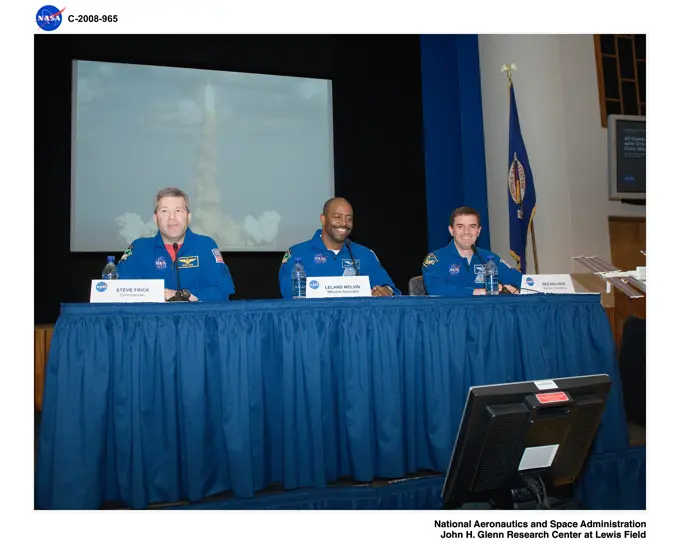
Members of the crew of STS-128 seated from left, Commander Rick Sturckow, mission specialists Patrick Forrester, Jose Hernandez and Christer Fuglesang of the European Space Agency, speak to the audience during a presentation in the auditorium at NASA Headquarters in Washington, Thursday, Nov. 5, 2009.
6145-45053845
CAPE CANAVERAL, Fla. - At the Kennedy Space Center Visitor Complex in Florida, Bob Cabana, the center's director, shares NASA's vision of developing the capabilities needed to send humans to an asteroid by 2025 and Mars in the 2030s with students, teachers, parents and VIPs during the 2014 DuPont Challenge Science Essay Competition awards ceremony at the Operations and Support Building II. The challenge, now in its 28th year, reaches out to students from grades seven through 12 from all 50 states and Canada. More than 200,000 students entered the competition. The DuPont Challenge aims to inspire students to excel and achieve in scientific writing and pursue careers in science, technology, engineering and mathematics STEM. The challenge honors space shuttle Challenger's STS-51L crew members who gave their lives while furthering the cause of exploration and discovery.
6145-44519288
JSC2001-E-05535 (28 February 2001) ---The STS-102 crew fields questions from various news media representatives at a press briefing at the Johnson Space Center (JSC).  From the right are astronauts James D. Wetherbee, mission commander; James M. Kelly, pilot; and Andrew S.W. Thomas and Paul W. Richards,both mission specialists. Out of frame at left are cosmonaut Yury V. Usachev, and astronauts James S. Voss and Susan J. Helms, all of whom will fulfill STS-102 mission specialist rolls until some point after the Space Shuttle Discovery links up with the International Space Station (ISS).  Expedition Two commander Usachev, representing Rosaviakosmos, will join Voss and Helms in the first crew exchange aboard the Earth-orbiting International Space Station (ISS).
6145-54676693
U. S. and Japan Space Agreement Signing. U.S. Secretary of State, Antony Blinken delivers remarks before U.S. Secretary of State, Antony Blinken and Japans Minister for Foreign Affairs, Hayashi Yoshimasa, sign an agreement that builds on a long history of collaboration in space exploration between the U.S. and Japan, Friday, Jan. 13, 2023, at the Mary W. Jackson NASA Headquarters building in Washington. The Framework Agreement Between the Government of Japan and the Government of the United States of America for Cooperation in Space Exploration and Use of Outer Space, Including the Moon and Other Celestial Bodies, For Peaceful Purposes covers joint activities including space science, Earth science, space operations and exploration, aeronautical science and technology, space technology, space transportation, and safety and mission assurance, among others.
6145-45173832
NASA Director of Applied Sciences Program (Earth Science Division) Lawrence Friedl speaks during the 2016 Annual Earth Science Applications Showcase, Wednesday, Aug. 1, 2018 at NASA Headquarters in Washington. Every summer students and young professionals from NASAs Applied Sciences DEVELOP National Program come to NASA Headquarters and present their research projects. DEVELOP is a training and development program where students work on Earth science research projects, mentored by science advisers from NASA and partner agencies, and extend research results to local communities.
6145-45053323
Ellen Stofan, NASA Chief Scientist, left, and David Miller, NASA Chief Technologist, right, participate in a panel discussion during an Exploration Forum showcasing NASA's human exploration path to Mars in the James E. Webb Auditorium at NASA Headquarters on Tuesday, April 29, 2014.
6145-58967841
Neal Seater, President, Greenfield Solar, holds up a small solar chip during the NASA Future Forum panel titled "Transferring and Commercializing Technology to Benefit Our Lives and Our Economy" at The Ohio State University on Tuesday, Feb. 21, 2012 in Columbus, Ohio. The NASA Future Forum features panel discussions on the importance of education to our nation's future in space, the benefit of commercialized space technology to our economy and lives here on Earth, and the shifting roles for the public, commercial and international communities in space.
6145-45144460
Marit Meyer, research aerospace engineer, Aerosol Science and Instrumentation, NASA, speaks on a panel on improving air quality for health in space and on Earth, at a pop-up makerspace hosted by Future Engineers with support from NASA and The American Society of Mechanical Engineers (ASME), at the Steven F. Udvar-Hazy Center, Thursday, September 21, 2017 in Chantilly, Virginia. Participants were able to create digital 3D models using Autodesk Tinkercad and watch objects being printed with Makerbot 3D printers.
6145-44784487
NASA Astronaut and Mission Specialist Dave Wolf, center, answers questions at the NASA Tweetup event held at NASA Headquarters, September 24, 2009 in Washington.  Nearly 200 of NASAs Twitter followers are in attendance.
6145-44977937
L-R: Dwayne Brown, NASA Public Affairs Officer, Jim Green, director, Planetary Science Division, NASA Headquarters, Lisa May, MAVEN program executive, NASA Headquarters, Kelly Fast, MAVEN program scientist, NASA Headquarters, Bruce Jakosky, MAVEN principal investigator, University of Colorado Boulder Laboratory for Atmospheric and Space Physics, and David Mitchell, MAVEN project manager, NASA's Goddard Space Flight Center, Greenbelt, Md. discuss the upcoming launch of the Mars Atmosphere and Volatile Evolution (MAVEN) mission, at a press conference at NASA Headquarters in Washington on Monday, Oct. 28th, 2013. MAVEN is the agency's next mission to Mars and the first devoted to understanding the upper atmosphere of the Red Planet. (
6145-45073821
CAPE CANAVERAL, Fla. - NASA holds a post-launch media briefing following the successful launch of NASA's SpaceX CRS-4 mission to the International Space Station. From left are Michael Curie, moderator, NASA Public Affairs, Sam Scimemi, International Space Station Division director, NASA Human Exploration and Operation Mission Directorate, and Hans Koenigsmann, vice president of Mission Assurance, SpaceX. Liftoff was at 1:52 a.m. EDT.The mission is the fourth of 12 SpaceX flights NASA contracted with the company to resupply the space station. It will be the fifth trip by a Dragon spacecraft to the orbiting laboratory. The spacecrafts 2.5 tons of supplies, science experiments, and technology demonstrations include critical materials to support 255 science and research investigations that will occur during the station's Expeditions 41 and 42.
6145-45187575
NASA Administrator Jim Bridenstine, left, JPL Director Michael Watkins, InSight Project Manager Tom Hoffman, InSight Principal Investigator Bruce Banerdt, MarCO chief engineer Andy Klesh, and InSight Instrument Operations Lead Elizabeth Barrett, listen to comments given by the International Space Station crew during a Mars InSight post-landing press conference, Monday, Nov. 26, 2018 at NASA's Jet Propulsion Laboratory in Pasadena, California. InSight, short for Interior Exploration using Seismic Investigations, Geodesy and Heat Transport, is a Mars lander designed to study the "inner space" of Mars: its crust, mantle, and core.
6145-45212478
Jason August, International Space Station Mission Evaluation Room manager, talks to NASA Social participants about the International Docking Adapter-3 payload during a Whats On Board science briefing at the agencys Kennedy Space Center in Florida on July 23, 2019. The briefing was held for SpaceXs 18th Commercial Resupply Services (CRS-18) mission to the station. The SpaceX Falcon 9 rocket and uncrewed Dragon spacecraft are scheduled to launch July 24, 2019, from Space Launch Complex 40 at Floridas Cape Canaveral Air Force Station.
6145-45189355
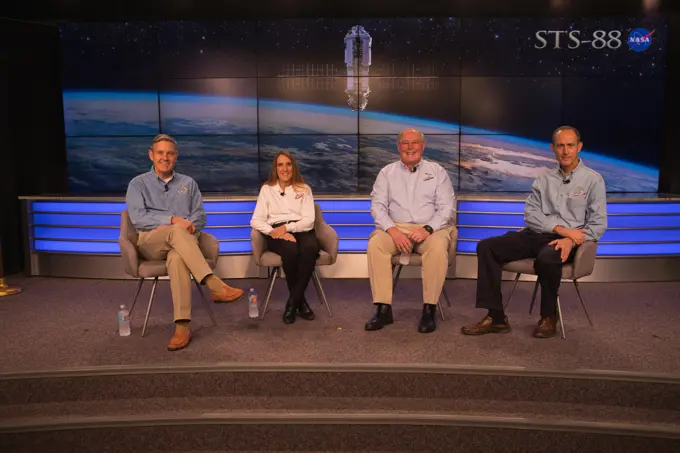
From left, Kennedy Space Center Director and STS-88 commander Bob Cabana, along with STS-88 mission specialists Nancy Currie-Gregg, Jerry Ross and Jim Newman, are recognized Dec. 10, 2018, at Kennedy Space Center in Florida during a 20th anniversary celebration of the first International Space Station assembly mission. The STS-88 mission paved the way for humans to live and work on the space station.
6177-V53617161
6145-45187591
NASA Administrator Jim Bridenstine, left, JPL Director Michael Watkins, InSight Project Manager Tom Hoffman, InSight Principal Investigator Bruce Banerdt, MarCO chief engineer Andy Klesh, and InSight Instrument Operations Lead Elizabeth Barrett, answer questions during a Mars InSight post-landing press conference, Monday, Nov. 26, 2018 at NASA's Jet Propulsion Laboratory in Pasadena, California. InSight, short for Interior Exploration using Seismic Investigations, Geodesy and Heat Transport, is a Mars lander designed to study the "inner space" of Mars: its crust, mantle, and core.
6145-44468934
Megan Cruz, NASA Communications, moderates a press conference ahead of the Crew-4 launch, Tuesday, April 26, 2022, at NASAs Kennedy Space Center in Florida. NASAs SpaceX Crew-4 mission is the fourth crew rotation mission of the SpaceX Crew Dragon spacecraft and Falcon 9 rocket to the International Space Station as part of the agencys Commercial Crew Program. NASA astronauts Kjell Lindgren, Robert Hines, Jessica Watkins, and ESA (European Space Agency) astronaut Samantha Cristoforetti are scheduled to launch at 3:52 a.m. ET on April 27 from Launch Complex 39A at the Kennedy Space Center.
6145-45220728
Omar Baez, launch director in NASAs Launch Services Program, speaks to news media during a prelaunch mission briefing for NASAs Ionospheric Connection Explorer (ICON), on Oct. 8, 2019, in the News Center auditorium at the agencys Kennedy Space Center in Florida. ICON is targeted to launch from Cape Canaveral Air Force Station in Florida on Oct. 9, 2019, aboard a Northrop Grumman Pegasus XL rocket carried aloft by the companys Stargazer L-1011 aircraft. The explorer will study the frontier of space - the dynamic zone high in Earth's atmosphere where terrestrial weather from below meets space weather above.
6145-45228006
A What's on Board Briefing for SpaceX's 19th Commercial Resupply Services (CRS-19) mission for NASA to the International Space Station took place on Dec. 3, 2019, at the agency's Kennedy Space Center in Florida. Bryan Dansbury, assistant program scientist for NASA's International Space Station Program Science Office shares an overview of the research being conducted aboard the space station and how it benefits exploration and humanity. The SpaceX Falcon 9 rocket and Dragon cargo module are scheduled to launch on Dec. 4, 2019, from Space Launch Complex 40 at Cape Canaveral Air Force Station in Florida.
6145-45102458
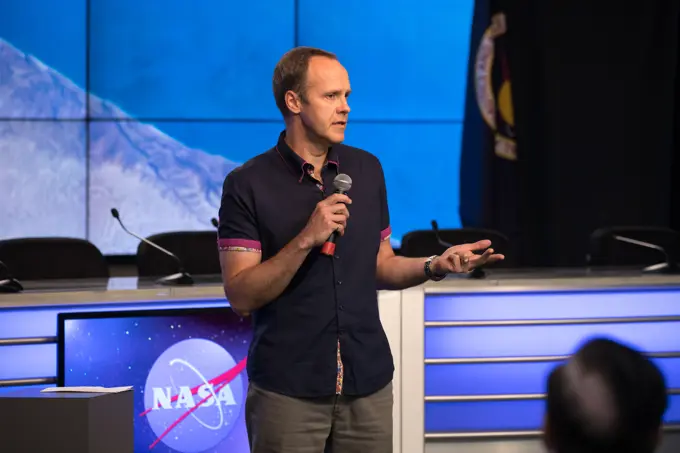
Dr. Dava Newman, NASA's deputy administrator, speaks to employees at the Florida spaceport during the annual KickStart Innovation Expo. The event gives employees an opportunity to present proposals for new ideas and processes. A small amount of funding is awarded to those selected allowing individuals or teams to procure needed items to implement their projects. Kennedy employees are encouraged to look for ways to do their work better and to propose concepts for tackling future mission needs.
6145-45164102
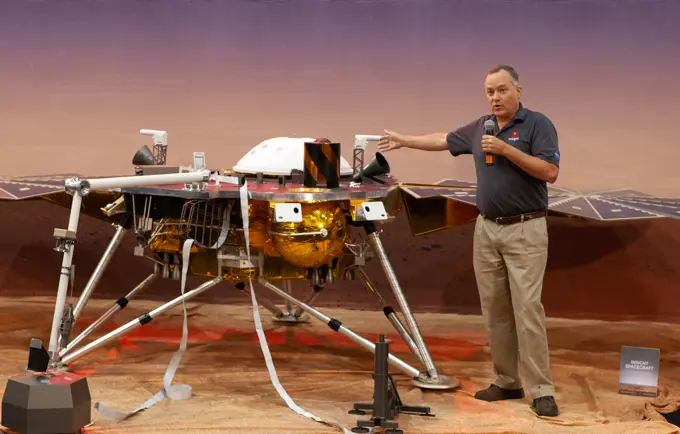
NASA Chief Scientist Jim Green discusses NASA's InSight mission during a prelaunch media briefing, Thursday, May 3, 2018, at Vandenberg Air Force Base in California. InSight, short for Interior Exploration using Seismic Investigations, Geodesy and Heat Transport, is a Mars lander designed to study the "inner space" of Mars: its crust, mantle, and core.
6177-V53824479
6145-45271087
Marshall Space Flight Center's Black History Month program Master of Ceremonies Nicholas Benjamin.
6145-45162341
NASA and industry leaders speak to NASA Social participants about the agency's Transiting Exoplanet Survey Satellite (TESS) in the Press Site auditorium at Kennedy Space Center in Florida. Speaking to the group, from left are Tom Barclay, TESS scientist, NASAs Goddard Space Flight Center, and Jenn Burt, Torres Postdoctoral Fellow, Massachusetts Institute of Technology. TESS is the next step in the search for planets outside of our solar system. The mission will find exoplanets that periodically block part of the light from their host stars, events called transits. The satellite will survey the nearest and brightest stars for two years to search for transiting exoplanets. TESS will launch on a SpaceX Falcon 9 rocket from Space Launch Complex 40 at Cape Canaveral Air Force Station no earlier than 6:32 p.m. EDT on Monday, April 16.
6145-44800553
PHOTO DATE:  01-21-10LOCATION:  Bldg 2, rm 122SUBJECT:    Expedition 23 press conference
6145-45171598
Ken Podwalski, Canadian ISS program manager, talks to members of the media during a briefing in the Kennedy Space Centers Press Site auditorium. The briefing focused on research planned for launch to the International Space Station. The scientific materials and supplies will be aboard a SpaceX Dragon spacecraft scheduled for liftoff from Cape Canaveral Air Force Station's Space Launch Complex 40. The SpaceX Falcon 9 rocket will launch the company's 15th Commercial Resupply Services mission to the space station.
6145-55971602
Inaugural NASA Climate Summit Opening Remarks. NASA Administrator Bill Nelson delivers opening remarks during the inaugural NASA Climate Summit Thursday, Dec. 8, 2022, at the Mary W. Jackson NASA Headquarters building in Washington.
6145-55971741
Sustainable Flight Demonstrator Project Announcement. Todd Citron, chief technology officer, The Boeing Company, left, delivers remarks during a news conference on NASAs Sustainable Flight Demonstrator project as NASA Administrator Bill Nelson, second from left, Bob Pearce, associate administrator for NASA's Aeronautics Research Mission Directorate, NASA Deputy Administrator Pam Melroy, and Brent Cobleigh, program manager for the Sustainable Flight Demonstrator at NASA's Armstrong Flight Research Center, look on, Wednesday, Jan. 18, 2023, at the Mary W. Jackson NASA Headquarters building in Washington, DC. Through a Funded Space Act Agreement, The Boeing company and its industry team will collaborate with NASA to develop and flight-test a full-scale Transonic Truss-Braced Wing demonstrator aircraft.
6145-55971316
NASAs Earth Information Center Ribbon Cutting. Dwane Roth of Big D Farms in Kansas, speaks before the ribbon cutting ceremony to open NASAs Earth Information Center, Wednesday, June 21, 2023, at the Mary W. Jackson NASA Headquarters building in Washington. The Earth Information Center is new immersive experience that combines live data sets with cutting-edge data visualization and storytelling to allow visitors to see how our planet is changing.
6145-45202681
NASA Associate Administrator, Human Exploration and Operations William Gerstenmaier, left, and NASA Special Assistant to the Administrator Mark Sirangelo, watch as a video is played during the House Subcommittee on Space and Aeronautics hearing titled "Keeping our sights on Mars: A Review of NASA's Deep Space Exploration Programs and Lunar Proposal", Wednesday, May 8, 2019 at the Rayburn House Office Building in Washington.
6145-44899020
CAPE CANAVERAL, Fla. -- NASA Director of Public Affairs Lisa Malone welcomes about 45 of NASAs social media followers for two days of presentations on the Kennedy Space Center's past, present and future.The social media participants gathered at the Florida spaceport on Aug. 2 and 3, 2012 to hear from key former and current leaders who related stories of the space agency's efforts to explore the unknown. It was the first social media event totally run by Kennedy.
6145-45284719
NASA Launch Commentator Derrol Nail participates in the launch broadcast for the Sentinel-6 Michael Freilich mission on Nov. 21, 2020, at Vandenberg Air Force Base in California. The SpaceX Falcon 9 rocket carrying the Sentinel-6 Michael Freilich spacecraft launched from Vandenbergs Space Launch Complex 4 at 9:17 a.m. PST (12:17 p.m. EST). The Sentinel-6/Jason-CS (Continuity of Service) mission consists of the Sentinel-6 Michael Freilich satellite, which will be followed by its twin, the Sentinel-6B satellite, in 2025. The Sentinel-6/Jason-CS mission is part of Copernicus, the European Unions Earth observation program, managed by the European Commission. Continuing the legacy of the Jason series missions, Sentinel-6/Jason-CS will extend the records of sea level into their fourth decade, collecting accurate measurements of sea surface height for more than 90% of the worlds oceans, and providing crucial information for operational oceanography, marine meteorology, and climate studies
6145-55971030
Artemis Human Landing System Announcement. NASA Administrator Bill Nelson gives remarks during an event announcing Blue Origin as the company selected to develop a sustainable human landing system for the Artemis V Moon mission, Friday, May 19, 2023 at the Mary W. Jackson NASA Headquarters building in Washington. The human landing system will take astronauts to and from Gateway in lunar orbit to the surface and back to the lunar space station as part of NASAs return to the Moon for science, exploration, and inspiration.
6145-45289142
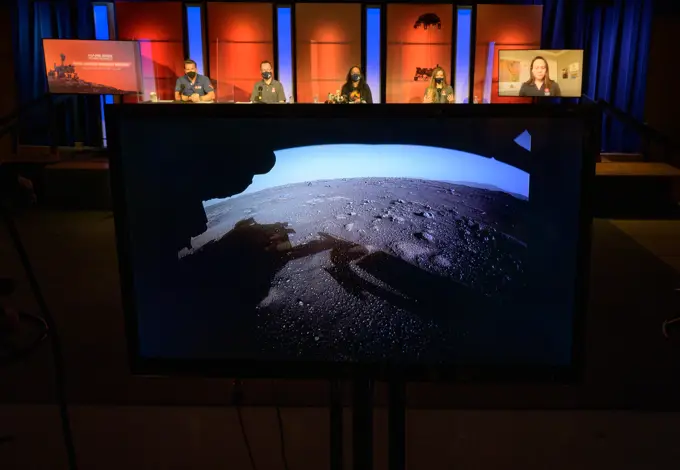
This first high-resolution, color image to be sent back by the Hazard Cameras (Hazcams) on the underside of NASAs Perseverance Mars rover after its landing on Feb. 18, 2021 is shown during a NASA Perseverance rover initial surface checkout briefing, Friday Feb. 19, 2021, at NASA's Jet Propulsion Laboratory in Pasadena, California. A key objective for Perseverances mission on Mars is astrobiology, including the search for signs of ancient microbial life. The rover will characterize the planets geology and past climate, pave the way for human exploration of the Red Planet, and be the first mission to collect and cache Martian rock and regolith.
6145-45121762
In the Kennedy Space Center's Press Site auditorium, members of the media participate in a mission briefing on the Geostationary Operational Environmental Satellite (GOES-R). Briefing participants from left are: Sean Potter of NASA Communications; Steven Goodman, NOAA's GOES-R program scientist; Joseph A. Pica, director of the National Weather Service Office of Observations; Sandra Cauffman, deputy director of NASA's Earth Science Division; and Damon Penn, assistant administrator for response at the Federal Emergency Management Agency. GOES-R is the first satellite in a series of next-generation GOES satellites for NOAA, the National Oceanographic and Atmospheric Administration. It will launch to a geostationary orbit over the western hemisphere to provide images of storms and help meteorologists predict severe weather conditionals and develop long-range forecasts.
6145-44980605
CAPE CANAVERAL, Fla. - During a news conference at NASA's Kennedy Space Center in Florida, NASA officials and university investigators outlined science plans for the Mars Atmosphere and Volatile EvolutioN, or MAVEN, mission. Participating in the briefing, from the left, are George Diller of NASA Public Affairs, Michael Meyer, lead Mars Scientist at NASA Headquarters, Bruce Jakosky, MAVEN principal investigator from the Laboratory for Atmospheric and Space Physics at the University of Colorado at Boulder, Janet Luhmann, MAVEN deputy principal investigator from the University of California at Berkeley, Nick Schneider, MAVEN Imaging Ultraviolet Spectrograph, or IUVS, instrument lead at the University of Colorado, Paul Mahaffy, MAVEN Neutral Gas and Ion Mass Spectrometer, or NGIMS, instrument lead at NASA's Goddard Space Flight Center in Greenbelt, Md., and David Mitchell, MAVEN Solar Wind Electron Analyzer, or SWEA, instrument lead at the University of California.MAVEN is being prepare
6145-45143938
Principle investigator for the Neutral Mass Spectrometer (INMS) at the Southwest Research Institute, Hunter Waite, right, speaks during a press conference previewing Cassini's End of Mission as director of NASA's Planetary Science Division, Jim Green, left, Cassini program manager at JPL, Earl Maize, second from left, and Cassini project scientist at JPL, Linda Spilker, second from right, look on, Wednesday, Sept. 13, 2017 at NASA's Jet Propulsion Laboratory in Pasadena, California. Since its arrival in 2004, the Cassini-Huygens mission has been a discovery machine, revolutionizing our knowledge of the Saturn system and captivating us with data and images never before obtained with such detail and clarity. On Sept. 15, 2017, operators will deliberately plunge the spacecraft into Saturn, as Cassini gathered science until the end. The plunge” ensures Saturn’s moons will remain pristine for future exploration. During Cassini’s final days, mission team members from all around the world ga
6145-55970866
Czech Republic Artemis Accords Signing. Foreign Affairs Minister for the Czech Republic, Jan Lipavský deliver remarks prior to the signing of the Artemis Accords as Miloslav Stašek, Ambassador of the Czech Republic to the United States, second from left, NASA Administrator Bill Nelson, second from right, and Acting Assistant Secretary of State for Oceans and International Environmental and Scientific Affairs Jennifer R. Littlejohn, right, look on, Wednesday, May 3, 2023, at The Mary W. Jackson NASA Headquarters building in Washington DC. The Czech Republic is the twenty fourth country to sign the Artemis Accords, which establish a practical set of principles to guide space exploration cooperation among nations participating in NASAs Artemis program.
6145-45164334
During a prelaunch briefing at Vandenberg Air Force Base in California, Tom Hoffman, InSight Project Manager at NASA's Jet Propulsion Laboratory, speaks to members of the media. The presentation focused on NASA's Interior Exploration using Seismic Investigations, Geodesy and Heat Transport, or InSight, Mars lander. InSight is scheduled for liftoff May 5, 2018, atop a United Launch Alliance (ULA) Atlas V rocket from Space Launch Complex 3 at Vandenberg. The spacecraft will be the first mission to look deep beneath the Martian surface studying the planet's interior by measuring its heat output and listen for marsquakes.
6145-44984793
CAPE CANAVERAL, Fla. - Lisa Colloredo, left, associate program manager of NASA's Commercial Crew Program, and Pam Underwood of the Federal Aviation Administration's Office of Commercial Transportation, both panelists of the Commercial Crew Transportation Capability, or CCtCap, Pre-Proposal Conference, are seen before the start of an industry conference inside the Television Auditorium at NASA's Kennedy Space Center in Florida. The conference was held following the Commercial Crew Program, or CCP, request for proposals from commercial companies for a development and certification contract under CCtCap. The contract will provide a finish line for the agency following more than four years of development work by CCP and American aerospace companies. CCtCap is the second phase of a two-phase certification plan for privately built and operated integrated crew transportation systems. CCPs goal is to aid in the development of commercial capabilities for crew transportation and rescue services
6145-45100014
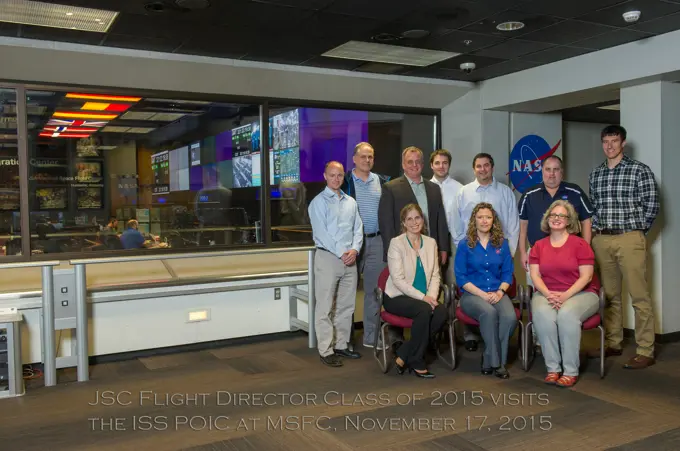
JSC FLIGHT DIRECTOR CLASS OF 2015 VISITS THE INTERNATIONAL SPACE STATION PAYLOAD OPERATION INTEGRATION CENTER AT MSFC, NOVEMBER 17, 2015
6145-45187332
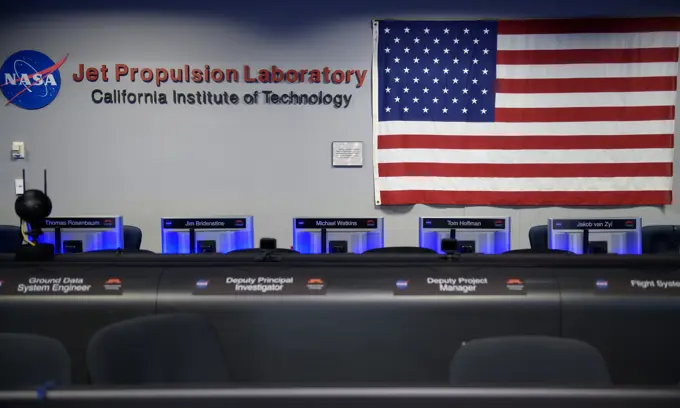
The Mission Support Area (MSA) is seen in advance of the Mars InSight and Mars Cube One (MarCO) teams arriving to support a landing on Mars, Monday, Nov. 26, 2018 at NASA's Jet Propulsion Laboratory in Pasadena, California. InSight, short for Interior Exploration using Seismic Investigations, Geodesy and Heat Transport, is a Mars lander designed to study the "inner space" of Mars: its crust, mantle, and core.
6145-45144213
Cassini project scientist at JPL, Linda Spilker, center, speaks about a montage of images, made from data obtained by Cassini's visual and infrared mapping spectrometer, shows the location on Saturn where the NASA spacecraft entered Saturn's atmosphere, Friday, Sept. 15, 2017 during a press conference at NASA's Jet Propulsion Laboratory in Pasadena, California. Cassini program manager at JPL, Earl Maize, left, and spacecraft operations team manager for the Cassini mission at Saturn, Julie Webster, right, also participated in the press conference. Since its arrival in 2004, the Cassini-Huygens mission has been a discovery machine, revolutionizing our knowledge of the Saturn system and captivating us with data and images never before obtained with such detail and clarity. On Sept. 15, 2017, operators deliberately plunged the spacecraft into Saturn, as Cassini gathered science until the end. Loss of contact with the Cassini spacecraft occurred at 7:55 a.m. EDT (4:55 a.m. PDT). The plunge
6145-45158614
NASA Astrophysics Division director Paul Hertz, left, Sara Seager, TESS deputy director of science, MIT, George Ricker, TESS principal investigator, MIT Kavli Institute for Astrophysics and Space Research, and Jeff Volosin, TESS project manager, NASAs Goddard Space Flight Center, right, discuss the upcoming launch of NASAs next planet hunter, the Transiting Exoplanet Survey Satellite (TESS), Wednesday, March 28, 2018 at NASA Headquarters in Washington.
6145-44571524
Held following Schirra's MA-8 6-orbital flight 10/03/1962.  (FROM COLOR)
6145-44564592
With the launch period for the Perseverance mission opening July 17, 2020, members of NASA's Perseverance Mars rover project continue the mission's march to the launch pad while working from their home offices during the coronavirus outbreak. Clockwise from upper left lead mobility systems engineer Rich Rieber (with son Ben); deputy project scientist Katie Stack Morgan; mission system verification and validation supervisor Ruth Fragoso; mission design and navigation manager Fernando Abilleira (below mission logo); staff assistant Monica Hopper; systems engineer Heather Bottom; project chief engineer Adam Steltzner; guidance and control systems engineer Swati Mohan; entry, Descent and Landing Phase Lead Al Chen (with son Max); project manager John McNamee; and Entry, Descent and Landing Systems Engineer Cj Giovingo.
PREVIOUS
of 2
NEXT
2401 S. Ervay, Suite 206
Dallas, Texas 75215
United States
Get Started
Free ResearchMy BoardsMy Cart
For Creators
How To License Your ContentContributor PortalFrame of Mind
Resources
API accessPricing
Contact
+1 866 236 0087help@viewpictures.co.uk Contact form
©2026 View Pictures. All Rights Reserved. -A
This site is protected by reCAPTCHA and Google Privacy Policy and Terms of Service apply.