My Boards
View Pictures
  • My Boards

NASA Space Operations

Images depicting NASA's space shuttle operations and spacecraft assembly, showcasing the intricate processes of space exploration.

Day In The Life of Artemis Employees
187 assets in this story
6145-44778464
CAPE CANAVERAL, Fla. - In the Vehicle Assembly Building's High Bay 4 at NASA's Kennedy Space Center in Florida, a crane moves the Ares I-X Super Stack 4 across the floor to High Bay 3 for integration with Super Stack 3.  Five super stacks make up the upper stage that will be integrated with the four-segment solid rocket booster first stage on the mobile launch platform.  Ares I-X is the test vehicle for the Ares I, which is part of the Constellation Program to return men to the moon and beyond. The Ares I-X flight test is targeted for  Oct. 31, pending formal NASA Headquarters approval.
6145-44653489
KENNEDY SPACE CENTER, FLA.  -    In this closeup,  workers can be seen attaching one segment of a large crane around Atlantis to raise it off the transporter into a vertical position.  Once it is raised, Atlantis will be lifted into high bay 3 of the Vehicle Assembly Building.  Then the orbiter will be lowered and mated with the external tank and solid rocket boosters already stacked on the mobile launcher platform.  Atlantis' launch window begins Aug. 28. During its 11-day mission to the International Space Station, the STS-115 crew of six astronauts will install the Port 3/4 truss segment with its two large solar arrays.
6145-58968854
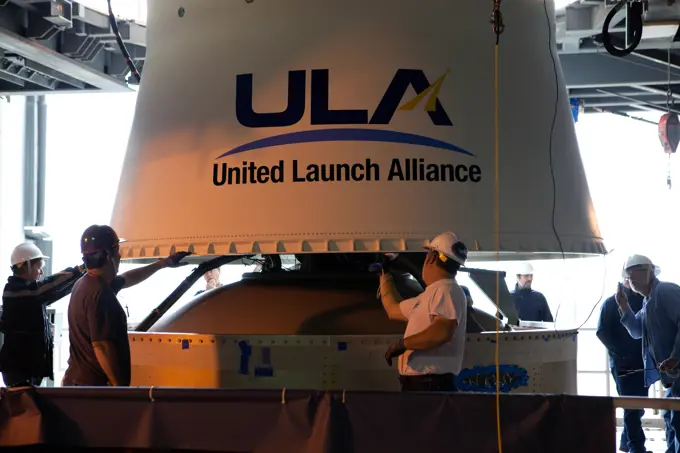
The Orion spacecraft was lifted on top of the Delta IV Heavy launch vehicle at ULA's Launch Complex 37 on Nov. 12, 2014. Over the next few days the Lockheed Martin/ULA team will work to complete the connections between Orion and the launch vehicle in preparation for Exploration Flight Test-1 (EFT-1).  Part of Batch image transfer from Flickr.
6145-55974814
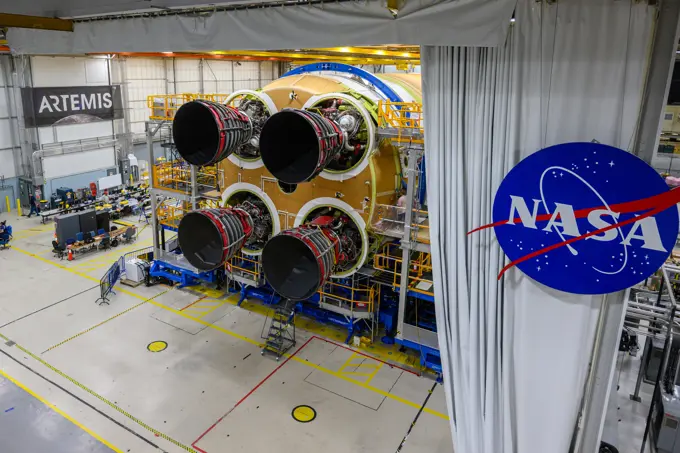
. These photos show how technicians at NASAs Michoud Assembly Facility in New Orleans installed the third and fourth RS-25 engines onto the core stage for the agencys SLS (Space Launch System) rocket that will help power NASAs first crewed Artemis mission to the Moon. Technicians added the first engine to the SLS core stage Sept. 11. The second engine was installed onto the stage Sept. 15 with the third and fourth engines following Sept. 19 and Sept. 20. Engineers consider the engines to be soft mated to the rocket stage. Technicians with NASA, Aerojet Rocketdyne, an L3Harris Technologies company and the RS-25 engines lead contractor, along with Boeing, the core stage lead contractor, will now focus efforts on the complex tax of fully securing the engines to the stage and integrating the propulsion and electrical systems within the structure. NASA is working to land the first woman and first person of color on the Moon under Artemis. SLS is part of NASAs backbone for deep space explora
6145-58967291
The launch abort system ogives are installed on the Orion test article at Lockheed Martin facilities near Denver on Sept. 8, 2011. The ogives are four protective panels that shield the crew module from the severe vibrations and sounds experienced during launch. Part of Batch image transfer from Flickr.
6145-58964775
KODIAK ISLAND, ALASKA - In the Launch Service Structure, Kodiak Launch Complex (KLC), the fairing is lowered over the Kodiak Star spacecraft in preparation for launch. The first launch to take place from KLC, Kodiak Star is scheduled to lift off on a Lockheed Martin Athena I launch vehicle on Sept. 17 during a two-hour window that extends from 5 p.m. to 7 p.m. p.m. ADT. The payloads aboard include the Starshine 3, sponsored by NASA, and the PICOSat, PCSat and Sapphire, sponsored by the Department of Defense (DoD) Space Test Program. KLC is the newest commercial launch complex in the United States, ideal for launch payloads requiring low-Earth polar or sun-synchronous orbits
6145-45130968
Inside the Neil Armstrong Operations and Checkout Building high bay at NASA's Kennedy Space Center in Florida, the Orion crew module from Exploration Flight Test 1 is lowered onto a custom-built transport stand. The crew module is being prepared for its move to the nearby Kennedy Space Center Visitor Complex and delivery to the IMAX Theater where it will be on display in the NASA Now exhibit. The Orion spacecraft launched atop a United Launch Alliance Delta IV rocket Dec. 5, 2014, from Space Launch Complex 37 at Cape Canaveral Air Force Station. The spacecraft built for humans traveled 3,604 miles above Earth and splashed down about 4.5 hours later in the Pacific Ocean.
6145-44827571
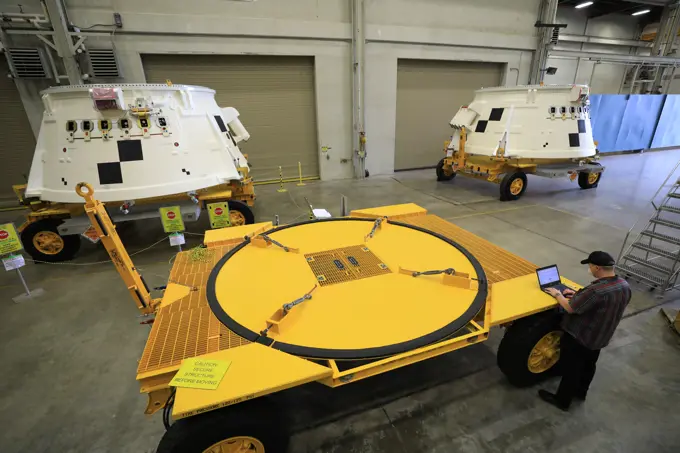
CAPE CANAVERAL, Fla. -- In the Operations and Checkout Building at NASA's Kennedy Space Center in Florida, a Lockheed Martin-led crew begins pathfinding operations on a full-scale Orion spacecraft mockup. The crew is conducting simulated manufacturing and assembly operations with the mockup to verify the tools, processes and spacecraft integration procedures work as expected.
6145-44534635
KENNEDY SPACE CENTER, Fla. -  After leaving the Orbiter Processing Facility, Orbiter Atlantis nears the Vehicle Assembly Building for space vehicle mate.  As part of final preparations before transfer to the launch pad, Atlantis will be lifted vertically into its VAB high bay and mated to the twin solid rocket boosters and external tank.  The STS-110 mission resumes International Space Station assembly operations with the delivery of the S0 truss, which will support solar panels providing additional power to the Station.  The payload will also include the first part of a Mobile Transporter that will provide a moveable base for the Stations Canadian robotic arm.  STS-110 is scheduled for launch April 4
6145-58964660
The orbiter Discovery is nearly vertical as overhead cranes lift it in the transfer aisle of the Vehicle Assembly Building. It will then be moved into high bay 1 for mating with its solid rocket boosters and external tank. Discovery will be launched March 8 on mission STS-102, the eighth construction flight to the International Space Station. The Shuttle will carry the Multi-Purpose Logistics Module Leonardo, the first of three pressurized modules provided by the Italian Space Agency to carry supplies and equipment to the Space Station and back to earth
6145-44679676
KENNEDY SPACE CENTER, FLA. --   In high bay 1 of the Vehicle Assembly Building, the orbiter Endeavour is lowered onto the mobile launcher platform.  The orbiter blocks the view of the external tank; on either side of the orbiter are the white solid rocket boosters.  The components will be mated for launch.  Endeavour will be launched on mission STS-118, its first flight in more than four years. The shuttle has undergone extensive modifications, including the addition of safety upgrades already added to shuttles Discovery and Atlantis. Endeavour also features new hardware, such as the Station-to-Shuttle Power Transfer System that will allow the docked shuttle to draw electrical power from the station and extend its visits to the orbiting lab.  Endeavour is targeted for launch on Aug. 7.
4404-1678
USA, California, Los Angeles, SpaceX Dragon capsule
6145-44900098
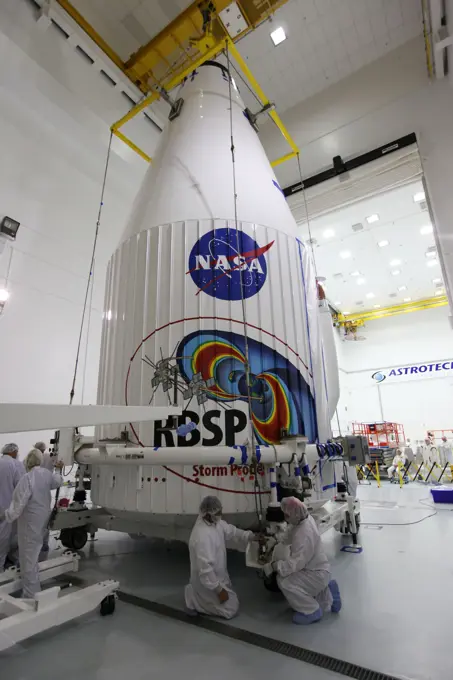
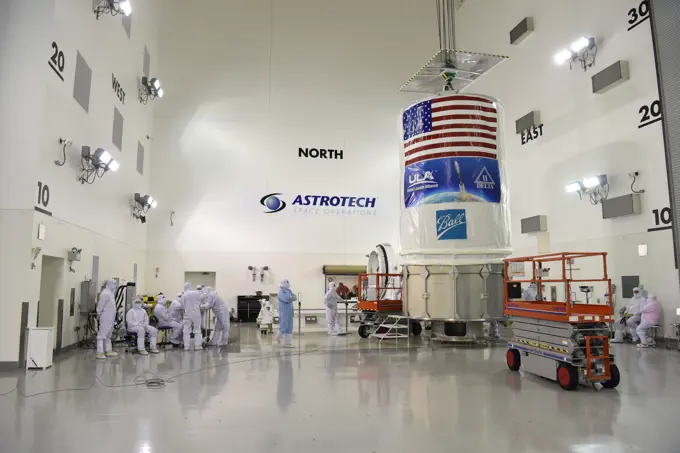
TITUSVILLE, Fla. - Inside the Astrotech payload processing facility in Titusville, Fla. near NASAs Kennedy Space Center, technicians attach a crane to lift the payload faring containing the two Radiation Belt Storm Probes, or RBSP, spacecraft on to a transporter to be moved to the launch complex.NASAs RBSP mission will help us understand the suns influence on Earth and near-Earth space by studying the Earths radiation belts on various scales of space and time. RBSP will begin its mission of exploration of Earths Van Allen radiation belts and the extremes of space weather after its liftoff aboard a United Launch Alliance Atlas V rocket from Space Launch Complex 41 at Cape Canaveral Air Force Station, Fla. Liftoff is targeted for Aug. 23, 2012.
6145-44861222
CAPE CANAVERAL, Fla. -- In the Vehicle Assembly Building at NASA's Kennedy Space Center in Florida, workers disconnect the transporter from shuttle Atlantis. An overhead crane then will lift the spacecraft into a high bay where it will be attached to its external fuel tank and solid rocket boosters already on the mobile launcher platform.Commander Chris Ferguson, Pilot Doug Hurley and Mission Specialists Sandra Magnus and Rex Walheim are expected to launch in mid-July, taking with them the Raffaello multi-purpose logistics module packed with supplies, logistics and spare parts. The STS-135 mission also will fly a system to investigate the potential for robotically refueling existing spacecraft and return a failed ammonia pump module to help NASA better understand the failure mechanism and improve pump designs for future systems. STS-135 will be the 33rd flight of Atlantis, the 37th shuttle mission to the space station, and the 135th and final mission of NASA's Space Shuttle Pro
6145-55974743
. These photos show how technicians at NASAs Michoud Assembly Facility in New Orleans installed the third and fourth RS-25 engines onto the core stage for the agencys SLS (Space Launch System) rocket that will help power NASAs first crewed Artemis mission to the Moon. Technicians added the first engine to the SLS core stage Sept. 11. The second engine was installed onto the stage Sept. 15 with the third and fourth engines following Sept. 19 and Sept. 20. Engineers consider the engines to be soft mated to the rocket stage. Technicians with NASA, Aerojet Rocketdyne, an L3Harris Technologies company and the RS-25 engines lead contractor, along with Boeing, the core stage lead contractor, will now focus efforts on the complex tax of fully securing the engines to the stage and integrating the propulsion and electrical systems within the structure. NASA is working to land the first woman and first person of color on the Moon under Artemis. SLS is part of NASAs backbone for deep space explora
6145-44745180
CAPE CANAVERAL, Fla. --  In high bay 4 of the Vehicle Assembly Building at NASA's Kennedy Space Center in Florida, a crane moves the Ares I-X upper stage simulator segment 7 toward segment 6 (in front, with U.S. flag decal). The upper stage simulator comprises 11 segments, each approximately 18 feet in diameter, that will be used in the test flight identified as Ares I-X in 2009.  The simulator segments will simulate the mass and the outer mold line.  The upper stage accounts for nearly one-quarter of the total height of the Ares I.  It will take the Ares I on the second phase of its journey from Earth, providing the guidance, navigation and control needed for the second phase of the Ares I ascent flight.
6145-44877589
CAPE CANAVERAL, Fla. -- At NASA's Kennedy Space Center in Florida, preparations are under way to move space shuttle Endeavour from Orbiter Processing Facility-1 (OPF-1) to the Vehicle Assembly Building (VAB).  Endeavour is switching places with shuttle Discovery which temporarily has been stored in the VAB.  Both shuttles will stop briefly outside OPF-3 for a "nose-to-nose" photo opportunity. Discovery then will be rolled into OPF-1 and Endeavour into the VAB.In OPF-1, Discovery will undergo further preparations for public display at the Smithsonian's National Air and Space Museum Steven F. Udvar-Hazy Center in Virginia. Endeavour will be stored in the VAB until October when it will be moved into OPF-2 for further work to get it ready for public display at the California Science Center in Los Angeles.
6145-45140660
Inside the Astrotech facility near NASA's Kennedy Space Center in Florida, the agency's TDRS-M satellite, enclosed in its payload fairing, is secured on a transport vehicle. The TDRS-M is the latest spacecraft destined for the agency's constellation of communications satellites that allows nearly continuous contact with orbiting spacecraft ranging from the International Space Station and Hubble Space Telescope to the array of scientific observatories. Liftoff atop a United Launch Alliance Atlas V rocket is scheduled to take place from Space Launch Complex 41 at Cape Canaveral Air Force Station on Aug. 18 at 8:03 a.m. EDT.
6145-44831225
CAPE CANAVERAL, Fla. -- At NASA's Kennedy Space Center in Florida, shuttle Discovery is ushered into the Vehicle Assembly Building (VAB) from Orbiter Processing Facility-3 during a move known as "rollover." Once inside the VAB, the shuttle will be joined to its solid rocket boosters and external fuel tank. Later this month, Discovery is scheduled to "rollout" to Launch Pad 39A for its launch to the International Space Station on the STS-133 mission.Targeted to liftoff Nov. 1, Discovery will take the Permanent Multipurpose Module (PMM) packed with supplies and critical spare parts, as well as Robonaut 2 (R2) to the station.
6145-58960211
CAPE CANAVERAL, Fla. -- The left spent booster nose cap from space shuttle Discovery's final launch is secured to a pallet on Freedom Star, one of NASA's solid rocket booster retrieval ships and will be returned to Port Canaveral in Florida.The shuttles two solid rocket booster casings and associated flight hardware are recovered in the Atlantic Ocean after every launch by Liberty Star and Freedom Star. The boosters impact the Atlantic about seven minutes after liftoff and the retrieval ships are stationed about 10 miles from the impact area at the time of splashdown. After the spent segments are processed, they will be transported to Utah, where they will be refurbished and stored, if needed.
6145-58961834
KENNEDY SPACE CENTER, FLA. - At Astrotech Space Operations in Titusville, Fla., workers help place the first half of the fairing around the GOES-N spacecraft. The fairing protects the spacecraft during launch. Geostationary Operational Environmental Satellites (GOES) are sponsored by NASAs Goddard Space Flight Center and the National Oceanic and Atmospheric Administration. GOES-N is targeted to launch June 23 from Launch Complex 37 at Cape Canaveral Air Force Station in Florida.
6145-45228738
The Northrop Grumman-manufactured right aft exit cone, the second of two for the Space Launch Systems solid rocket boosters, is in view inside the Rotation, Processing and Surge Facility at NASAs Kennedy Space Center in Florida on Dec. 9, 2019. The aft exit cone was shipped from Promontory, Utah. It will be checked out and prepared for the Artemis I uncrewed test flight. The aft exit cones sit at the bottommost part of the twin boosters. The cones help provide added thrust for the boosters, while protecting the aft skirts from the thermal environment during launch.
6145-58959163
TITUSVILLE, Fla. - Inside the Astrotech payload processing facility in Titusville, Fla. near NASAs Kennedy Space Center, the Tracking and Data Relay Satellite, TDRS-K, has been encapsulated in its payload fairing. The spacecraft will now be transported to Space Launch Complex 41 at Cape Canaveral Air Force Station. Liftoff for the TDRS-K is planned for January 30, 2013. The TDRS-K spacecraft is part of the next-generation series in the Tracking and Data Relay Satellite System, a constellation of space-based communication satellites providing tracking, telemetry, command and high-bandwidth data return services.
6145-44793473
CAPE CANAVERAL, Fla. - The Centaur second stage for the Atlas V rocket slated to launch NASA's Solar Dynamics Observatory, or SDO, rolls into the hangar at the Atlas Spaceflight Operations Center on Cape Canaveral Air Force Station in Florida.  The first stage of the Atlas V, at right, was delivered to the hangar on Oct. 27.SDO is the first space weather research network mission in NASA's Living With a Star Program. The spacecraft's long-term measurements will give solar scientists in-depth information about changes in the sun's magnetic field and insight into how they affect Earth. Liftoff on the United Launch Alliance Atlas V is scheduled for Feb. 3, 2010.
6145-44646896
KENNEDY SPACE CENTER, FLA. - In NASA's Space Station Processing Facility, an overhead crane has placed the Integrated Cargo Carrier (ICC) inside the payload canister.  The ICC is part of the payload on mission STS-121 to the International Space Station. The carrier holds the mobile transporter reel assembly that the astronauts will replace on the station and a spare pump module. The carrier and its cargo will be placed in Space Shuttle Discovery's payload bay at the pad.  Discovery is scheduled to launch on mission STS-121 from Launch Pad 39B in a window that opens July 1 and extends to July 19.
6145-45012212
T&R Endeavour OMS Pod Mate Test for Smithsonian Operations
6145-44620163
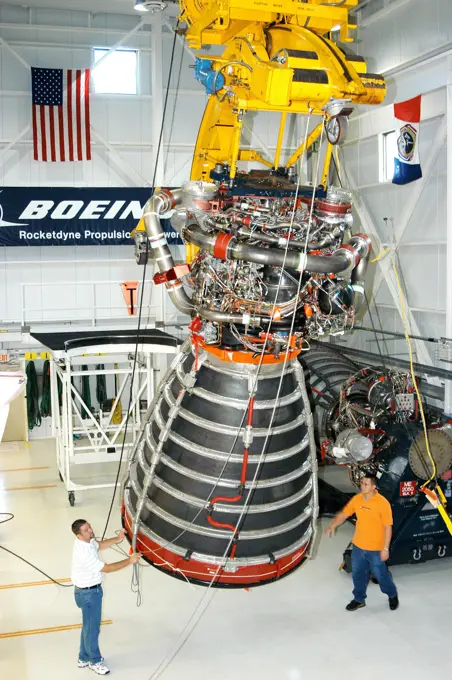
KENNEDY SPACE CENTER, FLA. - In the Space Shuttle Main Engine (SSME) Processing Facility, Boeing-Rocketdyne technicians steady SSME 2058, the first SSME fully assembled at KSC. The engine is being lifted from its vertical work stand into a horizontal position in preparation for shipment to NASAs Stennis Space Center in Mississippi to undergo a hot fire acceptance test. It is the first of five engines to be fully assembled on site to reach the desired number of 15 engines ready for launch at any given time in the Space Shuttle program. A Space Shuttle has three reusable main engines. Each is 14 feet long, weighs about 7,800 pounds, is seven-and-a-half feet in diameter at the end of its nozzle, and generates almost 400,000 pounds of thrust. Historically, SSMEs were assembled in Canoga Park, Calif., with post-flight inspections performed at KSC.  Both functions were consolidated in February 2002. The Rocketdyne Propulsion and Power division of The Boeing Co. manufactures the engines for
6145-44901154
CAPE CANAVERAL, Fla. - United Space Alliance technicians monitor the space shuttle Atlantis as it begins backing out of the Vehicle Assembly Building at NASA's Kennedy Space Center in Florida. Atlantis is switching places with Endeavour which had been in Bay 2 of the Orbiter Processing Facility OPF. In the OPF, Atlantis will undergo final preparations for its transfer to the Kennedy Space Center Visitor Complex targeted for November. The work is part of Transition and Retirement of the remaining space shuttles, Atlantis and Endeavour. Atlantis is being prepared for public display at Kennedy's Visitor Complex. Over the course of its 26-year career, Atlantis spent 293 days in space during 33 missions.
6145-44895216
CAPE CANAVERAL, Fla. - Space shuttle Atlantis' crew module and nose cap are visible during preparations to move the spacecraft out of Orbiter Processing Facility-1 and into High Bay 4 of the nearby Vehicle Assembly Building at NASA's Kennedy Space Center in Florida. The work is part of the Space Shuttle Program's transition and retirement processing of the space shuttle fleet. A groundbreaking was held Jan. 18 for Atlantis' future home, a 65,000-square-foot exhibit hall in Shuttle Plaza at the Kennedy Space Center Visitor Complex. Atlantis is scheduled to roll over to the visitor complex in November in preparation for the exhibit's grand opening in July 2013.
6145-44506777
KENNEDY SPACE CENTER, FLA. -- STS-106 crew members check out equipment inside the SPACEHAB module at Port Canaveral, Fla. They are visiting SPACEHAB to become familiar with the payload on their mission. During the mission, the crew will complete service module support tasks on orbit, transfer supplies and outfit the Space Station for the first long-duration crew. STS-106 is scheduled to launch Sept. 8.
6145-45227021
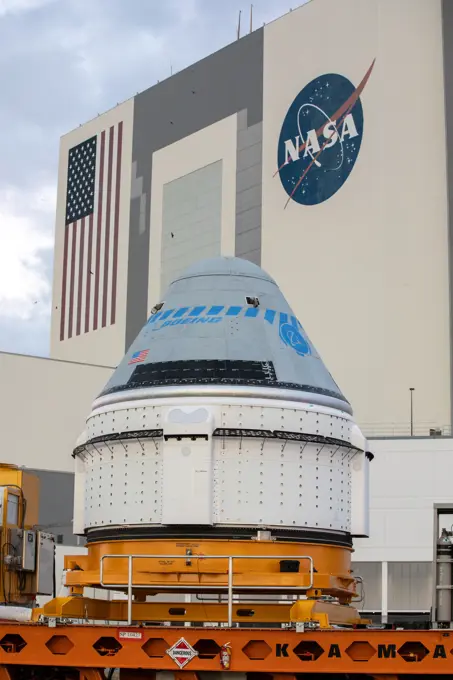
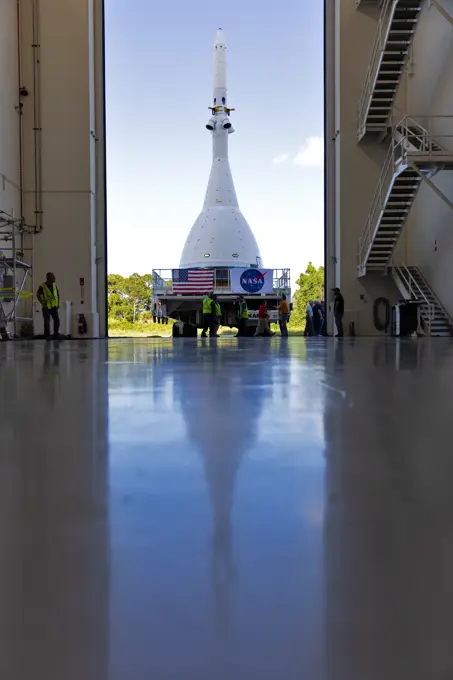
Boeings CST-100 Starliner spacecraft passes by the Vehicle Assembly Building at NASAs Kennedy Space Center in Florida on Nov. 21, 2019, making its way to the Space Launch Complex 41 Vertical Integration Facility at Cape Canaveral Air Force Station. At the pad, Starliner will be secured atop a United Launch Alliance Atlas V rocket in preparation for Boeings uncrewed Orbital Flight Test to the International Space Station for NASAs Commercial Crew Program.
6145-44646092
KENNEDY SPACE CENTER, FLA.  -  In the high bay at Astrotech Space Operations in Titusville, Fla., the first half of the fairing is moved into place around the GOES-N spacecraft.  When both halves are in place, they will encapsulate, or enclose, the GOES-N satellite for launch. The fairing protects the spacecraft during launch and flight through the atmosphere. Once out of the atmosphere, the fairing is jettisoned.  GOES-N is the latest in a series of Geostationary Operational Environmental Satellites for NOAA and NASA providing continuous monitoring necessary for intensive data analysis. GOES-N will be launched May 18 on a Boeing Delta IV rocket from Cape Canaveral Air Force Station in Florida.
6145-44908418
CAPE CANAVERAL, Fla. - Test operators prepare a model capsule ahead of tests inside the Vehicle Assembly Building at NASA's Kennedy Space Center in Florida to test a rotor system landing design. The design would give a capsule the stability and control of a helicopter, but would not be powered. Instead, the wind passing over the rotors as the capsule descends would make the blades turn, a process called auto-rotation. The intent is to give real spacecraft a soft landing with enough control that they could touch down anywhere in the world, whether it be a runway or parking lot. In other words, wherever a helicopter could land, a spacecraft could land, too.
6145-44978567
CAPE CANAVERAL, Fla. - Inside the Payload Hazardous Servicing Facility at NASA's Kennedy Space Center in Florida, engineers and technicians prepare the Mars Atmosphere and Volatile Evolution, or MAVEN, spacecraft for encapsulation inside its payload fairing.MAVEN is being prepared for its scheduled launch on Nov 18, 2013 from Cape Canaveral Air Force Station, Fla. atop a United Launch Alliance Atlas V rocket. Positioned in an orbit above the Red Planet, MAVEN will study the upper atmosphere of Mars in unprecedented detail.
6145-44956363
CAPE CANAVERAL, Fla. -- At the Kennedy Space Center Visitor Complex in Florida, construction crews have removed 16,000 square feet of plastic shrink-wrap from the space shuttle Atlantis. The spacecraft was enclosed in the plastic shrink-wrap since November of last year to protect the artifact from dust and debris during construction of the 90,000-square-foot facility.Last November, the space shuttle Atlantis made its historic final journey to its new home, traveling 10 miles from the Kennedy Space Center's Vehicle Assembly Building to the spaceport's visitor complex. The new $100 million "Space Shuttle Atlantis" facility will include interactive exhibits that tell the story of the 30-year Space Shuttle Program and highlights the future of space exploration. The "Space Shuttle Atlantis" exhibit scheduled to open June 29, 2013.
6145-45086181
CAPE CANAVERAL, Fla. -- Workers take photographs of NASA's Orion spacecraft during a viewing at the Launch Abort System Facility at NASA's Kennedy Space Center in Florida. Orion's back shell panels have been removed. The spacecraft completed the first flight test in December, was retrieved from the Pacific Ocean, and transported 2,700 miles overlandto Kennedy from Naval Base San Diego in California. Analysis of data obtained during its two-orbit, four-and-a-half hour mission Dec. 5 will provide engineers detailed information on how the spacecraft fared. Orion will be transported to the Payload Hazardous Servicing Facility for deservicing.
6145-44896564
CAPE CANAVERAL, Fla. - Inside the Astrotech payload processing facility near NASAs Kennedy Space Center in Florida, technicians use a lift to inspect the nose cone fairing for the Radiation Belt Storm Probes, or RBSP, spacecraft. The nose faring will house and protect the RBSP during liftoff aboard an Atlas V rocket.NASAs RBSP mission will help us understand the suns influence on Earth and near-Earth space by studying the Earths radiation belts on various scales of space and time. RBSP will begin its mission of exploration of Earths Van Allen radiation belts and the extremes of space weather after its liftoff aboard a United Launch Alliance Atlas V from Space Launch Complex 41 at Cape Canaveral Air Force Station, Fla. Liftoff is targeted for Aug. 23, 2012.
6145-58962974
KENNEDY SPACE CENTER, FLA. - The newly redesigned External Tank moves closer to its destination, the Vehicle Assembly Building, seen behind it. The tank arrived Jan. 5 after a 900-mile sea voyage aboard NASAs specially designed barge, Pegasus, from the Michoud Assembly Facility in New Orleans. In the transfer aisle of the VAB, the tank will be raised from a horizontal to a vertical position, then lifted high up into a storage cell, or checkout cell, where it will undergo inspections of the mechanical, electrical and thermal protection systems. New processing activities resulting from re-design of the tank include inspection of the bipod heater and External Tank separation camera, which includes charging the camera batteries. The tank will be then prepared for mating to the Solid Rocket Boosters. When preparations are complete, the tank will be lifted from the checkout cell, moved across the transfer aisle and into High Bay 1, where it will be lowered and attached to the boosters, which
6145-45208972
The cover of the shipping container carrying the heat shield for Orions Artemis 2 mission, NASAs first crewed mission, is lifted up inside the Neil Armstrong Operations and Checkout Building high bay at the agencys Kennedy Space Center in Florida on July 10, 2019. The heat shield, measuring roughly 16 feet in diameter, will protect astronauts upon re-entry on the second mission of Artemis. The heat shield arrived from Lockheed Martins manufacturing facility near Denver aboard NASAs Super Guppy Aircraft. The heat shield is a base titanium truss structure. Over the next several months, technicians will apply Avcoat, an ablative material that will provide the thermal protection. Artemis 2 will confirm all of the spacecrafts systems operate as designed in the actual environment of deep space with astronauts aboard.
6145-58972352
CAPE CANAVERAL, Fla. - At the Kennedy Space Center Visitor Complex in Florida, space shuttle Atlantis payload bay doors have been opened, revealing the payload bay. Atlantis is being prepared for display in the Space Shuttle Atlantis exhibit, a 90,000-square-foot facility, scheduled to open June 29, 2013. The new $100 million facility will include interactive exhibits that tell the story of the 30-year Space Shuttle Program and highlight the future of space exploration. Visitors to the exhibit will get an up close look at Atlantis with its payload bay doors open, similar to how it looked in space.
6145-45286198
Shown here is the SpaceX Cargo Dragon spacecraft on board the company's Go Navigator recovery ship after making its successful parachute-assisted splashdown west of Tampa off the Florida coast on Jan. 13, 2020, at 8:26 p.m. EST. Just after loading Dragon onto Go Navigator, SpaceX packed an Airbus H225 helicopter with the time-sensitive research cargo for delivery to NASAs Kennedy Space Center. Dragon returned more than 4,400 pounds of scientific experiments and other cargo from the International Space Station. The upgraded cargo Dragon capsule boasts double the powered locker capacity to preserve science samples, allowing for a significant increase in the research that can be carried back to Earth.
6145-45146645
The Orbital ATK Antares rocket is rolled from the Horizontal Integration Facility (HIF) to launch Pad-0A, Thursday, Nov. 9, 2017 at NASA's Wallops Flight Facility in Virginia. Orbital ATKs eighth contracted cargo resupply mission with NASA to the International Space Station will deliver over 7,400 pounds of science and research, crew supplies and vehicle hardware to the orbital laboratory and its crew.
6145-55971088
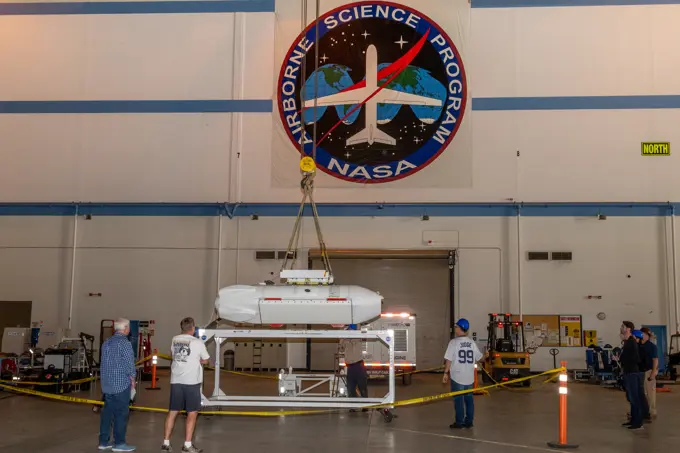
. The Uninhabited Aerial Vehicle Synthetic Aperture Radar, UAVSAR, is prepared for installation onto NASAs C-20A aircraft.THE UAVSAR uses a technique called interferometry to detect and measure very subtle deformations in the Earths surface, and the pod is specially designed to be interoperable with unmanned aircraft in the future.It will gather data from Gabon, Africa in September of 2023.
6145-58958584
CAPE CANAVERAL, Fla. - At the Kennedy Space Center Visitor Complex in Florida, one of space shuttle Atlantis payload bay doors has been opened. Atlantis is being prepared for display in the Space Shuttle Atlantis exhibit, a 90,000-square-foot facility, scheduled to open June 29, 2013. The new $100 million facility will include interactive exhibits that tell the story of the 30-year Space Shuttle Program and highlight the future of space exploration. Visitors to the exhibit will get an up close look at Atlantis with its payload bay doors open, similar to how it looked in space.
6145-44845790
VANDENBERG AIR FORCE BASE, Calif. -- At Vandenberg Air Force Base in California, technicians are preparing to join NASA's Glory spacecraft with the Taurus XL rocket's third stage housed inside a temporary processing tent near the pad at Space Launch Complex 576-E.The Orbital Sciences Corp. Taurus XL rocket will carry Glory into low Earth orbit. Once Glory reaches orbit, it will collect data on the properties of aerosols and black carbon. It also will help scientists understand how the sun's irradiance affects Earth's climate. Launch is scheduled for 5:09 a.m. EST Feb. 23. For information, visit www.nasa.gov/glory.
6145-45281474
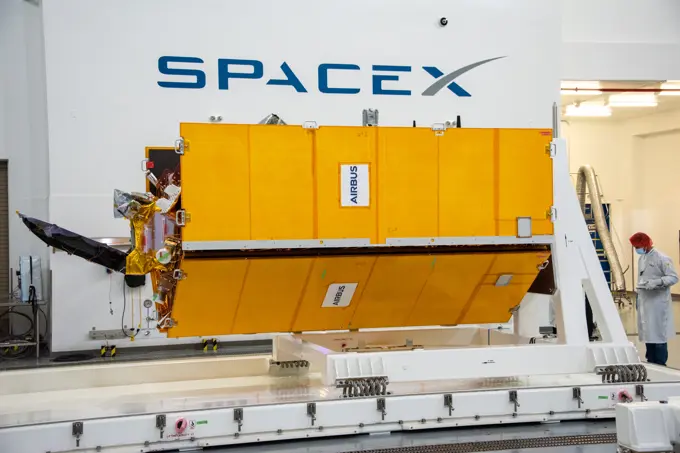
The Sentinel-6 Michael Freilich mission is an international partnership and the first launch of a constellation of two satellites that will observe changes in Earths sea levels for at least the next decade. Launching atop a SpaceX Falcon 9 rocket, Sentinel-6 Michael Freilich is targeted to lift off from Vandenberg Air Force Base in California on Nov. 10, 2020. The Launch Services Program at Kennedy Space Center in Florida is responsible for launch management.
6145-45208962
A flatbed truck with the shipping container carrying the heat shield for Orions Artemis 2 mission, NASAs first crewed mission, moves into the Neil Armstrong Operations and Checkout Building high bay at the agencys Kennedy Space Center in Florida on July 9, 2019. The heat shield, measuring roughly 16 feet in diameter, will protect astronauts upon re-entry on the second mission of Artemis. The heat shield arrived from Lockheed Martins manufacturing facility near Denver aboard NASAs Super Guppy Aircraft. The heat shield is a base titanium truss structure. Over the next several months, technicians will apply Avcoat, an ablative material that will provide the thermal protection. Artemis 2 will confirm all of the spacecrafts systems operate as designed in the actual environment of deep space with astronauts aboard.
6145-45066738
SAN DIEGO, Calif. - At the U.S. Naval Base San Diego in California, NASA and U.S. Navy personnel make sure that the Orion boilerplate test vehicle and support hardware are secured in the well deck of the USS Anchorage for Underway Recovery Test 2. NASA, Lockheed Martin and the U.S. Navy will conduct tests in the Pacific Ocean to prepare for recovery of the Orion crew module, forward bay cover and parachutes on its return from a deep space mission. The second underway recovery test will allow the teams to demonstrate and evaluate the recovery processes, procedures, new hardware and personnel in open waters.The Ground Systems Development and Operations Program is conducting the underway recovery tests. Orion is the exploration spacecraft designed to carry astronauts to destinations not yet explored by humans, including an asteroid and Mars. It will have emergency abort capability, sustain the crew during space travel and provide safe re-entry from deep space return velocities. The firs
6145-45145675
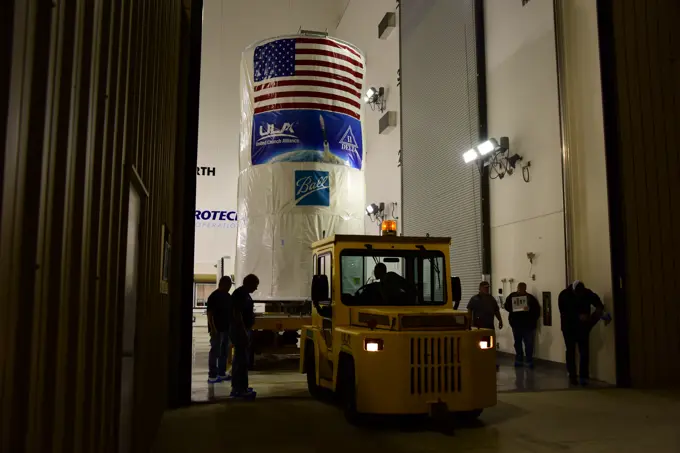
At Vandenberg Air Force Base in California, technicians and engineers have placed the Joint Polar Satellite System-1, or JPSS-1, spacecraft in a protective container. It then will be mounted on a transport trailer for its move from the Astrotech Processing Facility to Space Launch Complex 2. At the pad, JPSS-1 will be lifted for mating atop a United Launch Alliance Delta II rocket. Built by Ball Aerospace and Technologies Corp. of Boulder, Colorado, JPSS is the first in a series four next-generation environmental satellites in a collaborative program between the NOAA and NASA. Liftoff is scheduled to take place from Vandenberg's Space Launch Complex 2.
6145-45277046
Inside the Booster Fabrication Facility at NASA's Kennedy Space Center in Florida, the Artemis I aft skirts for the agency's Space Launch System (SLS) rockets twin solid rocket boosters are being readied for their move to the Rotation, Processing and Surge Facility (RPSF) on June 9, 2020. In view at left is the left aft skirt assembly, and at right is the right aft skirt assembly. The aft skirts were refurbished by Northrop Grumman. They house the thrust vector control system, which controls 70 percent of the steering during initial ascent of the SLS rocket. The segments will remain in the RPSF until ready for stacking with the forward and aft parts of the boosters on the mobile launcher in High Bay 3 of the Vehicle Assembly Building. Through the Artemis Program, NASA is working to land the first woman and next man on the Moon by 2024.
6145-45058858
HAWTHORNE, Calif. - The Dragon V2 stands on a stage inside SpaceX headquarters in Hawthorne, Calif., during its unveiling. The spacecraft is designed to carry people into Earth's orbit and was developed in partnership with NASA's Commercial Crew Program under the Commercial Crew Integrated Capability agreement. SpaceX is one of NASA's commercial partners working to develop a new generation of U.S. spacecraft and rockets capable of transporting humans to and from Earth's orbit from American soil. Ultimately, NASA intends to use such commercial systems to fly U.S. astronauts to and from the International Space Station.
4404-1397
USA, Florida, Cape Canaveral Air Force Space and Missile Museum, Boiler plate of Apollo capsule
6145-45286215
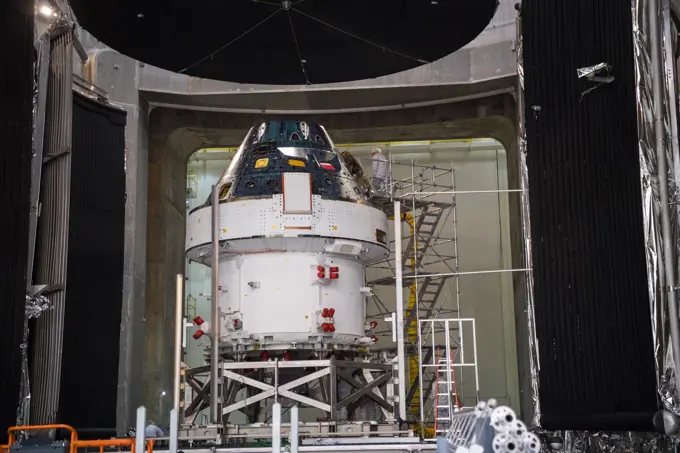
Orion is revealed for one of the final times on Jan. 14, as it is moved by crane to its transport pallet inside the Neil Armstrong Operations and Checkout Building at NASAs Kennedy Space Center in Florida, along its path to the pad ahead of the Artemis I launch. Teams across the globe have worked tirelessly to assemble the spacecraft which will receive a protective covering prior to departing for the Multi-Payload Processing Facility to begin ground processing by the Exploration Ground Systems and Jacobs teams.
6145-58959015
CAPE CANAVERAL, Fla. - At the Kennedy Space Center Visitor Complex in Florida, a close-up view shows space shuttle Atlantis payload bay doors have been opened, revealing the payload bay. Atlantis is being prepared for display in the Space Shuttle Atlantis exhibit, a 90,000-square-foot facility, scheduled to open June 29, 2013. The new $100 million facility will include interactive exhibits that tell the story of the 30-year Space Shuttle Program and highlight the future of space exploration. Visitors to the exhibit will get an up close look at Atlantis with its payload bay doors open, similar to how it looked in space.
6145-44925761
CAPE CANAVERAL, Fla. - Workers lift a solar array fairing at the processing hangar used by Space Exploration Technologies, or SpaceX, at Cape Canaveral Air Force Station, Fla. The fairing will be installed on the Dragon spacecraft undergoing launch preparations inside the hangar. The spacecraft will launch on the upcoming SpaceX CRS-2 mission. The flight will be the second commercial resupply mission to the International Space Station by SpaceX. NASA has contracted for a total of 12 commercial resupply flights from SpaceX and eight from the Orbital Sciences Corp.
6145-45281189
A protective cover panel has been installed over one of the solar arrays on the Orion spacecraft for Artemis I inside the Neil Armstrong Operations and Checkout Building high bay at NASAs Kennedy Space Center in Florida on Sept. 23, 2020. The iconic NASA worm and European Space Agency insignias on the Crew Module Adapter outer wall can be seen just above the panel. The solar arrays were extended, inspected, and then retracted, before installation on the spacecraft. Each of the four solar array panels will generate 11 kilowatts of power and span about 63 feet. The array is a component of Orions service module, which is provided by the European Space Agency and built by Airbus Defence and Space to supply Orions power, propulsion, air and water. The first in a series of increasingly complex missions, Artemis I will test the Orion spacecraft and Space Launch System as an integrated system ahead of crewed flights to the Moon. Under the Artemis program, NASA will land the first woman and
6145-45296464
The Space Launch System (SLS) rockets interim cryogenic propulsion stage (ICPS) sits in the transfer aisle of the Vehicle Assembly Building (VAB), upon being moved by teams with NASAs Exploration Ground Systems and contractor Jacobs at NASAs Kennedy Space Center in Florida on Saturday, June 19, 2021. After being fueled and serviced inside the Multi-Payload Processing Facility (MPPF), the ICPS will be hoisted into place atop the SLS core stage while its Aerojet Rocketdyne-built RL-10 engine will be protected inside the launch vehicle stage adapter (LVSA) on the mobile launcher in preparation for the launch of Artemis I. The ICPS will provide Orion spacecraft with the push needed for its flight around the Moon. The first in a series of increasingly complex missions, Artemis I will test SLS and the Orion spacecraft as an integrated system prior to crewed flights in which NASA will land the first woman and person of color on the Moon.
6145-45277529
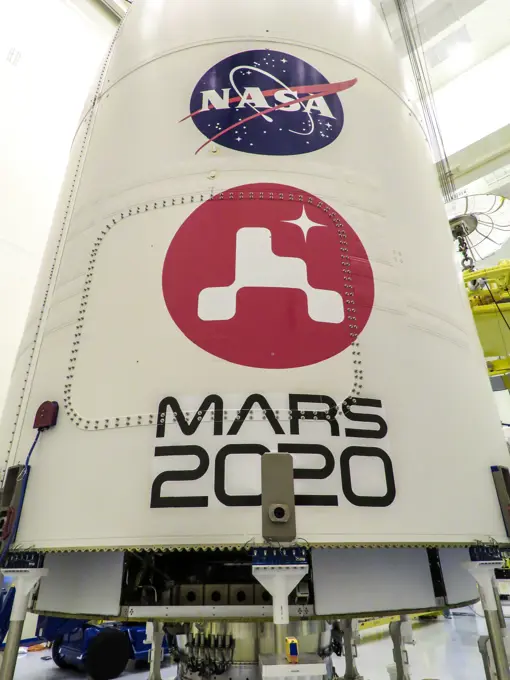
Inside the Payload Hazardous Servicing Facility at NASAs Kennedy Space Center in Florida, the Mars 2020 logo is installed on the United Launch Alliance Atlas V payload fairing on June 18, 2020. Secured inside the fairing is the agencys Mars 2020 Perseverance rover. The rover is scheduled to launch on July 20, 2020, atop the Atlas V 541 rocket from Space Launch Complex 41 at Cape Canaveral Air Force Station. The rover is part of NASAs Mars Exploration Program, a long-term effort of robotic exploration of the Red Planet. The rovers seven instruments will search for habitable conditions in the ancient past and signs of past microbial life on Mars. The Launch Services Program at Kennedy is responsible for launch management.
6145-44767085
CAPE CANAVERAL, Fla. -  In the Vehicle Assembly Building at NASA's Kennedy Space Center in Florida, media get a close look at various segments for the Ares I-X rocket being assembled in High Bay 4.  In front at left is the yellow crane known as the "birdcage" that is used to lift the crew module-launch abort system. Ares I-X is the test vehicle for the Ares I, which is part of the Constellation Program to return men to the moon and beyond. Ares I-X is targeted for launch in August 2009.
6145-45041464
CAPE CANAVERAL, Fla. - Inside the Vehicle Assembly Building at NASAs Kennedy Space Center in Florida, space shuttle Endeavour is being prepared for its move to Orbiter Processing Facility-2 (OPF-2). Shuttle Endeavour will remain in OPF-2 so that the orbiter maneuvering system (OMS) pods and forward reaction control system can be installed. Technicians also will offload water and Freon gas from lines located in Endeavours midbody. The work is part of Endeavours transition and retirement processing. The spacecraft is being prepared for public display at the California Science Center in Los Angeles. Endeavour flew 25 missions, spent 299 days in space, orbited Earth 4,671 times and traveled 122, 883, 151 miles over the course of its 19-year career. Endeavours STS-134 and final mission was completed after landing on June 1, 2011.
6145-45188082
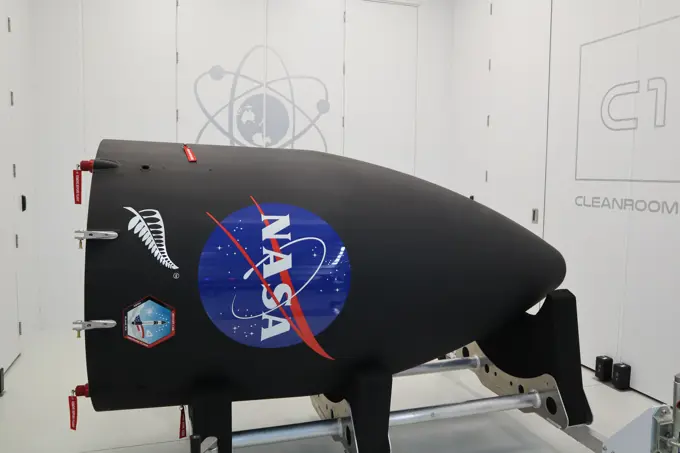
The Educational Launch of Nanosatellites 19 (ELaNa 19) payload has been encapsulated inside the Rocket Lab Electron rocket payload fairing on Dec. 1, 2018, at the companys facility in New Zealand. The ELaNa 19 payload comprises 10 CubeSats selected through NASAs CubeSat Launch Initiative. The liftoff marks the debut of the agencys innovative Venture Class Launch Services (VCLS) effort. Managed by NASAs Launch Services Program at Kennedy Space Center in Florida, VCLS was developed to offer small payloads dedicated rides to space.
6145-45145888
At Vandenberg Air Force Base in California, the Joint Polar Satellite System-1, or JPSS-1, spacecraft departs the Astrotech Processing Facility in a protective container on its way to Space Launch Complex 2. At the pad, JPSS-1 will be lifted for mating atop a United Launch Alliance Delta II rocket. Built by Ball Aerospace and Technologies Corp. of Boulder, Colorado, JPSS is the first in a series four next-generation environmental satellites in a collaborative program between the NOAA and NASA. Liftoff is scheduled to take place from Vandenberg's Space Launch Complex 2.
6145-45058868
HAWTHORNE, Calif. - The Dragon V2 stands on a stage inside SpaceX headquarters in Hawthorne, Calif., near a suspended cargo-carrying Dragon spacecraft that flew a previous mission. The new spacecraft, the Dragon V2, is designed to carry people into Earth's orbit and was developed in partnership with NASA's Commercial Crew Program under the Commercial Crew Integrated Capability agreement. SpaceX is one of NASA's commercial partners working to develop a new generation of U.S. spacecraft and rockets capable of transporting humans to and from Earth's orbit from American soil. Ultimately, NASA intends to use such commercial systems to fly U.S. astronauts to and from the International Space Station.
6145-44910330
CAPE CANAVERAL, Fla. - Inside Orbiter Processing Facility-2 at NASAs Kennedy Space Center in Florida, a United Space Alliance technician prepares to close space shuttle Atlantis midbody door for the final time.The orbiter is undergoing final preparations for its transfer to the Kennedy Space Center Visitor complex targeted for November. The work is part of Transition and Retirement of the remaining shuttle. Atlantis is being prepared for public display at the visitor complex. Over the course of its 26-year career, Atlantis spent 293 days in space during 33 missions.
6145-58959042
CAPE CANAVERAL, Fla. -- Technicians move NASA's Tracking and Data Relay Satellite, TDRS-K, into position for mating to a United Launch Alliance Atlas V rocket at Cape Canaveral Air Force Station's Space Launch Complex 41. Liftoff for the TDRS-K is planned for January 30, 2013. The TDRS-K spacecraft is part of the next-generation series in the Tracking and Data Relay Satellite System, a constellation of space-based communication satellites providing tracking, telemetry, command and high-bandwidth data return services.
6145-55974932
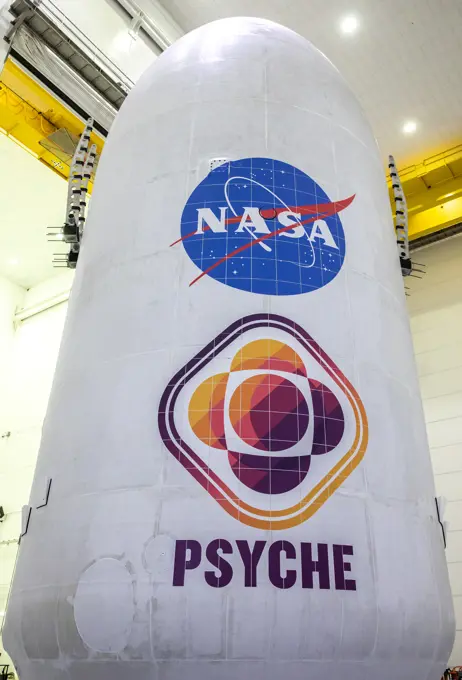
Psyche Transport from Astrotech to LC 39A. Teams transport NASA's encapsulated Psyche spacecraft from the Astrotech Space Operations Facility in Titusville to Launch Pad 39A at Kennedy Space Center in Florida on Friday, Oct. 6, 2023. Psyche will launch atop a SpaceX Falcon Heavy rocket. Liftoff is targeted for 10:16 a.m. EDT Thursday, Oct. 12. Riding with Psyche is a pioneering technology demonstration, NASA's Deep Space Optical Communications (DSOC) experiment.
6145-45147654
The Orion crew module for Exploration Mission-1 was moved into the thermal chamber in the Neil Armstrong Operations and Checkout Building high bay at NASA's Kennedy Space Center in Florida. The crew module will undergo a thermal cycle test to assess the workmanship of critical hardware and structural locations. The test also demonstrates crew module subsystem operations in a thermally stressing environment to confirm no damage or anomalous hardware conditions as a result of the test. The Orion spacecraft will launch atop NASA's Space Launch System rocket on its first uncrewed integrated flight.
6145-44985124
CAPE CANAVERAL, Fla. - At the Shuttle Landing Facility at NASA's Kennedy Space Center in Florida, the agency's Super Guppy aircraft is opened to offload the heat shield for the Orion spacecraft. The largest of its kind ever built, the heat shield is planned for installation on the Orion crew module in March of next year. The Orion spacecraft is scheduled to make its first unpiloted flight test, Exploration Flight Test-1 EFT-1, in September 2014.The Orion spacecraft is designed to meet requirements for traveling beyond low-Earth orbit. The spacecraft will serve as the exploration vehicle that will carry crews to space, sustain the astronauts during the space travel and provide safe re-entry from deep space.
6145-45055798
CAPE CANAVERAL, Fla. - The Orion boilerplate test vehicle is on display at Petco Park in San Diego, California, before the San Diego Padres' baseball game. The boilerplate test vehicle is being prepared for an Exploration Flight Test-1, or EFT-1, pre-transportation test. The Ground Systems Development and Operations Program will run the test at the U.S. Naval Base San Diego to simulate retrieval and transportation procedures for Orion after it splashes down in the ocean and is retrieved for return to land and ground transportation back to Kennedy Space Center in Florida.Orion is the exploration spacecraft designed to carry astronauts to destinations not yet explored by humans, including an asteroid and Mars. It will have emergency abort capability, sustain the crew during space travel and provide safe re-entry from deep space return velocities. The first unpiloted test flight of the Orion is scheduled to launch later this year atop a Delta IV rocket and in 2017 on NASAs Space Launch
6145-44678906
KENNEDY SPACE CENTER, FLA. --  At Launch Pad 17-B, at Cape Canaveral Air Force Station, the Delta II launch vehicle with NASAs Dawn spacecraft mission logo can be seen as it is moved into position for stacking with the Delta II launch vehicle.  Launch is scheduled for July 7.  Dawn is the ninth mission in NASA's Discovery Program. The spacecraft will be the first to orbit two planetary bodies, asteroid Vesta and dwarf planet Ceres,  during a single mission. Vesta and Ceres lie in the asteroid belt between Mars and Jupiter. It is also NASAs first purely scientific mission powered by three solar electric ion propulsion engines.
6145-58962614
KENNEDY SPACE CENTER, FLA. - The starboard side of orbiter Endeavour is shown from the rear as it sits inside the Florida Space Authoritys Reusable Launch Vehicle hangar at NASAs Kennedy Space Center. While in the hangar, Endeavour has undergone testing to see how orbiters respond to a new radar system that will be used during launch to detect debris. Endeavour is returning to the Orbiter Processing Facility today to continue Orbiter Major Modifications (OMM). OMMs are scheduled at regular intervals to enhance safety and performance, infuse new technology, and, in this case, perform Return to Flight modifications.
6145-44895504
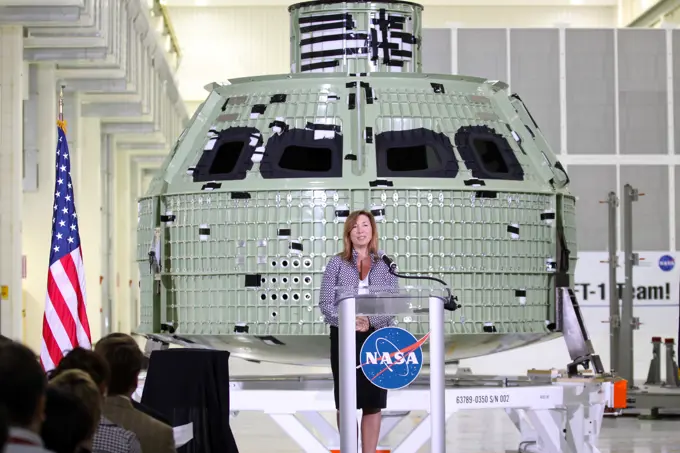
CAPE CANAVERAL, Fla. - NASA Deputy Administrator Lori Garver addresses the audience assembled in Kennedy Space Center's Operations and Checkout Building high bay for an event marking the arrival of NASA's first space-bound Orion capsule in Florida.Slated for Exploration Flight Test-1, an uncrewed mission planned for 2014, the capsule will travel farther into space than any human spacecraft has gone in more than 40 years. The capsule was shipped to Kennedy from NASA's Michoud Assembly Facility in New Orleans where the crew module pressure vessel was built. The Orion production team will prepare the module for flight at Kennedy by installing heat-shielding thermal protection systems, avionics and other subsystems.
7137-70492689
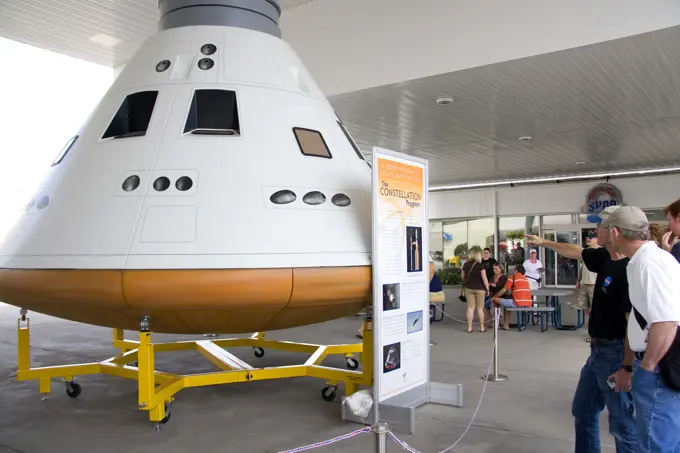
A model of the Orion spacecraft currently under development by NASA is part of Project Constellation, located at the Kennedy Space Center Visitor Complex in Cape Canaveral, Florida.
6145-45205861
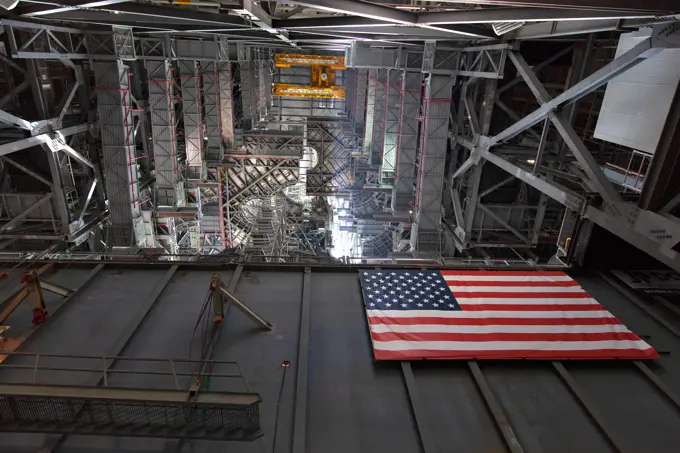
A view looking up at the mobile launcher (ML) in High Bay 3 of the Vehicle Assembly Building at NASAs Kennedy Space Center in Florida on June 18, 2019. Work is underway to lift the engine service platform that will provide access to the core stage of the Space Launch System (SLS) rocket in the center of the ML. The large work platform is designed to provide unrestricted access to the RS-25 engines on the SLS core stage from the ML. The service platform will be used for Artemis 1 and subsequent missions. For Artemis 1, the Orion spacecraft will launch atop the SLS rocket from Launch Pad 39B and begin an approximately three-week mission that will send Orion thousands of miles beyond the Moon. Exploration Ground Systems is overseeing work on the ML.
6145-58961577
KENNEDY SPACE CENTER, FLA. - The orbiter Discovery rolls into the Vehicle Assembly Building (VAB), marking a major milestone in the march to Return to Flight. First motion was at 1 29 a.m. EST. Inside the VAB, Discovery will be mated to the External Tank_Solid Rocket Booster assembly for Return to Flight mission STS-114. After all umbilicals have been connected, workers will perform an electrical and mechanical verification of the mated interfaces to verify all critical vehicle connections. A Space Shuttle interface test is performed to verify vehicle interfaces and vehicle-to-ground interfaces. The launch processing system is used to control and monitor orbiter systems as required. Space Shuttle Discovery will roll out to Launch Pad 39B approximately one week after the rollover to the VAB. The launch window for mission STS-114 is May 15 to June 3.
6145-45154127
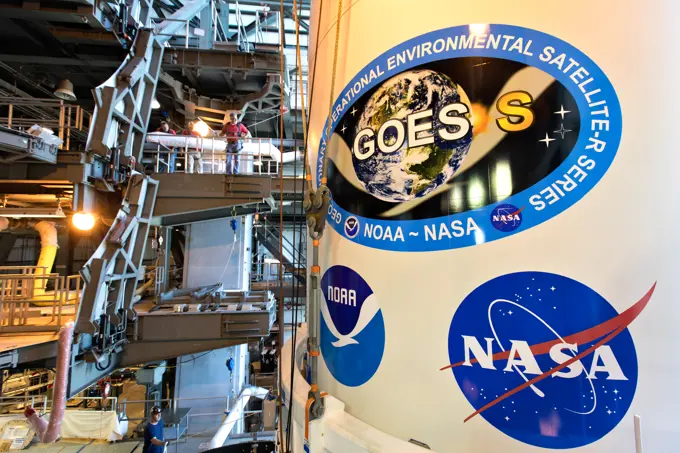
The payload fairing containing NOAA's Geostationary Operational Environmental Satellite-S (GOES-S) was lifted up by crane and moved into the United Launch Alliance (ULA) Vertical Integration Facility at Space Launch Complex 41 at Cape Canaveral Air Force Station in Florida. The fairing will be mated to the ULA Atlas V rocket. GOES-S is the second in a series of four advanced geostationary weather satellites. The satellite is slated to launch aboard the ULA Atlas V on March 1.
6145-44991266
MORRO BAY, Calif. - A SpaceX Dragon test article is seen prior to a test to evaluate its parachute deployment system as part of a milestone under its Commercial Crew Integrated Capability agreement with NASA's Commercial Crew Program. The parachute test took place over the Pacific Ocean, off the coast of Morro Bay, Calif.
6145-45132181
A close-up view of the Orion crew module from Exploration Flight Test 1 (EFT-1) on display at nearby NASA Kennedy Space Center Visitor Complex in Florida. The crew module is part of the NASA Now exhibit in the IMAX Theater. The Orion EFT-1 spacecraft launched atop a United Launch Alliance Delta IV rocket Dec. 5, 2014, from Space Launch Complex 37 at Cape Canaveral Air Force Station. The spacecraft built for humans traveled 3,604 miles above Earth and splashed down about 4.5 hours later in the Pacific Ocean.
6145-45203715
The test version of Orion attached to the Launch Abort System for the Ascent Abort-2 (AA-2) flight test exits the Launch Abort System Facility at NASAs Kennedy Space Center in Florida on May 22, 2019. The flight test article will make the 21.5 mile trek to Space Launch Complex 46 at Cape Canaveral Air Force Station in preparation for its launch this summer. During AA-2, a test version of Orion will launch on a booster to more than six miles in altitude, where Orions launch abort system will pull the capsule and its crew away to safety if an emergency occurs during ascent on the Space Launch System rocket. The AA-2 elements will be stacked together at the launch pad over the next several weeks. The launch is planned for July 2 and is a critical safety test that helps pave the way for Artemis missions near the Moon, and will enable astronauts to set foot on the lunar surface by 2024.
6145-58964713
KODIAK ISLAND, Alaska -- At the Launch Service Structure, Kodiak Launch Complex (KLC), the fairing is lowered over the Kodiak Star spacecraft in preparation for launch. The first orbital launch to take place from KLC, Kodiak Star is scheduled to lift off on a Lockheed Martin Athena I launch vehicle on Sept. 17 during a two-hour window that extends from 5 p.m. ADT. The payloads aboard include the Starshine 3, sponsored by NASA, and the PICOSat, PCSat and Sapphire, sponsored by the Department of Defense (DoD) Space Test Program. KLC is the newest commercial launch complex in the United States, ideal for launch payloads requiring low-Earth polar or sun-synchronous orbits
6145-45105000
Photos of the Launch Vehicle Data Center (LVDC) in Hangar AE -  Room #1 of LVDC - showing the engineering consule upgrades.
6145-55969999
Artemis II CMTA Turn Basin Testing. A crane lowers the Crew Module Test Article (CMTA) into water at the turn basin in the Launch Complex 39 area at NASAs Kennedy Space Center in Florida on Jan. 30, 2023. The CMTA is being used to practice recovery after splashdown of the Orion spacecraft to prepare for the Artemis II crewed mission. Exploration Ground Systems leads recovery efforts.
6145-44501637
KENNEDY SPACE CENTER, FLA. -- Technicians work in the aft compartment of Shuttle Endeavour's payload bay, where a new Enhanced Main Events Controller (E-MEC) will be installed. The original E-MEC in Endeavour became suspect during the Jan. 31 launch countdown and mission STS-99 was delayed when NASA managers decided to replace it. Each Shuttle carries two enhanced master events controllers (E-MECs), which provide relays for onboard flight computers to send signals to arm and fire pyrotechnics that separate the solid rockets and external tank during assent. Both E-MECs are needed for the Shuttle to be cleared for flight. Currently Endeavour and Columbia are the only two orbiters with the E-MECs. Built by Rockwell's Satellite Space Electronics Division, Anaheim, Calif., each unit weighs 65 pounds and is approximately 20 inches long, 13 inches wide and 8 inches tall. Previously, three Shuttle flights have been scrubbed or delayed due to faulty MECs: STS-73, STS-49 and STS-41-D. Before wor
4389-1456
Echo 2 Being Tested
6145-45128003
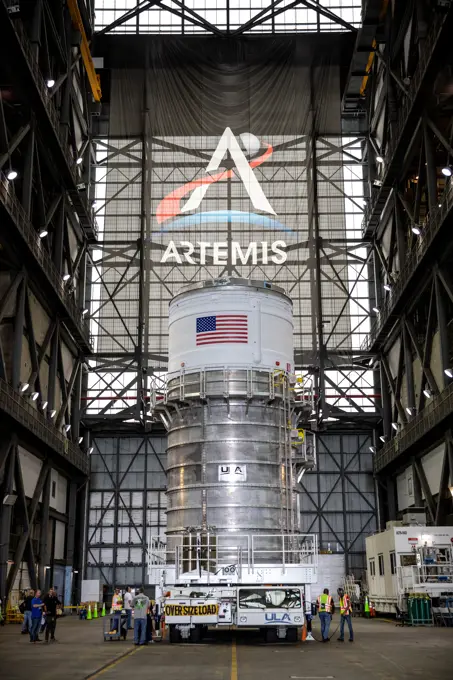
Technicians with United Launch Alliance (ULA) assist as the Centaur upper stage of the ULA Atlas V rocket is lowered onto the first stage booster inside the Vertical Integration Facility at Space Launch Complex 41 at Cape Canaveral Air Force Station in Florida. The rocket is being prepared for Orbital ATK's seventh commercial resupply mission, CRS-7, to the International Space Station. Orbital ATK's CYGNUS pressurized cargo module is scheduled to launch atop ULA's Atlas V rocket from Pad 41 on March 19, 2017. CYGNUS will deliver 7,600 of pounds of supplies, equipment and scientific research materials to the space station.
6145-44833774
CAPE CANAVERAL, Fla. -- At NASA's Kennedy Space Center in Florida, United Space Alliance employees gather and hold up a banner at a ceremony being held to commemorate the move from Kennedy's Assembly Refurbishment Facility (ARF) to the Vehicle Assembly Building (VAB) of the Space Shuttle Program's final solid rocket booster structural assembly -- the right-hand forward. The move was postponed because of inclement weather.
6145-58968156
An Apollo TV camera from the National Electronic Museum in Baltimore, Maryland is on display for NASA's briefing to release restored Apollo 11 moonwalk footage at the Newseum, Thursday, July 16, 2009, in Washington, DC.
PREVIOUS
of 2
NEXT
2401 S. Ervay, Suite 206
Dallas, Texas 75215
United States
Get Started
Free ResearchMy BoardsMy Cart
For Creators
How To License Your ContentContributor PortalFrame of Mind
Resources
API accessPricing
Contact
+1 866 236 0087help@viewpictures.co.uk Contact form
©2026 View Pictures. All Rights Reserved. -A
This site is protected by reCAPTCHA and Google Privacy Policy and Terms of Service apply.