My Boards
View Pictures
  • My Boards

NASA's Spacecraft and Rockets

Images showcasing spacecraft, rockets, and assembly facilities at NASA, depicting the processes behind space exploration.

Orion Media Day takes place at Lockheed Martins Waterton facility in Littleton, Colorado on Oct. 21, 2011. Part of Batch image transfer from Flickr.
276 assets in this story
6145-44587918
KENNEDY SPACE CENTER, FLA. -- Atlantis is seen after attachment of the orange external tank and solid rocket boosters. Space Shuttle Atlantis will be flying on mission STS-114, a Utilization Logistics Flight-1 to the International Space Station.  Along with a Multi-Purpose Logistics Module, Atlantis will also transport the next resident ISS crew, Expedition 7.  The Shuttle is scheduled to launch March 1, 2003, on the 12-day STS-114 mission.
6145-45020888
CAPE CANAVERAL, Fla. -- Technicians in the Payload Hazardous Servicing Facility at NASA's Kennedy Space Center in Florida check the placement of Atlas V rocket's payload fairing atop the transporter that will carry it to Space Launch Complex 41. The Mars Science Laboratory (MSL) spacecraft is enclosed in the fairing, which will protect the payload from heat and aerodynamic pressure generated during launch. MSL's components include a compact car-sized rover, Curiosity, which has 10 science instruments designed to search for evidence on whether Mars has had environments favorable to microbial life, including the chemical ingredients for life. The unique rover will use a laser to look inside rocks and release its gasses so that the rovers spectrometer can analyze and send the data back to Earth. Launch of MSL aboard a United Launch Alliance Atlas V rocket is planned for Nov. 25 from Space Launch Complex-41 on Cape Canaveral Air Force Station.
6145-44560481
KENNEDY SPACE CENTER, FLA. -- The Space Shuttle's first super lightweight external tank is lifted in KSC's Vehicle Assembly Building for STS-91 pre-flight processing. STS-91 is targeted for launch in late May. The improved tank is 7,500 pounds lighter than its predecessors and was developed to increase the Shuttle payload capacity on International Space Station assembly flights. Major changes to the lighter tank include the use of new materials and a revised internal design. The new liquid oxygen and liquid hydrogen tanks are constructed of aluminum lithium a lighter, stronger material than the metal alloy currently used. The redesigned walls of the liquid hydrogen tank were machined to provide additional strength and stability as well
6145-44841296
View of the engines of the first stage of the Soyuz TMA-20 booster rocket during mating operations on December 12, 2010 at the Baikonur Cosmodrome in Kazakhstan in advance of the launch of the Expedition 26 crew, Kondratyev, Coleman and Nespoli, on December 16, Baikonur time, to the International Space Station.-NASA/Victor Zelentsov
6145-44554169
The Space Shuttle Orbiter Discovery rolls over  from Orbiter Processing Facility 2 on top of the orbiter transporter to the Vehicle  Assembly Building for mating with its external tank and solid rocket boosters in  preparation for the STS-85 mission. Several payloads will be aboard Discovery during the  11-day mission, including the Manipulator Flight Demonstration (MFD) and the   Cryogenic Infrared Spectrometers and Telescopes for the Atmosphere-Shuttle Pallet  Satellite-2 (CRISTA-SPAS-2), as well as the Technology Applications and Science-1  (TAS-1) and International Extreme Ultraviolet Hitchhiker (IEH-2) experiments
6145-44758346
CAPE CANAVERAL, Fla. - In the Astrotech payload processing facility in Titusville, Fla., the first half of the payload fairing is moved around the GOES-O satellite.  The fairing is a molded structure that fits flush with the outside surface of the rocket and forms an aerodynamically smooth nose cone, protecting the spacecraft during launch and ascent. The latest Geostationary Operational Environmental Satellite, GOES-O was developed by NASA for the National Oceanic and Atmospheric Administration, or NOAA. The GOES satellites continuously provide observations of 60 percent of the Earth including the continental United States, providing weather monitoring and forecast operations as well as a continuous and reliable stream of environmental information and severe weather warnings. Once in orbit, GOES-O will be designated GOES-14, and NASA will provide on-orbit checkout and then transfer operational responsibility to NOAA. The GOES-O satellite is targeted to launch from Cape Canaveral Air F
6145-44479650
NASAs Space Launch System (SLS) rocket with the Orion spacecraft aboard is seen atop the mobile launcher as it rolls out of the Vehicle Assembly Building to Launch Complex 39B, Tuesday, Aug. 16, 2022, at NASAs Kennedy Space Center in Florida. NASAs Artemis I mission is the first integrated test of the agencys deep space exploration systems: the Orion spacecraft, SLS rocket, and supporting ground systems. Launch of the uncrewed flight test is targeted for no earlier than Aug. 29.
6145-44491489
JPSS-2 Spacecraft Transport to Pad and Lift/Mate. The United Launch Alliance Atlas V payload fairing containing the National Oceanic and Atmospheric Administrations (NOAA) Joint Polar Satellite System-2 (JPSS-2) arrives inside the vertical integration facility at Space Launch Complex 3 at Vandenberg Space Force Base (VSFB) in California on Oct. 18, 2022. Inside the fairing, JPSS-2 is stacked atop NASAs Low-Earth Orbit Flight Test of an Inflatable Decelerator (LOFTID) secondary payload. The fairing will be attached to the Atlas V rocket. JPSS-2 is the third satellite in the Joint Polar Satellite System series. It is scheduled to lift off from VSFB on Nov. 1 from SLC-3. JPSS-2, which will be renamed NOAA-21 after reaching orbit, will join a constellation of JPSS satellites that orbit from the North to the South pole, circling Earth 14 times a day and providing a full view of the entire globe twice daily. The NOAA/NASA Suomi National Polar-orbiting Partnership (Suomi NPP) satellite, and
6145-44996881
CAPE CANAVERAL, Fla. - At Cape Canaveral Air Force Station's Vertical Integration Facility at Launch Complex 41, engineers and technicians prepare to lift NASA's Tracking and Data Relay Satellite, or TDRS-L, spacecraft for mounting atop a United Launch Alliance Atlas V rocket. The TDRS-L satellite will be a part of the second of three next-generation spacecraft designed to ensure vital operational continuity for the NASA Space Network. It is scheduled to launch from Cape Canaveral's Space Launch Complex 41 atop a United Launch Alliance Atlas V rocket on Jan. 23, 2014. The current Tracking and Data Relay Satellite system consists of eight in-orbit satellites distributed to provide near continuous information relay contact with orbiting spacecraft ranging from the International Space Station and Hubble Space Telescope to the array of scientific observatories.
6145-44835289
CAPE CANAVERAL, Fla. -- At NASA's Kennedy Space Center in Florida, technicians prepare to move the STS-133 payload from the rotating service structure on Launch Pad 39A to space shuttle Discovery's payload bay. The move paves the way for the Terminal Countdown Demonstration Test (TCDT) this week, which will give the astronauts and teams at Kennedy and NASA's Johnson Space Center in Houston a chance to practice launch day tasks. Discovery and its STS-133 crew will deliver the Permanent Multipurpose Module, packed with supplies and critical spare parts, as well as Robonaut 2, the dexterous humanoid astronaut helper, to the International Space Station. Launch is targeted for 4:40 p.m. EDT, Nov. 1.
6145-44889616
CAPE CANAVERAL, Fla. - The SpaceX Falcon 9 rocket rolls between the lightning protection system  towers surrounding the pad at Space Launch Complex-40 on Cape Canaveral Air Force Station in Florida.Liftoff with the SpaceX Dragon capsule aboard is set for 4:55 a.m. EDT on May 19. The launch will be the company's second demonstration test flight for NASA's Commercial Orbital Transportation Services Program, or COTS. During the flight, the capsule will conduct a series of check-out procedures to test and prove its systems, including rendezvous and berthing with the International Space Station. If the capsule performs as planned, the cargo and experiments it is carrying will be transferred to the station. The cargo includes food, water and provisions for the stations Expedition crews, such as clothing, batteries and computer equipment. Under COTS, NASA has partnered with two aerospace companies to deliver cargo to the station.
6145-58968079
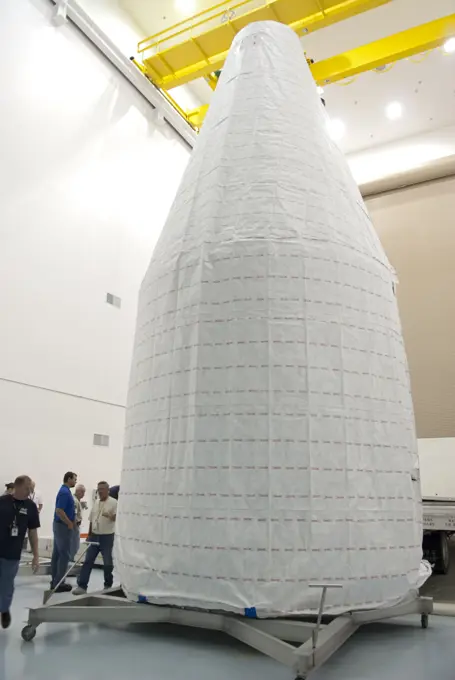
CAPE CANAVERAL, Fla. - Inside the Astrotech payload processing facility near NASAs Kennedy Space Center in Florida, technicians offload, inspect and prepare to uncover the nose cone fairing for the Radiation Belt Storm Probes, or RBSP, spacecraft. The nose faring will house and protect the RBSP during liftoff aboard an Atlas V rocket.NASAs RBSP mission will help us understand the suns influence on Earth and near-Earth space by studying the Earths radiation belts on various scales of space and time. RBSP will begin its mission of exploration of Earths Van Allen radiation belts and the extremes of space weather after its liftoff aboard a United Launch Alliance Atlas V from Space Launch Complex 41 at Cape Canaveral Air Force Station, Fla. Liftoff is targeted for Aug. 23, 2012.
6145-44831465
CAPE CANAVERAL, Fla. -- At NASA's Kennedy Space Center in Florida, a large yellow, metal sling lifts shuttle Discovery from the transfer aisle into High Bay 3 of the Vehicle Assembly Building. In the bay, the shuttle will be attached to its external fuel tank and solid rocket boosters. The operation began Sept. 9 and wrapped up early Sept. 10. Discovery is scheduled to roll out to Launch Pad 39A later this month in preparation for its launch to the International Space Station on the STS-133 mission.Targeted to lift off Nov. 1, Discovery will take the Permanent Multipurpose Module (PMM) packed with supplies and critical spare parts, as well as Robonaut 2 (R2) to the station.
6145-45082092
At Cape Canaveral Air Force Station's Launch Complex 37, United Launch Alliance CEO Tory Bruno, Johnson Space Center Director Ellen Ochoa and Kennedy Space Center Director Bob Cabana, foreground with backs to the camera, get a close-up view of the United Launch Alliance Delta IV Heavy rocket being prepared to launch NASA's Orion spacecraft on its first flight test.
6145-44724935
CAPE CANAVERAL, Fla. - Space shuttle Endeavour is suspended over the transfer aisle of the Vehicle Assembly Building at NASAs Kennedy Space Center.  The shuttle will be lifted into high bay 1 for mating with its external fuel tank and solid rocket boosters. After additional preparations are made, the shuttle will be rolled out to Launch Pad 39B. Endeavour is designated the rescue spacecraft for space shuttle Atlantis STS-125 mission to NASAs Hubble Space Telescope, targeted for October.  After Atlantis has safely returned from its flight, Endeavour will be moved to Launch Pad 39A for its STS-126 mission to the International Space Station, targeted for November.
6145-58972311
CAPE CANAVERAL, Fla. -- Enclosed in its payload fairing, NASA's Tracking and Data Relay Satellite, TDRS-K, is being prepare for the lift that will place it atop a United Launch Alliance Atlas V rocket at Cape Canaveral Air Force Station's Space Launch Complex 41. Liftoff for the TDRS-K is planned for January 30, 2013. The TDRS-K spacecraft is part of the next-generation series in the Tracking and Data Relay Satellite System, a constellation of space-based communication satellites providing tracking, telemetry, command and high-bandwidth data return services.
6145-44861227
CAPE CANAVERAL, Fla. -- In the Vehicle Assembly Building at NASA's Kennedy Space Center in Florida, shuttle Atlantis is suspended above the transfer aisle. The spacecraft will be positioned vertically in a high bay where it will be attached to its external fuel tank and solid rocket boosters already on the mobile launcher platform.Commander Chris Ferguson, Pilot Doug Hurley and Mission Specialists Sandra Magnus and Rex Walheim are expected to launch in mid-July, taking with them the Raffaello multi-purpose logistics module packed with supplies, logistics and spare parts. The STS-135 mission also will fly a system to investigate the potential for robotically refueling existing spacecraft and return a failed ammonia pump module to help NASA better understand the failure mechanism and improve pump designs for future systems. STS-135 will be the 33rd flight of Atlantis, the 37th shuttle mission to the space station, and the 135th and final mission of NASA's Space Shuttle Program
6145-58970492
The SpaceX Crew Dragon spacecraft undergoes final processing at Cape Canaveral Air Force Station, Florida, in preparation for the Demo-2 launch with NASA astronauts Bob Behnken and Doug Hurley to the International Space Station for NASAs Commercial Crew Program. Crew Dragon will carry Behnken and Hurley atop a Falcon 9 rocket, returning crew launches to the space station from U.S. soil for the first time since the Space Shuttle Program ended in 2011.
6145-44834020
CAPE CANAVERAL, Fla. -- In the Vehicle Assembly Building at NASA's Kennedy Space Center in Florida, External Fuel Tank-122 is being lowered toward a test stand where it will be checked out before launch.ET-122, the Space Shuttle Program's last external fuel tank was delivered to Kennedy's Turn Basin from NASAs Michoud Assembly Facility in New Orleans aboard the Pegasus Barge. After testing, ET-122 eventually will be attached to space shuttle Endeavour for the STS-134 mission to the International Space Station targeted to launch February, 2011.
6145-44911530
CAPE CANAVERAL, Fla. -- A Falcon 9 rocket with a Dragon capsule secured atop begins to roll from the processing hangar to the pad at Space Launch Complex 40 on Cape Canaveral Air Force Station in Florida.  Space Exploration Technologies Corp., or SpaceX, built both the rocket and capsule for NASA's first Commercial Resupply Services, or CRS-1, mission to the International Space Station.  Rollout was complete at 9:55 p.m. EDT.  SpaceX CRS-1 is an important step toward making Americas microgravity research program self-sufficient by providing a way to deliver and return significant amounts of cargo, including science experiments, to and from the orbiting laboratory. Launch is scheduled for 8:35 p.m. EDT on Oct. 7. NASA has contracted for 12 commercial resupply flights from SpaceX and eight from the Orbital Sciences Corp.
6145-44814692
STS-132 ATLANTIS LIFT & MATE TO ET/SRB STACK
6145-44679669
KENNEDY SPACE CENTER, FLA. --  The orbiter Endeavour is lifted into the upper levels of the Vehicle Assembly Building.  It will be moved laterally over a crossbeam and lowered into high bay 1 for stacking with the external tank and solid rocket boosters on the mobile launcher platform.tank and solid rocket boosters on the mobile launcher platform.  Endeavour will be launched on mission STS-118, its first flight in more than four years. The shuttle has undergone extensive modifications, including the addition of safety upgrades already added to shuttles Discovery and Atlantis. Endeavour also features new hardware, such as the Station-to-Shuttle Power Transfer System that will allow the docked shuttle to draw electrical power from the station and extend its visits to the orbiting lab.  Endeavour is targeted for launch on Aug. 7.
6145-44732449
CAPE CANAVERAL, Fla. -  This close-up shows space shuttle Atlantis being lowered onto its wheels in the transfer aisle of the Vehicle Assembly Building at NASA's Kennedy Space Center in Florida. Atlantis has been removed from its external fuel tank and solid rocket boosters stack after the delay of its STS-125 mission to NASA's Hubble Space Telescope.  Atlantis will be returned to the Orbiter Processing Facility. Atlantis' targeted launch on Oct. 14 was delayed when a system that transfers science data from the orbiting observatory to Earth malfunctioned on Sept. 27. The new target launch date is under review.
6145-44730630
The boilerplate Orion crew module for the Orion Launch Abort System Pad Abort-1 flight test undergoes moment-of-inertia testing at NASA Dryden's Flight Loads Lab.
6145-44745141
CAPE CANAVERAL, Fla. --  Suspended by a crane in the Vehicle Assembly Building at NASA's Kennedy Space Center in Florida, external fuel tank 130 is moved into high bay 2 for checkout before stacking with the solid rocket boosters and space shuttle Atlantis  for the STS-125 mission. The fuel tank was previously designated for the STS-127 mission. The STS-125 Hubble servicing mission  is targeted to launch May 12.
6145-52960735
Psyche: SpaceX Falcon 9 Heavy Vertical at LC 39A. NASAs Psyche spacecraft stands tall atop a SpaceX Falcon Heavy rocket at Kennedy Space Centers historic Launch Complex 39A in Florida on Tuesday, Oct. 10, 2023. Liftoff of the mission to the asteroid Psyche is targeted for 10:16 a.m. EDT on Thursday, Oct. 12. The spacecraft also is hosting a technology demonstration, NASAs Deep Space Optical Communications (DSOC), which will be the first test of laser communications beyond the Moon. NASAs Launch Services Program, based at Kennedy, is responsible for the insight and approval of the launch vehicle and manages the launch service for the Psyche mission.
6145-44748598
SDO - MEDIA DAY & FAIRING INSTALLATION
6145-44776931
CAPE CANAVERAL, Fla. - At NASA's Kennedy Space Center in Florida, space shuttle Endeavour arrives in  Orbiter Processing Facility #2.  Endeavour landed at 10:48 a.m. EDT, completing a journey of 6.5-million miles  on the STS-127 mission. Umbilicals are still attached to purge the vehicle of any possible residual explosive or toxic fumes. Towing normally begins within four hours after landing and is completed within six hours unless removal of time-sensitive experiments is required on the runway. In the OPF, turnaround processing procedures on Endeavour will include various post-flight deservicing and maintenance functions, which are carried out in parallel with payload removal and the installation of equipment needed for the next mission. The STS-127 mission was the 29th flight to the station, the 23rd flight of Endeavour and the 71st landing at Kennedy.
6145-44567726
Seen from behind, the orbiter Atlantis approaches the entrance of Orbiter Processing Facility 2 (OPF-2) where it will undergo preparations for its planned flight in June 1999. Atlantis spent 10 months in Palmdale, CA, undergoing extensive inspections and modifications in the orbiter processing facility there. The modifications included several upgrades enabling it to support International Space Station missions, such as adding an external airlock for ISS docking missions and installing thinner, lighter thermal protection blankets for weight reduction which will allow it to haul heavier cargo. OPF-2 consists of a 2,700-square-meter (29,000 square ft.) high bay. The building measures 29 meters (95 ft). high, 121 meters (397 ft.) long and 71 meters (233 ft.) wide
6145-44766695
CAPE CANAVERAL, Fla. - At Cape Canaveral Air Force Station in Florida, the GOES-O satellite  arrives at the mobile service tower on Launch Complex 37.  It will be lifted into the tower and mated with the United Launch Alliance Delta IV expendable launch vehicle. The GOES-O satellite is targeted to launch no earlier than June 26. The latest Geostationary Operational Environmental Satellite, GOES-O was developed by NASA for the National Oceanic and Atmospheric Administration, or NOAA. The GOES satellites continuously provide observations of 60 percent of the Earth including the continental United States, providing weather monitoring and forecast operations as well as a continuous and reliable stream of environmental information and severe weather warnings. Once in orbit, GOES-O will be designated GOES-14, and NASA will provide on-orbit checkout and then transfer operational responsibility to NOAA.
6145-44896304
The first stage of the Soyuz TMA-05M vehicle --- known as the business end” --- is shown at the Integration Facility at the Baikonur Cosmodrome in Kazakhstan July 11, 2012 awaiting mating to the spacecraft’s upper stages as preparations continued for the launch July 15 of Expedition 32/33 Soyuz Commander Yuri Malenchenko, NASA Flight Engineer Sunita Williams and Flight Engineer Aki Hoshide of the Japan Aerospace Exploration Agency to the International Space Station. NASA/Victor Zelentsov
6145-58962453
KENNEDY SPACE CENTER, FLA. - The orbiter Discovery is suspended vertically from an overhead crane in the transfer aisle of the Vehicle Assembly Building at NASAs Kennedy Space Center. Discovery will be lifted up and lowered to the Solid Rocket Booster and External Tank already stacked on the top of the Mobile Launcher Platform (MLP). After Discovery has been mated to the External Tank_Solid Rocket Booster assembly on the MLP and all umbilicals have been connected, workers will perform an electrical and mechanical verification of the mated interfaces to verify all critical vehicle connections. A Shuttle interface test is performed using the launch processing system to verify Space Shuttle vehicle interfaces and Space Shuttle vehicle-to-ground interfaces. In approximately one week, Space Shuttle Discovery will be ready for rollout to Launch Pad 39B for Return to Flight mission STS-114. The launch window for STS-114 is May 15 to June 3.
6145-44834017
CAPE CANAVERAL, Fla. -- In the Vehicle Assembly Building at NASA's Kennedy Space Center in Florida, External Fuel Tank-122 is lifted into a vertical position above the transfer aisle. The external tank is being moved to a test cell where it will be checked out before launch.ET-122, the Space Shuttle Program's last external fuel tank was delivered to Kennedy's Turn Basin from NASAs Michoud Assembly Facility in New Orleans aboard the Pegasus Barge. After testing ET-122 eventually will be attached to space shuttle Endeavour for the STS-134 mission to the International Space Station targeted to launch February, 2011.
6145-44642538
KENNEDY SPACE CENTER, FLA. - The GOES-N satellite, secured inside a payload fairing, arrives at the Astrotech payload processing facility in Titusville, Fla.  Liftoff of the satellite from Launch Complex 37 at Cape Canaveral Air Force Station in Florida was scrubbed in August 2005 due to technical issues and postponed to a later date. Due to the extended length of time the spacecraft had been atop its Delta IV rocket without launching, the weather satellite is being returned to Astrotech for some precautionary retesting and state of health checks. GOES-N is the latest in a series of Geostationary Operational Environmental Satellites for NOAA and NASA providing continuous monitoring necessary for intensive data analysis.
6145-44642836
KENNEDY SPACE CENTER, FLA.  -  In NASA Kennedy Space Center's Vehicle Assembly Building, the newly delivered external tank is lifted off its transporter.  Designated ET-119, the 154-foot tank is being raised to vertical and then will be lifted into a checkout cell for further work.  The tank, which will launch space shuttle Discovery on mission STS-121, will fly with many major safety changes, including the removal of the protuberance air load ramps. A large piece of foam from a ramp came off during the last shuttle launch in July 2005. The ramps were removed to eliminate a potential source of damaging debris to the space shuttle. The next launch of Discovery is scheduled for May 2006.
6145-44686194
KENNEDY SPACE CENTER, FLA. --  On its transporter, Space shuttle Discovery rolls to the Vehicle Assembly Building, at left.  In the VAB, the shuttle will be lifted and mated with the external tank and solid rocket boosters on the mobile launcher platform.  Discovery is targeted for launch to the International Space Station for mission STS-120 on Oct. 23.  The crew will be delivering and installing the Italian-built U.S. Node 2, named Harmony.  The pressurized module will act as an internal connecting port and passageway to additional international science labs and cargo spacecraft. In addition to increasing the living and working space inside the station, it also will serve as a work platform outside for the station's robotic arm.
6145-58964696
CAPE CANAVERAL, Fla. -- Shuttle Atlantis' three main engines take center stage to the banners commemorating the orbiters that served the Space Shuttle Program. In a ceremony held in front of Orbiter Processing Facility-1 at NASA's Kennedy Space Center in Florida, NASA Administrator Charles Bolden announced the facilities where four shuttle orbiters will be displayed permanently at the conclusion of the Space Shuttle Program. Shuttle Enterprise, the first orbiter built, will move from the Smithsonian's National Air and Space Museum Steven F. Udvar-Hazy Center in Virginia to the Intrepid Sea, Air & Space Museum in New York. The Udvar-Hazy Center will become the new home for shuttle Discovery, which retired after completing its 39th mission in March. Shuttle Endeavour, which is preparing for its final flight at the end of the month, will go to the California Science Center in Los Angeles. Atlantis, which will fly the last planned shuttle mission in June, will be displayed at the Kennedy S
6145-44929243
CAPE CANAVERAL, Fla. -NASA's Tracking and Data Relay Satellite, TDRS-K, enclosed in its payload fairing, is en route to its launch site from the Astrotech payload processing facility in Titusville, Fla. TDRS-K will lift off atop a United Launch Alliance Atlas V rocket from Cape Canaveral Air Force Station's Space Launch Complex 41, near NASA's Kennedy Space Center.The TDRS-K spacecraft is part of the next-generation series in the Tracking and Data Relay Satellite System, a constellation of space-based communication satellites providing tracking, telemetry, command and high-bandwidth data return services.
6145-44901383
CAPE CANAVERAL, Fla. - Technicians monitor progress as the space shuttle Atlantis is towed into Bay 2 of the Orbiter Processing Facility OPF at NASA's Kennedy Space Center in Florida. Atlantis is switching places with Endeavour that moved into the Vehicle Assembly Building. In the OPF, Atlantis will undergo final preparations for its transfer to the Kennedy Space Center Visitor Complex targeted for November. The work is part of Transition and Retirement of the remaining space shuttles, Atlantis and Endeavour. Atlantis is being prepared for public display at Kennedy's Visitor Complex. Over the course of its 26-year career, Atlantis spent 293 days in space during 33 missions.
6145-44758358
CAPE CANAVERAL, Fla. - The mockup Orion crew exploration vehicle is on the dock at the Trident Basin at Port Canaveral, Fla., waiting to be tested in open waters. Orion is targeted to begin carrying humans to the International Space Station in 2015 and to the moon by 2020. The goal of the operation, dubbed the Post-landing Orion Recovery Test, or PORT, is to determine what kind of motion astronauts can expect after landing, as well as outside conditions for recovery teams.  Orion, along with the Ares I and V rockets and the Altair lunar lander, are part of the Constellation Program.
6145-44508396
KENNEDY SPACE CENTER, FLA. -- The orbiter Atlantis heads toward the open door of the Vehicle Assembly Building (VAB) on the north side. In the VAB it will be lifted to vertical and placed aboard the mobile launcher platform (MLP) for stacking with the solid rocket boosters and external tank. Atlantis is scheduled to launch Sept. 8 on mission STS-106, the fourth construction flight to the International Space Station, with a crew of seven
6145-44831211
CAPE CANAVERAL, Fla. -- At NASA's Kennedy Space Center in Florida, shuttle Discovery begins to back out of Orbiter Processing Facility-3 during a move called "rollover" to the nearby Vehicle Assembly Building (VAB). Once inside the VAB, the shuttle will be joined to its solid rocket boosters and external fuel tank. Later this month, Discovery is scheduled to "rollout" to Launch Pad 39A for its launch to the International Space Station on the STS-133 mission.Targeted to liftoff Nov. 1, Discovery will take the Permanent Multipurpose Module (PMM) packed with supplies and critical spare parts, as well as Robonaut 2 (R2) to the station.
6145-45280965
Inside the Rotation, Processing and Surge Facility at NASAs Kennedy Space Center in Florida, Exploration Ground Systems and Jacobs TOSC workers completed painting of NASAs iconic “worm” logo on the Artemis I Space Launch System twin solid rocket boosters on Sept. 23, 2020. Originally created by the firm of Danne & Blackburn, the iconic “worm” logos bold, sleek design was officially introduced in 1975 and was incorporated into many of the agencys next-generation programs. It was retired in 1992, but has made a comeback in 2020 as the agency ushers in a new, modern era of human spaceflight. The first in a series of increasingly complex missions, Artemis I will test the Orion spacecraft and Space Launch System as an integrated system ahead of crewed flights to the Moon. Under the Artemis program, NASA will land the first woman and the next man on the Moon by 2024.
6145-44661242
KENNEDY SPACE CENTER, FLA. --  Inside the Vehicle Assembly Building, a crane and sling attached to the orbiter Discovery is lifting the vehicle toward the upper levels for transfer to high bay 3.  There it will be lowered onto the mobile launcher platform where the external tank and solid rocket boosters are already stacked.  Space Shuttle Discovery is scheduled to roll out to Launch Pad 39B no earlier than Nov. 7 for mission STS-116.  The mission is No. 20 to the International Space Station and construction flight 12A.1. The mission payload is the SPACEHAB module, the P5 integrated truss structure and other key components. The launch window for mission STS-116 opens Dec. 7.
6145-45104987
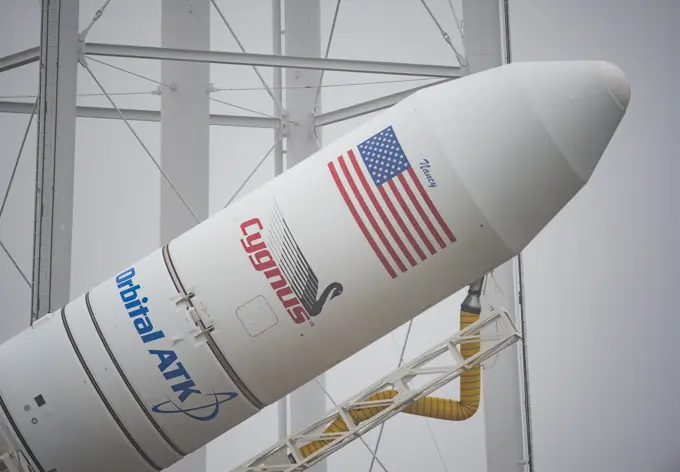
Encapsulated inside its payload fairing, the Cygnus spacecraft for the upcoming Orbital ATK Commercial Resupply Services-6 is mated atop a United Launch Alliance Atlas V rocket in the Vertical Integration Facility at Launch Complex-41 at Cape Canaveral Air Force Station. The Cygnus is scheduled to lift off atop a United Launch Alliance Atlas V rocket on March 22 to deliver hardware and supplies to the International Space Station.
6145-45191353
More than 700 NASA Marshall Space Flight Center team members, Boeing employees, Team Redstone participants and local officials filled 17 buses Feb. 6 to view the liquid hydrogen tank structural test article installed in Test Stand 4693 at Marshall. The 149-foot liquid hydrogen tank structural test article is the largest piece of structural test hardware for the core stage of NASAs Space Launch System (SLS). At 221 feet tall, Test Stand 4693 is the largest test stand at Marshall -- as well as one of the newest. During testing, dozens of hydraulic cylinders in the test stand will push and pull on the tank to simulate the stresses and loads it will endure during liftoff and flight for lunar missions.
6145-44833771
CAPE CANAVERAL, Fla. -- At NASA's Kennedy Space Center in Florida, Roger Elliot with United Space Alliance addresses the attendees at a ceremony being held to commemorate the move from Kennedy's Assembly Refurbishment Facility (ARF) to the Vehicle Assembly Building (VAB) of the Space Shuttle Program's final solid rocket booster structural assembly -- the right-hand forward. The move was postponed because of inclement weather.
6145-44624580
KENNEDY SPACE CENTER, FLA. - External Tank 118 (ET-118) is slowly moved above the transporter in the transfer aisle of the Vehicle Assembly Building before being lowered. The tank will be transferred to NASAs Michoud Assembly Facility in New Orleans.  The tank is being installed with an improved bipod fitting, which connects the external fuel tank to the Shuttle during launch. The new design, a significant milestone in the effort to return the Shuttle to safe flight, replaces the foam that was used to prevent ice buildup on the tanks bipod fittings with four rod-shaped heaters.  The heaters are being retrofitted on the 11 existing tanks and incorporated into the manufacture of all new tanks.
6145-44796145
VANDENBERG AIR FORCE BASE, Calif. - A United Launch Alliance Delta II rocket with NASAs Wide-field Infrared Survey Explorer, or WISE, satellite sits poised for launch at Space Launch Complex-2 at Vandenberg Air Force Base in California.   The Delta II is set for liftoff at 6:09 a.m. PST Dec. 14.  WISE will scan the entire sky in infrared light, picking up the glow of hundreds of millions of objects and producing millions of images.
6145-44744912
CAPE CANAVERAL, Fla. --  External Tank 130 rolls into the Vehicle Assembly Building at NASA's Kennedy Space Center in Florida.  The Pegasus barge transported the fuel tank from the Michoud Assembly Facility in New Orleans.  ET 130, which will be used on the Hubble servicing mission, STS-125, will be moved into a high bay for checkout. The fuel tank was previously designated for the STS-127 mission.
6145-44568295
KENNEDY SPACE CENTER, FLA. -- Wrapped in an anti-static blanket for protection, Deep Space 1 is lifted out of the transporter that carried it to Launch Pad 17A at Cape Canaveral Air Station. The spacecraft will be launched aboard a Boeing Delta 7326 rocket on Oct. 25. Deep Space 1 is the first flight in NASA's New Millennium Program, and is designed to validate 12 new technologies for scientific space missions of the next century, including the engine. Propelled by the gas xenon, the engine is being flight-tested for future deep space and Earth-orbiting missions. Deceptively powerful, the ion drive emits only an eerie blue glow as ionized atoms of xenon are pushed out of the engine. While slow to pick up speed, over the long haul it can deliver 10 times as much thrust per pound of fuel as liquid or solid fuel rockets. Other onboard experiments include software that tracks celestial bodies so the spacecraft can make its own navigation decisions without the intervention of ground control
6145-45166139
The Orbital ATK Antares rocket, with the Cygnus spacecraft onboard, is raised at launch Pad-0A, Friday, May 18, 2018 at Wallops Flight Facility in Virginia. The Antares will launch with the Cygnus spacecraft filled with 7,400 pounds of cargo for the International Space Station (ISS), including science experiments, crew supplies, and vehicle hardware. The mission is Orbital ATK's ninth contracted cargo delivery flight to ISS for NASA.
6145-44929452
CAPE CANAVERAL, Fla. -NASA's Tracking and Data Relay Satellite, TDRS-K, enclosed in its payload fairing, passes through the Launch Complex 39 area at NASA's Kennedy Space Center as it travels from the Astrotech payload processing facility in Titusville, Fla., to its launch site. TDRS-K will lift off atop a United Launch Alliance Atlas V rocket from Cape Canaveral Air Force Station's Space Launch Complex 41.The TDRS-K spacecraft is part of the next-generation series in the Tracking and Data Relay Satellite System, a constellation of space-based communication satellites providing tracking, telemetry, command and high-bandwidth data return services.
6145-44506138
The logo for the Tracking and Data Relay Satellite (TDRS-H) is predominantly displayed on the fairing that will encapsulate the satellite for launch. The fairing is in KSCs Spacecraft Assembly and Encapsulation Facility (SAEF-2) where TDRS is undergoing testing. The TDRS is scheduled to be launched from CCAFS June 29 aboard an Atlas IIA/Centaur rocket. One of three satellites (labeled H, I and J) being built in the Hughes Space and Communications Company Integrated Satellite Factory in El Segundo, Calif., the latest TDRS uses an innovative springback antenna design. A pair of 15-foot-diameter, flexible mesh antenna reflectors fold up for launch, then spring back into their original cupped circular shape on orbit. The new satellites will augment the TDRS systems existing Sand Ku-band frequencies by adding Ka-band capability. TDRS will serve as the sole means of continuous, high-data-rate communication with the space shuttle, with the International Space Station upon its completion, an
6145-44503515
At launch pad 36-A, Cape Canaveral Air Force Station, cables help guide the second stage of an Atlas II/Centaur rocket as it is lifted up the gantry (behind it) for mating with the first stage. Atlas II is designed to launch payloads into low earth orbit, geosynchronous transfer orbit or geosynchronous orbit. The rocket is the launch vehicle for the GOES-L satellite, part of the NOAA National Weather Service system in weather imagery and atmospheric sounding information. The primary objective of the GOES-L is to provide a full capability satellite in an on-orbit storage condition, to assure NOAA continuity in services from a two-satellite constellation. Launch services are being provided by the 45th Space Wing
6145-58962336
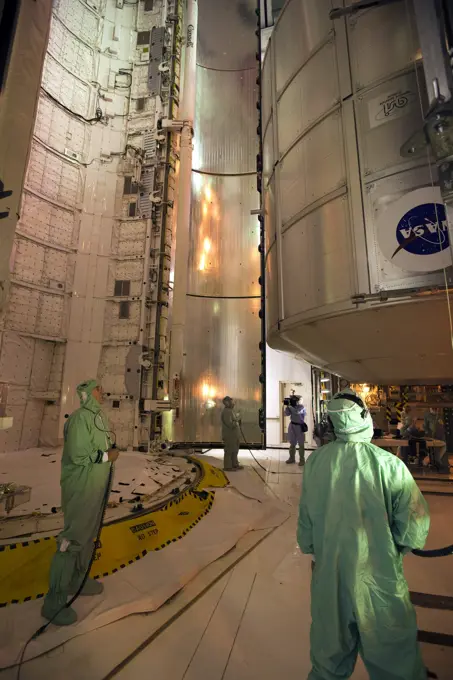
KENNEDY SPACE CENTER, FLA. - This view of the suspended 122-foot-long orbiter Discovery shows the underside with the Thermal Protection System tiles that cover it. After being demated from its External Tank and Solid Rocket Boosters in high bay 1, Discovery is being lowered in the transfer aisle of the Vehicle Assembly Building. The orbiter will be placed on a transporter and moved to high bay 3 for remating with another tank, ET-121. Discovery is expected to be rolled back to the launch pad in mid-June for Return to Flight mission STS-114. The launch window extends from July 13 to July 31.
6145-55974931
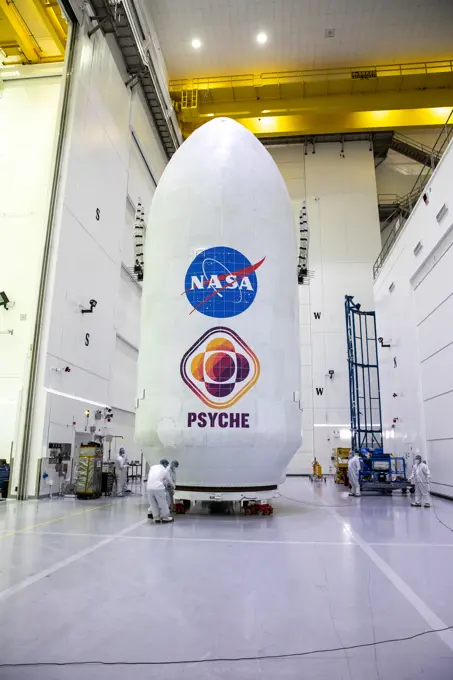
Psyche Transport from Astrotech to LC 39A. Teams transport NASA's encapsulated Psyche spacecraft from the Astrotech Space Operations Facility in Titusville to Launch Pad 39A at Kennedy Space Center in Florida on Friday, Oct. 6, 2023. Psyche will launch atop a SpaceX Falcon Heavy rocket. Liftoff is targeted for 10:16 a.m. EDT Thursday, Oct. 12. Riding with Psyche is a pioneering technology demonstration, NASA's Deep Space Optical Communications (DSOC) experiment.
6145-44552605
Workers prepare for the mating of the Atlas 1 payload fairing containing the GOES-K advanced weather satellite with the Lockheed Martin Atlas 1 expendable launch vehicle (AC-79) at Launch Complex 36, Pad B, Cape Canaveral Air Station. GOES-K will be the third spacecraft to be launched in the advanced series of Geostationary Operational Environmental Satellites (GOES). The GOES satellites are owned and operated by the National Oceanic and Atmospheric Administration (NOAA); NASA manages the design, development and launch of the spacecraft. GOES-K is targeted for an April 24 launch during a launch window which extends from 1:50-3:09 a.m. EDT
6145-44736975
The Space Shuttle Orbiter Enterprise is lowered to the floor of the transfer aisle in the Vehicle Assembly Building during destacking operations. The Enterprise, mated to an external tank and twin inert solid rocket boosters, formed a nonlaunchable Space Shuttle which was used for fit and fuction checks of assembly, test and launch facilities at the nation's Spaceport. Enterprise will be transported to the Shuttle Landing Facility, mounted piggyback on its 747 Shuttle Carrier Aircraft, and flown to NASA's Dryden Flight Research Center, CA.
6145-45203925
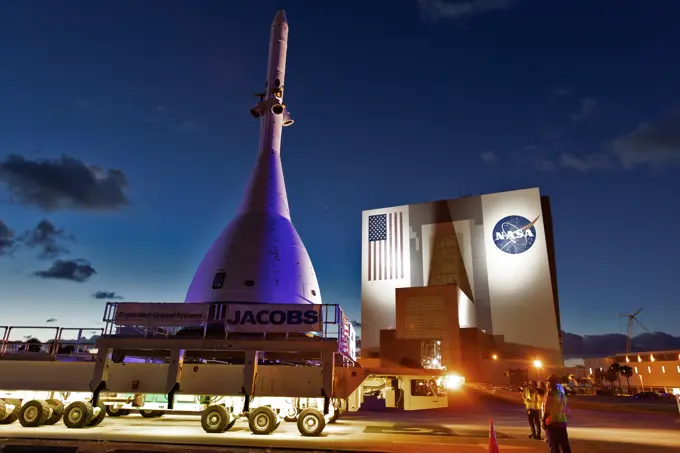
The test version of Orion attached to the Launch Abort System for the Ascent Abort-2 (AA-2) flight test passes by the iconic Vehicle Assembly Building at NASAs Kennedy Space Center in Florida on May 22, 2019, during its 21.5 mile trek to Space Launch Complex 46 at Cape Canaveral Air Force Station in preparation for its launch this summer. In the background is the iconic Vehicle Assembly Building. During AA-2, a test version of Orion will launch on a booster to more than six miles in altitude, where Orions launch abort system will pull the capsule and its crew away to safety if an emergency occurs during ascent on the Space Launch System rocket. The AA-2 elements will be stacked together at the launch pad over the next several weeks. The launch is planned for July 2 and is a critical safety test that helps pave the way for Artemis missions near the Moon, and will enable astronauts to set foot on the lunar surface by 2024.
6145-44972153
Doublebubble MIT N+3 D8 1/11 Scale Model in the 14x22 Foot Subsonic Tunnel
6145-45230817
The Space Shuttle main propulsion system includes three major elements. One of those elements is the External Tank (ET). The ET holds over one-half million gallons of liquid oxygen and liquid hydrogen that fuel the main engines.
6145-45226768
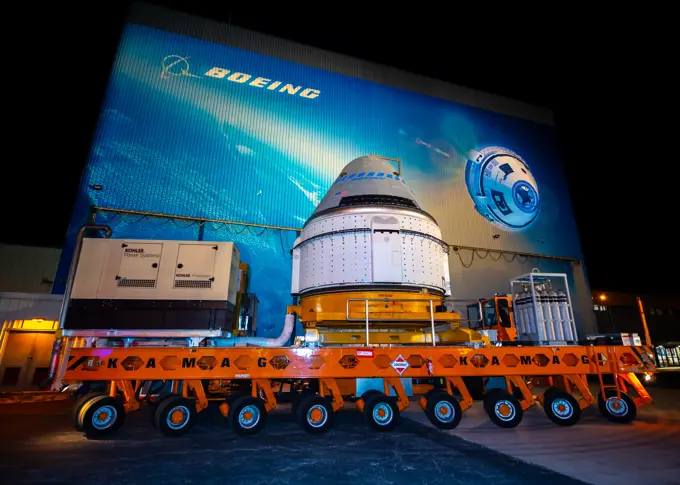
The Boeing CST-100 Starliner spacecraft rolls out from the companys Commercial Crew and Cargo Processing Facility at NASAs Kennedy Space Center in Florida on Nov. 21, 2019. The spacecraft will make the trip to Space Launch Complex 41 at Cape Canaveral Air Force Station where it will be secured atop a United Launch Alliance Atlas V rocket for Boeings Orbital Flight Test to the International Space Station for NASAs Commercial Crew Program.
6145-45163857
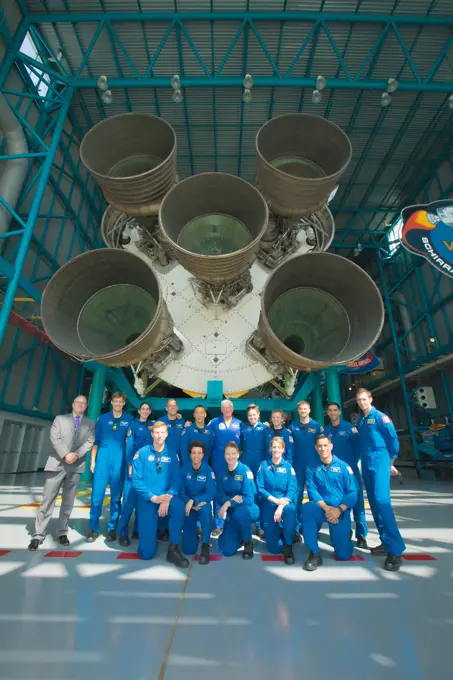
The 2017 class of astronaut candidates are inside the Saturn V Center at the Kennedy Space Center Visitor Complex near NASA's Kennedy Space Center in Florida. The candidates toured center facilities, including the Neil Armstrong Operations and Checkout Building high bay; the Launch Control Center, Launch Pad 39B, and the Vehicle Assembly Building. They also toured Boeing's Commercial Crew and Cargo Facility, United Launch Alliance's Space Launch Complex 41 at Cape Canaveral Air Force Station, and SpaceX's Launch Pad 39A at Kennedy. The candidates will spend about two years getting to know the space station systems and learning how to spacewalk, speak Russian, control the International Space Station's robotic arm and fly T-38s, before they're eligible to be assigned to a mission.
6145-45104973
Encapsulated inside its payload fairing, the Cygnus spacecraft for the upcoming Orbital ATK Commercial Resupply Services-6 mission departs the Payload Hazardous Servicing Facility at NASA's Kennedy Space Center in Florida. Mounted atop a KAMAG transporter, Cygnus is being moved to Space Launch Complex-41 at Cape Canaveral Air Force Station where it will be mounted atop a United Launch Alliance Atlas V rocket. The Cygnus is scheduled to lift off atop a United Launch Alliance Atlas V rocket on March 22 to deliver hardware and supplies to the International Space Station.
6145-44966822
CAPE CANAVERAL, Fla. -- At the Kennedy Space Center Visitor Complex in Florida, center director Bob Cabana speaks to news media representatives during the opening of the 90,000-square-foot "Space Shuttle Atlantis" facility. Also participating in the news briefing are, from the left, Mike Konzen of PGAV Destinations, Bill Moore, Delaware North Parks and Resorts chief operating officer, and Rick Abramson, Delaware North president.The new $100 million facility includes interactive exhibits that tell the story of the 30-year Space Shuttle Program and highlight the future of space exploration. The "Space Shuttle Atlantis" exhibit formally opened to the public on June 29, 2013.
6145-44552603
The Atlas 1 payload fairing with the encapsulated GOES-K advanced weather satellite awaits transport to the launch pad. GOES-K was prepared for launch at the Astrotech Space Operations LP facility in Titusville. GOES-K will be the third spacecraft to be launched in the advanced series of Geostationary Operational Environmental Satellites (GOES). The GOES satellites are owned and operated by the National Oceanic and Atmospheric Administration (NOAA); NASA manages the design, development and launch of the spacecraft. GOES-K is targeted for an April 24 launch aboard a Lockheed Martin Atlas 1 expendable launch vehicle (AC-79) from Launch Complex 36, Pad B, Cape Canaveral Air Station. The launch window opens at 1:50 a.m. and extends to 3:09 a.m. EDT. Once in orbit, GOES-K will become GOES-10, joining GOES-8 and GOES-9 in space
6145-45074060
2014-09-21-14-00-27-2Outside the Korolev Museum at the Baikonur Cosmodrome in Kazakhstan, the Expedition 41/42 prime and backup crews participate in the raising of the flag bearing their crew insignia Sept. 21 during ceremonial pre-flight activities. From left to right are prime crewmembers Alexander Samokutyaev of the Russian Federal Space Agency (Roscosmos), Elena Serova of Roscosmos and Barry Wilmore of NASA and backup crewmembers Gennady Padalka of Roscosmos, Scott Kelly of NASA and Mikhail Kornienko of Roscosmos.  Wilmore, Samokutyaev and Serova will launch on Sept. 26, Kazakh time, in the Soyuz to begin a 5 ½ month mission on the International Space Station. Serova will become the fourth Russian woman to fly in space and the first to live and work on the station. Kelly and Kornienko will launch in March 2015 to spend a full year on the station.NASA/Victor Zelentsov
6145-45154365
From the left, United Launch Alliance (ULA) president and CEO Tory Bruno leads a tour for Vice President Mike Pence, his wife, Karen Pence, and NASA Acting Administrator Robert Lightfoot on Feb. 20, 2018. They are in the ULA Horizontal Integration Facility (HIF), at Cape Canaveral Air Force Station in Florida. The HIF is where the Delta IV Heavy boosters are being processed for NASAs upcoming Parker Solar Probe mission. During his visit, Pence will chair a meeting of the National Space Council on Feb. 21, 2018 in the high bay of NASA Kennedy Space Centers Space Station Processing Facility. The council's role is to advise the president regarding national space policy and strategy, and review the nation's long-range goals for space activities.
6145-44956361
CAPE CANAVERAL, Fla. -- At the Kennedy Space Center Visitor Complex in Florida, construction crews have removed 16,000 square feet of plastic shrink-wrap from the space shuttle Atlantis. The spacecraft was enclosed in the plastic shrink-wrap since November of last year to protect the artifact from dust and debris during construction of the 90,000-square-foot facility.Last November, the space shuttle Atlantis made its historic final journey to its new home, traveling 10 miles from the Kennedy Space Center's Vehicle Assembly Building to the spaceport's visitor complex. The new $100 million "Space Shuttle Atlantis" facility will include interactive exhibits that tell the story of the 30-year Space Shuttle Program and highlights the future of space exploration. The "Space Shuttle Atlantis" exhibit scheduled to open June 29, 2013.
6145-45214201
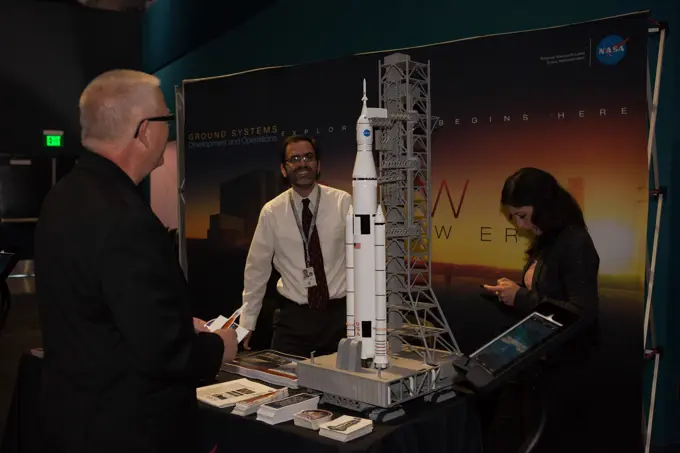
During a ribbon cutting ceremony on Aug. 16, 2019, in High Bay 2 of the Vehicle Assembly Building (VAB) at NASAs Kennedy Space Center in Florida, a scale model of the Northrop Grumman OmegA launch system is in view. The VAB is getting its first commercial tenant. Northrop Grumman signed a Reimbursable Space Act Agreement with NASA for use of the facilities. The company will assemble and test its new OmegA rocket inside the massive facilitys High Bay 2. The company also will modify mobile launcher platform-3 to serve as the launch vehicles assembly and launch platform. Northrop Grumman is developing the OmegA rocket, an intermediate/heavy-class launch vehicle, as part of a launch services agreement with the U.S. Air Force.
6145-44966980
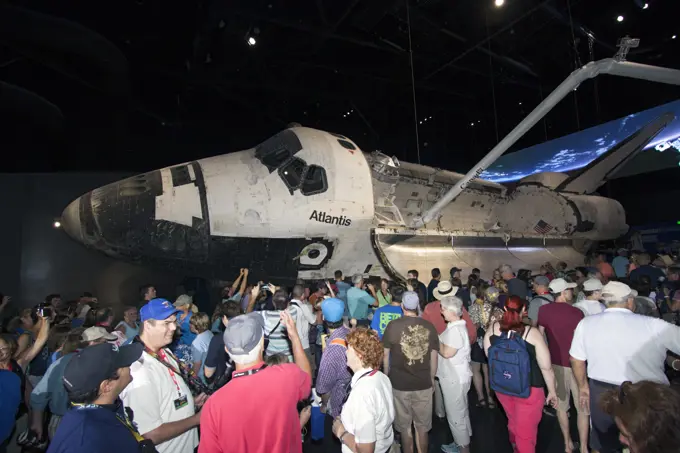
CAPE CANAVERAL, Fla. -- Inside the new "Space Shuttle Atlantis" facility at the Kennedy Space Center Visitor Complex in Florida, guests gather around the spacecraft on display with payload bay doors open and remote manipulator system robot arm extended.The new $100 million facility includes interactive exhibits that tell the story of the 30-year Space Shuttle Program and highlight the future of space exploration. The "Space Shuttle Atlantis" exhibit formally opened to the public on June 29, 2013.
6145-44965564
CAPE CANAVERAL, Fla. - Stephanie Abrams, a meteorologist with The Weather Channel, performs a live interview with Ed Mango, manager of NASA's Commercial Crew Program, or CCP, in front of the Atlantis display at the Kennedy Space Center Visitor Complex in Florida. Mango explained the program is working with the commercial aerospace industry to return America's domestic capability to launch astronauts from U.S. soil to the International Space Station around the middle of the decade. He also discussed the program's role in helping NASA reach its deep-space exploration goals.
6145-45214205
During a ribbon cutting ceremony on Aug. 16, 2019, in High Bay 2 of the Vehicle Assembly Building (VAB) at NASAs Kennedy Space Center in Florida, a scale model of the Northrop Grumman OmegA launch system is on display. The VAB is getting its first commercial tenant. Northrop Grumman signed a Reimbursable Space Act Agreement with NASA for use of the facilities. The company will assemble and test its new OmegA rocket inside the massive facilitys High Bay 2. The company also will modify mobile launcher platform-3 to serve as the launch vehicles assembly and launch platform. Northrop Grumman is developing the OmegA rocket, an intermediate/heavy-class launch vehicle, as part of a launch services agreement with the U.S. Air Force.
6145-45104201
In the Space Shuttle Atlantis exhibit facility at the Kennedy Space Center's Visitor Complex, a guest is briefed on work taking place in the Florida spaceport's Ground Systems Development and Operations Program. This followed a presentation by center director Bob Cabana who updated community leaders on current and future activities at the space center.
6145-45040163
CAPE CANAVERAL, Fla. -- In Orbiter Processing Facility-2 at NASA's Kennedy Space Center in Florida, Lord Stanleys Cup sits in the flight deck of space shuttle Atlantis. The Stanley Cup was awarded to the Boston Bruins after winning the 2011 National Hockey League (NHL) Championship. Jeremy Jacobs, chairman and chief executive officer of Delaware North Companies and owner of the Boston Bruins, brought the cup for Kennedy and Delaware North employees to view and take photographs of. The Stanley Cup is 34 1/4 inches tall, weighs 34 1/2 pounds and is more than 100 years old. Atlantis is being prepared for public display in 2013 at the Kennedy Space Center Visitor Complex.
PREVIOUS
of 3
NEXT
2401 S. Ervay, Suite 206
Dallas, Texas 75215
United States
Get Started
Free ResearchMy BoardsMy Cart
For Creators
How To License Your ContentContributor PortalFrame of Mind
Resources
API accessPricing
Contact
+1 866 236 0087help@viewpictures.co.uk Contact form
©2026 View Pictures. All Rights Reserved. -A
This site is protected by reCAPTCHA and Google Privacy Policy and Terms of Service apply.