My Boards
View Pictures
  • My Boards

Nuclear Test Site Equipment

Images of nuclear test site experiments and equipment, including structures and testing apparatus used at the Nevada Test Site.

(HWB) Hybrid Wing Body Aerodynamic Test in 14x2212.3 Foot Span HWB Model as tested in the 14x22 Foot Subsonic Tennel Aerodynamic Test
286 assets in this story
6145-44849655
ISS026-E-030086 (26 Feb. 2011) --- This view of the aft portion of the space shuttle Discovery, including the three main engines and orbital maneuvering system (OMS) pods, was provided by an Expedition 26 crew member during a survey of the approaching STS-133 vehicle prior to docking with the International Space Station. As part of the survey and part of every mission's activities, Discovery performed a back-flip for the rendezvous pitch maneuver (RPM). The image was photographed with a digital still camera, using a 400mm lens at a distance of about 600 feet (180 meters).
1525-25305570
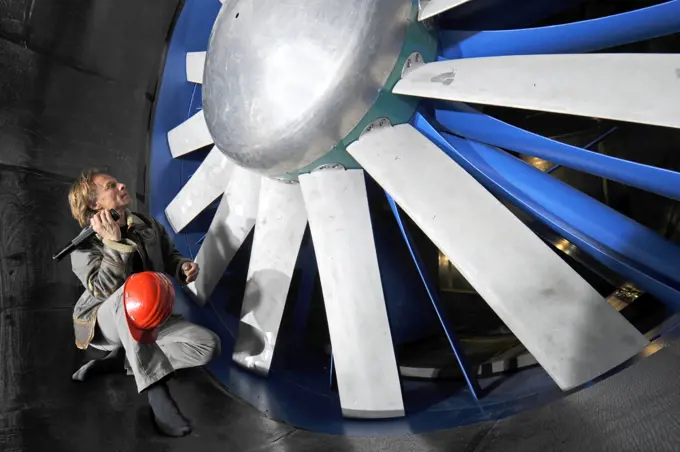
An engineer, with a hardtop on his knee and a flashlight in his hand, inspecting the huge rotor of an industrial windtunnel
6145-45116538
An integrated test of the MARCO POLO/Mars Pathfinder in-situ resource utilization, or ISRU, system takes place at NASAs Kennedy Space Center in Florida. A mockup of MARCO POLO, an ISRU propellant production technology demonstration simulated mission, is tested in a regolith bin with RASSOR 2.0, the Regolith Advanced Surface Systems Operations Robot. On the surface of Mars, mining robots like RASSOR will dig down into the regolith and take the material to a processing plant where usable elements such as hydrogen, oxygen and water can be extracted for life support systems. Regolith also shows promise for both construction and creating elements for rocket fuel.
6177-V53550759
6145-44889128
CAPE CANAVERAL, Fla. - In a test facility behind the Operations and Checkout Building at NASAs Kennedy Space Center in Florida, the prototype rover Artemis Jr. for NASAs Regolith and Environment Science and Oxygen and Lunar Volatile Extraction, or RESOLVE, project dismounts from the RESOLVE lander during a dry run using ramps attached to the prototype lander.RESOLVE consists of a rover and drill provided by the Canadian Space Agency to support a NASA payload that is designed to prospect for water, ice and other lunar resources. RESOLVE also will demonstrate how future explorers can take advantage of resources at potential landing sites by manufacturing oxygen from soil. NASA will conduct field tests in July outside of Hilo, Hawaii, with equipment and concept vehicles that demonstrate how explorers might prospect for resources and make their own oxygen for survival while on other planetary bodies.
6145-45242815
An experiment vehicle plunges into the deceleration pit at the end of a 5.18-second drop in the Zero-Gravity Research Facility at NASA's Glenn Research Center. The Zero-Gravity Research Facility was developed to support microgravity research and development programs that investigate various physical sciences, materials, fluid physics, and combustion and processing systems. Payloads up to 1 meter in diameter and 455 kg in weight can be accommodated. The facility has a 145-meter evacuated shaft to ensure a disturbance-free drop. This is No.1 of a sequence of 4 images. (
6145-58963491
JSC2011-E-029126 (25 March 2011) --- NASA astronauts Michael Fincke and Greg Chamitoff (partially obscured), both STS-134 mission specialists, attired in training versions of their Extravehicular Mobility Unit (EMU) spacesuits, are about to be submerged in the waters of the Neutral Buoyancy Laboratory (NBL) near NASA's Johnson Space Center. Divers are in the water to assist the Fincke and Chamitoff in their rehearsal, which intended to help prepare them for work on the exterior of the International Space Station.
6145-44519521
A piece of the fairing that will cover the Mars Odyssey Orbiter during is lifted up the gantry at Launch Pad 17-A, Cape Canaveral Air Force Station. The 2001 Mars Odyssey Orbiter is scheduled for launch on a Delta rocket April 7, 2001. Mars Odyssey contains three science instruments: THEMIS, the Gamma Ray Spectrometer (GRS), and the Mars Radiation Environment Experiment (MARIE). THEMIS will map the mineralogy and morphology of the Martian surface using a high-resolution camera and a thermal infrared imaging spectrometer. The GRS will achieve global mapping of the elemental composition of the surface and determine the abundance of hydrogen in the shallow subsurface. The MARIE will characterize aspects of the near-space radiation environment with regards to the radiation-related risk to human explorers
6145-48825016
undefined. 1972 - 2012. Department of Energy. National Nuclear Security Administration. Photographs Related to Nuclear Weapons Testing at the Nevada Test Site.
6145-44909320
This view of the American flag medallion on NASA's Mars rover Curiosity was taken by the rover's MAHLI camera during the 44th Martian sol on Sept. 19, 2012. The flag is one of four 'mobility logos' placed on the rover's mobility rocker arms.
6145-44830552
Interior view of the Space Station Processing Facility
6145-45070861
Earth Observation taken during a night pass by the Expedition 40 crew aboard the International Space Station (ISS). Folder lists this as New Zealand Aurora night pass. Docked Soyuz and Progress spacecraft also visible. On crewmember's Flickr site - The Moon, about to dive into a glowing ocean of green᥿9.
6145-50600213
A780345 AREA 17 ELEANA SHALE CARL O DUIMSTRA MAR 16 78 EG&G/NTS PHOTO LAB Publication Date: 3/16/1978  AREA 17; DUIMSTRA, CARL; EDGERTON, GERMESHAUSEN & GRIER; EG&G; ELEANA SHALE; EQUIPMENT & INSTRUMENTS; INSTRUMENTS & EQUIPMENT; NEVADA; NEVADA TEST SITE; NTS; NUCLEAR ENERGY TECHNOLOGY; NUCLEAR EXPLOSIONS; NUCLEAR TESTING; NUCLEAR TESTS; TEST SITES; TESTS; UGT; UNDERGROUND TESTING; WEAPON EFFECTS; WEAPONS RELATED; WEAPONS TECHNOLOGY; WIRE & CABLES; WIRING; AREA 17 - ELEANA SHALE  historical images. 1972 - 2012. Department of Energy. National Nuclear Security Administration. Photographs Related to Nuclear Weapons Testing at the Nevada Test Site.
6145-58966784
ISS028-E-015081 (10 July 2011) --- This is one of a series of images showing various parts of the space shuttle Atlantis in Earth orbit as photographed by one of the six crewmembers on the International Space Station as the shuttle posed for photo and visual surveys and performed a back-flip for the rendezvous pitch maneuver (RPM). An 800 millimeter lens was used to capture this particular series of images.
6177-V70815011
4128-V58570635
6145-45224827
iss061e027009 (Nov. 4, 2019) --- NASA astronauts (from left) Christina Koch, Jessica Meir and Andrew Morgan peer through the International Space Station's "window to the world," the cupola. The trio were on robotics duty monitoring the arrival and capture of the Cygnus space freighter from Northrop Grumman.
4377-368
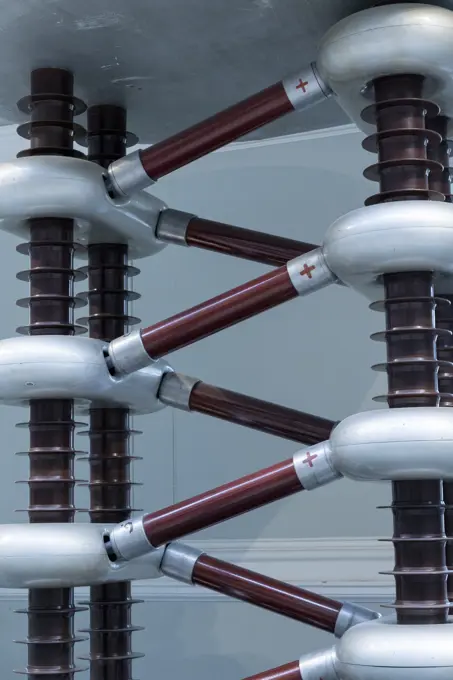
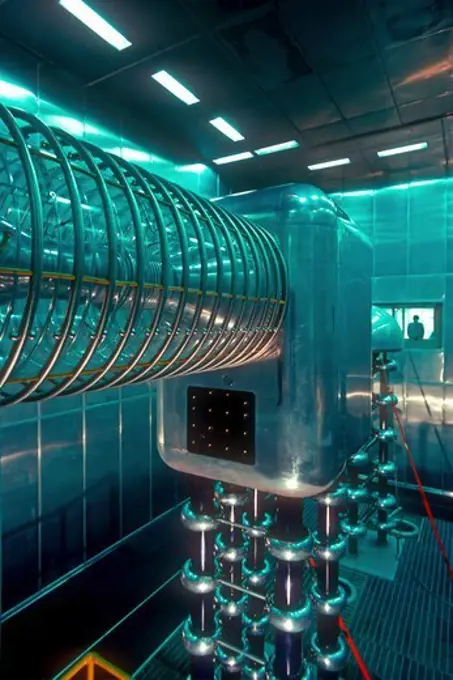
Interior View of the Cockroft-Walton Particle Accelerator
4368-126
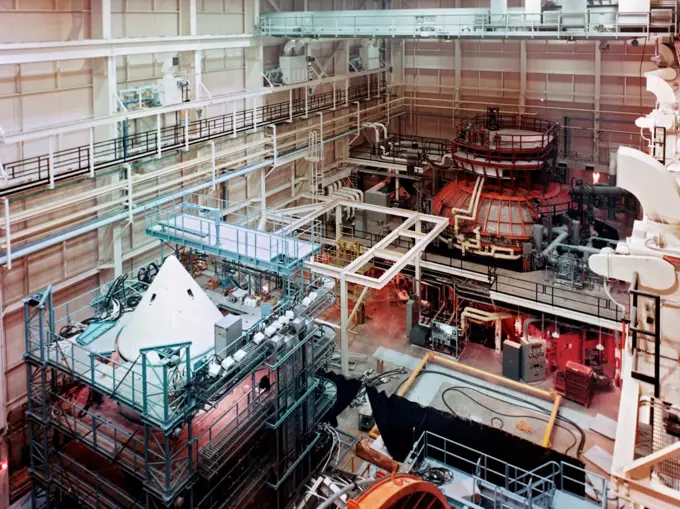
Vacuum chamber B inside the Space Environment Simulation Laboratory at the Manned Spacecraft Center, Houston, Texas. A scale model of the Apollo capsule awaits testing.
6145-44965162
VANDENBERG ABF, Calif. - A look through the inside of the fuselage of the Orbital Sciences L-1011 aircraft called "Stargazer" after arrival at Vandenberg Air Force Base for the upcoming launch of the company's Pegasus XL rocket lifting NASA's IRIS solar observatory into orbit. The aircraft will carry the winged rocket to an altitude of 39,000 feet before releasing the Pegasus so its own motors can ignite to send the IRIS into space. The L-1011 is a modified airliner equipped to hold the Pegasus under its body safely. IRIS, short for Interface Region Imaging Spectrograph, is being prepared for launch from Vandenberg June 26. IRIS will open a new window of discovery by tracing the flow of energy and plasma through the chromospheres and transition region into the suns corona using spectrometry and imaging. IRIS fills a crucial gap in our ability to advance studies of the sun-to-Earth connection by tracing the flow of energy and plasma through the foundation of the corona and the region a
6145-44619895
3% Space Shuttle Model Testing for Return to flight in the Ames 9X7ft wind tunnel test T97-0131 (IA-700B) with pressure sensitive paint
6145-45116536
An integrated test of the MARCO POLO/Mars Pathfinder in-situ resource utilization, or ISRU, system takes place at NASAs Kennedy Space Center in Florida. A mockup of MARCO POLO, an ISRU propellant production technology demonstration simulated mission, is tested in a regolith bin with RASSOR 2.0, the Regolith Advanced Surface Systems Operations Robot. On the surface of Mars, mining robots like RASSOR will dig down into the regolith and take the material to a processing plant where usable elements such as hydrogen, oxygen and water can be extracted for life support systems. Regolith also shows promise for both construction and creating elements for rocket fuel.
1746-29962064
Soyuz-4 and Soyuz 5 spacecraft docking - the world's first orbital docking of spacecraft's.
6145-44892524
CAPE CANAVERAL, Fla. - The NASA payload is installed on the prototype rover Artemis Jr. for NASAs Regolith and Environment Science and Oxygen and Lunar Volatile Extraction, or RESOLVE, project in a test facility behind the Operations and Checkout Building at NASAs Kennedy Space Center in Florida. The cylindrical structure at left is the drill.The drill and rover were provided to NASA by the Canadian Space Agency. The NASA payload is designed to prospect for water, ice and other lunar resources. RESOLVE also will demonstrate how future explorers can take advantage of resources at potential landing sites by manufacturing oxygen from soil. NASA will conduct field tests in July outside of Hilo, Hawaii, with equipment and concept vehicles that demonstrate how explorers might prospect for resources and make their own oxygen for survival while on other planetary bodies.
7125-70425421
Atomic particle accelerator. Cockcroft-Walton Generator. National Museum of Scotland. Edinburgh, Scotland.
6177-V54005552
6145-50594934
A830642 UE16B HEGF JERRY CUDERMAN (Project Engineer) APR 26 83EG&G/NTS PHOTO LAB Publication Date: 4/26/1983  CUDERMAN, JERRY; EDGERTON, GERMESHAUSEN & GRIER; EG&G; HEGF; HIGH ENERGY GAS FRAC; INSTRUMENTATION; INSTRUMENTS & EQUIPMENT; NEVADA; NEVADA TEST SITE; NTS; NUCLEAR ENERGY TECHNOLOGY; TEST SITES; TUBES; TUBES, TEST; TUNNELS; TUNNELS BY USAGE; UGT; UNDERGROUND TESTING  historical images. 1972 - 2012. Department of Energy. National Nuclear Security Administration. Photographs Related to Nuclear Weapons Testing at the Nevada Test Site.
6145-44703874
VANDENBERG AIR FORCE BASE, Calif.  -  In Building 1555, workers help guide a wing toward the Pegasus XL launch vehicle for a fit check.  The Pegasus will launch NASA's Interstellar Boundary Explorer Mission, or IBEX, satellite from Kwajalein Island in the Marshall Islands, South Pacific.  IBEX will make the first map of the boundary between the solar system and interstellar space.  IBEX is the first mission designed to detect the edge of the solar system. As the solar wind from the sun flows out beyond Pluto, it collides with the material between the stars, forming a shock front. IBEX contains two neutral atom imagers designed to detect particles from the termination shock at the boundary between the solar system and interstellar space. IBEX also will study galactic cosmic rays, energetic particles from beyond the solar system that pose a health and safety hazard for humans exploring beyond Earth orbit. IBEX will make these observations from a highly elliptical orbit that takes it beyo
1848-65025679
Astronomical observatory telescope indoor blue sky
6145-44717457
S71-2250X (June 1971) --- A close-up view of the Scientific Instrument Module (SIM) to be flown for the first time on the Apollo 15 lunar landing mission. Mounted in a previously vacant sector of the Apollo Service Module (SM), the SIM carries specialized cameras and instrumentation for gathering lunar orbit scientific data. SIM equipment includes a laser altimeter for accurate measurement of height above the lunar surface; a large-format panoramic camera for mapping, correlated with a metric camera and the laser altimeter for surface mapping; a gamma ray spectrometer on a 25-feet extendible boom; a mass spectrometer on a 21-feet extendible boom; X-ray and alpha particle spectrometers; and a subsatellite which will be injected into lunar orbit carrying a particle and magnetometer, and the S-Band transponder.
6177-V68162905
6145-45093623
This parachute testing for NASA's InSight mission to Mars was conducted inside the world's largest wind tunnel, at NASA Ames Research Center, Moffett Field, California, in February 2015.
6145-58968496
NASA GLENN/NASA LANGLEY LOADS COMPARISON TEST WITH 6 COMPONENT FORCE/MOMENT BALANCE AND 1.7% HIGH SPEED RESEARCH MODEL 5. in the 10x10 supersonic wind tunnel
6177-V53838602
6145-44965904
VANDENBERG AIR FORCE BASE, Calif. - Technicians and engineers at Vandenberg Air Force Base in California mate the Pegasus XL rocket with the Interface Region Imaging Spectrograph, or IRIS, solar observatory to the Orbital Sciences L-1011 carrier aircraft.Scheduled for launch from Vandenberg on June 26, 2013, IRIS will open a new window of discovery by tracing the flow of energy and plasma through the chromospheres and transition region into the suns corona using spectrometry and imaging. The IRIS mission will observe how solar material moves, gathers energy and heats up as it travels through a largely unexplored region of the solar atmosphere. The interface region, located between the sun's visible surface and upper atmosphere, is where most of the sun's ultraviolet emission is generated. These emissions impact the near-Earth space environment and Earth's climate.
6145-44997099
ISS038-E-029133 (12 Jan. 2014) --- The Ant Forage Habitat Facility is featured in this image photographed by an Expedition 38 crew member on the International Space Station. The study examines the behavior of ants by comparing groups living on Earth to those in space.
6145-45137907
A lightweight simulator version of NASA's Resource Prospector undergoes a mobility test in a regolith bin at the agency's Kennedy Space center in Florida. The Resource Prospector mission aims to be the first mining expedition on another world. Operating on the moons poles, the robot is designed to use instruments to locate elements at a lunar polar regions, then excavate and sample resources such as hydrogen, oxygen and water. These resources could support human explores on their way to destinations such as farther into the solar system.
6145-44474665
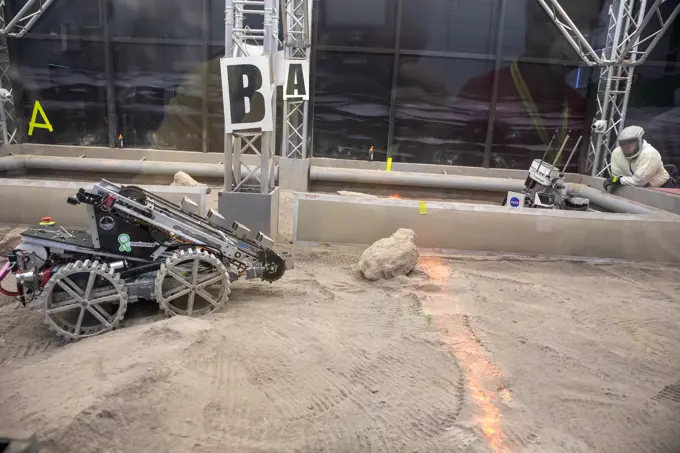
A robotic miner from Marquette University in Milwaukee, Wisconsin, prepares to dig in the mining arena during NASAs LUNABOTICS competition on May 27, 2022, at the Center for Space Education near the Kennedy Space Center Visitor Complex in Florida. More than 35 college and university teams from around the U.S. have designed and built remote-controlled robots for the mining competition. Teams use their autonomous or remote-controlled robots to maneuver and dig in a supersized sandbox filled with lunar simulant and rocks. The objective of the challenge is to see which teams robot can collect and deposit the most rocky regolith within a specified amount of time.
6145-44773633
In this view from behind a test rover at NASA's Jet Propulsion Laboratory, Pasadena, Calif., the rear wheels of the rover are turned toward the left, and the left-front wheel is turned toward the the right.
6145-45204726
Drew Smith, a robotics engineer, makes adjustments to the Regolith Advanced Surface Systems Operations Robot (RASSOR) during testing in the regolith bin inside Swamp Works at NASAs Kennedy Space Center in Florida on June 5, 2019. Smith and other members of the Granular Mechanics and Regolith Operations Lab run tests, which simulates the Moons reduced gravity using the gravity assist offload system to see how RASSOR excavates regolith. On the surface of the Moon, mining robots like RASSOR will excavate the regolith and take the material to a processing plant where usable elements such as hydrogen, oxygen and water can be extracted for life support systems. RASSOR can scoop up icy regolith which can be used to make operations on the Moon sustainable.
6177-V53648610
6177-V53607089
1848-56097151
An galaxy outlook telescope of the company Euroscope, Germany, Europe
1746-29962170
The descent module of the Soyuz-37 spacecraft.
6145-45245621
UNSTART PROGRAM - 10X10 FOOT SUPERSONIC WIND TUNNEL AS PART OF THE HIGH SPEED RESEARCH PROGRAM
6145-45299007
After the scoop on the end of NASA's Mars InSight lander was used to push down on the top of the spacecraft's mole, or self-hammering heat probe, it was held in place to essentially block the mole from popping out of the soil. The movement of sand grains in the scoop, seen here, suggested that the mole had began bumping up against the bottom of the scoop while hammering on June 20, 2020. Movie available at
1848-54541857
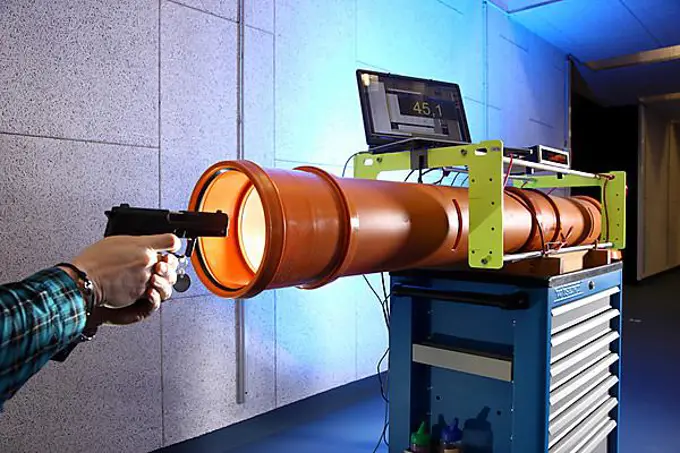
Kriminaltechnisches Institut, KTI, Forensic Science Institute, weapons department, air soft guns is being examined and the energy of the bullet calculated, police, Landeskriminalamt, LKA, State Criminal Police Office, North Rhine-Westphalia, Germany, Europe
6145-44689874
ISS016-E-007007 (30 Oct. 2007) --- A view of a damaged P6 4B solar array wing on the International Space Station. NASA halted the deployment -- which is about 80 percent complete -- to evaluate the damage.
6145-45057370
CAPE CANAVERAL, Fla. - Competition judges monitor the progress of a robot digging in the simulated Martian soil in the Caterpillar Mining Arena during NASAs 2014 Robotic Mining Competition at the Kennedy Space Center Visitor Complex in Florida. More than 35 teams from colleges and universities around the U.S. have designed and built remote-controlled robots for the mining competition. The competition is a NASA Human Exploration and Operations Mission Directorate project designed to engage and retain students in science, technology, engineering and mathematics, or STEM, fields by expanding opportunities for student research and design. Teams use their remote-controlled robotics to maneuver and dig in a supersized sandbox filled with a crushed material that has characteristics similar to Martian soil. The objective of the challenge is to see which teams robot can collect and move the most regolith within a specified amount of time.
6145-44707822
SOFIA (Stratospheric Observatory for Infrared Astronomy) primary mirror being coated in the Ames N-211 Vacuum Chamber.
1899-18984758
(KSC). A technician is working on the Advanced Automated Directional Solidification Furnace (AADSF), which will be used by researchers to study the solidification of semiconductor materials in microgravity. Scientists will be able to better understand how microgravity influences the solidification process of these materials and develop better methods for controlling that process during future Space flights and Earth-based production. All STS-87 experiments are scheduled for launch on Nov. 19 from KSC.
6145-44643527
Space Shuttle 3% scale model to analyze removal of PAL ramp and other effects i the 9x7ft w.t.
6145-45239767
Space Shuttle Orbitor Model (A-100) testing in the NASA Ames Research Center 40x80ft Subsonic Wind Tunnel
6145-44607002
Footage taken at the JPL In-Situ Instruments Laboratory, or 'testbed,' shows engineers practicing the deployment of the test rover's robotic arm.
6145-58969624
An Orion water drop test, with instrumented test dummies, takes place on May 11, 2016 at NASA's Langley Research Center in Virginia.
6145-44553943
Airbags and Sojourner Rover
6177-V53472070
6145-44681529
KENNEDY SPACE CENTER, FLA.  --  Inside the mobile service tower of Launch Pad 17-A at Cape Canaveral Air Force Station in Florida, the top of NASA's Phoenix Mars Lander can be seen after workers removed the container lid. Phoenix is scheduled to launch on the Delta II launch vehicle no earlier than Aug. 3. Phoenix will land in icy soils near the north polar permanent ice cap of Mars and explore the history of the water in these soils and any associated rocks, while monitoring polar climate. Landing on Mars is planned in May 2008 on arctic ground where a mission currently in orbit, Mars Odyssey, detected high concentrations of ice just beneath the top layer of soil. NASA/George Shelton
1570R-139166
A model built to scale of an explosion at a nuclear power plant
6145-45273570
iss062e102157 (3/18/2020) --- A view of the Gut on Chip CubeLab aboard the International Space Station (ISS). Organ-Chips as a Platform for Studying Effects of Space on Human Enteric Physiology (Gut on Chip) examines the effect of microgravity and other space-related stress factors on Emulates human innervated Intestine-Chip (hiIC).  Results could contribute to prevention methods and treatments for these effects, helping to protect astronaut health on future long-term missions.
6145-48824002
undefined. 1972 - 2012. Department of Energy. National Nuclear Security Administration. Photographs Related to Nuclear Weapons Testing at the Nevada Test Site.
6145-44741967
Marsokhod Russian Rover explores Kilauea, Hawaii via telepresence for Jason IV 'Island Earth' Projects (Volcano simulates Martian Terrain)
6145-45156859
iss055e001931 (Mar. 12, 2018) --- Dwarf wheat plants during routine cleaning in the Advanced Plant Habitat Facility, a facility to conduct plant bioscience research on the International Space Stations (ISS).
6145-44863234
CAPE CANAVERAL, Fla. -- University students prepare for NASA's second annual Lunabotics Mining Competition inside the "Lunarena" at the Kennedy Space Center Visitor Complex in Florida. Thirty-six teams of undergraduate and graduate students from the United States, Bangladesh, Canada, Colombia and India will participate in NASA's Lunabotics Mining Competition May 26 - 28 at the agency's Kennedy Space Center in Florida. The competition is designed to engage and retain students in science, technology, engineering and mathematics (STEM). Teams will maneuver their remote controlled or autonomous excavators, called lunabots, in about 60 tons of ultra-fine simulated lunar soil, called BP-1. The competition is an Exploration Systems Mission Directorate project managed by Kennedy's Education Division. The event also provides a competitive environment that could result in innovative ideas and solutions for NASA's future excavation of the moon.
6145-45232428
MARS BALLOON INFLATION TEST IN THE SPACE POWER FACILITY SPF AT NASA PLUM BROOK STATION
6177-V53550518
6145-44664700
ISS014-E-10058 (18 Dec. 2006) --- Astronaut Robert L. Curbeam Jr., STS-116 mission specialist, works with the port overhead solar array wing on the International Space Station's P6 truss during the mission's fourth session of extravehicular activity (EVA). European Space Agency (ESA) astronaut Christer Fuglesang (out of frame), mission specialist, worked in tandem with Curbeam, using specially prepared, tape-insulated tools, to guide the array wing neatly inside its blanket box during the 6-hour, 38-minute spacewalk.
6145-45055091
TRACT 2 Frame Drop Test AT NASA Langley Research Center's Landing and Impact Research (LandIR) Facility
6145-58972152
VANDENBERG AIR FORCE BASE, Calif. - In the Horizontal Processing Facility at Space Launch Complex 2 on Vandenberg Air Force Base in California, preparations are underway to install the engine bell around the second-stage nozzle of the Delta II rocket for NASA's Orbiting Carbon Observatory-2 mission, or OCO-2. OCO-2 is scheduled to launch aboard a United Launch Alliance Delta II rocket from Space Launch Complex 2 in July. The rocket's second stage will insert OCO-2 into a polar Earth orbit. OCO-2 will collect precise global measurements of carbon dioxide in the Earth's atmosphere and provide scientists with a better idea of the chemical compound's impacts on climate change. Scientists will analyze this data to improve our understanding of the natural processes and human activities that regulate the abundance and distribution of this important atmospheric gas.
6145-44574993
KENNEDY SPACE CENTER, FLA. -- The SPACEHAB Double module arrives at the payload changeout room at Launch Pad 39B before being transferred to Space Shuttle Discovery's payload bay for mission STS-96. Above it is the Integrated Cargo Carrier, which holds nonpressurized payloads such as a Russian crane, the Strela, and a U.S.-built crane. The second flight supporting construction of the International Space Station, STS-96 is a logistics and resupply mission, carrying more than 5,000 pounds of supplies, plus experiments such as STARSHINE, which was developed by and for students. The crew of seven are Commander Kent V. Rominger, Pilot Rick Douglas Husband, and Mission Specialists Ellen Ochoa (Ph.D.), Tamara E. Jernigan (Ph.D.), Daniel Barry (M.D., Ph.D.), Julie Payette, with the Canadian Space Agency, and Valery Ivanovich Tokarev, with the Russian Space Agency. Liftoff is scheduled for May 20 at 9:32 a.m. EDT
4351-498
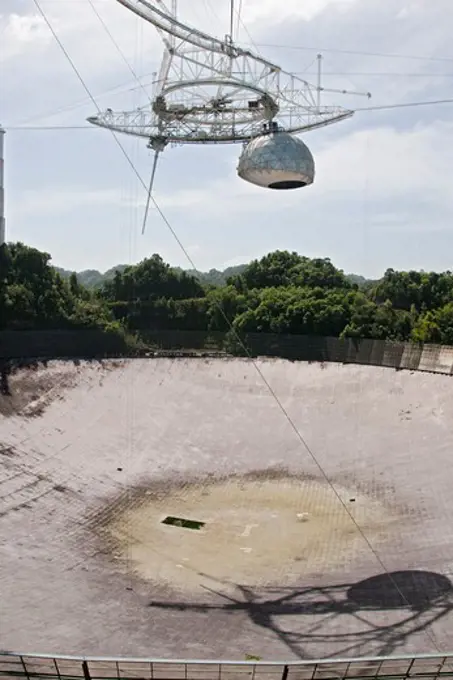
The Arecibo Observatory is a radio telescope just over 1,000 feet (305 m) across, the largest single radio telescope. The main metal collecting dish sits fixed a hemispherical karst sinkhole. Because it is fixed, a spherical reflector hangs 500 feet (150 m) over the dish on a 900 ton platform, known as 'the feed'. The observatory is the primary location of the National Astronomy and Ionosphere Center, NAIC.
6177-V53844175
6145-45257633
Engineers are engaged in the construction of a high gain antenna for one of the Voyager spacecraft in This archival photo taken on October 29, 1975.
6145-44861465
ISS027-E-032227 (18 May 2011) --- This partial view of the starboard wing of the space shuttle Endeavour was provided by an Expedition 27 crew member during a survey of the approaching STS-134 vehicle prior to docking with the International Space Station. As part of the survey and part of every mission's activities, Endeavour performed a back-flip for the rendezvous pitch maneuver (RPM). The image was photographed with a digital still camera, using a 400mm lens at a distance of about 600 feet (180 meters).
6145-44857455
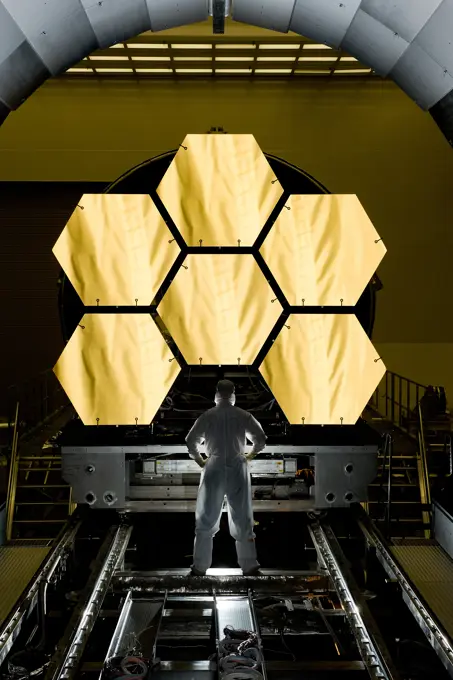
ERNIE WRIGHT STANDS NEAR THE JAMES WEBB SPACE TELESCOPE MIRRORS AS THEY SIT JUST OUTSIDE THE TESTING CHAMBER IN THE XRAY CALIBRATION FACILITY AT MSFC
6145-44808944
S94-33357 (1994) --- Scott Bleiseth, top, prepares to spin Mike Hess, a fellow EVA engineer, during a test on the air-bearing floor in the Shuttle Mock-up and Integration Laboratory at NASA's Johnson Space Center. The hardware being tested is part of the Simplified Aid for EVA Rescue (SAFER). The pair was developing techniques by which the non-SAFER equipped spacewalker will impart a rotation to the SAFER-using spacewalker during the STS-64 mission. Once the SAFER astronaut is spinning, the device will be activated and its automatic attitude hold capability will be tested. SAFER is to fly on STS-76 as well.
6188-65148296
Teleskop zur Sternenbeobachtung *** Telescope to Stargazing 1033902938
1801-64348209
eden project temperate bios with plant
6177-V53546588
1746-29968156
the Dog Belka, spent a day in space, on-board Korabl-Sputnik 2 (Sputnik 5), on 19 August 1960 before safely returning to Earth.
6176-62019114
The Bio Machine that requlates the five environments in the Biodome at the Olympic Park, Montreal, Quebec, Canada
6145-44728750
The Soyuz TMA-13 spacecraft arrives at the launch pad at the Baikonur Cosmodrome in Kazakhstan, Friday, Oct. 10, 2008.   The Soyuz is scheduled to launch to the International Space Station Oct. 12 with Expedition 18 Commander Michael Fincke, Flight Engineer Yuri V. Lonchakov and American spaceflight participant Richard Garriott.  The three crew members will dock their Soyuz to the International Space Station on Oct. 14.  Fincke and Lonchakov will spend six months on the station, while Garriott will return to Earth Oct. 24 with two of the Expedition 17 crew members currently on the International Space Station.
1746-28997677
Photograph taken of the NASA space research project involving a glider. Dated 20th Century
6145-44684610
KENNEDY SPACE CENTER, FLA. --  In the Space Station Processing Facility, or SSPF, at NASA's Kennedy Space Center, sections of the Special Purpose Dexterous Manipulator, known as Dextre, are lined up under cover.  In front of them is a poster that illustrates the assembled third and final component of the mobile servicing system on the International Space Station.  Dextre will work with the mobile base and Canadarm2 on the station to perform critical construction and maintenance tasks.  Dextre is part of the payload scheduled on mission STS-123, targeted to launch Feb. 14, 2008.
6145-44644602
ISS012-E-22884 (29 March 2006) --- A close-up view of signs on the Pressurized Mating Adapter-1 (PMA-1) hatchway photographed by an Expedition 12 crewmember on the International Space Station.
6145-44920110
ISS034-E-009706 (23 Dec. 2012) --- Ornaments adorn the Russian segment of the International Space Station in preparation for Christmas.  This scene is in the Zvezda module, but not too far away, on the NASA side of the outpost, stockings and other decorations were soon beingprepared for the holiday.
PREVIOUS
of 3
NEXT
2401 S. Ervay, Suite 206
Dallas, Texas 75215
United States
Get Started
Free ResearchMy BoardsMy Cart
For Creators
How To License Your ContentContributor PortalFrame of Mind
Resources
API accessPricing
Contact
+1 866 236 0087help@viewpictures.co.uk Contact form
©2026 View Pictures. All Rights Reserved. -A
This site is protected by reCAPTCHA and Google Privacy Policy and Terms of Service apply.