My Boards
View Pictures
  • My Boards
← Science

Planetary Spectacles of Jupiter and Saturn

Stunning images of Saturn and Jupiter captured by spacecraft, showcasing their striking atmospheres, rings, and features like the Great Red Spot.

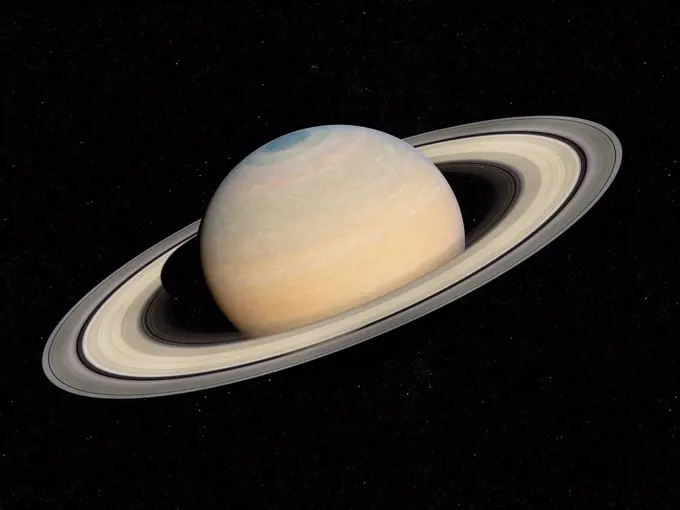
Illustration of Saturn
187 assets in this story
4128R-15582461
Illustration of Neptune
6145-44512975
This sequence of nine true-color, narrow-angle images shows the varying appearance of Jupiter as it rotated through more than a complete 360-degree turn. Image from NASA's Cassini spacecraft.
6145-45297710
Jupiter's volcanically active moon Io casts its shadow on the planet in this dramatic image from NASA's Juno spacecraft. As with solar eclipses on the Earth, within the dark circle racing across Jupiter's cloud tops one would witness a full solar eclipse as Io passes in front of the Sun. Such events occur frequently on Jupiter because it is a large planet with many moons. In addition, unlike most other planets in our solar system, Jupiter's axis is not highly tilted relative to its orbit, so the Sun never strays far from Jupiter's equatorial plane (+/- 3 degrees). This means Jupiter's moons regularly cast their shadows on the planet throughout its year. Juno's close proximity to Jupiter provides an exceptional fish-eye view, showing a small fraction near the planet's equator. The shadow is about 2,200 miles (3,600 kilometers) wide, approximately the same width as Io, but appears much larger relative to Jupiter. A little larger than Earth's Moon, Io is perhaps most famous for its many a
1574R-017999
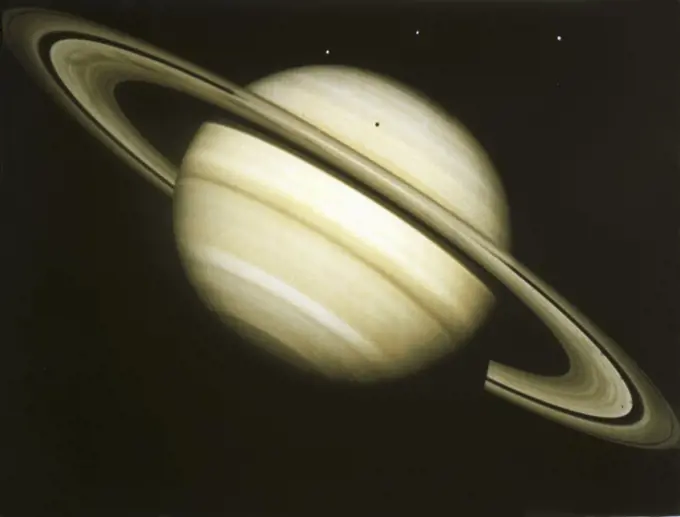
Saturn
4239-69143486
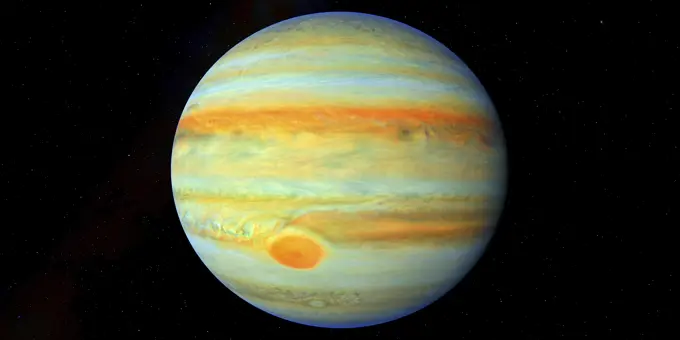
Artist's concept of planet Jupiter.
4048-10971
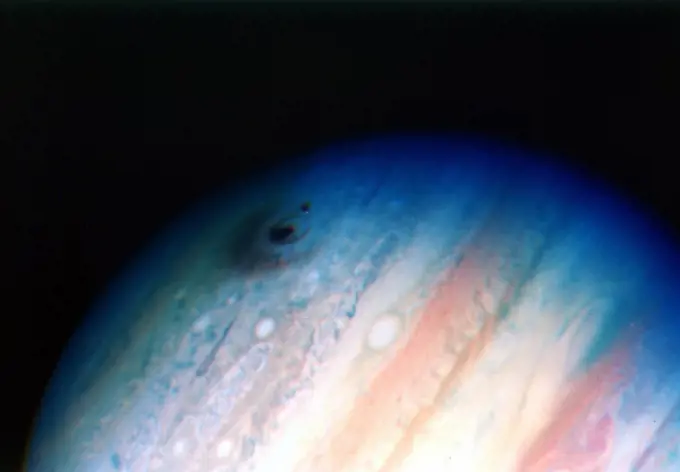
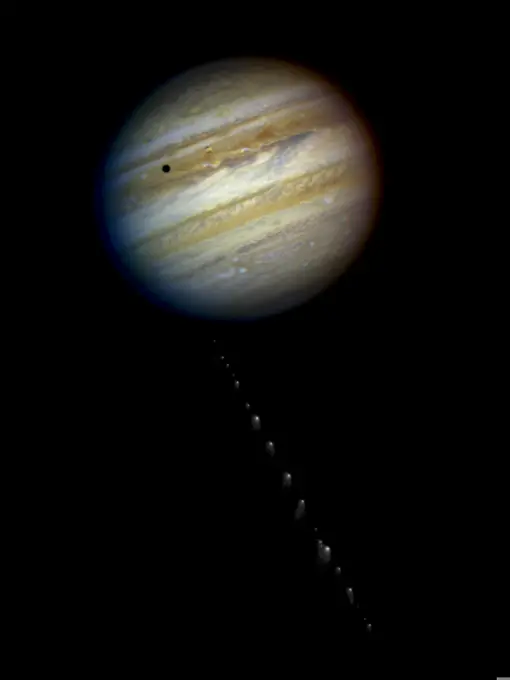
Comet P/Shoemaker-Levy 9 approaching Jupiter on May 17, 1994. The comet's train of 21 icy fragments stretched across 710 thousand miles.
1746-19631685
Comet Shoemaker-Levy, 1994. Impact with Jupiter 20 July 1994. NASA photograph.
6145-44955714
This is a composite photo, assembled from separate images of Jupiter and comet Shoemaker-Levy 9, as imaged by the NASA/ESA Hubble Space Telescope in 1994.
1746-19671607
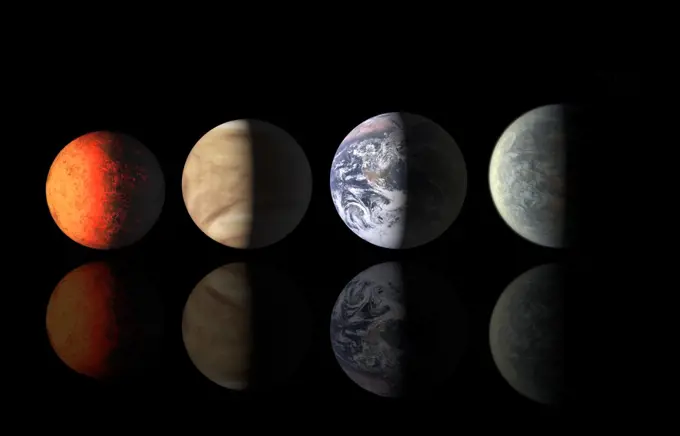
This chart compares the first Earth-size planets found around a sun-like star to planets in our own solar system, Earth and Venus. NASA's Kepler mission discovered the newfound planets, called Kepler-20e and Kepler-20f.
6145-44558368
This 'family portrait,' a composite of the Jovian system, includes the edge of Jupiter with its Great Red Spot, and Jupiter's four largest moons, known as the Galilean satellites. From top to bottom, the moons shown are Io, Europa, Ganymede and Callisto.
6145-44734540
Pioneer Venus Occp. Image 00204 Venus
4389-1087
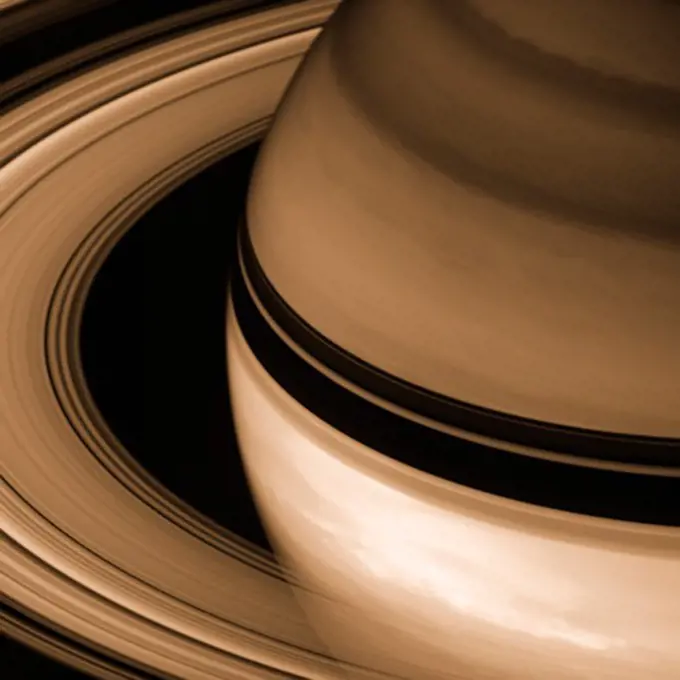
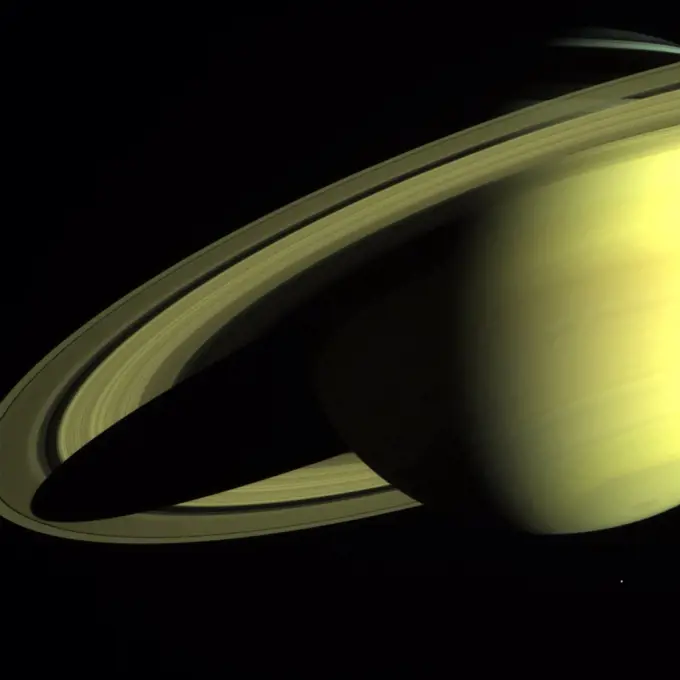
Saturn's Rings and Ring Shadows as Seen by Cassini
6145-44562317
Jupiter's Northern Hemisphere in True Color (Time Set 1)
4239R-20480143
Saturn
4239-69143473
Illustration of planet Saturn.
6145-45260154
This composite, false-color infrared image of Jupiter reveals haze particles over a range of altitudes, as seen in reflected sunlight. It was taken using the Gemini North Telescope's Near-InfraRed Imager (NIRI) on May 18, 2017, in collaboration with the investigation of Jupiter by NASA's Juno mission. Juno completed its sixth close approach to Jupiter a few hours after this observation. The multiple filters corresponding to each color used in the image cover wavelengths between 1.69 microns and 2.275 microns. Jupiter's Great Red Spot (GRS) appears as the brightest (white) region at these wavelengths, which are primarily sensitive to high-altitude clouds and hazes near and above the top of Jupiter's convective region. The GRS is one of the highest-altitude features in Jupiter's atmosphere. Narrow spiral streaks that appear to lead into it or out of it from surrounding regions probably represent atmospheric features being stretched by the intense winds within the GRS, such as the hook-li
6145-44546618
This view from NASA's Voyager 1 in 1979 is of the region just to the east of the Red Spot, seen in greatly exaggerated color.
6145-44546650
During August 16 and 17, 1989, the Voyager 2 narrow-angle camera was used to photograph Neptune almost continuously, recording approximately two and one-half rotations of the planet.
6145-44673522
The Cassini spacecraft gazes upward at the face of giant Saturn, seeing beyond the equator to where ring shadows fall across the bluish northern latitudes
1746-19671701
This color composite view combines violet, green, and infrared images of Jupiter's intriguing moon, Europa, for a view of the moon in enhanced color designed to bring out subtle color differences in the surface (right)
4128R-11288320
Jupiter, computer artwork.
6145-44786771
This image showcases the Saturnian system, beginning with the planet itself and panning out to its newest addition -- an enormous ring discovered in infrared light by NASA's Spitzer Space Telescope.
6145-45127469
NASA's Juno spacecraft soared directly over Jupiter's south pole when JunoCam acquired this image on February 2, 2017. This enhanced color version highlights the bright high clouds and numerous meandering oval storms.
6145-44912935
Jupiter has been suffering more impacts over the last four years than ever previously observed, including this meteoroid impact on Sept. 10, 2012. Right-hand image is an infrared image NASA's Infrared Telescope Facility on Mauna Kea, Hawaii.
4239R-8768
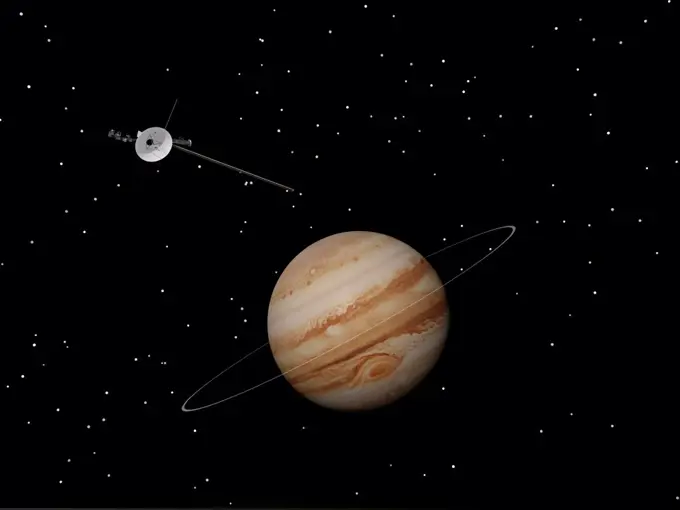
Voyager spacecraft near Jupiter and its unrecognized ring.
4409-21509397
Saturn and its ring; Jupiter and its belts, Henry Frères, Paul Henry, Prosper Henry, 22-apr-1886.
6145-44736753
Range 12.2 million kilometers (7.6 million miles) The view in this photo shows Jupiter's Great Red Spot emerging from the five-hour Jovian night. One of the three bright, oval clouds which were observed to form approximately 40 years ago can be seen immediately below the Red Spot. Most of the other features appearing in this view are too small to be seen clearly from Earth. The color picture was assembled from three black and white photos in the Image Processing Lab at JPL.
4128R-15582463
Illustration of Neptune
4128-V58567678
6145-45247175
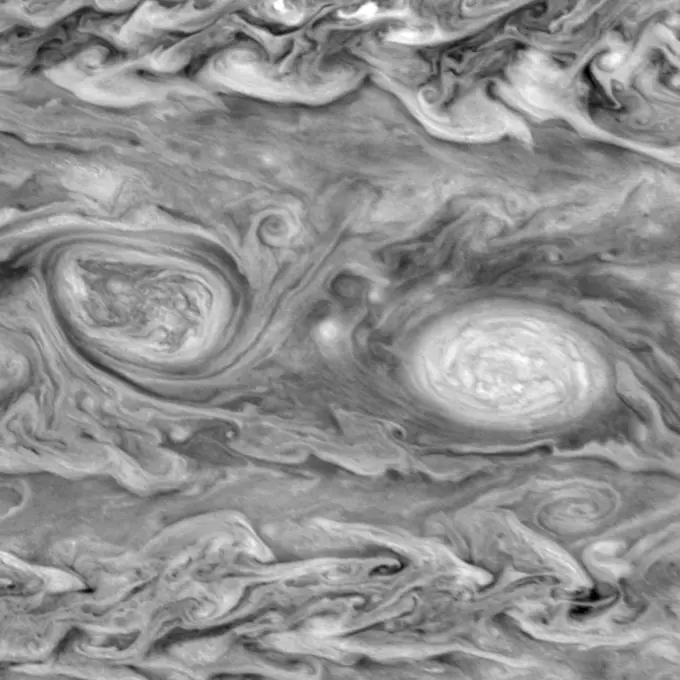
Two frame movie of a pair of vortices in Jupiter's southern hemisphere. The two frames are separated by ten hours. The right oval is rotating counterclockwise, like other anticyclonic bright vortices in Jupiter's atmosphere. The left vortex is a cyclonic (clockwise) vortex. The differences between them (their brightness, their symmetry, and their behavior) are clues to how Jupiter's atmosphere works. The frames span about fifteen degrees in latitude and longitude and are centered at 141 degrees west longitude and 36 degrees south planetocentric latitude. Both vortices are about 3500 kilometers in diameter in the north-south direction. The images were taken in near infrared light at 756 nanometers and show clouds that are at a pressure level of about 1 bar in Jupiter's atmosphere. North is at the top. The smallest resolved features are tens of kilometers in size. These images were taken on May 7, 1997, at a range of 1.5 million kilometers by the Solid State Imaging system on NASA's Gali
6145-45298239
Dramatic atmospheric features in Jupiter's northern hemisphere are captured in this view from NASA's Juno spacecraft. The new perspective shows swirling clouds that surround a circular feature within a jet stream region called Jet N6. This color-enhanced image was taken at 9 20 a.m. PST (12 20 p.m. EST) on Feb. 12, 2019, as the spacecraft performed its 18th close flyby of the gas giant planet. At the time, Juno was about 8,000 miles (13,000 kilometers) from the planet's cloud tops, above a latitude of approximately 55 degrees north.
6145-44734548
Photograph by Pioneer Venus Venus image 0693
6145-44566182
This image was returned by NASA's Voyager 2 spacecraft on July 3, 1989. The planet and its largest satellite, Triton, are captured in view; Triton appears in the lower right corner at about 5 o'clock relative to Neptune.
6145-44596189
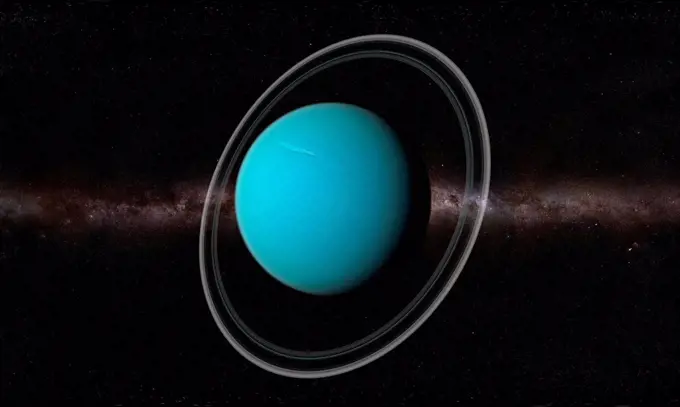
A recent Hubble Space Telescope (HST) view reveals Uranus surrounded by its 4 major rings and 10 of its 17 known satellites. This false color image was generated by Erich Karoschka using data taken with Hubble's Near Infrared Camera and Multi-Object Spectrometer. The HST recently found about 20 clouds. The colors in the image indicate altitude. The green and blue regions show where the atmosphere is clear and can be penetrated by sunlight. In yellow and grey regions, the sunlight reflects from a higher haze or cloud layer. The orange and red colors indicate very high clouds, such as cirrus clouds on Earth.
4128R-11284566
Uranus, computer artwork.
6145-44741742
This is a composite photo, assembled from separate images of Jupiter and Comet P/Shoemaker-Levy 9 as imaged by the Wide Field & Planetary Camera-2 (WFPC-2), aboard NASA's Hubble Space Telescope (HST). Jupiter was imaged on May 18, 1994, when the giant planet was at a distance of 420 million miles (670 million KM) from Earth. This 'true-color' picture was assembled from separate HST exposures in red, blue, and green light. Jupiter's rotation between exposures creates the blue and red fringe on either side of the disk. HST can resolve details in Jpiter's magnifient cloud belts and zones as small as 200 miles (320 km) across (wide field mode). This detailed view is only surpassed by images from spacecraft that have traveled to Jupiter. The dark spot on the disk of Jupiter is the shadow of the inner moon Io. This volcanic moon appears as an orange and yellow disk just to the upper right of the shadow. Though Io is approximately the size of Earth's Moon (but 2,000 times farther away), HST c
6145-44674287
Best Color Image of Jupiter's Little Red Spot
4128-V58574841
6145-44521636
Saturn's Atmospheric Changes
1746-19631726
Mosaic of Jupiter and its inner satelite lo. NASA photograph.
6145-44639901
Tethys floats before the massive, golden-hued globe of Saturn in this natural color view. The thin, dark line of the rings curves around the horizon at top
6145-44562285
These images, taken on February 19, 1997 by NASA's Galileo orbiter, show two of the three long-lived White Ovals that formed to the south of the Jupiter's Great Red Spot.
6145-44569326
Possible variations in chemical composition from one part of Saturn's ring system to another are visible in this archival image from NASA's Voyager 2.
6145-44616320
Saturn from Far and Near (Cassini-Huygens)
6145-44739926
This picture of Neptune was produced from images taken through the ultraviolet, violet and green filters of the Voyager 2 wide-angle camera. This 'false' color image has been made to show clearly details of the cloud structure and to paint clouds located at different altitudes with different colors. Dark, deeplying clouds tend to be masked in the ultraviolet wavelength since overlying air molecules are particularly effective in scattering sunlight there which brightens the sky above them. Such areas appear dark blue in this photo. The Great Dark Spot (GDS) and the high southern latitudes have a deep bluish cast in this image, indication they are regions where visible light (but not ultraviolet light) may penetrate to a deeper layer of dark cloud or haze in Neptune's atmosphere. Conversely, the pinkish clouds may be positioned at high altitudes.
6145-44549200
These Jupiter photographs are part of a set taken by NASA's Voyager 1 on December 10 and 11, 1978 from a distance of 83 million km (52 million miles) or more than half the distance from the Earth to the sun.
4128R-15536563
Illustration of Saturn
4128-24796282
Neptune with moons and atmosphere, illustration
6145-44562288
These images, taken on February 19, 1997 by NASA's Galileo orbiter, show two of the three long-lived White Ovals that formed to the south of the Jupiter's Great Red Spot.
6145-44561499
Jupiter's Equatorial Region in the Near-Infrared (Time Set 1)
6145-44618873
An infrared composite image of the two hemispheres of Uranus obtained with Keck Telescope adaptive optics.
6145-44497221
Hubble Views Ancient Storm in the Atmosphere of Jupiter - October, 1995
6145-44944231
The dark hot spot in this false-color image from NASA's Cassini spacecraft is a window deep into Jupiter's atmosphere. All around it are layers of higher clouds, with colors indicating which layer of the atmosphere the clouds are in.
4128R-15545557
Illustration of Uranus
6145-44734539
Pioneer Venus Occp. Image 00199 Venus
6145-44556289
The Great Red Spot (GRS) of Jupiter as seen by NASA's Galileo imaging system. The image is a mosaic of six images taken over an 80 second interval during the first GRS observing sequence on June 26, 1996.
6145-44516633
Polarized Light from Jupiter
6145-44869211
These false-color images from NASA's Cassini spacecraft chronicle a day in the life of a huge storm that developed from a small spot that appeared 12 weeks earlier in Saturn's northern mid-latitudes.
1916-111271075
An all-sky aurora from Churchill, Manitoba, on Feb 17, 2015, in a frame from a 250-frame time-lapse movie. Taken from the Churchill Northern Studies Centre, using an 8mm Sigma  fish-eye lens on the Canon 6D for a 360° view of the sky, though with the camera titled about 25° to create an image suitable for projection in a tilted-dome digital planetarium. This a  15-second exposure at ISO 3200 and f/3.5. The temperature was about -30° C.
6145-44562297
These images, taken on February 19, 1997 by NASA's Galileo orbiter, show two of the three long-lived White Ovals that formed to the south of the Jupiter's Great Red Spot.
4128-28968464
Uranus, illustration
6145-44562299
These images, taken on February 19, 1997 by NASA's Galileo orbiter, show two of the three long-lived White Ovals that formed to the south of the Jupiter's Great Red Spot.
4239R-568
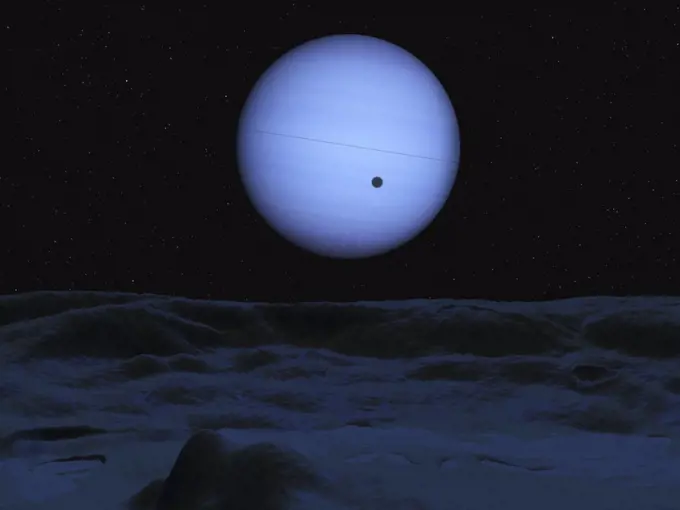
A full Neptune washes Triton's frozen surface with an indigo light, the only source of illumination on this now Triton's dark side
6145-45098445
This illustration based on data from NASA's Cassini spacecraft is of the interior of Saturn's moon Enceladus showing a global liquid water ocean between its rocky core and icy crust.
6145-44563576
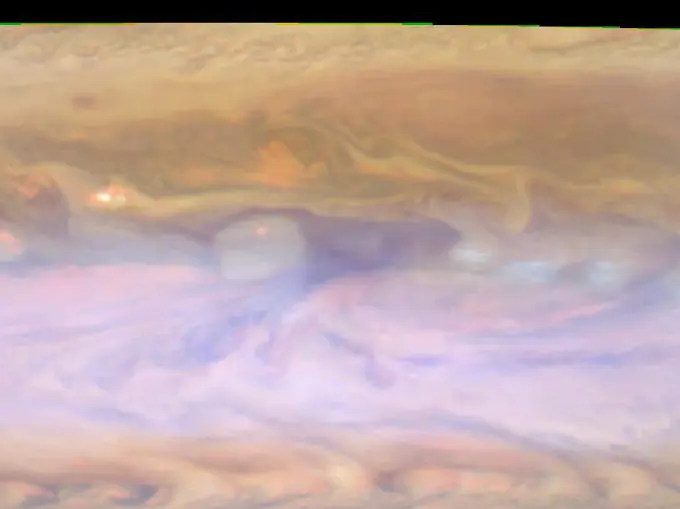
Hubble Views the Galileo Probe Entry Site on Jupiter
1848-64915228
Man with telescope looking at the stars. Saturn planet, isolated on black. Elements of this image are furnished by NASA
4128-V58558640
227-465
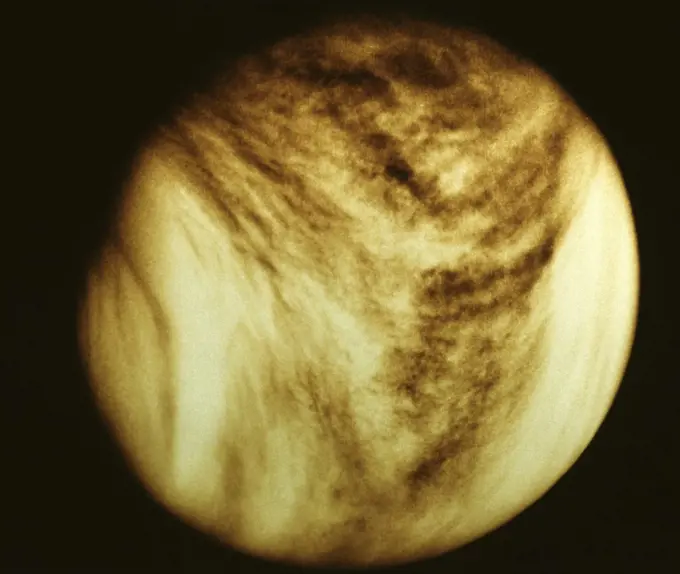
Venus taken by the Pioneer Venus Orbiter (3/3/79) Was taken from 40,920 miles away
6145-44799536
Saturn's moon Tethys with its prominent Odysseus Crater silently slips behind Saturn's largest moon Titan and then emerges on the other side in this image taken by NASA's Cassini spacecraft.
6145-45264894
A long, brown oval known as a brown barge in Jupiter's North North Equatorial Belt is captured in this color-enhanced image from NASA's Juno spacecraft. This image was taken at 6 01 p.m. PDT (9 01 p.m. EDT) on Sept. 6, 2018, as the spacecraft performed its 15th close flyby of Jupiter. Citizen scientist Kevin M. Gill created this image using data from the spacecraft's JunoCam imager.
6145-44740397
Range 1.7 million miles This photo of Venus was taken by the Galileo spacecraft's Solid State Imaging System. A high-pass spatial filter has been applied in order to emphasize the smaller-scale cloud features, and the rendition has been colorized to a bluish hue in order to emphasize the subtle contrasts in the cloud markings and to indicate how it was taken through a violet filter. The sulfuric acid clouds indicate considerable convective activity, in the equatorial regions of the planet to the left and downwind of the subsolar point (afternoon on Venus), They are analogous to 'fair weather clouds' on Earth. The filamentary dark features visible in the colorized image are here revealed to be composed of several dark nodules, like strings on a bead, each about 60 miles across.
6145-44493517
This illustration shows Saturn's icy moon Enceladus with the plume of ice particles, water vapor and organic molecules that sprays from fractures in the moon's south polar region. A cutaway version of this graphic is also available, showing the moon's interior ocean and hydrothermal activity  both of which were discovered by NASA's Cassini mission (see PIA20013). This global view was created using a Cassini-derived map of Enceladus (see PIA18435).
4353-298
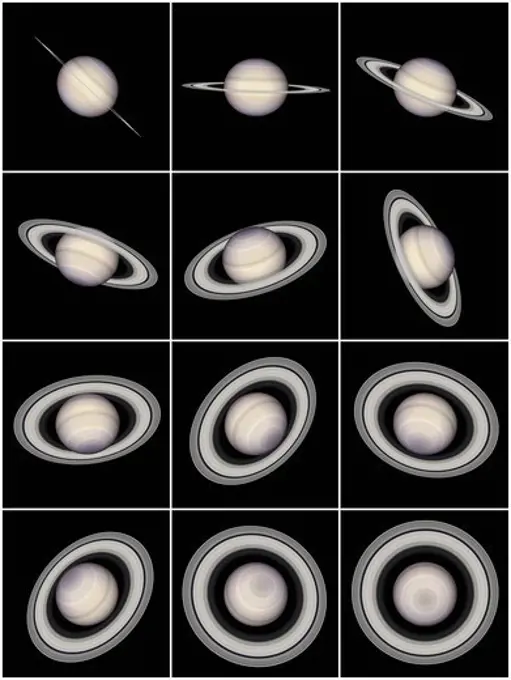
Digital Illustration of Saturn's Appearance From Different Angles
6145-44880546
Following the path of one of Jupiter's jet streams, a line of v-shaped chevrons travels west to east just above Jupiter's Great Red Spot as seen by NASA's Cassini spacecraft.
6145-44736728
Range 4.3 million km. ( 2.7 million miles ) This photograph taken from Voyager I, shows the area east of the Great Red Spot. The dark halo surrounding the bright spot, just to the right of the bright oval, is said by scientists to be, almost certainly, a five micron hot spot. This is a region of the atmosphere warmer than those around it. The dark halo may represent an area in which we are looking deeper into Jupiter's Atmosphere, although not yet completely understood.
4353-131
Chicken's Egg Suspended Above Woman's Belly
6145-44540723
This is an image of the planet Uranus taken by the spacecraft Voyager 2 in 1986.
6145-44736434
Photograph by Pioneer Venus OCPP imagery 0900 collected 5-14-88 10th anniversary release Venus image 7540
5507-49069199
Realistic image of different planets Moon, Neptune, Pluto, Saturn, Uranus, Venus on a transparent background. Planets isolated on transparent background in PNG format, space elements
6145-44917625
Inspired by data from NASA's Cassini mission, this artist's impression of Saturn's moon Titan shows the change in observed atmospheric effects before, during and after equinox in 2009.
1746-28998701
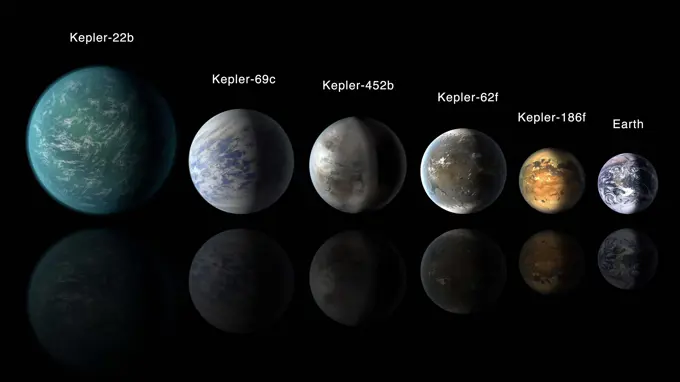
Exoplanets shown in comparison to the size of the earth. An exoplanet (or extra solar planet), is a planet that orbits a star other than the Sun. The first scientific detection of an exoplanet was in 1988. The first confirmed detection came in 1992; since then, and as of 1 February 2017, there have been 3,572 exoplanets in 2,682 planetary systems and 602 multiple planetary systems confirmed
6145-45299531
During its 33rd low pass over the cloud tops of Jupiter on April 15, 2021, NASA's Juno spacecraft captured the intriguing evolution of a feature in the giant planet's atmosphere known as Clyde's Spot. The feature is informally named for amateur astronomer Clyde Foster of Centurion, South Africa, who discovered it in 2020 using his own 14-inch telescope. On June 2, 2020, just two days after Foster's initial discovery, Juno provided detailed observations of Clyde's Spot (upper image), which scientists determined was a plume of cloud material erupting above the top layers of the Jovian atmosphere just southeast of Jupiter's Great Red Spot, which is currently about 1.3 times as wide as Earth. These powerful convective outbreaks occasionally occur in this latitude band, known as the South Temperate Belt. The initial plume subsided quickly, and within a few weeks it was seen as a dark spot. Many features in Jupiter's highly dynamic atmosphere are short lived, but the April 2021 observation f
1848-51143086
Planet Saturn. Solar system. Cosmos art. Elements of this image furnished by NASA
5507-49069203
Realistic image of blue planet Neptune on a transparent background. Planet Neptune isolated on transparent background in PNG format, space elements, astronomy concept.
1525-27110530
Rainbow soap bubble on a dark background. Close-up of a bubble. Rainbow soap bubble on a dark background.
6145-44736732
Range 4.3 million km. ( 2.7 million miles ) This photograph taken from Voyager I shows Jupiter's Great Red Spot and one of the white ovals seen from Earth . These white ovals were seen to have formed in 1939 & 1940, and have remained somewhat consistant since. The Great Red Spot is three times the size of the Earth. This photograph represents the finnest detail seen to date, with the smallest details being 80 km. ( 45 miles ) across.
4285-18123
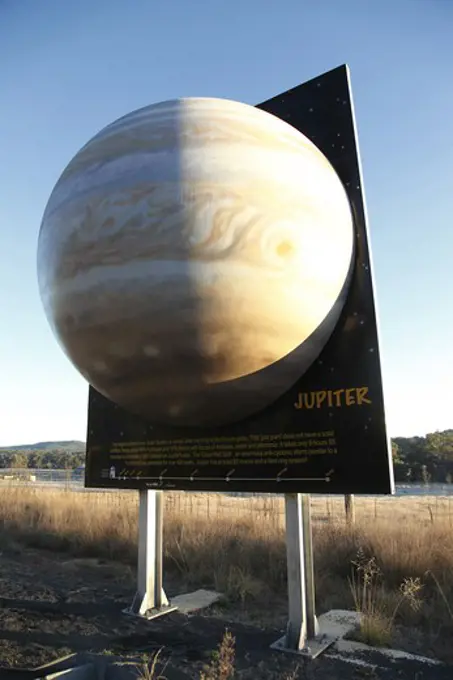
Australia, New South Wales, Coonabarabran, Virtual Solar System, Model of the Planet Neptune
PREVIOUS
of 2
NEXT
2401 S. Ervay, Suite 206
Dallas, Texas 75215
United States
Get Started
Free ResearchMy BoardsMy Cart
For Creators
How To License Your ContentContributor PortalFrame of Mind
Resources
API accessPricing
Contact
+1 866 236 0087help@viewpictures.co.uk Contact form
©2026 View Pictures. All Rights Reserved. -A
This site is protected by reCAPTCHA and Google Privacy Policy and Terms of Service apply.