Refined Lace Details

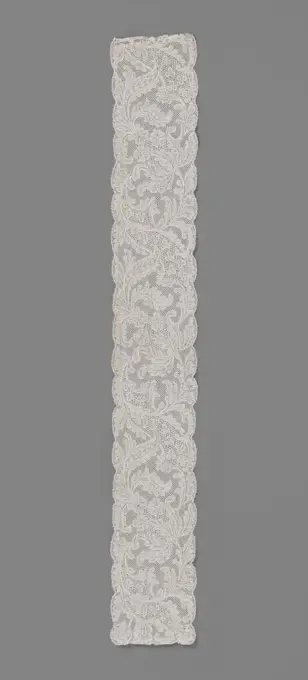
Exquisite lace items featuring intricate designs of flora and fauna, highlighting needlework techniques from 17th to 18th century Europe.

Trimming, Medium: flat strips of gold metallic foil, gold metallic foil wound onto yellow silk Technique: bobbin lace, metallic, Metallic gold lace in repeated zigzag pattern set in bands and alternating with narrow stripes., Europe, 18th century, lace, Trimming
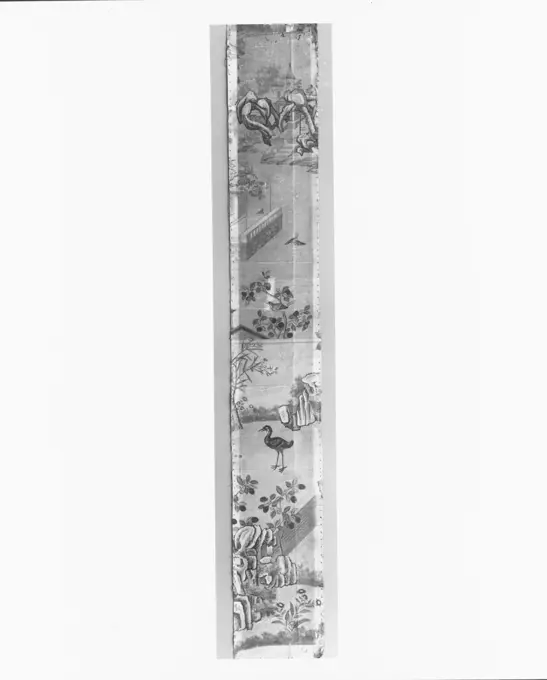
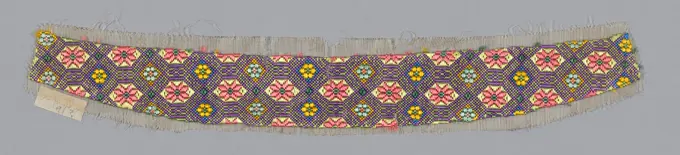
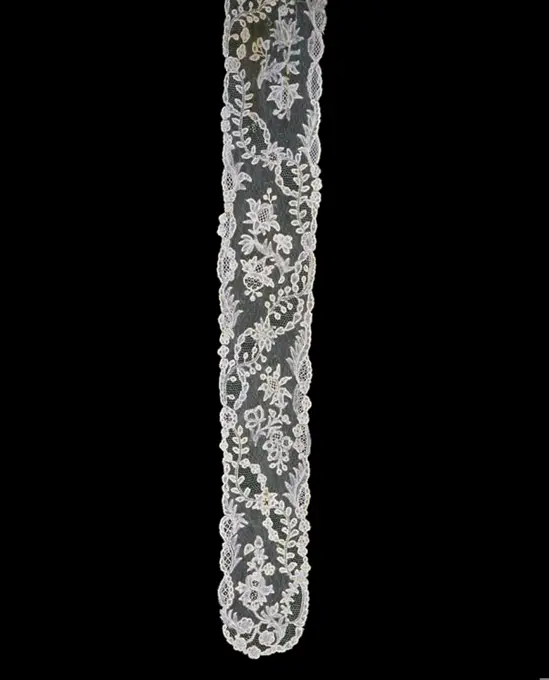
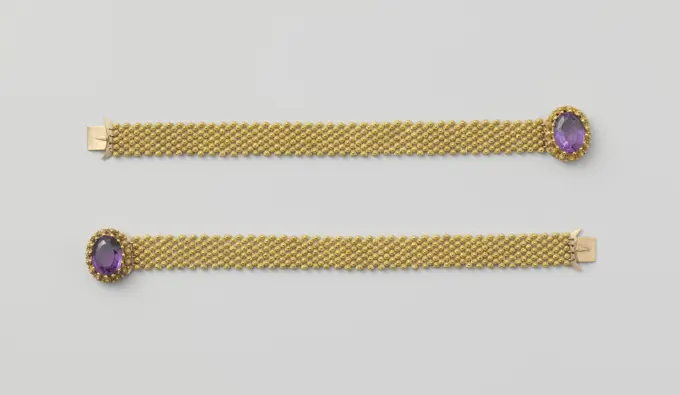
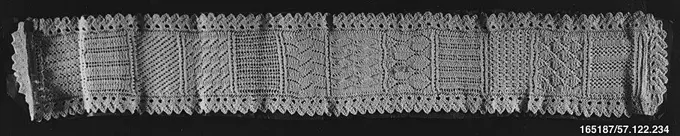
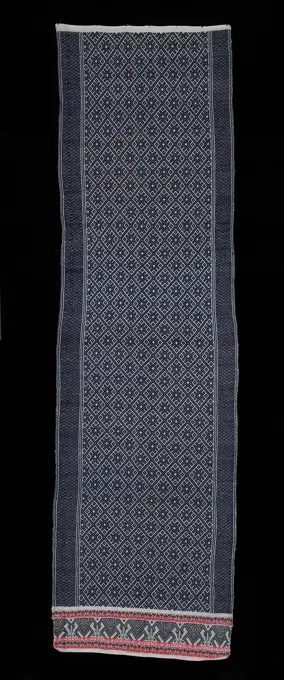
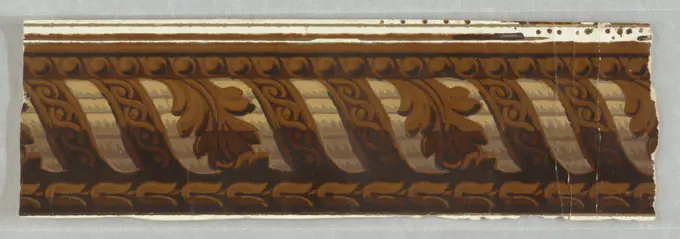
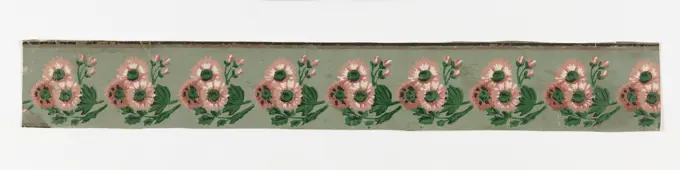
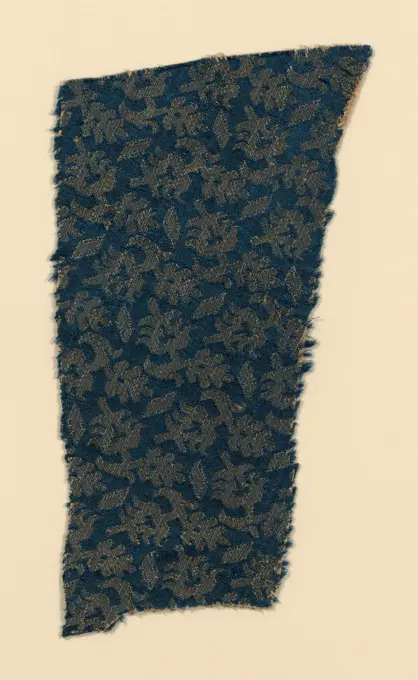
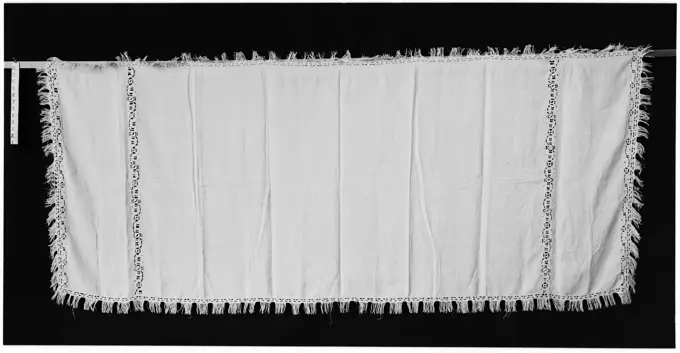
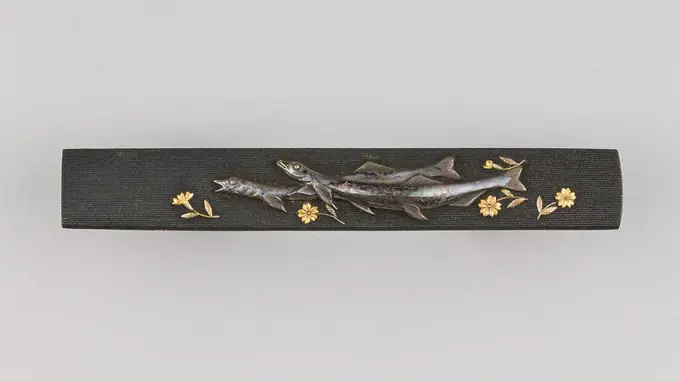
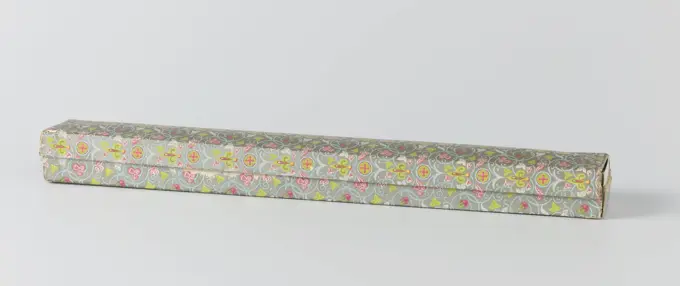
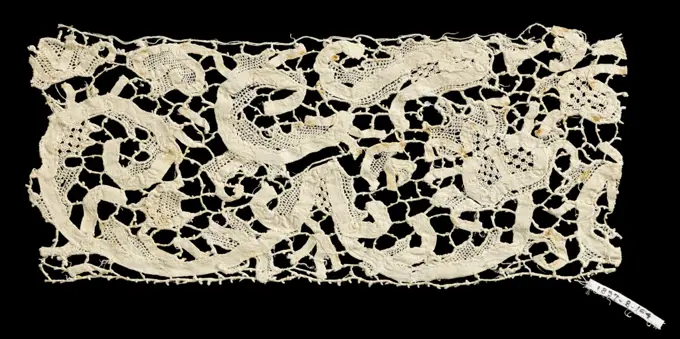
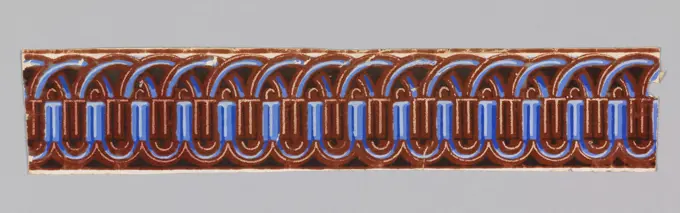
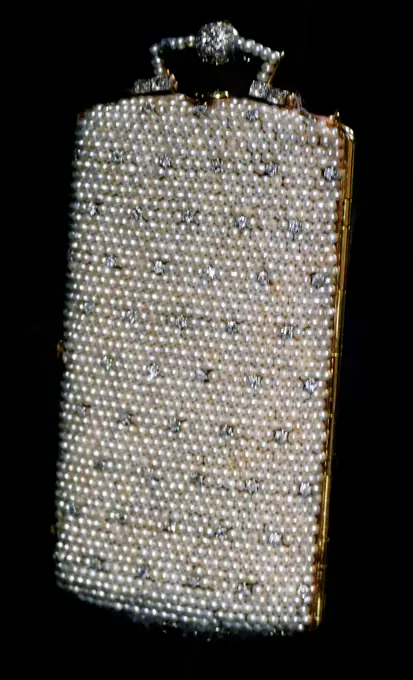
Border, Technique: bobbin lace, Bobbin lace border, floral scroll; early 19th century Maline, early 19th century, lace, BorderBobbin Lace Insertion, 17th century. Italy, 17th century. Lace, bobbin; average: 11.5 x 77.5 cm (4 1/2 x 30 1/2 in.).Silk brokaat ribbon; A repeating pattern has been applied to a white surface that consists of two stylized motifs in silver and gold separated by a pink bar, anonymous, c. 1700 - c. 1715 Silk brokaat ribbon. A repeating pattern has been applied to a white surface that consists of two stylized motifs in silver, gold and pink. The edges are trimmed with decorative band. West-Europa whole: Silk. brocade (textile) Silk brokaat ribbon. A repeating pattern has been applied to a white surface that consists of two stylized motifs in silver, gold and pink. The edges are trimmed with decorative band. West-Europa whole: Silk. brocade (textile)Wallpaper Panel 1700-1730 This wallpaper panel is part of a set originally consisting of seventeen pieces (see 14.106.1-.16 for set.). The panels depict mountain landscapes, scenes with houses, birds, and flowering shrubs. They were hand-painted in China during the early eighteenth century for export to England. There, as in America, such exotic wallpaper enjoyed a vogue among the fashionable gentry. Considered a great luxury, it added richness and colors to walls. This wallpaper hung in an English home for two hundred years. The panels are installed, in whole or in part, in the Powel Room in The American Wing.. Wallpaper Panel 9657Gimp 18th century Italian. Gimp 213734Piece 18th century () European. Piece 225081Fragment (Dress Fabric) Made 1875-1900 China. embroidered on silk . Han-ChinesePair of Lappets (Joined) Made 1765-1775 Flanders. Linen, bobbin part lace of a type known as Brussels with a Droschel mesh ground .Strikdas for a lady of batist with plumetis embroidery and with a bet and an edge of machine valenciennes side, anonymous, c. 1875 - c. 1899 Strikdas for a lady of natural-colored batist with plumetis embroidery and with a bet and an edge of machine Valenciennes side. The embroidery consists of a wavy branch with flowers and ivy leaves. The intermediate facility and the scalloped edge are made of mechanical Valenciennes side with a row of five-leaf flowers. West-Europa cotton (textile). batiste embroidering Strikdas for a lady of natural-colored batist with plumetis embroidery and with a bet and an edge of machine Valenciennes side. The embroidery consists of a wavy branch with flowers and ivy leaves. The intermediate facility and the scalloped edge are made of mechanical Valenciennes side with a row of five-leaf flowers. West-Europa cotton (textile). batiste embroideringGold and Amethist bracelet, Jean Baptiste Bonnard, c. 1824 - c. 1829 Bracelet of gold and amethyst. The stones are surrounded and connected to golden rosettes. Amsterdam gold (metal). amethyst (mineral) Bracelet of gold and amethyst. The stones are surrounded and connected to golden rosettes. Amsterdam gold (metal). amethyst (mineral)Cap streamer, Medium: linen Technique: bobbin lace, Brussels style, Cap streamer with a design of a serpentine garland and floral sprays., Belgium, mid-18th century, lace, Cap streamerSampler 19th century German. Sampler 228161Hats slips from Valenciennes side, sewn, anonymous, c. 1800 - c. 1825 Hats slips from Valenciennes side, sewn. The barbes have round ends, are completely sculpted and fell with picots. The decoration consists of strips of connected rosettes; In the middle such a strip and along the edge. West-Europa linen (material) Valenciennes lace Hats slips from Valenciennes side, sewn. The barbes have round ends, are completely sculpted and fell with picots. The decoration consists of strips of connected rosettes; In the middle such a strip and along the edge. West-Europa linen (material) Valenciennes laceBobbin Lace (Needlepoint Design) Insertion, 17th century. Italy, Genoa, 17th century. Lace, bobbin; average: 5.1 x 42.3 cm (2 x 16 5/8 in.).Fragment (France); linen bobbin laceCeremonial blanket, 82 x 23 1/2 in. (208.28 x 59.69 cm), Cotton, LaosBand, Medium: linen Technique: needle lace with ground of loop & twist with twist return, Burano, Italy, 19th century, lace, BandFringe (France); silkFichu of needle side with stripped twigs and rose buds, anonymous, c. 1900 Fichu of natural-colored needle side: Burano side. Triangular model. The triangular midfield has thrown twigs with rose buttons and is enclosed by a pearl list. A wide edge runs around midfield with a zigzag pattern of a leaf garland. This pendulum forms from the sharp corners, towards midfield, a diamond shape and two in size increasing pent corners. Turned Feston stitches form the square Maas soil in midfield, the wide edge has been worked separately with a striking focus on Maza nuts. The motifs are made with feston stitches and two types of open decorative stitches. The relief contours are filled and fested. Finished on all sides with a richly decorated edge of arches and leaves. BURANO silk Fichu of natural-colored needle side: Burano side. Triangular model. The triangular midfield has thrown twigs with rose buttons and is enclosed by a pearl list. A wide edge runs around midfield with a zigzag pattern of aBobbin Lace Insertion, mid 16th century. Italy, Venice, mid 16th century. Lace, bobbin; average: 9.9 x 33.1 cm (3 7/8 x 13 1/16 in.).Trimming (Spain); silk, metallic threadNeedlepoint Lace Lappet, 1715-1774. France, Alençon, 18th century (Louis XV Period, 1715-1774). Lace, needlepoint: linen; average: 117.5 x 10.5 cm (46 1/4 x 4 1/8 in.).Trimming, Medium: silk Technique: woven, Yellow trimming fragment in a design of crosses alternating with lozenges between borders in a chevron pattern; picot edges., France, 19th century, trimmings, TrimmingBand or Border (from Woman's Garment) Made 1875-1900 China. .Trimming, Medium: silk Technique: cut and uncut supplementary warp pile in a satin foundation (velvet), Yellow trimming fragment in a design of a scrolling stem with acorns., France, 19th century, trimmings, TrimmingEdging (Italy); linenGalloon Made 1601-1800 Italy. silk .Border, Medium: Technique: bobbin lace, Bobbin lace border, blossom repeat; early 19th century Maline., early 19th century, lace, BorderGlass Fragment British 19th century View more. Glass Fragment. British. 19th century. Glass. Glass-StainedPiece 18th-19th century Japan. Piece 66828Galloon 18th century French or Italian. Galloon 214054Cap streamer, Medium: linen Technique: bobbin lace, Brussels style, Brussels-style cap streamer in pattern showing naturalistic flowers in compartments., Belgium, 18th century, lace, Cap streamerWhite realistic hang blank fabric horizontal canvas banner sign vector on rope for advertising. 3d empty textile material poster mockup set isolated on transparent background. Hanging cloth signboard. White hang blank fabric canvas banner sign vectorBorder, Medium: silk (cat card 1964) Technique: bobbin lace made in Lille style with heavy outlining thread, Border in a Lille-style pattern., Spain, late 18th century, lace, BorderBorder 16th-17th century Italian. Border 217770Piece 18th century Japan. Piece 71216Panel 6th-8th century. Panel 452200Belt -Border, Block-printed and flocked, Wide central band of fluted rod and ribbon twist. Acanthus leaves also wrap around the rod at intervals. Narrow band of beading above. Band of husk or bellfower along bottom edge a) printed in brown flock and shades of tan; b) printed in green flock and shades of tan., England, ca. 1860, Wallcoverings, BorderTrimming, Medium: silk Technique: woven, Pink and yellow trimming fragment in a design of a central band with four-petal flowers separated by curving lines and between broken borders., France, 19th century, trimmings, TrimmingBorder; linenPiece 17th century Japan. Piece 71045Border (France); block-printed on handmade paper; 52.5 x 7.5 cm (20 11/16 x 2 15/16 in.)Strook naaldkant met druiventakken.Strip natural-colored coniferous lace: Alençon side. Scattering pattern of trilature sprigs and grape branches on a fine hexagonal maas soil. The grape branches, with two leaves on either side, lie slanted side by side. A concatenation of picoted circles forms a regular archery that winds along the branches, this is also the finish on the bottom of the strip. The top is trimmed with a border clamping side.Trimming (Spain); silk, metallic; 1899-11-1Strip 18th century Italian. Strip. Italian. 18th century. Bobbin lace. Textiles-LacesLace, 1700s, maker unknown. Gift of Mrs G. Acland Allen, 1955.Panel of the coffin of Djehuty-hotep, left side, part of uppersectionFragment gestreept zijdeweefsel.Fragment striped silk tissue in orange and white.Cutslip from Binchekant and Mechelen side, Anonymous, c. 1730 - c. 1740 Capslip from Binchekant, with straight bottom corners. The pattern consists of wavy leaf vines on which flowers. The scalloped edge is trimmed with picots. Binche linen (material). Binche Lace / Mechlin (Lace) Capslip from Binchekant, with straight bottom corners. The pattern consists of wavy leaf vines on which flowers. The scalloped edge is trimmed with picots. Binche linen (material). Binche Lace / Mechlin (Lace)Fragment Made 1600-1650 Italy. Silk, satin damask weave .Trimming, Medium: silk Technique: cut supplementary warp pile (velvet) on fancy ground, Red silk trimming fragment in a design of leaves on an angular stem., France, 19th century, trimmings, TrimmingStrip of bobbin with lying heart -shaped flour between two drop -shaped leaves, anonymous, c. 1840 - c. 1860 Strip of blue with natural -colored bobbin, blonde van caen. The repeating and connected pattern consists of a lying heart -shaped flour along the underside of the strip, between two drop -shaped leaves on a slue -placed oval. The successive motifs form a scrap edge. Along the top of the strip the motifs are connected to each other by a blue Maas soil, a tuler land. The flowers and leaves are opened and equipped with picots, the ovals are made in linen battle and all motifs run a silver thread as a contour wire. The top of the strip is straight finished. The scrap edge along the bottom is finished with picots. Caen (possibly) silk bobbin lace / Caen blonde Strip of blue with natural -colored bobbin, blonde van caen. The repeating and connected pattern consists of a lying heart -shaped flour along the underside of the strip, between two drop -shaped leaves on a slue -placed oval.Border, Medium: linen Technique: bobbin lace, Brussels style, Band with a scalloped border of elaborate floral sprays along one edge. Fond: Droschel., Belgium, late 18th century, lace, BorderBorder, Medium: linen Technique: needle lace, Borders show floral and foliated sprays running in serpentine arrangement, interspersed by bow-knots., France, late 18th-early 19th century, lace, BorderBobbin Lace Edging, 19th century. England, Buckinghamshire, 19th century. Lace, bobbin; average: 100.4 x 4.5 cm (39 1/2 x 1 3/4 in.).Banknote motifs: two bands of lathe work ornament. Artist: Associated with Cyrus Durand (American, 1787-1868). Dimensions: plate: 6 5/8 x 1 15/16 in. (16.8 x 4.9 cm)sheet: 8 1/16 x 2 15/16 in. (20.5 x 7.4 cm). Printer: Printed by A. B. & C. Durand & Company (American, active 1824-27); Printed by Durand, Perkins, and Company (New York). Date: ca. 1824-42. Museum: Metropolitan Museum of Art, New York, USA.Cover late 16th century Greek or Portuguese. Cover. Greek or Portuguese. late 16th century. Cutwork. Textiles-LacesTextile (France); silk; Anonymous bequest in memory of Albert and Rebecca Elsberg; 1938-82-67-hPiece 17th century Japan. Piece 71734Border, Medium: linen Technique: bobbin lace, Mechlin style, Straight border of Mechlin lace with a design of buds sprinkled over the field, and a border of detached leaf and flower motifs above a row of flowers., Belgium, early 19th century, lace, BorderKnife Handle (Kozuka). Culture: Japanese. Dimensions: L. 3 13/16 in. (9.7 cm); W. 9/16 in. (1.4 cm); thickness 5/16 in. (0.8 cm); Wt. 1.2 oz. (34 g). Maker: Kyokuryuken Tadayuki (Japanese). Date: 18th century. Museum: Metropolitan Museum of Art, New York, USA.Rectangular fan box of cardboard on the outside covered with fantasy paper with a gray stock, c. 1890 - c. 1900 Rectangular fan box of cardboard on the outside covered with fantasy paper with a gray stock. White paper is stuck along the raised edges of the box. The lid is somewhat bulky. In the lid address Label: J.A. Tognacca & F. Tocca/ Bronzes/ Objets d'Art/ Amsterdam. Amsterdam (possibly) Completely: Cardboard. whole: Paper printing Rectangular fan box of cardboard on the outside covered with fantasy paper with a gray stock. White paper is stuck along the raised edges of the box. The lid is somewhat bulky. In the lid address Label: J.A. Tognacca & F. Tocca/ Bronzes/ Objets d'Art/ Amsterdam. Amsterdam (possibly) Completely: Cardboard. whole: Paper printingTrimming, Medium: silk Technique: woven, Pink and yellow trimming fragment with a central band of alternating flower and line motifs. One red border and one yellow border; picot edges., France, 18th century, trimmings, TrimmingFragment, Medium: linen Technique: bobbin lace, Brussels style, Brussels style fragment of fantastic leaves and flowers., Northern Europe, early 18th century, lace, FragmentBrocade Band 15th century German. Brocade Band 463283Border, Machine-printed, flocked, Green flock; surmounted by dentil molding and quatrefoils enclosed in circles done in buff color, and gilt., France, 1850, Wallcoverings, BorderDoggersbanklint, anonymous, in or after 1781 ribbon (material) Ribbon, ending in three points on the left. In the middle a red weapon behind which crossed guns and Dutch and English ship flag. Right and left performances of a triton with a shell in the shape of a horn at his mouth and a red-white-blue flag in his left hand, left behind him two boats in the sea, to his right the inscription: Doggersbank (2 x repeated ). In the middle of the flag: Zoutman (2 x repeated). Netherlands silk snipping / printing  DoggersbankUilacapitztli (Pottery Flute) 1350-1521 Aztec. Uilacapitztli (Pottery Flute). Aztec. 1350-1521. clay. Pre-Columbian. Mexico. Aerophone-Whistle Flute-recorderFringe, Medium: silk Technique: woven, Pink fringe with a plain-woven heading and thread skirt., Spain, 17th century, trimmings, Fringe3D render of grate and textured alphabet capital letter . 3D render of grate alphabet letterEdge; linen; Bequest of Marian Hague; 1971-50-382Sash, 17th-18th century. Poland, 17th-18th century. Brocade; silk and metal; overall: 436.7 x 28 cm (171 15/16 x 11 in.).Fragment; linen; 1897-8-164Strip -Textile; medium:Trimming, Medium: silk Technique: woven, Trimming fragment in a design of green and yellow chevrons set between borders in pink and white; yellow picot edges., France, 19th century, trimmings, TrimmingVintage decorative frame. Retro design for invitations, greetings and cards. Old style.. Vintage decorative frame. Retro design for invitations, greetings and cards.Quiver. Korea, Joseon dynasty (1392-1910), 19th century. Arms and Armor. Burlwood veneer on wood core with carved and applied decoration and brass fittingsSampler (Mexico); cotton, linenChinese ornamentWedding necktie 1856 American. Wedding necktie 122641vintage frame on old wall with retro figureBorder, Block-printed, flocked, stencilled, handmade paper, Strapwork in gray between gray-bordered cartouches with Chinoiserie vignette: Chinaman with stringed instrument, on curved bridge amidst flowers, trees, birds, parasol, on gray background. Gray ground, largely covered by maroon flocking with foliate motifs, and outlinings of cartouche and of strapwork in black flocked thin lines., France, 1835, Wallcoverings, BorderBorder (France); block-printed and flocked on machine-made paper; 23 x 4.5 cm (9 1/16 x 1 3/4 in.)Passementerie late 18th century French. Passementerie 225058Trimming, Medium: silk Technique: cut and uncut supplementary warp pile on satin ground (velvet), Red trimming fragment in a design of a curving stem with flowers, leaves and buds between wavy borders., France, 19th century, trimmings, TrimmingFragment, Medium: cotton Technique: mordant painted and immersion dyed and resist dyed (chintz) on plain weave, A narrow strip patterned with a variety of stylized flowers on a curving stem on a purple background. The blossoms are in two shades of red, purple, blue and green (over-painting of yellow on blue). Possibly a fragment of an all-over patterned fabric., South India, 18th century, printed, dyed & painted textiles, FragmentTrimming (France); silkFringe early 18th century probably European. Fringe 213630Vanity case or Powder Case (Compaq), French, made in Paris by Charles Holl. 1925. Gold, platinum, diamonds, enamel and sapphires. The front has mounted pearls. Border, Medium: linen Technique: bobbin lace, Brussels style, Border showing floral sprays with oval forms., Belgium, 1750-65, lace, BorderSampler 19th century German or Austrian. Sampler 228163Nice elegant woman bag isolated on the whiteSash, Medium: silk Technique: plain weave, Narrow sash or belt of vertically ribbed silk plain weave. Pale blue ground with fine horizontal stripes of red, yellow, green, black, and white. Ends striped more broadly in same colors. Ends have short fringe formed by warp ends., Italy, 1883, woven textiles, SashConcha Belt, c. 1970, 48 in. (121.92 cm), Silver, leather, United States, 20th centuryCollar 1700-1941 American. Collar. American. 1700-1941. cottonTextile 16th century China. Textile 53664Tile tableau with the sea battle at Duins, 1639, Anonymous, c. 1640 - c. 1660 Tile tableau of 260 tiles (5 x 52) with a multicolored (blue, yellow and brown) representation of a sea battle, the Battle of Duins in 1639. Netherlands earthenware. tin glaze majolica  Second Boomdwarsstraat (Amsterdam) Tile tableau of 260 tiles (5 x 52) with a multicolored (blue, yellow and brown) representation of a sea battle, the Battle of Duins in 1639. Netherlands earthenware. tin glaze majolica  Second Boomdwarsstraat (Amsterdam)Piece 18th-19th century Japan. Piece 67256