Refined Lace Details

Exquisite lace items featuring intricate designs of flora and fauna, highlighting needlework techniques from 17th to 18th century Europe.


Trimming, Medium: flat strips of gold metallic foil, gold metallic foil wound onto yellow silk Technique: bobbin lace, metallic, Metallic gold lace in repeated zigzag pattern set in bands and alternating with narrow stripes., Europe, 18th century, lace, Trimming
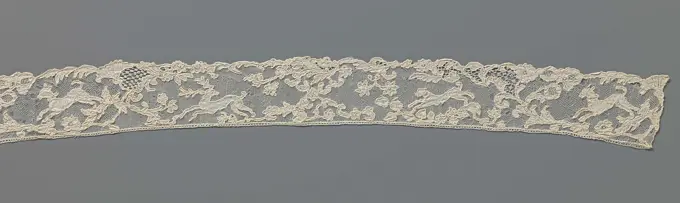
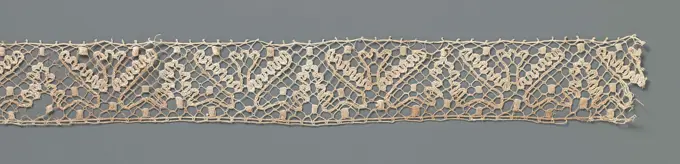
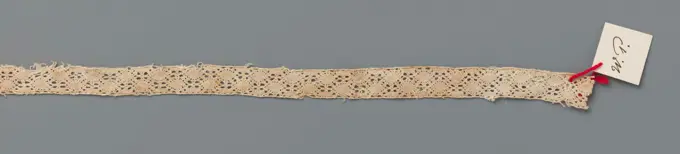
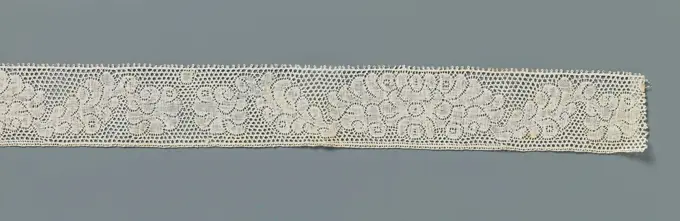
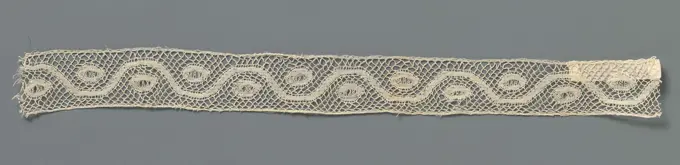
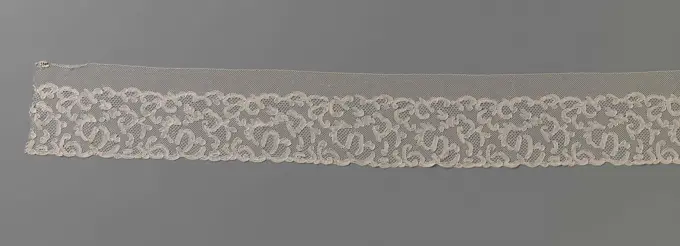
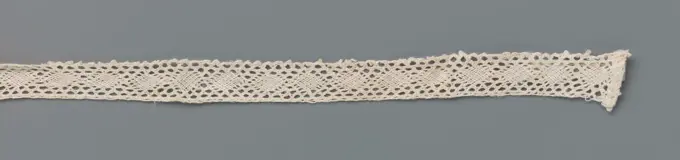
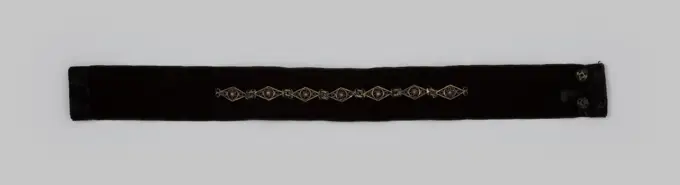
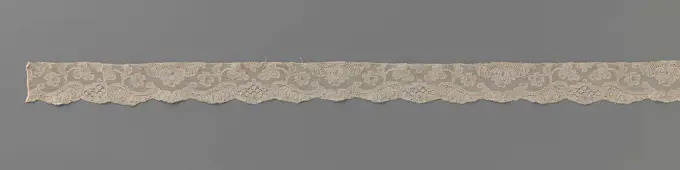
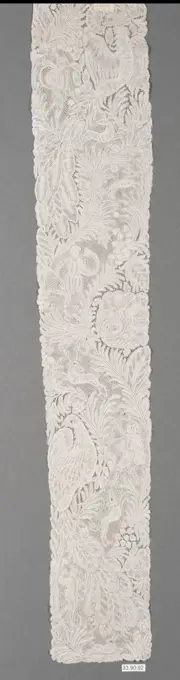
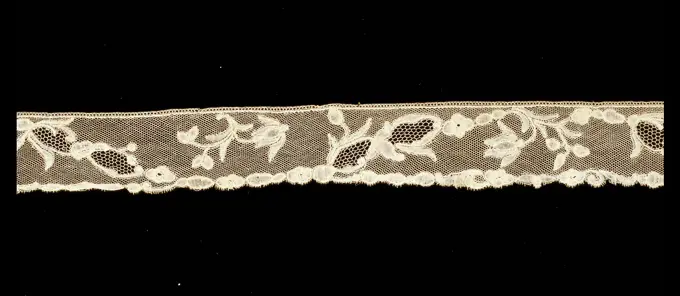
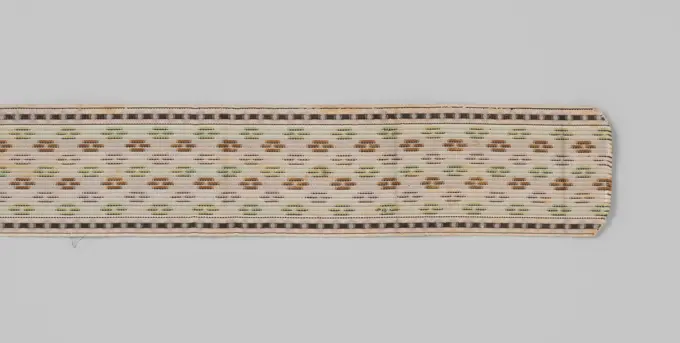
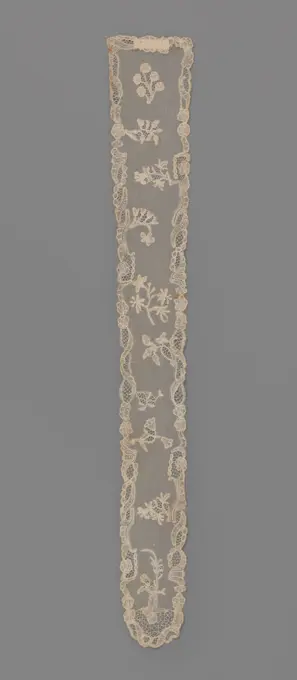
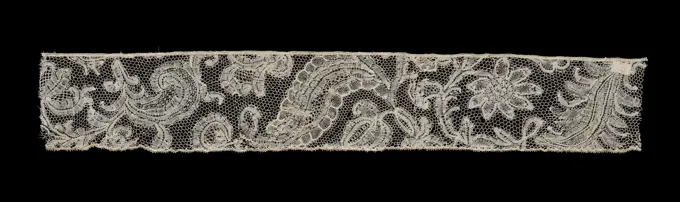
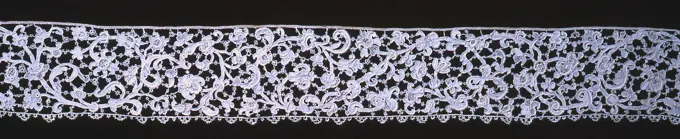
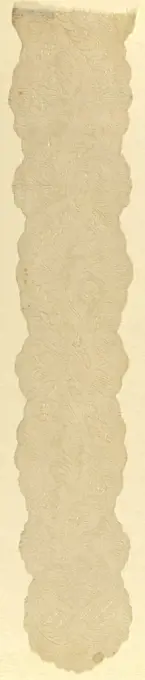
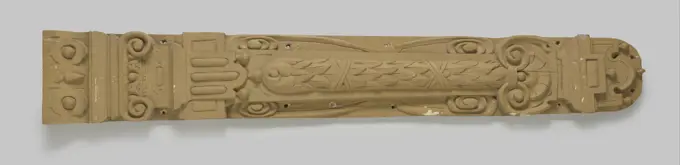
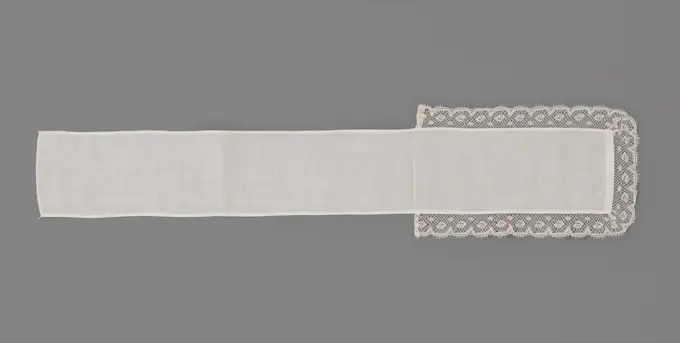
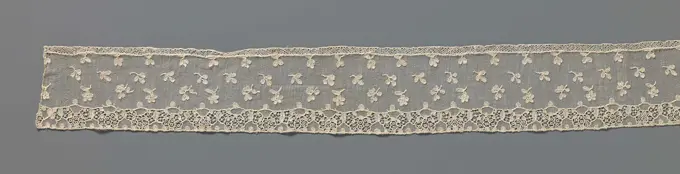
Band, Medium: linen Technique: needle lace with ground of loop & twist with twist return, Design of a hunter with gun, a man with horn, and 4 stags, all shown mixed with brances and flowers., Italy, 18th century, lace, BandCap Streamers (France); linenBorder (Italy); linenStrook naaldkant met herten en honden.Strip natural-colored coniferous lace: Alençon side. The repeating pattern consists of a deer hunted by dogs. The animals are surrounded by tendrils with a variety of flowers. The motifs are made up of feston stitches with recesses and equipped with relief contours. The motifs are interconnected by a fine hexagonal Maas soil, an alençon ground, with across worked meshes. Some spaces between the tendrils are filled with ornamental grounds. The scalloped top creates from the pattern with the floral drinks and is finished with very fine picots. The underside is trimmed with a border in the climbing side.Border, Medium: linen Technique: punto in aria needle lace with bobbin lace heading, Lace border with quatrefoil motif combined with balanced scrolls and narrow pointed edge. Bobbin heading., Italy, 17th century, lace, BorderStrip bobbin with a continuous row of circles and trapezoidal fields, anonymous, c. 1800 - c. 1899 Strip of natural -colored bobbin, Swedish side. The strip is attached to a light blue cardboard with pins, with seven other strips. Above the strip is written on the cardboard "Laces from Dalecarlia. (Dalarna)". The repeating and continuous pattern is formed by a bundle of wires that has been worked through a mesh soil, a diamond -shaped litter. These meshes are interrupted by a simple decorative land of three larger oval meshes. Around these three oval meshes, the thick wire forms a trapezoidal field and then forms a configuration of three circular fields in the tub graft and then a trapezium -shaped field around the oval meshes. And so on. Top and bottom of the strip are straight and equipped with picots. Dalarna linen (material) bobbin lace Strip of natural -colored bobbin, Swedish side. The strip is attached to a light blue cardboard with pins, with seven other strips. Above the stripTrimming, Medium: flat strips of gold metallic foil, gold metallic foil wound onto yellow silk Technique: bobbin lace, metallic, Metallic gold lace in repeated zigzag pattern set in bands and alternating with narrow stripes., Europe, 18th century, lace, TrimmingTrimming, Medium: linen Technique: needle lace, six-sided reworked ground, Serpentine floral pattern., France, 18th century, lace, TrimmingStrip of needle side with plumed tendrils, anonymous, c. 1875 - c. 1895 Strip of natural -colored needle side: Venetian rose side. On a bar of land with six -sided meshes, rich branches, to the left and right, are swiveling and right -wing, sometimes dwelling, sometimes walking. There are multifaceted, carefully detailed button -shaped flowers. Here and there the top of a slender has grown through an opening in the branch. Straight finish of alternately an eye and a triangle. BURANO linen (material) Venetian rose point Strip of natural -colored needle side: Venetian rose side. On a bar of land with six -sided meshes, rich branches, to the left and right, are swiveling and right -wing, sometimes dwelling, sometimes walking. There are multifaceted, carefully detailed button -shaped flowers. Here and there the top of a slender has grown through an opening in the branch. Straight finish of alternately an eye and a triangle. BURANO linen (material) Venetian rose pointStrook kloskant met driehoekige velden en gestileerde kelkbloem.Strip natural colosside. The repeating pattern consists of two alternating triangular fields. One field is formed by a straight down hanging, stylized chalis flour between two leaves. The other triangular field is formed by the space between two consecutive fields with bowl flowers. There is a more or less Christmas tree-shaped motif in this field. The motifs are interconnected by a coarse diamond-shaped mesh soil, a fat mat of grille, strewn with square moes. The motifs are made with thick contour wires and regularly winding braided straps. The Moeses are made in shape stroke. Upper and bottom of the strip are straight finished, the underside with picots. According to tradition, the strip would have put a cloth together with associated strip.Bobbin Lace Edging, 18th century. France, Valenciennes or Flanders, 18th century. Lace, bobbin: linen; average: 4.5 x 36.9 cm (1 3/4 x 14 1/2 in.).Border, Medium: linen Technique: bobbin lace, Mechlin style, Mechlin border with the upper part showing floral sprays and leaf ornaments with little squares sprinkled over the field. The lower part has an openwork band with medallions and a scalloped border of pendant flowers., Belgium or France, early 19th century, lace, BorderBorder with Foliage Scrolls.Lace with small and refined, as well as large and imposing, motifs was made in Venice at the end of the 17th century. These are two variations of the first kind, the so-called Venetian raised and small scale lace. The French call it point de neige, literally snowflake stitch.Strook naaldkant met ijle spiraalranken.Strip natural needle side: Venetian rosion side. On a regular six-sided Maas soil there is an open backdrop of Iche Spiral Rinks that are decorated here and there with a relief rose. Straight outer edge with a row of contiguous arcs.Tussenzetsel van kloskant met spitsovaaltjes.Interesting of natural Dutch clamping side. The pattern consists in the longitudinal direction of a double row of spits. The ovals are alternately worked in linen battle with openwork edges or by a configuration of four larger and five smaller recesses. The lower and top row skifts relative to each other. The top and bottom are straight finished.Fragment bobbin for chimney mantle, anonymous, c. 1850 - c. 1920  Netherlands  bobbin lace  Netherlands  bobbin laceStrook kloskant met pioenroos tussen gebogen langgerekte bladeren.Strip natural-colored Dutch clamping side. The repeating pattern consists of a stylized peony that releases a long curved leaf on the left and right with a smaller flower to the peony. The motifs are connected by a round table ground with braid. The motifs are made in linen stroke, where open-worked edges ensure contours around petals and leaf growers. Upper and bottom of the strip are straight finished.Strook kloskant met cirkeltje tussen ovaal pioenroos-motief.Strip natural-colored Dutch clamping side. The repeating and symmetrical pattern consists of a stylized oval peony between two smaller and round peonies, which with an S-shaped leaf from the side of flour. There is a loose circle along the bottom of the strip between the consecutive peony motifs. The motifs are made in linen battle with recesses and open editors. In the linen work a single loose snowflakes occurs. The motifs are connected by a grille, a Paris soil. The top and bottom are immediately finished with picots on one side.Bobbin Lace Edging, mid 18th century. Belgium, Mechelen, mid 18th century. Lace, bobbin; average: 4.8 x 88.9 cm (1 7/8 x 35 in.).Das van Valenciennes-Kant, Anonymous, c. 1880 Das van Valenciennes side, made of an intermediate brush with continuous winding branch with leaves and flowers surrounded by a smoothly set slightly scalloped strip with flowers, a connected sling of festons and moesjes. West-Europa . Valenciennes lace Das van Valenciennes side, made of an intermediate brush with continuous winding branch with leaves and flowers surrounded by a smoothly set slightly scalloped strip with flowers, a connected sling of festons and moesjes. West-Europa . Valenciennes laceKloskant collar with sprinkling flowers and medallions in the flower edge The smallest motifs are applications, anonymous, c. 1775 - c. 1799 Kloskant collar with drochel soil, Brabantse Kloskant. The collar has a pattern of sprinkling flowers and along the scalloped lower edge a pattern of contiguous medallions, alternately enclosed by small and large C-shapes. Volwerk in linen battle with cloated relief and thick contour threads. The smallest motifs have been applied. The scums along the bottom are trimmed with picots. Brussels linen (material) bobbin lace / Brabant bobbin lace Kloskant collar with drochel soil, Brabantse Kloskant. The collar has a pattern of sprinkling flowers and along the scalloped lower edge a pattern of contiguous medallions, alternately enclosed by small and large C-shapes. Volwerk in linen battle with cloated relief and thick contour threads. The smallest motifs have been applied. The scums along the bottom are trimmed with picots. Brussels linen (material) bobBand, Medium: linen Technique: needlework on knotted net, Small piece of blue net with a square mesh and knotted at the corners. Embroidered in white showing a conventionalized flower and vine design., Italy, 17th century, lace, BandTussenzetsel kloskant met opengewerkte ovalen in trapeziumvormende golven.Interesting of natural colosside, Valenciennes side. Over the center line of the strip, a wavy strap with flattened golf tops and valleys, thereby creating trapezoidal spaces, with a one and more detached oval. The motifs are connected by a mesh soil, a diamond-shaped valenciennes ground. The motifs are made in linselag with openwork edges and an open and decorated center in the ovals. Upper and bottom of the strip are straight finished.Applique lace, Early 19th Century, Brussels, maker unknown. Gift of Yvonne Riddiford, 2007.Fragment early 18th century Flemish. Fragment 218852Scarf Made 1800-1820 India. Wool, pieced double interlocking 2 2 twill tapestry weave; ends pieced in 2 2 'S' twill weave; embroidered in fly, satin, and stem stitches; laid work and couching; main warp fringe .Bobbin Lace Edging, 18th century. Italy, Milan, 18th century. Lace, bobbin design on mesh ground: linen; average: 10.8 x 199.4 cm (4 1/4 x 78 1/2 in.).Sampler 19th century German. Sampler 228640Border, Medium: linen Technique: needle lace with ground of loop & twist with twist return, Border of Point d'Alençon with a design of small-scale floral shapes edged by a garland on one side., France, late 18th century, lace, BorderStrook kloskant met bezonken ornament.Strip natural colosside: Parisian side. Under a closed pin-stroke-soil without motifs, a wide job of woody C-Voluard leaves and other curved forms that are grouped in diagonal direction. The motifs are made in linen stroke with thicker and shiny contour wires. The closed pins stroke, with which the motifs are connected to each other, runs under different curved motifs in a rose ground, which has been applied as ornamental soil. The top of the strip is straight finished. The slight sloping edge along the underside stems from the pattern with the wooded curved motifs.Border, Medium: linen Technique: needle lace, Indeterminate pattern of scrolls with leaves and roselike forms., Belgium, 18th century, lace, BorderRibbon, salmon color, white and silver, stock of the majority of the tours with cross stripes of silver slamé, anonymous, c. 1750 - c. 1770 Ribbon, possibly for garter, salmon color, white and silver. Fond of the majority of the tours with cross stripes of silver lamé. The ornament is partly of browned silverlamé, which is flottant up to the outskirts. Pattern of blending into each other interlocking classic palmets. Self -sides decorated with Hanekammen. France (possibly) silk. Ribbon, possibly for garter, salmon color, white and silver. Fond of the majority of the tours with cross stripes of silver lamé. The ornament is partly of browned silverlamé, which is flottant up to the outskirts. Pattern of blending into each other interlocking classic palmets. Self -sides decorated with Hanekammen. France (possibly) silk.Fringe (Spain); silkTussenzetsel van kloskant met een middenlijn van ruitjes.Interesting of natural colosside. The pattern consists of a center line of closed diamonds, always placed one separate diamond, but close to the next. The diamonds are connected by a maas soil. The motifs are made in linen stroke. Upper and bottom of the strip are straight finished. The short sides are finished with a soil. The intermediate site comes from or intended for bedding.Kloskant intermediary with geometric zigzag pattern, anonymous, c. 1500 - c. 1699  Piles of natural -colored bobbin side with lighter and slightly darker threads. The geometric pattern consists of a zigzag line of always three squares up and three down. The squares are made in linen battle, they are all surrounded by a border of small recesses. The braid ground is closed, the meshes are small. Flanders linen (material) bobbin laceEdge; medium:; 1931-27-19Strook kloskant met boogjes langs de onderrand.Natural collate strip, Valenciennes side. Along the bottom edge of the strip, a continuous strap in linse stroke runs that the slight regular schulls forms. In addition, the strip consists of a mesh soil, a diamond-shaped valenciennes ground. The top of the strip is straight finished. The arcs along the underside are finished with picots.Edge, Medium: linen Technique: bobbin lace, Brussels style, Edging with architectural ornaments and trees., Belgium, 18th century, lace, EdgeHeat slip of the application side with large flower, Royal Dutch Side Working School, c. 1908 - c. 1918 Capslip of natural -colored application side, bobbin lacquered on mechanical tulle. The rectangular field is decorated with wide sprinkled twigs, on which various flowers grow. At the ends there is always a thin stem with a large, openwork palm flower, rising from a triangular 'hill', the sides of which are composed of scoops and medallions. There is a bow in the cross edges; The long edges of Betsaan from flat scoops of switching tires, rosettes and long adhesive drinks. The Hague linen (material) Capslip of natural -colored application side, bobbin lacquered on mechanical tulle. The rectangular field is decorated with wide sprinkled twigs, on which various flowers grow. At the ends there is always a thin stem with a large, openwork palm flower, rising from a triangular 'hill', the sides of which are composed of scoops and medallions. There is a bow in the cross edges; The long edgeBobbin Lace Edging, mid 18th century. Belgium, Binche, mid 18th century. Lace, bobbin; average: 5.5 x 55 cm (2 3/16 x 21 5/8 in.).Bobbin Lace Edging, 18th century. France, Valenciennes, 18th century. Lace, bobbin; average: 6.1 x 284.5 cm (2 3/8 x 112 in.).Black velvet collar decorated with seven lying windows of copper, anonymous, c. 1900 - c. 1915 Seven lying windows of copper have been put on the black velvet collar, which are filled with filigrein. The closure consists of press studs. Netherlands (possibly) lint: velvet (fabric weave). versiering: copper (metal) filigree Seven lying windows of copper have been put on the black velvet collar, which are filled with filigrein. The closure consists of press studs. Netherlands (possibly) lint: velvet (fabric weave). versiering: copper (metal) filigreeStrook kant met drielobbig cartouche en afhangende bloem met druppelvormig hart.Strip natural colosside: Mechelen side. The repeating pattern consists of two accumulating symmetrical compositions. One composition consists of a triple cartouche, which lies along the bottom and is flanked left and right by an elongated s-voltage with five lobes at the bottom. From the S vultuts, a splitting branch with one leaf and two flowers exprceed. The other composition consists of a flour dependent on the top with a drip-shaped heart, between two leaves. The motifs are connected by a fine Maas soil. The motifs are made in linen stroke with few recesses, but with openwork edges. There are contour lines around the motifs with slightly thicker and shiny wire. Some different ornamental grounds have been applied, including a snowflakes soil, in, among other things, the cartouche and between the leaves. The bland scaled underside comes from the pattern and is finished with picots. The top is just finisheTextile, Medium: cotton Technique: block printed on plain weave, Large scale design of a woody vine with exotic flowers, parrots and smaller birds, in shades of brown, tan, rose, red, blue, and faded violet on an off-white ground. Fine picotage around parrot's eyes. Right selvedge present., England, 1785-95, printed, dyed & painted textiles, TextileStrip bobbin with two candelabar motifs, anonymous, c. 1690 - c. 1699 Strip of natural-colored bobbin, binche side. The repeating and thin pattern consists of a two different symmetrical candle -bug motifs. The narrowest of the two has a drop -shaped center, the wider is fitted with volutes from four points around the center, and form an X. The Kandelaber motifs are alternately reversed. The motifs are connected by an irregular decorative land, a snowflake land. The top is finished with a separate strap. The bottom is straight finished and provided with picots. Southern Netherlands linen (material) Bobbi Lace / Binche Lace Strip of natural-colored bobbin, binche side. The repeating and thin pattern consists of a two different symmetrical candle -bug motifs. The narrowest of the two has a drop -shaped center, the wider is fitted with volutes from four points around the center, and form an X. The Kandelaber motifs are alternately reversed. The motifs are connected by an irregular decoratPleated Fan And Case (France); parchment leaf painted with gouache, gilded and painted ivory sticks, guards inlaid with mother-of-pearlStrip of needle side with floral motifs, anonymous, c. 1690 - c. 1699 Strip of natural needle side, venise flat. Pattern with highly curved sities and simple flower and leaf shapes. The strip is possible (a part of) a hat -slip. Irregular bar with picots. The strip is finished on one short sides and two long sides with a picot edge with arcs. The side is sewn on a light pink. unknown linen (material) flat Venetian (needle point) Strip of natural needle side, venise flat. Pattern with highly curved sities and simple flower and leaf shapes. The strip is possible (a part of) a hat -slip. Irregular bar with picots. The strip is finished on one short sides and two long sides with a picot edge with arcs. The side is sewn on a light pink. unknown linen (material) flat Venetian (needle point)Galloon 18th century French. Galloon 213905Edging, Medium: cotton on cotton Technique: deflected element work, One sleeve edging or short ruffle embroidered in design of flowers and leaves arranged around curving band., Germany, 18th century, embroidery & stitching, EdgingStrook kloskant met klaverblaadjes.There is a row of 'sequins' and two rows of clover leaves on a coarse mesh stock (square mesh). The scivels are flat and smooth. Valenciennes side.Fringe (Italy); metallic foil on a silk coreLappet (one of a pair) early 18th century Flemish, Brussels. Lappet (one of a pair) 222781Border (Belgium); linen; 1911-25-1Band (Italy); linenKloskant's intermediate mate with a volute motif on remains of linen bedding with work with pulled threads, anonymous, c. 1640 - c. 1660 Intermediate springs of natural -colored Dutch bobbin side. The repeating and symmetrical pattern consists of a volute motif that is alternately placed in reverse. The motifs are made in linen battle with openwork edges and are connected by a traly land. Top and bottom of the strip are straight finished and each attached to a narrow strip of linen - hems - with a narrow edge of work with extended threads. On one long side, part of the work with extended threads have disappeared and the middle part is a separate hem where no traces of work with extended threads can be seen. Every short side is sewn together. It concerns the remains of bedding, probably a pillowcase. Possibly the side is made in Flanders and the bedding is made in the Northern Netherlands. Southern Netherlands (possibly)Northern Netherlands (possibly) linen (material) bobbin lace IntermPrzeszo Przyszoci unknownBobbin Lace Lappet, 19th century. France, Chantilly, 19th century. Lace, bobbin: silk; overall: 98.2 x 11 cm (38 11/16 x 4 5/16 in.).Pleated fan and box, Linen bobbin lace leaf, incised and pierced mother-of-pearl sticks with silver and gold foil, gilt metal bail, Pleated fan. White bobbin lace leaf in floral design. Incised and pierced mother-of-pearl sticks with silver and gold flowering vine design. Mother-of-pearl rivet head and gilt metal bail., USA, late 19th century, costume & accessories, Pleated fan and boxEdging third quarter 18th century French or Italian, Venice (Burano) The Metropolitan Museum's great lace collection was started when the Museum became the first among American museums to organize a permanent collection of lace with the acceptance of the McCallum Collection in 1879 and the bequests of Mrs. John Jacob Astor, Mrs. Robert L. Stuart, Mrs. Augustus Cleveland, and Mrs. A. W. Winters shortly thereafter. In 1893 a loan collection of antique laces shown at the World's Columbian Exposition in Chicago was assembled by a committee of New York women headed by Catharine Augusta Newbold. About 1900 Miss Newbold arranged and labeled an exhibition of laces and linenworks lent to the Metropolitan Museum by Mrs. James Boorman Johnstone and the Misses Johnstone. "Her scholarly knowledge of lace technique enabled the Museum for the first time to offer a comprehensive display of lace illustrating its historical development," wrote Miss Frances Morris, then curator of the textile department.Band, Medium: linen, silk Technique: embroidery, drawnwork, Strip of insertion in a design of scrolling angular oak branches with foliage and acorns in reserve on the linen ground. Background of drawn work embroidered with red silk., Italy, 16th century, embroidery & stitching, BandLappet, c. 1750, 93 15/16 x 2 9/16 in. (238.6 x 6.51 cm), Linen; bobbin lace, Belgium, 18th centuryCeintuur ribbon of cream -colored silk in rip binding, decorated with a stripe pattern in light green, light brown and lilac; A pearl edge runs along the edges with a black dot, anonymous, c in every 'pearl'. 1820 - c. 1830 Ceintuur ribbon of cream -colored silk in rip binding, decorated with a stripe pattern in light green, light brown and lilac. A pearl edge runs along the edges with a black dot in every 'pearl', probably women's clothing. Netherlands (possibly) whole: Silk Ceintuur ribbon of cream -colored silk in rip binding, decorated with a stripe pattern in light green, light brown and lilac. A pearl edge runs along the edges with a black dot in every 'pearl', probably women's clothing. Netherlands (possibly) whole: SilkFringe (Italy); silkGalloon early 19th century French. Galloon 213955Fan Holder 18th-19th century China. Fan Holder 68826Fragment, Medium: silk Technique: woven, Lozenge pattern framing central diamond., 17th century, woven textiles, FragmentGalloon 17th century French. Galloon. French. 17th century. Textiles-TrimmingsCapsive from Devonshirekant with an angel with a palm branch at the end, Anonymous, c. 1775 - c. 1800 Capslip from Devonshirekant with an angel with a palm branch at the round end. The remaining decoration consists of flowers and flower branches. The barbe is irregularly sculpted and is fully equipped with a picot edge. England linen (material) Devon lace Capslip from Devonshirekant with an angel with a palm branch at the round end. The remaining decoration consists of flowers and flower branches. The barbe is irregularly sculpted and is fully equipped with a picot edge. England linen (material) Devon laceStrip bobbin with abstract drawing with peaks, anonymous, c. 1840 - c. 1860  Strip of natural -colored bobbin: Lille side. The repeating and continuous pattern consists of an abstract drawing with peaks like a mountain landscape along the underside of the strip. This allows two two -placed and openwork ovals and an openwork circle. The motifs are connected by a fine grid, a tuler land. The motifs are made in linen battle, where only the ovals and circles have a thicker contour wire. A decorative land has been used in the ovals. The top and bottom of the strip are straight finished, with the bottom with picots. Lille linen (material) bobbin lace / Lille laceFragments, Medium: cotton Technique: machine made, Machine made fragments in imitation of point appliqué has a pattern of scrolling stems with leaves and flowers on machine net. Component b has floral motifs within hexagons formed by stems and leaves., possibly France, ca. 1890, lace, FragmentsBobbin Lace Edging, 19th century. Flanders, 19th century. Lace, bobbin: linen; average: 8.3 x 51.5 cm (3 1/4 x 20 1/4 in.).Galloon 17th century () European. Galloon. European. 17th century (). Silk and metal thread. Textiles-Trimmingsweapons arms swords Middle Ages sword for foot soldiers Italian circa 1500,Galloon 17th-18th century Unknown. Galloon. Unknown. 17th-18th century. Metal thread. Textiles-TrimmingsBorder (Italy); linenTrimming (Italy); silk, metallic threadPin. UnknownPiece 18th century Japan. Piece 71666Border 18th century Spanish. Border 218789Cap streamer, Medium: linen Technique: bobbin lace, Binche ground, Flowers and leaves on undulating stem with scalloped border., Belgium, 18th century, lace, Cap streamerTissue with ornamental strip, anonymous, c. 400 - c. 500 Natural linen tissue fragment with woven edge decorations in dark purple of curls of curly curled leaf vines, within which animals are halfway, including, from right to left, a lion, a ram (), A Capricorn, a dog, a hare, a bear ( ) and a lion. The upper strip of natural tissue has formed three lines by woven thicker impact wires. Egypt Ketting an element: Linen (material). Entry: Wool tapestry Natural linen tissue fragment with woven edge decorations in dark purple of curls of curly curled leaf vines, within which animals are halfway, including, from right to left, a lion, a ram (), A Capricorn, a dog, a hare, a bear ( ) and a lion. The upper strip of natural tissue has formed three lines by woven thicker impact wires. Egypt Ketting an element: Linen (material). Entry: Wool tapestryTrimming (Italy); silk, silver threadSculpted style of oak, from the so -called house of Alva, Warmoestraat in Amsterdam, c. 1500 - c. 1699 Carryed oak style, from the so -called house of Alva, Warmoestraat in Amsterdam. In total it concerns six painted styles (see BK-KOG-754-2 to 7). See also BK-KOG-755-A to H, these are two capitals and six styles of untreated oak that come from the same house.  oak (wood). paint (coating) Carryed oak style, from the so -called house of Alva, Warmoestraat in Amsterdam. In total it concerns six painted styles (see BK-KOG-754-2 to 7). See also BK-KOG-755-A to H, these are two capitals and six styles of untreated oak that come from the same house.  oak (wood). paint (coating)Strip early 18th century Flemish, Mechlin. Strip 218183Fragment Eastern textile ,, 1800 - 1850 An excerpt of a fabric. Diamond shapes in white on a black soil. In the silk. cotton (textile). An excerpt of a fabric. Diamond shapes in white on a black soil. In the silk. cotton (textile).Needle. UnknownStrip of needle side with spindly tendrils, anonymous, c. 1890 - c. 1899 Strip of natural -colored needle side: Venetian rose side. Very open bars of bar with wide wavy, spindly, branched tifles, which are decorated with florets, among other things. Burano (possibly) linen (material) Venetian rose point Strip of natural -colored needle side: Venetian rose side. Very open bars of bar with wide wavy, spindly, branched tifles, which are decorated with florets, among other things. Burano (possibly) linen (material) Venetian rose pointBorder, Medium: linen Technique: needle lace with ground of loop and twist with twist return, Narrow border of Point de Venise à Réseau with floral blossoms in asymmetric pattern. Fond: réseau. Modes: fond de neige, portes, gaze quadrillée., Italy, 1700-1750, lace, BorderSub -sleek of mechanical tulle decorated with tracing in the form of four -leaf flowers, anonymous, c. 1800 - c. 1900 Sub -sleek of mechanical tulle decorated with tracing in the form of four -leaf flowers. West-Europa whole: Sub -sleek of mechanical tulle decorated with tracing in the form of four -leaf flowers. West-Europa whole:Textile Sample from Sample Book 19th century Japan. Textile Sample from Sample Book. Japan. 19th century. Silk. Textiles-WovenEdging 16th century Italian, Genoa. Edging 221119Strip bastard with stylized eyes or "Ögontröst", anonymous, c. 1800 - c. 1899 Strip of natural -colored bobbin, Swedish side. The strip is attached to a light blue cardboard with pins, with four other strips. The strip is attached to a light blue cardboard with pins, with four other strips. At the top of the cardboard is "Wadstena. Sweden." Written and under the strip is "Eye-Bright. (Ögontröst)". The repeating and symmetrical pattern consists of four diamond -shaped meshes, which together form a larger window. The space between the successive windows has been worked in linen stroke with a circle in the middle, this may be a stylized eyesive flower. Top and bottom of the strip are straight and equipped with picots. On the strip hangs a red thread with a gold -colored seal, on which three spools are depicted and on the other side a monogram with a V and an Ö (vadstena Östergötland). Vadstena linen (material) bobbin lace / Swedish lace Strip of natural -colored bobbin, Swedish side. The Border; linenStrikdas, rectangular, linen batist with smoothly set sculpted and potented strip of Valenciennes side, anonymous, c. 1880 - c. 1890 Strikdas, rectangular, of linen batist with smooth-set sculpted and potented strip of Valenciennes side. Netherlands linen (material) Valenciennes lace Strikdas, rectangular, of linen batist with smooth-set sculpted and potented strip of Valenciennes side. Netherlands linen (material) Valenciennes laceLace, 1700s, maker unknown. Gift of M Thorpe, 1984.Strook naaldkant met rechte rand met fantasievormen.Strip natural-colored coniferous lace: Alençon side. Spreading dotty with three rows of twigs and flour branches on a fine hexagonal maas soil. At the bottom a pattern of shapes filled with a fine hexagonal maas soil, various ornamental grounds and full work with and without recesses. The underside is finished with a straight picro edge. The top is trimmed with a border clamping side.Piece 19th century Japan. Piece 71687Belt, 20th century, 41 1/2 x 3 3/4 in. (105.41 x 9.53 cm) (including braids, without tie), Wool, Bolivia, 20th centuryCollar 1700-1941 American. Collar. American. 1700-1941. cottonCopy of the Goods of Montpellier, Duplicata de la Matrice de Montpellier Made 1809 France (Object made in), Montpellier (Object made for). This book illustrates the huge variety of intricate patterns printed in vivid colors on cotton textiles for fashion during the early 19th century. The book comes from Montpellier, a town on the southern coast of France that is not known today as a center of textile printing. Thus these samples indicate how much more widespread the textile industry was in Europe during the Industrial Revolution. This book contains more than 1,600 small samples.. Cotton, plain weave; block printed and copperplate printed; total of swatches 1650 swatches .