My Boards
View Pictures
  • My Boards

Rocket Launch Vehicles and Towers

Images of rockets on launch pads, depicting towering structures and preparations for space launches, emphasizing human technological achievements.

A rocket flight tower disengaging at the Guiana Space Centre, French Guiana, South America.
180 assets in this story
6145-44847360
VANDENBERG AIR FORCE BASE, Calif. -- On Space Launch Complex 576-E at Vandenberg Air Force Base in California, workers in a bucket conduct closeout procedures on the Taurus XL rocket in preparations for liftoff. The umbilical tower attached to the upper stack will fall away from the spacecraft during launch.The Orbital Sciences Taurus XL rocket will launch Glory into low Earth orbit. Once Glory reaches orbit, it will collect data on the properties of aerosols and black carbon. It also will help scientists understand how the sun's irradiance affects Earth's climate. Launch is scheduled for 5:09 a.m. EST Feb. 23. For information, visit www.nasa.gov/glory.
6145-45239250
Explorer 1 satellite. This photo was taken during the installation of Explorer-1, the first United States' Earth-orbiting satellite, to its launch vehicle, Jupiter-C, in January 1958
6176-67067643
Apollo 9 Saturn V rocket, 1969. Artist: Unknown
6145-45157091
jsc2018e025516 - In the Integration Facility at the Baikonur Cosmodrome in Kazakhstan, engineers look on as the upper stage of a Soyuz booster rocket is raised to a vertical position March 14 after the Soyuz MS-08 spacecraft was encapsulated into the booster. Expedition 55 crewmembers Drew Feustel and Ricky Arnold of NASA and Oleg Artemyev of Roscosmos will launch in the Soyuz March 21 for a five-month mission on the International Space Station...NASA/Victor Zelentsov.
6177-V70814844
6145-44569616
KENNEDY SPACE CENTER,  Fla. -- Flanked by a solid rocket booster and external tank at left, STS-88 crew members pose for a group photograph near the top of the Fixed Service Structure at Launch Pad 39A. They are (front to back) Mission Commander Robert D. Cabana, Mission Specialist Nancy J. Currie, Pilot Frederick W. "Rick" Sturckow, Mission Specialists Jerry L. Ross, James H. Newman, and (at right) Sergei Krikalev, a Russian cosmonaut. The crew are at KSC to participate in the Terminal Countdown Demonstration Test (TCDT), a dress rehearsal for launch. Mission STS-88 is targeted for launch on Dec. 3, 1998. It is the first U.S. flight for the assembly of the International Space Station and will carry the Unity connecting module
7109-70409136
Rockets at the International Space Hall of Fame, Alamogordo, New Mexico, Usa
6145-45045448
VIERA, Fla. - A full-scale test version of NASA's new Orion Multi-Purpose Crew Vehicle displayed outside the Space Coast Stadium greets those attending the stadiums Space Day. Bob Cabana, director of NASAs Kennedy Space Center in Florida, was on hand to throw the first pitch of a spring training game between Major League Baseball's Washington Nationals and the Houston Astros. Kennedy also set up a booth at the stadium for the occasion to highlight some of the contributions the space agency has made to sports, transportation and everyday life.
6145-44554995
The first stage of the Delta II rocket which will to be used to launch the Advanced Composition Explorer (ACE) spacecraft is erected at Launch Complex 17A at Cape Canaveral Air Station. Scheduled for launch on Aug. 25, ACE will study low-energy particles of solar origin and high-energy galactic particles. The ACE observatory will be placed into an orbit almost a million miles (1.5 million kilometers) away from the Earth, about 1/100 the distance from the Earth to the Sun
6145-44541758
Employees at the Space Power Facility (SPF) at Plum Brook Station tested a new generation of Atlas/Centaur launch vehicles. General Dynamics conducted the tests December 22 and January 3, 1990 to determine the flight readiness of a new 14-foot diameter payload fairing. The fairing will accommodate new weather satellites, the U.S. Air Force Combined Release and Radiation Effects (CRRES) satellite, and other future payloads. At a simulated altitude of 85,000 feet, the cone-shaped fairing separated in half from a hinge at the bottom. Half of the fairing was then released from the test stack and recovered in a catch-net. The payload fairing separations were the first tests of major space hardware to be conducted in the SPF in more than 15 years.
6145-44519291
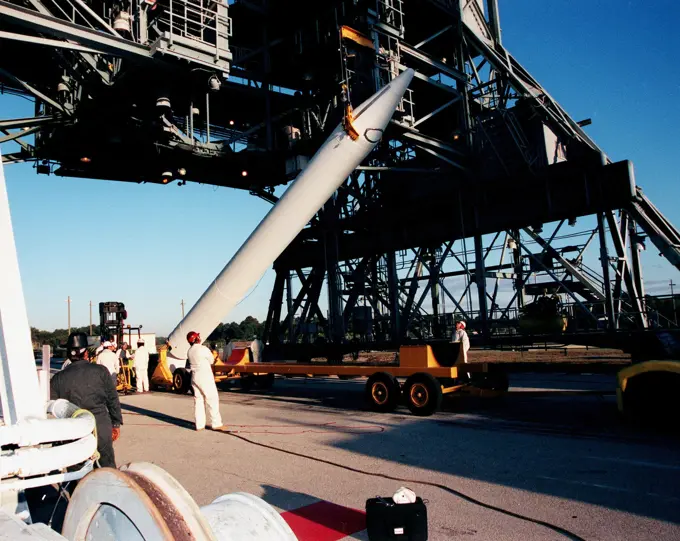
Two solid rocket boosters, in the background, are lifted up the gantry on Launch Pad 17-A, Cape Canaveral Air Force Station, for stacking with a Delta 7925 rocket. The rocket, scheduled to launch April 7, 2001, will carry the 2001 Mars Odyssey Orbiter, containing three science instruments: THEMIS, the Gamma Ray Spectrometer (GRS), and the Mars Radiation Environment Experiment (MARIE). THEMIS will map the mineralogy and morphology of the Martian surface using a high-resolution camera and a thermal infrared imaging spectrometer. The GRS will achieve global mapping of the elemental composition of the surface and determine the abundance of hydrogen in the shallow subsurface. The MARIE will characterize aspects of the near-space radiation environment with regards to the radiation-related risk to human explorers
6145-44879458
CAPE CANAVERAL, Fla. -- NASA's Gravity Recovery and Interior Laboratory mission is readied for liftoff aboard a United Launch Alliance Delta II Heavy rocket from Space Launch Complex 17B on Cape Canaveral Air Force Station. GRAIL will fly twin spacecraft in tandem around the moon to precisely measure and map variations in the moon's gravitational field. The mission will provide the most accurate global gravity field to date for any planet, including Earth. This detailed information will reveal differences in the density of the moon's crust and mantle and will help answer fundamental questions about the moon's internal structure, thermal evolution, and history of collisions with asteroids. The aim is to map the moon's gravity field so completely that future lunar vehicles can safely navigate anywhere on the moons surface.  Launch is scheduled for 8:37:06 a.m. EDT Sept. 8.
6177-V53807377
6145-58960548
CAPE CANAVERAL, Fla. - At the Kennedy Space Center Visitor Complex in Florida, 110 people, representing 36 countries, celebrate becoming American citizens during a naturalization ceremony. U.S. Citizenship and Immigration Services administered the oath in the complex's Rocket Garden in honor of the upcoming Independence Day holiday. This was the first naturalization ceremony hosted by a NASA facility. An estimated 3,800 candidates will become citizens at 55 special ceremonies, including the one at Kennedy, held across the country and around the world July 1-6.
6145-44482102
NASA astronauts and astronaut candidates view NASAs Artemis I Space Launch System and Orion spacecraft atop the mobile launcher on the pad at Launch Complex 39B at the agencys Kennedy Space Center in Florida on Sept. 2, 2022. The astronauts are, from left to right: Victor Glover, NASA astronaut; Marcos Berrios, NASA astronaut candidate; Anne McClain, NASA astronaut; Anil Menon and Deniz Burnham, NASA astronaut candidates; and Zena Cardman, NASA astronaut. The first in a series of increasingly complex missions, Artemis I will provide a foundation for human deep space exploration and demonstrate our commitment and capability to extend human presence to the Moon and beyond. The primary goal of Artemis I is to thoroughly test the integrated systems before crewed missions by operating the spacecraft in a deep space environment, testing Orions heat shield, and recovering the crew module after reentry, descent, and splashdown. In later missions, NASA will land the first woman and the first
6145-44509978
KENNEDY SPACE CENTER, Fla. --  Just after dawn, Launch Pad 39A is caught in silhouette and reflected in the water nearby. On the pad is Space Shuttle Discovery, waiting for launch on mission STS-92 Oct. 5, 2000. At the left of the pad is the 300,000-gallon water tank that is part of the sound suppression system during launches. At far left, the ball-shaped structure is a storage tank for one of the cryogenic liquid propellants of the orbiters main engines
4404-1139
UK, Leicester, Rockets at Leicester Space Centre
6145-45058872
The Soyuz TMA-13M rocket is seen as the service structure lowered in preperation for launch in the early morning hours of Thursday, May 29, 2014 at the Baikonur Cosmodrome in Kazakhstan.  Launch of the Soyuz rocket will send Expedition 40 Soyuz Commander Maxim Suraev, of the Russian Federal Space Agency, Roscosmos, Flight Engineer Alexander Gerst, of the European Space Agency, ESA, and Flight Engineer Reid Wiseman of NASA on a five and a half month mission aboard the International Space Station.
6145-44709702
S61-01927 (5 May 1961) --- Mercury-Redstone 3 (MR-3), the United States' first manned spaceflight, is launched from Cape Canaveral on a suborbital mission. Astronaut Alan B. Shepard Jr. was the pilot of the Mercury spacecraft, designated Freedom 7 . The spacecraft attained a maximum speed of 5,180 miles per hour (mph), reached an altitude of 116 1/2 statute miles, and landed 302 statute miles downrange from Cape Canaveral, Florida.
6145-44597152
KENNEDY SPACE CENTER, FLA. -  On Launch Complex 17-A, Cape Canaveral Air Force Station, the Boeing Delta II rocket and its Mars Exploration Rover (MER-A) payload are free of the tower  and ready for launch.  This will be the third launch attempt in as many days after weather concerns postponed the launches June 8 and June 9.  MER-A is the first of two rovers being launched to Mars.  When the two rovers arrive at Mars in 2004, they will bounce to airbag-cushioned landings at sites offering a balance of favorable conditions for safe landings and interesting science. The rovers see sharper images, can explore farther and examine rocks better than anything that has ever landed on Mars.  The designated site for MER-A mission is Gusev Crater, which appears to have been a crater lake.  The second rover, MER-B, is scheduled to launch June 25.
6145-44603013
A Soyuz TMA-3 spacecraft and its booster rocket is raised, Thursday, Oct. 16, 2003, on the launch pad  at the Baikonur Cosmodrome, Kazakhstan during preparations for liftoff Oct. 18 to carry Expedition 8 Commander and NASA Science Officer Michael Foale, Expedition 8 Soyuz Commander Alexander Kaleri and European Space Agency astronaut Pedro Duque of Spain to the International Space Station.
6145-44494890
As light peers over the horizon at the crack of dawn, NASA's Far Ultraviolet Spectroscopic Explorer (FUSE) satellite waits for launch on Launch Pad 17A, Cape Canaveral Air Station, aboard the Boeing Delta II rocket. Liftoff is scheduled for 11:39 a.m. EDT. FUSE was developed to investigate the origin and evolution of the lightest elements in the universe hydrogen and deuterium. In addition, the FUSE satellite will examine the forces and process involved in the evolution of the galaxies, stars and planetary systems by investigating light in the far ultraviolet portion of the electromagnetic spectrum
6145-44572019
A fourth and final Solid Rocket Booster arrives at Pad 17A, Cape Canaveral Air Station to be mated with a Boeing Delta II rocket. The rocket will carry the Stardust satellite into space for a close encounter with the comet Wild 2 in January 2004. Using a medium called aerogel, Stardust will capture comet particles flying off the nucleus of the comet, plus collect interstellar dust for later analysis. The collected samples will return to Earth in a Sample Return Capsule to be jettisoned as Stardust swings by Earth in January 2006. Stardust is scheduled to be launched on Feb. 6, 1999
6145-44980626
CAPE CANAVERAL, Fla. - At Cape Canaveral Air Force Station's Space Launch Compex-41, John Grunsfeld, NASA associate administrator for the Science Mission Directorate along with other agency and contractor officials spoke to members of the news media about preparations for the Mars Atmosphere and Volatile EvolutioN, or MAVEN, mission. Standing behind him are, from the left, David Mitchell, NASA's MAVEN project manager at the Goddard Space Flight Center, Greenbelt, Md., Bruce Jakosky, MAVEN principal investigator from the Laboratory for Atmospheric and Space Physics at the University of Colorado at Boulder, NASA Administrator Charles Bolden, Amanda Mitskevich, NASA Launch Services Program manager, and Jim Sponnick, vice president of Atlas and Delta Programs for United Launch Alliance.MAVEN is being prepared for its scheduled launch on Nov. 18, 2013 from Cape Canaveral Air Force Station, Fla. atop a United Launch Alliance Atlas V rocket. Positioned in an orbit above the Red Planet, MAV
6145-44571807
A solid rocket booster is lifted off a transport vehicle for its transfer to the mobile launch tower at Pad 17A, Cape Canaveral Air Station. It will be mated with a Boeing Delta II rocket that will carry the Stardust spacecraft into space for a close encounter with the comet Wild 2 in January 2004. Using a medium called aerogel, Stardust will capture comet particles flying off the nucleus of the comet, plus collect interstellar dust for later analysis. The collected samples will return to Earth in a sample return capsule to be jettisoned as Stardust swings by Earth in January 2006. Stardust is scheduled to be launched on Feb. 6, 1999
6145-45086475
VANDENBERG AFB, California - Detail of mission and NASA logos at Space Launch Complex-2 at Vandenberg AFB, California - the launch site for NASA's SMAP spacecraft. For more, go to www.nasa.gov/smap
6145-44624221
Expedition 10 Commander and NASA Science Officer Leroy Chiao tours the launch pad on Saturday, October 9, 2004, at the Baikonur Cosmodrome in Kazakhstan prior to liftoff to the International Space Station October 14.
6145-58965353
Two solid rocket boosters, in the background, are lifted up the gantry on Launch Pad 17-A, Cape Canaveral Air Force Station, for stacking with a Delta 7925 rocket. The rocket, scheduled to launch April 7, 2001, will carry the 2001 Mars Odyssey Orbiter, containing three science instruments THEMIS, the Gamma Ray Spectrometer (GRS), and the Mars Radiation Environment Experiment (MARIE). THEMIS will map the mineralogy and morphology of the Martian surface using a high-resolution camera and a thermal infrared imaging spectrometer. The GRS will achieve global mapping of the elemental composition of the surface and determine the abundance of hydrogen in the shallow subsurface. The MARIE will characterize aspects of the near-space radiation environment with regards to the radiation-related risk to human explorers
6177-V53825178
6145-45047944
CAPE CANAVERAL, Fla. - Six-year-old Connor Johnson gives a big thumbs up following a ceremony in the Kennedy Space Center Visitor Complex' Rocket Garden during which NASA Kennedy Space Center Director and former astronaut Robert Cabana presented him with space mementos to inspire the youngster to continue the dream he has had since the age of three of becoming an astronaut. From left are Connor's brother Liam, Cabana and Connor. Connor, of Denver, Colo., gained national attention for having the "right stuff" when he launched an online petition on the White House website in December 2013 to save NASAs funding from budget cuts. One of the mementos, a piece of space history, was a bolt used to hold the International Space Station's Unity module in place in space shuttle Endeavour's payload bay on the STS-88 mission, the first station assembly mission and Cabana's fourth and final spaceflight. Connor and his family were the guests of Delaware North Companies Parks & Resorts, the concessio
6177-V53547809
6145-44567234
The Plasma Experiment for Planetary Exploration (PEPE), one of two advanced science experiments flying on the Deep Space l mission, is being installed on the spacecraft in the Payload Hazardous Servicing Facility. PEPE combines several instruments that study space plasma in one compact 13-pound (6-kilogram) package. Space plasma is composed of charged particles, most of which flow outward from the Sun. The first flight in NASA's New Millennium Program, Deep Space 1 is designed to validate 12 new technologies for scientific space missions of the next century. The spacecraft is scheduled to launch during a period opening Oct. 15 and closing Nov. 10, 1998. Most of its mission objectives will be completed within the first two months. A near-earth asteroid, 1992 KD, has also been selected for a possible flyby
5514-51159985
50th Anniversary Celebration of the Apollo 11 Moon Landing
6145-45214452
Vice President Mike Pence delivers opening remarks during the sixth meeting of the National Space Council, Tuesday, Aug. 20, 2019 at the Smithsonian National Air and Space Museum's Steven F. Udvar-Hazy Center in Chantilly, Va. Chaired by the Vice President, the council's role is to advise the President regarding national space policy and strategy, and review the nation's long-range goals for space activities.
6145-44492278
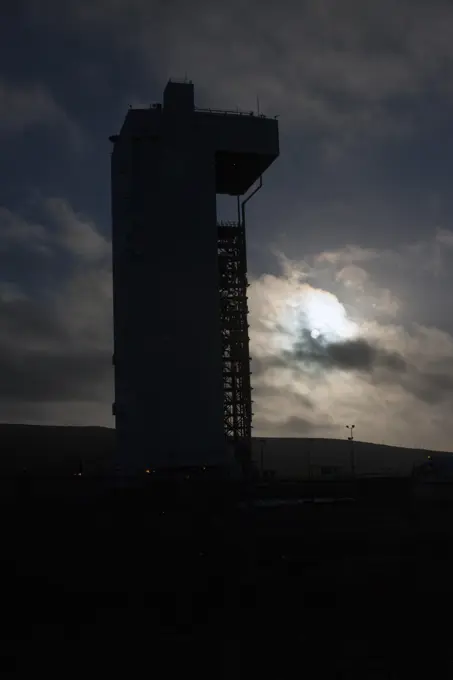
Total Lunar Eclipse. This composite made from ten images shows the progression of the Moon during a total lunar eclipse above the Vehicle Assembly Building, Nov. 8, 2022, at NASAs Kennedy Space Center in Florida. Visible trailing the Moon in this composite is Mars.
6145-58972277
VANDENBERG AFB, Calif. -- At Space Launch Complex 3E at Vandenberg Air Force Base, Kennedy Space Center Director Bob Cabana discusses the Landsat Data Continuity Mission, or LDCM, satellite mission with NASA social media followers. The Landsat Data Continuity Mission LDCM is the future of Landsat satellites. It will continue to obtain valuable data and imagery to be used in agriculture, education, business, science, and government. The Landsat Program provides repetitive acquisition of high resolution multispectral data of the Earth's surface on a global basis. The data from the Landsat spacecraft constitute the longest record of the Earth's continental surfaces as seen from space. It is a record unmatched in quality, detail, coverage, and value. Liftoff is planned for Feb. 11, 2013 aboard a United Launch Alliance Atlas V rocket.
4128R-15466418
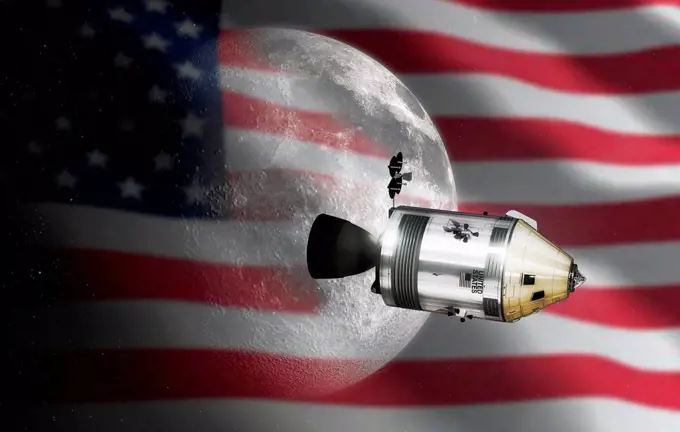
Apollo Command and Service Module and US flag, illustration
6145-44479398
The first half of the United Launch Alliance (ULA) Atlas V payload fairing is moved into position for a fit check at the Astrotech Processing Facility at Vandenberg Space Force Base (VSFB) in California on Aug. 13, 2022, for NASA and the National Oceanic and Atmospheric Administrations (NOAA) Joint Polar Satellite System-2 (JPSS-2) satellite mission. JPSS-2 is the third satellite in the Joint Polar Satellite System series. It is scheduled to lift off from VSFB on Nov. 1 from Space Launch Complex-3 East. JPSS-2 will scan the globe as it orbits from the North to the South Pole, crossing the equator 14 times a day. From 512 miles above Earth, it will capture data that inform weather forecasts, extreme weather events, and climate change. The Visible Infrared Radiometer Suite instrument will collect imagery for global observations of the land, atmosphere, cryosphere, and oceans. Launching as a secondary payload to JPSS-2 is NASAs Low-Earth Orbit Flight Test of an Inflatable Decelerator (L
6145-45291700
The Soyuz rocket is raised vertical, Tuesday, April 6, 2021, at the Site 31 launch pad of the Baikonur Cosmodrome in Kazakhstan. Expedition 65 NASA astronaut Mark Vande Hei, Roscosmos cosmonauts Pyotr Dubrov and Oleg Novitskiy are scheduled to launch aboard their Soyuz MS-18 spacecraft on April 9.
6145-45136467
Undergraduate and graduate students with teams that participated in NASA's 8th Annual Robotic Mining Competition eat dinner in the Apollo-Saturn V Center at NASA's Kennedy Space Center Visitor Complex in Florida, before the awards ceremony. More than 40 student teams from colleges and universities around the U.S. used their uniquely-designed mining robots to dig in a supersized sandbox filled with BP-1, or simulated Martian soil, and participated in other competition requirements, May 22-26 at the visitor complex. The Robotic Mining Competition is a NASA Human Exploration and Operations Mission Directorate project designed to encourage students in science, technology, engineering and math, or STEM fields. The project provides a competitive environment to foster innovative ideas and solutions that could be used on NASA's Journey to Mars.
6145-44666250
KENNEDY SPACE CENTER, FLA. --  Painters' platforms are seen hanging on the side of Kennedy Space Center's 525-foot-high Vehicle Assembly Building to facilitate the repainting of the American flag and the NASA logo. Workers use rollers and brushes to do the painting. The flag and logo were last painted in 1998, honoring NASA's 40th anniversary. The flag spans an area 209 feet by 110 feet, or about 23,437 square feet. Each stripe is 9 feet wide and each star is 6 feet in diameter. The logo, also known as the "meatball," measures 110 feet by 132 feet, or about 12,300 square feet.
6145-58958761
VANDENBERG AFB, Calif. -- The sun sets in the west behind Space Launch Complex 3 at Vandenberg Air Force Base where preparations continue for the launch of the Landsat Data Continuity Mission, or LDCM, satellite atop an Atlas V rocket. The Landsat Data Continuity Mission LDCM is the future of Landsat satellites. It will continue to obtain valuable data and imagery to be used in agriculture, education, business, science, and government. The Landsat Program provides repetitive acquisition of high resolution multispectral data of the Earth's surface on a global basis. The data from the Landsat spacecraft constitute the longest record of the Earth's continental surfaces as seen from space. It is a record unmatched in quality, detail, coverage, and value. Liftoff is planned for Feb. 11, 2013 aboard a United Launch Alliance Atlas V rocket.
6145-44752570
STS-132 ET-136 LIFT TO CELL
6145-45253341
A space shuttle main engine test April 21, 2006, at NASA Stennis Space Center marked the 40th anniversary of the first rocket engine test at the site. The firing also marked the 25th anniversary of NASA's STS-1, the first space shuttle mission. Then called the Mississippi Test Facility, the center conducted its first test on April 23, 1966. That historic test was on an S-II (second) stage, a cluster of five J-2 engines that powered the Saturn V rockets that took America's Apollo missions to the moon.
6145-45046417
CAPE CANAVERAL, Fla. - NASA astronaut candidates Tyler "Nick" Hague, from left, Josh Cassada, Anne McClain, Nicole Mann, Christina Hammock, Jessica Meir, Andrew Morgan and Victor Glover visit Launch Complex 5 at Cape Canaveral Air Force Station in Florida, adjacent to NASA's Kennedy Space Center. The launch pad is the place where Mercury astronaut Alan Shepard lifted off on May 5, 1961 to become America's first man in space. The astronaut class of 2013 was selected by NASA after an extensive year-and-a-half search. The new group will help the agency push the boundaries of exploration and travel to new destinations in the solar system.
6145-45175221
NASA Associate Administrator for the Science Mission Directorate Thomas Zurbuchen, left, American solar astrophysicist, and professor emeritus at the University of Chicago, Eugene Parker, center, and President and Chief Executive Officer for United Launch Alliance Tory Bruno pose for a group photo in front of  the ULA Delta IV Heavy rocket with NASA's Parker Solar onboard, Friday, Aug. 10, 2018, Launch Complex 37 at Cape Canaveral Air Force Station, Florida. This is the first NASA mission that has been named for a living individual. Parker Solar Probe is humanitys first-ever mission into a part of the Suns atmosphere called the corona.  Here it will directly explore solar processes that are key to understanding and forecasting space weather events that can impact life on Earth.
6145-45213193
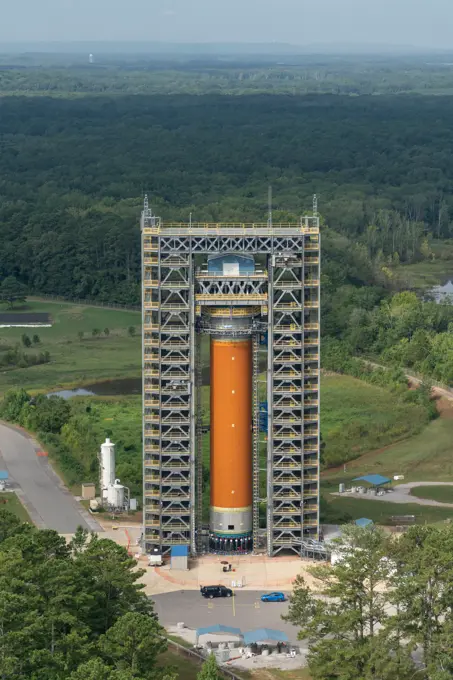
Aerial photograph of MSFC test stand 4693 with the Liquid Hydrogen test article (LH2) in the stand
1848-53878997
NASA's Infinity Science Center. Infinity contains exhibits on 50 years of space exploration and offers bus tours of the nearby Stennis Space Center, Infinity Science Center, Bay St. Louis, Mississippi, United States, North America
6145-45208482
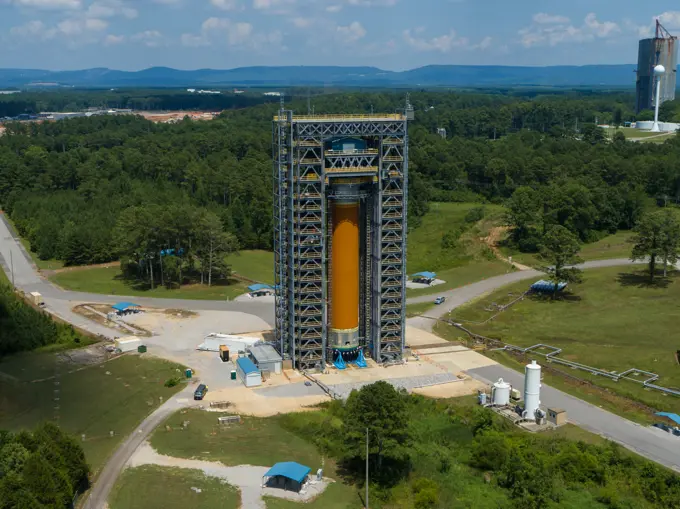
LH2 STA in NASA Marshall Space Flight Center West Test Area Test Stand.
6145-44531796
The Delta II rocket with the THEMIS spacecraft atop sits ready for launch on Pad 17-B at Cape Canaveral Air Force Station in this aerial view of the launch complex area as the mobile service tower begins to move away. THEMIS, an acronym for Time History of Events and Macroscale Interactions during Substorms, consists of five identical probes that will track violent, colorful eruptions near the North Pole. This will be the largest number of scientific satellites NASA has ever launched into orbit aboard a single rocket. The THEMIS mission aims to unravel the mystery behind auroral substorms, an avalanche of magnetic energy powered by the solar wind that intensifies the northern and southern lights. The mission will investigate what causes auroras in the Earths atmosphere to dramatically change from slowly shimmering waves of light to wildly shifting streaks of bright color. Launch is scheduled for 6:05 p.m.
6145-44965440
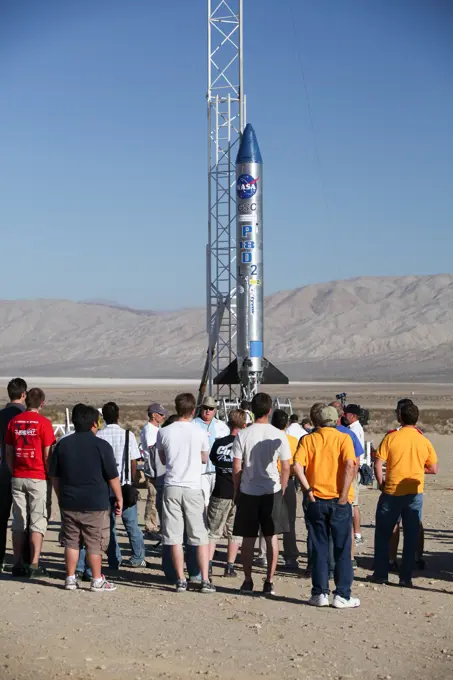
MOJAVE DESERT, Calif. - In the Mojave Desert in California, students and engineers participate in a pre-launch briefing before the lift off of the Garvey Spacecraft Corporation's Prospector P-18D rocket. The rocket is scheduled to launch the RUBICS-1 payload on a high-altitude, suborbital flight. The rocket will carry four satellites made from four-inch cube sections.The rocket reached a peak altitude of about 9,000 feet, however the parachute deployed prematurely and the vehicle continued on its trajectory, coasting and tumbling to a hard landing on its side. In spite of the rough ride, all four CubeSats were recovered. PhoneSat and RUBICS received data in flight, but sustained structural damage. CP-9 and StangSat fared better, and their teams are working to recover as much information as possible. Collectively known as CubeSats, the satellites were designed to record shock, vibrations and heat inside the rocket. The results will be used to prove or strengthen their designs before
6145-44619890
This photograph depicts a view of the test firing of all five F-1 engines for the Saturn V S-IC test stage at the Marshall Space Flight Center. The S-IC stage is the first stage, or booster, of a 364-foot long rocket that ultimately took astronauts to the Moon. Operating at maximum power, all five of the engines produced 7,500,000 pounds of thrust. The S-IC Static Test Stand was designed and constructed with the strength of hundreds of tons of steel and cement, planted down to bedrock 40 feet below ground level, and was required to hold down the brute force of the 7,500,000-pound thrust. The structure was topped by a crane with a 135-foot boom. With the boom in the up position, the stand was given an overall height of 405 feet, placing it among the highest structures in Alabama at the time. When the Saturn V S-IC first stage was placed upright in the stand , the five F-1 engine nozzles pointed downward on a 1,900-ton, water-cooled deflector. To prevent melting damage, water was sprayed
6145-44515846
KENNEDY SPACE CENTER, Fla. --  The STS-98 crew gathers at Launch Pad 39A for a media briefing before continuing their emergency egress training. Facing an audience (foreground) of photographers, videographers and writers are (left to right) Pilot Mark Polansky, Mission Specialist Thomas Jones, Commander Ken Cockrell and Mission Specialists Marsha Ivins and Robert Curbeam. In the background is the Fixed Service Structure with its 80-foot lightning mast on top. The Space Shuttle is hidden behind it. The crew is standing in the landing zone for the slidewire baskets that provide an escape route for personnel aboard the Space Shuttle and orbiter access arm until 30 seconds before launch. They are at KSC to take part in Terminal Countdown Demonstration Test activities, which also include a simulated launch countdown. STS-98 is the seventh construction flight to the International Space Station, carrying as payload the U.S. Lab Destiny, a key element in the construction of the ISS. Launch of
6145-44630314
Expedition 11 Commander Sergei Krikalev, Flight Engineer and NASA Science Officer John Phillips and European Space Agency astronaut Roberto Vittori of Italy ride the elevator to the top of the Soyuz TMA-6 rocket, Friday, April 15, 2005 at the Baikonur Cosmodrome in Kazakhstan.
6145-58968901
Visitors view a full-scale mockup of NASA's Orion crew exploration vehicle during its one-day display Wednesday at StenniSphere, the visitor center at John C. Stennis Space Center. The mockup is used in tests to study the environment for astronauts and recovery crews after an Orion ocean splashdown. It was en route to Johnson Space Center in Houston for the next phase of testing.
6145-45164575
At Vandenberg Air Force Base in California, the gantry rolls back at Space Launch Complex 3 in preparation for the liftoff of NASA's Interior Exploration using Seismic Investigations, Geodesy and Heat Transport, or InSight, Mars lander. The United Launch Alliance Atlas V rocket now is poised to boost the spacecraft with liftoff scheduled for 4:05 a.m. PDT (7:05 a.m. EDT). InSight will be the first mission to look deep beneath the Martian surface. It will study the planet's interior by measuring its heat output and listen for marsquakes. InSight will use the seismic waves generated by marsquakes to develop a map of the planets deep interior. The resulting insight into Mars formation will provide a better understanding of how other rocky planets, including Earth, were created.
6145-58968724
The Orion boilerplate test article inside the well deck of the USS Anchorage during recovery practice operations Aug. 4, 2014. NASA and U.S. Navy practiced recovery techniques off the coast of California, in preparation for Exploration Flight Test-1 (EFT-1). Part of Batch image transfer from Flickr.
6145-45210692
A full-sized, 363-foot Saturn V rocket is projected onto the east face of the Washington Monument 50 years to the day after astronauts Neil Armstrong, Michael Collins, and Buzz Aldrin launched on Apollo 11, the first mission to land astronauts on the Moon, Tuesday, July 16, 2019. On Friday, July 19, and Saturday, July 20, a special 17-minute show, Apollo 50: Go for the Moon” will combine full-motion projection-mapping artwork on the monument and archival footage to recreate the launch of Apollo 11 and tell the story of the first moon landing.
6145-44574854
KENNEDY SPACE CENTER, Fla. -- Reflected in the turn basin at Launch Complex 39 Area, the Space Shuttle Discovery stands atop the crawler-transporter, which carries its cargo at 1 mph to Launch Pad 39B. The vehicle takes about five hours to cover the journey from the Vehicle Assembly Building to the launch pad. Liftoff of Discovery on mission STS-96 is targeted for May 20 at 9:32 a.m. EDT. STS-96 is a logistics and resupply mission for the International Space Station, carrying such payloads as a Russian crane, the Strela; a U.S.-built crane; the Spacehab Oceaneering Space System Box (SHOSS), a logistics items carrier; and STARSHINE, a student-led experiment
6145-45177491
NASA's Kennedy Space Center in Florida observes U.S. Constitution Day, the official birthday of our U.S. government, with the theme "Freedom Needs Space." A remembrance poster made appearances in various locations around the multi-user spaceport, including near the iconic Vehicle Assembly Building. Constitution Day is an American federal observance. It recognizes the adoption of the U.S. Constitution and those who have become U.S. citizens. Constitution Day is observed on Sept. 17, the day in 1787 that delegates to the Constitutional Convention signed the document in Philadelphia.
7050-70037066
USA, Florida, Titusville, Kennedy Space Center, NASA.
6145-44865057
The Soyuz TMA-02M spacecraft is seen at the launch pad after being raised into vertical position on Sunday, June 5, 2011 at the Baikonur Cosmodrome in Kazakhstan. The launch of the Soyuz spacecraft with Expedition 28 Soyuz Commander Sergei Volkov of Russia, NASA Flight Engineer Mike Fossum and JAXA (Japan Aerospace Exploration Agency) Flight Engineer Satoshi Furukawa is scheduled for Wednesday, June 8, 2011.
6145-44639344
KENNEDY SPACE CENTER, FLA. - In the Payload Hazardous Servicing Facility, the two fairing sections close in around the New Horizons spacecraft to encapsulate it. The fairing protects the spacecraft during launch and flight through the atmosphere. Once out of the atmosphere, the fairing is jettisoned.  The compact 1,060-pound New Horizons probe carries seven scientific instruments that will characterize the global geology and geomorphology of Pluto and its moon Charon, map their surface compositions and temperatures, and examine Pluto's complex atmosphere. After that, flybys of Kuiper Belt objects from even farther in the solar system may be undertaken in an extended mission. New Horizons is the first mission in NASA's New Frontiers program of medium-class planetary missions. The spacecraft, designed for NASA by the Johns Hopkins University Applied Physics Laboratory in Laurel, Md., will fly by Pluto and Charon as early as summer 2015.
6145-44482475
A lightning strike was recorded at Launch Complex 39B at NASAs Kennedy Space Center in Florida on Sept. 14, 2022. NASAs Space Launch System (SLS) and Orion spacecraft atop the mobile launcher are in view on the launch pad in preparation for the Artemis I mission. The lightning strike was recorded by cameras stationed at the pad and mobile launcher using a special filter called a “clear day frame,” which provides an overlay of the raw frame on a reference image. Artemis I will be the first integrated test of the SLS and Orion spacecraft. In later missions, NASA will land the first woman and the first woman of color on the surface of the Moon, paving the way for a long-term lunar presence and serving as a steppingstone on the way to Mars.
7003-71254139
France, Midi-Pyrenees Region, Haute-Garonne Department, Toulouse, Cite de l'Espace space park, Russian Soyuz space station
6145-45242310
On the 25th Anniversary of the Apollo-11 space launch, Marshall celebrated with a test firing of the Space Shuttle Main Engine at the Technology Test Bed (SSME-TTB). This drew a large crowd who stood in the fields around the test site and watched as plumes of white smoke verified ignition.
6145-29097202
Inspection tour of NASA installations: Huntsville Alabama, Redstone Army Airfield and George C. Marshall Space Flight Center, 9:35AM. President John F. Kennedy and Vice President Lyndon B. Johnson visit with Director of the George C. Marshall Space Flight Center (MSFC), Dr. Wernher von Braun (center), during a tour of the MSFC at Redstone Arsenal, Huntsville, Alabama. The Saturn C-1 rocket sits in background. President Kennedy visited the MSFC as part of a two-day inspection tour of National Aeronautics and Space Administration (NASA) field installations.
6177-V54005355
6145-55187187
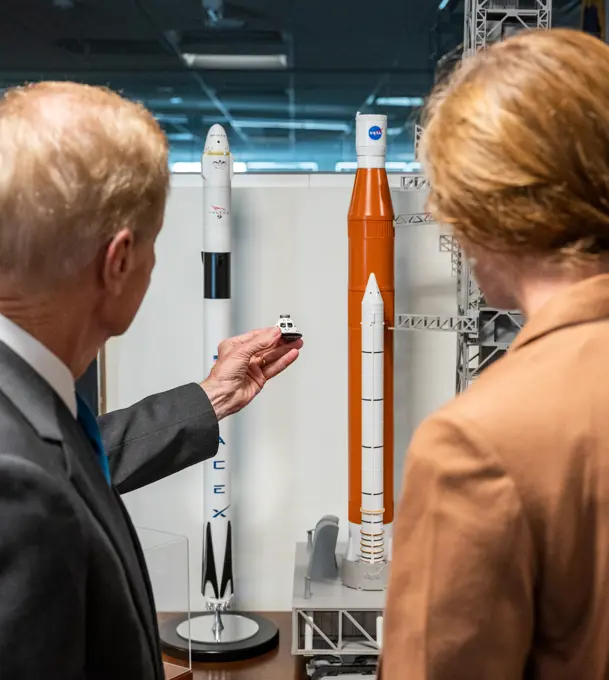
NASA-USAID MoU Signing Ceremony. NASA Administrator Bill Nelson meets with USAID Administrator Samantha Power and staff prior to signing a NASA-USAID Memorandum of Understanding (MoU) Friday, Nov. 4, 2022, at the Mary W. Jackson NASA Headquarters building in Washington. The MoU will enhance and expand the Agencies longstanding partnership that promotes science and technology solutions to address international development challenges in areas such as global health, climate change, food security, disaster mitigation and response, biodiversity conservation, and environmental management for sustainable development.
1848-50962217
Nasa logo in front of Kennedy Space Center, Spaceport, Cape Canaveral, Merritt Island, Florida
6145-45176040
On August 15, 2018 NASA Administrator Jim Bridenstine visited Marshall Space Flight Center. Upon his arrival he was greeted by MSFC Acting Director Jody Singer along with the senior management team. From atop Marshalls Test Stand 4693, NASA Administrator Jim Bridenstine and SLS Stages Integration Manager Tim Flores discuss the capabilities of Marshalls newest test stand. The qualification test version of the liquid hydrogen tank for the Space Launch Systems core stage will be positioned between the stands 221-foot-tall twin towers where it will be pushed, pulled and subjected to the stresses it will endure during liftoff and flight.
6145-45164574
American professional basketball player Chris Bosh poses for a photograph in front of the United Launch Alliance (ULA) Atlas-V rocket with NASA's InSight spacecraft onboard, Friday, May 4, 2018, at Vandenberg Air Force Base in California. Bosh joined other social media guests on a behind the scenes tour ahead of the planned launch. InSight, short for Interior Exploration using Seismic Investigations, Geodesy and Heat Transport, is a Mars lander designed to study the "inner space" of Mars: its crust, mantle, and core.
1899-60969
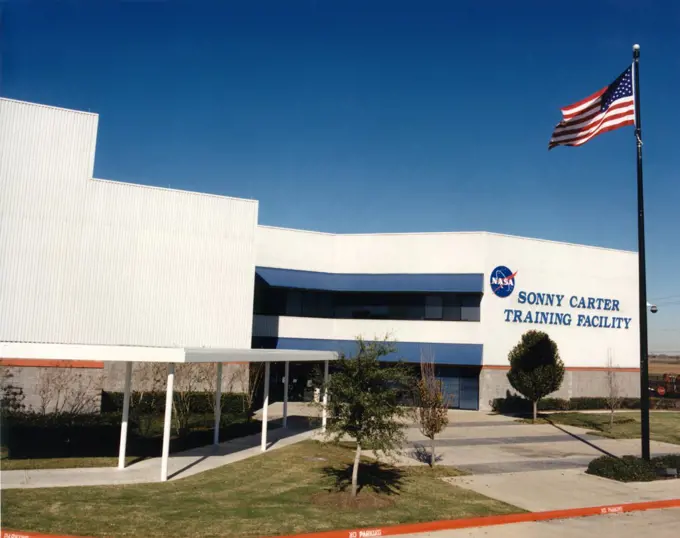
Texas, Houston. Johnson Space Center. Sonny Carter Training Facility
6145-44815972
KSC WEATHER - CLOUDS & FOG WAVEOFF STS-131 LANDING OPPORTUNITY 1
6145-44695918
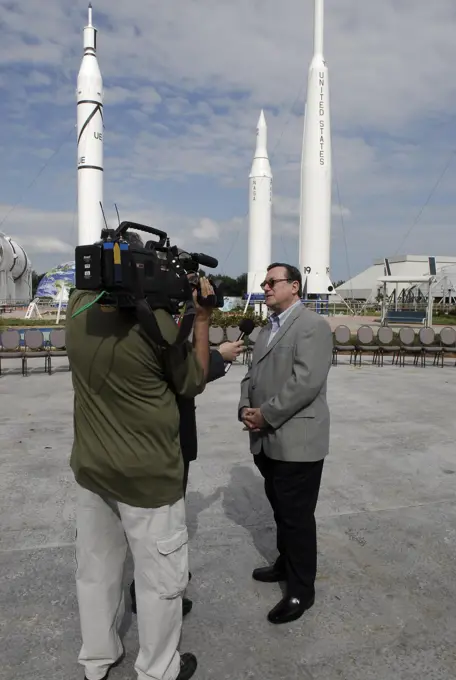
KENNEDY SPACE CENTER, FLA. -- In the rocket garden at NASA's Kennedy Space Center Visitor Complex, Gilles Noghes, ambassador of Monaco, is interviewed.  Noghes is one of The Chiefs of Diplomatic Missions from more than 45 countries who toured various facilities around Kennedy. The visit, one of the largest tours undertaken by the diplomatic corps, is part of the State Department's new Experience America program. The international dignitaries were provided an overview of the United States' space exploration programs and NASA's international cooperation in pursuit of exploration and scientific discovery. They visited various locations at Kennedy, including the Space Station Processing Facility and Launch Pad 39A where space shuttle Atlantis is being prepared for its upcoming mission to the International Space Station.
6145-44859881
Cape Canaveral, Fla. -- The sunrise casts a haze over the Shuttle Landing Facility and the Vehicle Assembly Building at NASA's Kennedy Space Center in Florida, where the arrival of NASA's Mars Science Laboratory (MSL) first three elements are being delivered by an Air Force C-17 cargo plane.The cruise stage, back shell and heat shield, the first flight elements to arrive for the MSL mission, were taken to the Payload Hazardous Servicing Facility (PHSF) located in the KSC Industrial Area to begin processing. The Curiosity rover will arrive next month. A United Launch Alliance Atlas V-541 configuration will be used to loft MSL into space. Curiositys 10 science instruments are designed to search for evidence on whether Mars has had environments favorable to microbial life, including chemical ingredients for life.  The unique rover will use a laser to look inside rocks and release its gasses so that the rovers spectrometer can analyze and send the data back to Earth. MSL is schedule
6145-44533103
KENNEDY SPACE CENTER, Fla. -  The new NASA Administrator Sean O'Keefe poses for the photographer near Launch Pad 39A.  Space Shuttle Columbia is poised on the pad behind him for launch Feb. 28 and mission STS-109.  The administrator was at KSC on an agencywide familiarization tour of NASA field centers.  He was nominated for the position as administrator in November 2001 by President George W. Bush.  He was sworn in Dec. 21 as the agency's 10th chief
6145-58959189
CAPE CANAVERAL, Fla. -- At NASA's Kennedy Space Center in Florida, engineers launched a small rocket as part of Rocket University. The goal was to test its systems and to verify that it performed as designed. The event was supported by the Spaceport Rocketry Association, a 40-year-old organization that provides launch demonstrations and educational programs. As part of Rocket University, the engineers are given an opportunity to work a fast-track project to develop skills in developing spacecraft systems of the future. As NASA plans for future spaceflight programs to low-Earth orbit and beyond, teams of engineers at Kennedy are gaining experience in designing and flying launch vehicle systems on a small scale. Four teams of five to eight members from Kennedy are designing rockets complete with avionics and recovery systems. Launch operations require coordination with federal agencies, just as they would with rockets launched in support of a NASA mission.
6145-44797156
The Soyuz TMA-17 rocket is seen moments after Expedition 22 Soyuz Commander Oleg Kotov of Russia, NASA Flight Engineer Timothy J. Creamer of the U.S., and Flight Engineer Soichi Noguchi of Japan boarded the spacecraft at the Baikonur Cosmodrome in Kazakhstan on Monday, Dec. 21, 2009. Kotov, Creamer and Noguchi launched in their Soyuz TMA-17 rocket from the Baikonur Cosmodrome in Kazakhstan on Monday, Dec. 21, 2009. (
6145-44006113
National Oceanic and Atmospheric Administration - Polar Max Conference
PREVIOUS
of 2
NEXT
2401 S. Ervay, Suite 206
Dallas, Texas 75215
United States
Get Started
Free ResearchMy BoardsMy Cart
For Creators
How To License Your ContentContributor PortalFrame of Mind
Resources
API accessPricing
Contact
+1 866 236 0087help@viewpictures.co.uk Contact form
©2026 View Pictures. All Rights Reserved. -A
This site is protected by reCAPTCHA and Google Privacy Policy and Terms of Service apply.