My Boards
View Pictures
  • My Boards

Saturn's Atmosphere and Rings

Stunning images capturing Saturn's rings and atmosphere, showcasing various moons and weather patterns.
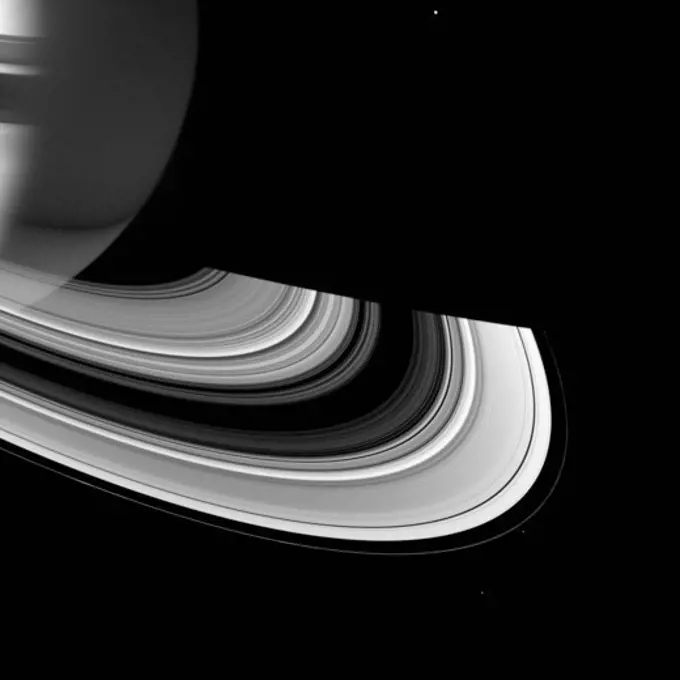
Saturn's Rings and Shadows
196 assets in this story
6145-44745962
Prometheus Emerges
6145-44748303
A Star Shines Through
6145-44658687
The Janus/Epimetheus Ring
4389-231
Close-up of Saturn's Knotted F Ring Seen by Cassini
6145-44564633
This image shows a crescent Uranus, a view that Earthlings never witnessed until Voyager 2 flew near and then beyond Uranus on Jan 24, 1986.
6145-44693098
True Colors
1746-19670995
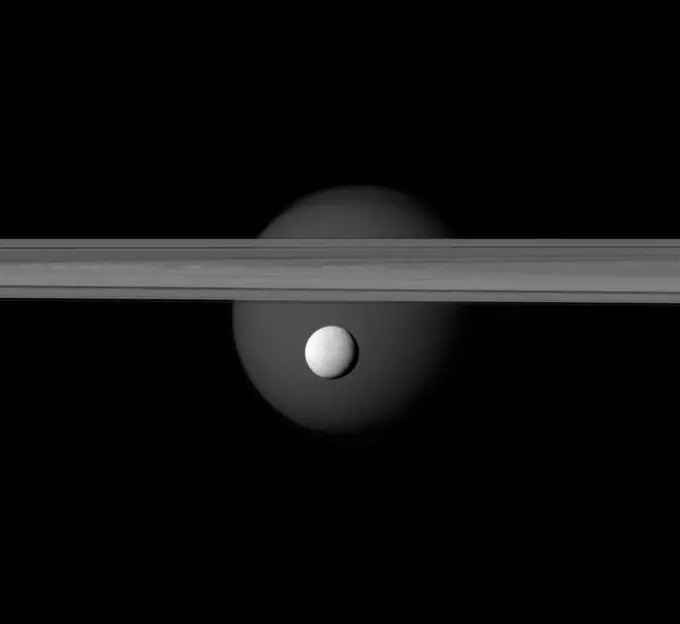
The brightly reflective moon Enceladus appears before Saturn's rings while the larger moon Titan looms in the distance.
6145-44708585
Distant Moon
6145-44631379
Pair to Compare
6145-44662332
A broad and ghostly spoke drifts past under the Cassini spacecraft's gaze. The spoke-forming region of the B ring displays faint longitudinal variations in brightness, from left to right
6145-44610161
Saturn Methane Image
6145-44655560
With Saturn's terminator as a backdrop, this view of the unlit face of the rings makes it easy to distinguish between areas that are actual gaps, where light passes through essentially unimpeded, and areas where the rings block or scatter light
6145-45129711
NASA's Cassini spacecraft zoomed in on Saturn's A ring, revealing narrow, detailed structures that get even finer as the cameras' resolution increases.
6145-45092596
Not all of Saturn's rings are created equal: here the C and D rings appear side-by-side, but the C ring, which occupies the bottom half of this image, clearly outshines its neighbor. This image is from NASA's Cassini spacecraft.
4389-647
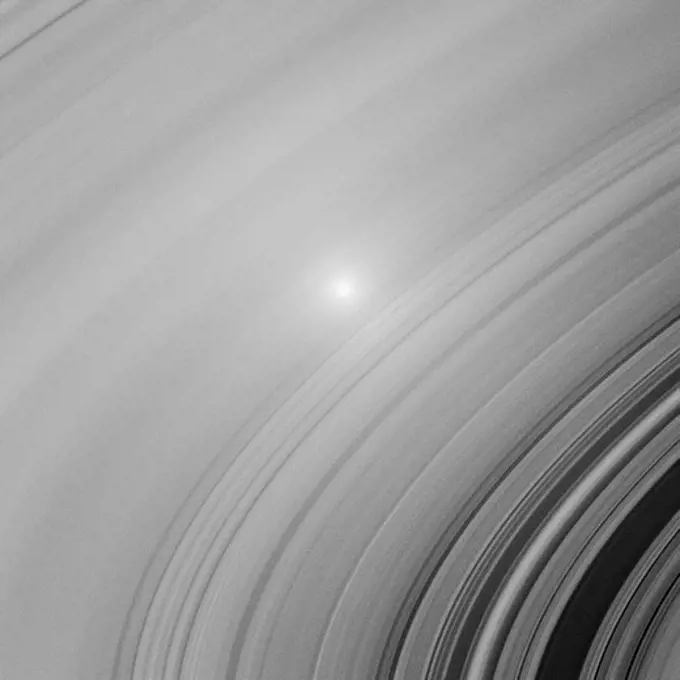
Reflection of the Sun on Saturn's Rings
6145-44822066
Resembling ornaments hanging from Saturn's rings, two moons accent this portrait of the planet captured by NASA's Cassini spacecraft. The moon Enceladus is on the right. Dione is on the left.
1746-19670972
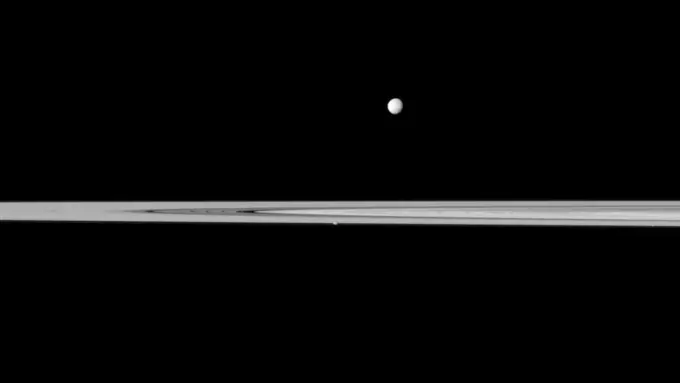
Saturn's small moon Prometheus appears embedded within the planet's rings near the center of this Cassini spacecraft view while the larger moon Mimas orbits beyond the rings.
6145-45036842
The line of Saturn's rings disrupts NASA's Cassini spacecraft's view of the moons Tethys and Titan. Larger Titan is on the left. Tethys is near the center of the image.
6145-44709996
Swirling Storms
6145-44692303
Enceladus in Hiding
6145-44767388
Diminutive Debut
6145-44638637
Rough Sphere of Tethys
6145-45119990
Saturn appears as a serene globe amid tranquil rings in this view from NASA's Cassini spacecraft. In reality, the planet's atmosphere is an ever-changing scene of high-speed winds and evolving weather patterns, punctuated by occasional large storms.
6145-44712972
Polar Clouds on Titan
6145-44886822
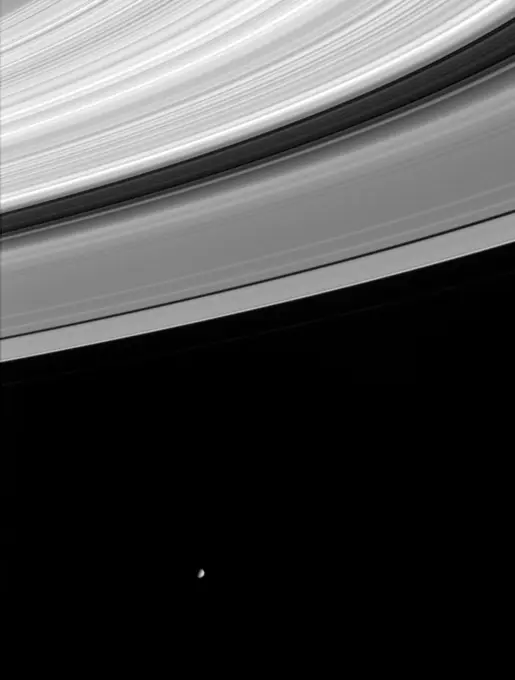
A pair of Saturn's many moons joins the planet in this scene captured by NASA's Cassini spacecraft. Tethys appears as a small white dot above the rings on the far left, Enceladus appears as a smaller bright speck beside the planet.
6145-45135225
Saturn's hexagonal polar jet stream is the shining feature of almost every view of the north polar region of Saturn. The region, in shadow for the first part of NASA's Cassini mission, now enjoys full sunlight.
4389-642
Two of Saturn's Moons Lit by Saturn
6145-44662309
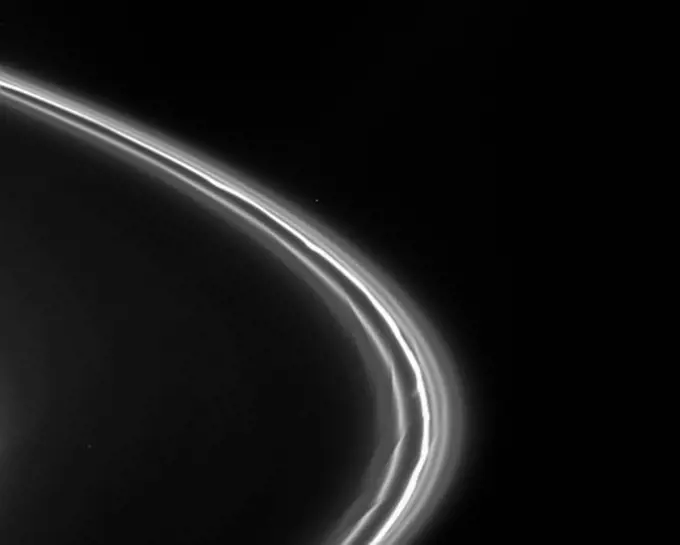
This view shows Prometheus with a streamer it has created in the inner edge of the F ring. Prometheus comes close to the inner edge of the ring once per orbit, perturbing the ring particles there
6145-44668152
This group of spokes in Saturn's B ring extends over more than 5,000 kilometers (3,100 miles) radially across the ringplane
6145-44672035
This Cassini spacecraft view shows details of Saturn's outer A ring, including the Encke and Keeler gaps. The A ring brightens substantially outside the Keeler Gap
6145-45024339
During a flyby of Saturn's moon Enceladus on Oct. 1, 2011, NASA's Cassini spacecraft snapped this portrait of the moon joined by its sibling Epimetheus and the planet's rings.
6145-44662314
The spoke-producing region of the B ring displays fine-scale asymmetry in the azimuthal direction -- the direction along which the ring particles orbit Saturn -- from upper left to lower right across the image
6145-44650421
Saturn's Streamers
6145-44665515
Exposure of Polar Layered Deposits
6145-45042298
Craters appear well defined on icy Rhea in front of the hazy orb of the much larger moon Titan in this view from NASA's Cassini spacecraft.
6145-44967927
The shadows of Saturn's rings edge ever farther southward as Saturn creeps towards southern winter (or northern summer). Saturn is now almost exactly halfway between its equinox (August 2009) and southern winter solstice (in May 2017).
4389-577
Storms Merging on Saturn
6145-44752843
Busy Moon
6145-44775074
This image shows a large impact shown on the bottom left on Jupiter's south polar region captured on July 20, 2009, by NASA's Infrared Telescope Facility in Mauna Kea, Hawaii.
6145-44639602
One Moon Among Billions
6145-44728454
Focus on Enceladus
6145-44749913
Seasons Conceal South Pole Storm
6145-44639631
Small Worlds of Saturn
6145-44789351
NASA's Cassini Orbiter peers toward the distant, icy plains of Saturn's moon Tethys. The planet's A and F rings slice across the top of this view.
6145-44664448
An extreme enhancement of the original image, presented at right, reveals the grainy region with greater clarity
6145-44644600
Structure in the Shadows
6145-44616570
Passage through the Ring Plane
6145-44662026
NASA's Mars Exploration Rover Opportunity used its navigation camera to take the images combined into this stereo view of the rover's surroundings on the 958th sol, or Martian day, of its surface mission (Oct. 4, 2006)
6145-45078809
This image from an animiation of comet C/2013 A1 Siding Spring were taken by the Mast Camera (Mastcam) on NASA's Curiosity Mars rover as the comet passed near the red planet on Oct. 19, 2014.
6145-44674285
Jupiter's High-Altitude Clouds
6145-44571805
Saturn's Faint Inner D-ring
6145-44644064
Haze Layers on Titan
6145-45034452
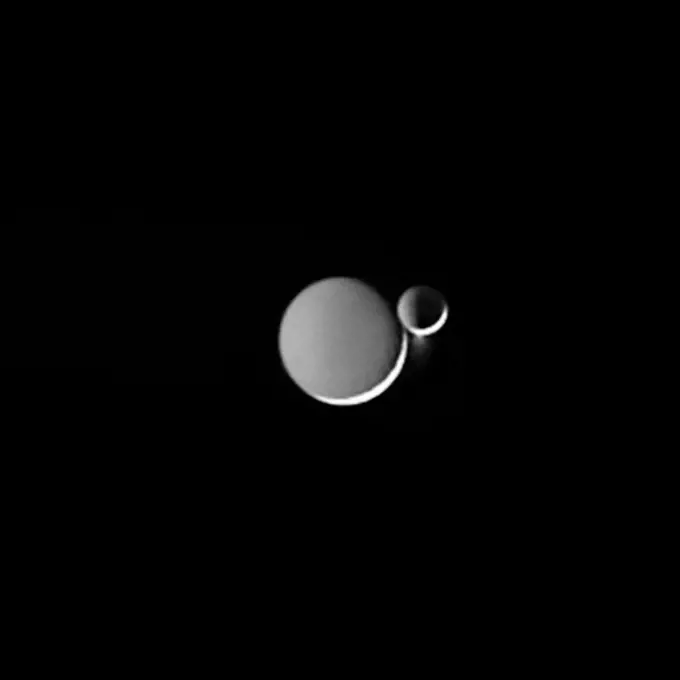
Saturn's largest moon, Titan, appears deceptively small paired here with Dione, Saturn's fourth-largest moon, in this view from NASA's Cassini spacecraft.
6145-44778235
The moon Prometheus casts a shadow on the thin F ring marked with streamer-channels created by the moon in this image taken as Saturn approaches its August 2009 equinox.
4389-516
First View of Janus/Epimetheus Ring
6145-44657342
Prometheus zooms across the Cassini spacecraft's field of view, attended by faint streamers and deep gores in the F ring. This movie sequence of five images shows the F ring shepherd moon shaping the ring's inner edge
6145-44678341
Sunlight scatters through Titan's atmosphere, illuminating high hazes and bathing the entire moon in a soft glow
6145-44546880
These four images of Jupiter and the luminous night-side impact of fragment W of Comet Shoemaker-Levy 9 were taken NASA's Galileo spacecraft on July 22, 1994.
6145-44625108
High in the Titan Atmosphere
6145-45097608
Dione hangs in front of Saturn and its icy rings in this view, captured during Cassini's final close flyby of the icy moon. North on Dione is up.
6145-44628523
New Ring Phenomena
6145-44638465
Titan's Ultraviolet Haze
6145-44769117
The Cassini spacecraft examines the dark region of Senkyo on Saturn's largest moon, Titan. Senkyo is in the center of the image, and it lies just south of the moon's equator.
6145-44505867
Saturn's Shadow Upon the Rings
6145-44778240
A vertically extended structure or object in Saturn's F ring casts a shadow long enough to reach the A ring in this Cassini image taken just days before planet's August 2009 equinox.
6145-44627194
Saturn's Ring Patterns
6145-44645126
This atmospheric close-up shows a bright, somewhat distorted feature in Saturn's southern hemisphere
6145-44806859
NASA's Cassini spacecraft captured dramatic plumes, both large and small, spray water ice out from many locations along the famed 'tiger stripes' near the south pole of Saturn's moon Enceladus.
6145-44658955
Titan's murky atmosphere shines as a halo of scattered light
6145-44470448
The International Space Station flies into an orbital sunset at an altitude of 266 miles above the Atlantic Ocean off the coast of South Africa.
6145-44632704
This image of NASA's Deep Impact's impactor probe was taken by the mission's mother ship, or flyby spacecraft, after the two separated at 11:07 p.m. Pacific time, July 2 (2:07 a.m. Eastern time, July 3), 2005.
6145-44649518
Uncovering Rhea
6145-44566175
This NASA Hubble Space Telescope image of the planet Uranus reveals the planet's rings, at least five of the inner moons, and bright clouds in the planet's southern hemisphere.
6145-44667402
Titan bears a distinct east-west banded pattern in this Cassini spacecraft image taken in the ultraviolet
6145-44636387
Saturnian Meteorology
6145-44769885
The shadow of the moon Tethys stretches across Saturn's A ring before fading into the B ring as the shadow extends towards the lower right of this image.
6145-44644874
Edgy Atlas
6145-44797413
NASA's Cassini spacecraft looks toward the dark side of Saturn's largest moon as a circle of light is produced by sunlight scattering through the periphery of Titan's atmosphere. A detached, high-altitude global haze layer encircles the moon.
6145-45130206
The propeller informally named 'Earhart' is seen in this view from NASA's Cassini spacecraft at much higher resolution than ever before. In this view, half of the Encke Gap is visible as the dark region at right.
6145-45260152
As NASA's Juno spacecraft flew through the narrow gap between Jupiter's radiation belts and the planet during its first science flyby, Perijove 1, on August 27, 2016, the Stellar Reference Unit (SRU-1) star camera collected the first image of Jupiter's ring taken from the inside looking out. The bright bands in the center of the image are the main ring of Jupiter's ring system. While taking the ring image, the SRU was viewing the constellation Orion. The bright star above the main ring is Betelgeuse, and Orion's belt can be seen in the lower right. Juno's Radiation Monitoring Investigation actively retrieves and analyzes the noise signatures from penetrating radiation in the images of the spacecraft's star cameras and science instruments at Jupiter.
6145-44786487
Titan's North Polar Hood
6145-44665199
Science at the Shadow Boundary
6145-44632202
This image shows comet Tempel 1 as seen by NASA's Deep Impact spacecraft on June 20, 2005. The object on the right is a star.
6145-45054130
This view captured by NASA's Cassini spacecraft looks toward the trailing hemisphere of Titan. Titan's south polar vortex mimics the moon itself, creating an elegant crescent within a crescent.
6145-45258133
Cassini gazed toward high southern latitudes near Saturn's south pole to observe ghostly curtains of dancing light -- Saturn's southern auroras, or southern lights. These natural light displays at the planet's poles are created by charged particles raining down into the upper atmosphere, making gases there glow. The dark area at the top of this scene is Saturn's night side. The auroras rotate from left to right, curving around the planet as Saturn rotates over about 70 minutes, compressed here into a movie sequence of about five seconds. Background stars are seen sliding behind the planet. Cassini was moving around Saturn during the observation, keeping its gaze fixed on a particular spot on the planet, which causes a shift in the distant background over the course of the observation. Some of the stars seem to make a slight turn to the right just before disappearing. This effect is due to refraction -- the starlight gets bent as it passes through the atmosphere, which acts as a lens. R
6145-44967084
This frame from an animation shows Phobos, the larger of the two moons of Mars, passing overhead, as observed by NASA's Mars rover Curiosity, centered straight overhead starting shortly after sunset.
6145-58966413
NASA's Cassini spacecraft captures a crescent of Saturn's moon Enceladus. Lit terrain seen here is in the area between the leading hemisphere and Saturn-facing side of Enceladus (504 kilometers, or 313 miles across). North on Enceladus is up.
6145-44496230
This mosaic from NASA's Galileo Probe is of an equatorial 'hotspot' on Jupiter and shows the features of a hazy cloud layer tens of kilometers above Jupiter's main visible cloud deck.
6145-44665748
The bright crescent of Saturn's moon Enceladus slides past distant Rhea in this mutual event, or occultation, movie from Cassini
6145-44724023
The Anthe Arc
6145-45059158
Titan's polar vortex stands illuminated where all else is in shadow in this image from NASA's Cassini spacecraft.
6145-44484140
This collage and animation represent NASA radar observations of near-Earth asteroid 7335 1989 JA on May 26, 2022, one day before it made its closest approach with Earth. The potentially hazardous asteroid came within 2.5 million miles (4 million kilometers) of our planet, or 10.5 times the distance between the Earth and the Moon. Astronomers at NASA's Jet Propulsion Laboratory used the 230-foot (70-meter) radio antenna at the Deep Space Network's Goldstone Deep Space Communications Complex near Barstow, California, to precisely track the asteroid's motion and obtain detailed radar images. 1989 JA is a binary system, consisting of a large asteroid and a significantly smaller satellite asteroid that revolve around each other without touching. The larger asteroid is about 0.4 miles (700 meters) across and shows several topographic features as it rotates. The secondary asteroid, which was discovered this year, is between 100 and 200 meters in diameter and has an orbital period of about 17
6145-44825960
NASA's New Horizons Long Range Reconnaissance Imager (LORRI) observed Neptune on June 23, apl2010, as part of a test of the critical optical navigation Annual Checkout (ACO)-4.
6145-44558059
Deimos
6145-44634798
Filaments and Vortices
6145-44558076
Phobos
PREVIOUS
of 2
NEXT
2401 S. Ervay, Suite 206
Dallas, Texas 75215
United States
Get Started
Free ResearchMy BoardsMy Cart
For Creators
How To License Your ContentContributor PortalFrame of Mind
Resources
API accessPricing
Contact
+1 866 236 0087help@viewpictures.co.uk Contact form
©2026 View Pictures. All Rights Reserved. -A
This site is protected by reCAPTCHA and Google Privacy Policy and Terms of Service apply.