My Boards
View Pictures
  • My Boards

Saturn's Mysteries

Images of Saturn and its moons, highlighting the planet's rings and surface features, captured by the Cassini spacecraft.

Moons that Pass in the Night
160 assets in this story
6145-44645089
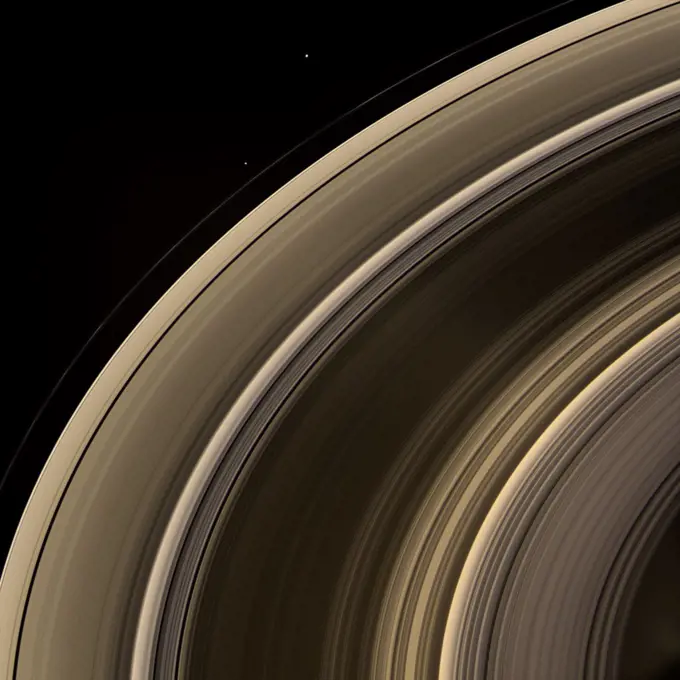
s our robotic emissary to Saturn, the Cassini spacecraft is privileged to behold such fantastic sights as this pairing of two moons beyond the rings. The bright, narrow F ring is the outermost ring structure seen here
6145-45086760
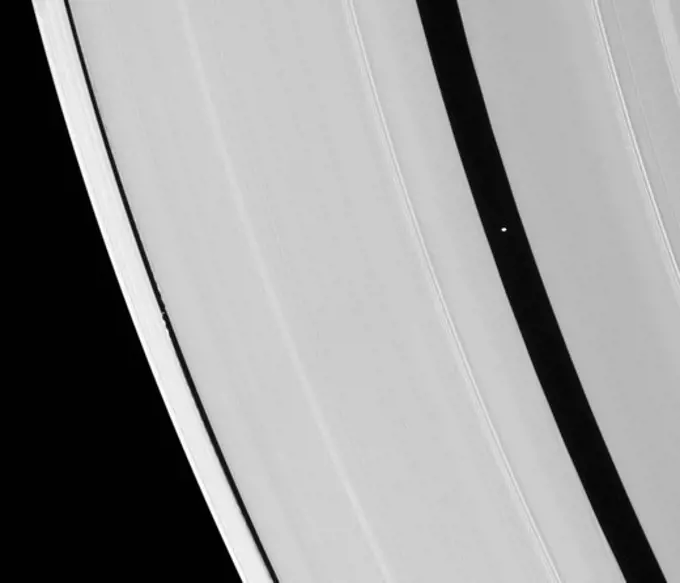
Two masters of their craft are caught at work shaping Saturn's rings captured by NASA's Cassini spacecraft. Pandora (upper right) sculpts the F ring. Meanwhile, Daphnis is busy holding open the Keeler gap (bottom center).
6145-44617573
Rings and Moons
1746-19670948
From on high, the Cassini spacecraft spies a group of three ring moons in their travels around Saturn.
4389-603
Saturn's Rings and Shadow
6145-44665992
North Polar Layered Deposits Exposed Wall
6145-44625391
The Storms Continue
6145-44783955
This mosaic, part of a larger mosaic of images captured by NASA's Cassini Orbiter just hours before exact equinox at Saturn, shows that the spiral corrugation in the planets inner rings continues right up to the inner B ring.
6145-44828100
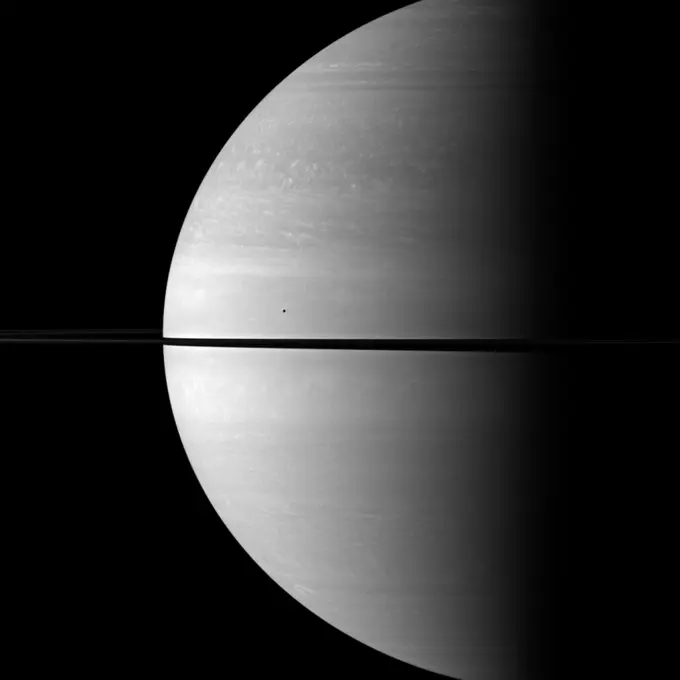
The immense size of Saturn is emphasized in this portrait by NASA's Cassini spacecraft that features the moon Mimas shown in front of the planet. Mimas appears as only a small dot above the rings near the center of the image.
6145-58969916
Prometheus and Pan Pair
6145-44639909
After journeying a bit more than an hour across the Solar System, bright sunlight reflects off the gleaming icy cliffs in the wispy terrain of Dione and is captured by NASA's Cassini spacecraft's cameras several light seconds later
6145-44878625
Saturn's fourth largest moon, Dione, appears like a solitary ornament suspended above the rings in view from NASA's Cassini spacecraft. The rings are closer to Cassini in this view, with Dione more distant.
6145-44617351
Bands and Swirls in Infrared
6145-44638855
When Moons Align
6145-44749361
B Ring's Straw-like Clumps
6145-44623247
Moon and its Flock
6145-45125772
Dione's lit hemisphere faces away from NASA's Cassini spacecraft's camera, yet the moon's darkened surface features are dimly illuminated in this image, due to Saturnshine.
4389-518
New Rings in the Cassini Division
6145-44826487
As Enceladus spews water ice from its south polar region, NASA's Cassini also shows Saturn's faint G ring before the moon.
6145-44795093
This image, taken by NASA's Cassini spacecraft, shows the shadows of two moons as they appear on Saturn, above and below the plane of the planet's rings.
6145-44973771
This image, taken by NASA's Cassini spacecraft, shows A beautiful 'mini-jet' appearing in the dynamic F ring of Saturn. Saturn's A ring (including the Keeler gap and just a hint of the Encke gap at the upper-right) also appears.
6145-44803473
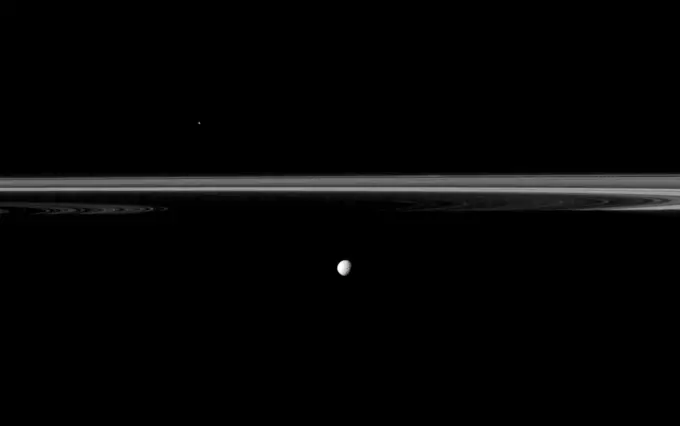
Saturn shares its space with its moon Tethys in this scene captured by NASA's Cassini spacecraft. Tethys can be seen above the rings near the middle of the image. This view looks toward the northern, sunlit side of the rings from just above the ringplane.
6145-44620434
Infrared South Pole
6145-44643291
The Air Up There
6145-45259405
Many of the features seen in Saturn's rings are shaped by the planet's moons. This view from NASA's Cassini spacecraft shows two different effects of moons that cause waves in the A ring and kinks in a faint ringlet. The view captures the outer edge of the 200-mile-wide (320-kilometer-wide) Encke Gap, in the outer portion of Saturn's A ring. This is the same region features the large propeller called Earhart. Also visible here is one of several kinked and clumpy ringlets found within the gap. Kinks and clumps in the Encke ringlet move about, and even appear and disappear, in part due to the gravitational effects of Pan -- which orbits in the gap and whose gravitational influence holds it open. The A ring, which takes up most of the image on the left side, displays wave features caused by Pan, as well as the moons Pandora and Prometheus, which orbit a bit farther from Saturn on both sides of the planet's F ring. This view was taken in visible light with the Cassini spacecraft narrow-ang
6145-44574860
High-resolution View of Saturn's Rings
6145-44831042
A quartet of Saturn's moons are shown with a sliver of the rings in this view from NASA's Cassini spacecraft. From left to right in this image are Epimetheus, Janus, Prometheus, and Atlas.
6145-44632201
Probing Saturn's Atmosphere
4389-539
Moons in the Gaps of Saturn's Rings
6145-44782399
The shadow of the moon Janus dwarfs the shadow of Daphnis on Saturn's A ring in this image taken as the planet approached its August 2009 equinox.
6145-44651350
This MOC image shows layers exposed by erosion in a trough within the north polar residual cap of Mars, diving beneath a younger covering of polar materials
6145-44825496
This image is from a simulation showing the changes to a portion of Saturn's F ring as the shepherding moon Prometheus swings by it. The animation uses data obtained by the imaging cameras aboard NASA's Cassini spacecraft.
6145-44825474
Crisp details on Dione contrast with the haziness of Titan in image from NASA's Cassini spacecraft of a pair of Saturn's moons. Smaller Dione is at the bottom of the image, and that moon's wispy terrain is visible.
6145-44632160
Titan Beyond the Rings
1746-19670990
Saturn's moon Mimas joins the planet's rings which appear truncated by the planet's shadow in this Cassini spacecraft image.
6145-44695864
Field of Moons
6145-44550498
Rings of Jupiter Star Trail
6145-44989987
Taken by NASA's Cassini spacecraft, this image shows Saturn's polar jet stream.
6145-44782677
A wide shadow is cast onto the thin F ring and the A ring by the moon Janus in this image taken as Saturn approached its August 2009 equinox.
6145-44676757
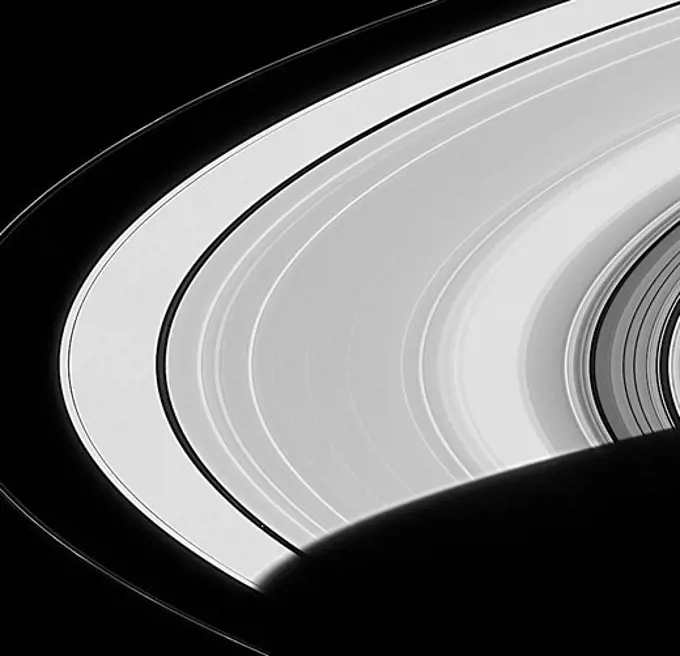
This Cassini spacecraft view shows a group of more than a dozen spokes in Saturn's outer B ring. The B ring displays the azimuthal asymmetry, or variation with longitude around the planet, that is characteristic of the spoke-forming region
6145-45119207
Saturn's clouds are full of raw beauty, but they also represent a playground for a branch of physics called fluid dynamics, which seeks to understand the motion of gases and liquids. This image is from NASA's Cassini spacecraft.
6145-44825746
Saturn is overexposed in this image taken by NASA's Cassini spacecraft in order to show the dim rings. Pandora (below rings to the left) has been brightened by a factor of 1.3 relative to the planet and the rings to enhance its visibility.
6145-44812291
Although the sun is on the other side of Saturn in this dramatic image, some sunlight scatters through the uppermost part of the atmosphere to reach NASA's Cassini spacecraft's cameras.
6145-44822605
A pair of small moons join Saturn's second largest moon in this NASA Cassini spacecraft image spotlighting Rhea in front of the rings. Janus is seen beyond the rings on the right and Prometheus is visible between the main rings and thin F ring on left.
6145-44613066
Merging Saturnian Storms
6145-44827582
Saturn's moon Rhea is gently lit in front of a background of the planet with a wide shadow cast by the rings which are seen nearly edge-on in this image captured by NASA's Cassini spacecraft.
6145-44573927
Saturn's F-ring and Inner Satellite
4389-531
Detail of Saturn's Rings
6145-44632962
Solar EclipsesDaily
4389-1086
Saturn's F Ring and Mimas as Seen by Cassini
6145-45076850
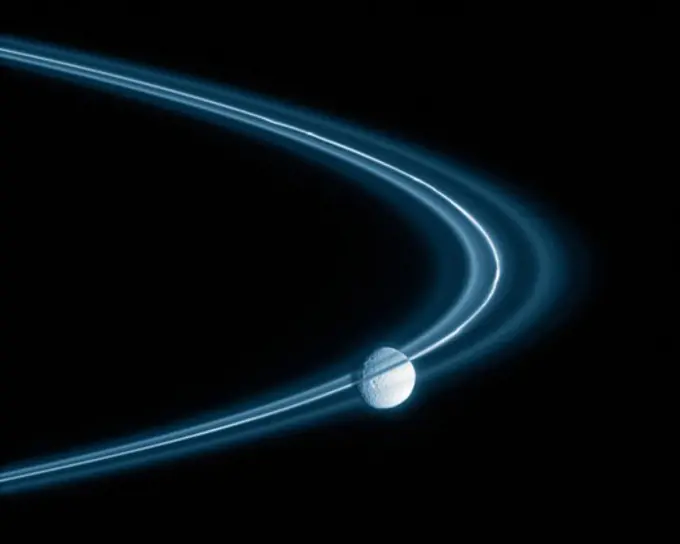
Like a drop of dew hanging on a leaf, Tethys appears to be stuck to the A and F rings from this perspective of NASA's Cassini spacecraft.
6145-45260690
Reflected sunlight is the source of the illumination for visible wavelength images such as the one above. However, at longer infrared wavelengths, direct thermal emission from objects dominates over reflected sunlight. This enabled instruments that can detect infrared radiation to observe the pole even in the dark days of winter when Cassini first arrived at Saturn and Saturn's northern hemisphere was shrouded in shadow. Now, 13 years later, the north pole basks in full sunlight. Close to the northern summer solstice, sunlight illuminates the previously dark region, permitting Cassini scientists to study this area with the spacecraft's full suite of imagers. This view looks toward the northern hemisphere from about 34 degrees above Saturn's ringplane. The image was taken with the Cassini spacecraft wide-angle camera on April 25, 2017 using a spectral filter which preferentially admits wavelengths of near-infrared light centered at 752 nanometers. The view was acquired at a distance of
6145-44882881
The shadow of the moon Mimas creates a smudge on the southern hemisphere of Saturn in this view from NASA's Cassini spacecraft. Mimas does not appear here, but it does cast its shadow on the planet in the lower left of the image.
6145-44546881
This view of pale blue-green Uranus was recorded by NASA's Voyager 2 on Jan 25, 1986, as the spacecraft left the planet behind. The thin crescent of Uranus is seen here between the spacecraft, the planet and the Sun.
4129-1682
Halo X-Ray
6145-44704574
Saturn's Watch Spiral
6145-44573930
Spokes on Side of Saturn's Rings
6145-44789861
NASA's Cassini Orbiter captures a far-off view of the two-toned surface of Saturn's moon, Iapetus.
6145-44944894
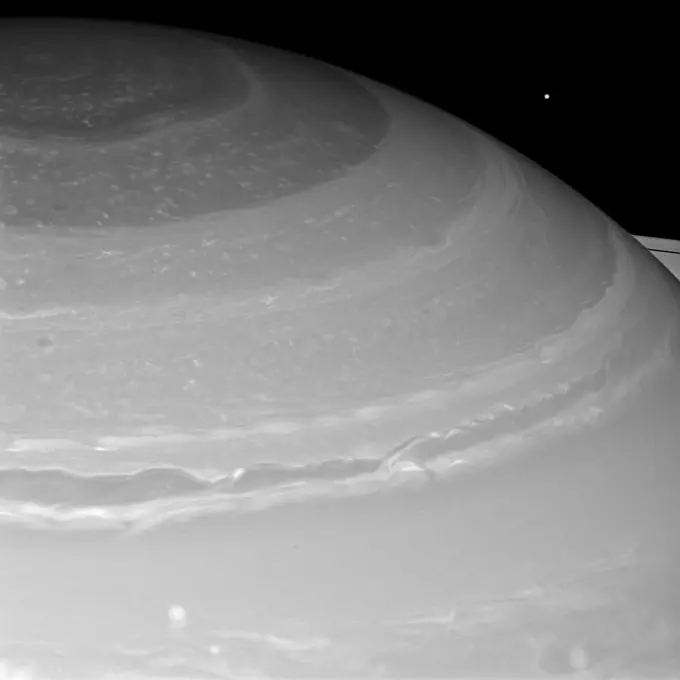
Saturn and its north polar hexagon dwarf Mimas as the moon peeks over the planet's limb. Saturn's A ring also makes an appearance on the far right. Mimas is 246 miles (396 kilometers) across.
6145-45258362
This view of Saturn's A ring features a lone propeller -- one of many such features created by small moonlets embedded in the rings as they attempt, unsuccessfully, to open gaps in the ring material. The image was taken by NASA's Cassini spacecraft on Sept. 13, 2017. It is among the last images Cassini sent back to Earth. The view was taken in visible light using the Cassini spacecraft wide-angle camera at a distance of 420,000 miles (676,000 kilometers) from Saturn. Image scale is 2.3 miles (3.7 kilometers).
PREVIOUS
of 2
NEXT
2401 S. Ervay, Suite 206
Dallas, Texas 75215
United States
Get Started
Free ResearchMy BoardsMy Cart
For Creators
How To License Your ContentContributor PortalFrame of Mind
Resources
API accessPricing
Contact
+1 866 236 0087help@viewpictures.co.uk Contact form
©2026 View Pictures. All Rights Reserved. -A
This site is protected by reCAPTCHA and Google Privacy Policy and Terms of Service apply.