My Boards
View Pictures
  • My Boards

Saturn's Rings and Dynamics

Stunning images of Saturn's rings captured by Cassini, highlighting the interactions within the rings and features like F ring dynamics.

Gravity-Induced Undulations
180 assets in this story
6145-45084855
NASA's Cassini orbiter shows Saturn's main rings, seen here on their 'lit' face, appear much darker than normal. That's because they tend to scatter light back toward its source -- in this case, the Sun.
6145-44778238
As Saturn approaches its August 2009 equinox, a shadow is cast by a narrow, vertically extended feature in the F ring.
6145-44800558
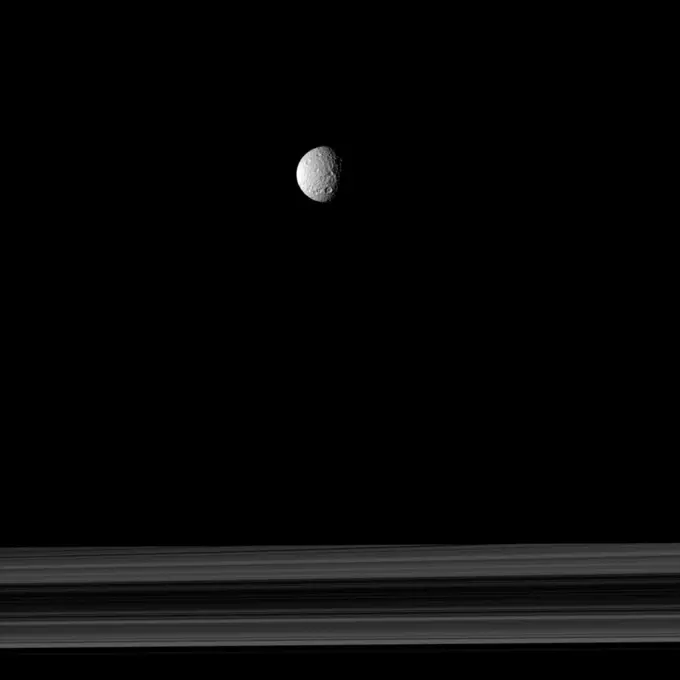
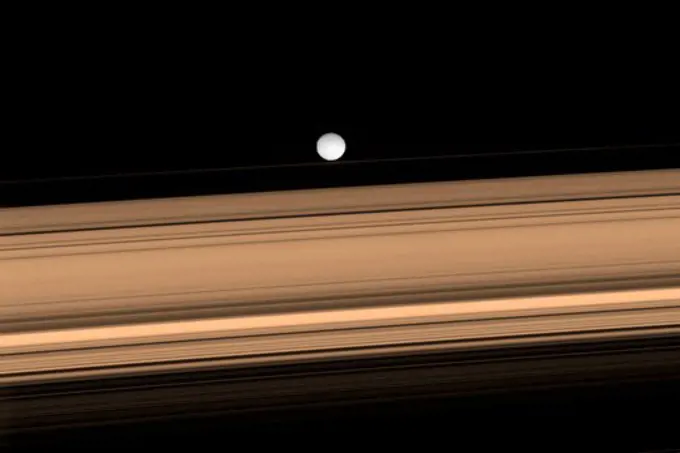
The cratered moon Mimas appears as if it has been hung like an ornament above Saturn's rings in this image taken by NASA's Cassini spacecraft.
6145-44640958
Moons in Perspective
1746-19670950
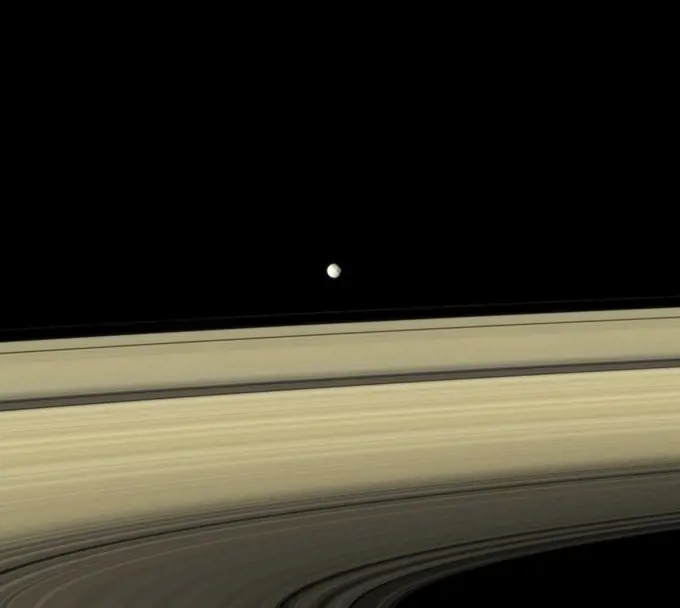
Mimas appears to hover above the colorful rings. Cassini.
6145-44635581
Unidentified F Ring Objects
6145-44748024
Moons in a Row
6145-45261228
From high above Saturn's northern hemisphere, NASA's Cassini spacecraft gazes over the planet's north pole, with its intriguing hexagon and bullseye-like central vortex. Saturn's moon Mimas is visible as a mere speck near upper right. At 246 miles (396 kilometers across) across, Mimas is considered a medium-sized moon. It is large enough for its own gravity to have made it round, but isn't one of the really large moons in our solar system, like Titan. Even enormous Titan is tiny beside the mighty gas giant Saturn. This view looks toward Saturn from the sunlit side of the rings, from about 27 degrees above the ring plane. The image was taken in green light with the Cassini spacecraft wide-angle camera on March 27, 2017. The view was acquired at a distance of approximately 617,000 miles (993,000 kilometers) from Saturn. Image scale is 37 miles (59 kilometers) per pixel. Mimas' brightness has been enhanced by a factor of 3 in this image to make it easier to see.
6145-44807932
The shadow of Saturn's moon Dione, cast onto the planet, is elongated in dramatic fashion in this image captured by NASA's Cassini spacecraft. The moon itself does not appear here, but the shadow can be seen south of the ringplane.
6145-44835292
NASA's Cassini spacecraft looks between Saturn's A and B rings to spy structure in the Cassini Division. The Cassini Division, occupying the middle and left of the image, contains five dim bands of ring material, but not all of the division is shown here.
6145-44710268
Streaming Away
6145-44631908
Looking Through the Rings
6145-44639584
Close to the Shepherd Moons
6145-44810801
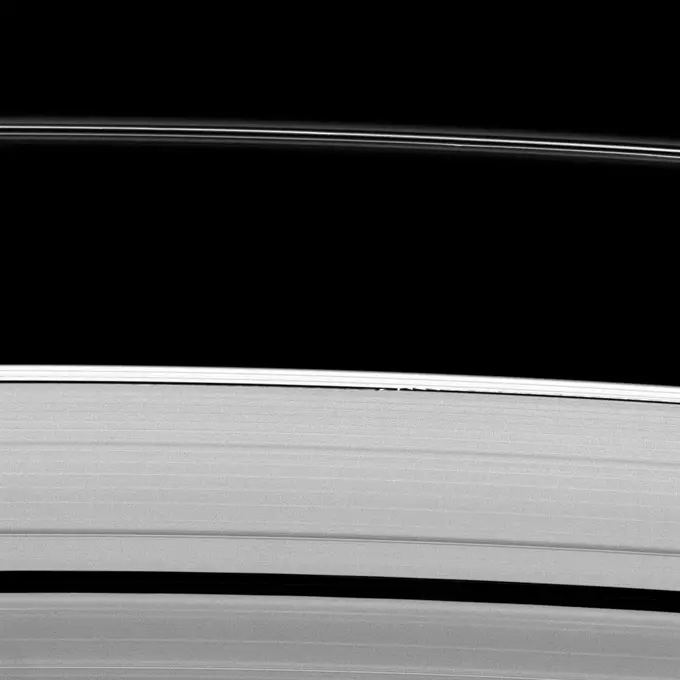
Saturn's moon Pan, orbiting in the Encke Gap near the top of the image, casts a short shadow on the A ring in this image taken by NASA's Cassini spacecraft about six months after the planet's August 2009 equinox.
6145-44795844
From just above the plane of Saturn's rings, NASA's Cassini spacecraft snapped this shot of Saturn two months after Saturn's August 2009 equinox, showing the shadow of its rings as a narrow band on the planet.
6145-45094171
NASA's Cassini imaging scientists processed this view of Saturn's moon Dione, taken during a close flyby on June 16, 2015. This was Cassini's fourth targeted flyby of Dione.
6145-44665736
Multiple jets of icy particles are blasted into space by the active venting on Saturn's moon Enceladus
6145-44784446
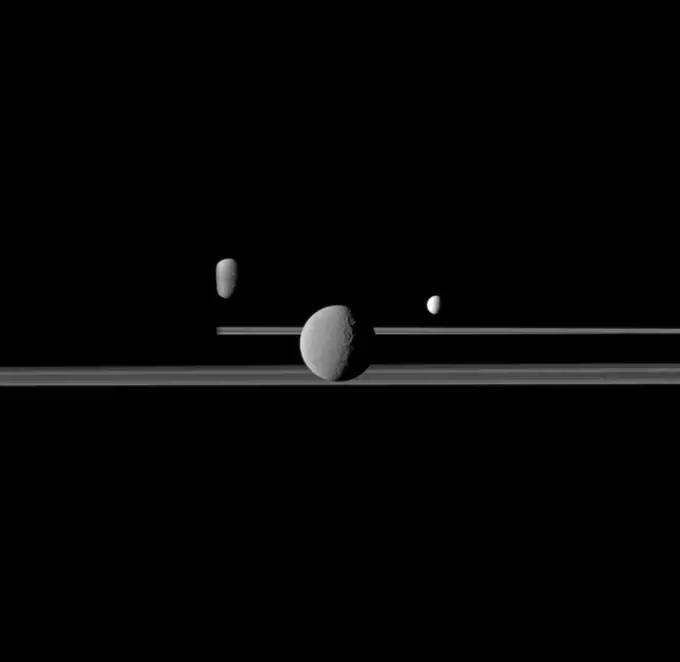
Beyond the ansa of Saturn's rings, a crescent Rhea completes this ring-and-moon composition captured by NASA's Cassini spacecraft.
6145-45087540
Tiny Epimetheus is dwarfed by adjacent slivers of the A and F rings in this image from NASA's Cassini spacecraft.
6145-44696147
Coming to Light
6145-44660762
The two prominent dark gaps in Saturn's A ring contain small embedded moons and a host of other intriguing features
6145-44638451
Dione and Pandora
6145-44992150
Winter is approaching in the southern hemisphere of Saturn and with this cold season has come the familiar blue hue that was present in the northern winter hemisphere at the start of NASA's Cassini mission.
6145-44685643
Window Into Worlds
1746-19670971
The Cassini spacecraft observes three of Saturn's moons set against the darkened night side of the planet. Rhea, Enceladus and Dione.
6145-44505870
Saturn's F-Ring
6145-44911814
NASA's Cassini spacecraft captures Saturn's ever-changing F ring, showing its bright core, another strand of ring material, and a breakaway clump of material close to the core.
6145-45261225
Before NASA's Cassini entered its Grand Finale orbits, it acquired unprecedented views of the outer edges of the main ring system. For example, this close-up view of the Keeler Gap, which is near the outer edge of Saturn's main rings, shows in great detail just how much the moon Daphnis affects the edges of the gap. Daphnis creates waves in the edges of the gap through its gravitational influence. Some clumping of ring particles can be seen in the perturbed edge, similar to what was seen on the edges of the Encke Gap back when Cassini arrived at Saturn in 2004. This view looks toward the sunlit side of the rings from about 3 degrees above the ring plane. The view was acquired at a distance of approximately 18,000 miles (30,000 kilometers) from Daphnis and at a Sun-Daphnis-spacecraft, or phase, angle of 69 degrees. Image scale is 581 feet (177 meters) per pixel. The image was taken in visible light with the Cassini spacecraft narrow-angle camera on Jan. 16, 2017.
6145-44635977
Three Views of Saturn (Animation)
6145-45088065
Many color images are taken by NASA's Cassini spacecraft in red light so scientists can study the often subtle color variations of Saturn's rings. These variations may reveal clues about the chemical composition and physical nature of the rings.
6145-45083320
Although solid-looking in many images, NASA's Cassini orbiter shows that Saturn's rings are actually translucent. In this picture, we can glimpse the shadow of the rings on the planet through the A and C rings themselves, towards the lower right corner.
6145-44636131
Clumps for Encke
4389-537
Two Moons of Saturn
4389-1089
Mimas Above Rings of Saturn, as Seen by Cassini
6145-44871896
Saturn's small, potato-shaped moon Prometheus appears embedded within the planet's rings near the center of this view from NASA's Cassini spacecraft while the larger moon Mimas orbits beyond the rings.
6145-44638548
Captivating Dione
6145-44667086
The Cassini spacecraft continues to observe brightness variations along the orbital direction within Saturn's B ring
6145-44632423
Revealing Pan's Influence
6145-44665519
Layering in North Polar Layered Deposits
6145-45252543
Atmospheric features in Saturn's north polar region are revealed in spectacular detail in this Cassini image, taken in the near infrared spectral region, where methane gas is not very absorbing. The dark shadows of Saturn's rings drape across the planet, creating the illusion of atmospheric bands. Dots of bright clouds give the appearance that this is an active place. The image was taken with the Cassini spacecraft wide angle camera on Dec. 14, 2004, at a distance of 717,800 kilometers (446,100 miles) from Saturn through a filter sensitive to wavelengths of infrared light centered at 939 nanometers. The image scale is about 43 kilometers (27 miles) per pixel. http //photojournal.jpl.nasa.gov/catalog/PIA06567
6145-44967379
The shepherd moon Pan orbits Saturn in the Encke gap while the A ring surrounding the gap displays wave features created by interactions between the ring particles and Saturnian moons in this image from NASA's Cassini spacecraft.
6145-44783956
An unusually large propeller feature is detected just beyond the Encke Gap in this Cassini image of Saturns outer A ring taken a couple days after the planets August 2009 equinox.
6145-44700419
Inspecting the Edge
6145-44666299
The Cassini spacecraft stares toward Saturn through its gauzy veil of rings. The great ice-particle screen acts like a filter here, attenuating the glare from the planet and making its high altitude haze easy to see
6145-44823899
Saturn's brightly lit rings slice across this NASA Cassini spacecraft picture taken before a backdrop of the planet's clouds.
6145-44834033
The moon Mimas casts a shadow and creates a single blemish on the kingly crescent of Saturn. Mimas is not shown in this view, but its shadow can be seen on the planet just north of the rings and their shadow.
6145-44730865
Enceladus Oct. 9, 2008 Flyby - Posted Image #5
6145-44873596
NASA's Cassini spacecraft examines Titan's north polar hood, the part of the atmosphere of Saturn's largest moon appearing dark at the top of this image.
6145-44665985
With the Sun directly behind Cassini, the spacecraft spies the opposition surge in Saturn's inner A ring. The opposition effect becomes visible from this special viewing geometry
6145-44644853
Rhea Beyond the Rings
6145-44780049
The shadows of Saturn's rings appear as a narrow band on the planet in this image taken as Saturn approaches its August 2009 equinox.
6145-44638551
On Approach to Dione
6145-45108050
At first glance, Saturn's rings appear to be intersecting themselves in an impossible way. In actuality, this view from NASA's Cassini spacecraft shows the rings in front of the planet, upon which the shadow of the rings is cast.
6145-44639634
Slicing Through Dione
4389-580
Saturn's Rings and Moons
1746-19670988
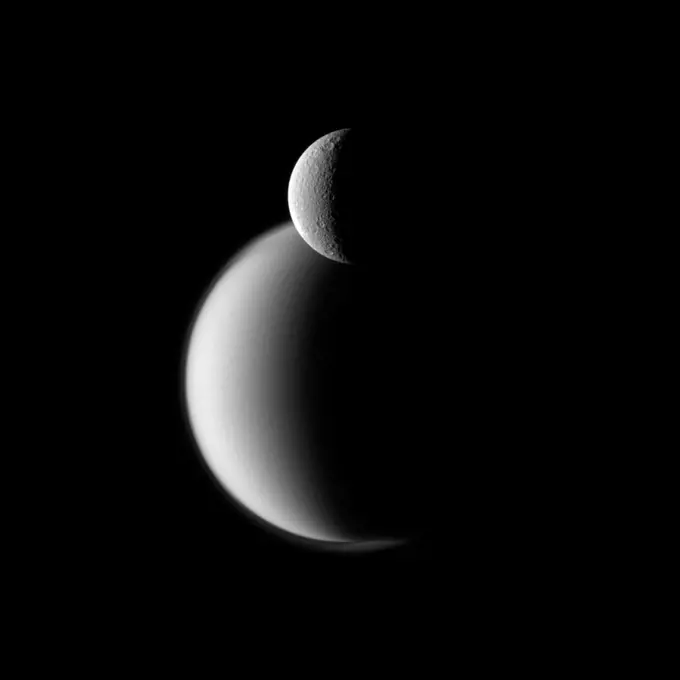
Craters appear well defined on icy Rhea in front of the hazy orb of the much larger moon Titan in this Cassini spacecraft view of these two Saturn moons.
6145-44629046
Art and Science
6145-44809191
Saturn's rings and its moon Rhea are imaged before a crescent of the planet in this image captured by NASA's Cassini spacecraft. The shadows of the rings continue to grow wider after their disappearing act during the planet's August 2009 equinox.
6145-44616594
Two pairs of dark spots, or storms, in Saturn's atmosphere squeeze past each other as they dance around the planet. In this group of four storms, the top left and lower right storms are fringed with white clouds as seen by NASA's Cassini spacecraft.
6145-44640379
Whiffs of cloud dance in Saturn's atmosphere, while the dim crescent of Rhea (1,528 kilometers, or 949 miles across) hangs in the distance.The dark ringplane cuts a diagonal across the top left corner of this view
6145-44637434
The Cassini Division's Edge
6145-44808410
NASA's Cassini spacecraft records Titan's seasonal hemispheric dichotomy, with the moon's northern half appearing slightly lighter than the southern half in this image.
6145-45075863
Although it looks like a simple hexagon, this feature surrounding Saturn's north pole is really a manifestation of a meandering polar jet stream. This image was taken by NASA's Cassini spacecraft.
6145-44630845
Straight Across the Rings
6145-44891141
Light and dark halves of Titan are visible in this image from NASA's Cassini spacecraft which illustrates the seasonal changes in the northern and southern hemispheres.
6145-44777202
As Saturn's equinox continues to approach, the moon Pan casts a slightly longer shadow on the A ring.
1746-19670982
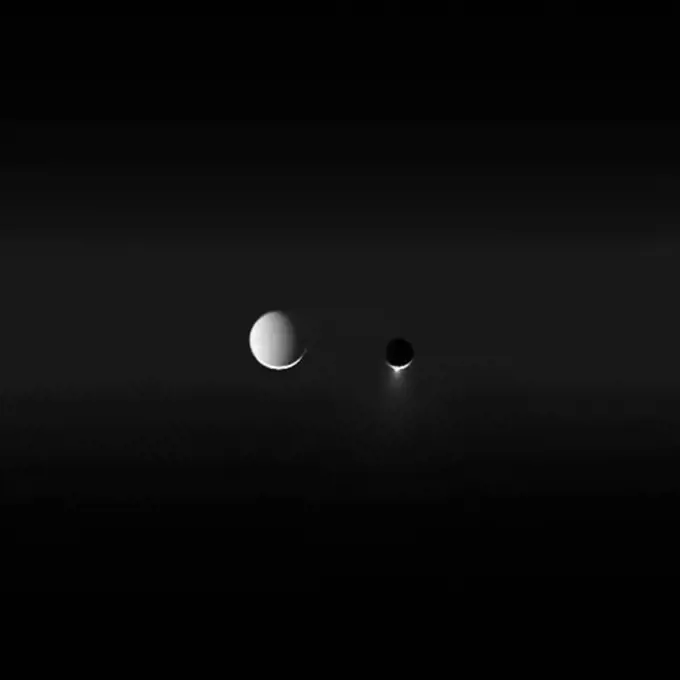
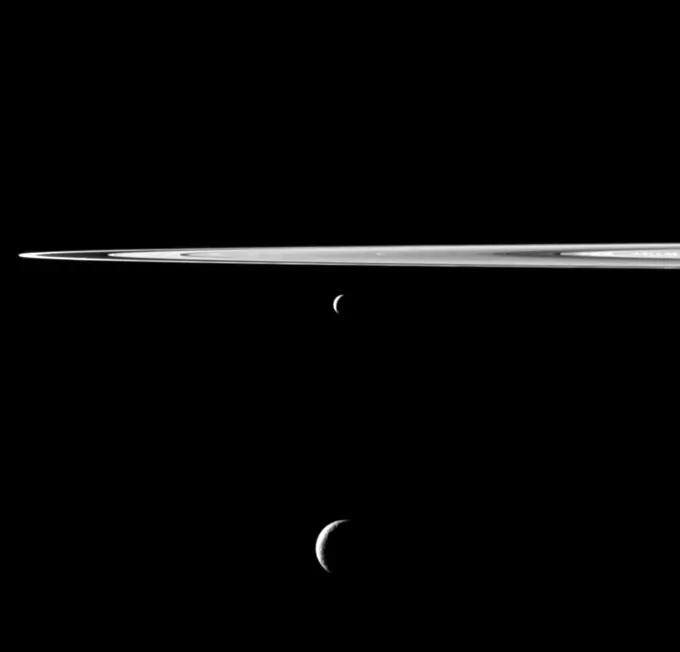
A pair of Saturn's moons appears as if hung below the planet's rings in this Cassini spacecraft view. Enceladus and Tethys.
6145-44661225
Edge waves in the Keeler Gap betray the presence of the embedded moon Daphnis. At left lies the brilliant F ring with its flanking strands
6145-44897123
Saturn's moon Enceladus is partially eclipsed by the planet in this view from NASA's Cassini spacecraft which also features the moon Titan in the distance.
6145-44855531
NASA's Cassini spacecraft looks past the cratered south polar area of Saturn's moon Rhea to spy the moon Dione and the planet's rings in the distance. Dione's 'wispy' terrain can be seen on the trailing hemisphere of that moon.
6145-44655050
Flattened Crescent
6145-44674019
Titan's fast-rotating atmosphere creates circumpolar bands in the north
6145-44770382
The Cassini spacecraft looks down on Titan's north pole and unveils the moon's upper-most atmospheric hazes, creating the appearance of a halo around Saturn's largest moon.
6145-44668639
Looking toward high northern latitudes on Titan, the Cassini spacecraft spies a banded pattern encircling the pole
6145-44645597
Gaseous Saturn rotates quickly -- once every approximately 10.8 hours -- and its horizontal cloud bands rotate at different rates relative to each other
6145-44670223
This view of Titan taken on Feb. 25, 2007, reveals a giant lake-like feature in Titan's North Polar Region
6145-44636157
Faint Southern Clouds
6145-44610737
In this five-minute exposure taken from the surface of Mars by NASA's Spirit rover, stars appear as streaks due to the rotation of the planet, and instantaneous cosmic-ray hits appear as points of light.
6145-45135458
This view from NASA's Cassini spacecraft is the sharpest ever taken of belts of the features called propellers in the middle part of Saturn's A ring. The propellers are the small, bright features that look like double dashes.
6145-44626702
Cassini Snaps Image of ESA's Huygens Probe
PREVIOUS
of 2
NEXT
2401 S. Ervay, Suite 206
Dallas, Texas 75215
United States
Get Started
Free ResearchMy BoardsMy Cart
For Creators
How To License Your ContentContributor PortalFrame of Mind
Resources
API accessPricing
Contact
+1 866 236 0087help@viewpictures.co.uk Contact form
©2026 View Pictures. All Rights Reserved. -A
This site is protected by reCAPTCHA and Google Privacy Policy and Terms of Service apply.