My Boards
View Pictures
  • My Boards

Solar Activity and Flare Phenomena

Images of the Sun showcasing dynamic solar flares, plasma arcs, and coronal holes, highlighted in vibrant hues of orange and yellow. Observed in extreme ultraviolet light.

Satellite view of solar flares
108 assets in this story
6188-66494674
Solar energy A Glowing floaing above a hand. Sun images provided by NASA. Copyright: xZoonar.com/J.xSandvikx 2518500
1848-64410983
Transits of Mercury, Mercury Transit in Front of the Sun
6145-45261190
Coronal mass ejections were popping out from the Sun at a pace of two per day on average (Apr. 18-23, 2013). We counted ten CMEs for the five days, but some of the eruptions were complex and difficult to differentiate from one another. Almost all of them blew particles out to the left, most of them probably originating from the same active region. These were taken by the STEREO (Ahead) spacecraft s coronagraph, in which the black disk blocks the Sun (represented by the white circle) so that we can observe the fainter features beyond it.
1525-25396251
Unknown fiery planet on a dark blue background
4389-1658
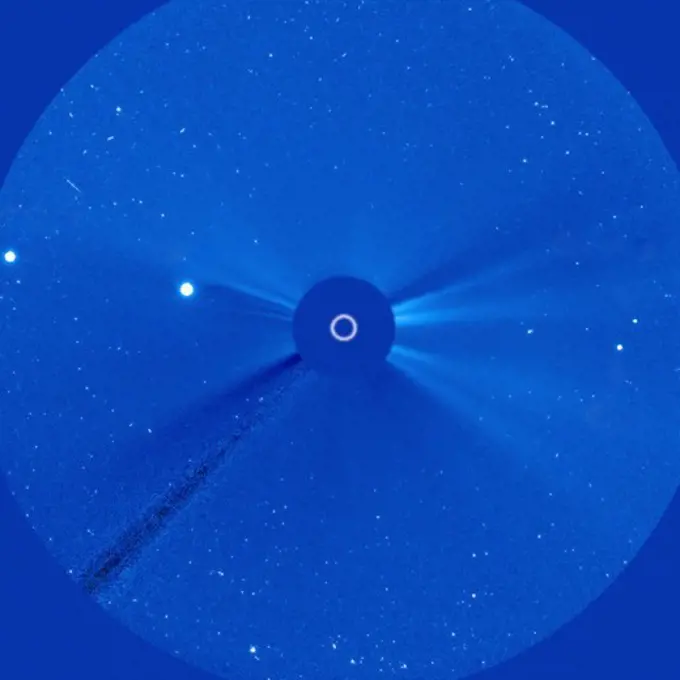
The three other inner planets and Jupiter are visible with the light of the Sun blocked by Solar and Heliospheric Observatory (SOHO)'s LASCO C3 coronagraph. The white circle represents the size and position of the Sun; the blue disk hides the corona. The planets are, left of the Sun and heading inwards, Jupiter and Venus.  To the right are Mercury (farther out toward the edge) and Mars just below it.
4128R-5985
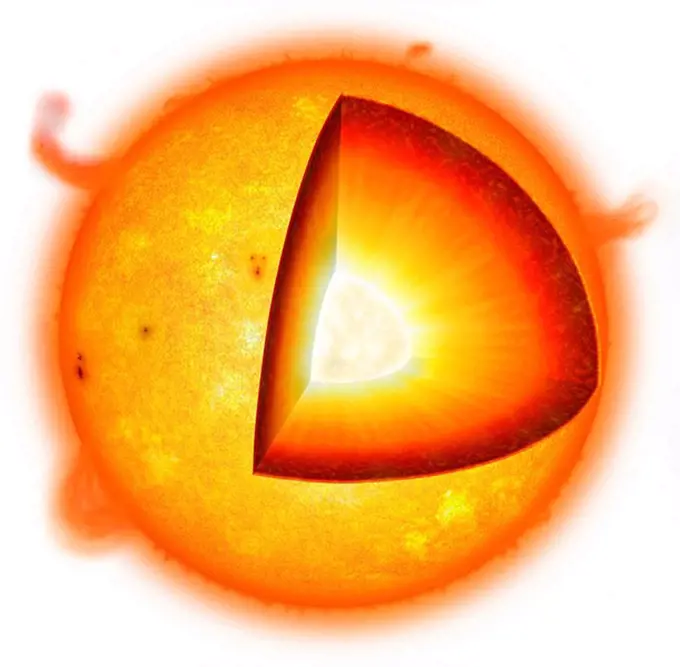
Solar interior, computer artwork.
4239-57493442
Comparing the size of the Sun at aphelion and perihelion (split sun view).
6145-45263600
This computer-generated image shows the structure of the cyclonic pattern observed over Jupiter's south pole. Like in the North, Jupiter's south pole also contains a central cyclone, but it is surrounded by five cyclones with diameters ranging from 3,500 to 4,300 miles (5,600 to 7,000 kilometers) in diameter. Almost all the polar cyclones (at both poles), are so densely packed that their spiral arms come in contact with adjacent cyclones. However, as tightly spaced as the cyclones are, they have remained distinct, with individual morphologies over the seven months of observations detailed in the paper. The data used in generating this image was collected by the Jovian Infrared Auroral Mapper (JIRAM) instrument aboard the Juno spacecraft during the fourth Juno pass over Jupiter on Feb. 2, 2017. JIRAM is able to collect images in the infrared wavelengths around 5 micrometers (µm) by measuring the intensity of the heat coming out of the planet. The heat from the planet is radiated to spac
PREVIOUS
of 2
NEXT
2401 S. Ervay, Suite 206
Dallas, Texas 75215
United States
Get Started
Free ResearchMy BoardsMy Cart
For Creators
How To License Your ContentContributor PortalFrame of Mind
Resources
API accessPricing
Contact
+1 866 236 0087help@viewpictures.co.uk Contact form
©2026 View Pictures. All Rights Reserved. -A
This site is protected by reCAPTCHA and Google Privacy Policy and Terms of Service apply.