My Boards
View Pictures
  • My Boards

Space Exploration Activities

Images of astronauts and spacecraft operations, highlighting activities outside the International Space Station, with deep space backgrounds and details of equipment in use.

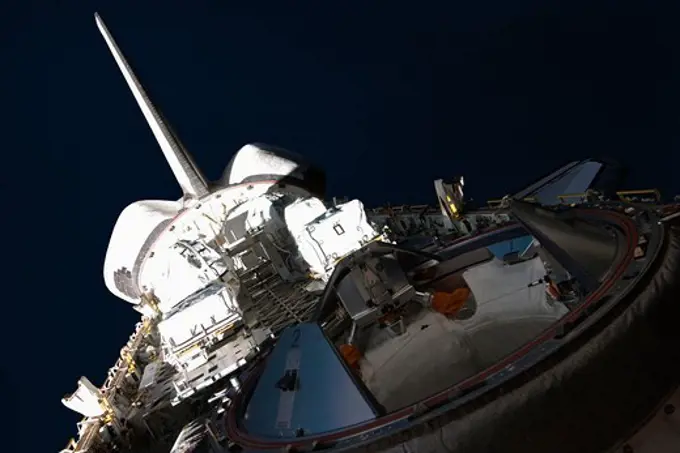
Payload Bay of Space Shuttle Atlantis
434 assets in this story
6145-44829064
S93-30238 (5 Mar 1993) --- Wearing training versions of Space Shuttle Extravehicular Mobility Units (EMU), astronauts Thomas D. Akers (red stripe) and Kathryn C. Thornton use the spacious pool of the Johnson Space Center's (JSC) Weightless Environment Training Facility (WET-F) to rehearse for the Hubble Space Telescope (HST) repair mission. They are working with a full scale mockup of a solar array fixture.
6145-44965127
ISS036-E-007470 (12 June 2013) --- This wide view of the seven windows of the International Space Stations Cupola serves to give a paneled look of Earth, in this case, a point in the South Atlantic. The Cupola is used to conduct experiments, dockings and observations of Earth such as this. The observatory was launched aboard STS-130 on Feb. 8 2010 and attached to the Tranquility  node.
6145-44708413
S124-E-010226 (11 June 2008) --- The forward and zenith sides of the Pressurized Mating Adapter 2 (PMA-2), Harmony node and Columbus laboratory with the Sun Monitoring on the External Payload Facility of Columbus (SOLAR), European Technology Exposure Facility (EuTEF) and Materials International Space Station Experiment (MISSE) payloads are photographed from Space Shuttle Discovery as the two spacecraft begin their relative separation. Earlier the STS-124 and Expedition 17 crews concluded almost nine days of cooperative work onboard the shuttle and station. Undocking of the two spacecraft occurred at 6:42 a.m. (CDT) on June 11, 2008.
6145-48826605
A91522 U12P DISTANT ZENITH GAS SAMPLERS IN LOS RAY PEABODY (Project Engineer) AUG 29 91 EG&G/NTS PHOTO LAB Publication Date: 8/29/1991  DISTANT ZENITH; DISTANT ZENITH TEST; EDGERTON, GERMESHAUSEN & GRIER; EG&G; EQUIPMENT; EQUIPMENT & INSTRUMENTS; EQUIPMENT (SNL); GAS SAMPLERS; GAS SAMPLERS IN LOS; INSTRUMENTS & EQUIPMENT; LINE OF SIGHT PIPE; NEVADA; NEVADA TEST SITE; NTS; NUCLEAR ENERGY TECHNOLOGY; NUCLEAR TESTING; NUCLEAR TESTS; P-TUNNEL; TEST SITES; TUNNELS; UGT; UNDERGROUND; UNDERGROUND TESTING; WIRE & CABLES; DISTANT ZENITH-GAS SAMPLERS  historical images. 1972 - 2012. Department of Energy. National Nuclear Security Administration. Photographs Related to Nuclear Weapons Testing at the Nevada Test Site.
6145-44633750
S114-E-5700 (28 July 2005) --- This image of the International Space Station easing toward the Space Shuttle Discovery was photographed by one of the STS-114 astronauts in the orbiter's crew cabin.
6145-45082066
GMT336_21_56_Terry Virts_night pass moscow siberia sunrise on array_123
6145-45240770
Extra vehicular activity - Astronaut Kathy Thornton on the end of orbiter Endeavour's remote manipulator system arm, hovers over equipment associated with servicing chores on the Hubble Space Telescope (HST).
6145-44681300
iss015e19102 (7/23/2007) --- View of Materials International Space Station Experiment (MISSE) Passive Experiment Container (PEC) mounted to the exterior of the Quest/Airlock (A/L). Photo taken during a session of Extravehicular Activity (EVA) on Expedition 15. Materials on the International Space Station Experiment 3 and 4 (MISSE - 3 and 4) are the third and fourth in a series of five suitcase-sized test beds attached to the outside of the space station. The beds were deployed during a spacewalk by the station crew in August 2006. They are exposing hundreds of potential space construction materials and different types of solar cells to the harsh environment of space. Mounted to the space station for about a year, the equipment then will be returned to Earth for study. Investigators will use the resulting data to design stronger, more durable spacecraft.
6177-V54005280
6145-45244591
In February 1980, a satellite called Solar Maximum Mission Spacecraft, or Solar Max, was launched into Earth's orbit. Its primary objective was to provide a detailed study of solar flares, active regions on the Sun's surface, sunspots, and other solar activities. Additionally, it was to measure the total output of radiation from the Sun. Not much was known about solar activity at that time except for a slight knowledge of solar flares. After its launch, Solar Max fulfilled everyone's expectations. However, after a year in orbit, Solar Max's Altitude Control System malfunctioned, preventing the precise pointing of instruments at the Sun. NASA scientists were disappointed at the lost data, but not altogether dismayed because Solar Max had been designed for Space Shuttle retrievability enabling the repair of the satellite. On April 6, 1984, Space Shuttle Challenger (STS-41C), Commanded by astronaut Robert L. Crippen and piloted by Francis R. Scobee, launched on a historic voyage. This voy
6145-44975427
ISS037-E-004184 (3 Oct. 2013) --- One of the Expedition 37 crew members on Oct. 3 exposed this frame showing a Russian Soyuz vehicle docked to the International Space Station against a backdrop of a pale blue part of Earth.
6145-44663920
S116-E-05765 (11 Dec. 2006) --- The International Space Station's Canadarm2 moves toward the station's new P5 truss section for a hand-off from Space Shuttle Discovery's Remote Manipulator System (RMS) robotic arm.
6145-44776125
S127-E-009369 (27 July 2009) --- Astronaut Tom Marshburn, STS-127 mission specialist, participates in the mission's fifth and final session of extravehicular activity (EVA) as construction and maintenance continue on the International Space Station. During the four-hour, 54-minute spacewalk, Marshburn and astronaut Christopher Cassidy (out of frame), mission specialist, secured multi-layer insulation around the Special Purpose Dexterous Manipulator known as Dextre, split out power channels for two space station Control Moment Gyroscopes, installed video cameras on the front and back of the new Japanese Exposed Facility and performed a number of get ahead” tasks, including tying down some cables and installing handrails and a portable foot restraint to aid future spacewalkers.
6145-50602619
A760610 U12N MIGHTY EPIC SCATTER ALCOVE PALMER NELSON (PROJECT ENGINEER) MAY 11 76 EG&G/NTS PHOTO LAB Publication Date: 5/11/1976  CABLES, COAXIAL; EDGERTON, GERMESHAUSEN & GRIER; EG&G; EQUIPMENT & INSTRUMENTS; HOSES; INSTRUMENTS & EQUIPMENT; MIGHTY EPIC; NELSON, PALMER; NEVADA; NEVADA TEST SITE; NTS; NUCLEAR ENERGY TECHNOLOGY; NUCLEAR TESTING; NUCLEAR TESTS; ROCKS & MINERALS (MISC); ROCKS (MISCELLANEOUS); SCATTER ALCOVE; STRUCTURAL MATERIALS; TEST SITES; UGT; UNDERGROUND; UNDERGROUND TESTING; MIGHTY EPIC-SCATTER ALCOVE  historical images. 1972 - 2012. Department of Energy. National Nuclear Security Administration. Photographs Related to Nuclear Weapons Testing at the Nevada Test Site.
6145-58971471
iss070e009144 (Oct. 25, 2023) --- Expedition 70 Flight Engineer Nikolai Chub from Roscosmos is pictured during a spacewalk to inspect a backup radiator, deploy a nanosatellite, and install communications hardware on the International Space Station's Nauka science module.
6145-44951601
Earth observation taken by the Expedition 35 crew aboard the ISS. Night view of the docked Soyuz TMA-07M and Progress 50P spacecraft against a backdrop of city lights.
6145-45241841
STS051-98-021 (16 Sept. 1993) --- In the Space Shuttle Discovery's aft cargo bay, astronaut Carl E. Walz gets his turn on the Portable Foot Restraint (PFR). Astronauts Walz, waving to his crew mates inside Discovery's cabin, and James H. Newman each put in some time evaluating the PFR, one of the pieces of gear to be used on the Hubble Space Telescope (HST) STS-61 servicing mission (scheduled later this year) and other Shuttle missions.
6145-44546122
STS074-332-029 (15 Nov 1995) --- A 35mm camera aimed through the Space Shuttle Atlantis aft windows captured rendezvous and docking operations with the Space Shuttle Atlantis and Russias Mir Space Station in Earth-orbit.  The new Docking Module (DM), carried into space by the Atlantis is about to contact Kristall on the cluster of Mir components.  The flight began with a November 12, 1995, launch from Kennedy Space Center (KSC) and ended with landing there on November 20, 1995.  The crew members were astronauts Kenneth D. Cameron, mission commander; James D. Halsell, Jr., pilot; William S. McArthur, Jr., Jerry L. Ross and Canadian astronaut Chris A. Hadfield, all mission specialists.  The Mir-20 crew is composed of cosmonauts Yuriy P. Gidzenko, commander; and Sergei V. Avdeyev, engineer; along with the European Space Agencys (ESA) Thomas Reiter, cosmonaut researcher.  Joint activities on the Mir and the Space Shuttle Atlantis ended on November 18, 1995, when the two spacecraft separ
6145-45062280
ISS040-E-016995 (22 June 2014) --- This nighttime view featuring portions of an aurora and a Russian spacecraft docked to the International Space Station was photographed by an Expedition 40 crew member on the station.
6145-45068585
Earth Observation taken during a night pass by the Expedition 40 crew aboard the International Space Station (ISS). Folder lists this as Middle East. Docked Soyuz and Progress spacecraft also visible.
6145-45034888
ISS030-E-016617 (25 Dec. 2011) --- Brightness from sunlight appears to peek through the spaces between sections of a solar array panel on a Russian spacecraft which is docked to the International Space Station in this photograph recorded and downlinked from the orbital complex on Dec. 25, 2011. Earth's atmospheric limb is visible behind the panel as it "runs" horizontally through the scene.
6145-44485886
The Moon Gallery payload is pictured suspended in weightlessness inside the International Space Station's "window to the world," the seven-windowed cupola. The Moon Gallery experiment evaluates the performance of a single-board computer platform with a high-quality camera in the space stations radiation environment. Photos and videos taken with the camera become part of an art installation known as the Moon Gallery.
6145-52961105
. DCIM100GOPROGOPR1311.
6145-44544053
STS051-06-023 (16 Sept 1993) --- Astronauts James H. Newman (in bay) and Carl E. Walz, mission specialists, practice space walking techniques and evaluate tools to be used on the first Hubble Space Telescope (HST) servicing mission scheduled for later this year.  Walz rehearses using the Power Ratchet Tool (PRT), one of several special pieces of gear to be put to duty during the scheduled five periods of extravehicular activity (EVA) on the STS-61 mission.
6145-44528130
STS105-E-5037 (11 August 2001) --- One of the STS-105 crew members on the flight deck of the Earth-orbiting Space Shuttle Discovery used a digital still camera to record this image of the partially illuminated portside cargo bay and the silhouetted Orbiter Docking System's docking mechanism. The shuttle's Canadarm or Remote Manipulator System (RMS) arm is in its stowed position at right.
6145-45003371
Progress and Apple. Image was released by astronaut on Twitter.
6145-45166916
iss055e074760 (May 24, 2018) --- This view taken from inside the Cupola shows the Orbital ATK space freighter approaching its capture point about 10 meters from the International Space Station where it was grappled with the Canadarm2 robotic arm.
6145-44828597
STS061-99-009 (9 Dec 1993) --- Sunlight reflects off the Space Shuttle Endeavour's aft windows and the shiny Hubble Space Telescope (HST) prior to its post-servicing deployment near the end of the eleven-day mission. A handheld Hasselblad camera was used inside Endeavour's cabin to record the image.
6145-44545048
STS063-711-069 (3-11 Feb. 1995) --- This close-up scene of Russian Mir Space Station's docking target was exposed by one of the STS-63 crew members using a handheld Hasselblad camera during close proximity operations between the space shuttle Discovery and Russia's Mir Space Station.
6145-44543018
STS048-05-024 (15 Sept 1991) --- The Upper Atmosphere Research Satellite (UARS), in the grasp of the Remote Manipulator System (RMS), was captured on film by a camera aimed through one of the Space Shuttle Discovery's overhead windows.  At the time of the photo, deployment of UARS' solar array panel was in progress.  A few hours later, the huge satellite was free and on its way to a higher orbit.  Data from UARS will enable scientists to study ozone depletion in the stratosphere, or upper atmosphere.  The image was photographed with a 35mm camera.
6145-44469892
Roscosmos cosmonauts Oleg Artemyev and Denis Matveev are pictured attached to the Nauka multipurpose laboratory module during a seven-hour and 42-minute spacewalk to activate the European robotic arm on the International Space Station.
6145-45236425
This is a close-up view of a right rear wheel strut of the Lunar Roving Vehicle (LRV) No. 1. The LRV was built to give Apollo astronauts a greater range of mobility during lunar exploration. It was an open-space and collapsible vehicle about 10 feet long with large mesh wheels, anterna, appendages, tool caddies, and camera. An LRV was used on each of the last three Apollo missions; Apollo 15, Apollo 16, and Apollo 17. It was built by the Boeing Company under the direction of the Marshall Space Flight Center.
6177-V53841369
6145-44818385
ISS023-E-042388 (10 May 2010) --- Russian cosmonaut Oleg Kotov, Expedition 23 commander, is pictured in a window of the Cupola of the International Space Station.
PREVIOUS
of 5
NEXT
2401 S. Ervay, Suite 206
Dallas, Texas 75215
United States
Get Started
Free ResearchMy BoardsMy Cart
For Creators
How To License Your ContentContributor PortalFrame of Mind
Resources
API accessPricing
Contact
+1 866 236 0087help@viewpictures.co.uk Contact form
©2026 View Pictures. All Rights Reserved. -A
This site is protected by reCAPTCHA and Google Privacy Policy and Terms of Service apply.