My Boards
View Pictures
  • My Boards

Space Exploration Technology

Images of rockets and spacecraft in assembly and testing phases, highlighting significant milestones in space exploration and technology advancement.
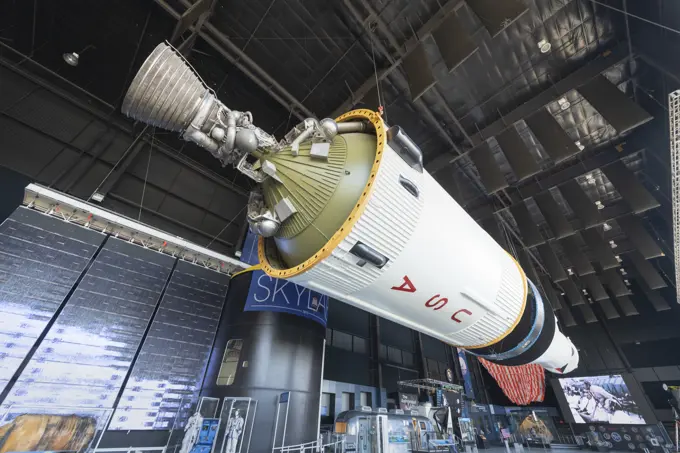
Rocketdyne J-2 engine on S-IVB (Saturn V Third Stage) of Saturn V Moon Rocket. Davidson Center for Space Exploration: Saturn V Hall. U.S. Space and Rocket Center, Huntsville, Alabama.
269 assets in this story
6145-45121521
In Building 1555 at Vandenberg Air Force Base in California, an Orbital ATK Pegasus XL rocket is seen after payload fairing installation. On board Pegasus are eight NASA Cyclone Global Navigation Satellite System, or CYGNSS, spacecraft. When preparations are competed at Vandenberg, the L-1011/Pegasus XL combination will be flown to NASAs Kennedy Space Center in Florida. On Dec. 12, 2016, the carrier aircraft is scheduled to take off from the Skid Strip at Cape Canaveral Air Force Station and CYGNSS will launch on the Pegasus XL rocket with the L-1011 flying off shore. CYGNSS satellites will make frequent and accurate measurements of ocean surface winds throughout the life cycle of tropical storms and hurricanes. The data that CYGNSS provides will help scientists to probe key air-sea interaction processes that take place near the core of storms, which are rapidly changing and play a crucial role in the beginning and intensification of hurricanes.
6145-44515579
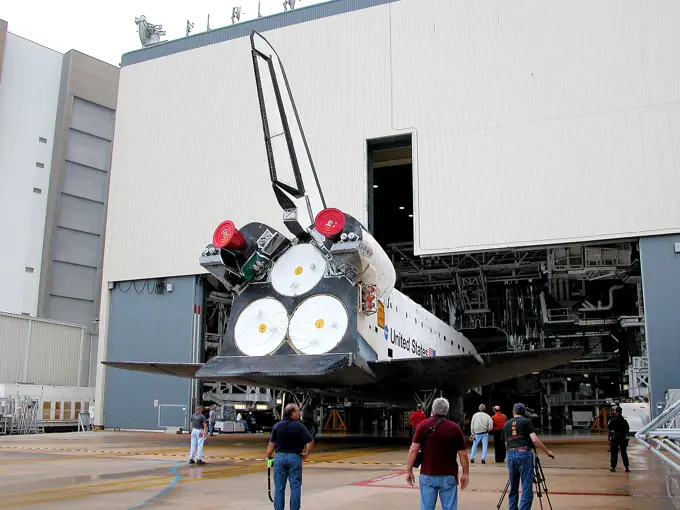
KENNEDY SPACE CENTER, Fla. -- Space Shuttle Atlantis, on its Mobile Launcher Platform, begins to roll out to Launch Pad 39A, this time on another crawler transporter. An attempt to roll out on Jan. 2 incurred a failed computer processor on the first crawler transporter. The Shuttle was returned to the Vehicle Assembly Building Using a secondary computer processor on the vehicle. Atlantis will fly on mission STS-98, the seventh construction flight to the International Space Station, carrying the U.S. Laboratory, named Destiny. The lab module will have five system racks already installed inside. After delivery of electronics in the lab, electrically powered attitude control for Control Moment Gyroscopes will be activated. Atlantis is scheduled for launch no earlier than Jan. 19, 2001, with a crew of five
6145-58963068
KENNEDY SPACE CENTER, FLA. - The open doors of the Vehicle Assembly Building (VAB) at NASAs Kennedy Space Center shed a light border around the External Tank on Space Shuttle Discovery. The Shuttle, which comprises the orbiter, External Tank (ET) and twin Solid Rocket Boosters (SRBs), is beginning its long, slow journey to Launch Pad 39B. First motion was at 2 04 p.m. EDT. The Space Shuttle rests on the Mobile Launcher Platform, which is moved by the Crawler-Transporter underneath. The Crawler is 20 feet high, 131 feet long and 114 feet wide. It moves on eight tracks, each containing 57 shoes, or cleats, weighing one ton each. Loaded with the Space Shuttle, the Crawler can move at a maximum speed of approximately 1 mile an hour. A leveling system in the Crawler keeps the Shuttle vertical while negotiating the 5 percent grade leading to the top of the launch pad. Launch of Discovery on its Return to Flight mission, STS-114, is targeted for May 15 with a launch window that extends to Jun
6145-44576755
KENNEDY SPACE CENTER, FLA. --  On Launch Pad 17-A, Cape Canaveral Air Force Station, workers oversee the lifting of the Boeing Delta II rocket into the gantry above. The rocket is the launch vehicle for the CONTOUR spacecraft, scheduled to launch July 1. CONTOUR will provide the first detailed look into the heart of a comet -- the nucleus. The spacecraft will fly close to at least two comets, Encke and Schwassmann-Wachmann 3, taking pictures of the nucleus while analyzing the gas and dust that surround these rocky, icy building blocks of the solar system.
6145-44646397
KENNEDY SPACE CENTER, FLA.  -   On Launch Complex 37 at Cape Canaveral Air Force Station in Florida, the GOES-N spacecraft arrives at the upper level of the mobile service tower and is moved toward the second stage of the Boeing Delta IV rocket (lower right).  GOES-N is the latest in a series of Geostationary Operational Environmental Satellites for NOAA and NASA, providing continuous monitoring necessary for intensive data analysis.  GOES-N is scheduled to be launched May 18 in an hour-long window between 6:14 and 7:14 p.m. EDT.
6145-45172837
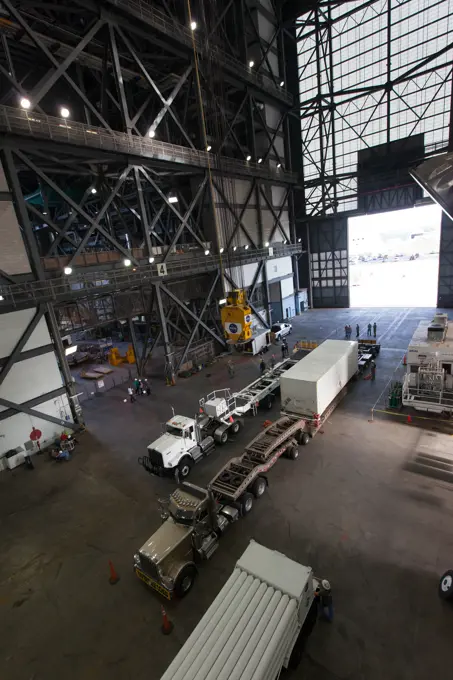
The ground test motor for Orion's Launch Abort System (LAS) arrives by flatbed truck in its shipping container in the transfer aisle of the Vehicle Assembly Building on July 20, 2018, at NASA's Kennedy Space Center in Florida. It will be transferred to the Rotation, Processing and Surge Facility where it will be inspected and prepared for transport to Space Launch Complex 46 (SLC-46) at Cape Canaveral Air Force Station for mechanical fit testing. This inert motor will not be used for flight, but will be used to certify flight hardware assembly in preparation for a full-stress test of the LAS, called Ascent Abort-2 (AA-2) flight test, scheduled for April 2019. During the test, the booster will launch from SLC 46, carrying a fully functional LAS and a 22,000-pound Orion test vehicle to an altitude of 31,000 feet and traveling at more than 1,000 miles an hour. The test will verify the LAS can steer the crew module and astronauts aboard to safety in the event of an issue with the Space Lau
6145-44978717
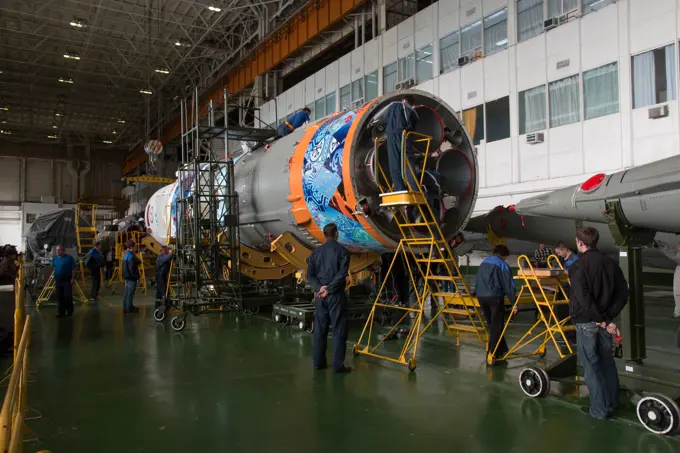
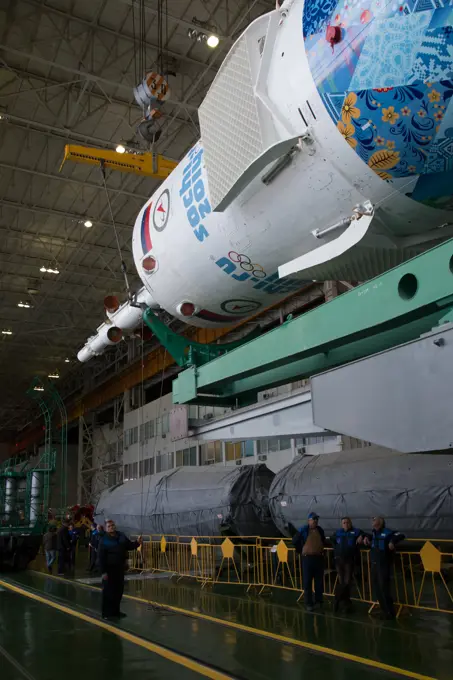
Workers make final preperations to a Soyuz TMA-11M spacecraft on Monday, Nov. 4, 2013, at the Baikonur Cosmodome in Baikonur, Kazakhstan. The rocket is adorned with the logo of the Sochi Olympic Organizing Committee and other related artwork to commemorate the launch of the Olympic torch with the crew for a four-day visit to the station. The torch will return to Earth with another trio of station residents on Nov. 11 and will be part of the torch relay that ends with the lighting of the flame at the Fisht Stadium in Sochi, Russia Feb. 7 to mark the opening of the 2014 Winter Olympics.
6145-44605420
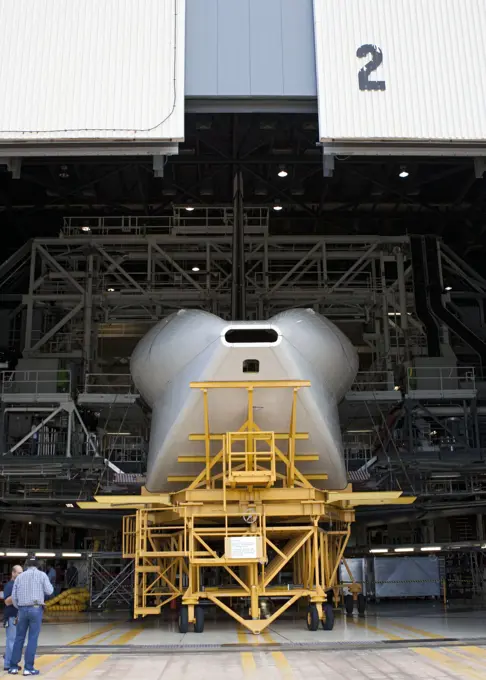
KENNEDY SPACE CENTER, FLA. - The Space Shuttle orbiter Atlantis awaits transport from the Orbiter Processing Facility (OPF) to the Vehicle Assembly Building (VAB). The move will allow work to be performed in the OPF that can only be accomplished while the bay is empty. Work scheduled in the processing facility includes annual validation of the bay's cranes, work platforms, lifting mechanisms, and jack stands. Atlantis will remain in the VAB for about 10 days, then return to the OPF as work resumes to prepare it for launch in September 2004 on the first return-to-flight mission, STS-114.
6145-44832460
CAPE CANAVERAL, Fla. -- At NASA's Kennedy Space Center in Florida, space shuttle Discovery begins its nighttime trek, known as "rollout," from the Vehicle Assembly Building to Launch Pad 39A. It will take the shuttle, attached to its external fuel tank, twin solid rocket boosters and mobile launcher platform, about six hours to complete the move atop a crawler-transporter. Rollout sets the stage for Discovery's STS-133 crew to practice countdown and launch procedures during the Terminal Countdown Demonstration Test in mid-October.  Targeted to liftoff Nov. 1, Discovery will take the Permanent Multipurpose Module (PMM) packed with supplies and critical spare parts, as well as Robonaut 2 (R2) to the International Space Station.
6145-58961413
KENNEDY SPACE CENTER, FLA. - The orbiter Discovery slowly rolls out of the Orbiter Processing Facility bay 3 to begin its transfer to the Vehicle Assembly Building. First motion was at 1 29 a.m. EST. Inside the VAB, Discovery will be mated to the External Tank_Solid Rocket Booster assembly for Return to Flight mission STS-114. After all umbilicals have been connected, workers will perform an electrical and mechanical verification of the mated interfaces to verify all critical vehicle connections. A Space Shuttle interface test is performed to verify vehicle interfaces and vehicle-to-ground interfaces. The launch processing system is used to control and monitor orbiter systems as required. Space Shuttle Discovery will roll out to Launch Pad 39B approximately one week after the rollover to the VAB. The launch window for mission STS-114 is May 15 to June 3.
6145-44777209
CAPE CANAVERAL, Fla. - Space shuttle Discovery, installed on the mobile launcher platform atop the crawler-transporter, moves out of the Vehicle Assembly Building at NASA's Kennedy Space Center in Florida to  Launch Pad 39A. First motion out of the Vehicle Assembly Building was at 2:07 a.m. EDT Aug. 4. Rollout was delayed approximately 2 hours due to lightning in the area.  The 3.4-mile journey was slower than usual as technicians stopped several times to clear mud from the crawler's treads and bearings.   Discovery's 13-day flight will deliver a new crew member and 33,000 pounds of equipment to the International Space Station. The equipment includes science and storage racks, a freezer to store research samples, a new sleeping compartment and the COLBERT treadmill.  Launch of Discovery on its STS-128 mission is targeted for late August.
6145-58962731
KENNEDY SPACE CENTER, FLA. - The External Tank that will be used to return the Space Shuttle program to flight is lifted into high bay 3 in the Vehicle Assembly Building. The tank, ET-121, and the Solid Rocket Boosters were originally scheduled to fly with orbiter Atlantis on mission STS-121 but will now be used to launch Discovery on mission STS-114. Once secure in the high bay, a new heater will be added to the feedline bellows to minimize the potential for ice and frost buildup. STS-114 is the first Return to Flight mission to the International Space Station. The launch window extends from July 13 through July 31.
6145-54676048
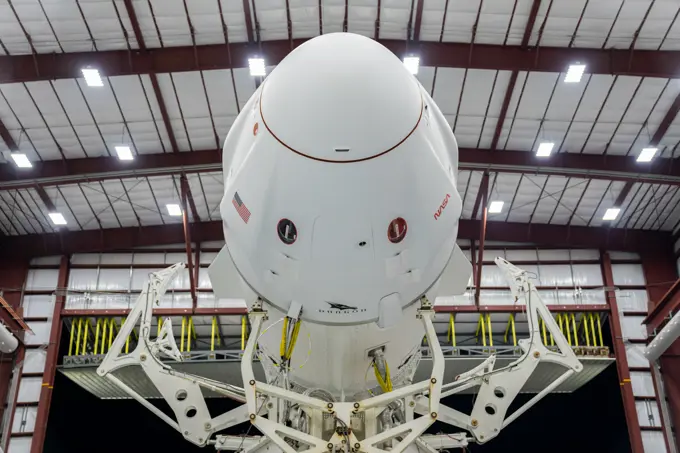
NASA/SpaceX Crew-6 Rollout for Launch. Inside the SpaceX horizontal processing facility at NASAs Kennedy Space Center in Florida, the SpaceX Falcon 9 rocket with Dragon spacecraft Endeavour attached are ready for rollout to Launch Complex 39A on Feb. 22, 2023, for NASAs SpaceX Crew-6 mission. NASA astronauts, Stephen Bowen, spacecraft commander, and Warren Woody Hoburg, pilot; along with mission specialists Sultan Alneyadi, UAE (United Arab Emirates) astronaut, and Andrei Fedyaev, Roscosmos cosmonaut, are slated to launch for their science mission on the International Space Station at 1:45 a.m. EST on Feb. 27 from Launch Complex 39A. Crew-6 is the sixth crew rotation mission with SpaceX to the station, and the seventh flight of Dragon with people as part of the agencys Commercial Crew Program.
6145-44913190
The Soyuz rocket is ready to be rolled out to the launch pad by train, on Sunday, October 21, 2012, at the Baikonur Cosmodrome in Kazakhstan.  Launch of the Soyuz rocket is scheduled for October 23 and will send Expedition 33/34 Flight Engineer Kevin Ford of NASA, Soyuz Commander Oleg Novitskiy and Flight Engineer Evgeny Tarelkin of ROSCOSMOS on a five-month mission aboard the International Space Station.
6145-58961863
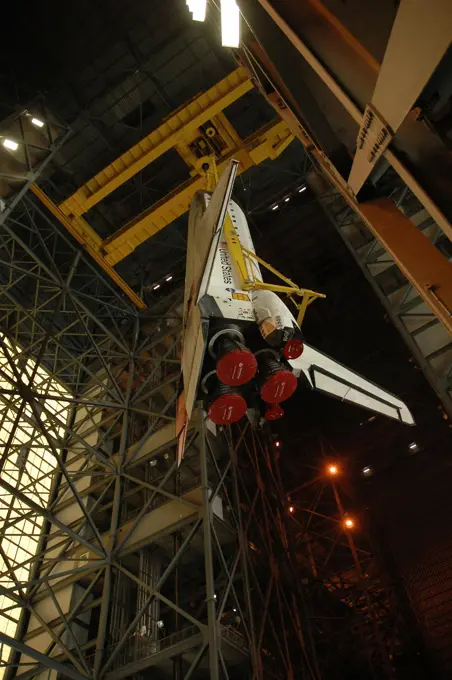
KENNEDY SPACE CENTER, FLA. - The orbiter Discovery hangs suspended above the floor of the transfer aisle in the Vehicle Assembly Building. It will be lifted over a cross-beam into high bay 3 and remated with the new External Tank, ET-121, and Solid Rocket Boosters in the bay. That tank was originally scheduled to fly with Atlantis on the second Return to Flight mission, STS-121. A new heater was added to the tank's feedline bellows, part of the pipeline that carries the liquid oxygen to the orbiters main engines, to minimize the potential for ice and frost buildup. After the remate, technicians will work final closeouts on the fully assembled Space Shuttle stack, and perform liquid oxygen and liquid hydrogen electrical mates and an interface verification test. Discovery is currently scheduled to return to Launch Pad 39B on June 13.
6145-44680195
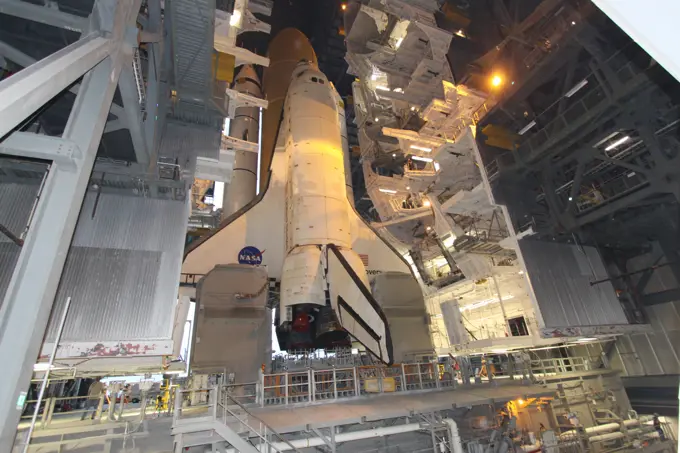
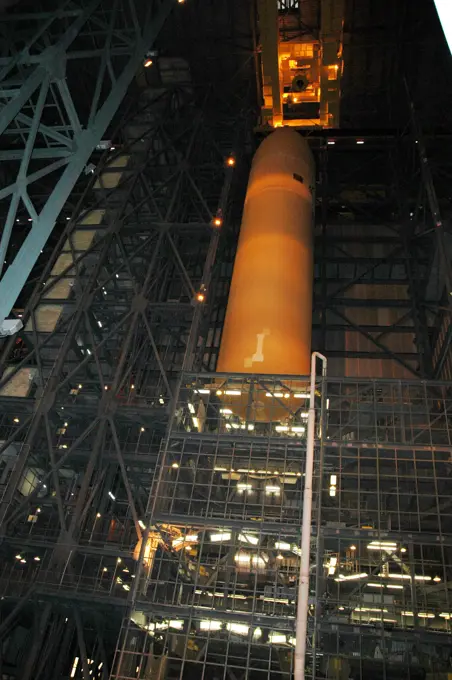
KENNEDY SPACE CENTER, FLA. --   Space Shuttle Endeavour is viewed from a high level in the Vehicle Assembly Building.  Lights from above cast an orange glow.  Visible behind Endeavour are the orange external tank and the white solid rocket boosters on either side.  The many platform levels on either side of the shuttle provide access for work. The shuttle assembly rests on the mobile launcher platform, which will be lifted by the crawler-transporter for the slow journey to the pad. Rollout was originally planned for just after midnight on July 10 but the move was canceled by NASA managers because unfavorable weather was predicted to arrive in the launch area before the vehicle would be secured at the pad.   Rollout is scheduled to begin again about 9 p.m. July 10.
6145-44831231
CAPE CANAVERAL, Fla. -- At NASA's Kennedy Space Center in Florida, shuttle Discovery is ushered into the Vehicle Assembly Building (VAB) from Orbiter Processing Facility-3 during a move known as "rollover." Once inside the VAB, the shuttle will be joined to its solid rocket boosters and external fuel tank. Later this month, Discovery is scheduled to "rollout" to Launch Pad 39A for its launch to the International Space Station on the STS-133 mission.Targeted to liftoff Nov. 1, Discovery will take the Permanent Multipurpose Module (PMM) packed with supplies and critical spare parts, as well as Robonaut 2 (R2) to the station.
6145-44974531
The Soyuz rocket and Soyuz TMA-10M spacecraft are assembled at Building 112 on the Baikonur Cosmodrome, on Sunday, Sept. 22, 2013 in Baikonur, Kazakhstan.  Launch of the Soyuz rocket is scheduled for September 26 and will send Expedition 37 Soyuz Commander Oleg Kotov, NASA Flight Engineer Michael Hopkins and Russian Flight Engineer Sergei Ryazansky on a five and a half-month mission aboard the International Space Station.
6145-44623271
KENNEDY SPACE CENTER, FLA. - Technicians on Pad 17-A, Cape Canaveral Air Force Station, work on the bottom of the Solid Rocket Booster for the Swift-Delta launch before the SRB is raised into the mobile service tower.  The SRB is one of three to be attached to the Boeing Delta rocket that is the launch vehicle for the Swift spacecraft and its Gamma-Ray Burst Mission.   Swift is a medium-class Explorer mission managed by NASAs Goddard Space Flight Center in Greenbelt, Md.
6145-44660491
KENNEDY SPACE CENTER, FLA. -   Inside the mobile service tower on Launch Pad 17-B at Cape Canaveral Air Force Station, workers secure the two halves of the fairing that enclose the STEREO spacecraft.  The fairing is a molded structure that fits flush with the outside surface of the Delta II upper stage booster and forms an aerodynamically smooth nose cone, protecting the spacecraft during launch and ascent. The STEREO (Solar Terrestrial Relations Observatory) mission is the first to take measurements of the sun and solar wind in 3-dimension. This new view will improve our understanding of space weather and its impact on the Earth.  Designed and built by the Applied Physics Laboratory (APL) , the STEREO mission is being managed by NASA Goddard Space Flight Center. APL will maintain command and control of the observatories throughout the mission, while NASA tracks and receives the data, determines the orbit of the satellites, and coordinates the science results. STEREO is expected to lif
6145-44499058
KENNEDY SPACE CENTER, FLA. -- Orbiter Endeavour rolls into the Vehicle Assembly Building on its orbiter transfer vehicle. In high bay 1 it will be mated to the external tank and solid rocket boosters. Space Shuttle Endeavour is targeted for launch on mission STS-99 Jan. 13, 2000 at 1:11 p.m. EST. STS-99 is the Shuttle Radar Topography Mission, an international project spearheaded by the National Imagery and Mapping Agency and NASA, with participation of the German Aerospace Center DLR. The SRTM consists of a specially modified radar system that will gather data for the most accurate and complete topographic map of the Earth's surface that has ever been assembled. SRTM will make use of radar interferometry, wherein two radar images are taken from slightly different locations. Differences between these images allow for the calculation of surface elevation, or change. The SRTM hardware will consist of one radar antenna in the shuttle payload bay and a second radar antenna attached to the
6145-44812584
CAPE CANAVERAL, Fla. - On Launch Pad 39A at NASA's Kennedy Space Center in Florida, space shuttle Discovery lifts off on a column of dazzling smoke and fire headed for the International Space Station on the STS-131 mission. Shuttle Discovery lifted off at 6:21 a.m. EDT on April 5, 2010. The seven-member STS-131 crew will deliver the multi-purpose logistics module Leonardo, filled with supplies, a new crew sleeping quarters and science racks that will be transferred to the International Space Station's laboratories. The crew also will switch out a gyroscope on the stations truss, install a spare ammonia storage tank and retrieve a Japanese experiment from the stations exterior. STS-131 is the 33rd shuttle mission to the station and the 131st shuttle mission overall.
6145-44978734
Workers make final preperations to a Soyuz TMA-11M spacecraft on Monday, Nov. 4, 2013, at the Baikonur Cosmodome in Baikonur, Kazakhstan. The rocket is adorned with the logo of the Sochi Olympic Organizing Committee and other related artwork to commemorate the launch of the Olympic torch with the crew for a four-day visit to the station. The torch will return to Earth with another trio of station residents on Nov. 11 and will be part of the torch relay that ends with the lighting of the flame at the Fisht Stadium in Sochi, Russia Feb. 7 to mark the opening of the 2014 Winter Olympics.
6145-44487037
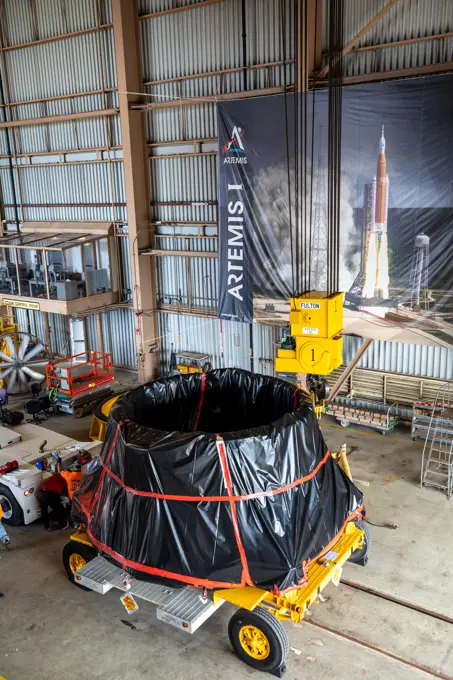
In this view looking down inside the Vehicle Assembly Building at NASAs Kennedy Space Center in Florida on March 14, 2022, most of the work platforms have been retracted from around the Artemis I Space Launch System rocket and Orion spacecraft in preparation to roll out to launch pad 39B. The Kennedy ground systems team is working to remove equipment and scaffolding away from the rocket and will continue retracting the platforms until the entire rocket is revealed ahead of the wet dress rehearsal test, which is scheduled to occur approximately two weeks after it arrives to 39B. Artemis I is the first in a series of increasingly complex missions that will enable human exploration to the Moon and Mars.
6145-45046205
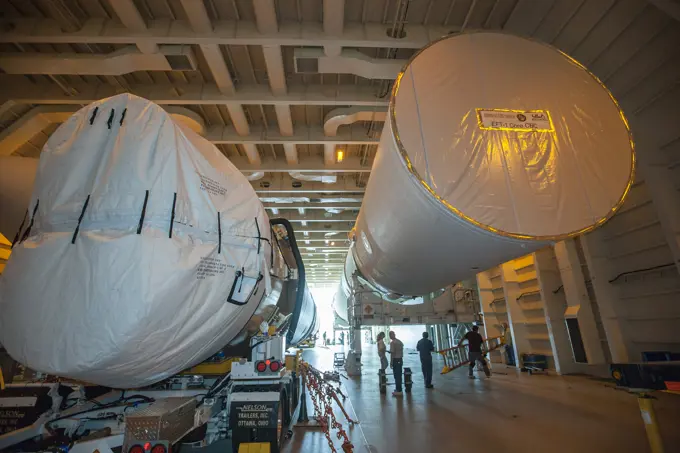
CAPE CANAVERAL, Fla. - A barge arrives at the U.S. Army Outpost wharf at Port Canaveral in Florida, carrying two of the three United Launch Alliance Delta IV heavy boosters for NASAs upcoming Exploration Flight Test-1, or EFT-1, mission with the Orion spacecraft. The core booster and starboard booster will be offloaded and then transported to the Horizontal Integration Facility, or HIF, at Space Launch Complex 37 on Cape Canaveral Air Force Station. The port booster and the upper stage are planned to be shipped to Cape Canaveral in April. At the HIF, all three boosters will be processed and checked out before being moved to the nearby launch pad and hoisted into position. During the EFT-1 mission, Orion will travel farther into space than any human spacecraft has gone in more than 40 years. The data gathered during the flight will influence design decisions, validate existing computer models and innovative new approaches to space systems development, as well as reduce overall mission
6145-44652125
KENNEDY SPACE CENTER, FLA. -   External tank No. 118 is suspended over the transfer aisle of the Vehicle Assembly Building before being raised to vertical and into high bay 3 for mating with solid rocket boosters stacked there.  The tank is designated to fly on mission STS-115 with Atlantis.  It will fly with many major safety changes, including the removal of the protuberance air load ramps. The mission will deliver the second port truss segment, the P3/P4 Truss, to attach to the first port truss segment, the P1 Truss, as well as deploy solar array set 2A and 4A.  Launch of Space Shuttle Atlantis is scheduled for late August.
6145-45177994
NASA's mobile launcher is secured inside High Bay 3 at the Vehicle Assembly Building (VAB) on Sept. 11, 2018, at NASA's Kennedy Space Center in Florida. In view are several levels of the new work platforms. The crew access arm, at the top, is being extended. The mobile launcher will spend seven months in the VAB undergoing testing. The 380-foot-tall structure is equipped with the crew access arm and several umbilicals that will provide power, environmental control, pneumatics, communication and electrical connections to the agency's Space Launch System and Orion spacecraft. Exploration Ground Systems is preparing the ground systems necessary to launch SLS and Orion on Exploration Mission-1, missions to the Moon and on to Mars.
6145-44552606
The Atlas 1 payload fairing with the encapsulated GOES-K advanced weather satellite is being lifted into position for mating to the Lockheed Martin Atlas 1 expendable launch vehicle (AC-79) at Launch Complex 36, Pad B, Cape Canaveral Air Station. GOES-K will be the third spacecraft to be launched in the advanced series of Geostationary Operational Environmental Satellites (GOES). The GOES satellites are owned and operated by the National Oceanic and Atmospheric Administration (NOAA); NASA manages the design, development and launch of the spacecraft. GOES-K is targeted for an April 24 launch during a launch window which extends from 1:50-3:09 a.m. EDT. Once in orbit, GOES-K will become GOES-10, joining GOES-8 and GOES-9 in space
6145-44750726
CAPE CANAVERAL, Fla. - In high bay 4 of the Vehicle Assembly Building at NASA's Kennedy Space Center, workers position the Ares I-X crew module mock-up onto a mock-up of the service module during a fit check of the hardware.  When fully developed, the 16-foot diameter crew module will furnish living space and reentry protection for future astronauts, and the service modules main engine will be used to break out of lunar orbit for the return trip to Earth.  Ares I-X is the test flight for the Ares I, which is part of the Constellation Program to return men to the moon and beyond. The I-X flight will provide NASA an early opportunity to test and prove hardware, facilities and ground operations associated with Ares I launches. Targeted for the summer of 2009, the launch of the full-scale Ares I-X will be the first in a series of unpiloted rocket launches from Kennedy.
6145-45296932
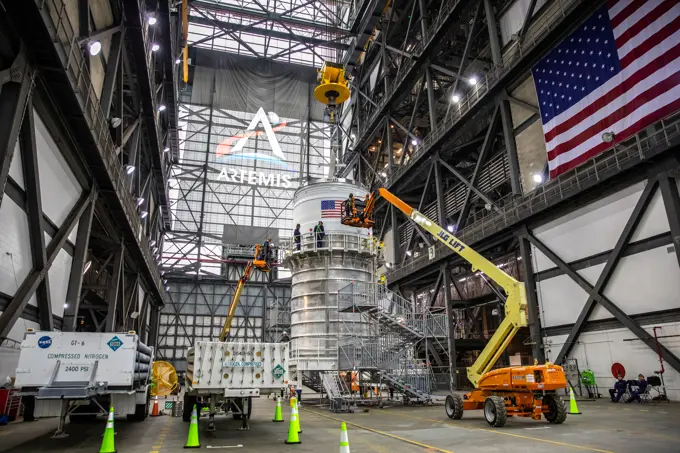
Teams with NASAs Exploration Ground Systems and contractor Jacobs integrate the interim cryogenic propulsion stage (ICPS) for NASAs Space Launch System (SLS) rocket with the launch vehicle stage adapter (LVSA) atop the massive SLS core stage in the agencys Vehicle Assembly Building (VAB) at NASAs Kennedy Space Center in Florida on July 5, 2021. The ICPS is a liquid oxygen and liquid hydrogen-based system that will fire its RL 10 engine to give the Orion spacecraft the big in-space push needed to fly tens of thousands of miles beyond the Moon. The next component to be stacked on top of ICPS will be the Orion stage adapter, which will connect the ICPS with the spacecraft. Through Artemis, NASA will send the first woman and the first person of color to the lunar surface, as well as establish a sustainable presence on and around the Moon. As the first in an increasingly complex set of missions, Artemis I will test SLS and Orion as an integrated system prior to crewed flights to the Moo
6145-44745970
CAPE CANAVERAL, Fla. --  On Complex 17-B at Cape Canaveral Air Force Station in Florida, workers wrap protective covers around the engine bell of the second stage of the Delta 2 rocket before it is lifted into the mobile service tower.  In the tower, the second stage will be mated to the first stage of the Delta 2, which is the launch vehicle for NASA's Kepler spacecraft.  The Kepler mission is specifically designed to survey our region of the Milky Way galaxy to discover hundreds of Earth-size and smaller planets in or near the habitable zone and determine how many of the billions of stars in our galaxy have such planets.  Results from this mission will allow us to place our solar system within the continuum of planetary systems in the Galaxy.  NASA's planet-hunting Kepler mission is scheduled to launch no earlier than March 5, 2009.
6145-44679670
KENNEDY SPACE CENTER, FLA. --  The orbiter Endeavour is lifted into the upper levels of the Vehicle Assembly Building. It will be moved laterally over a crossbeam and lowered into high bay 1 for stacking with the external tank and solid rocket boosters on the mobile launcher platform. Endeavour will be launched on mission STS-118, its first flight in more than four years. The shuttle has undergone extensive modifications, including the addition of safety upgrades already added to shuttles Discovery and Atlantis. Endeavour also features new hardware, such as the Station-to-Shuttle Power Transfer System that will allow the docked shuttle to draw electrical power from the station and extend its visits to the orbiting lab. Endeavour is targeted for launch on Aug. 7.
6145-44896338
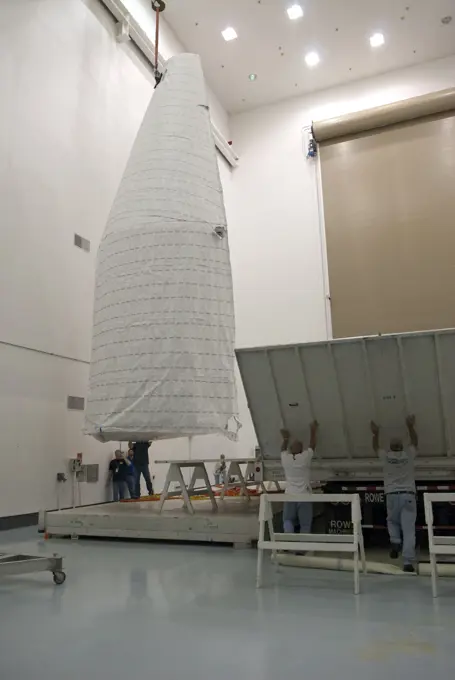
CAPE CANAVERAL, Fla. - Inside the Astrotech payload processing facility near NASAs Kennedy Space Center in Florida, technicians uncrate, offload and prepare to uncover the nose cone fairing for the Radiation Belt Storm Probes, or RBSP, spacecraft. The nose faring will house and protect the RBSP during liftoff aboard an Atlas V rocket.NASAs RBSP mission will help us understand the suns influence on Earth and near-Earth space by studying the Earths radiation belts on various scales of space and time. RBSP will begin its mission of exploration of Earths Van Allen radiation belts and the extremes of space weather after its liftoff aboard a United Launch Alliance Atlas V from Space Launch Complex 41 at Cape Canaveral Air Force Station, Fla. Liftoff is targeted for Aug. 23, 2012.
6145-44686198
KENNEDY SPACE CENTER, FLA. --   In the transfer aisle of the Vehicle Assembly Building, the overhead lifting sling hoists space shuttle Discovery off the transporter.  Discovery will be raised to a vertical position and lifted into high bay 1 for mating with the external tank and solid rocket boosters waiting on the mobile launcher platform.  Discovery is targeted for launch to the International Space Station for mission STS-120 on Oct. 23.  The crew will be delivering and installing the Italian-built U.S. Node 2, named Harmony.  The pressurized module will act as an internal connecting port and passageway to additional international science labs and cargo spacecraft. In addition to increasing the living and working space inside the station, it also will serve as a work platform outside for the station's robotic arm.
6145-44778231
CAPE CANAVERAL, Fla. - In NASA Kennedy Space Center's Vehicle Assembly Building, a crane lowers the Ares I-X Super Stack 3 into High Bay 4. There it will be integrated with Super Stack 2. The upper stage comprises five super stacks, which are integrated with the four-segment solid rocket booster first stage on the mobile launch platform.  Ares I-X is the test vehicle for the Ares I, which is part of the Constellation Program to return men to the moon and beyond. The Ares I-X flight test is targeted for  Oct. 31, pending formal NASA Headquarters approval.
6145-44733310
ISS018-E-008638 (16 Nov. 2008) --- A close-up view of Space Shuttle Endeavour's tail section was provided by Expedition 18 crewmembers on the International Space Station. The image provides partial views of the shuttle's main engines, orbital maneuvering system (OMS) pods, vertical stabilizer, the payload bay door panels and the Leonard Multi-Purpose Logistics Module located in the cargo bay. Before docking with the station, astronaut Chris Ferguson, STS-126 commander, flew the shuttle through a roll pitch maneuver or basically a backflip to allow the space station crew a good view of Endeavour's heat shield. Using digital still cameras equipped with both 400 and 800 millimeter lenses, the ISS crewmembers took a number of photos of the shuttle's thermal protection system and sent them down to teams on the ground for analysis. A 400 millimeter lens was used for this image.
6145-58959842
CAPE CANAVERAL, Fla. - Seen from above, space shuttle Discovery begins its leap off of Launch Pad 39A at NASA's Kennedy Space Center in Florida beginning the STS-131 mission. Shuttle Discovery lifted off at 6 21 a.m. EDT on April 5, 2010. The seven-member STS-131 crew will deliver the multi-purpose logistics module Leonardo, filled with supplies, a new crew sleeping quarters and science racks that will be transferred to the International Space Station's laboratories. The crew also will switch out a gyroscope on the stations truss, install a spare ammonia storage tank and retrieve a Japanese experiment from the stations exterior. STS-131 is the 33rd shuttle mission to the station and the 131st shuttle mission overall.
6145-44963091
An technician helps guide the Soyuz rocket during the assembly at the Baikonur Cosmodrome, Saturday, May 25, 2013, in Kazakhstan. The launch of the Soyuz rocket and TMA-09M spacecraft to the International Space Station (ISS) with Expedition 36/37 Soyuz Commander Fyodor Yurchikhin of the Russian Federal Space Agency (Roscosmos), Flight Engineers; Luca Parmitano of the European Space Agency, and Karen Nyberg of NASA, is scheduled for Wednesday May 29, Kazakh time. Yurchikhin, Nyberg, and, Parmitano, will remain aboard the station until mid-November.
6145-44477408
A SpaceX Falcon 9 rocket, topped with the Cargo Dragon spacecraft, is rolled out from the companys hangar at NASAs Kennedy Space Center in Florida on July 12, 2022, to the launch pad in preparation for the 25th commercial resupply services launch. The mission will deliver new science investigations, supplies, and equipment to the crew aboard the International Space Station. Liftoff is scheduled for 8:44 p.m. EDT on Thursday, July 14, from Kennedys Launch Complex 39A.
6145-58958967
CAPE CANAVERAL, Fla. - Construction crews clean space shuttle Atlantis following the removal of 16,000 square feet of plastic shrink-wrap that enclosed the spacecraft since November of last year to protect the artifact from dust and debris during construction of the 90,000-square-foot facility. The new $100 million 'Space Shuttle Atlantis' facility will include interactive exhibits that tell the story of the 30-year Space Shuttle Program and highlights the future of space exploration. The 'Space Shuttle Atlantis' exhibit scheduled to open June 29, 2013.
6145-44489497
SpaceX Crew-5 Roll to Pad. SpaceXs Falcon 9 rocket, with the Dragon Endurance spacecraft atop, prepares to roll out of the companys horizontal processing facility to Launch Complex 39A at the agencys Kennedy Space Center in Florida on Oct. 1, 2022, for NASAs SpaceX Crew-5 launch. Endurance will carry NASA astronauts Nicole Mann, commander; Josh Cassada, pilot; and Mission Specialists Koichi Wakata, of JAXA (Japan Aerospace Exploration Agency), and Roscosmos cosmonaut Anna Kikina to the International Space Station for a science expedition mission as part of NASAs Commercial Crew Program. Liftoff is targeted for noon EDT on Oct. 5, 2022.
6145-44605436
KENNEDY SPACE CENTER, FLA. - The Space Shuttle orbiter Atlantis backs out of the Orbiter Processing Facility (OPF) for its move to the Vehicle Assembly Building (VAB). The move will allow work to be performed in the OPF that can only be accomplished while the bay is empty. Work scheduled in the processing facility includes annual validation of the bay's cranes, work platforms, lifting mechanisms, and jack stands. Atlantis will remain in the VAB for about 10 days, then return to the OPF as work resumes to prepare it for launch in September 2004 on the first return-to-flight mission, STS-114.
6145-44657648
ISS013-E-79933 (11 Sept. 2006) --- This view of part of the crew cabin and the forward portion of the cargo bay of the Space Shuttle Atlantis was provided by an Expedition 13 crew member during a backflip maneuver performed by the approaching visitors to the International Space Station.  Part of the P3/P4 Integrated Truss Structure can be seen in the stowed position.
6145-45277281
The first of two Artemis I aft skirts for NASA's Space Launch System (SLS) rockets twin solid rocket boosters is moved into the Rotation Processing and Surge Facility (RPSF) at the agencys Kennedy Space Center in Florida on June 10, 2020. The aft skirts were refurbished by Northrop Grumman. They house the thrust vector control system, which controls 70 percent of the steering during initial ascent of the SLS rocket. The segments will remain in the RPSF until ready for stacking with the forward and aft parts of the boosters on the mobile launcher in High Bay 3 of the Vehicle Assembly Building. Through the Artemis Program, NASA is working to land the first woman and next man on the Moon by 2024.
6145-58963718
KENNEDY SPACE CENTER, FLA. - Inside the Vehicle Assembly Building, NASA ET_SRB Operations Manager Ken Tenbusch provides information for the media about the stacking of the aft skirt and lower segment of the Solid Rocket Booster in the background. These first segments are a significant milestone in the preparations for Return to Flight mission STS-114. Two SRBs support the liftoff of the Space Shuttle on a launch. The twin 149-foot tall, 12-foot diameter SRBs provide the main propulsion system during launch to place the 180,000-pound orbiters in the proper orbit around the Earth. They operate parallel with the Space Shuttle main engines for the first two minutes of flight and jettison away from the orbiter with help from the Booster Separation Motors, about 26.3 nautical miles above the Earths surface.
6145-45290946
Expedition 65 prime crew members NASA astronaut Mark Vande Hei, second from left, Russian cosmonauts Oleg Novitskiy of Roscosmos, center, and Pyotr Dubrov of Roscosmos, third from right, are seen touring building 254 during a fit check to prepare for launch, Saturday, March 27, 2021 at the Baikonur Cosmodrome in Kazakhstan. They are scheduled to launch on a Soyuz rocket April 9.
6145-44899506
CAPE CANAVERAL, Fla. -- The tail cone that will cover space shuttle Endeavours replica shuttle main engines arrives at Orbiter Processing Facility-2, or OPF-2, from the Vehicle Assembly Building at NASAs Kennedy Space Center in Florida. Inside OPF-2, the tail cone will be installed on Endeavour.The work is part of Transition and Retirement of the remaining space shuttles, Endeavour and Atlantis. Endeavour is being prepared for public display at the California Science Center in Los Angeles. Its ferry flight to California is targeted for mid-September. Endeavour was the last space shuttle added to NASAs orbiter fleet. Over the course of its 19-year career, Endeavour spent 299 days in space during 25 missions.
6145-58960740
CAPE CANAVERAL, Fla. -- A close-up view of External Tank-138 being lifted above the transfer aisle in the Vehicle Assembly Building at NASA's Kennedy Space Center in Florida. The external fuel tank is being moved into a test cell where it will be checked out before launch. ET-138, the last newly manufactured tank, was originally designated to fly on Endeavour's STS-134 mission to the International Space Station, but later reassigned to fly on space shuttle Atlantis' final mission, STS-135.
6145-44474921
With all of the work platforms retracted, NASAs Space Launch System and Orion spacecraft atop the mobile launcher are in view in High Bay 3 of the Vehicle Assembly Building at the agencys Kennedy Space Center in Florida on June 3, 2022. The crawler-transporter, driven by engineers, will slide under the Artemis I stack atop the mobile launcher and carry it to Launch Complex 39B for a wet dress rehearsal test ahead of the Artemis I launch. Artemis I will be the first integrated test of the SLS and Orion spacecraft. In later missions, NASA will land the first woman and the first person of color on the surface of the Moon, paving the way for a long-term lunar presence and serving as a steppingstone on the way to Mars.
6145-58962698
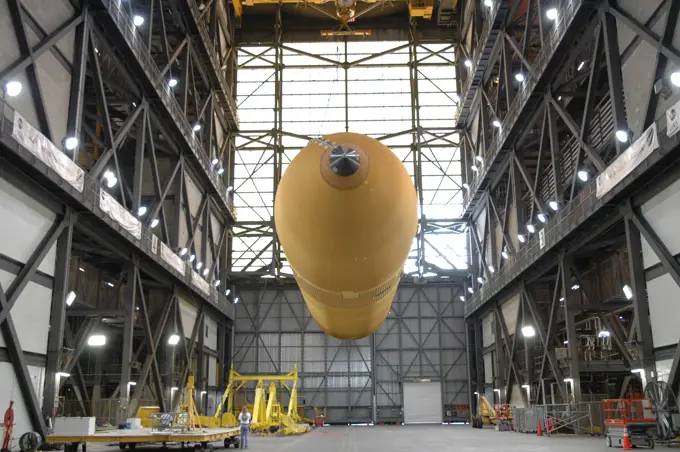
KENNEDY SPACE CENTER, FLA. - The redesigned External Tank is raised above its transporter in the Vehicle Assembly Building. It will be lifted into the 'checkout cell' where the tanks mechanical, electrical and thermal protection systems are inspected. The tank will also undergo new processes resulting from its redesign, including inspection of the bipod heater and External Tank separation camera. The tank will be prepared for 'mating' to the Shuttles Solid Rocket Boosters. When preparations are complete, the tank will be lifted from the checkout cell, moved across the transfer aisle and into High Bay 1. It will be lowered and attached to the boosters, which are sitting on the Mobile Launch Platform. The SRBs and ET will be flying with Shuttle Discovery for the Return to Flight mission STS-114. The launch planning window is May 12 to June 3, 2005.
6145-45210450
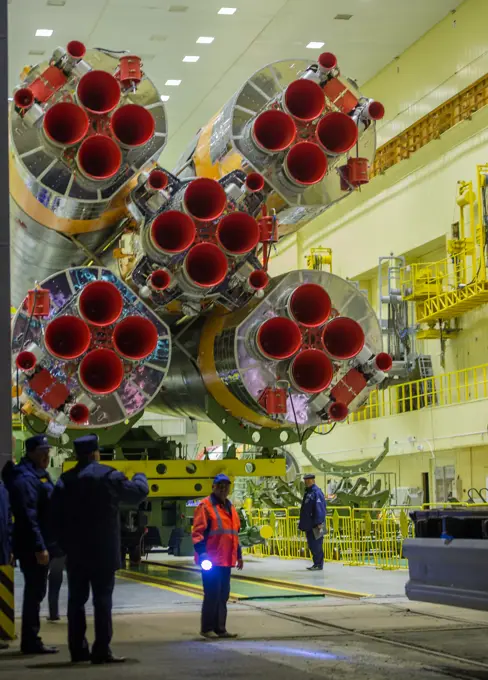
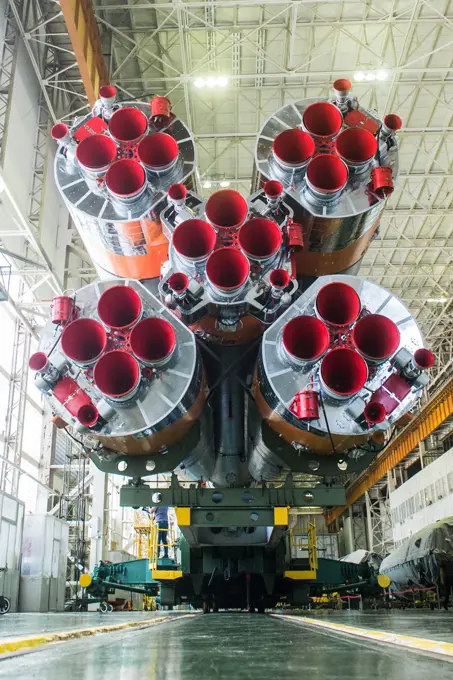
jsc2019e039432 - In the Integration Building at the Baikonur Cosmodrome in Kazakhstan, the first stage engines of the Soyuz booster are prominent in the field of view July 16 as final preparations begin for the launch of three new crewmembers to the International Space Station. Drew Morgan of NASA, Alexander Skvortsov of Roscosmos and Luca Parmitano of the European Space Agency will launch July 20 on the Soyuz MS-13 spacecraft from the Baikonur Cosmodrome for a mission on the International Space Station...Andrey Shelepin/GCTC.
6145-44896039
At the Baikonur Cosmodrome in Kazakhstan, the Soyuz TMA-05M spacecraft (right) is readied for its encapsulation into the upper stage of its Soyuz booster (left) July 8, 2012 in advance of its rollout to the launch pad July 12 and the launch of its occupants, Expedition 32/33 Soyuz Commander Yuri Malenchenko, NASA Flight Engineer Sunita Williams and Flight Engineer Aki Hoshide of the Japan Aerospace Exploration Agency July 15 for a four-month mission on the International Space Station.NASA/Victor Zelentsov
6145-58958517
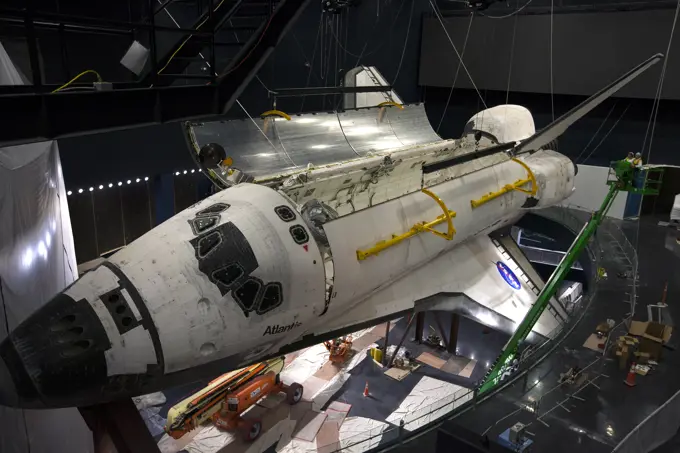
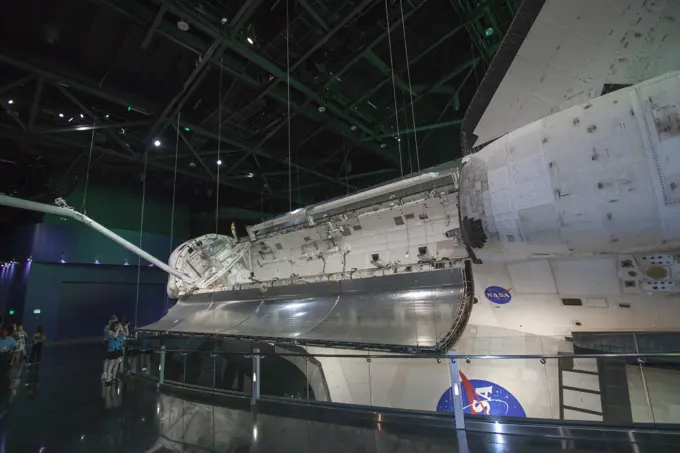
CAPE CANAVERAL, Fla. - At the Kennedy Space Center Visitor Complex in Florida, one of space shuttle Atlantis payload bay doors has been opened. Atlantis is being prepared for display in the Space Shuttle Atlantis exhibit, a 90,000-square-foot facility, scheduled to open June 29, 2013. The new $100 million facility will include interactive exhibits that tell the story of the 30-year Space Shuttle Program and highlight the future of space exploration. Visitors to the exhibit will get an up close look at Atlantis with its payload bay doors open, similar to how it looked in space.
6145-58962904
KENNEDY SPACE CENTER, FLA. - The redesigned External Tank is being raised to a vertical position in the Vehicle Assembly Building and will be lifted into the 'checkout cell' where the tank's mechanical, electrical and thermal protection systems are inspected. The tank will also undergo new processes resulting from its redesign, including inspection of the bipod heater and External Tank separation camera. The tank will be prepared for 'mating' to the Shuttles Solid Rocket Boosters. When preparations are complete, the tank will be lifted from the checkout cell, moved across the transfer aisle and into High Bay 1. It will be lowered and attached to the boosters, which are sitting on the Mobile Launch Platform. The SRBs and ET will be flying with Shuttle Discovery for the Return to Flight mission STS-114. The launch planning window is May 12 to June 3, 2005.
6145-45296429
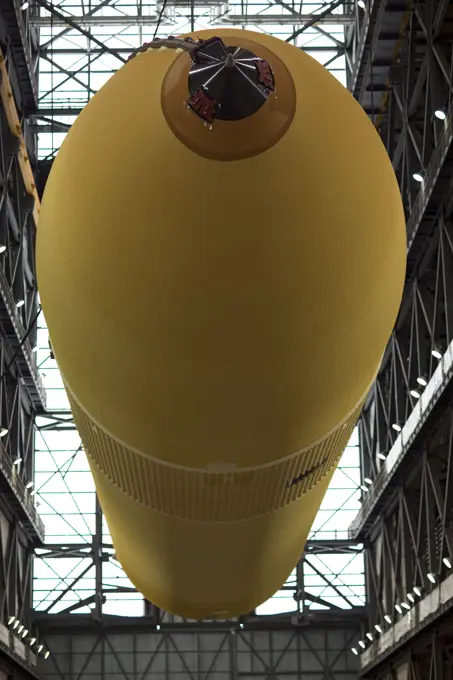
Teams with NASAs Exploration Ground Systems and contractor Jacobs begin to rotate the Space Launch System (SLS) core stage - the largest part of the rocket - into a vertical position in preparation for its move to High Bay 3 in the Vehicle Assembly Building, where it will be placed atop the mobile launcher in between the twin solid rocket boosters, at NASAs Kennedy Space Center in Florida on June 11, 2021. The 188,000-pound core stage, with its four RS-25 engines, will provide more than 2 million pounds of thrust during launch and ascent, and coupled with the boosters, will provide more than 8.8 million pounds of thrust to send the Artemis I mission to space. Under the Artemis program, NASA will land the first woman and first person of color on the Moon, as well as establish a sustainable presence on the lunar surface in preparation for human missions to Mars.
6145-45041466
CAPE CANAVERAL, Fla. - Inside the Vehicle Assembly Building at NASAs Kennedy Space Center in Florida, technicians prepare space shuttle Endeavour for its move to Orbiter Processing Facility-2 (OPF-2).Shuttle Endeavour will remain in OPF-2 so that the orbiter maneuvering system (OMS) pods and forward reaction control system can be installed. Technicians also will offload water and Freon gas from lines located in Endeavours midbody. The work is part of Endeavours transition and retirement processing. The spacecraft is being prepared for public display at the California Science Center in Los Angeles. Endeavour flew 25 missions, spent 299 days in space, orbited Earth 4,671 times and traveled 122, 883, 151 miles over the course of its 19-year career. Endeavours STS-134 and final mission was completed after landing on June 1, 2011.
6145-58965846
CAPE CANAVERAL, Fla. - At NASA's Kennedy Space Center in Florida, the space shuttle mock-up, dubbed Pathfinder, undergoes a lift test in the Vehicle Assembly Building on May 31, 1978. The mock-up, constructed at NASA's Marshall Space Flight Center in Huntsville, Ala., possessed the general dimensions, weight and balance of a real space shuttle. It was shipped to Kennedy by barge and then used to fit-check the work platforms of the Mate-Demate Device, orbiter processing facilities and Vehicle Assembly Building, as well as support ground crew training. It also was used to rehearse post-landing procedures at Kennedy's Shuttle Landing Facility. After being on display at the 'Great Space Shuttle Exposition' in Tokyo from June 1983 to August 1984, the mock-up returned to Marshall and now is on permanent display at the U.S. Space and Rocket Center near Huntsville.
6145-45280961
Inside the Rotation, Processing and Surge Facility at NASAs Kennedy Space Center in Florida, Exploration Ground Systems and Jacobs TOSC workers completed painting of NASAs iconic “worm” logo on the Artemis I Space Launch System twin solid rocket boosters on Sept. 23, 2020. Originally created by the firm of Danne & Blackburn, the iconic “worm” logos bold, sleek design was officially introduced in 1975 and was incorporated into many of the agencys next-generation programs. It was retired in 1992, but has made a comeback in 2020 as the agency ushers in a new, modern era of human spaceflight. The first in a series of increasingly complex missions, Artemis I will test the Orion spacecraft and Space Launch System as an integrated system ahead of crewed flights to the Moon. Under the Artemis program, NASA will land the first woman and the next man on the Moon by 2024.
6145-45193332
In the Integration Building at the Baikonur Cosmodrome in Kazakhstan, the Soyuz MS-12 spacecraft is encapsulated into the nose fairing of the Soyuz booster rocket March 6. Expedition 59 crewmembers Nick Hague and Christina Koch of NASA and Alexey Ovchinin of Roscosmos will launch on March 14, U.S. time, on the Soyuz MS-12 spacecraft from the Baikonur Cosmodrome for a six-and-a-half month mission on the International Space Station...NASA/Victor Zelentsov.
6145-58960918
CAPE CANAVERAL, Fla. -- This is a 3-D image of space shuttle Endeavour as it is outfitted with a metal sling that will lift the spacecraft from the transfer aisle into a high bay of the Vehicle Assembly Building at NASA's Kennedy Space Center in Florida. In the bay, the shuttle will be attached to its external fuel tank and solid rocket boosters. Endeavour is targeted to roll out to Kennedy's Launch Pad 39A for its final mission, STS-134, on March 9. To view this image, use green and magenta 3-D glasses.Endeavour and six-member crew will deliver the Express Logistics Carrier-3, Alpha Magnetic Spectrometer-2 (AMS), a high-pressure gas tank, additional spare parts for the Dextre robotic helper and micrometeoroid debris shields to the International Space Station. Endeavour's final launch is targeted for April 19 at 7:48 p.m. EDT.
6145-55974133
. The engine that will power NASAs quiet supersonic X-59 in flight is installed, marking a major milestone in the experimental aircrafts journey toward first flight. The installation of the F414-GE-100 engine at Lockheed Martins Skunk Works facility brings the vehicle close to the completion of its assembly.
6145-44966557
CAPE CANAVERAL, Fla. -- At the Kennedy Space Center Visitor Complex in Florida, guests participate in an early viewing of the Space Shuttle Atlantis and other exhibits inside the 90,000-square-foot facility.The new $100 million facility will include interactive exhibits that tell the story of the 30-year Space Shuttle Program and highlight the future of space exploration. The "Space Shuttle Atlantis" exhibit is scheduled to open June 29, 2013.
6145-45132188
jsc2017e044355 (April 12, 2017) --- In the Integration Facility at the Baikonur Cosmodrome in Kazakhstan, the upper stage of a Soyuz booster is raised back onto its test stand April 12 after the Soyuz MS-04 spacecraft was encapsulated in the rocket segment. The Soyuz rockets three stages were then mated together on April 15 in advance of the launch of Expedition 51 crewmembers Fyodor Yurchikhin of the Russian Federal Space Agency (Roscosmos) and Jack Fischer of NASA April 20 on the Soyuz MS-04 spacecraft from Baikonur for a four and a half month mission on the International Space Station.
6145-44514241
Inside Orbiter Processing Facility bay 3, Atlantis is ready for rollover to the Vehicle Assembly Building. In the VAB it will be raised to vertical and lifted up and into high bay 3 for stacking with its external tank and solid rocket boosters. Atlantis will fly on mission STS-98, the seventh construction flight to the International Space Station. The orbiter will carry in its payload bay the U.S. Laboratory, named Destiny, that will have five system racks already installed inside of the module. After delivery of electronics in the lab, electrically powered attitude control for Control Moment Gyroscopes will be activated. Atlantis is scheduled for launch on Jan. 18, 2001, at 2:44 a.m. EST, with a crew of five
6145-44692782
KENNEDY SPACE CENTER, FLA. --  The external tank for space shuttle Endeavour's STS-123 mission is moved into the transfer aisle of the Vehicle Assembly Building.  The tank was shipped from NASA's Michoud Assembly Facility near New Orleans aboard the Pegasus barge.  Endeavour is targeted for launch to the International Space Station on Feb. 14.
6145-44472465
Several concept designs for Artemis crew transportation vehicles (CTV) are lined up in the transfer aisle of the Vehicle Assembly Building at NASAs Kennedy Space Center in Florida on May 11, 2022. Canoo Technologies Inc., was awarded a contract to design and provide the next generation of CTVs for the Artemis crewed missions. Representatives with Canoo were at the spaceport demonstrating the environmentally friendly fleet of vehicles. Artemis II will be the first Artemis mission flying crew aboard Orion. In later missions, NASA will land the first woman and the first person of color on the surface of the Moon, paving the way for a long-term lunar presence and serving as a steppingstone on the way to Mars.
6145-58962482
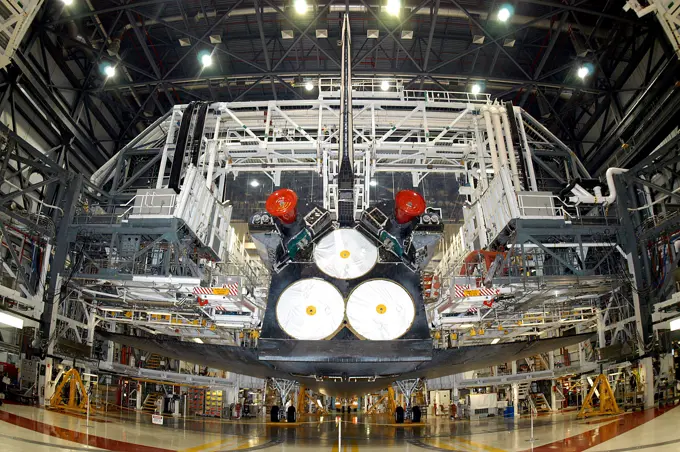
KENNEDY SPACE CENTER, FLA. - An overview of the orbiter Endeavour is shown as it sits inside the Florida Space Authoritys Reusable Launch Vehicle hangar at NASAs Kennedy Space Center. While in the hangar, Endeavour has undergone testing to see how orbiters respond to a new radar system that will be used during launch to detect debris. Endeavour is returning to the Orbiter Processing Facility today to continue Orbiter Major Modifications (OMM). OMMs are scheduled at regular intervals to enhance safety and performance, infuse new technology, and, in this case, perform Return to Flight modifications.
6145-44923033
CAPE CANAVERAL, Fla. -- At Cape Canaveral Air Force Station's Space Launch Complex 41 in Florida, United Launch Alliance technicians support operations to mate the Centaur stage to the Atlas V rocket that will carry the Tracking and Data Relay Satellite, TDRS-K, into orbit.Launch of the TDRS-K on the Atlas V rocket is planned for January 29, 2013. The TDRS-K spacecraft is part of the next-generation series in the Tracking and Data Relay Satellite System, a constellation of space-based communication satellites providing tracking, telemetry, command and high-bandwidth data return services.
6145-45081846
At NASA's Kennedy Space Center in Florida, members of the news media tour the spaceport's Vehicle Assembly Building VAB. Like the Apollo Saturn V and space shuttles of the past, the Space Launch System rocket will be stacked and checked out in the VAB prion to being rolled to the launch pad. Orion is the exploration spacecraft designed to carry astronauts to destinations not yet explored by humans, including an asteroid and Mars. It will have emergency abort capability, sustain the crew during space travel and provide safe re-entry from deep space return velocities. The first unpiloted flight test of Orion is scheduled to launch Dec. 4, 2014 atop a United Launch Alliance Delta IV Heavy rocket, and in 2018 on NASAs Space Launch System rocket.
PREVIOUS
of 3
NEXT
2401 S. Ervay, Suite 206
Dallas, Texas 75215
United States
Get Started
Free ResearchMy BoardsMy Cart
For Creators
How To License Your ContentContributor PortalFrame of Mind
Resources
API accessPricing
Contact
+1 866 236 0087help@viewpictures.co.uk Contact form
©2026 View Pictures. All Rights Reserved. -B
This site is protected by reCAPTCHA and Google Privacy Policy and Terms of Service apply.