My Boards
View Pictures
  • My Boards

Space Launch Vehicle Assembly

Images depicting the assembly process of space launch vehicles, showcasing external tanks and solid rocket boosters in various stages of integration at NASA facilities.

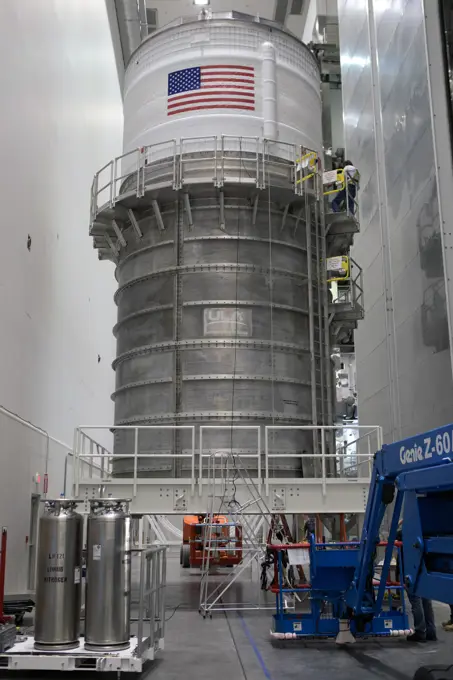
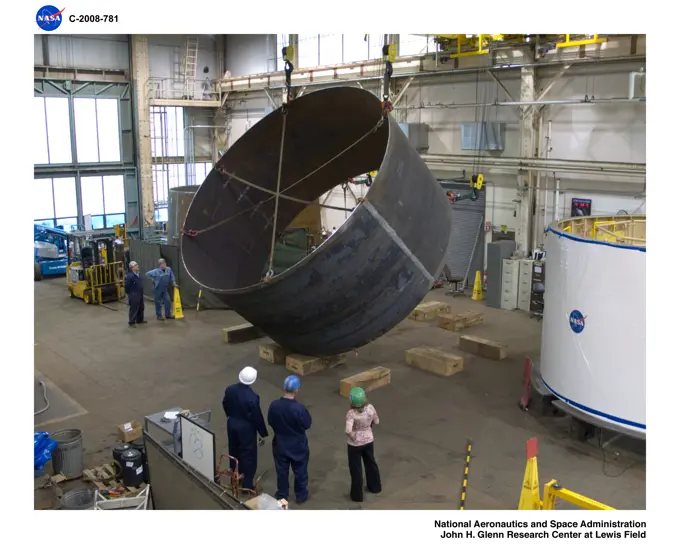
LAUNCH VEHICLE STAGE ADAPTER (LVSA) AFT CONE MOVE FROM THE VERTICAL WELD TOOL TO THE FLOOR OF BLDG 4755
253 assets in this story
6145-44674072
KENNEDY SPACE CENTER, FLA. --  In the Vehicle Assembly Building, external tank No. 117 is slowly raised from horizontal to vertical.  Once vertical, the tank will be lifted into the checkout cell in high bay 2 for processing.  ET-117 arrived aboard the Pegasus barge after its voyage around the Florida Peninsula from the Michoud Assembly Facility near New Orleans. The tank is slated for mission STS-118, which is targeted for launch in early August.
6145-45118197
The Soyuz rocket and Soyuz MS-02 spacecraft are assembled on Friday, Oct. 14, 2016 at the Baikonur Cosmodrome in Kazakhstan.  Expedition 49 flight engineer Shane Kimbrough of NASA, Soyuz commander Sergey Ryzhikov of Roscosmos, and flight engineer Andrey Borisenko of Roscosmos are scheduled to launch from the Baikonur Cosmodrome in Kazakhstan on Oct. 19.
6145-48821792
A900813 U12P DISTANT ZENITH FAC H.E. WRAP GEORGE STALLER (Project Engineer) NOV 21 90 EG&G/NTS PHOTO LAB Publication Date: 11/21/1990  DISTANT ZENITH; EDGERTON, GERMESHAUSEN & GRIER; EG&G; EQUIPMENT; EQUIPMENT & INSTRUMENTS; FAC; FAC H.E. WRAP; H.E. WRAP; INSTRUMENTS & EQUIPMENT; INSTRUMENTS AND EQUIPMENT; MALE; MALES; MEN; MEN (ADD MALE MODIFIER); NEVADA; NEVADA TEST SITE; NTS; NUCLEAR ENERGY TECHNOLOGY; P-TUNNEL; TEST SITES; TUNNELS; UGT; UNDERGROUND TESTING; WEAPONS EFFECTS  historical images. 1972 - 2012. Department of Energy. National Nuclear Security Administration. Photographs Related to Nuclear Weapons Testing at the Nevada Test Site.
6145-45105452
NASAs upgraded crawler-transporter 2 (CT-2) begins its trek from the Vehicle Assembly Building (VAB) at the agencys Kennedy Space Center in Florida to Launch Pad 39B to test recently completed upgrades and modifications for NASAs journey to Mars. The Ground Systems Development and Operations Program at Kennedy oversaw upgrades to the crawler in the VAB. The crawler will carry the mobile launcher with Orion atop the Space Launch System rocket to Pad 39B for Exploration Mission-1, scheduled for 2018.
6145-45139920
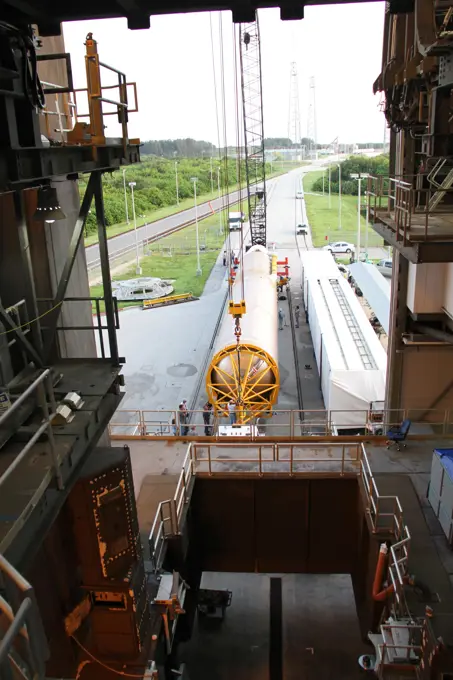
The Interim Cryogenic Propulsion Stage (ICPS) for NASA's Space Launch System (SLS) rocket is packed inside a canister and ready to be moved from the United Launch Alliance (ULA) Delta Operations Center near Space Launch Complex 37 at Cape Canaveral Air Force Station to the Space Station Processing Facility at NASA's Kennedy Space Center in Florida. The ICPS is the first integrated piece of flight hardware to arrive for the SLS. It is the in-space stage that is located toward the top of the rocket, between the Launch Vehicle Stage Adapter and the Orion Spacecraft Adapter. It will provide some of the in-space propulsion during Orion's first flight test atop the SLS on Exploration Mission-1.
6145-44713950
S68-55034 (3 Dec. 1968) --- The first (S-1C) stage of the Saturn 505 launch vehicle being prepared for erection in the high bay area of the Kennedy Space Center's (KSC) Vehicle Assembly Building (VAB). Saturn 505 is the launch vehicle for the Apollo 10 mission.
6145-44778470
CAPE CANAVERAL, Fla. - In the Vehicle Assembly Building's High Bay 3, a worker watches as a crane lowers the Ares I-X Super Stack 4 for integration with Super Stack 3.  Five super stacks make up the upper stage that will be integrated with the four-segment solid rocket booster first stage on the mobile launch platform.  Ares I-X is the test vehicle for the Ares I, which is part of the Constellation Program to return men to the moon and beyond. The Ares I-X flight test is targeted for  Oct. 31, pending formal NASA Headquarters approval.
6145-45239238
The S-IC-T stage was hoisted into the S-IC Static Test Stand at the Marshall Space Flight Center. The S-IC-T stage was a static test vehicle, not intended for flight. It was ground tested repeatedly over a period of many months to prove the vehicle's propulsion system. The 280,000-pound stage, 138 feet long and 33 feet in diameter, housed the fuel and liquid oxygen tanks that held a total of 4,400,000 pounds of liquid oxygen and kerosene. The two tanks were cornected by a 26-foot intertank section. Other parts of the booster included the forward skirt and the thrust structure, on which the engines were to be mounted. Five F-1 engines, each weighing 10 tons, gave the booster a total thrust of 7,500,000 pounds, roughly equivalent to 160 million horsepower.
6145-45050774
VANDENBERG AIR FORCE BASE, Calif. - A crane supports the solid rocket motor, or SRM, for NASA's Orbiting Carbon Observatory-2 mission, or OCO-2, following its delivery to the mobile service tower at Space Launch Complex 2 on Vandenberg Air Force Base in California. Operations are underway to attach the Delta II rocket's three SRMs, known as graphite epoxy motors, to the rocket's first stage.OCO-2 is scheduled to launch into a polar Earth orbit aboard a United Launch Alliance Delta II 7320-10C rocket in July. Once in orbit, OCO-2 will collect precise global measurements of carbon dioxide in the Earth's atmosphere and provide scientists with a better idea of the chemical compound's impacts on climate change. Scientists will analyze this data to improve our understanding of the natural processes and human activities that regulate the abundance and distribution of this important atmospheric gas.
6145-44505849
At Launch Pad 36A, Cape Canaveral Air Force Station, a Centaur rocket is raised to a vertical position before lifting it up the launch tower. It will be mated with the lower stage Atlas IIA rocket, already in the tower, to launch the latest Tracking and Data Relay Satellite (TDRS) June 29 from CCAFS. The TDRS is one of three (labeled H, I and J) being built in the Hughes Space and Communications Company Integrated Satellite Factory in El Segundo, Calif. The new satellites will augment the TDRS systems existing Sand Ku-band frequencies by adding Ka-band capability. TDRS will serve as the sole means of continuous, high-data-rate communication with the space shuttle, with the International Space Station upon its completion, and with dozens of unmanned scientific satellites in low earth orbit
6145-44777444
CAPE CANAVERAL, Fla. - In the Vehicle Assembly Building's High Bay 3 at NASA's Kennedy Space Center in Florida, a crane  lowers Super Stack 2, part of the Ares I-X upper stage, for integration with Super Stack 1. The upper stage comprises five super stacks, which are integrated with the four-segment solid rocket booster first stage on the mobile launch platform.  Ares I-X is the test vehicle for the Ares I, which is part of the Constellation Program to return men to the moon and beyond. The Ares I-X flight test is targeted for  Oct. 31, pending formal NASA Headquarters approval.
6145-45132433
The Soyuz rocket is prepared to be rolled out to the launch pad on Monday, April 17, 2017 at the Baikonur Cosmodrome in Kazakhstan. The Soyuz MS-04 spacecraft, scheduled to launch April 20 Baikonur time, will carry Expedition 51 Soyuz Commander Fyodor Yurchikhin of Roscosmos and Flight Engineer Jack Fischer of NASA into orbit to begin their four and a half month mission on the International Space Station.
4389-763
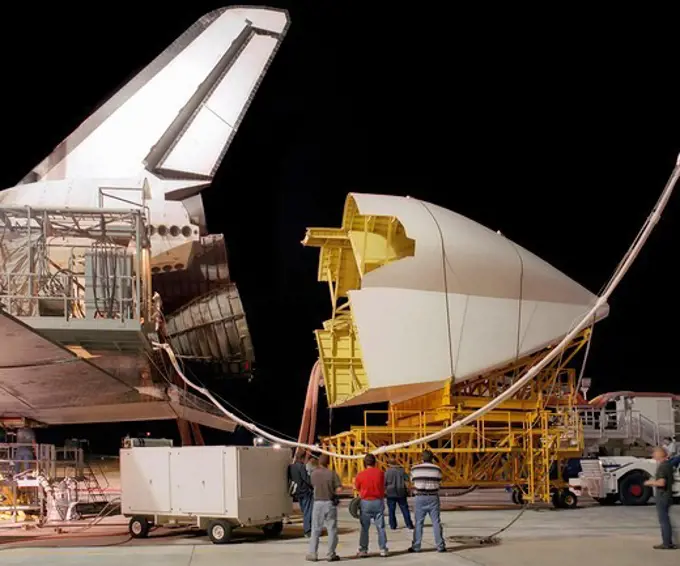
Attaching Tail Cone to Space Shuttle Discovery
6145-45073533
CAPE CANAVERAL, Fla. - Inside the Vehicle Assembly Building, or VAB, at NASA's Kennedy Space Center in Florida, a crane is being used to lower the 175-ton crane from Level 16 down to the transfer aisle floor. Upgrades to the crane's 45-year-old controls will be performed in order to improve reliability, precision and safety. The Ground Systems Development and Operations Program is overseeing upgrades and modifications to the VAB. The crane will be upgraded so that it can support lifting needs for NASA and other exploration vehicles, including the agency's Space Launch System and Orion spacecraft.
6145-45210957
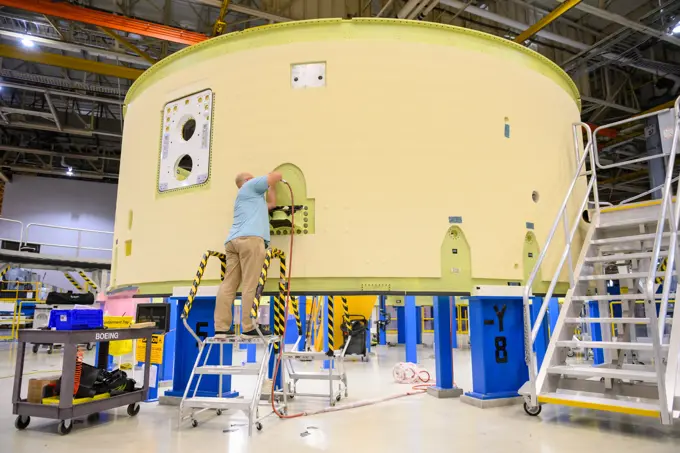
Space Launch System Corestage-2 (Artemis-2) Forward Skirt after recieiving spray-on foam insulation(SOFI) at NASA's Michoud Assembly Facility.
6145-58964963
KENNEDY SPACE CENTER, Fla. -- After rollback of the Rotating Service Structure on Launch Pad 39B, Space Shuttle Endeavour is bathed in light. Seen is one of the twin solid rocket boosters that flank the orange external tank. Above the external tank is the Gaseous Oxygen Vent Arm that vents gaseous oxygen vapors away from the Shuttle. The vent hood assembly at the end is often referred to as the 'beanie cap.' Stretching to the crew hatch on the side is the Orbiter Access Arm with its environmentally controlled White Room at the end. The Shuttle sits on the Mobile Launcher Platform with the two service tail masts on either side of the main engines. The tail masts support the fluid, gas and electrical requirements of the orbiter's liquid oxygen and liquid hydrogen aft T-0 umbilicals. Each tail mast is 31 feet (9.4 meters) high, 15 feet (4.6 meters) long and 9 feet (3.1 meters) wide. Endeavour is scheduled to launch on mission STS-108 Nov. 29 at 7 41 p.m. On this 12th flight to the Interna
6145-58962345
KENNEDY SPACE CENTER, FLA. - Suspended high inside the Vehicle Assembly Building, the External Tank (ET) designated for the Return to Flight mission STS-114 is carefully lowered between the Solid Rocket Boosters (SRBs) on the Mobile Launcher Platform. The ET will be mated to the SRBs for launch. The 154-foot long ET is recently redesigned to meet recommendations of the Columbia Accident Investigation Board before returning to flight. Among dozens of changes is a redesigned forward bipod fitting to reduce the risk to the Space Shuttle from falling debris during ascent. Considered a test flight, STS-114 is scheduled to launch during a window extending May 15 to June 3. The Shuttle will carry supplies and equipment to the International Space Station.
6145-45235936
This photograph is a view of stacking the major components of the S-IC (first) stage of the Saturn V vehicle at the Boeing vertical assembly building at the Michoud Assembly Facility (MAF). The view shows placing the liquid oxygen tank on the intertank and the fuel tank assembly. The Saturn IB and Saturn V first stages were manufactured at the MAF located 24 kilometers (approximately 15 miles) east of downtown New Orleans, Louisiana. The prime contractors, Chrysler and Boeing, jointly occupied the MAF. The basic manufacturing building boasted 43 acres under one roof. By 1964, NASA added a separate engineering and office building, vertical assembly building, and test stage building. By 1966, other changes to the site included enlarged barge facilities and other miscellaneous support buildings.
6145-55901512
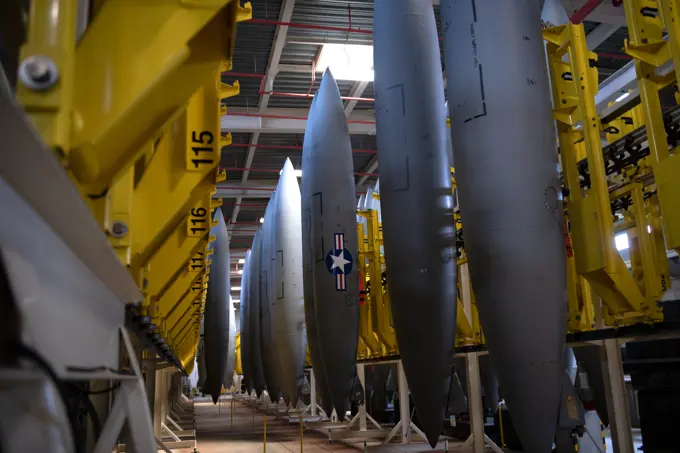
External aircraft fuel tanks are arranged on the vertical tank storage system in an 18th Component Maintenance Squadron fuels building at Kadena Air Base, Japan, Sept. 16, 2022. Each of the three VTSS units can hold up to 100 external aircraft fuel tanks.
6145-45048718
The Soyuz rocket and Soyuz TMA-12M spacecraft are assembled at Building 112 on the Baikonur Cosmodrome on Saturday, March 22, 2014 in Baikonur, Kazakhstan. Launch of the Soyuz is scheduled for March 26 and will send Expedition 39 Soyuz Commander Alexander Skvortsov of the Russian Federal Space Agency, Roscosmos, Flight Engineer Steven Swanson of NASA, and Flight Engineer Oleg Artemyev of Roscosmos on a six month mission to the International Space Station.
1848-49469488
Construction of weather satellites at space company OHB in Bremen. Bremen, 14.07.2022, Bremen, Germany, Europe
4316-4201
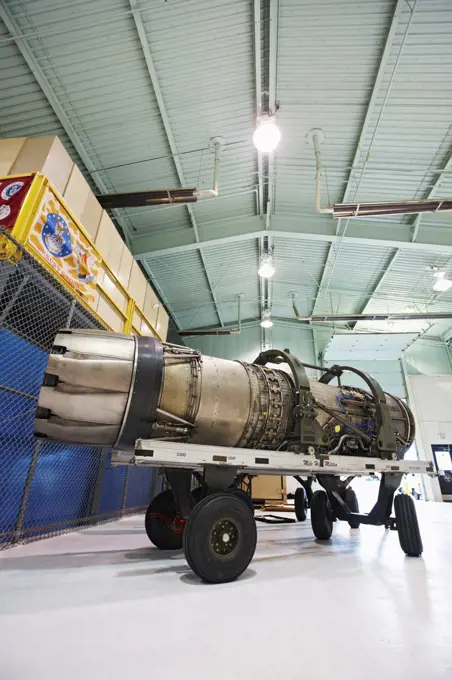
Jet Engine
6145-45280462
Workers with NASAs Exploration Ground Systems (EGS) finishes the first coat of the bright red “worm” logo taking shape on the side of an Artemis I solid rocket booster segment inside the Rotation, Processing and Surge Facility (RPSF) at Kennedy Space Center in Florida. The EGS team used a laser projector to mask off the logo with tape, then painted the first coat of the iconic design. The booster segments will help propel the Space Launch System (SLS) rocket on Artemis I, a test of the Orion spacecraft and SLS as an integrated system ahead of crewed flights to the Moon. Northrop Grumman, which built the booster segments, is covering the cost of the painting.
6145-45231589
Tiltrotor Aircraft, Transport Aircraft T-Cab moving into NASA Ames Vertical Motion Simulaotor (VMS) from I-Cab Fixed Base Area in bldg. N-243 using trolly.
6145-44624296
The Soyuz TMA-5 spacecraft is mated to its booster rocket in a processing hangar at the Baikonur Cosmodrome in Kazakhstan Monday, October 11, 2004, in preparation for its rollout to the launch pad October 12 and its liftoff October 14 to carry Expedition 10 Commander and NASA Science Officer Leroy Chiao, Flight Engineer and Soyuz Commander Salizhan Sharipov and Russian Space Forces cosmonaut Yuri Shargin to the International Space Station.
6145-44618116
KENNEDY SPACE CENTER, FLA. -  On Pad 17-B, Cape Canaveral Air Force Station, workers steady the Solid Rocket Booster (SRB) waiting to be lifted up the mobile service tower. The SRB and eight others will be mated to the Boeing Delta II Heavy rocket for the Aug. 2 launch of the MESSENGER spacecraft to the planet Mercury.  The spacecraft is expected to reach orbit around Mercury in March 2011.  MESSENGER was built for NASA by the Johns Hopkins University Applied Physics Laboratory in Laurel, Md.
6145-44512198
KENNEDY SPACE CENTER, FLA. -- As the orbiter Endeavour hangs suspended from a crane inside the Vehicle Assembly Building, workers make adjustments on it before it is lifted and stacked with its external tank and solid rocket boosters. The stack is in high bay 1. Space Shuttle Endeavour is scheduled to be launched Nov. 30 on mission STS-97, the sixth construction flight to the International Space Station
6145-44696188
KENNEDY SPACE CENTER, FLA. --In the Space Station Processing Facility at NASA's Kennedy Space Center, workers stand by as an overhead crane lowers the Japanese Experiment Module, called Kibo, onto the scale for weighing.  Also known as the JEM-PM, the module is the primary payload for space shuttle Discovery's STS-124 mission, which is targeted for launch to the International Space Station on April 24.
6145-45289939
This image shows technicians and engineers beginning the process of the forward join on the core stage of NASAs Space Launch System rocket for Artemis II, the first crewed mission of NASAs Artemis program at NASAs Michoud Assembly Facility. The forward join connects the forward skirt, the liquid oxygen tank (LOX) and the intertank structures to form the top part of the SLS rockets core stage. Now, NASA and Boeing, the SLS prime contractor, will continue to integrate various systems inside the forward part of the core stage and prepare for structural joining of the liquid hydrogen tank and engine section to form the bottom of the stage. Together with its four RS-25 engines, the rockets massive 212-foot-tall core stage — the largest stage NASA has ever built — and its twin solid rocket boosters will produce 8.8 million pounds of thrust to send NASAs Orion spacecraft, astronauts and supplies beyond Earths orbit to the Moon and, ultimately, Mars. Offering more payload mass, volume
6145-45252047
Ares 1-X Project US-1 Segment
6145-44879480
CAPE CANAVERAL, Fla. -- Preparations are under way to lift the first stage of the Atlas V rocket for NASA's Mars Science Laboratory (MSL) mission into the Vertical Integration Facility at Space Launch Complex 41 on Cape Canaveral Air Force Station.A United Launch Alliance Atlas V-541 configuration will be used to loft MSL into space. Curiositys 10 science instruments are designed to search for evidence on whether Mars has had environments favorable to microbial life, including chemical ingredients for life.  The unique rover will use a laser to look inside rocks and release its gasses so that the rovers spectrometer can analyze and send the data back to Earth. MSL is scheduled to launch Nov. 25 with a window extending to Dec. 18 and arrival at Mars Aug. 2012.
6145-45048975
VANDENBERG AIR FORCE BASE, Calif. - Workers maneuver half of the fairing for NASA's Orbiting Carbon Observatory-2 mission, or OCO-2, newly arrived at Space Launch Complex 2 on Vandenberg Air Force Base in California, into position underneath the crane. Operations are underway to hoist this section of the fairing into the Delta II launcher's environmental enclosure, or clean room, at the top of the tower where the other half already is in position. The fairing will protect OCO-2 during launch aboard a United Launch Alliance Delta II rocket from Space Launch Complex 2 in July. The observatory will collect precise global measurements of carbon dioxide in the Earth's atmosphere and provide scientists with a better idea of the chemical compound's impacts on climate change. Scientists will analyze this data to improve our understanding of the natural processes and human activities that regulate the abundance and distribution of this important atmospheric gas.
1801-62828595
Royal Opera House Production Workshop, Purfleet, United Kingdom. Architect: Nicholas Hare Architects LLP, 2013. Perspective of production hall with set designers at work.
6145-48919443
110820-N-TC958-013NORFOLK (Aug. 20, 2011) The 112,000-pound main mast of the aircraft carrier USS Harry S. Truman (CVN 75) is installed two days ahead of schedule at Norfolk Naval Shipyard during the shipÕs 13-month docked planned incremental availability.
6145-45237463
This photo depicts the installation of an External Tank (ET) into the Marshall Space Flight Center Dynamic Test Stand, building 4550. It is being mated to the Solid Rocket Boosters (SRB's) for a Mated Vertical Ground Vibration Test (MVGVT). At 154-feet long and more than 27-feet in diameter, the ET is the largest component of the Space Shuttle, the structural backbone of the entire Shuttle system, and is the only part of the vehicle that is not reusable.
1848-53880171
Construction site of the new hydropower plant in Rheinfelden, shaft 3, positioning the impeller, 6.5 metres in diameter and weighing 40 tons, Rheinfelden - Ost, Rheinfelden - Baden, Baden-Wuerttemberg, Germany, Europe
6145-44485213
Crews at NASAs Michoud Assembly Facility in New Orleans reinstalled the iconic NASA meatball logo to the side of the 43-acre factory following a months-long project to replace the corrugated asbestos paneling original to the buildings construction on the outer façade of the facility. The new paneling is an insulated metal sandwich panel, which provides an increased insulation R-value. The new fastening system can withstand significant wind loads, adding greater protection against hurricanes, tornados, and other storm-related events common to the area; and is critical to help protect vital hardware for the Space Launch System rockets and the Orion Spacecrafts manufactured at Michoud for NASAs Artemis missions, which will land the first woman and first person of color on the moon.
6145-44711345
Closeup view of the interior of Apollo S/C 012 C/M, Pad 34, showing the effects of the intense heat of the flash fire which killed the Prime Crew of the A/S 204 Mission. CAPE KENNEDY, FL CAPE KENNEDY, FL
6145-44712679
CAPE CANAVERAL, Fla. - This elevated view of Launch Pad 39A at NASA's Kennedy Space Center shows workers preparing to fill steel grid structures, welded to the wall of the flame trench, with a heat-resistant concrete called Fondue Fyre, developed during NASA's Apollo lunar program. Damage to the trench occurred during the May 31 launch of Discovery on the STS-124 mission. A 75- by 20-foot section of the east wall was destroyed and debris scattered as far as the pad perimeter fence. Repairs are expected to be completed before the targeted Oct. 8 launch of Atlantis on the NASA Hubble Space Telescope servicing mission.
6145-45219986
Preparations are underway to move the Space Launch System Core Stage pathfinder to the north end of the transfer aisle inside the Vehicle Assembly Building at NASAs Kennedy Space Center in Florida on Oct. 3, 2019. A cover, called a spider, in view at the far end of the transfer aisle, will be attached to the top of the pathfinder. With the spider secured in place, a crane will be attached to it to lift the pathfinder into the vertical position. The 212-foot-long core stage pathfinder arrived in NASA's Pegasus Barge at Kennedys Launch Complex 39 turn basin wharf on Sept. 27, 2019. The Pegasus Barge made its first delivery to Kennedy in support of the agency's Artemis missions. The upgraded 310-foot-long barge arrived, ferrying the SLS core stage pathfinder, a full-scale mock-up of the rocket's core stage. It will be used by Exploration Ground Systems and its contractor, Jacobs, to practice offloading, moving and stacking maneuvers, using important ground support equipment to train emp
6145-45256886
GPM is a joint mission between NASA and the Japan Aerospace Exploration Agency (JAXA). The Core Observatory will link data from a constellation of current and planned satellites to produce next-generation global measurements of rainfall and snowfall from space.On Feb. 11, the Core Observatory was moved into the spacecraft fairing assembly building and into the Encapsulation Hall. Final inspections and preparations were completed for the installation into the fairing, which began on Feb 13. The fairing is the part of the rocket that will contain the spacecraft at the top of the H-IIA rocket.The encapsulation process for the H-IIA is very different than for most U.S. rockets. For U.S. rockets, the fairing is usually in two pieces that close around the payload like a clamshell. To install the GPM Core Observatory into the fairing of the H-IIA rocket, first the Core Observatory and the Payload Attach Fitting (PAF) are set up in scaffolding in the Encapsulation Hall. Then, the fairing i
6145-54416790
An MX Pathfinder missile undergoes assembly. Base: Vandenberg Air Force Base State: California (CA) Country: United States Of America (USA)
6145-55901510
External aircraft fuel tanks are arranged on the vertical tank storage system in an 18th Component Maintenance Squadron fuels building at Kadena Air Base, Japan, Sept. 16, 2022. Each external aircraft fuel tank is held in a numbered section of the VTSS, allowing for easy logging and identification of tanks for maintenance and inspection purposes.
6145-58972134
CAPE CANAVERAL, Fla. - Crawler-transporter 2, or CT-2, enters the Vehicle Assembly Building at NASAs Kennedy Space Center in Florida. Visible are the new roller bearing assemblies that were installed on one side of the crawler. The Ground Systems Development and Operations Program completed a roller bearing assembly test on CT-2 truck sections A and C. The left- and right-hand steering was tested in both directions. The temperature of the roller assemblies was monitored and recorded as it traveled along the crawlerway. Engineers and technicians performed visual inspections of the roller bearing pumps, valves and lines to ensure that the grease injectors worked properly and provided the required flow of grease to the new roller assemblies. Work continues in high bay 2 to upgrade CT-2. The modifications are designed to ensure CT-2s ability to transport launch vehicles currently in development, such as the agencys Space Launch System, to the launch pad. The Ground Systems Development and
6145-44647682
KENNEDY SPACE CENTER, FLA. --   External tank No. 117 sits on a transporter inside NASA's Vehicle Assembly Building.  It is waiting for the move to the barge waiting at the Turn Basin in the Launch Complex 39 Area. The tank is being shipped to NASAs Michoud Assembly Facility in Louisiana for modifications.  The barge will be moved to Port Canaveral where one of NASAs solid rocket booster retrieval ships will take it and tow it around the Florida peninsula to Michoud.
6145-58964592
KENNEDY SPACE CENTER, FLA. -- At Launch Pad 39B the payload canister, with the Multi-Purpose Logistics Module Leonardo inside, nears the payload changeout room on the Rotating Service Structure. Umbilical hoses, maintaining a controlled environment for the cargo, are still attached to the lower end of the canister. At the PCR, the payload ground-handling mechanism (PGHM) will be used to transfer Leonardo out of the canister and then into Space Shuttle Discoverys payload bay. One of Italys major contributions to the International Space Station program, Leonardo is a reusable logistics carrier. It is the primary delivery system used to resupply and return Station cargo requiring a pressurized environment. Leonardo is the primary payload on mission STS-102 and will deliver up to 10 tons of laboratory racks filled with equipment, experiments and supplies for outfitting the newly installed U.S. Laboratory Destiny. STS-102 is scheduled to launch March 8 at 6 45 a.m. EST
4409-62620437
Cartagena, 12/19/2017. Report on the military arsenal at the Cartagena Naval Base. In the image, construction work on the new S 80 submarine at the Navantia shipyard. Photo: Jaime García. ARCHDC.
6145-44778511
CAPE CANAVERAL, Fla. - In the Vehicle Assembly Building's High Bay 4, assembly of the Ares I-X rocket nears completion. The yellow framework, nicknamed the "birdcage," is lowered by crane toward Super Stack 5. The birdcage has the ability to lift and to stack and de-stack the Ares I-X rocket's Super Stack 5. Next, the stack will be lifted on top of the segments already in place on the mobile launcher platform, completing assembly of the rocket.  Five super stacks make up the rocket's upper stage that will be integrated with the four-segment solid rocket booster first stage. Ares I-X is the test vehicle for the Ares I, which is part of the Constellation Program to return men to the moon and beyond. The Ares I-X flight test is targeted for Oct. 31, pending formal NASA Headquarters approval.
6145-44496716
KENNEDY SPACE CENTER, FLA. -- Inside a high bay of the Space Station Processing Facility (SSPF), workers remove the top of the shipping canister from the Multi-Purpose Logistics Module (MPLM) called Raffaello. After transfer to a workstand, the MPLM will undergo testing, joining the first Italian-built MPLM, Leonardo, in the SSPF. One of Italy's major contributions to the ISS program, the MPLM is a reusable logistics carrier and the primary delivery system used to resupply and return station cargo requiring a pressurized environment. Weighing nearly 4.5 tons, the Raffaello measures 21 feet long and 15 feet in diameter. Raffaello is scheduled to be launched on mission STS-100 July 27, 2000
6145-30256302
U.S. Secretary of State John Kerry and British Foreign Secretary Philip Hammond join Massachusetts Governor Deval Patrick and Massachusetts Clean Energy Center CEO Alicia Barton in examine a windmill blade before a joint event focused on climate change at the Wind Technology Testing Center in Boston, Massachusetts, on October 9, 2014.
6145-45272907
Day In The Life of Artemis Employees
6145-44759113
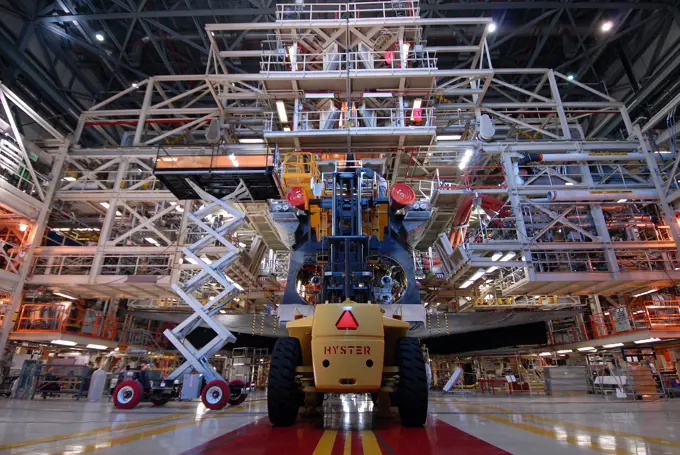
CAPE CANAVERAL, Fla. - At NASA's Kennedy Space Center in Florida, the Hyster forklift is ready to move away from space shuttle Discovery after removing one of the three main engines. Engine removal is part of the post-landing processing.  Discovery completed the STS-119 mission March 28 with a landing at Kennedy's Shuttle Landing Facility.  Each engine is 14 feet long, weighs about 6,700 pounds, and is 7.5 feet in diameter at the end of the nozzle. Discovery next will be used on the STS-128 mission to deliver supplies and equipment to the International Space Station.  The launch is targeted for Aug. 6.
6145-45221974
Structural Heat Intercept-Insulation-Vibration Evaluation Rig, SHIVER
PREVIOUS
of 3
NEXT
2401 S. Ervay, Suite 206
Dallas, Texas 75215
United States
Get Started
Free ResearchMy BoardsMy Cart
For Creators
How To License Your ContentContributor PortalFrame of Mind
Resources
API accessPricing
Contact
+1 866 236 0087help@viewpictures.co.uk Contact form
©2026 View Pictures. All Rights Reserved. -A
This site is protected by reCAPTCHA and Google Privacy Policy and Terms of Service apply.