My Boards
View Pictures
  • My Boards

Space Mission Control Activities

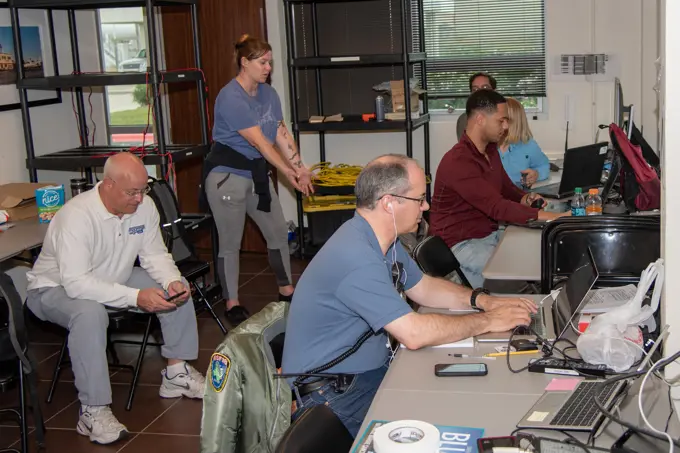
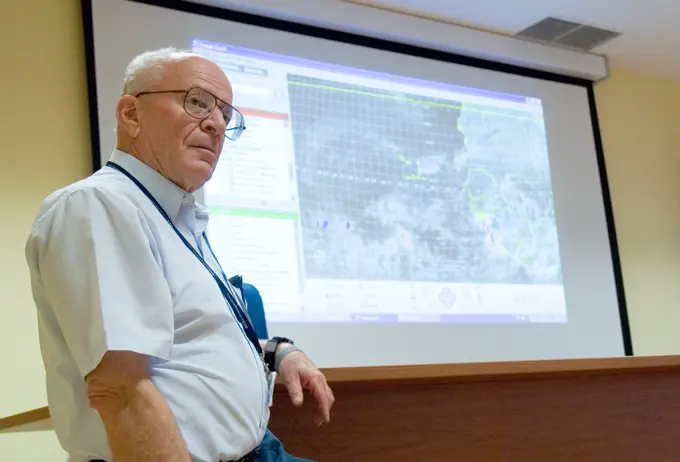
Dynamic scenes of flight controllers and crew members engaged in space mission operations, featuring multiple screens and high-tech equipment.

National Weather StationBoiseIdahoUSA
170 assets in this story
6145-54676554
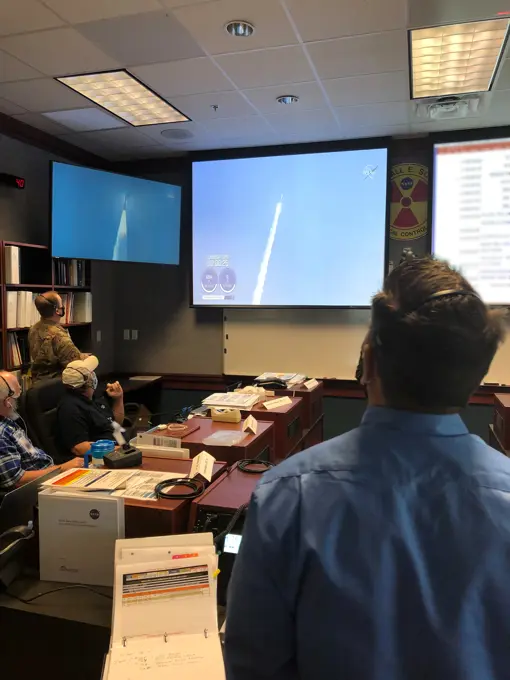
Artemis I Orion Recovery Opertaions. Inside a control room aboard USS Portland, members and leaders of NASAs Landing and Recovery team run through preparations and procedures ahead of the Orion Spacecrafts return from the Moon on Dec. 11 as part of the Artemis I mission.
6145-45198128
Tom Clark, standing, a manager with contractor ERC, works with Quentin Jones and Emily Hadley, both mechanical engineers for the liquid oxygen system, with ERC, during a countdown demonstration event of cryogenic propellant loading April 12, 2019, inside Firing Room 2 in the Launch Control Center at NASAs Kennedy Space Center in Florida. The practice simulation involved loading of liquid hydrogen and liquid oxygen into the Space Launch System rockets core and upper stages to prepare for Exploration Mission-1 (EM-1). During the tanking exercise, the team worked through surprise issues in real-time. The practice countdown events are training opportunities coordinated by EM-1 Launch Director Charlie Blackwell-Thompson with Exploration Ground Systems.
6145-44819434
PHOTO DATE:  05-14-10LOCATION: Bldg. 30 south - WFCRSUBJECT: STS-132/ULF4  WFCR Flight Controllers on Console During Launch with Flight Director Richard Jones
6145-58963499
KENNEDY SPACE CENTER, FLA. - A technician monitors the illumination test results being conducted on the Deep Impact spacecraft as a final check of performance. Launch aboard a Boeing Delta II rocket from Pad 17-B, Cape Canaveral Air Force Station, Fla., is scheduled for Jan. 8. The Deep Impact mission is the first to explore a comet's interior by using a spacecraft to create a crater, allowing us to look deep inside. Dramatic images from both the flyby spacecraft and the impactor will be sent back to distant Earth as data in near-realtime. These first-ever views deep beneath a comets surface, and additional scientific measurements will provide clues to the formation of the solar system. Amateur astronomers will combine efforts with astronomers at larger telescopes to offer the public an earth-based look at this incredible July 2005 encounter with a comet.
6145-45185012
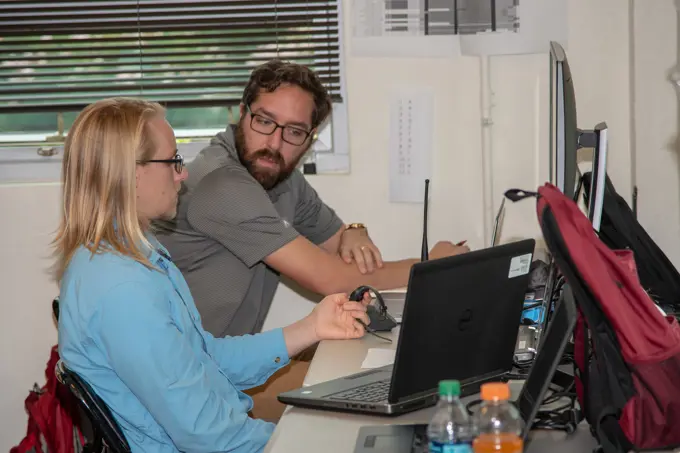
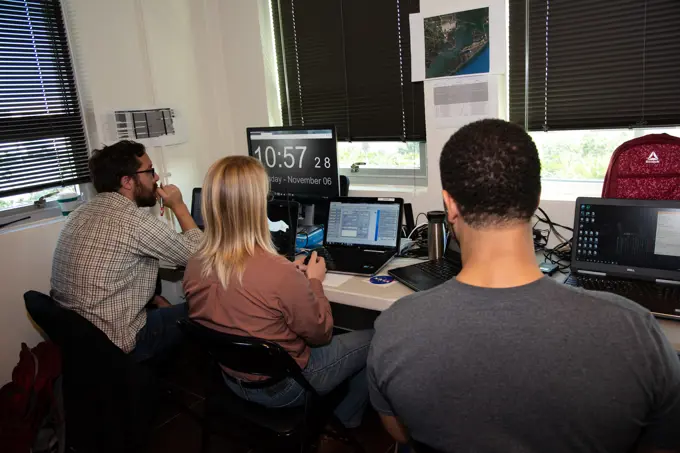
While NASAs F/A-18 goes supersonic off the coast, a team of researchers monitor the flight and operate multiple sound monitor stations around Galveston and its surrounding area. This allows NASA to obtain accurate sound level data, which gets matched to community response data.
6145-44792712
CAPE CANAVERAL, Fla. - Bob Cabana, in the foreground, director of NASA's Kennedy Space Center, watches the launch of space shuttle Atlantis from the Operations Management Room, a glass partitioned area overlooking the main floor of Firing Room 4, in Kennedy's Launch Control Center.Liftoff of Atlantis from Launch Pad 39A on its STS-129 mission to the International Space Station came at 2:28 p.m. EST Nov. 16.
6145-44513495
JSC2000-07294 (20 November 2000) --- The40-odd flight controllers assigned to the STS-97 ascent team and some special guests pose for a group portrait in theshuttle flight control room in Houston's Mission Control Center (JSC).  The fiveguests attired in the blue and white shirts are the flight crew members for the STS-97 crew, scheduled to be launched from Florida on the last day of this month.  The astronauts are, from the left, Joseph R. Tanner, Carlos I. Noriega, Brent W. Jett, Jr., Michael J. Bloomfield and Marc Garneau, who represents the Canadian Space Agency (CSA). Ascent shift flight director Wayne Hale stands next to Tanner.
6145-45187567
Mars InSight team members all react after receiving confirmation that the Mars InSight lander successfully touched down on the surface of Mars, Monday, Nov. 26, 2018 inside the Mission Support Area at NASA's Jet Propulsion Laboratory in Pasadena, California. InSight, short for Interior Exploration using Seismic Investigations, Geodesy and Heat Transport, is a Mars lander designed to study the "inner space" of Mars: its crust, mantle, and core.
6177-V53549175
5514-53894376
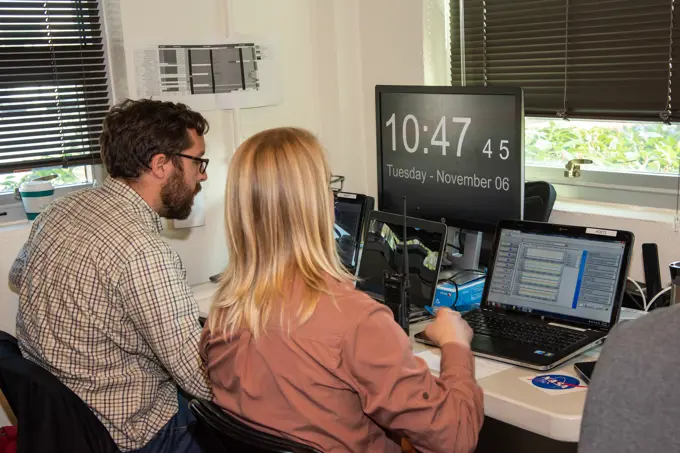
Researchers monitor weather at computers within the Mt. Washington Observatory on the summit of Mt. Washington.
4354-303
Meteorologists Watch a Severe Storm Develop
6145-44643268
The science laboratory, Spacelab-J (SL-J), flown aboard the STS-47 flight was a joint venture between NASA and the National Space Development Agency of Japan (NASDA) utilizing a manned Spacelab module. The mission conducted 24 materials science and 20 life science experiments, of which 35 were sponsored by NASDA, 7 by NASA, and two collaborative efforts. Materials science investigations covered such fields as biotechnology, electronic materials, fluid dynamics and transport phenomena, glasses and ceramics, metals and alloys, and acceleration measurements. Life sciences included experiments on human health, cell separation and biology, developmental biology, animal and human physiology and behavior, space radiation, and biological rhythms. Test subjects included the crew, Japanese koi fish (carp), cultured animal and plant cells, chicken embryos, fruit flies, fungi and plant seeds, and frogs and frog eggs. From the Huntsville Operations Support Center (HOSC) Spacelab Payload Operations
6145-55152445
Participants from the Spanish Air and Space Force monitor and track a simulated satellite in close proximity to the International Space Station during day four of Global Sentinel 2022 at Vandenberg Space Force Base, Calif., July 28, 2022. Day four focused on geosynchronous orbit rendezvous proximity operations and supports the tenets of responsible behavior in space as part of on-going spaceflight safety scenarios. Global Sentinel scenarios provide a platform for U.S. and allied partners to build partnerships, hone communication practices and exchange ideas for operations in the space domain.
6145-45288649
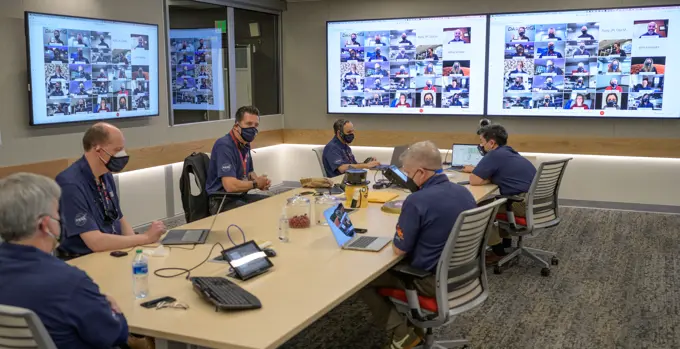
Members of NASAs Perseverance Mars rover management team meet via remote and in mission control, Thursday, Feb. 18, 2021, at NASA's Jet Propulsion Laboratory in Pasadena, California. A key objective for Perseverances mission on Mars is astrobiology, including the search for signs of ancient microbial life. The rover will characterize the planets geology and past climate, pave the way for human exploration of the Red Planet, and be the first mission to collect and cache Martian rock and regolith.
6177-V53550740
6145-44966251
VANDENBERG AIR FORCE BASE, Calif. - At Vandenberg Air Force Base in California, mission managers participate in a pre-launch dress rehearsal in the Launch Vehicle Data Center for NASAs Interface Region Imaging Spectrograph, or IRIS, solar observatory.Scheduled for launch from Vandenberg on June 26 aboard an Orbital Sciences Pegasus XL rocket, IRIS will open a new window of discovery by tracing the flow of energy and plasma through the chromospheres and transition region in to the suns corona using spectrometry and imaging. The IRIS mission will observe how solar material moves, gathers energy and heats up as it travels through a largely unexplored region of the solar atmosphere. The interface region, located between the suns visible surface and upper atmosphere, is where most of the suns ultraviolet emission is generated. These emissions impact the near-Earth space environment and Earths climate.
6177-V54005359
6145-45299536
Engineer Mallory Lefland experienced the tension and relief shared by the team on Mars 2020 Perseverance landing day, on Feb. 18, 2021. She watched the dramatic entry, descent, and landing from inside a mission support area at NASA's Jet Propulsion Laboratory in Southern California. JPL built and manages operations of the Mars 2020 Perseverance rover for NASA. A key objective for Perseverance's mission on Mars is astrobiology, including the search for signs of ancient microbial life. The rover will characterize the planet's geology and past climate, pave the way for human exploration of the Red Planet, and be the first mission to collect and cache Martian rock and regolith (broken rock and dust). Subsequent NASA missions, in cooperation with ESA (European Space Agency), would send spacecraft to Mars to collect these sealed samples from the surface and return them to Earth for in-depth analysis. The Mars 2020 mission is part of a larger program that includes missions to the Moon as a wa
6145-44719357
S73-26849 (25 May 1973) --- Four flight directors for the Skylab 1 and 2 mission are grouped around the flight director's console in the Mission Operations Control Room in the Mission Control Center at Johnson Space Center during the Skylab 2 Command/Service Module (CSM) fly around inspection of the Skylab 1 space station cluster. They are, going counterclockwise from center foreground, Donald R. Puddy (white shirt), Milton Windler, Philip C. Shaffer and M.P. Frank. A view of the Skylab 1 Orbital Workshop seen from the Skylab 2 CSM is visible on the television monitor in the background.
6145-45288666
Members of NASAs Perseverance Mars rover team study data on monitors in mission control, Thursday, Feb. 18, 2021, at NASA's Jet Propulsion Laboratory in Pasadena, California. A key objective for Perseverances mission on Mars is astrobiology, including the search for signs of ancient microbial life. The rover will characterize the planets geology and past climate, pave the way for human exploration of the Red Planet, and be the first mission to collect and cache Martian rock and regolith.
6145-44899522
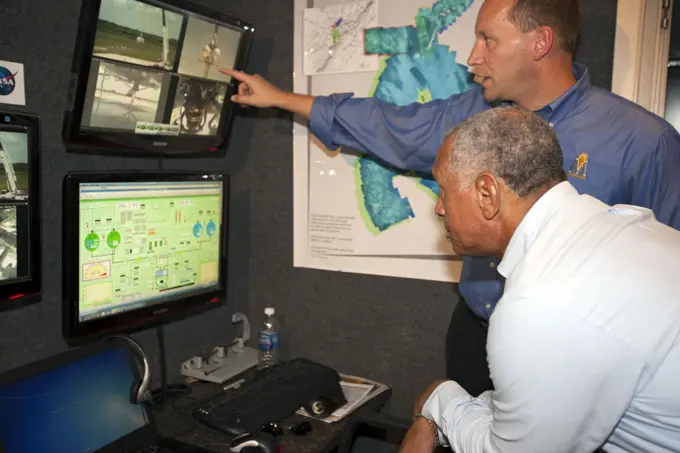
CAPE CANAVERAL, Fla. - At NASAs Kennedy Space Center in Florida, NASA Administrator Charles Bolden joins Morpheus project manager Dr. Jon Olansen, pointing at monitor, in the control room at the Shuttle Landing Facility for the first tethered flight of the Morpheus lander.After undergoing testing at Johnson Space Center in Houston for nearly a year, Morpheus arrived at Kennedy on July 27 to begin about three months of tests. A field, replete with boulders, rocks, slopes, craters and hazards to avoid, was created at the north end of Kennedy's runway to provide a realistic landscape for test flights of the lander. Morpheus utilizes autonomous landing and hazard avoidance technology, or ALHAT, to navigate to a safe landing site during its descent. Project Morpheus is one of 20 small projects comprising the Advanced Exploration Systems, or AES, program in NASA's Human Exploration and Operations Mission Directorate. AES projects pioneer new approaches for rapidly developing prototype sys
6145-58969934
NASA Astronaut Class 22 tours Goddard Space Flight Center
6145-44483088
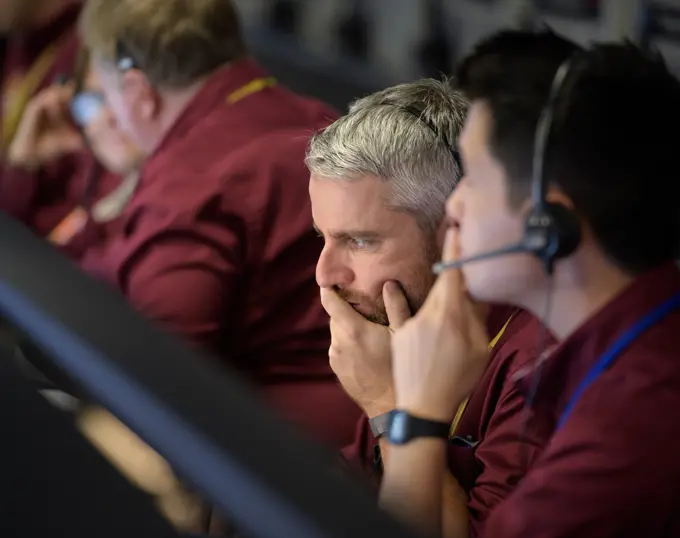
NASAs Double Asteroid Redirection Test (DART) command team at Johns Hopkins University, Applied Physics Laboratory monitoring the DART spacecrafts impact into the asteroid Dimorphos. The operation is the first of its kind test to redirect deadly asteroids from hitting Earth.
6145-45288656
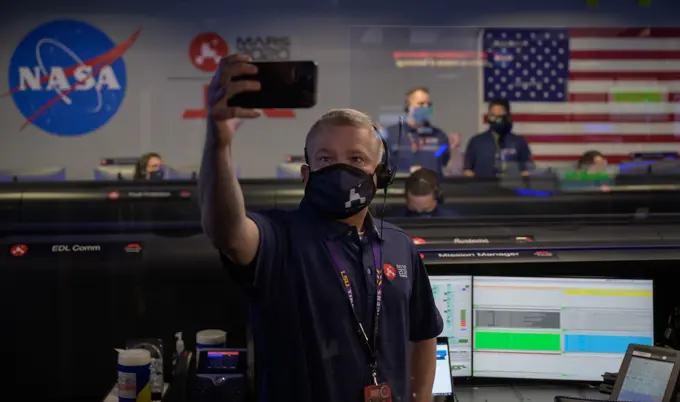
Perseverance mission manager Keith Comeaux takes a selfie as the NASAs Perseverance Mars rover team begins to settle in to track landing in mission control, Thursday, Feb. 18, 2021, at NASA's Jet Propulsion Laboratory in Pasadena, California. A key objective for Perseverances mission on Mars is astrobiology, including the search for signs of ancient microbial life. The rover will characterize the planets geology and past climate, pave the way for human exploration of the Red Planet, and be the first mission to collect and cache Martian rock and regolith.
6145-45185793
While NASAs F/A-18 goes supersonic off the coast, a team of researchers monitor the flight and operate multiple sound monitor stations around Galveston and its surrounding area. This allows NASA to obtain accurate sound level data, which gets matched to community response data.
6145-45185017
While NASAs F/A-18 goes supersonic off the coast, a team of researchers monitor the flight and operate multiple sound monitor stations around Galveston and its surrounding area. This allows NASA to obtain accurate sound level data, which gets matched to community response data.
6145-58961289
KENNEDY SPACE CENTER, FLA. - An employee at the Space Station Processing Facility monitors engineering certification testing of the Alpha Magnetic spectrometer (AMS). The AMS is a superconducting magnet that will be used in an experiment from the International Space Station (ISS) to search for antimatter and dark matter in space. The testing is being performed to ensure that data flow from the external payload AMS and the internal AMS crew operation post can be successfully routed through the ISS systems.
6177-V53549174
6145-44538212
S79-30442 (29 March 1979) --- Granvil A. (Al) Pennington studies the monitor on his console - the instrumentation/communications officer (INCO) position - during simulations in the mission operations control room of the mission control center. The simulations are in preparation for STS-1, the first of a series of orbital fight test (OFT) in the space shuttle orbiter 102 Columbia.
6145-44828060
Susan Kool, a researcher from the Langley Research Center, works on monitoring the Lidar Atmospheric Sensing Experiment (LASE) aboard the NASA DC-8 aircraft, Monday, Aug. 16, 2010, at Fort Lauderdale Hollywood International Airport in Fort Lauderdale, Fla. LASE probes the atmosphere using lasers and is part of the Genesis and Rapid Intensification Processes (GRIP) experiment is a NASA Earth science field experiment in 2010 that is being conducted to better understand how tropical storms form and develop into major hurricanes.
6145-44787026
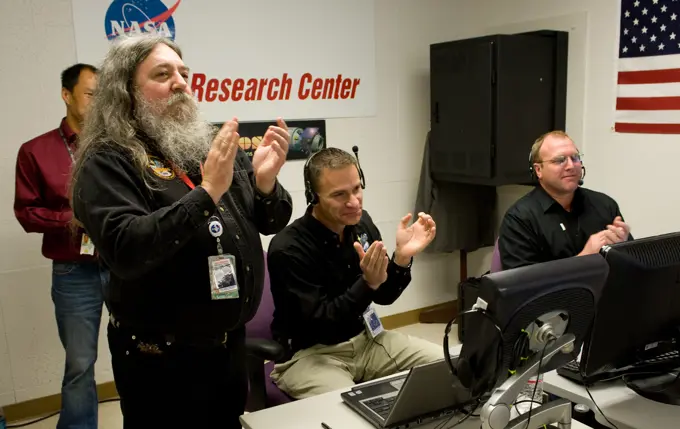
LCROSS Impact Night From left to right Khanh Trinh (Simulator Engineer) in back, John Bresina (Command Sequencing Engineer), Dan Andrews (LCROSS Project Manager), and John Schreiner (Mission Operations Manager), clap after confirmation the LCROSS spacecraft successfully impacted its target crater on the moon.
6145-45288655
Members of NASAs Perseverance Mars rover team study data on monitors in mission control, Thursday, Feb. 18, 2021, at NASA's Jet Propulsion Laboratory in Pasadena, California. A key objective for Perseverances mission on Mars is astrobiology, including the search for signs of ancient microbial life. The rover will characterize the planets geology and past climate, pave the way for human exploration of the Red Planet, and be the first mission to collect and cache Martian rock and regolith.
6145-45144181
Todd Brown, right, working Cassini's attitude and articulation control subsystems, is seen at his console during the spacecraft's final plunge into Saturn, Friday, Sept. 15, 2017 at NASA's Jet Propulsion Laboratory in Pasadena, California. Since its arrival in 2004, the Cassini-Huygens mission has been a discovery machine, revolutionizing our knowledge of the Saturn system and captivating us with data and images never before obtained with such detail and clarity. On Sept. 15, 2017, operators deliberately plunged the spacecraft into Saturn, as Cassini gathered science until the end. Loss of contact with the Cassini spacecraft occurred at 7:55 a.m. EDT (4:55 a.m. PDT). The plunge” ensures Saturn’s moons will remain pristine for future exploration. During Cassini’s final days, mission team members from all around the world gathered at NASA’s Jet Propulsion Laboratory, Pasadena, California, to celebrate the achievements of this historic mission.
6145-44820483
Photo Date: 05/19/10Location: Bldg.30 south, FCR-1Subject: Team photo of ISS ULF-4 Flight Control Team - Orbit 1 - Flight Director Holly Ridings.
6145-44500390
JSC2009-E-120846 (20 May 2009) --- The members of the STS-125 Orbit 3 flight control team pose for a group portrait in the space shuttle flight control room in the Mission Control Center at NASA's Johnson Space Center. Flight director Paul Dye (center left) is visible on the front row.
6145-45190842
Director of the Johns Hopkins University Applied Physics Laboratory Ralph Semmel celebrates with other mission team members after they received signals from the spacecraft that it is healthy and collected data during the flyby of Ultima Thule, Tuesday, Jan. 1, 2019 at the Mission Operations Center of the Johns Hopkins University Applied Physics Laboratory (APL) in Laurel, Maryland.
6145-58967150
PHOTO DATE: 05-13-09LOCATION: Bldg. 30 south , WFCR & BackroomsSUBJECT: STS-125 Flight Controllers on Console During HST Grapple - Orbit 1 - Bldg. 30 south.  Flight Director: Tony Ceccacci
6145-44508762
JSC2000-06076 (September 2000) --- The ascent/entry team for STS-106 poses with flight director Wayne Hale (holding insignia) in Mission Control Center.
6145-45185789
While NASAs F/A-18 goes supersonic off the coast, a team of researchers monitor the flight and operate multiple sound monitor stations around Galveston and its surrounding area. This allows NASA to obtain accurate sound level data, which gets matched to community response data.
6145-52282287
Medical Laboratory of the Dive Medical Center (DMC) of the Mining Service (MD) in Den Helder, April 1991.
6177-V70815366
6145-45187353
Tom Hoffman, InSight Project Manager, NASA JPL, gives a high-five to other Mars InSight team members after receiving confirmation that the Mars InSight lander successfully touched down on the surface of Mars, Monday, Nov. 26, 2018 inside the Mission Support Area at NASA's Jet Propulsion Laboratory in Pasadena, California.  InSight, short for Interior Exploration using Seismic Investigations, Geodesy and Heat Transport, is a Mars lander designed to study the "inner space" of Mars: its crust, mantle, and core.
6145-44820482
Photo Date: 05/19/10Location: Bldg.30 South, WFCRSubject: Team photo of STS132 Flight Control Team - Orbit 3 - Flight Director Ginger Kerrick
6145-45185015
While NASAs F/A-18 goes supersonic off the coast, a team of researchers monitor the flight and operate multiple sound monitor stations around Galveston and its surrounding area. This allows NASA to obtain accurate sound level data, which gets matched to community response data.
6145-44967935
Date: 07-16-13Location: Bldg 30 South, FCR-1Subject:  Expedition 36 ISS flight controllers on console during EVA #23 with Chris Cassidy and Luca Parmitano.
6177-V53550382
6145-45071719
Date: 09-10-14Location: Bldg 30, FCR-1Subject: Expedition 40 flight controllers and Flight Director on console during undocking of Soyuz 38 from the ISS.
255-69336222
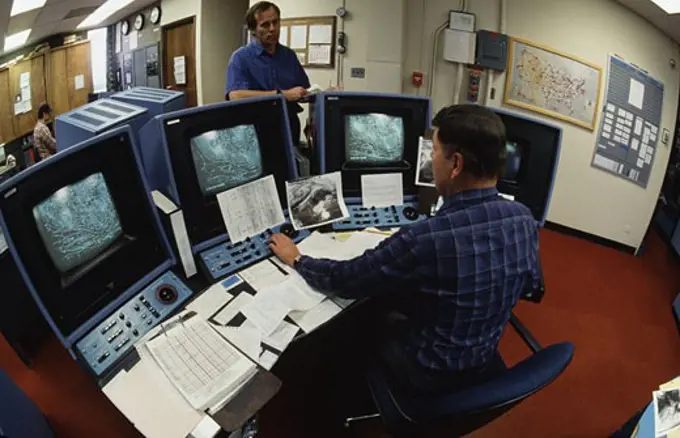
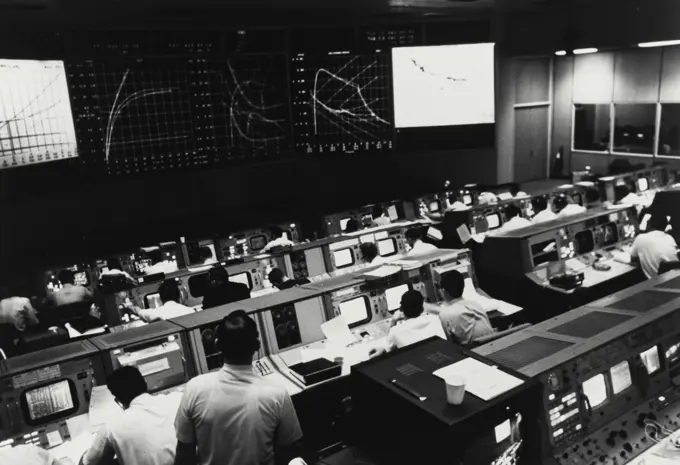
Vintage Photograph. Control Room at Mission Control Center in Houston Texas NASA.
6145-44601121
KENNEDY SPACE CENTER, FLA. -   Astronaut Soichi Noguchi, with the National Space Development Agency of Japan (NASDA), works at a console during a Multi-Element Integrated Test (MEIT) of the U.S. Node 2 and the Japanese Experiment Module (JEM).  Noguchi is assigned to mission STS-114 as a mission specialist.   Node 2 attaches to the end of the U.S. Lab on the ISS and provides attach locations for the Japanese laboratory, European laboratory, the Centrifuge Accommodation Module and, eventually, Multipurpose Logistics Modules. It will provide the primary docking location for the Shuttle when a pressurized mating adapter is attached to Node 2.  Installation of the module will complete the U.S. Core of the ISS.   The JEM, developed by NASDA,  is Japan's primary contribution to the Station. It will enhance the unique research capabilities of the orbiting complex by providing an additional environment for astronauts to conduct science experiments.
6145-44594492
This is an overall view of the Russian Mission Control Center in Korolev, Russia during the Expedition 7 mission, Wednesday, April 30, 2003.
6145-55975066
. Artemis-1 flight controllers during Orion Distant Retrograde Departure. Photo Date: December 1, 2022. Location: Building 30, MCC, FCR-1. Photographer: Robert Markowitz
6145-44849419
PHOTO DATE:  02-26-11LOCATION: Bldg. 30 south SUBJECT: STS-133/ULF5 Flight Controllers on Console - Shuttle Orbit 2.  Flight Director: Ginger Kerrick
6145-44655330
NASA African Monsoon Multidisciplinary Analyses (NAMMA) DC-8 deployment to Cape Verde, Sal island, Africa
6145-44510865
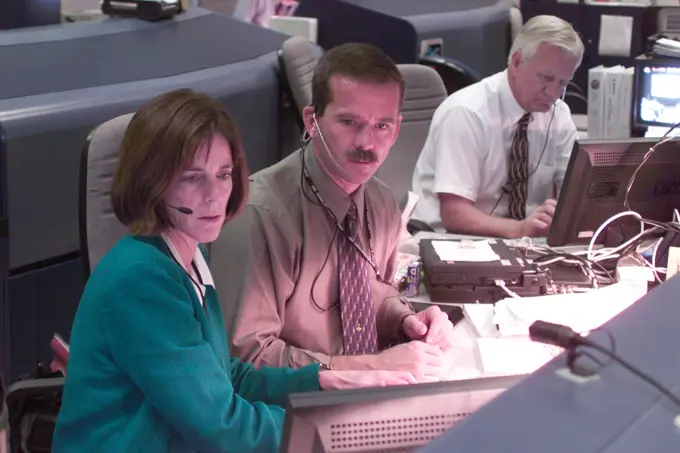
JSC2000-E-22831 (13 September 2000) ---Astronauts Barbara R. Morgan and Chris A. Hadfield listen to downlinked audio from the Space Shuttle Atlantis at the approximate midway point of the STS-106 mission.  The two are working at the Spacecraft Communicator (CAPCOM) console in Houston's Mission Control Center (MCC).  Nearby is Bill Reevesat the Flight Director console.
6145-58966128
Teams conduct powerup and docking operations for the Sensor Test for Orion Relative Navigation Risk Mitigation (STORRM) in a payload support room at Johnson Space Centers Mission Control Center in Houston on May 18, 2011. STORMM was successfully demonstrated on Space Shuttle Endeavours STS-134 mission to the International Space Station..The goal of STORRM was to validate a new relative navigation sensor based on advanced laser and detector technology that will make docking and undocking spacecraft easier and safer. It also tested the hardware in the same environment that the sensors would experience on the first Orion rendezvous to another vehicle. Part of Batch image transfer from Flickr.
6145-44816013
STS131-S-087 (20 April 2010) --- NASA Kennedy Space Center Director Bob Cabana, left, Special Assistant to the Director Robert Hubbard, center, and NASA Deputy Administrator Lori Garver scan the sky for the space shuttle Discovery as it approaches for landing at the Kennedy Space Center in Cape Canaveral, Florida, on April 20, 2010. Discovery and the STS-131 mission crew, NASA astronauts Alan Poindexter, commander; James P. Dutton Jr., pilot; Dorothy Metcalf-Lindenburger, Rick Mastracchio, Stephanie Wilson, Clayton Anderson and Japanese astronaut Naoko Yamazaki, all mission specialists, returned from their mission to the International Space Station.
6145-44655332
NASA African Monsoon Multidisciplinary Analyses (NAMMA) DC-8 deployment to Cape Verde, Sal island, Africa
6145-54345508
Regions - Images Relating to the Discover-AQ Program - images and video clips relating to the Discover-AQ Program. Discover-AQ stands for Deriving Information on Surface conditions from COlumn and VERtically resolved observations relevant to Air Quality , Environmental Protection Agency
6145-45290755
Janine Captain, principal investigator for NASAs Mass Spectrometer observing lunar operations (MSolo) takes part in a joint simulation of the Peregrine One Mission on March 26, 2021, where MSolo connected from inside the Neil Armstrong Operations and Checkout Building at NASAs Kennedy Space Center in Florida to Astrobotics mission control facility in Pittsburgh, Pennsylvania. MSolo is a commercial off-the-shelf mass spectrometer modified to work in space and it will help analyze the chemical makeup of landing sites on the Moon, as well as study water on the lunar surface. This was the first mission round of simulations for Peregrine Mission One to develop and refine procedures between Astrobotics Peregrine Lander and MSolo. Later, there will be other simulations with multiple instruments. Peregrine Mission One will be one of NASAs first Commercial Lunar Payload Delivery Service (CLPS) missions where under the Artemis program, commercial deliveries beginning in 2021 will perform sc
6145-45187337
Mars InSight team members monitor the status of the lander prior to it touching down on Mars, Monday, Nov. 26, 2018 inside the Mission Support Area at NASA's Jet Propulsion Laboratory in Pasadena, California.  InSight, short for Interior Exploration using Seismic Investigations, Geodesy and Heat Transport, is a Mars lander designed to study the "inner space" of Mars: its crust, mantle, and core.
6145-45279262
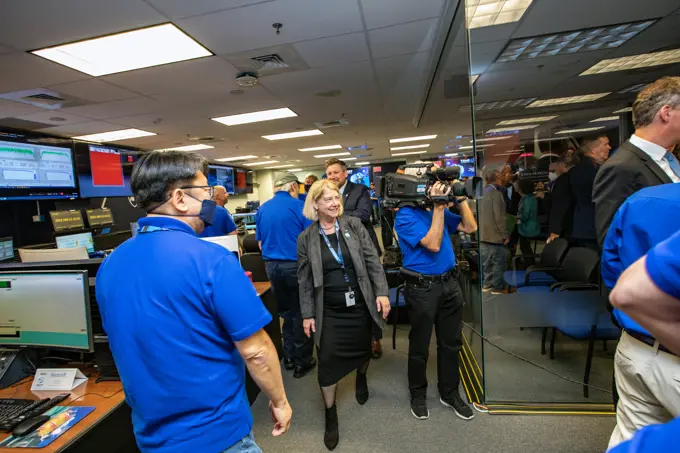
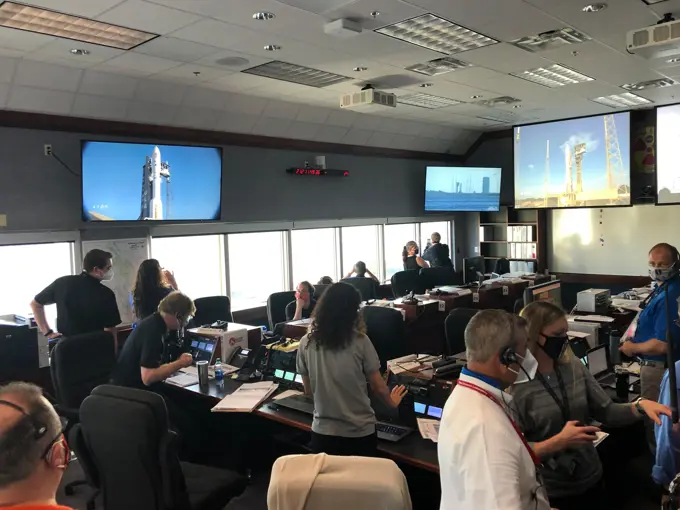
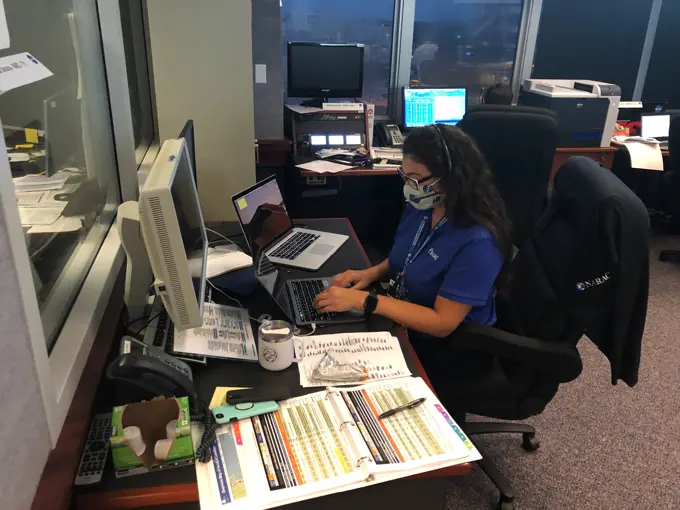
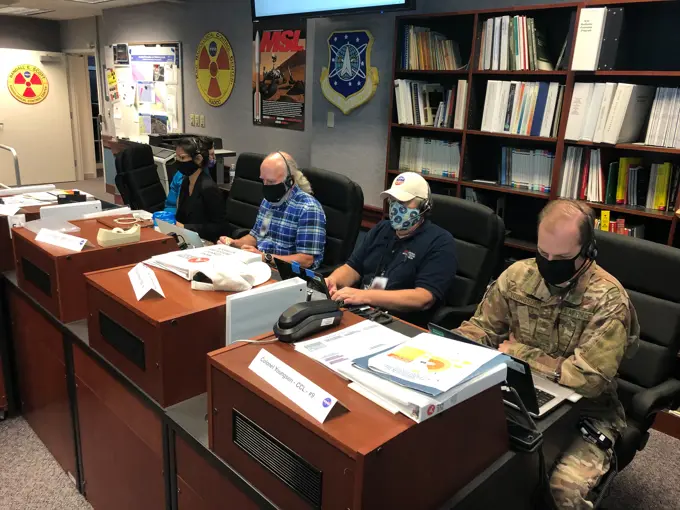
Joint Information Center (JIC), Emergency Operations Center (EOC) and Radiation Control Center (RADCC) members prepare for the launch of NASAs Mars 2020 Perseverance rover and Ingenuity helicopter on July 30, 2020, at the agencys Kennedy Space Center in Florida. JIC members include representatives on the local, regional and national level. Mars 2020 launched on a United Launch Alliance Atlas V 541 rocket from Space Launch Complex 41 at nearby Cape Canaveral Air Force Station. Liftoff was at 7:50 a.m. EDT. The rover is part of NASAs Mars Exploration Program, a long-term effort of robotic exploration of the Red Planet. The rover will search for habitable conditions in the ancient past and signs of past microbial life on Mars. The Launch Services Program at Kennedy is responsible for launch management.
6145-44482880
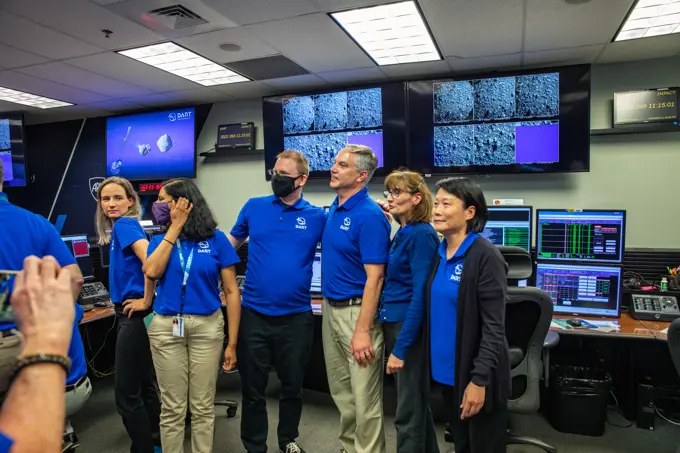
NASAs Double Asteroid Redirection Test (DART) command team at Johns Hopkins University, Applied Physics Laboratory monitoring the DART spacecrafts impact into the asteroid Dimorphos. The operation is the first of its kind test to redirect deadly asteroids from hitting Earth.
6145-44782923
CAPE CANAVERAL, Fla. - In NASA Kennedy Space Center's Launch Control Center, NASA's Ares I-X mission team monitor data from the firing room as the rocket undergoes its first power-up.   Part of the Constellation Program, the Ares I-X is the test vehicle for the Ares I, which is the essential core of a space transportation system that eventually will carry crewed missions back to the moon, on to Mars and out into the solar system. The Ares I-X flight test is targeted for  Oct. 31.
6145-45288647
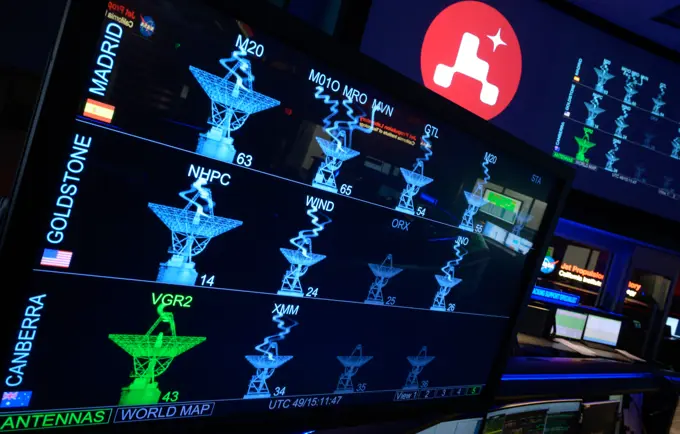
Monitors show the status of NASA's Deep Space Network ahead of the Perseverance Mars rover landing, Thursday, Feb. 18, 2021, at NASA's Jet Propulsion Laboratory in Pasadena, California.  A key objective for Perseverances mission on Mars is astrobiology, including the search for signs of ancient microbial life. The rover will characterize the planets geology and past climate, pave the way for human exploration of the Red Planet, and be the first mission to collect and cache Martian rock and regolith.
6145-44655305
NASA African Monsoon Multidisciplinary Analyses (NAMMA) DC-8 deployment to Cape Verde, Sal island, Africa
6145-45288875
Members of NASAs Perseverance rover team react in mission control after receiving confirmation the spacecraft successfully touched down on Mars, Thursday, Feb. 18, 2021, at NASA's Jet Propulsion Laboratory in Pasadena, California. A key objective for Perseverances mission on Mars is astrobiology, including the search for signs of ancient microbial life. The rover will characterize the planets geology and past climate, pave the way for human exploration of the Red Planet, and be the first mission to collect and cache Martian rock and regolith.
6145-45144198
Cassini team members embrace after the spacecraft was deliberately plunged into Saturn, Friday, Sept. 15, 2017 at NASA's Jet Propulsion Laboratory in Pasadena, California. Since its arrival in 2004, the Cassini-Huygens mission has been a discovery machine, revolutionizing our knowledge of the Saturn system and captivating us with data and images never before obtained with such detail and clarity. On Sept. 15, 2017, operators deliberately plunged the spacecraft into Saturn, as Cassini gathered science until the end. Loss of contact with the Cassini spacecraft occurred at 7:55 a.m. EDT (4:55 a.m. PDT) The plunge” ensures Saturn’s moons will remain pristine for future exploration. During Cassini’s final days, mission team members from all around the world gathered at NASA’s Jet Propulsion Laboratory, Pasadena, California, to celebrate the achievements of this historic mission.
6145-45279239
Joint Information Center (JIC), Emergency Operations Center (EOC) and Radiation Control Center (RADCC) members prepare for the launch of NASAs Mars 2020 Perseverance rover and Ingenuity helicopter on July 30, 2020, at the agencys Kennedy Space Center in Florida. JIC members include representatives on the local, regional and national level. Mars 2020 launched on a United Launch Alliance Atlas V 541 rocket from Space Launch Complex 41 at nearby Cape Canaveral Air Force Station. Liftoff was at 7:50 a.m. EDT. The rover is part of NASAs Mars Exploration Program, a long-term effort of robotic exploration of the Red Planet. The rover will search for habitable conditions in the ancient past and signs of past microbial life on Mars. The Launch Services Program at Kennedy is responsible for launch management.
6145-45279028
Joint Information Center (JIC), Emergency Operations Center (EOC) and Radiation Control Center (RADCC) members prepare for the launch of NASAs Mars 2020 Perseverance rover and Ingenuity helicopter on July 30, 2020, at the agencys Kennedy Space Center in Florida. JIC members include representatives on the local, regional and national level. Mars 2020 launched on a United Launch Alliance Atlas V 541 rocket from Space Launch Complex 41 at nearby Cape Canaveral Air Force Station. Liftoff was at 7:50 a.m. EDT. The rover is part of NASAs Mars Exploration Program, a long-term effort of robotic exploration of the Red Planet. The rover will search for habitable conditions in the ancient past and signs of past microbial life on Mars. The Launch Services Program at Kennedy is responsible for launch management.
6145-45279015
Joint Information Center (JIC), Emergency Operations Center (EOC) and Radiation Control Center (RADCC) members prepare for the launch of NASAs Mars 2020 Perseverance rover and Ingenuity helicopter on July 30, 2020, at the agencys Kennedy Space Center in Florida. JIC members include representatives on the local, regional and national level. Mars 2020 launched on a United Launch Alliance Atlas V 541 rocket from Space Launch Complex 41 at nearby Cape Canaveral Air Force Station. Liftoff was at 7:50 a.m. EDT. The rover is part of NASAs Mars Exploration Program, a long-term effort of robotic exploration of the Red Planet. The rover will search for habitable conditions in the ancient past and signs of past microbial life on Mars. The Launch Services Program at Kennedy is responsible for launch management.
PREVIOUS
of 2
NEXT
2401 S. Ervay, Suite 206
Dallas, Texas 75215
United States
Get Started
Free ResearchMy BoardsMy Cart
For Creators
How To License Your ContentContributor PortalFrame of Mind
Resources
API accessPricing
Contact
+1 866 236 0087help@viewpictures.co.uk Contact form
©2026 View Pictures. All Rights Reserved. -B
This site is protected by reCAPTCHA and Google Privacy Policy and Terms of Service apply.