My Boards
View Pictures
  • My Boards

Space Shuttle Approaches ISS

Images showcase various Space Shuttles approaching the International Space Station against vibrant Earth backdrops, highlighting details like cargo modules and mission operations.
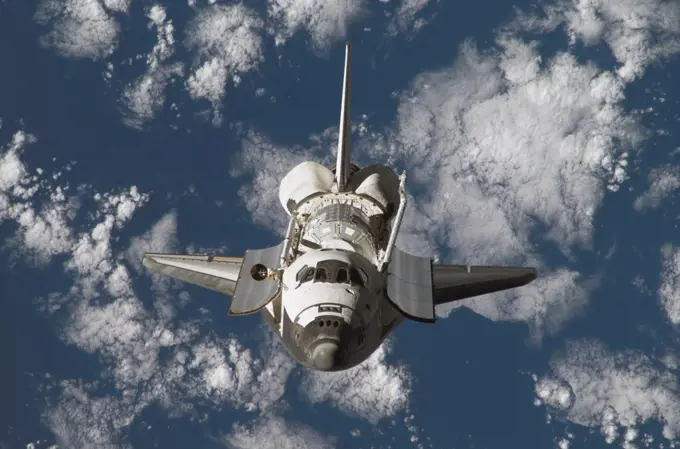
October 25, 2007 - Backdropped by a blue and white Earth, Space Shuttle Discovery approaches the International Space Station during STS-120 rendezvous and docking operations. Docking occurred at 7:40 a.m. (CDT) on October 25, 2007. The Harmony node is visible in Discovery's cargo bay.
163 assets in this story
6145-44781352
ISS020-E-035638 (30 Aug. 2009) --- This is one of a series of 400mm survey digital still photographs of the Space Shuttle Discovery as it  performed a full 360-degree backflip. The series of photos were  made by the Expedition 20 crew onboard the International Space Station as the two spacecraft drew near to each other on STS-128s third flight day.
6145-45184307
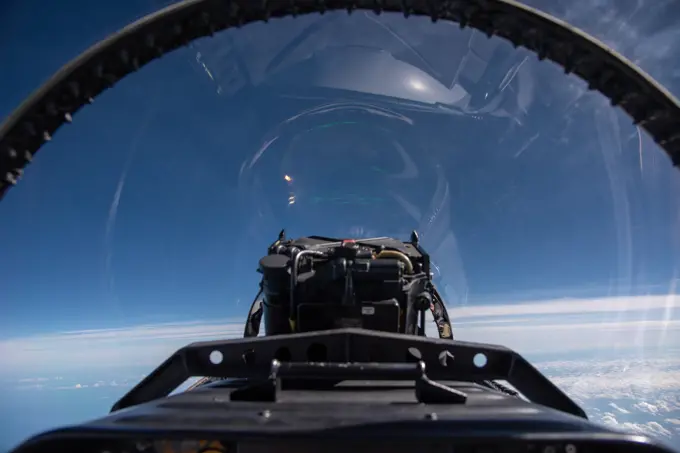
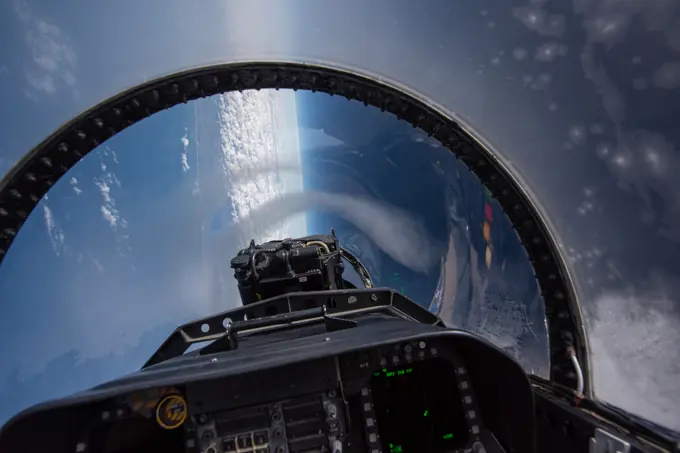
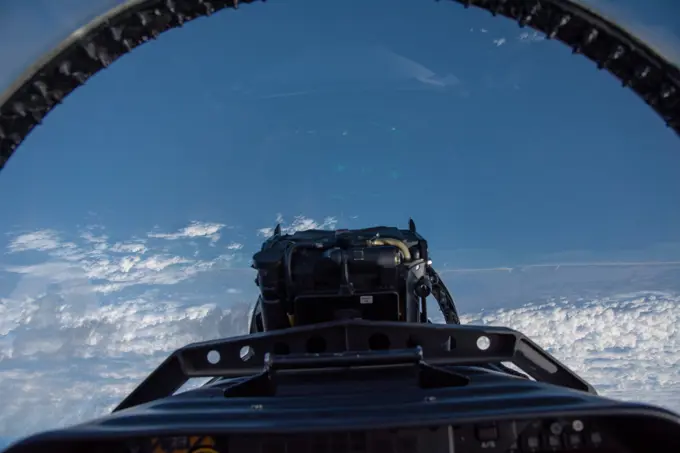
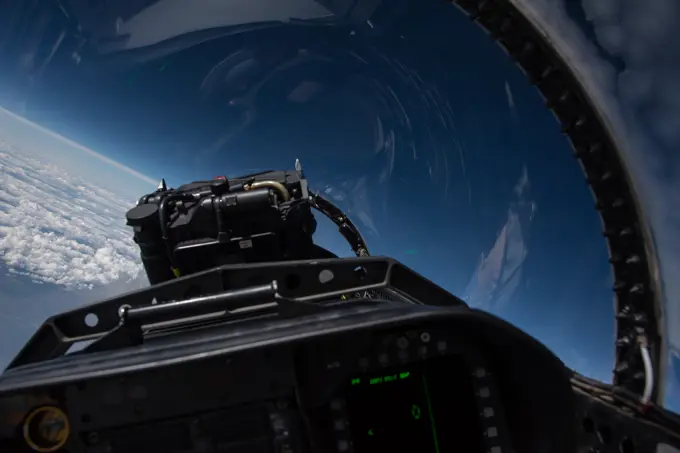
NASA test pilots perform the quiet supersonic dive maneuver off the coast of Galveston, Texas to create a quieter version of the sonic boom, in order to obtain recruited community survey feedback data. The test pilot climbs to around 50,000 feet, followed by a supersonic, inverted dive. This creates sonic boom shockwaves in a way that they are quieter in a specific area. Meanwhile, NASA researchers match community feedback to the sound levels of the flights, using an electronic survey and microphone monitor stations on the ground. This is preparing NASA for community response models for the future X-59 QueSST.
6145-44803979
ISS022-E-060644 (9 Feb. 2010) --- The space shuttle Endeavour is featured in this image photographed by an Expedition 22 crew member as the shuttle approaches the International Space Station during STS-130 rendezvous and docking operations. Docking occurred at 11:06 p.m. (CST) on Feb. 9, 2010.
6177-V53472062
6145-44871525
ISS028-E-015808 (10 July 2011) --- The space shuttle Atlantis is seen over the Bahamas prior to a perfect docking with the International Space Station at 10:07 a.m. (CDT).  Part of a Russian Progress spacecraft which is docked to the station is in the foreground.
6145-44683317
ISS015-E-21705 (10 Aug. 2007) --- A nadir view of the Space Shuttle Endeavour as it flies about 600 feet from the International Space Station. This is one of a series of photographs of the Space Shuttle Endeavour as it is flown through a slow back flip to allow the crewmembers on the nearby International Space Station to document the vehicle's thermal protection system condition and other parts.
6145-52930652
. iss069e018140 (June 6, 2023) - The SpaceX Dragon cargo craft approaches the International Space Station for an automated docking less than a day after launching from NASA's Kennedy Space Center loaded with over 7,000 pounds of science experiments, station hardware, and crew supplies. Both spacecraft were orbiting 259 miles above the Sea of Japan at the time of this photograph from the orbital outpost.
6145-44871529
ISS028-E-015815 (10 July 2011) --- The space shuttle Atlantis is seen over the Bahamas prior to a perfect docking with the International Space Station at 10:07 a.m. (CDT).  Part of a Russian Progress spacecraft which is docked to the station is in the foreground.
6145-45186812
iss057e102393 (Nov. 19, 2018) --- Northrop Grumman's Cygnus space freighter with its prominent cymbal-shaped UltraFlex solar arrays slowly approaches the International Space Station before it's capture with the Canadarm2 robotic arm operated by Expedition 57 Flight Engineer Serena Auñón-Chancellor and ESA (European Space Agency) astronaut Alexander Gerst.
6145-44657654
ISS013-E-80048 (11 Sept. 2006)---A crewmember aboard the International Space Station captured this high angle view of the Space Shuttle Atlantis with a digital still camera as the orbiter performed a backflip while it was about 600 feet from the station during its approach. The flip, done on every shuttle mission, allows a full photographic survey of the shuttle heat shield to be taken by the station crew. This image from that survey shows the crew cabin and part of the cargo bay, the orbiter docking system, part of the P3/P4 Integrated Truss Structure, the Ku-band antenna, part of the remote manipulator system arm and the orbiter boom sensor system (OBSS).
6145-58961025
S133-E-007577 (1 March 2011) --- In the grasp of the International Space Stations Canadarm2, the Italian-built Permanent Multipurpose Module (PMM) is transferred from space shuttle Discoverys payload bay to be permanently attached to the Earth-facing port of the stations Unity node.
6145-44636386
ISS011-E-14111 (3 October 2005) --- Backdropped by the blackness of space and Earth’s horizon, the Soyuz TMA-7 spacecraft approaches the international space station. Onboard the spacecraft are astronaut William S. McArthur, Jr., Expedition 12 commander and NASA science officer; cosmonaut Valery I. Tokarev, Expedition 12 flight engineer and Soyuz commander; and U. S. Spaceflight Participant Gregory Olsen. The Soyuz linked up to the Pirs Docking Compartment at 12:27 a.m. (CDT) on Oct. 3, 2005 as the two spacecraft flew over eastern Asia. The docking followed Friday’s launch from Baikonur Cosmodrome in Kazakhstan.
6145-44861462
ISS027-E-032065 (18 May 2011) --- This close-up view of the nose of space shuttle Endeavour was provided by an Expedition 27 crew member during a survey of the approaching STS-134 vehicle prior to docking with the International Space Station. As part of the survey and part of every mission's activities, Endeavour performed a back-flip for the rendezvous pitch maneuver (RPM). The station crew member used a digital still camera with an 800mm focal length, as the two spacecraft were approximately 600 feet (180 meters) apart.
6145-44657653
ISS013-E-80047 (11 Sept. 2006) --- A crewmember aboard the International Space Station took this picture with a handheld digital still camera as the Space Shuttle Atlantis performed a backflip while it was about 600 feet from the station during its approach. The flip, done on every shuttle mission, allows a full photographic survey of the shuttle heat shield to be taken by the station crew. This image from that survey shows the three the main engines, and part of the starboard wing and the starboard orbital maneuvering system (OMS) pod.
6145-44724231
ISS017-E-015496 (5 Sept. 2008) --- Backdropped by a blanket of clouds, European Space Agency's (ESA) "Jules Verne" Automated Transfer Vehicle (ATV) continues its relative separation from the International Space Station. The ATV undocked from the aft port of the Zvezda Service Module at 4:29 p.m. (CDT) on Sept. 5, 2008 and was placed in a parking orbit for three weeks, scheduled to be deorbited on Sept. 29 when lighting conditions are correct for an ESA imagery experiment of reentry.
6145-44529946
ISS003-E-6844 (23 October 2001) --- A Soyuz spacecraft approaches the International Space Station (ISS) carrying the Soyuz taxi crew, Commander Victor Afanasyev, Flight Engineer Konstantin Kozeev and French Flight Engineer Claudie Haignere for an eight-day stay on the station. Afanasyev and Kozeev represent Rosaviakosmos, and Haignere represents ESA, carrying out a flight program for CNES, the French Space Agency, under a commercial contract with the Russian Aviation and Space Agency. This image was taken with a digital still camera.
6145-58966779
ISS028-E-015827 (10 July 2011) --- The space shuttle Atlantis is seen over the Bahamas prior to a perfect docking with the International Space Station at 10:07 a.m. (CDT).  Part of a Russian Progress spacecraft which is docked to the station is in the foreground.
6145-52930651
. GMT157_EHDC3_1157
6145-44838724
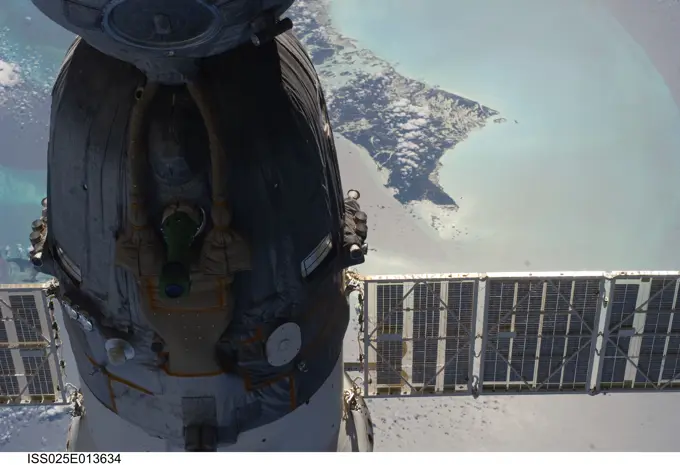
ISS025-E-013634 (9 Nov. 2010) --- The Soyuz TMA-19 spacecraft dominates the foreground of this image exposed by one of the Expedition 25 crew members as the International Space Station and the docked Russian spacecraft were 220 miles above the Caribbean Sea.The island of Andros, in the Bahamas chain, can be seen in the background. Three members of the current six-person staffing aboard the orbital complex are expected to return to Earth in the Soyuz in about two and half weeks.
6145-44518486
ISS01-E-5387 (16 February 2001) --- This nadir image of the Space Shuttle Atlantis  backdropped over the western Sahara Desert was photographed by the three-man Expedition One crew aboard the International Space Station (ISS) shortly after the shuttle and the outpost unlinked following several days of joint operations of the two crews.  The scene was recorded with a digital still camera.
6145-44852433
ISS026-E-032223 (7 March 2011) ---  Backdropped against the blackness of space,  Discovery is seen from the International Space Station as the two orbital spacecraft accomplish their relative separation on March 7 after an aggregate of 12 astronauts and cosmonauts worked together for over a week.During a post undocking fly-around, the crew members aboard the two spacecraft collected a series of photos of each others vehicle.
6145-44912116
ISS033-E-011554 (10 Oct. 2012) --- Backdropped by a cloud-covered part of Earth, the SpaceX Dragon commercial cargo craft makes its relative approach to the International Space Station prior to grapple by the stations Canadarm2 robotic arm, controlled by Expedition 33 crew members.
6145-44861470
ISS027-E-032252 (18 May 2011) --- This view of the nose, crew cabin and forward payload bay of the space shuttle Endeavour was provided by an Expedition 27 crew member during a survey of the approaching STS-134 vehicle prior to docking with the International Space Station. As part of the survey and part of every mission's activities, Endeavour performed a back-flip for the rendezvous pitch maneuver (RPM). The image was photographed with a digital still camera, using a 400mm lens at a distance of about 600 feet (180 meters).
6145-44523681
ISS002-E-5891 (21 April 2001) --- A distant view of the Space Shuttle Endeavour preparing to dock with the International Space Station (ISS) during the STS-100 mission.  The STS-100 crewmembers are delivering the Canadarm2, Space Station Remote Manipulator System (SSRMS), and equipment stowed in the Multipurpose Logistics Module (MPLM) Raphaello to the ISS which are visible in Endeavour's payload bay.  The image was taken with a digital still camera.
6145-44819698
ISS023-E-041569 (16 May 2010) --- This view of crew cabin of the space shuttle Atlantis was provided by an Expedition 23 crew member during a survey of the approaching STS-132 vehicle prior to docking with the International Space Station. As part of the survey and part of every mission's activities, Atlantis performed a back-flip for the rendezvous pitch maneuver (RPM). The image was photographed with a digital still camera, using a 400mm lens at a distance of about 600 feet (180 meters).
6145-44496457
KENNEDY SPACE CENTER, FLA. -- Following the landing of Space Shuttle Columbia on July 27, this close-up view shows what appear to be three small holes in the liquid hydrogen tubes inside the nozzle on main engine No. 3. Engineers will examine the engine to determine if a possible hydrogen leak occurred during the STS-93 launch on July 23
6145-44523577
ISS02-E-5821 (21 April 2001) --- The Space Shuttle Endeavour, with six astronauts and a cosmonaut onboard,approaches the International Space Station (ISS) for an April 21 docking.  The photo was taken with a digital still camera by one of the three Expedition Two crew members onboard the Station.
6145-44510624
S106-E-5317 (18 September 2000) --- The International Space Station (ISS) is seen following its undocking with the Space Shuttle Atlantis. After accomplishing all mission objectives in outfitting the station for the first resident crew, the seven astronauts and cosmonauts undocked at 3:46 (GMT) on Sept. 18 over Russia near the northeastern portion of Ukraine. When Atlantis was at a safe distance from the station, about 450 feet, astronaut Scott D. Altman, pilot, performed a 90-minute, double-loop fly around to enable the crew to document the station’s exterior. He fired Atlantis’ jets one final time to separate from the station at 5:35 GMT, September 18.
6145-44795623
ISS022-E-007830 (7 Dec. 2009) --- The propulsion compartment of the Poisk Mini-Research Module 2 (MRM2) departs from the International Space Station and was deorbited four hours later for a destructive reentry in Earths atmosphere. The undocking occurred at 6:16 p.m. (CST) on Dec. 7, 2009. Its departure opens up a docking port for Russian vehicles on Poisk, which will first be used when NASA astronaut Jeffrey Williams, Expedition 22 commander; and Russian cosmonaut Maxim Suraev, flight engineer, relocate their Soyuz spacecraft in January 2010.
6145-44531245
ISS003-E-8308 (7 December 2001) --- The Space Shuttle Endeavour, controlled by the flight crew of STS-108, is surrounded by darkness as it approaches the International Space Station (ISS). The Raffaello logistics module that is being brought up to the orbiting outpost is clearly visible in Endeavour's cargo bay. Among other activities the Endeavour's mission will include the change out of the station crews.  The image was recorded with a digital still camera.
6145-44633481
ISS011-E-11084 (28 July 2005) --- Discovery was about 600 feet from the International Space Station (ISS) when Station Commander Sergei Krikalev and Station NASA Science Officer and Flight Engineer John Phillips took photos for about a minute and a half as Discovery Commander Eileen Collins guided the spacecraft through the flip. Krikalvev used an 800 mm lens. The photos will be analyzed by engineers on the ground as additional data to evaluate the condition of Discovery's heat shield.
6145-45184081
NASA test pilots perform the quiet supersonic dive maneuver off the coast of Galveston, Texas to create a quieter version of the sonic boom, in order to obtain recruited community survey feedback data. The test pilot climbs to around 50,000 feet, followed by a supersonic, inverted dive. This creates sonic boom shockwaves in a way that they are quieter in a specific area. Meanwhile, NASA researchers match community feedback to the sound levels of the flights, using an electronic survey and microphone monitor stations on the ground. This is preparing NASA for community response models for the future X-59 QueSST.
6145-44506443
S66-37943 (3 June 1966) --- The Augmented Target Docking Adapter is photographed against the background of the blackness of space from the Gemini-9 spacecraft during one of their three rendezvous in space. The ATDA and Gemini-9 spacecraft are 71.5 feet apart. Failure of the docking adapter protective cover to fully separate on the ATDA prevented the docking of the two spacecraft. The ATDA was described by the Gemini-9 crew as an Angry Alligator.
6145-44813369
ISS023-E-020010 (7 April 2010) --- This partial view of the port wing of the space shuttle Discovery was provided by an Expedition 23 crew member during a survey of the approaching STS-131 vehicle prior to docking with the International Space Station. As part of the survey and part of every mission's activities, Discovery performed a back-flip for the rendezvous pitch maneuver (RPM). The image was photographed with a digital still camera, using a 400mm lens at a distance of about 600 feet (180 meters).
6145-44795627
ISS022-E-007842 (7 Dec. 2009) --- The propulsion compartment of the Poisk Mini-Research Module 2 (MRM2) departs from the International Space Station and was deorbited four hours later for a destructive reentry in Earths atmosphere. The undocking occurred at 6:16 p.m. (CST) on Dec. 7, 2009. Its departure opens up a docking port for Russian vehicles on Poisk, which will first be used when NASA astronaut Jeffrey Williams, Expedition 22 commander; and Russian cosmonaut Maxim Suraev, flight engineer, relocate their Soyuz spacecraft in January 2010.
6145-44754165
ISS018-E-040777 (17 March 2009) --- A close-up view of Space Shuttle Discoverys main engines was provided by Expedition 18 crewmembers on the International Space Station. Before docking with the station, astronaut Lee Archambault, STS-119 commander, flew the shuttle through a Rendezvous Pitch Maneuver or basically a backflip to allow the space station crew a good view of Discovery's heat shield. Using digital still cameras equipped with both 400 and 800 millimeter lenses, the ISS crewmembers took a number of photos of the shuttle's thermal protection system and sent them down to teams on the ground for analysis. A 800 millimeter lens was used for this image.
6145-44819708
ISS023-E-044611 (16 May 2010) ---  Flying above the  Atlantic coast  of Spain  and the Gulf of Cadiz,   the space shuttle Atlantis is shown making its relative approach to the International Space Station, from which this photo was taken.  The tip of a Russian spacecraft, temporarily docked to the orbital outpost can be seen at top center. The coast includes the city of Ayamonte (left of image as photographed), past Huelva (under Atlantis), past the sand dunes,  the Rio Guadalquivir, to the city of Rota. Center point coordinates of the area pictured in the image are 37.3 degrees north latitude and 6.7 degrees west longitude.
6145-44996449
ISS038-E-027441 (12 Jan. 2014) --- The Orbital Sciences Corp. Cygnus commercial cargo craft is photographed by an Expedition 38 crew member on the International Space Station during rendezvous and berthing operations on Jan. 12, 2014. A blue and white part of Earth provides the backdrop for the scene.
6145-44919889
ISS034-E-010180 (21 Dec. 2012) --- As the International Space Station and SoyuzTMA-07M spacecraft were making their relative approaches on Dec. 21, one of the Expedition 34 crew members on the orbital outpost captured this photo of the Soyuz. The background is in northern Algeria, near the Atlas Mountains. Inside the arriving spacecraft were astronaut Chris Hadfield of the Canadian Space Agency, cosmonaut Roman Romanenko of Russia's Federal Space Agency and NASA astronaut Tom Marshburn.
6145-44806323
ISS022-E-069080 (19 Feb. 2010) --- This view of the crew cabin and forward payload bay of the space shuttle Endeavour was provided by an Expedition 22 crew member on the International Space Station soon after the shuttle and station began their post-undocking relative separation. Undocking of the two spacecraft occurred at 7:54 p.m. (EST) on Feb. 19, 2010.
6145-44547929
STS077-S-011 (29 May 1996) --- As its main landing gear touches down on Runway 33 at the Kennedy Space Center (KSC), the Space Shuttle Endeavour returns to Florida following a ten-day mission in space.  Touchdown came at 7:09 a.m. (EDT), May 29, 1996.  Leading the crew onboard was astronaut John H. Casper, mission commander.  Other crew members were astronauts Curtis L. Brown, Jr., pilot; along with Daniel W. Bursch, Mario Runco, Jr., Andrew S. W. Thomas and Marc Garneau, all mission specialists.  Garneau represents the Canadian Space Agency (CSA).  During the approximately 10-day mission, the crew performed a variety of payload activities, including microgravity research aboard the Spacehab 4 Module, deployment and retrieval of the Spartan 207 and deployment and rendezvous with the Passive Aerodynamically-Stabilized Magnetically-Damped Satellite (PAMS).
6145-44815759
ISS023-E-024682 (17 April 2010) --- The space shuttle Discovery flies with its payload bay facing Earth so that the astronauts and cosmonauts onboard the International Space Station could survey and photograph it following the relative separation of the two spacecraft on April 17.
6145-44635309
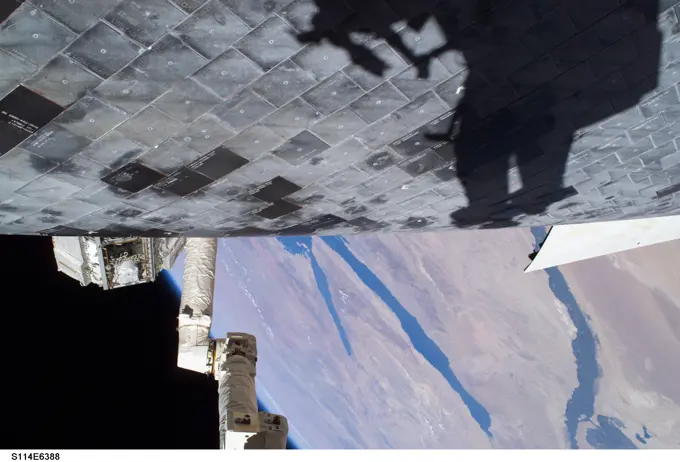
Launched on July 26, 2005 from the Kennedy Space Center in Florida, STS-114 was classified as Logistics Flight 1. Among the Station-related activities of the mission were the delivery of new supplies and the replacement of one of the orbital outpost's Control Moment Gyroscopes (CMGs). STS-114 also carried the Raffaello Multi-Purpose Logistics Module and the External Stowage Platform-2. A major focus of the mission was the testing and evaluation of new Space Shuttle flight safety, which included new inspection and repair techniques. Upon its approach to the International Space Station (ISS), the Space Shuttle Discovery underwent a photography session in order to assess any damages that may have occurred during its launch and/or journey through Space. The missions third and final Extra Vehicular Activity (EVA) included taking a close-up look and the repair of the damaged heat shield. Gap fillers were removed from between the orbiters heat-shielding tiles located on the crafts underbel
6145-44542775
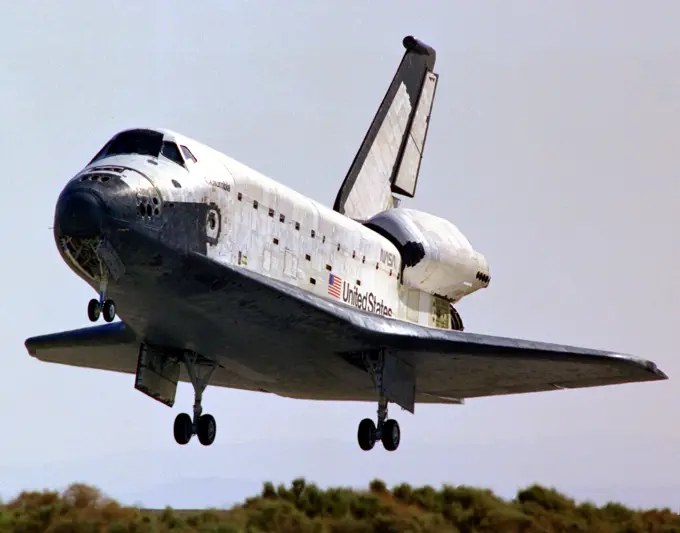
Space Shuttle Columbia nears its touchdown on Runway 22 at Edwards, California, at 8:39 a.m., 14 June 1991, as the STS-40 life sciences mission comes to an end at NASA's Ames-Dryden Flight Research Facility (later redesignated Dryden Flight Research Center) after nine days of orbital flight. Aboard Columbia during the extended mission were Bryan D. O'Connor, mission commander; Sidney M. Gutierrez, pilot; mission specialists James P. Bagian, Tamara E. Jernigan, and Margaret Rhea Seddon; and payload specialists Francis Andrew Gaffney and Millie Hughes-Fulford. STS-40 was the first space shuttle mission dedicated to life sciences research to explore how the body reacts to a weightless environment and how it readjusts to gravity on return to earth. Columbia was launched on the STS-40 mission 5 June 1991, from Kennedy Space Center in Florida.
6145-44521077
KENNEDY SPACE CENTER, Fla. -- Space Shuttle Discovery kicks up a swirl of dust as it touches down on runway 15 at the KSC Shuttle Landing Facility. Main gear touchdown occurred about 2:31:42 a.m. EST, nose wheel touchdown at 2:31:54 a.m., and wheel stop at 2:33:06 a.m. The landing, on orbit 201, concluded mission STS-102, the eighth flight to the International Space Station, carrying the first Multi-Purpose Logistics Module Leonardo, to the ISS and Expedition Two, a replacement crew for the Station. The 12-day, 19-hour, 51-minute mission returned both the Leonardo and the first resident crew of the ISS, Expedition One, to KSC. Discovery logged 5.3 million miles on this mission. The landing marked the 54th at KSC in the history of the program, and the 12th night landing at KSC
6145-44871572
ISS028-E-015128 (10 July 2011) --- This is one of a series of images showing various parts of the space shuttle Atlantis in Earth orbit as photographed by one of the six crewmembers on the International Space Station as the shuttle posed” for photo and visual surveys and performed a back-flip for the rendezvous pitch maneuver (RPM).  An 800mm lens was used to capture this particular series of images.
6145-44543292
The Space Shuttle Endeavour concludes mission STS-49 at NASA's Ames-Dryden Flight Research Facility (later redesignated Dryden Flight Research Center), Edwards, California, with a 1:57 p.m. (PDT) landing 16 May on Edward's concrete runway 22. The planned 7-day mission, which began with a launch from Kennedy Space Center, Florida, at 4:41 p.m. (PFT), 7 May, was extended two days to allow extra time to rescue the Intelsat VI satellite and complete Space Station assembly techniques originally planned. After a perfect rendezvous in orbit and numerous attempts to grab the satellite, space walking astronauts Pierre Thuot, Rick Hieb and Tom Akers successfully rescued it by hand on the third space walk with the support of mission specialists Kathy Thornton and Bruce Melnick. The three astronauts, on a record space walk, took hold of the satellite and directed it to the shuttle where a booster motor was attached to launch it to its proper orbit. Commander Dan Brandenstein and Pilot Kevin Chilto
6145-44541726
STS033-S-010 (27 Nov 1989) --- The Space Shuttle Discovery, with a crew of five astronauts aboard, touches down on a runway at Edwards Air Force Base in southern California.  The landing occurred at 16:31:02 p.m. (PST), Nov. 27, 1989.  Onboard Discovery for the DOD-devoted mission were astronauts Frederick D. Gregory, John E. Blaha, Kathryn C. Thornton, F. Story Musgrave and Manley L. Carter.
6145-44544814
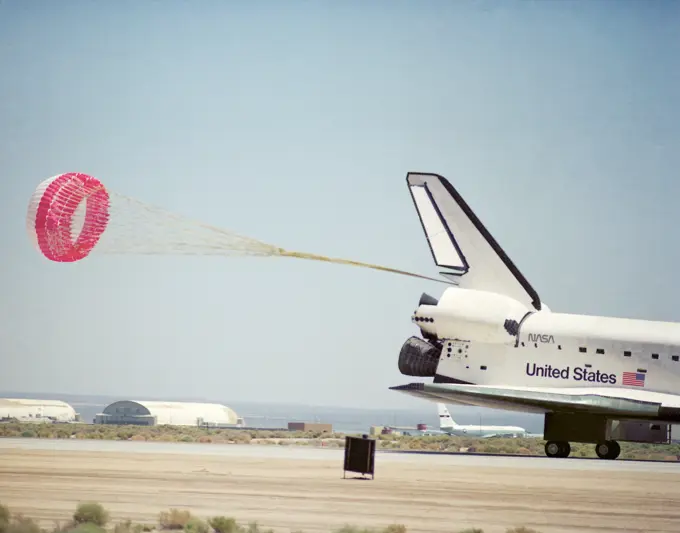
STS068-S-061 (11 October 1994) --- The drag chute system, one of 13 Detailed Test Objectives (DTO) for STS-68, is deployed as the Space Shuttle Endeavour completes an eleven-day mission at Edwards Air Force Base, California.  Landing occurred at 10:02 a.m. (PDT), October 11, 1994.  Onboard were astronauts Michael A. Baker, mission commander; Terrence W. Wilcutt, pilot; Thomas D. Jones, payload commander; and Daniel W. Bursch, Peter J. K. (Jeff) Wisoff and Steven L. Smith, all mission specialists.
6145-44569885
After nine days and 3.6 million miles in space, orbiter Discovery prepares to land on runway 33 at the Shuttle Landing Facility. Discovery returns to Earth with its crew of seven after successfully completing mission STS-95. The STS-95 crew members are Mission Commander Curtis L. Brown Jr.; Pilot Steven W. Lindsey; Mission Specialist Scott E. Parazynski; Mission Specialist Stephen K. Robinson; Payload Specialist John H. Glenn Jr., a senator from Ohio; Mission Specialist Pedro Duque of Spain, with the European Space Agency (ESA); and Payload Specialist Chiaki Mukai, with the National Space Development Agency of Japan (NASDA). The mission included research payloads such as the Spartan solar-observing deployable spacecraft, the Hubble Space Telescope Orbital Systems Test Platform, the International Extreme Ultraviolet Hitchhiker, as well as the SPACEHAB single module with experiments on space flight and the aging process
6145-44782438
S128-E-010021 (8 Sept. 2009) --- Using a still camera at a window on the aft flight deck of Space Shuttle Discovery, NASA astronaut Tim Kopra, STS-128 mission specialist, photographs the International Space Station (visible through the window) after the undocking of the two spacecraft.
6145-45184292
NASA test pilots perform the quiet supersonic dive maneuver off the coast of Galveston, Texas to create a quieter version of the sonic boom, in order to obtain recruited community survey feedback data. The test pilot climbs to around 50,000 feet, followed by a supersonic, inverted dive. This creates sonic boom shockwaves in a way that they are quieter in a specific area. Meanwhile, NASA researchers match community feedback to the sound levels of the flights, using an electronic survey and microphone monitor stations on the ground. This is preparing NASA for community response models for the future X-59 QueSST.
6145-45184314
NASA test pilots perform the quiet supersonic dive maneuver off the coast of Galveston, Texas to create a quieter version of the sonic boom, in order to obtain recruited community survey feedback data. The test pilot climbs to around 50,000 feet, followed by a supersonic, inverted dive. This creates sonic boom shockwaves in a way that they are quieter in a specific area. Meanwhile, NASA researchers match community feedback to the sound levels of the flights, using an electronic survey and microphone monitor stations on the ground. This is preparing NASA for community response models for the future X-59 QueSST.
6145-58965639
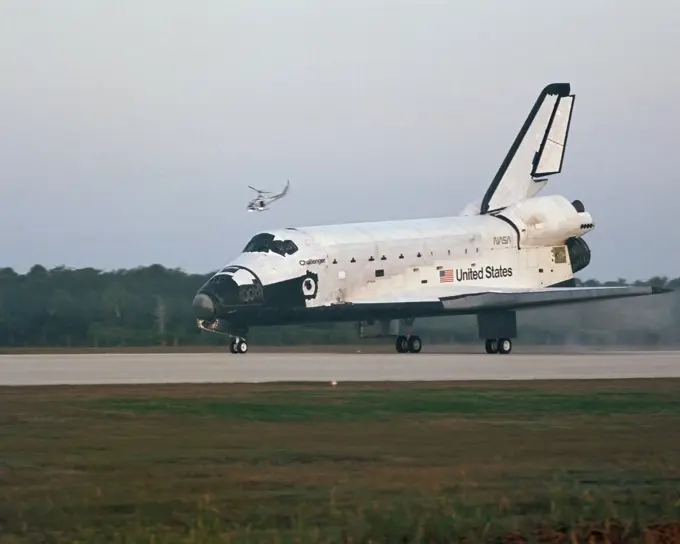
CAPE CANAVERAL, Fla. -- Commander Vance Brand and Pilot Robert 'Hoot' Gibson guide spaceship Challenger to the first-ever landing at Kennedy Space Center. The historic touchdown occurred at 7 15 55 a.m. EST, Feb. 11, 1984. Also aboard were Mission Specialists Bruce McCandless II, Ronald McNair and Robert Stewart.
6145-44554597
KENNEDY SPACE CENTER, FLA. -- The Space Shuttle orbiter Columbia glides in for  a touchdown on Runway 33 at KSCs Shuttle Landing Facility at approximately 6:46 a.m.  EDT with Mission Commander  James D. Halsell Jr. and Pilot Susan L. Still at the  controls to complete the STS-94 mission. Also on board are Mission Specialist Donald A.  Thomas, Mission Specialist Michael L. Gernhardt, Payload Commander Janice Voss, and  Payload Specialists Roger K.Crouch and Gregory T. Linteris. During the Microgravity  Science Laboratory-1 (MSL-1) mission, the Spacelab module was used to test some of the  hardware, facilities and procedures that are planned for use on the International Space  Station while the flight crew conducted combustion, protein crystal growth and materials  processing experiments. This mission was a reflight of  the STS-83 mission that lifted off   from KSC in April of this year. That space flight was cut short due to indications of a  faulty fuel cell
6145-44555750
KENNEDY SPACE CENTER, FLA. -- With Commander Curtis L. Brown, Jr. and Pilot Kent V. Rominger at the controls, the Space Shuttle orbiter Discovery touches down on Runway 33 at KSCs Shuttle Landing Facility at 7:07:59 a.m. EDT Aug. 19 to complete the 11-day, 20-hour and 27-minute-long STS-85 mission. The first landing opportunity on Aug. 18 was waved off due to the potential for ground fog. Also onboard the orbiter are Payload Commander N. Jan Davis, Mission Specialist Robert L. Curbeam, Jr., Mission Specialist Stephen K. Robinson and Payload Specialist Bjarni V. Tryggvason. During the 86th Space Shuttle mission, the crew deployed the Cryogenic Infrared Spectrometers and Telescopes for the Atmosphere-Shuttle Pallet Satellite-2 (CRISTA-SPAS-2) free-flyer to conduct research on the Earths middle atmosphere, retrieving it on flight day 9. The crew also conducted investigations with the Manipulator Flight Demonstration (MFD), Technology Applications and Science-1 (TAS-1) and International
6145-44769074
STS007-32-1667 (22 June 1983) --- The Earth-orbiting Space Shuttle Challenger over a heavily cloud-covered portion of the Earth was captured by a 70mm camera onboard the temporarily free-flying Shuttle Pallet Satellite (SPAS-01) during a busy Day 5 on the STS-7 mission. Visible in the cargo bay are the protective cradles for the now vacated Telesat Anik C2 and Palapa-B communications satellites, the pallet for the NASA Office of Space and Terrestrial Applications (OSTA-2); the Remote Manipulator System (RMS) and the KU-Band antenna. The STS-7 astronaut crew and the RMS arm later retrieved the SPAS and returned it to a stowed position in the cargo bay of the Space Shuttle Challenger for the return to Earth.
6145-44733623
S126-E-008146 (18 Nov. 2008) --- An extravehicular activity (EVA) tool bag drifts away from the International Space Station during the mission's first scheduled spacewalk for STS-126. About halfway into the spacewalk, one of the grease guns that astronaut Heidemarie Stefanyshyn-Piper (out of frame), mission specialist, was preparing to use on the Solar Alpha Rotary Joint released some Braycote grease into her crew lock bag, which is the tool bag the spacewalkers use during their activities. As she was cleaning the inside of the bag, it drifted away from her and toward the aft and starboard portion of the International Space Station. Inside the bag were two grease guns, a scraper, a scraper debris container, several wipes in a caddy and tethers.
6145-44861478
ISS027-E-032533 (18 May 2011) --- This view of space shuttle Endeavours forward section, including a partial view of the crew cabin, forward payload bay, docking mechanism and Canadarm, was provided by an Expedition 27 crew member during a survey of the approaching STS-134 vehicle prior to docking with the International Space Station. As part of the survey and part of every mission's activities, Endeavour performed a back-flip for the rendezvous pitch maneuver (RPM). The image was photographed with a digital still camera, using a 400mm lens at a distance of about 600 feet (180 meters).
6145-44815760
ISS023-E-025405 (17 April 2010) --- The underside of space shuttle Discovery is visible in this image photographed by an Expedition 23 crew member on the International Space Station soon after the shuttle and station began their post-undocking relative separation. Undocking of the two spacecraft occurred at 7:52 a.m. (CDT) on April 17, 2010, ending a stay of 10 days, 5 hours and 8 minutes. The visit included three spacewalks and delivery of more than seven tons of equipment and supplies. The recognizable feature on Earth below is the south end of Isla de Providencia, about 150 miles off the coast of Nicaragua near 13.3 degrees north latitude 81.4 degrees west longitude. The island belongs to Colombia.
6145-45254098
STS118-S-073 (21 Aug. 2007) ---  NASA Administrator Michael Griffin  (center in white shirt) and other NASA managers give thumbs up signals to the crew of the Space Shuttle Endeavour shortly after its  touchdown August 21, 2007, at the Kennedy Space Center, Florida, concluding  STS-118.
6145-44635089
Investigation of Flying Qualities on the Lockheed P-80A airplane plan view Note Used in publication in Flight Research at Ames; 57 Years of Development and Validation of Aeronautical Technology
6145-44657629
S115-E-05306 (10 Sept. 2006) --- While working to survey the thermal protection system on the Space Shuttle Atlantis, the orbiter boom sensor system (OBSS), attached to the remote manipulator system (RMS) arm was positioned near the shuttle's aft cabin windows. This enabled one of the STS-115 crewmembers to record this digital still close-up image of the Canadian-built system.
PREVIOUS
of 2
NEXT
2401 S. Ervay, Suite 206
Dallas, Texas 75215
United States
Get Started
Free ResearchMy BoardsMy Cart
For Creators
How To License Your ContentContributor PortalFrame of Mind
Resources
API accessPricing
Contact
+1 866 236 0087help@viewpictures.co.uk Contact form
©2026 View Pictures. All Rights Reserved. -A
This site is protected by reCAPTCHA and Google Privacy Policy and Terms of Service apply.