My Boards
View Pictures
  • My Boards

Space Shuttle Endeavour Maintenance

Technicians work on the space shuttle Endeavour in a processing facility, aligning the airlock hatch and performing maintenance for its retirement display.

DATE: 1-7-14LOCATION: Bldg. 9NW - POGO StandSUBJECT: Astronaut Scott Kelly during ISS EVA POGO 1 training.
245 assets in this story
6145-44883936
James Jacobson, a Data Analyst based out of Ames Research Center, explains his Digital Mapping System instrument to two teachers flying with Operation IceBridge, (top to bottom) Tom Koch Svennesen, of Greenland, and Peter Gross, of Denmark, on April 14, 2012.
6145-55975233
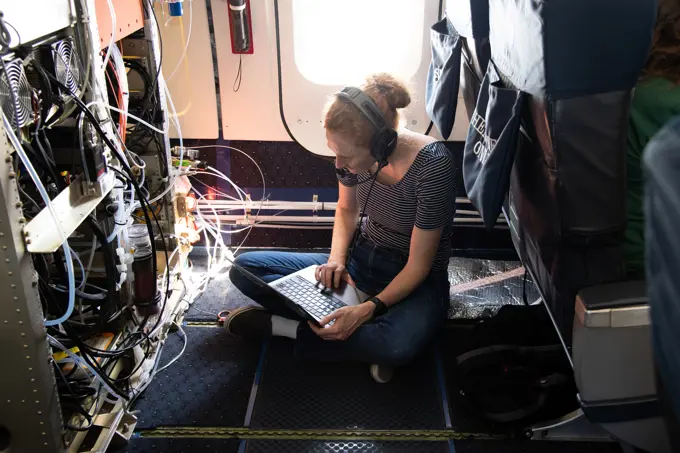
. NASA Armstrongs Student Airborne Research Program celebrates 15 years of success in 2023. An eight-week summer internship program, SARP offers upper-level undergraduate students the opportunity to acquire hands-on research experience as part of a scientific campaign using NASA Airborne Science Program flying science laboratoriesaircraft outfitted specifically for research projects. Students onboard NASAs DC-8 aircraft, the largest flying science laboratory in the world, help scientists from NOAA, the National Oceanic and Atmospheric Administration with a science project investigating air quality and non-vehicular pollution sources called AEROMMA, which measures Atmospheric Emissions and Reactions Observed from Megacities to Marine Areas. In 2023, NASA also introduced a sister program, SARP East to complement the West Coast program.
6145-45170398
A Commercial Crew astronaut participates in a Boeing/United Launch Alliance emergency egress system demonstration at Cape Canaveral Air Force Stations Launch Complex 41 in Florida on June 19, 2018. The system features seats attached to slide wires which would carry astronauts and ground crew more than 1,300 feet away from the crew access tower in the unlikely event of an emergency prior to liftoff.
6145-44831744
SAMUEL SMITH (WELD TECHNICIAN, JACOBS ESTS GROUP/ALL POINTS) AND ANDRÉ PASEUR (WELD TECHNICIAN, JACOBS ESTS GROUP/ERC) DISPLAY TWO PROCESS DEMONSTRATION ARTICLES - A 9-FOOT BUTT WELD (FOREGROUND) AND A HEXAGON FABRICATED FROM FRICTION STIR WELDED PLATES (BACKGROUND) - THAT WERE FABRICATED FROM 6AL-4V TITANIUM (ELI) USING THERMAL STIR WELDING. THIS WORK WAS PERFORMED FOR A NASA TECHNOLOGY TRANSFER INDUSTRIAL PARTNER (KEYSTONE SYNERGETIC ENTERPRISES, INC.) IN SUPPORT OF A PROJECT FOR THE U.S. NAVY
6145-44601674
KENNEDY SPACE CENTER, FLA. -    Jeff Thon, an SRB mechanic with United Space Alliance, tests a technique for vertical solid rocket booster propellant grain inspection.  The inspection of segments is required as part of safety analysis.
6145-44502968
The Hero Team (278) gets some help from a Kennedy Space Center research and development machine shop in repairing their robot, named Hero. The team of Edgewater High School students was co-sponsored by NASA Kennedy Space Center and Honeywell. Students from all over the country are at the KSC Visitor Complex for the FIRST (For Inspiration and Recognition of Science and Technology) Southeast Regional competition March 9-11 in the Rocket Garden. Teams of high school students are testing the limits of their imagination using robots they have designed, with the support of business and engineering professionals and corporate sponsors, to compete in a technological battle against other schools' robots. Of the 30 high school teams competing, 16 are Florida teams co-sponsored by NASA and KSC contractors. Local high schools participating are Astronaut, Bayside, Cocoa Beach, Eau Gallie, Melbourne, Melbourne Central Catholic, Palm Bay, Rockledge, Satellite, and Titusville
6145-45181338
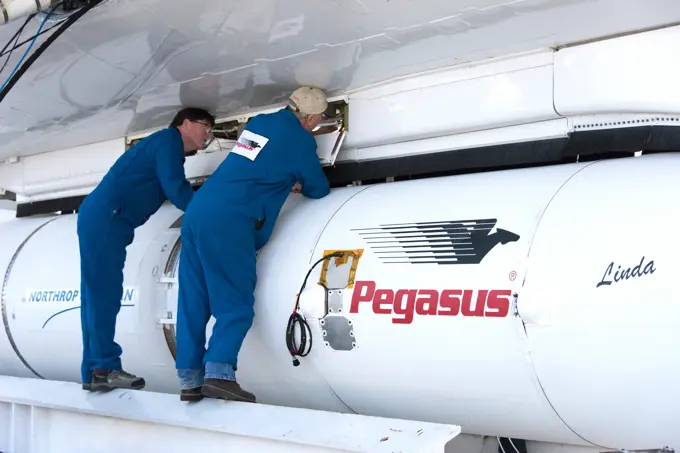
Technicians secure Northrop Grumman's Pegasus XL rocket, containing NASA's Ionospheric Connection Explorer (ICON), beneath the company's L-1011 Stargazer aircraft at the hot pad at Vandenberg Air Force Base in California, on Oct. 14, 2018. The Stargazer will take off from the hot pad and travel to Cape Canaveral Air Force Station in Florida. The Pegasus XL rocket will launch ICON from the Skid Strip at the Cape. ICON will study the frontier of space - the dynamic zone high in Earth's atmosphere where terrestrial weather from below meets space weather above. The explorer will help determine the physics of Earth's space environment and pave the way for mitigating its effects on our technology and communications systems.
6145-44669997
VANDENBERG AIR FORCE BASE, CALIF. --   At North Vandenberg Air Force Base in California, workers offload from the truck the shipping container with NASA's AIM spacecraft inside. AIM is the seventh Small Explorers mission under NASA's Explorer Program. The program provides frequent flight opportunities for world-class scientific investigations from space within heliophysics and astrophysics. The AIM spacecraft will fly three instruments designed to study polar mesospheric clouds located at the edge of space, 50 miles above the Earth's surface in the coldest part of the planet's atmosphere. The mission's primary goal is to explain why these clouds form and what has caused them to become brighter and more numerous and appear at lower latitudes in recent years. AIM's results will provide the basis for the study of long-term variability in the mesospheric climate and its relationship to global climate change. AIM is scheduled to be mated to the Pegasus XL during the second week of April, af
6145-52171909
A member of the Italian National Antarctic Research Program, (PNRA), fills out a customs declaration at the passenger terminal as he outprocesses for departure from Christchurch, New Zealand, to the South Pole for a four-month stay. The PNRA is participating in the United States Antarctic Program under the Authority for New Technologies, Energy and Environment, (ENEA), and will board a C-141 Starlifter aircraft out of Christchurch to the ice of Antarctica during Operation DEEP FREEZE 2001. Subject Operation/Series: DEEP FREEZE 2001 Base: Christchurch State: Canterbury Country: New Zealand (NZL)
6145-44623544
Expedition 10 Commander and NASA Science Officer Leroy Chiao donned his launch and entry suit and climbed aboard the Soyuz TMA-5 spacecraft Friday, October 5, 2004, at the Baikonur Cosmodrome in Kazakhstan for a dress rehearsal of launch day activities leading to their liftoff October 14 to the International Space Station.  Chiao and Sharipov, the first crew of all-Asian extraction, will spend six months on the Station.  Shargin will return to Earth October 24 with the Stations' current residents, Expedition 9 Commander Gennady Padalka and NASA Flight Engineer and Science Officer Mike Fincke.
4168-5967
ANTARCTICA, JELBART ICE SHELF, GERMAN NEUMAYER STATION, RESEARCHER JENS FICKERT
6145-44581730
KENNEDY SPACE CENTER, FLA. -- WESH-TV 2 News Anchor Wendy Chioji (right) is given a tour of Launch Complex 39B by NASA's Stephen Bulloch. Chioji was at KSC to speak at the 2002 Combined Federal Campaign (CFC) kickoff rally.
1899-18984677
Boeing technicians, from right, John Pearce Jr., Mike Vawter and Rob Ferraro prepare a Russian replacement computer for stowage aboard the Space Shuttle Atlantis shortly before the scheduled launch of Mission STS-86, slated to be the seventh docking of the Space Shuttle with the Russian Space Station Mir. The preparations are being made at the SPACEHAB Payload Processing Facility in Cape Canaveral. The last-minute cargo addition requested by the Russians will be mounted on the aft bulkhead of the SPACEHAB Double Module, which is being used as a pressurized cargo container for science/logistical equipment and supplies that will be exchanged between Atlantis and the Mir. Using the Module Vertical Access Kit (MVAC), technicians will be lowered inside the module to install the computer for flight. Liftoff of STS-86 is scheduled Sept. 25 at 10:34 p.m. from Launch Pad 39A.
6145-44602732
In the Orbiter Processing Facility, Rick Cady, with United Space Alliance, removes a tile from Endeavour. Tile check is part of routine maintenance and return to flight activities on the orbiter fleet.
6145-58963754
KENNEDY SPACE CENTER, FLA. - The media look at equipment on board one of the Solid Rocket Booster (SRB) retrieval ships. The stop was part of a day-long event that featured the movement of the first SRB segments to the Vehicle Assembly Building for stacking for Return to Flight mission STS-114. Two SRBs support the liftoff of the Space Shuttle on a launch. The twin 149-foot tall, 12-foot diameter SRBs provide the main propulsion system during launch to place the orbiters in the proper orbit around the Earth. They operate parallel with the Space Shuttle main engines for the first two minutes of flight and jettison away from the orbiter, with help from the Booster Separation Motors, about 26.3 nautical miles above the Earths surface.
6145-44600618
Workers make a tile-fit check on the underside of the orbiter Discovery in the Orbiter Processing Facility. The vehicle has undergone Orbiter Major Modifications in the past year, a process that includes the tile check.
1899-28701091
Florida, Cape Canaveral, astronaut John Glenn takes off on friendship 7 for the third mission around the earth, 1962.
6145-44997965
CAPE CANAVERAL, Fla. - A technician monitors the flow of propellant loading in the Project Morpheus prototype lander as it is prepared for its third free flight test at the north end of the Shuttle Landing Facility at NASAs Kennedy Space Center in Florida. The 57-second test began at 1:15 p.m. EST with the Morpheus lander launching from the ground over a flame trench and ascending about 187 feet, nearly doubling the target ascent velocity from the last test in December 2013. The lander flew forward, covering about 154 feet in 20 seconds before descending and landing within 11 inches of its target on a dedicated pad inside the autonomous landing and hazard avoidance technology, or ALHAT, hazard field. Project Morpheus tests NASAs ALHAT and an engine that runs on liquid oxygen and methane, or green propellants, into a fully-operational lander that could deliver cargo to other planetary surfaces. The landing facility provides the lander with the kind of field necessary for realistic tes
6145-44585230
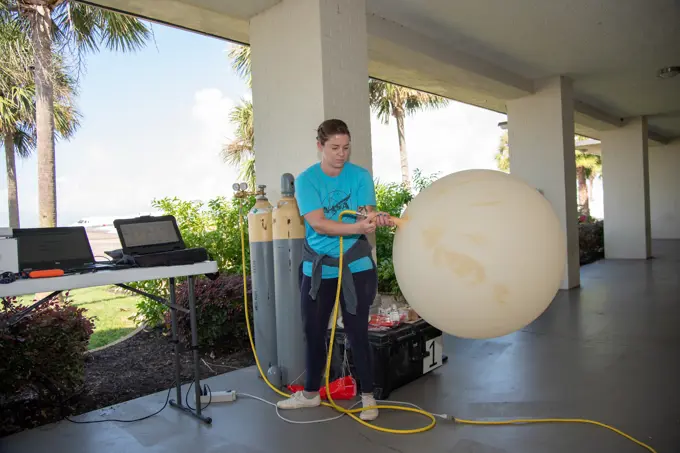
KENNEDY SPACE CENTER, FLA. - Stephen Ezell, meteorological systems operator at Weather Station A, Cape Canaveral Air Force Station, gets ready to release a weather balloon.   Such balloons are released twice a day collecting data such as temperature and humidity as they rise.  The data is released to agencies nationwide, including the 45th Space Wing which uses the data for its daily weather reports.  The weather station provides additional data to NASA for launches -- releasing 12 balloons in eight hours prior to liftoff - and landings - releasing 5 balloons in six and a half hours before expected touchdown.
4389-1730
Edmund Callaghan with Cryogenic Magnet
6145-44903962
NASA Physical Oceanography Program Scientist Eric Lindstrom talks about the instruments onboard the Woods Hole Oceanographic Institution research vessel Knorr on Tuesday, Sept. 4, 2012, in Woods Hole, Mass.  Various scientific instruments will be deployed in the Atlantic Ocean as part of the Salinity Processes in the Upper Ocean Regional Study (SPURS) which is set to sail on Sept. 6.  The NASA-sponsored expedition will sail to the North Atlantic's saltiest spot to get a detailed, 3-D picture of how salt content fluctuates in the ocean's upper layers and how these variations are related to shifts in rainfall patterns around the planet.
5514-29983694
Climbing in the Kitchen during quarantine time
6145-45184793
In order to make sure weather conditions are acceptable at multiple altitudes, NASA meteorologists on the ground conduct constant monitoring operations, and launch weather balloons to get accurate data for aircraft and pilot.
6145-30235234
U.S. Secretary of State John Kerry listens to a scientist describe his work with permafrost core samples as the Secretary toured Scott Base, the New Zealand research station in the Antarctic, on November 12, 2016, following a visit to neighboring McMurdo Station and other U.S. research facilities around Ross Island and the Ross Sea in an effort to learn about the effects of climate change on the Continent.
6145-44613386
Flight Engineer and NASA Science Officer Mike Fincke, foreground, leaps over a ditch after the Expedition 9 prime and backup crews stopped to look at desert tulips just outside the gates to the Soyuz launch pad, Wednesday, April 14, 2004 in Baikonur, Kazakhstan.
6145-44594509
KENNEDY SPACE CENTER, FLA. -  Andrew Shepard, expedition leader, National Undersea Research Center, University of North Carolina at Wilmington, N. Car., poses on deck of the Liberty Star  with some of the equipment to be used in the Oculina Banks project.  The ship will be the site of an undersea expedition to characterize the condition of the deep-sea coral reefs and reef fish populations in the Oculina Banks, a marine protected area, 20 miles offshore of the east coast of Florida.  He and other scientists will be deploying an underwater robot, a seafloor sampler, and the Passive Acoustic Monitoring System (PAMS).  Dr. Grant Gilmore was co-principle investigator of the PAMS,  originally developed by NASA to monitor the impact of rocket launches on wildlife refuge lagoons at KSC.   The research is sponsored by NOAA Fisheries.  The ship departed from Port Canaveral April 29 and will return May 9.
6145-55971512
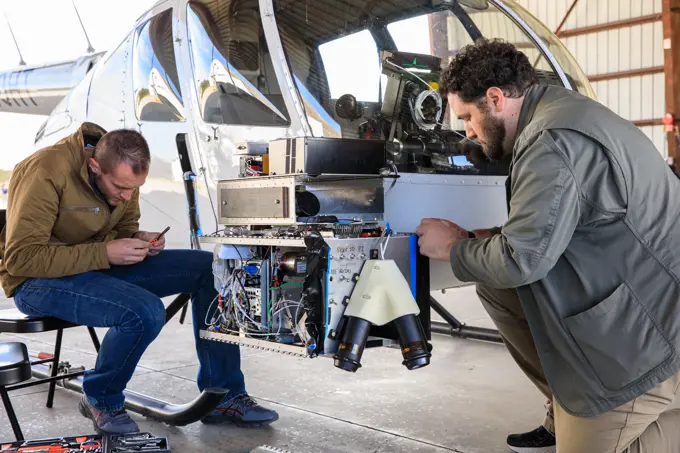
Intuitive Machines CLPS Testing. Two Intuitive Machines employees ready navigation pod sensors for the companys Nova-C lunar lander in preparation for testing at NASAs Kennedy Space Center in Florida on Nov. 18, 2022. The test involved flying the sensors over a simulated lunar surface at the Launch and Landing Facility on a private helicopter. Intuitive Machines is scheduled to launch two missions to the Moon in 2023 - one of which will carry NASAs Mass Spectrometer observing lunar operations (MSolo) instrument that will help analyze the chemical makeup of landing sites on the Moon, as well as study water on the lunar surface. Through NASAs Commercial Lunar Payload Services initiative, the agency selected Intuitive Machines to deliver science and technology demonstration payloads to the Moon, contributing to NASAs goal of establishing a sustainable human presence on the lunar surface.
6145-44655321
NASA African Monsoon Multidisciplinary Analyses (NAMMA) DC-8 deployment to Cape Verde, Sal island, Africa
6145-44609140
KENNEDY SPACE CENTER, FLA. - On a tour of the Orbiter Processing Facility, Kathy Laufenberg (left) directs the attention of Deputy Director Woodrow Whitlow Jr. to an area on a rudder speed brake panel on Endeavour.  The Center Director, Jim Kennedy, and Whitlow are on a tour of the Orbiter Processing Facility.  Endeavour is in its Orbiter Major Modification period, which began in December 2003.
6145-44630828
Expedition 10 Commander Leroy Chiao signs the inside of the helicopter that will take him back to Kustanay, Kazakhstan, Monday, April 25, 2005.  Chiao, Flight Engineer Salizhan Sharipov and European Space Agency astronaut Roberto Vittori brought their Soyuz TMA-5 capsule to a pre-dawn landing April 25 northeast of the town of Arkalyk to wrap up a six-month mission aboard the International Space Station for Chiao and Sharipov, and a ten-day mission for Vittori, who flew under a commercial contract between ESA and the Russian Federal Space Agency.
6145-44596380
KENNEDY SPACE CENTER, FLA. - Astronaut Soichi Noguchi, with the National Space Development Agency of Japan (NASDA), looks at the Japanese Experiment Module after its arrival at Port Canaveral, Fla.   Built by the Tsukuba Space Center near Tokyo, the pressurized module is the first element of the JEM, Japans primary contribution to the space station, to be delivered to KSC. It will enhance the unique research capabilities of the orbiting complex by providing an additional shirt-sleeve environment for astronauts to conduct science experiments. The JEM also includes two logistics modules, an exposed pallet for space environment experiments and a robotic manipulator system that are still under construction in Japan. The various JEM components will be assembled in space over the course of three space shuttle missions.
6145-58963690
KENNEDY SPACE CENTER, FLA. - The media tour the Parachute Refurbishment Facility, which cleans and repairs the Solid Rocket Booster (SRB) parachutes after a Space Shuttle launch. The stop was part of a day-long event that featured the movement of the first SRB segments to the Vehicle Assembly Building for stacking for Return to Flight mission STS-114. Two SRBs support the liftoff of the Space Shuttle on a launch. The twin 149-foot tall, 12-foot diameter SRBs provide the main propulsion system during launch to place the orbiters in the proper orbit around the Earth. They operate parallel with the Space Shuttle main engines for the first two minutes of flight and jettison away from the orbiter, with help from the Booster Separation Motors, about 26.3 nautical miles above the Earths surface.
1812-111557635
Two scientists experimenting with a water sample
6145-44596377
KENNEDY SPACE CENTER, FLA. - Astronaut Soichi Noguchi, with the National Space Development Agency of Japan (NASDA), looks at the Japanese Experiment Module after its arrival at Port Canaveral, Fla.   Built by the Tsukuba Space Center near Tokyo, the pressurized module is the first element of the JEM, Japans primary contribution to the space station, to be delivered to KSC. It will enhance the unique research capabilities of the orbiting complex by providing an additional shirt-sleeve environment for astronauts to conduct science experiments. The JEM also includes two logistics modules, an exposed pallet for space environment experiments and a robotic manipulator system that are still under construction in Japan. The various JEM components will be assembled in space over the course of three space shuttle missions.
6145-44650920
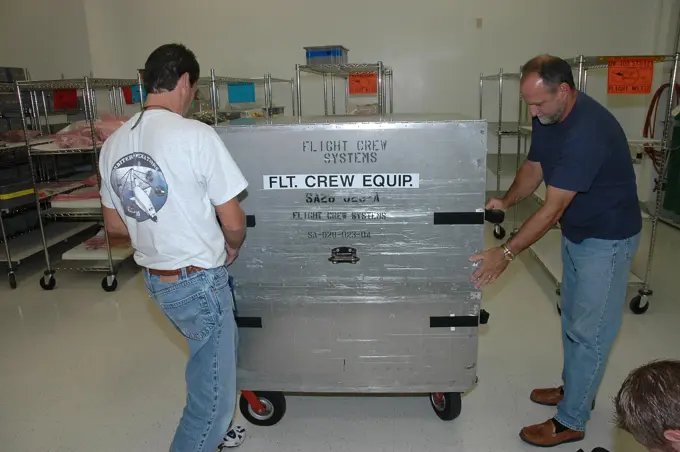
KENNEDY SPACE CENTER, FLA. -    In the Space Station Processing Facility at NASA's Kennedy Space Center, flight crew systems technician Troy Mann and flight crew systems manager Jim Blake secure the storage boxes holding the food containers that will be stowed on Space Shuttle Discovery for the flight of mission STS-121.  The containers hold meals prepared for the mission crew.   Astronauts select their own menus from a large array of food items. Astronauts are supplied with three balanced meals, plus snacks.  Foods flown on space missions are researched and developed at the Space Food Systems Laboratory at the Johnson Space Center (JSC) in Houston, which is staffed by food scientists, dietitians and engineers. Foods are analyzed through nutritional analysis, sensory evaluation, storage studies, packaging evaluations and many other methods.   Each astronauts food is stored aboard the space shuttle and is identified by a colored dot affixed to each package.  Launch of Space Shuttle Dis
4220-20134976
Observation boat looking for Killer Whales (Orcinus orca). Tysfjord - Lofoten Isles - Norway.
6145-44644868
KENNEDY SPACE CENTER, FLA. -- Astronaut Dave Williams dons his wet suit before heading for the National Oceanic and Atmospheric Administration (NOAA) Aquarius Underwater Laboratory.  Williams is leading a 17-day undersea mission as part of the NASA Extreme Environment Mission Operations (NEEMO) project.  Other members of the mission are astronauts Nicole Stott and Ron Garan, plus Dr. Tim Broderick of the University of Cincinnati. The undersea laboratory is situated three miles off Key Largo in the Florida Keys National Marine Sanctuary, anchored 62 feet below the surface.  The astronauts are testing space medicine concepts and moon-walking techniques.
6145-44629591
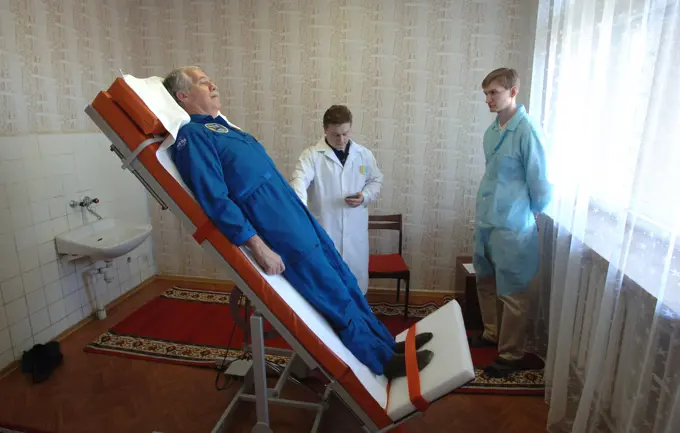
Expedition 11 Flight Engineer John Phillips takes part in a  tilt table test, Monday, April 11, 2005, in Baikonur, Kazakhstan as technicians collect pre-launch data on the state of his equilibrium prior to the April 15 launch to the International Space Station.
4413-20030717
Nikita Tananaev, researcher, explaining the melting permafrost in one of the underground laboratories of the permafrost institute for studying permarfrost and storing cores at negative temperatures, Yakutsk, Republic of Sakha, Russia
6145-44569611
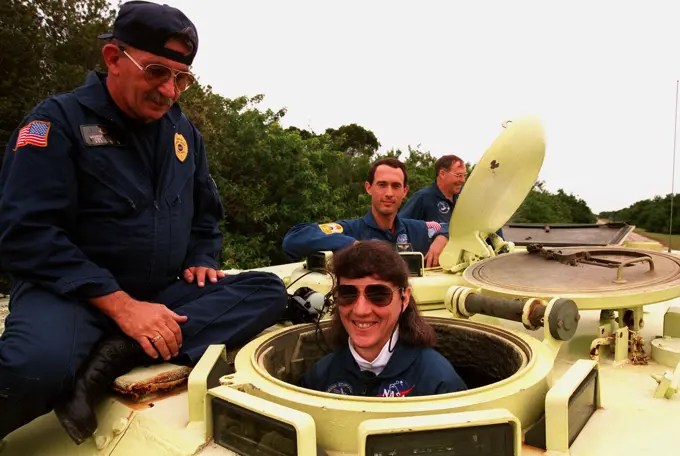
STS-88 Mission Specialist Nancy J. Currie prepares to operate an M-113, an armored personnel carrier, as part of emergency egress training under the watchful eye of instructor George Hoggard (left) during Terminal Countdown Demonstration Test (TCDT) activities. The TCDT also provides the crew with simulated countdown exercises and opportunities to inspect their mission payloads in the orbiter's payload bay. Mission STS-88 is targeted for launch on Dec. 3, 1998. It is the first U.S. flight for the assembly of the International Space Station and will carry the Unity connecting module. Others in the STS-88 crew are Mission Commander Robert D. Cabana; Pilot Frederick W. "Rick" Sturckow; and Mission Specialists Jerry L. Ross, James H. Newman, and Sergei Konstantinovich Krikalev, a Russian cosmonaut
6145-45044949
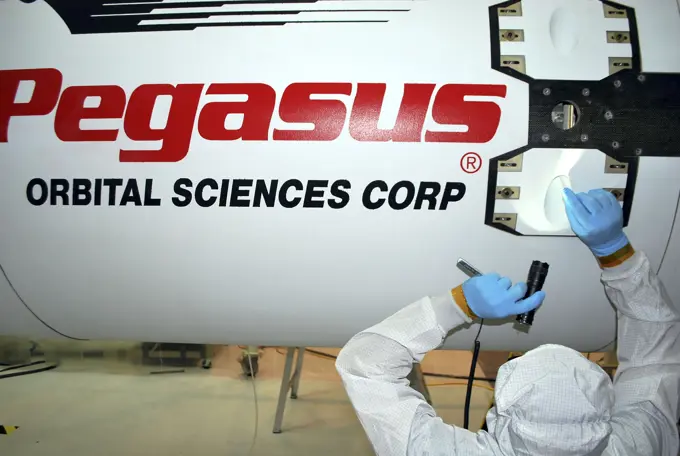
VANDENBERG AIR FORCE BASE, Calif. - Inside the Orbital Sciences processing facility at Vandenberg Air Force Base in California, an Orbital technician secures the Pegasus payload fairing around NASA's Nuclear Spectroscopic Telescope Array, or NuSTAR, completing the two-day process. On Feb. 17, NuSTAR was mated to its Pegasus XL rocket, which is positioned behind the spacecraft outside the environmental enclosure.  The fairing will protect the spacecraft from the heat and aerodynamic pressure generated during ascent to orbit.  Encapsulation of NuSTAR in its fairing is a significant prelaunch milestone.  After processing of the rocket and spacecraft are complete, they will be flown on Orbital's L-1011 carrier aircraft from Vandenberg to the Ronald Reagan Ballistic Missile Defense Test Site on the Pacific Oceans Kwajalein Atoll for launch in March. The high-energy x-ray telescope will conduct a census of black holes, map radioactive material in young supernovae remnants, and study the o
6145-44769369
STS-133 DISCOVERY BOUNDARY LAYER TRANSITION TILE BONDING
6145-44603047
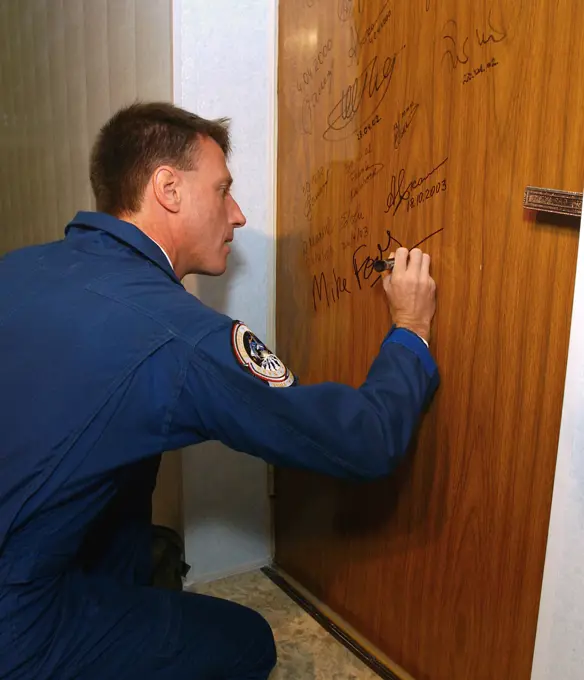
Expedition 8 Commander and NASA Science Officer Mike Foale signs his name to the door of his room at the Cosmonaut Hotel crew quarters, Saturday, Oct. 18, 2003, in Baikonur, Kazakhstan prior to departing for the launch pad. Foale, along with Expedition 8 Soyuz Commander Alexander Kaleri and European Space Agency Astronaut Pedro Duque of Spain were launched on a Soyuz TMA-3 vehicle from Baikonur to the International Space Station, arriving on Oct. 20.
6145-44629589
European Space Agency astronaut Roberto Vittori, of Italy, left, and Expedition 11 Commander Sergei Krikalev participate in tilt table tests, Sunday, April 10, 2005, so technicians can collect pre-launch data on the state of their equilibrium prior to the April 15 launch to the International Space Station with Flight Engineer John Phillips in Baikonur, Kazakhstan.
6145-44639579
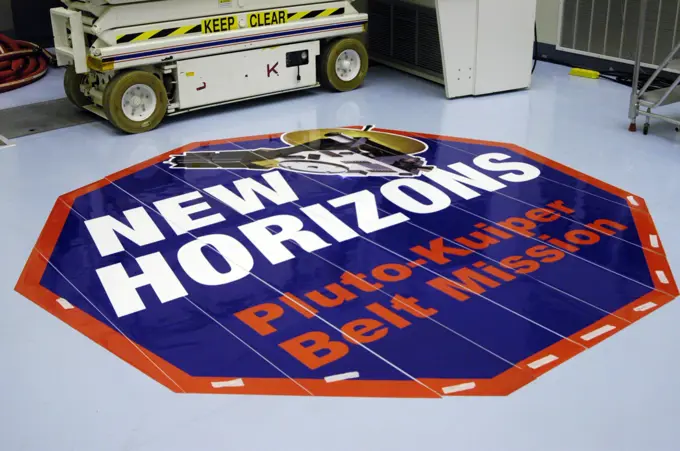
KENNEDY SPACE CENTER, FLA. - The mission decal for New Horizons is laid out in strips on the floor of the Payload Hazardous Servicing Facility before installation onto the spacecraft's fairing. New Horizons carries seven scientific instruments that will characterize the global geology and geomorphology of Pluto and its moon Charon, map their surface compositions and temperatures, and examine Pluto's complex atmosphere. After that, flybys of Kuiper Belt objects from even farther in the solar system may be undertaken in an extended mission. New Horizons is the first mission in NASA's New Frontiers program of medium-class planetary missions. The spacecraft, designed for NASA by the Johns Hopkins University Applied Physics Laboratory in Laurel, Md., will launch aboard a Lockheed Martin Atlas V rocket and fly by Pluto and Charon as early as summer 2015.
PREVIOUS
of 3
NEXT
2401 S. Ervay, Suite 206
Dallas, Texas 75215
United States
Get Started
Free ResearchMy BoardsMy Cart
For Creators
How To License Your ContentContributor PortalFrame of Mind
Resources
API accessPricing
Contact
+1 866 236 0087help@viewpictures.co.uk Contact form
©2026 View Pictures. All Rights Reserved. -A
This site is protected by reCAPTCHA and Google Privacy Policy and Terms of Service apply.