My Boards
View Pictures
  • My Boards

Space Shuttle Launches

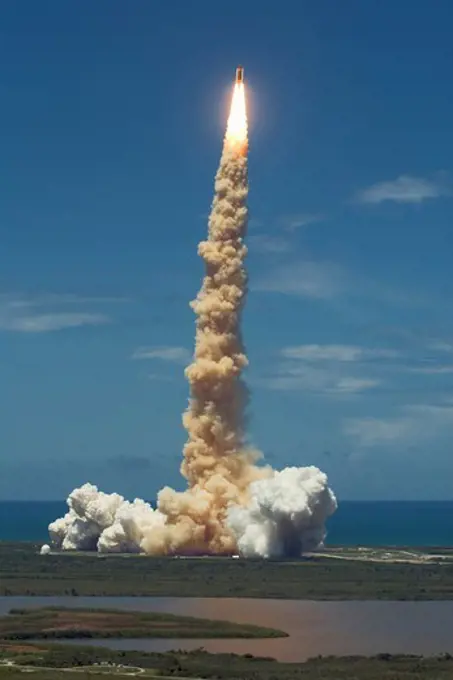
Dramatic views of various Space Shuttle launches against blue and twilight skies, showcasing powerful liftoffs with trails of smoke.

Launch of Space Shuttle Discovery on STS-121
157 assets in this story
6145-44587081
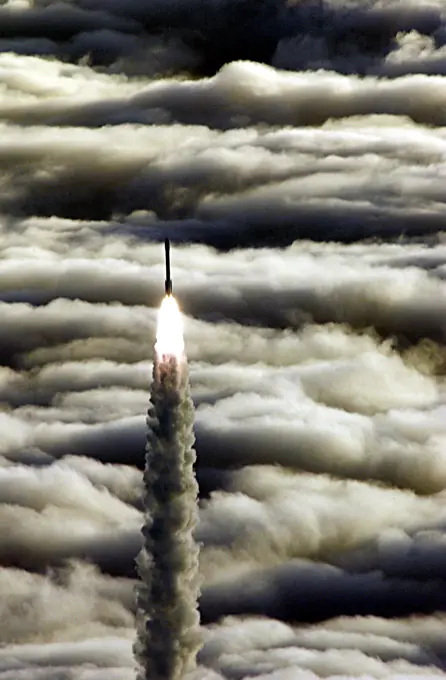
VANDENBERG AFB, Calif. --  A Boeing Delta II rocket soars above the clouds here today at Vandenberg AFB, Calif.  The NASA payloads aboard the rocket are the ICESat, an Ice Cloud and land Elevation Satellite, and CHIPSat, a Cosmic Hot Interstellar Plasma Spectrometer.  ICESat, a 661-pound satellite, is a benchmark satellite for the Earth Observing System that will help scientists determine if the global sea level is rising or falling.  It will observe the ice sheets that blanket the Earths poles to determine if they are growing or shrinking.  It will assist in developing an understanding of how changes in the Earths atmosphere and climate affect polar ice masses and global sea level.  The Geoscience Laser Altimeter System is the sole instrument on the satellite.  CHIPSat, a suitcase-size 131-pound satellite, will provide information about the origin, physical processes and properties of the hot gas contained in the interstellar medium.  This launch marks the first Delta from Vandenber
6145-45294479
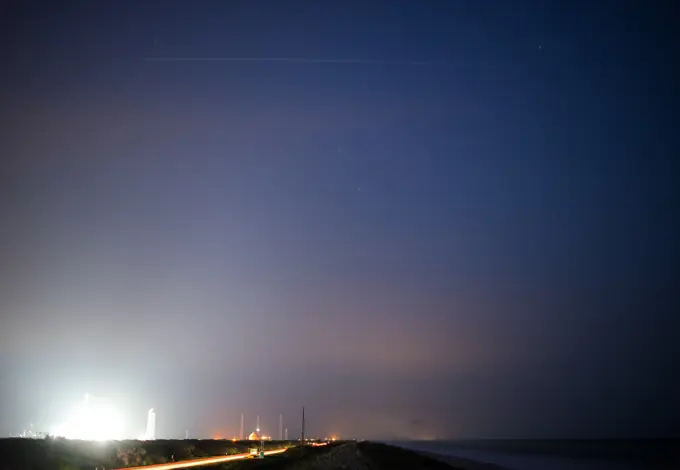
The International Space Station is seen in this one minute exposure as it flies over Launch Complex 39A, Saturday, April 24, 2021, at NASAs Kennedy Space Center in Florida. The SpaceX Crew Dragon with NASA astronauts Shane Kimbrough and Megan McArthur, ESA (European Space Agency) astronaut Thomas Pesquet, and Japan Aerospace Exploration Agency (JAXA) astronaut Akihiko Hoshide onboard, which launched from Launch Complex 39A at 5:49 a.m. EDT on April 23, docked with the complex at 5:08 a.m. EDT. Kimbrough, McArthur, Pesquet, and Hoshide will join the Expedition 65 crew of Shannon Walker, Michael Hopkins, Victor Glover, and Mark Vande Hei of NASA, Soichi Noguchi of the Japan Aerospace Exploration Agency (JAXA), and Roscosmos cosmonauts Oleg Novitskiy and Pyotr Dubrov onboard the space station.
7175-70561322
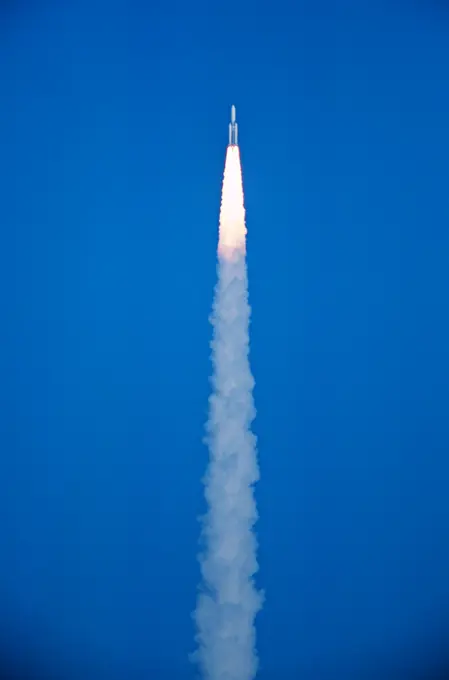
North America, USA, Florida, Cape Canaveral. A rocket launch at the John F. Kennedy Space Center on Cape Canaveral.
5507-49091323
an aerial view of a rocket launching into the sky
4356-191
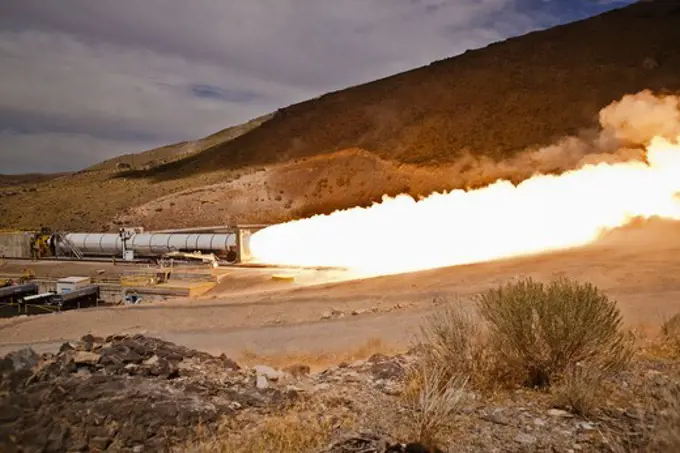
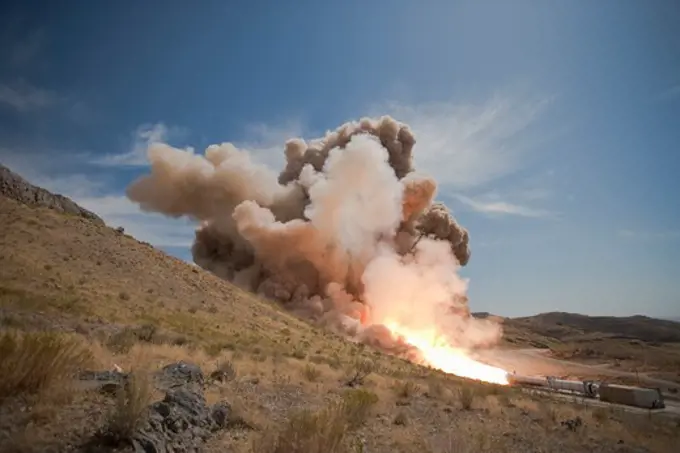
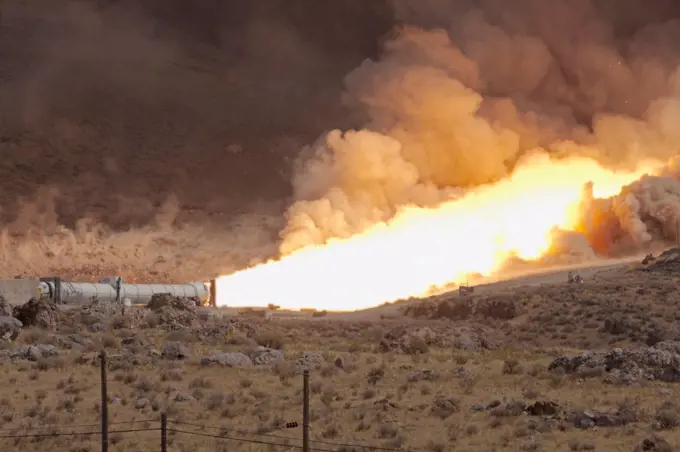
Largest Rocket in the World Successfully Test Fired, Seen From Remote Camera Only 225 Feet From Rocket's Nozzle
4367-231
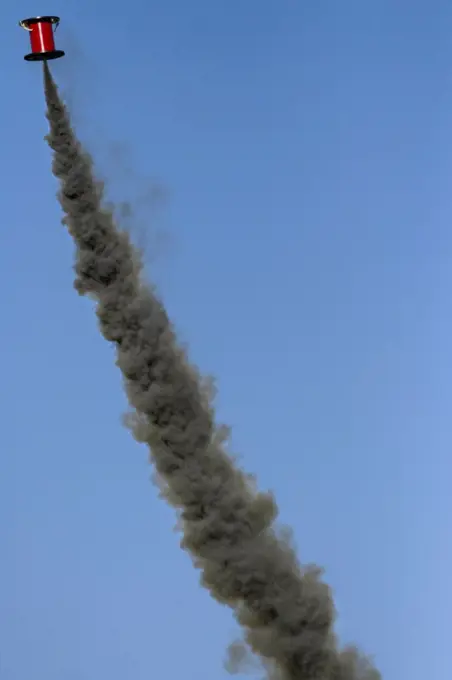
A rocket make out of a spool of wire, at a launch event sponsored by the Southern Arizona Rocketry Association (SARA).
6145-45242840
A close-up view of Bantam duration testing of the 40K Fastrac II Engine for X-34 at Marshall Space Flight Center's (MSFC) test stand 116. The Bantam test refers to the super lightweight engines of the Fastrac program. The engines were designed as part of the low cost X-34 Reusable Launch Vehicle (RLV). The testing of these engines at MSFC allowed the engineers to determine the capabilities of these engines and the metal alloys that were used in their construction. The Fastrac and X-34 programs were cancelled in 2001.
6145-55970891
TROPICS Rocket Launch. A Rocket Lab Electron rocket lifts off Launch Complex 1, Pad B, in Māhia, New Zealand on May 8 at 1 p.m. New Zealand time (May 7 at 9 p.m. EDT), carrying two NASA CubeSats designed to study tropical cyclones, including hurricanes and typhoons. NASAs Time-Resolved Observations of Precipitation structure and storm Intensity with a Constellation of Smallsats (TROPICS) CubeSats will provide data on temperature, precipitation, water vapor, and clouds by measuring microwave frequencies, providing insight into storm formation and intensification.
6145-45240540
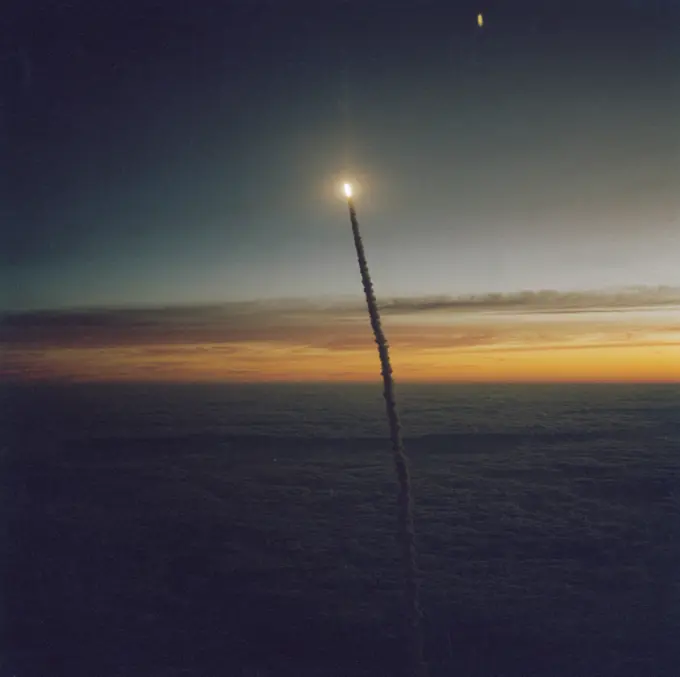
41G-90139 (5 October 1984) --- A Florida dawn scene forms the backdrop for the climbing Space Shuttle Challenger, its two solid rocket boosters and external fuel tank. Seven crewmembers, a space record, head for a busy eight-day stay in Earth orbit. The scene was photographed by astronaut Paul J. Weitz, who was piloting the Shuttle training aircraft (STA).
6188-65603212
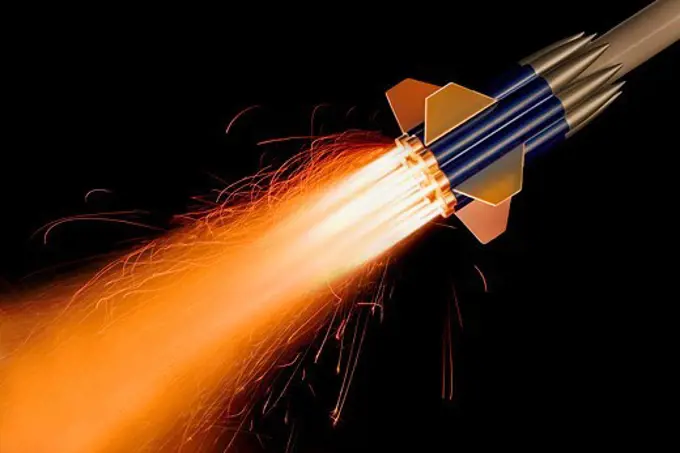
nuclear rocket test 3d illustration of a nuclear rocket test Copyright: xZoonar.com/magannx 11186613
6177-V53836787
6145-54182249
An Air Force Global Strike Command unarmed Minuteman III intercontinental ballistic missile launches during an operational test at 12:49 A.M. PDT Tuesday 16 Aug, 2022 at Vandenberg Space Force Base, Calif. ICBM test launches demonstrate that the U.S. ICBM fleet is relevant, essential and key to leveraging dominance in an era of strategic competition.
6145-45027609
CAPE CANAVERAL, Fla. - At NASA Kennedy Space Center's Press Site in Florida, participants in NASA's Tweetup photograph the launch of the agency's Mars Science Laboratory (MSL) from the turn basin.  The tweeters will share their experiences with followers through the social networking site Twitter. The 197-foot-tall United Launch Alliance Atlas V rocket lifted off Space Launch Complex-41 on neighboring Cape Canaveral Air Force Station at 10:02 a.m. EST at the opening of the launch window.  MSL's components include a car-sized rover, Curiosity, which has 10 science instruments designed to search for signs of life, including methane, and help determine if the gas is from a biological or geological source.
6145-44557602
A seven-year journey to the ringed planet Saturn began on Oct. 15, 1997 with the liftoff of a Titan IVB/Centaur carrying NASA's Cassini orbiter and its attached Huygens probe.
6177-V53650893
6145-44823100
The Soyuz TMA-19 rocket launches from the Baikonur Cosmodrome in Kazakhstan on Wednesday, June 16, 2010 carrying Expedition 24 NASA Flight Engineers Shannon Walker and Douglas Wheelock, and Soyuz Commander Fyodor Yurchikhin of Russia to the International Space Station.  Their Soyuz TMA-19 rocket launched at 3:35 a.m Kazakhstan time.  (
6177-V53550785
6145-44428396
A United Launch Alliance Delta II rocket successfully launches from Vandenberg Air Force Base Space Launch Complex-2, Jan. 31, 2015 at 6:22 a.m. PDT. This Delta II rocket carried NASA's Soil Moisture Active Passive; the first Earth observing satellite. SMAP is designed to collect global observations of surface soil moisture and its freeze/thaw state. High resolution space-based measurements of soil moisture and whether the soil is frozen or thawed will give scientists a new capability to observe and predict natural hazards of extreme weather, climate change, floods and droughts, and will help reduce uncertainties in the understanding of Earth's water and carbon cycles.
6177-V54019898
6145-44715994
View of lightning striking near Pod 39A during the launch of Apollo XII from 16mm film. 1. APOLLO XII - LAUNCH (LIGHTNING) KENNEDY SPACE CENTER, FL
6145-45240795
The journey back to Mars begins with a liftoff of the Mars Global Surveyor atop a Delta II 7925A expendable launch vehicle from the Cape Canaveral Air Station. After an approximate 10-month interplanetary odyssey, the spacecraft will arrive at Mars and begin a 4-month aerobreaking phase, an irnovative technique first demonstrated during the Magellan mission to Venus, to achieve a mapping orbit. It will take about 2 Earth years for Surveyor to circle above most of the planet, its suite of sophisticated remote-sensing instruments building a comprehensive global portrait of Mars by mapping its topography, magnetism, mineral composition and atmosphere. Among the locations the Surveyor will pass over are the landing sites where the two U.S. Viking landers have stood since 1975 as silent monuments to the most recent successful U.S. missions to Mars. The Global Surveyor is the first of a trio of spacecraft being launched to Mars; next is Russia's Mars `96 spacecraft, followed by the U.S.'s Ma
6145-44722414
S86-25294 (30 Oct. 1985) --- Barbara R. Morgan and Sharon Christa McAuliffe (right) are pictured during a visit to NASA's Kennedy Space Center (KSC) Launch Complex 39 to witness the launch of the space shuttle Challenger. McAuliffe is scheduled to launch aboard the space shuttle Challenger, STS-51L mission, herself early next year as the United States first in-space citizen observer. Morgan is the backup for the Teacher-in-Space Project s payload specialist position. The photo was taken by Keith Meyers of the New York Times. EDITOR S NOTE The STS-51L crew members lost their lives in the space shuttle Challenger accident moments after launch on Jan. 28, 1986 from the Kennedy Space Center (KSC).
4315-121
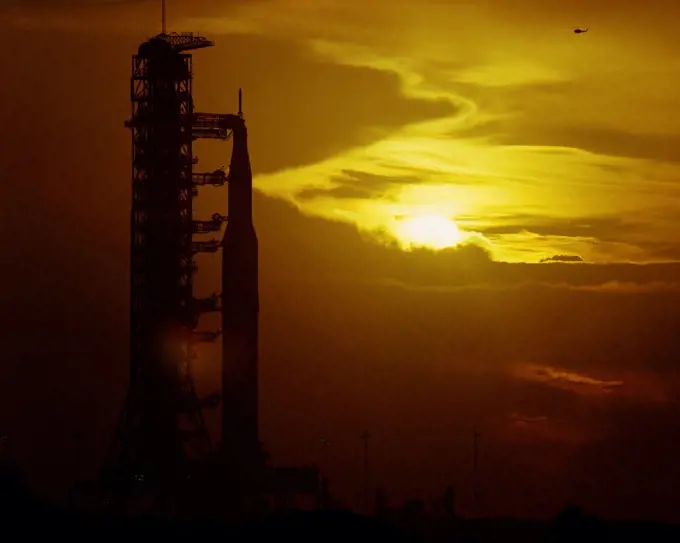
The Sun Rises Over the Apollo 17
4356-202
Largest Rocket in the World Successfully Test Fired, Seen From Remote Camera Angle About 200 Yards Away
4356-211
Largest Rocket in the World Successfully Test Fired
6145-44645552
LCROSS (Lunar CRater Observation and Sensing Satellite) Mission Art IMAGES COURTESY OF NORTHROP GRUMMAN, WILLIAM FURLONG, ARTIST This NASA Ames spacecraft is a small 'secondary payload' spacecraft that will travel with Lunar Reconnaissance Obriter (LRO) satellite to the moon on the same rocket, the Evolved Expendable Launch Vehicle (EELV) to be launched from Kennedy Space Center, Florida in a search for water ice on the moon's south polar region. As the spacecraft approaches the moon's south pole, the upper stge will separate, and then will impact a crater in the south pole area. A plume from the upper stage crash will develope as the Shepherding Spacecraft heads in toward the moon. The Shepherding Spacecrat will fly through the plume, and instruments on the spacecraft wil analyze the cloud to look for signs of water and other compounds. Additional space and Earth-based instruments will study the 2.2-millon-pound (1000-metric-ton) plume. 'The LCROSS mission will help us to determine if
6177-V53847370
6177-V68164454
6145-45212224
The Soyuz MS-13 rocket is launched with Expedition 60 Soyuz Commander Alexander Skvortsov of Roscosmos, flight engineer Andrew Morgan of NASA, and flight engineer Luca Parmitano of ESA (European Space Agency), Saturday, July 20, 2019 at the Baikonur Cosmodrome in Kazakhstan. Skvortsov, Morgan, and Parmitano launched at 12:28 p.m. Eastern time (9:28 p.m. Baikonur time) to begin their mission to the International Space Station.
6145-44488735
A lightning strike was recorded at Launch Complex 39B at NASAs Kennedy Space Center in Florida during the evening of April 2, 2022. NASAs Space Launch System (SLS) and Orion spacecraft were undergoing a prelaunch test called a wet dress rehearsal at the pad for the Artemis I mission. The lightning strike was recorded by cameras stationed at the pad and mobile launcher using a special filter called a “clear day frame,” which provides an overlay of the raw frame on a reference image. Artemis I will be the first integrated test of the SLS and Orion spacecraft. In later missions, NASA will land the first woman and the first woman of color on the surface of the Moon, paving the way for a long-term lunar presence and serving as a steppingstone on the way to Mars.
6177-V53820764
6145-45175582
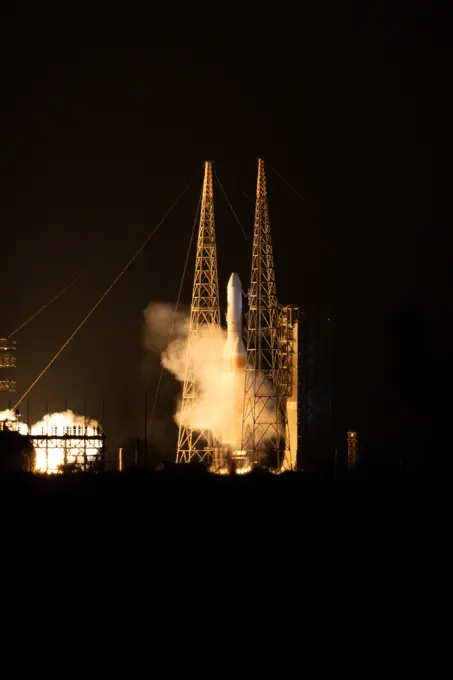
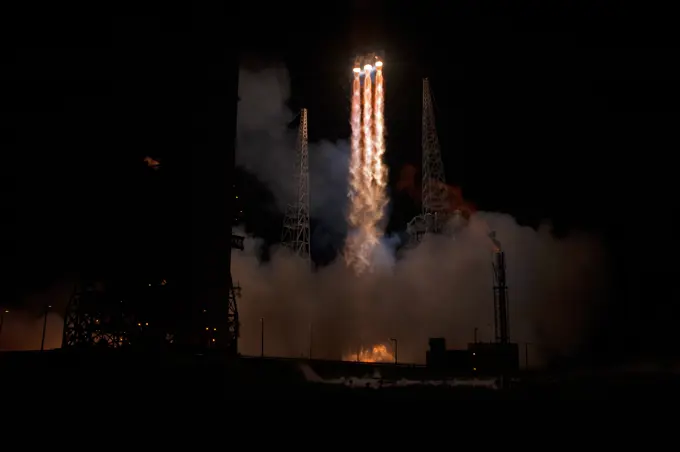
At Cape Canaveral Air Force Station's Space Launch Complex 37, the Delta IV Heavy rocket with NASA's Parker Solar Probe, lifts off at 3:31 a.m. EDT on Sunday, Aug. 12, 2018. The spacecraft was built by Applied Physics Laboratory of Johns Hopkins University in Laurel, Maryland. The mission will perform the closest-ever observations of a star when it travels through the Sun's atmosphere, called the corona. The probe will rely on measurements and imaging to revolutionize our understanding of the corona and the Sun-Earth connection.
6145-45175561
At Cape Canaveral Air Force Stations Space Launch Complex 37, the United Launch Alliance Delta IV Heavy rocket with NASA's Parker Solar Probe, lifts off at 3:31 a.m. EDT on Sunday, Aug. 12, 2018. The spacecraft was built by Applied Physics Laboratory of Johns Hopkins University in Laurel, Maryland. The mission will perform the closest-ever observations of a star when it travels through the Sun's atmosphere, called the corona. The probe will rely on measurements and imaging to revolutionize our understanding of the corona and the Sun-Earth connection.
6145-58969754
The abort motor for Orions launch abort system fired for five seconds in a test at the Promontory, Utah facility of manufacturer Orbital ATK on June 15, 2017. Part of Batch images transfer from Flickr.
6145-44552069
STS082-S-008 (21 Feb 1997) --- The Space Shuttle Discovery partially lights up the early morning sky as it as it lands on Runway 15 at the Kennedy Space Center (KSC), following a 10-day mission in Earth-orbit.  Landing occurred at 3:32:26 a.m.  (EST), February 21, 1997.  The crew members are astronauts Kenneth D. Bowersox, commander; Scott J. Horowitz, pilot; Mark C. Lee, payload commander; and mission specialists Steven A. Hawley, Gregory J. Harbaugh, Steven L. Smith and Joseph R. Tanner.  The primary mission of the flight was to service the Hubble Space Telescope (HST) - a task which required five Extravehicular Activities (EVA) (including an unscheduled EVA) of two alternating two-member teams.  STS-82 represents the 22nd flight of Discovery and the 82nd Space Transportation System (STS) flight, as well as the ninth nocturnal landing in STS history.
6145-44785958
The Soyuz TMA-16 launches from the Baikonur Cosmodrome in Kazakhstan on Wednesday, Sept. 30, 2009 carrying Expedition 21 Flight Engineer Jeffrey N. Williams, Flight Engineer Maxim Suraev and Spaceflight Participant Guy Laliberté to the International Space Station. (
6145-44468703
Following two years of virtual events, high school and college teams from across the country return to Bragg Farms in Toney, Alabama, to compete in NASAs Student Launch rocketry competition April 23.
6145-44772995
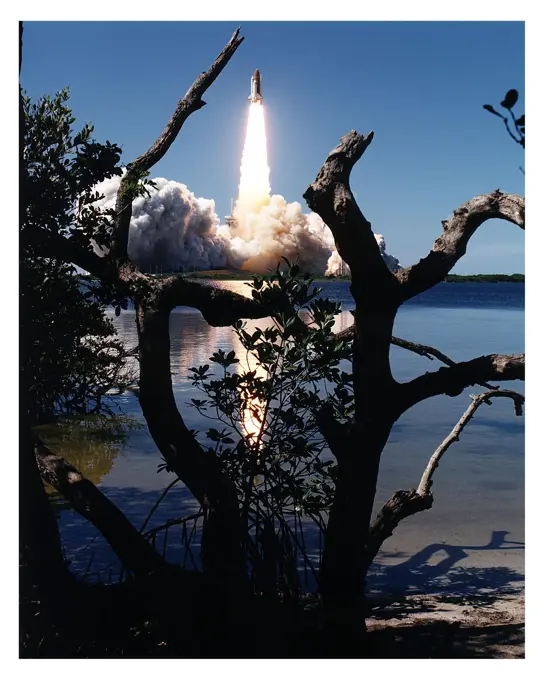
CAPE CANAVERAL, Fla. - Spectators at the NASA Kennedy Space Center's Banana River viewing site lean for better views of space shuttle Endeavour as it roars into space on the STS-127 mission. Liftoff was on-time at 6:03 p.m. EDT.  This was the sixth launch attempt for the STS-127 mission.  The launch was scrubbed on June 13 and June 17 when a hydrogen gas leak occurred during tanking due to a misaligned Ground Umbilical Carrier Plate.  The mission was postponed July 11, 12 and 13 due to weather conditions near the Shuttle Landing Facility at Kennedy that violated rules for launching, and lightning issues. Endeavour will deliver the Japanese Experiment Module's Exposed Facility and the Experiment Logistics Module-Exposed Section in the final of three flights dedicated to the assembly of the Japan Aerospace Exploration Agency's Kibo laboratory complex on the International Space Station.
6145-44552379
Like a rising sun lighting up the afternoon sky, the Space Shuttle Columbia soars from Launch Pad 39A at 2:20:32 p.m. EST, April 4, on the 16-day Microgravity Science Laboratory-1 (MSL-1) mission. The crew members are Mission Commander James D. Halsell, Jr.; Pilot Susan L. Still; Payload Commander Janice Voss; Mission Specialists Michael L. Gernhardt and Donald A. Thomas; and Payload Specialists Roger K. Crouch and Gregory T. Linteris. During the scheduled 16-day STS-83 mission, the MSL-1 will be used to test some of the hardware, facilities and procedures that are planned for use on the International Space Station as well as research in combustion, protein crystal growth and materials processing experiments
6145-44614123
The Soyuz TMA-4 vehicle blasts off from the Baikonur Cosmodrome in Kazakhstan, Monday, April 19, 2004 carrying Expedition 9 Commander Gennady Padalka, Flight Engineer and NASA International Space Station Science Officer Michael Fincke and European Space Agency astronaut Andre Kuipers of the Netherlands to the International Space Station.  Padalka and Fincke will spend six months on the Station, while Kuipers returns home April 30 with the Expedition 8 crew.
6145-45218761
The Soyuz MS-15 spacecraft is launched with Expedition 61 crewmembers Jessica Meir of NASA and Oleg Skripochka of Roscosmos, and spaceflight participant Hazzaa Ali Almansoori of the United Arab Emirates, Wednesday, Sept. 25, 2019 from the Baikonur Cosmodrome in Kazakhstan.
6177-V53855795
6145-45212433
The Soyuz MS-13 rocket is launched with Expedition 60 Soyuz Commander Alexander Skvortsov of Roscosmos, flight engineer Andrew Morgan of NASA, and flight engineer Luca Parmitano of ESA (European Space Agency), Saturday, July 20, 2019 at the Baikonur Cosmodrome in Kazakhstan. Skvortsov, Morgan, and Parmitano launched at 12:28 p.m. Eastern time (9:28 p.m. Baikonur time) to begin their mission to the International Space Station.
6177-V53807370
6177-V54000690
6145-44812811
STS-131 LIFTS OFF INTO THE EARLY MORNING SKY AS SPECTATORS AT THE BANANA CREEK VIEWING AREA OBSERVE
6145-44769345
51F-S-068 (29 July 1985) --- The Space Shuttle Challenger heads toward Earth-orbit with the Spacelab-2 experiment pallet and a team of astronauts and scientists onboard. This photograph was taken by Otis Imboden of the National Geographic Society for NASA from the press site at Kennedy Space Center (KSC).
4356-154
Rocket Motor Test Firing
6145-45058117
The Soyuz TMA-13M spacecraft is seen shortly after being raised into a vertical position on the launch pad on Monday, May 26, 2014, at the Baikonur Cosmodrome in Kazakhstan.  Launch of the Soyuz rocket is scheduled for May 29 and will send Expedition 40 Soyuz Commander Maxim Suraev, of the Russian Federal Space Agency, Roscosmos, Flight Engineer Alexander Gerst, of the European Space Agency, ESA, and Flight Engineer Reid Wiseman of NASA on a five and a half month mission aboard the International Space Station.
6145-45284454
A SpaceX Falcon 9 rocket lifts off at 7:27 p.m. EST from Launch Complex 39A at NASAs Kennedy Space Center in Florida on Nov. 15, 2020, carrying the companys Crew Dragon Resilience capsule. Onboard the capsule are NASAs SpaceX Crew-1 NASA astronauts, Michael Hopkins, spacecraft commander; Victor Glover, pilot; Shannon Walker, mission specialist; and Japan Aerospace Exploration Agency astronaut Soichi Noguchi, mission specialist. Crew-1 is the first regular crew mission of a U.S. commercial spacecraft with astronauts to the International Space Station as part of NASAs Commercial Crew Program. The Crew Dragon will dock with the space station and the crew will remain on the orbiting laboratory for a six-month science mission.
6145-45160600
After eight months of designing, building and testing, the middle school, high school and college and university teams launched their rockets as part of NASA Student Launch on Sunday, April 8. The rockets and their payloads are designed to fly to 1-mile in altitude before deploying recovery systems that brings them safely to the ground.
6145-44593922
April 24, 2003, Baikonur Cosmodrome, Kazakhstan.  The Soyuz rocket is erected at the launch pad.  Expedition Seven is scheduled to launch onboard the Soyuz this Saturday April 26, 2003.
6145-55974592
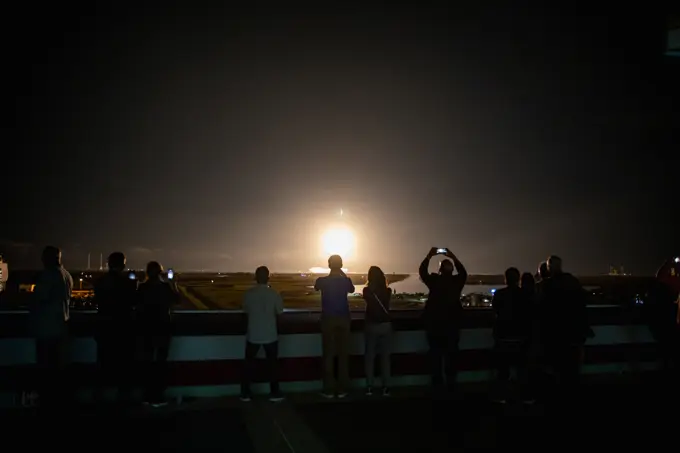
Artemis I Launch. Guests watch the launch of NASAs Space Launch System rocket carrying the Orion spacecraft on the Artemis I flight test, Wednesday, Nov. 16, 2022, from Operations and Support Building II at NASAs Kennedy Space Center in Florida. NASAs Artemis I flight test is the first integrated flight test of the agencys deep space exploration systems: the Orion spacecraft, Space Launch System (SLS) rocket, and ground systems. SLS and Orion launched at 1:47 a.m. EST, from Launch Pad 39B at the Kennedy Space Center. The Moon is in the upper right.
6145-45242081
This 1989 artist's rendering shows how a Shuttle-C would look during launch. As envisioned by Marshall Space Flight Center plarners, the Shuttle-C would be an unmanned heavy-lift cargo vehicle derived from Space Shuttle elements. The vehicle would utilize the basic Shuttle propulsion units (Solid Rocket Boosters, Space Shuttle Main Engine, External Tank), but would replace the Orbiter with an unmanned Shuttle-C Cargo Element (SCE). The SCE would have a payload bay lenght of eighty-two feet, compared to sixty feet for the Orbiter cargo bay, and would be able to deliver 170,000 pound payloads to low Earth orbit, more than three times the Orbiter's capacity.
6177-V53550779
6145-44482382
A lightning strike was recorded at Launch Complex 39B at NASAs Kennedy Space Center in Florida on Sept. 12, 2022. NASAs Space Launch System (SLS) and Orion spacecraft atop the mobile launcher are in view on the launch pad in preparation for the Artemis I mission. The lightning strike was recorded by cameras stationed at the pad and mobile launcher using a special filter called a “clear day frame,” which provides an overlay of the raw frame on a reference image. Artemis I will be the first integrated test of the SLS and Orion spacecraft. In later missions, NASA will land the first woman and the first woman of color on the surface of the Moon, paving the way for a long-term lunar presence and serving as a steppingstone on the way to Mars.
6177-V54000673
PREVIOUS
of 2
NEXT
2401 S. Ervay, Suite 206
Dallas, Texas 75215
United States
Get Started
Free ResearchMy BoardsMy Cart
For Creators
How To License Your ContentContributor PortalFrame of Mind
Resources
API accessPricing
Contact
+1 866 236 0087help@viewpictures.co.uk Contact form
©2026 View Pictures. All Rights Reserved. -A
This site is protected by reCAPTCHA and Google Privacy Policy and Terms of Service apply.