My Boards
View Pictures
  • My Boards

Space Shuttle Launches

Dramatic photographs of space shuttle launches, capturing the power and excitement of rocket liftoffs against stunning natural backdrops.

Launch of Shuttle Columbia on STS_32
274 assets in this story
6145-45241577
Midmorning proved the perfect time for a Space Shuttle launch as the thunderstorms that characteristically develop later in the day during hot Florida summers held off long enough to allow a flawless liftoff for the Space Shuttle Columbia (STS-78) and her crew of seven and the Life and Microgravity Spacelab (LMS), managed by Marshall Space Flight Center. During the 17 day spaceflight, the crew conducted a diverse slate of experiments divided into a mix of life science and microgravity investigations; and, in a marner very similar to future international space station operations, LMS researchers from the United States and their European counterparts shared resources such as crew time and equipment.
6145-44545574
STS070-S-003 (13 JULY 1995) --- Framed by Florida foliage, the Space Shuttle Discovery begins its 21st Spaceflight.  Five NASA astronauts and a Tracking and Data Relay Satellite (TDRS) were aboard for the liftoff, which occurred at 9:41:55 a.m. (EDT), July 13, 1995 from Launch Pad 39B.  Onboard were astronauts Terence T. (Tom) Henricks, Kevin R. Kregel, Nancy J. Curie, Donald A. Thomas and Mary Ellen Weber.  This mission also marks the maiden flight of the new Block I Space Shuttle Main Engine configuration designed to increase engine performance as well as safety and reliability.
6145-44713702
S68-27366 (4 April 1968) --- The five F-1 engines of the huge Apollo/Saturn V space vehicle's first (S-IC) stage leave a gigantic trail of flame in the sky above the Kennedy Space Center seconds after liftoff. The launch of the Apollo 6 (Spacecraft 020/Saturn 502) unmanned space mission occurred at 07 00 01.5 (EST), April 4, 1968. This view of the Apollo 6 launch was taken from a chase plane.
6145-44564858
The first Scout prepared for launch at Wallops Island July 1, 1960, and launched the evening of the same day. -- Photograph published in Winds of Change, 75th Anniversary NASA publication (page 73), by James Schultz.
6145-44713930
S68-50712 (16 Sept. 1968) --- Nighttime view of Launch Complex 34, Kennedy Space Center, showing the Apollo 7 (Spacecraft 101/Saturn 205) stack on pad.
6145-44720539
S81-30462 (12 April 1981) --- The space shuttle Columbia rises off Pad 39A a few seconds past 7 a.m. (EST) on April 12, 1981. Onboard, astronauts John W. Young, STS-1 commander, and Robert L. Crippen, pilot, head toward an Earth-orbital mission which represents the beginning of a new era in space transportation. Thousands of persons were in the area to view the historic launch.
6145-44819101
STS-132 LAUNCH L-1 RSS ROLLBACK
6145-44771928
CAPE CANAVERAL, Fla. - On Launch Pad 39A at NASA's Kennedy Space Center in Florida, the rotating service structure, or RSS, at front left, is rolled away from space shuttle Endeavour. First motion was at 11:00 p.m. EDT. The rollback is in preparation for Endeavour's liftoff on the STS-127 mission with a crew of seven.  This is the third launch attempt for the STS-127 mission. The first two attempts on June 13 and June 17 were scrubbed when a hydrogen gas leak occurred during tanking due to a misaligned Ground Umbilical Carrier Plate.  Endeavour will deliver the Japanese Experiment Module's Exposed Facility, or JEM-EF, and the Experiment Logistics Module-Exposed Section, or ELM-ES, in the final of three flights dedicated to the assembly of the Japan Aerospace Exploration Agency's Kibo laboratory complex on the International Space Station.  STS-127 is the 29th flight for the assembly of the space station.
6145-44567488
S62-08106 (19 Dec. 1960) --- Launch of the unmanned Mercury Redstone 1A (MR-1A) from Cape Canaveral on Dec. 19, 1960. Successful flight to peak altitude of 135 statue miles. Horizontal distance of 235 statue miles.
6145-44475102
NASAs Artemis I Moon rocket - carried atop the crawler-transporter 2 - prepares to roll past the iconic countdown clock at the NASA News Center on its way to Launch Complex 39B on June 6, 2022, at the agencys Kennedy Space Center in Florida. The rocket is traveling to the launch pad for NASAs next wet dress rehearsal attempt ahead of the Artemis I launch. The first in an increasingly complex series of missions, Artemis I will test the Space Launch System rocket and Orion spacecraft as an integrated system prior to crewed flights to the Moon. Through Artemis, NASA will land the first woman and first person of color on the lunar surface, paving the way for a long-term lunar presence and using the Moon as a steppingstone before venturing to Mars.
6177-V53826589
6145-45235952
Launch of a three-stage Vanguard (SLV-7) from Cape Canaveral, Florida, September 18, 1959. Designated Vanguard III, the 100-pound satellite was used to study the magnetic field and radiation belt. In September 1955, the Department of Defense recommended and authorized the new program, known as Project Vanguard, to launch Vanguard booster to carry an upper atmosphere research satellite in orbit. The Vanguard vehicles were used in conjunction with later booster vehicle such as the Thor and Atlas, and the technique of gimbaled (movable) engines for directional control was adapted to other rockets.
6145-44515871
KENNEDY SPACE CENTER, FLA. -- The Apollo 11 Saturn V space vehicle lifts off with Astronauts Neil A. Armstrong, Michael Collins and Edwin E. Aldrin Jr. at 9:32 a.m. EDT July 16, 1969, from Kennedy Space Center's Launch Complex 39A. During the planned eight-day mission, Armstrong and Aldrin will descend in a lunar module to the Moon's surface while Collins orbits overhead in the command module. The two astronauts are to spend 22 hours on the Moon, including two and one-half hours outside the lunar module. They will gather samples of lunar material and willl deploy scientific experiments which will transmit data about the lunar environment. They will rejoin Collins in the command module for the return trip to Earth
1525-56568917
Space Shuttle takes off to moon. Elements of this image furnished by NASA.
6188-63292859
Space Shuttle hebt in den Sternenhimmel ab, Raumschiff erkundet den Weltraum *** Space Shuttle lifts in the Starry sky from, Spaceship explored the Space 1102813595
6145-44737241
Space Shuttle Columbia Launch Preparation at NASA KSC (Kennedy Space Center) Ref 108-KSC-81PC-455
6145-44563294
KENNEDY SPACE CENTER, FLA. -- The Space Shuttle Columbia lifts off from Launch Pad 39B at 2:19 p.m. EDT Apr. 17 to begin the nearly 17-day STS-90 Neurolab mission. A torrent of water is seen flowing onto the mobile launcher platform as several large quench nozzles, or "rainbirds," mounted on platform's surface operate as a sound suppression system. The crew members are Commander Richard Searfoss, Pilot Scott Altman, Mission Specialists Richard Linnehan, D.V.M., Dafydd (Dave) Williams, M.D., with the Canadian Space Agency, and Kathryn (Kay) Hire; and Payload Specialists Jay Buckey, M.D., and James Pawelczyk, Ph.D. Investigations during the Neurolab mission will focus on the effects of microgravity on the nervous system
6145-44720109
S75-28387 (2 July 1975) --- A nighttime view of Pad B, Launch Complex 39, Kennedy Space Center, showing the ASTP Apollo/Saturn 1B space vehicle on the pad during Apollo-Soyuz Test Project prelaunch preparations. An ASTP countdown demonstration wet test (CDDT) was being conducted at KSC when this photograph was taken. The liftoff was on July 15, 1975.
6145-52960679
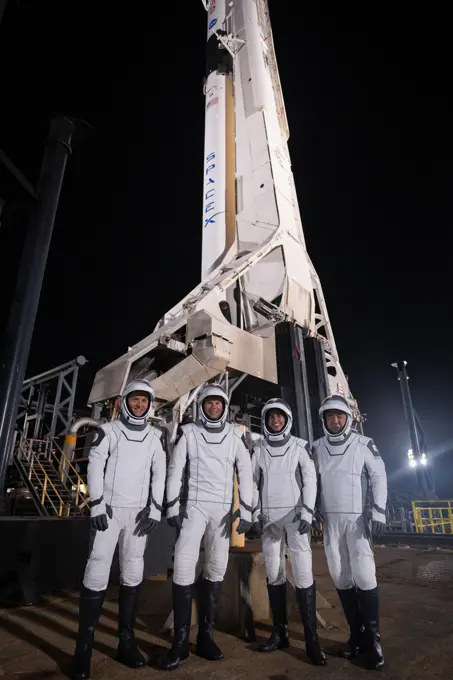
NASA's SpaceX Crew-7 Dry Dress Rehearsal. From left, Roscosmos cosmonaut Konstantin Borisov, ESA (European Space Agency) astronaut Andreas Mogensen, NASA astronaut Jasmin Moghbeli, and JAXA (Japan Aerospace Exploration Agency) astronaut Satoshi Furukawa stand in front of SpaceXs Falcon 9 rocket and Dragon spacecraft, named Endurance, as part of a countdown dress rehearsal for NASAs SpaceX Crew-7 mission at the agencys Kennedy Space Center in Florida on Tuesday, Aug. 22, 2023. The four crewmates will fly to the International Space Station for a six-month rotation, conducting research and science experiments. Liftoff is targeted for 3:50 a.m. EDT Friday, Aug. 25, 2023.
6145-44531799
In this close-up aerial view, the Delta II rocket with the THEMIS spacecraft atop sits ready for launch on Pad 17-B at Cape Canaveral Air Force Station. THEMIS, an acronym for Time History of Events and Macroscale Interactions during Substorms, consists of five identical probes that will track violent, colorful eruptions near the North Pole. This will be the largest number of scientific satellites NASA has ever launched into orbit aboard a single rocket. The THEMIS mission aims to unravel the mystery behind auroral substorms, an avalanche of magnetic energy powered by the solar wind that intensifies the northern and southern lights. The mission will investigate what causes auroras in the Earths atmosphere to dramatically change from slowly shimmering waves of light to wildly shifting streaks of bright color. Launch is scheduled for 6:05 p.m.
6145-44480618
Artemis 1
6145-44879748
CAPE CANAVERAL, Fla. - Rising from fire and smoke, the United Launch Alliance Delta II Heavy rocket lifted off at 9:08 a.m. EDT Sept. 10 from Space Launch Complex 17B on Cape Canaveral Air Force Station in Florida carrying NASAs twin Gravity Recovery and Interior Laboratory (GRAIL) mission to the moon.GRAIL will fly twin spacecraft in tandem around the moon to precisely measure and map variations in the moon's gravitational field. The mission will provide the most accurate global gravity field to date for any planet, including Earth. This detailed information will reveal differences in the density of the moon's crust and mantle and will help answer fundamental questions about the moon's internal structure, thermal evolution, and history of collisions with asteroids. The aim is to map the moon's gravity field so completely that future moon vehicles can safely navigate anywhere on the moons surface.
6188-60979113
Space Rocket Flies to Planets Mars Before A Starry Background Aerospace Concept 1102808694
6145-44488000
Standing atop the mobile launcher, NASAs Space Launch System (SLS) rocket is photographed at Launch Pad 39B at the agencys Kennedy Space Center in Florida on March 18, 2022. The rocket, with the Orion capsule atop, was carried from the Vehicle Assembly Building to the pad - a 4.2-mile journey that took nearly 11 hours to complete - by the agencys crawler-transporter 2 for a wet dress rehearsal ahead of the uncrewed Artemis I launch. Artemis I will test SLS and Orion as an integrated system prior to crewed flights to the Moon. Through Artemis, NASA will land the first woman and the first person of color on the lunar surface, paving the way for a long-term lunar presence and serving as a steppingstone on the way to Mars.
6145-45175328
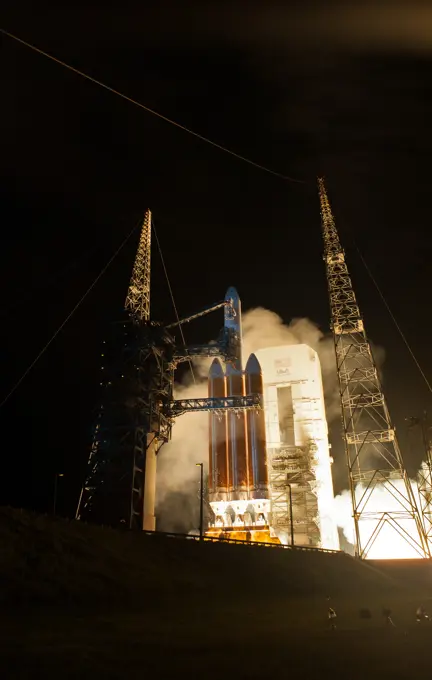
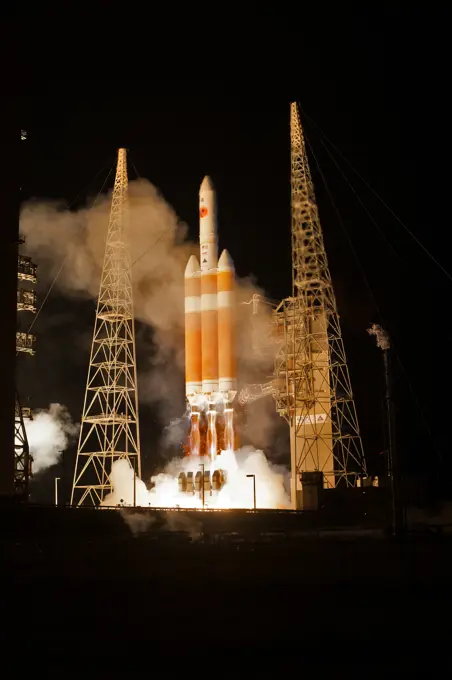
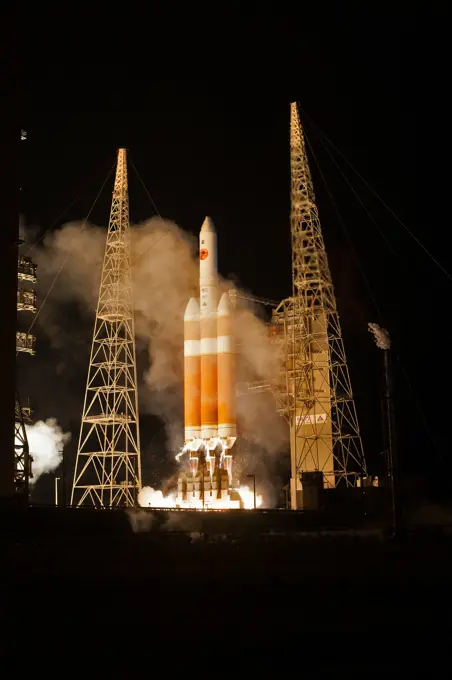
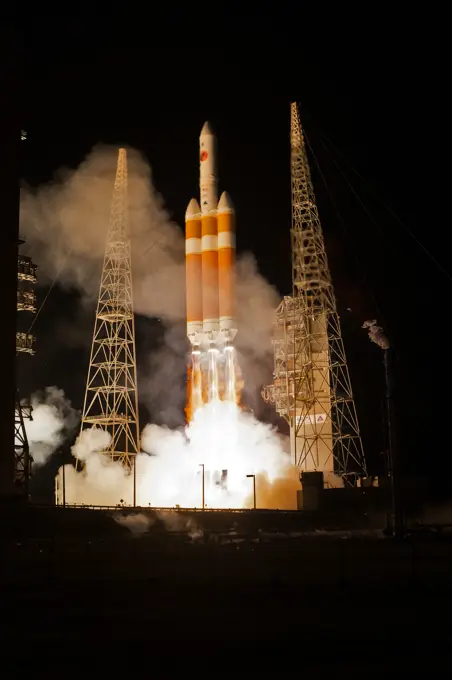
At Cape Canaveral Air Force Station's Space Launch Complex 37, the United Launch Alliance Delta IV Heavy rocket with NASA's Parker Solar Probe, lifts off at 3:31 a.m. EDT on Sunday, Aug. 12, 2018. The spacecraft was built by Applied Physics Laboratory of Johns Hopkins University in Laurel, Maryland. The mission will perform the closest-ever observations of a star when it travels through the Sun's atmosphere, called the corona. The probe will rely on measurements and imaging to revolutionize our understanding of the corona and the Sun-Earth connection.
6145-45121772
nhq201611180002 (Nov. 18, 2016) --- In this one second exposure photograph, the Soyuz MS-03 spacecraft is seen launching from the Baikonur Cosmodrome with Expedition 50 crewmembers NASA astronaut Peggy Whitson, Russian cosmonaut Oleg Novitskiy of Roscosmos, and ESA astronaut Thomas Pesquet from the Baikonur Cosmodrome in Kazakhstan, Friday, Nov. 18, 2016, (Kazakh time) (Nov 17 Eastern time). Whitson, Novitskiy, and Pesquet will spend approximately six months on the orbital complex.
6177-V53550783
1746-111906629
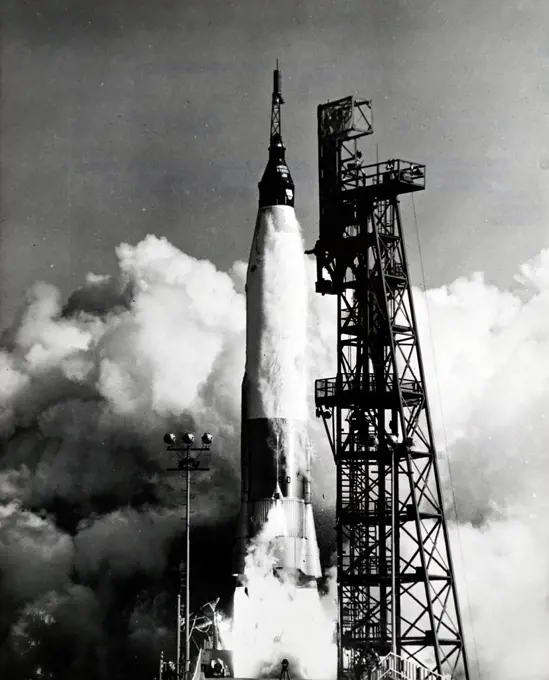
Photograph taken during the launch of Mercury-Atlas 6, the third human spaceflight for the U.S. and part of Project Mercury. Dated 20th century
6145-44974255
This photograph from Sept. 5, 1977, shows the launch of NASA's Voyager 1 spacecraft from NASA's Kennedy Space Center at Cape Canaveral, Fla.
6145-44879455
CAPE CANAVERAL, Fla. -- At Space Launch Complex 17B on Cape Canaveral Air Force Station, the mobile service tower is aglitter as it rolls away from the United Launch Alliance Delta II rocket that will launch NASA's Gravity Recovery and Interior Laboratory mission.  The "rollback" began at about 11:20 p.m. EDT Sept. 7.GRAIL will fly twin spacecraft in tandem around the moon to precisely measure and map variations in the moon's gravitational field. The mission will provide the most accurate global gravity field to date for any planet, including Earth. This detailed information will reveal differences in the density of the moon's crust and mantle and will help answer fundamental questions about the moon's internal structure, thermal evolution, and history of collisions with asteroids. The aim is to map the moon's gravity field so completely that future lunar vehicles can safely navigate anywhere on the moons surface.  Launch is scheduled for 8:37:06 a.m. EDT Sept. 8.
1746-29017991
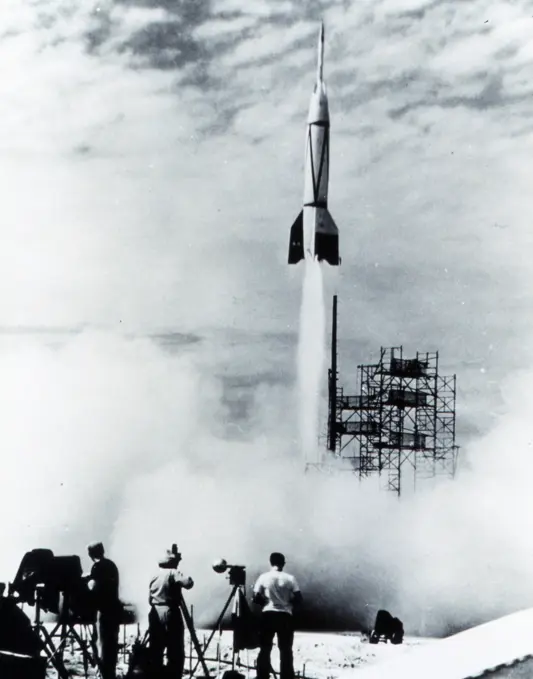
Photograph of a V-2 Rocket, the world's first long-range guided ballistic missile, being launched. The missile with a liquid-propellant rocket engine was developed during the Second World War in Germany as a "vengeance weapon", assigned to attack Allied cities as retaliation for the Allied bombings against German cities. Dated 20th Century
6145-44640120
The Titan III/Centaur, Viking 1, is sitting on the launch pad ready for blast off. The launch occurred on August 20, 1975. The mission was for the scientific investigation of Mars, and United States first attempt to soft land a spacecraft on another planet.
6145-45175573
At Cape Canaveral Air Force Stations Space Launch Complex 37, the United Launch Alliance Delta IV Heavy rocket with NASA's Parker Solar Probe, lifts off at 3:31 a.m. EDT on Sunday, Aug. 12, 2018. The spacecraft was built by Applied Physics Laboratory of Johns Hopkins University in Laurel, Maryland. The mission will perform the closest-ever observations of a star when it travels through the Sun's atmosphere, called the corona. The probe will rely on measurements and imaging to revolutionize our understanding of the corona and the Sun-Earth connection.
4239R-20480772
Cape Canaveral, Florida, November 1972 - Searchlights illuminate this nighttime scene at Launch Complex 39, Kennedy Space Center, showing the Apollo 17 (Spacecraft 114/Lunar Module 12/Saturn 512) space vehicle during prelaunch preparations. Apollo 17, the final lunar landing mission in NASA's Apollo program, will be the first nighttime liftoff of the huge Saturn V launch vehicle.
6145-45247189
STS106-S-010 (8 Sept. 2000) --- The Space Shuttle Atlantis is mirrored in nearby marsh waters as it makes its 22nd launch into space. The perfect on-time liftoff for STS-106 occurred at 8:45:47 a.m. (EDT), Sept. 8, 2000. Onboard the shuttle were astronauts Terrence W. Wilcutt, Scott D. Altman, Edward T. Lu,  Richard A. Mastracchio and Daniel C. Burbank, along with cosmonauts Yuri I. Malenchenko and Boris V. Morukov who represent the Russian Aviation and Space Agency.
6145-44736978
The Space Shuttle 'Enterprise' stands on Kenndey Space Center Pad 39A highlighted against the darkened Florida sky during testing of the high-intensity lighting system. The banks of xenon lights are used during lanuch preparations.
1848-54920751
Space Shuttle Atlantis. Cosmos art. Elements of this image furnished by NASA
6145-44509979
KENNEDY SPACE CENTER, Fla. --  While the morning sun paints the sky pale gold, the structures on Launch Pad 39A are silhouetted in brown. Space Shuttle Discovery can be seen on the other side of the Fixed Service Structure; the Rotating Service Structure at right is still open. At left is the 300,000-gallon water tank that is part of the sound suppression system during launches. Discovery will launch on mission STS-92 Oct. 5, 2000
6145-45175572
At Cape Canaveral Air Force Stations Space Launch Complex 37, the United Launch Alliance Delta IV Heavy rocket with NASA's Parker Solar Probe, lifts off at 3:31 a.m. EDT on Sunday, Aug. 12, 2018. The spacecraft was built by Applied Physics Laboratory of Johns Hopkins University in Laurel, Maryland. The mission will perform the closest-ever observations of a star when it travels through the Sun's atmosphere, called the corona. The probe will rely on measurements and imaging to revolutionize our understanding of the corona and the Sun-Earth connection.
7050-76395834
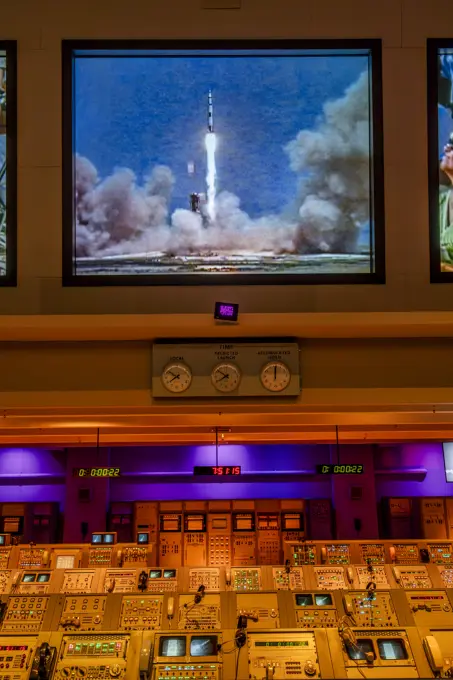
Historic Apollo Mission Launch Captured in Vintage Control Room Display - A Glimpse into Space Exploration History, Florida, Merritt Island, NASA, USA
6145-44564342
KENNEDY SPACE CENTER,  Fla. -- The Space Coast's natural foliage frames the Space Shuttle Discovery and the reflection of the intense heat and light of its liftoff from Launch Pad 39A at 6:06:24 p.m. EDT June 2. On board Discovery are Mission Commander Charles J. Precourt; Pilot Dominic L. Gorie; and Mission Specialists Wendy B. Lawrence, Franklin R. Chang-Diaz, Janet Lynn Kavandi and Valery Victorovitch Ryumin. The nearly 10-day mission will feature the ninth and final Shuttle docking with the Russian space station Mir, the first Mir docking for the Space Shuttle orbiter Discovery, the first on-orbit test of the Alpha Magnetic Spectrometer (AMS), and the first flight of the new Space Shuttle super lightweight external tank. Astronaut Andrew S. W. Thomas will be returning to Earth as an STS-91 crew member after living more than four months aboard Mir
6145-45175574
At Cape Canaveral Air Force Stations Space Launch Complex 37, the United Launch Alliance Delta IV Heavy rocket with NASA's Parker Solar Probe, lifts off at 3:31 a.m. EDT on Sunday, Aug. 12, 2018. The spacecraft was built by Applied Physics Laboratory of Johns Hopkins University in Laurel, Maryland. The mission will perform the closest-ever observations of a star when it travels through the Sun's atmosphere, called the corona. The probe will rely on measurements and imaging to revolutionize our understanding of the corona and the Sun-Earth connection.
6145-44597184
Blue sky and sun are the backdrop for a flawless launch of MER-A, known as Spirit,” the first of two Mars Exploration Rovers to be sent to Mars. Liftoff occurred on time at 1:58 p.m. EDT from Launch Complex 17-A, Cape Canaveral Air Force Station. When the two rovers arrive at Mars in 2004, they will bounce to airbag-cushioned landings at sites offering a balance of favorable conditions for safe landings and interesting science. The rovers see sharper images, can explore farther and examine rocks better than anything that has ever landed on Mars. The designated site for the MER-A mission is Gusev Crater, which appears to have been a crater lake. The second rover, MER-B, is scheduled to launch June 25.
6145-44480617
Artemis 1
6145-44552360
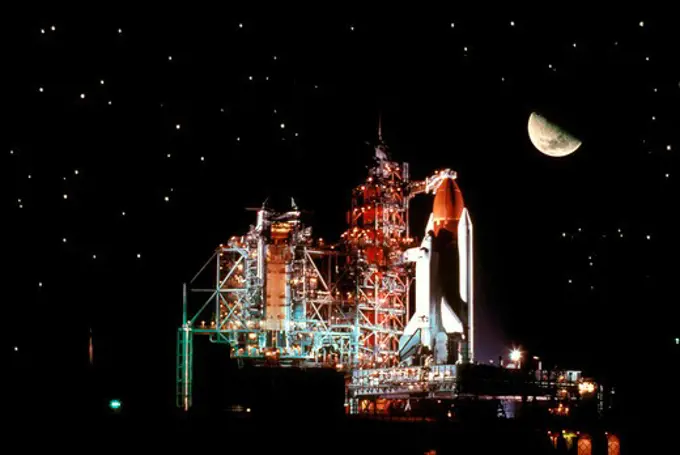
The Space Shuttle Columbia stands poised in the night for the STS-83 Microgravity Science Laboratory-1 (MSL-1) mission after the Rotating Service Structure of Launch Pad 39A has been moved back prior to the start of fueling operations that take place about 12 hours before liftoff. During the scheduled 16-day STS-83 mission, the MSL-1 will be used to test some of the hardware, facilities and procedures that are planned for use on the International Space Station as well as research in combustion, protein crystal growth and materials processing experiments
6145-44553126
The Space Shuttle Atlantis turns night into day for a few moments as it lifts off on May 15 at 4:07:48 a.m. EDT from Launch Pad 39A on the STS-84 mission. The fourth Shuttle mission of 1997 will be the sixth docking of the Space Shuttle with the Russian Space Station Mir. The commander is Charles J. Precourt. The pilot is Eileen Marie Collins. The five mission specialists are C. Michael Foale, Carlos I. Noriega, Edward Tsang Lu, Jean-Francois Clervoy of the European Space Agency and Elena V. Kondakova of the Russian Space Agency. The planned nine-day mission will include the exchange of Foale for U.S. astronaut and Mir 23 crew member Jerry M. Linenger, who has been on Mir since Jan. 15. Linenger transferred to Mir during the last docking mission, STS-81; he will return to Earth on Atlantis. Foale is slated to remain on Mir for about four months until he is replaced in September by STS-86 Mission Specialist Wendy B. Lawrence. During the five days Atlantis is scheduled to be docked with
6177-V53855578
6145-44879972
CAPE CANAVERAL, Fla. - Spotlights illuminate the United Launch Alliance Delta II Heavy rocket that will launch NASAs twin Gravity Recovery and Interior Laboratory (GRAIL) mission from Space Launch Complex 17B on Cape Canaveral Air Force Station in Florida. Liftoff is scheduled for 9:08:52 a.m. EDT Sept. 10. GRAIL will fly twin spacecraft in tandem around the moon to precisely measure and map variations in the moon's gravitational field. The mission will provide the most accurate global gravity field to date for any planet, including Earth. This detailed information will reveal differences in the density of the moon's crust and mantle and will help answer fundamental questions about the moon's internal structure, thermal evolution, and history of collisions with asteroids. The aim is to map the moon's gravity field so completely that future moon vehicles can safely navigate anywhere on the moons surface.
6145-44709708
S61-02409 (5 May 1961) --- Launching of the Mercury-Redstone 3 (MR-3) rocket from Cape Canaveral on astronaut Alan B. Shepard s suborbital mission.
6177-V53834914
6145-44668401
KENNEDY SPACE CENTER, FLA. -- At Launch Pad 17-B at Cape Canaveral Air Force Station, the mobile service tower moves away from the Delta II rocket with the THEMIS spacecraft atop. THEMIS, an acronym for Time History of Events and Macroscale Interactions during Substorms, consists of five identical probes that will track violent, colorful eruptions near the North Pole.  This will be the largest number of scientific satellites NASA has ever launched into orbit aboard a single rocket.  The THEMIS mission aims to unravel the mystery behind auroral substorms, an avalanche of magnetic energy powered by the solar wind that intensifies the northern and southern lights.  The mission will investigate what causes auroras in the Earths atmosphere to dramatically change from slowly shimmering waves of light to wildly shifting streaks of bright color.  Launch is scheduled for 6:05 p.m.
6177-V53559133
6145-45091789
The service structure arms are seen being lowered in this long exposure photograph less than an hour before the Soyuz TMA-16M spacecraft launched to the International Space Station with Expedition 43 NASA Astronaut Scott Kelly, Russian Cosmonauts Mikhail Kornienko, and Gennady Padalka of the Russian Federal Space Agency (Roscosmos) onboard Saturday, March 28, 2015, Kazakh time (March 27 Eastern time) from the Baikonur Cosmodrome in Kazakhstan. As the one-year crew, Kelly and Kornienko will return to Earth on Soyuz TMA-18M in March 2016.
6145-44597179
KENNEDY SPACE CENTER, FLA. -   With smoke and steam billowing beneath, the Delta II rocket with its Mars Exploration Rover (MER-A) payload leaps off the launch pad into the blue sky to begin its journey to Mars.  Liftoff occurred on time at 1:58 p.m. EDT from Launch Complex 17-A, Cape Canaveral Air Force Station.  MER-A, known as "Spirit," is the first of two rovers being launched to Mars. When the two rovers arrive at the red planet in 2004, they will bounce to airbag-cushioned landings at sites offering a balance of favorable conditions for safe landings and interesting science. The rovers see sharper images, can explore farther and examine rocks better than anything that has ever landed on Mars. The designated site for the MER-A mission is Gusev Crater, which appears to have been a crater lake. The second rover, MER-B, is scheduled to launch June 25.
4286-17549
Space Shuttle Atlantis #AC5
6177-V53615885
6145-45058871
The Soyuz TMA-13M rocket is launched with Expedition 40 Soyuz Commander Maxim Suraev, of the Russian Federal Space Agency, Roscosmos, Flight Engineer Alexander Gerst, of the European Space Agency, ESA, and Flight Engineer Reid Wiseman of NASA, Thursday, May 29, 2014 at the Baikonur Cosmodrome in Kazakhstan. Suraev, Gerst, and Wiseman will spend the next five and a half months aboard the International Space Station.
6177-V53603542
6145-44752826
CAPE CANAVERAL, Fla. - After rollback of the mobile service tower on Cape Canaveral Air Force Station's Launch Pad 17-B, in Florida, NASA's Kepler spacecraft sits poised for launch atop the United Launch Alliance Delta II 7925 rocket.  Kepler is a spaceborne telescope designed to search the nearby region of our galaxy for Earth-size planets orbiting in the habitable zone of stars like our sun. The habitable zone is the region around a star where temperatures permit water to be liquid on a planet's surface.  The challenge for Kepler is to look at a large number of stars in order to statistically estimate the total number of Earth-size planets orbiting sun-like stars in the habitable zone. Kepler will survey more than 100,000 stars in our galaxy.
6145-44476156
A full Moon is in view from Launch Complex 39B at NASAs Kennedy Space Center in Florida on June 14, 2022. The Artemis I Space Launch System (SLS) and Orion spacecraft, atop the mobile launcher, are being prepared for a wet dress rehearsal to practice timelines and procedures for launch. The first in an increasingly complex series of missions, Artemis I will test SLS and Orion as an integrated system prior to crewed flights to the Moon. Through Artemis, NASA will land the first woman and first person of color on the lunar surface, paving the way for a long-term lunar presence and using the Moon as a steppingstone on the way to Mars.
6145-45230544
Wernher von Braun and his team were responsible for the Jupiter-C hardware. The family of launch vehicles developed by the team also came to include the Juno II, which was used to launch the Pioneer IV satellite on March 3, 1959. Pioneer IV passed within 37,000 miles of the Moon before going into solar orbit.
6145-44698796
STS122-S-066 (20 Feb. 2008) --- Space Shuttle Atlantis approaches landing on runway 15 of the Shuttle Landing Facility at NASA's Kennedy Space Center, concluding the 13-day STS-122 mission. Onboard are NASA astronauts Steve Frick, commander; Alan Poindexter, pilot; Leland Melvin, Rex Walheim, Stanley Love, Daniel Tani, and European Space Agency (ESA) astronaut Hans Schlegel, all mission specialists. Main gear touchdown was 9:07:10 a.m. (EST). Nose gear touchdown was 9:07:20 a.m. Wheel stop was at 9:08:08 a.m. Mission elapsed time was 12 days, 18 hours, 21 minutes and 44 seconds. During the mission, Atlantis' crew installed the new Columbus laboratory, leaving a larger space station and one with increased science capabilities. The Columbus Research Module adds nearly 1,000 cubic feet of habitable volume and affords room for 10 experiment racks, each an independent science lab.
6145-54506432
A Titan II rocket launches from Vandenberg Air Force Base, California. The rocket took off from Space Launch Complex-4 west carrying NASA's National Oceanic and Atmospheric Administration-L weather satellite. The launch is the result of a combined effort by the men and women of the 30th Space Wing, NASA and the Space and Missile Systems Center in Los Angeles. The spacelift commander for this mission was US Air Force Colonel Steve Lanning, 30th Space Wing commander. US Air Force Major Dave Salm, 2nd Space Launch Squadron, is the Air Force launch director. NOAA-L will primarily provide long-range weather forecasting. It will operate in tandem with currently orbiting NOAA satellites. NOAA-L .... Complete Scene Caption: A Titan II rocket launches from Vandenberg Air Force Base, California. The rocket took off from Space Launch Complex-4 west carrying NASA's National Oceanic and Atmospheric Administration-L weather satellite. The launch is the result of a combined effort by the men and wome
6145-44826078
Installing the Long Duration Exposure Facility (LDEF) using the payload strongback, into Canister 1 O&C high bay, March 6, 1984
6145-44569883
Orbiter Discovery prepares to land on runway 33 at the Shuttle Landing Facility. Main gear touchdown was at 12:04 p.m. EST, landing on orbit 135. Discovery returns to Earth with its crew of seven after successfully completing mission STS-95, lasting nearly nine days and 3.6 million miles. The crew members are Mission Commander Curtis L. Brown Jr.; Pilot Steven W. Lindsey; Mission Specialist Scott E. Parazynski; Mission Specialist Stephen K. Robinson; Payload Specialist John H. Glenn Jr., a senator from Ohio; Mission Specialist Pedro Duque of Spain, with the European Space Agency (ESA); and Payload Specialist Chiaki Mukai, M.D., with the National Space Development Agency of Japan (NASDA). The mission included research payloads such as the Spartan solar-observing deployable spacecraft, the Hubble Space Telescope Orbital Systems Test Platform, the International Extreme Ultraviolet Hitchhiker, as well as the SPACEHAB single module with experiments on space flight and the aging process
6145-44676751
The Apollo 11 mission, the first manned lunar mission, launched from the Kennedy Space Center, Florida via the Saturn V launch vehicle on July 16, 1969 and safely returned to Earth on July 24, 1969. The Saturn V vehicle produced a holocaust of flames as it rose from its pad at Launch complex 39. The 363 foot tall, 6,400,000 pound rocket hurled the spacecraft into Earth parking orbit and then placed it on the trajectory to the moon. This high angle view of the launch was provided by a fisheye’ camera mounted on the launch tower. The Saturn V was developed by the Marshall Space Flight Center (MSFC) under the direction of Dr. Wernher von Braun. Aboard the spacecraft were astronauts Neil A. Armstrong, commander; Michael Collins, Command Module (CM) pilot; and Edwin E. Aldrin Jr., Lunar Module (LM) pilot. With the success of Apollo 11, the national objective to land men on the Moon and return them safely to Earth had been accomplished.
6145-45235688
JSC2007-E-046477 (5 May 1961) --- Launching of the Mercury-Redstone 3 (MR-3) spacecraft from Cape Canaveral on a suborbital mission -- the first U.S. manned spaceflight. Original image number was 61-MR3-74.
6145-44709707
S61-02408 (5 May 1961) --- Launching of the Mercury-Redstone 3 (MR-3) rocket from Cape Canaveral on astronaut Alan B. Shepard s suborbital mission.
6145-44510023
S68-48662 (11 Oct. 1968) --- The Apollo 7/Saturn IB space vehicle is launched from the Kennedy Space Center's Launch Complex 34 at 11:03 a.m. (EDT), Oct. 11, 1968. Apollo 7 (Spacecraft 101/Saturn 205) is the first of several manned flights aimed at qualifying the spacecraft for the half-million mile round trip to the moon. Aboard the Apollo spacecraft are astronauts Walter M. Schirra Jr., commander; Donn F. Eisele, command module pilot; and Walter Cunningham, lunar module pilot. (This view is framed by palm trees on either side).
6145-45210694
A full-sized, 363-foot Saturn V rocket is projected onto the east face of the Washington Monument 50 years to the day after astronauts Neil Armstrong, Michael Collins, and Buzz Aldrin launched on Apollo 11, the first mission to land astronauts on the Moon, Tuesday, July 16, 2019. On Friday, July 19, and Saturday, July 20, a special 17-minute show, Apollo 50: Go for the Moon” will combine full-motion projection-mapping artwork on the monument and archival footage to recreate the launch of Apollo 11 and tell the story of the first moon landing.
6145-45270568
A Northrop Grumman Antares rocket carrying a Cygnus resupply spacecraft is seen at sunrise as the Moon sets on Pad-0A, Sunday, Feb. 9, 2020, at NASA's Wallops Flight Facility in Virginia. Northrop Grummans 13th contracted cargo resupply mission with NASA to the International Space Station will deliver more than 7,500 pounds of science and research, crew supplies and vehicle hardware to the orbital laboratory and its crew. The CRS-13 Cygnus spacecraft is named after the first African American astronaut, Major Robert Henry Lawrence Jr..
7137-70491471
NA, USA, Alabama, Huntsville. Lunar landing display at Space center and camp.
6145-44859345
CAPE CANAVERAL, Fla. -- Kennedy Space Center Director and former astronaut Bob Cabana addresses the audience at a celebration at Complex 5/6 on Cape Canaveral Air Force Station in Florida.The celebration was held at the launch site of the first U.S. manned spaceflight May 5, 1961, to mark the 50th anniversary of the flight.  Fifty years ago, astronaut Alan Shepard lifted off inside the Mercury capsule, "Freedom 7," atop an 82-foot-tall Mercury-Redstone rocket at 9:34 a.m. EST, sending him on a remarkably successful, 15-minute suborbital flight. The event was attended by more than 200 workers from the original Mercury program and included a re-creation of Shepard's flight and recovery, as well as a tribute to his contributions as a moonwalker on the Apollo 14 lunar mission.
6145-45210695
A full-sized, 363-foot Saturn V rocket is projected onto the east face of the Washington Monument 50 years to the day after astronauts Neil Armstrong, Michael Collins, and Buzz Aldrin launched on Apollo 11, the first mission to land astronauts on the Moon, Tuesday, July 16, 2019. On Friday, July 19, and Saturday, July 20, a special 17-minute show, Apollo 50: Go for the Moon” will combine full-motion projection-mapping artwork on the monument and archival footage to recreate the launch of Apollo 11 and tell the story of the first moon landing.
PREVIOUS
of 3
NEXT
2401 S. Ervay, Suite 206
Dallas, Texas 75215
United States
Get Started
Free ResearchMy BoardsMy Cart
For Creators
How To License Your ContentContributor PortalFrame of Mind
Resources
API accessPricing
Contact
+1 866 236 0087help@viewpictures.co.uk Contact form
©2026 View Pictures. All Rights Reserved. -B
This site is protected by reCAPTCHA and Google Privacy Policy and Terms of Service apply.