My Boards
View Pictures
  • My Boards

Space Transport and Logistics

Images of space shuttle components and vehicles being transported for launch, highlighting NASA's operational logistics and technology.

The first stage of a Titan IV launch vehicle is offloaded from a C-5B Galaxy aircraft for an official acceptance and dedication ceremony. The launch vehicle was built by Martin Marietta Denver Aerospace. Base: Cape Canaveral State: Florida (FL) Country: United States Of America (USA)
167 assets in this story
6145-44617587
KENNEDY SPACE CENTER, FLA.  - In the predawn hours, the Aura spacecraft is transported the short distance from the Astrotech payload processing facility to Space Launch Complex 2 on North Vandenberg Air Force Base, Calif.  The latest in the Earth Observing System (EOS) series, Aura is scheduled to launch July 10 aboard a Boeing Delta II rocket.  Auras four state-of-the-art instruments will study the dynamics of chemistry occurring in the atmosphere.  The spacecraft will provide data to help scientists better understand the Earths ozone, air quality and climate change.
6145-52146950
A 71M Aerostat Test Balloon sits awaiting lift off from the Aerostat Test Bed at McGregor Range, New Mexico. The aerostat can elevate to 15,000 feet above sea level and will be able to track fast moving aircraft and cruise missiles with a range up to 150 nautical miles by radar, which is located under the belly of the aerostat. The aerostat will be used by the Blue (friendly) Forces during Exercise ROVING SANDS '96. Subject Operation/Series: ROVING SANDS '96 Base: Mcgregor Range State: New Mexico (NM) Country: United States Of America (USA)
6145-44750411
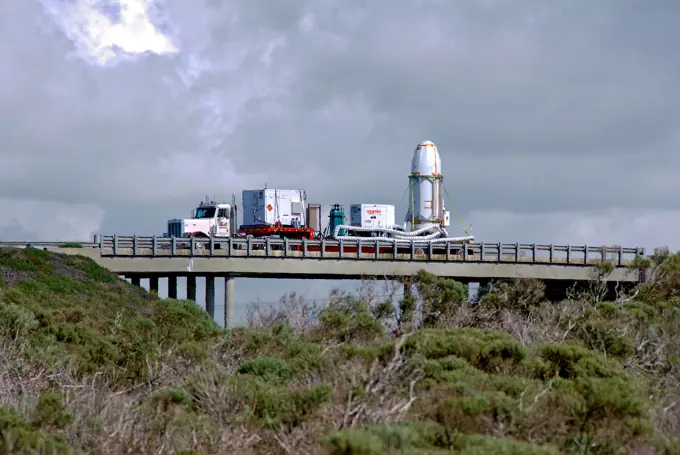
VANDENBERG AIR FORCE BASE, Calif. --  At Vandenberg Air Force Base in California, the transporter holding NASA's Orbiting Carbon Observatory, or OCO, heads for Launch Complex 576-E. OCO will collect precise global measurements of carbon dioxide (CO2) in the Earth's atmosphere. Scientists will analyze OCO data to improve our understanding of the natural processes and human activities that regulate the abundance and distribution of this important greenhouse gas. OCO is scheduled to launch Feb. 24 aboard an Orbital Sciences' Taurus XL rocket.
6145-44636670
KENNEDY SPACE CENTER, FLA. -  External tank 120 is moved from NASA Kennedy Space Centers Vehicle Assembly Building (in the background) to the Turn Basin and the waiting barge Pegasus.  The tank will be loaded onto the barge for transport to NASAs Michoud Assembly Facility in Louisiana for additional modifications.  This tank is the first of the newly designed tanks that were delivered to Kennedy.  Previously, the tank was stacked with Discovery and, more recently, Atlantis.  The tank has already gone through two tanking cycles during tanking tests but was replaced with tank #121 for Discoverys return to flight mission STS-114.
6145-44795511
CAPE CANAVERAL, Fla. - At NASA's Kennedy Space Center in Florida, the ExPRESS Logistics Carrier 3, or ELC-3, arrives at the Space Station Processing Facility.ELC-3 and the Alpha Magnetic Spectrometer are the primary payloads for space shuttle Endeavour's STS-134 mission to the International Space Station. The STS-134 crew will also deliver spare parts including two S-band communications antennas, a high pressure gas tank, additional spare parts for Dextre and micrometeoroid debris shields.  Endeavour's launch is targeted for July 29, 2010.
6145-44648721
KENNEDY SPACE CENTER, FLA. -    The redesigned external fuel tank, designated ET-118, that will launch Space Shuttle Atlantis on mission, STS-115 begins moving out of the Pegasus barge that carried it from the Michoud Assembly Facility in New Orleans. The tank will be moved into the Vehicle Assembly Building and lifted into a checkout cell for further work. It will fly with many major safety changes, including the removal of the protuberance air load ramps.
6145-44985663
CAPE CANAVERAL, Fla. - Workers load NASA's TDRS-L satellite onto a trailer at the Shuttle Landing Facility at NASA's Kennedy Space Center in Florida. The TDRS is the latest spacecraft destined for the agency's constellation of communications satellites that allows nearly continuous contact with orbiting spacecraft ranging from the International Space Station and Hubble Space Telescope to the array of scientific observatories.
6145-58967664
CAPE CANAVERAL, Fla. - Cranes remove a full-size, 149-foot-long, space shuttle solid rocket booster, or SRB, replica from the Kennedy Space Center Visitor Complex as the space-themed attraction makes way for a new exhibit featuring space shuttle Atlantis, which is currently undergoing preparations to go on public display. The SRB is being placed into temporary storage at NASA's Kennedy Space Center. The SRB was part of a mockup of the external tank and two SRBs at the visitor complex that were used to show visitors the size of actual space shuttle components. A space shuttle rode piggyback on the tank and boosters at liftoff and during the ascent into space. The SRBs burned out after about two-and-a-half minutes of flight. After recovery from the ocean, the boosters could be used repeatedly.
6145-58962989
KENNEDY SPACE CENTER, FLA.  A truck carrying an Atlas V rocket heads away from the Cape Canaveral Air Force Station Skid Strip. The rocket is being transferred to the Atlas Space Operations Center. The Atlas V is the launch vehicle for the New Horizons spacecraft. New Horizons is designed to help us understand worlds at the edge of our solar system by making the first reconnaissance of Pluto and Charon - a 'double planet' and the last planet in our solar system to be visited by spacecraft. The mission will then visit one or more objects in the Kuiper Belt region beyond Neptune. New Horizons is scheduled to launch from Launch Complex 41 at CCAFS in January 2006, swing past Jupiter for a gravity boost and scientific studies in February or March 2007, and reach Pluto and its moon, Charon, in July 2015.
6145-45074336
The Soyuz TMA-14M spacecraft is rolled out to the launch pad by train on Tuesday, Sept. 23, 2014 at the Baikonur Cosmodrome in Kazakhstan.  Launch of the Soyuz rocket is scheduled for Sept. 26 and will carry Expedition 41 Soyuz Commander Alexander Samokutyaev of the Russian Federal Space Agency (Roscosmos), Flight Engineer Barry Wilmore of NASA, and Flight Engineer Elena Serova of Roscosmos into orbit to begin their five and a half month mission on the International Space Station.
6145-44647686
KENNEDY SPACE CENTER, FLA. --  External tank No. 117 rolls past NASA's Launch Control Center on its way to the Turn Basin in the Launch Complex 39 Area and the waiting barge. The tank is being shipped to NASAs Michoud Assembly Facility in Louisiana for modifications.  The barge will be moved to Port Canaveral where one of NASAs solid rocket booster retrieval ships will take it and tow it around the Florida peninsula to Michoud.
6145-44980141
JAMES WEBB SPACE TELESCOPE (JWST) BACKPLANE MOVE FROM MARSHALL SPACE FLIGHT CENTERS X-RAY CALIBRATION FACILITY (XCRF) TO THE REDSTONE ARSENAL AIRFIELD WHERE THE TEST ARTICLE WAS PLACED IN A USAF C-5 GALAXY FOR ITS FLIGHT BACK TO THE MANUFACTURER.
6145-44703615
VANDENBERG AIR FORCE BASE, Calif.  -    The OSTM/Jason-2 satellite is transported from the airstrip at Vandenberg Air Force Base.  The satellite will be taken to the Astrotech processing facility.  The OSTM, or Ocean Topography Mission, on the Jason-2 satellite is a follow-on to Jason-1. It will take oceanographic studies of sea surface height into an operational mode for continued climate forecasting research and science and industrial applications.  This satellite altimetry data will help determine ocean circulation, climate change and sea-level rise. OSTM is a joint effort by the National Oceanic and Atmospheric Administration, NASA, Frances Centre National dEtudes Spatiales and the European Meteorological Satellite Organisation. OSTM/Jason-2 will be launched aboard a United Launch Alliance Delta II 7320 from Vandenberg on June 15.
6145-45031593
CAPE CANAVERAL, Fla. - The high-fidelity space shuttle model which was on display at the NASA Kennedy Space Center Visitor Complex in Florida travels down Saturn Causeway as it makes its way to Kennedy's Launch Complex 39 turn basin. In the background is the Operations Support Building I.The shuttle was part of a display at the visitor complex that also included an external tank and two solid rocket boosters that were used to show visitors the size of actual space shuttle components. The full-scale shuttle model is being transferred from Kennedy to Space Center Houston, NASA Johnson Space Center's visitor center. The model will stay at the turn basin for a few months until it is ready to be transported to Texas via barge. The move also helps clear the way for the Kennedy Space Center Visitor Complex to begin construction of a new facility next year to display space shuttle Atlantis in 2013.
6145-54421898
An inert Maverick (AGM-65B) air-to-surface missile. Base: Holloman Air Force Base State: New Mexico (NM) Country: United States Of America (USA)
1848-51741661
Hot air balloon being filled with air, Kulala Wilderness Reserve, Namib Desert, Tsaris Mountains, Hardap Region, Namibia, Africa
6145-44834011
CAPE CANAVERAL, Fla. -- In the Vehicle Assembly Building at NASA's Kennedy Space Center in Florida, External Fuel Tank-122 sits on its transporter in the transfer aisle waiting to be lifted into a test cell.ET-122, the Space Shuttle Program's last external fuel tank was delivered to Kennedy's Turn Basin from NASAs Michoud Assembly Facility in New Orleans aboard the Pegasus Barge. After testing, ET-122 eventually will be attached to space shuttle Endeavour for the STS-134 mission to the International Space Station targeted to launch February, 2011.
6145-44852703
CAPE CANAVERAL, Fla. -- Bob Cabana, director of NASA's Kennedy Space Center in Florida, checks out the underside of space shuttle Discovery, following its final return from space. Touchdown on the Shuttle Landing Facility's Runway 15 was at 11:57 a.m. EST, bringing an end to the 13-day STS-133 mission to the International Space Station.Discovery and its six-member crew delivered the Permanent Multipurpose Module, packed with supplies and critical spare parts, as well as Robonaut 2, the dexterous humanoid astronaut helper, to the orbiting outpost. STS-133 was Discovery's 39th and final mission. This was the 133rd Space Shuttle Program mission and the 35th shuttle voyage to the space station.
1848-60297154
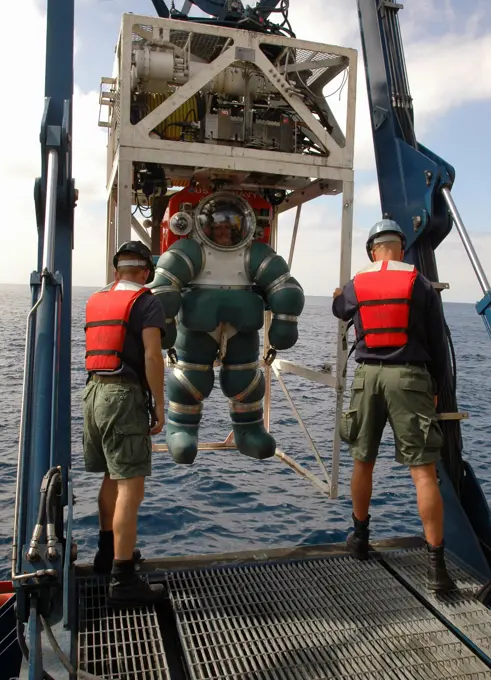
Soviet submarine apparatus Shuttle-6000 and Pisces-VII. Kaliningrad (until 1946 Koenigsberg), Russia, Europe
6145-44771174
CAPE CANAVERAL, Fla. - The United Launch Alliance Delta IV first stage is being transported to the Horizontal Integration Facility on Cape Canaveral Air Force Station's Launch Complex 37.  The Delta IV is the launch vehicle for the latest Geostationary Operational Environmental Satellite, known as GOES-P, developed by NASA for the National Oceanic and Atmospheric Administration, or NOAA.
6145-44761740
CAPE CANAVERAL, Fla. - The Pegasus barge is docked in the turn basin in the Launch Complex 39 Area at NASA's Kennedy Space Center in Florida.  Inside is the external fuel tank, ET- 132, designated for space shuttle Discovery on the STS-128 mission.  The tank will be offloaded and transported to a high bay in the Vehicle Assembly Building for checkout.  On the STS-128 mission, Discovery will carry science and storage racks to the International Space Station. Launch of Discovery is targeted for Aug. 6.
6145-44611252
KENNEDY SPACE CENTER, FLA. -  A Universal Coolant Transporter (UCT), manufactured  in Sharpes, Fla., passes the Astronaut Hall of Fame on its way to Kennedy Space Center.  Replacing the existing ground cooling unit, the UCT is designed to service payloads for the Space Shuttle and International Space Station, and may be capable of servicing space exploration vehicles of the future.  It will provide ground cooling to the orbiter and returning payloads, such as science experiments requiring cold or freezing temperatures, during post-landing activities at the Shuttle Landing Facility and during transport of the payloads to other facilities.
6145-44698284
KENNEDY SPACE CENTER, FLA. --The U.S. Air Force Thunderbirds, at right, fly past Launch Pad 39A at NASA's Kennedy Space Center where space shuttle Endeavour waits to launch on the STS-123 mission.  At left, the rotating service structure has closed around the shuttle, with only the tip of the external tank showing. The aircraft had flown earlier to support the Daytona 500, also celebrating its 50th anniversary, and chose to fly over Kennedy on their way to their next assignment.  Endeavour is being prepared for launch on the STS-123 mission targeted for March 11.
6145-44725845
CAPE CANAVERAL, Fla. -   With the Vehicle Assembly Building at NASA's Kennedy Space Center left behind (at left), the crawler-transporter slowly rolls along the crawlerway with space shuttle Endeavour on top. First motion was at 11:15 p.m. Sept. 18. Endeavour completed the 4.2-mile journey to Launch Pad 39B on Sept. 19 at 6:59 a.m. EDT. For the first time since July 2001, two shuttles are on the launch pads at the same time at the center. Endeavour will stand by at pad B in the unlikely event that a rescue mission is necessary during space shuttle Atlantis' upcoming mission to repair NASA's Hubble Space Telescope, targeted to launch Oct. 10. After Endeavour is cleared from its duty as a rescue spacecraft, it will be moved to Launch Pad 39A for the STS-126 mission to the International Space Station. That flight is targeted for launch Nov. 12.
6145-44883676
CAPE CANAVERAL, Fla. - Space shuttle Discovery makes its way to the Shuttle Landing Facility, or SLF, in darkness at NASAs Kennedy Space Center in Florida.  Its move from the Vehicle Assembly Building got under way at 5 a.m. EDT.At the SLF, Discovery will be hoisted onto a Shuttle Carrier Aircraft, or SCA, with the aid of a mate-demate device.  The SCA, a modified Boeing 747 jet airliner, is scheduled to ferry Discovery to the Washington Dulles International Airport in Virginia on April 17, after which the shuttle will be placed on permanent public display in the Smithsonian's National Air and Space Museum Steven F. Udvar-Hazy Center.
1848-53800730
Hot air balloon take-off, Bagan Myanmar
6145-54433636
DN-SC-86-01101. Base: Moscow Country: U.S.S.R. (SUN)
6145-45122249
At Vandenberg Air Force Base in California, an Orbital ATK Pegasus XL rocket is transported from the hangar at Building 1555 to be mated to L-1011 carrier aircraft near Vandenberg's runway. On board Pegasus are eight NASA Cyclone Global Navigation Satellite System, or CYGNSS, spacecraft. When preparations are competed at Vandenberg, the L-1011/Pegasus XL combination will be flown to NASAs Kennedy Space Center in Florida. On Dec. 12, 2016, the carrier aircraft is scheduled to take off from the Skid Strip at Cape Canaveral Air Force Station and CYGNSS will launch on the Pegasus XL rocket with the L-1011 flying off shore. CYGNSS satellites will make frequent and accurate measurements of ocean surface winds throughout the life cycle of tropical storms and hurricanes. The data that CYGNSS provides will enable scientists to probe key air-sea interaction processes that take place near the core of storms, which are rapidly changing and play a critical role in the beginning and intensification
6145-58967476
Tucked inside a protective payload transportation canister, NASAs National Polar-orbiting Operational Environmental Satellite System Preparatory Project (NPP) spacecraft is trucked to launch pad. NPP represents a critical first step in building the next-generation of Earth-observing satellites. NPP will carry the first of the new sensors developed for this satellite fleet, now known as the Joint Polar Satellite System (JPSS), to be launched in 2016. NPP is the bridge between NASA's Earth Observing System (EOS) satellites and the forthcoming series of JPSS satellites. The mission will test key technologies and instruments for the JPSS missions. NPP is targeted to launch Oct. 28 from Space Launch Complex-2 aboard a United Launch Alliance Delta II rocket.
6145-54266859
B-52 Stratofortress tail number 61-0009, nicknamed Damage Inc. II, completed its nearly 1,500 mile month-long trip from Arizona to Oklahoma Jan. 22, 2022, when it arrived at the Boeing facility near Tinker Air Force Base. The fuselage will be reassembled with the left wing and the aircraft will be used as a mock-up for Air Force-led modernization efforts on the B-52 fleet. (Air Force photo by Mark Hybers)
6145-45278192
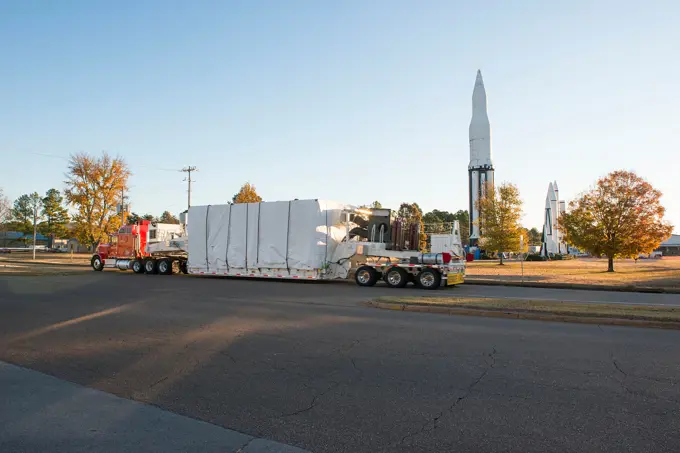
Jody Singer, director of NASAs Marshall Space Flight Center inHuntsville, Alabama, joins local government officials and others as the Marshall moveteam prepares to transport the Artemis I launch vehicle stage adapter for the agencysSpace Launch System (SLS) rocket. Huntsville-based Teledyne Brown Engineeringbuilt the launch vehicle stage adapter at a state-of-the-art manufacturing facility atMarshall. Teledyne officials joined Singer to see the adapter one last time before itheads to the barge. This is the last piece of Marshall-built SLS rocket hardware set fordelivery to Kennedy in preparation of the Artemis I mission to the Moon. A move teamled by Marshalls Center Operations will transport the adapter from the manufacturingfacility to NASAs Pegasus barge. The barge will take the adapter to NASAs KennedySpace Center in Florida for assembly and launch. Other parts of the Artemis I SLSrocket that were manufactured in Alabama include the Orion stage adapter built byMars
6145-44974712
The Soyuz rocket is rolled out of Building 112 at the Baikonur Cosmodrome to make its way to the launch pad, Monday, Sept. 23, 2013 in Kazakhstan. Launch of the Soyuz rocket is scheduled for September 26 and will send Expedition 37 Oleg Kotov, NASA Flight Engineer Michael Hopkins and Russian Flight Engineer Sergei Ryazansky on a five and a half-month mission aboard the International Space Station.
6145-45219746
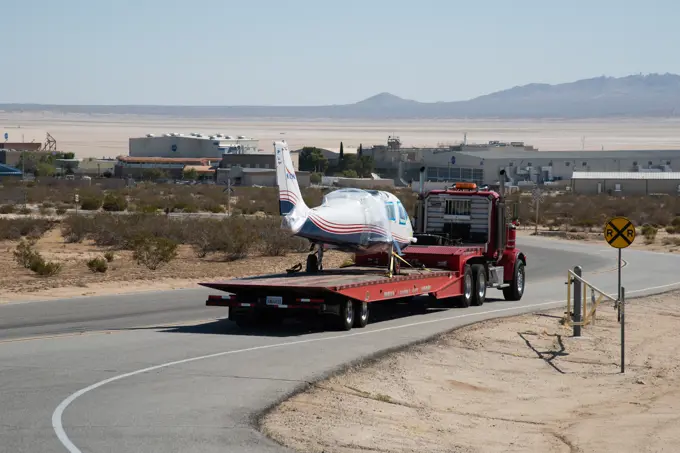
NASAs all-electric X-57 Maxwell, in its Mod II configuration, arrives at NASAs Armstrong Flight Research Center in Edwards, California. The X-plane was delivered by prime contractor Empirical Systems Aerospace of San Luis Obispo, California, in two parts, with the wing separated from the fuselage, to aid in a more timely delivery. X-57 is NASAs first crewed X-plane in two decades, and seeks to further advance the design and airworthiness process for distributed electric propulsion technology for general aviation aircraft.
4404-1526
USA, Arizona, Meteor City, Wind turbine blade on low-loader truck passing Meteor City
1457-1299
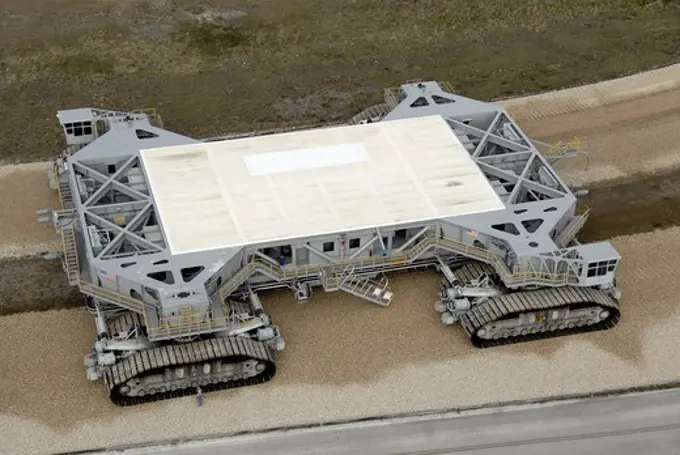
An aerial view shows the crawler-transporter at NASA's Kennedy Space Center, Cape Canaveral, Florida, USA
6145-45162589
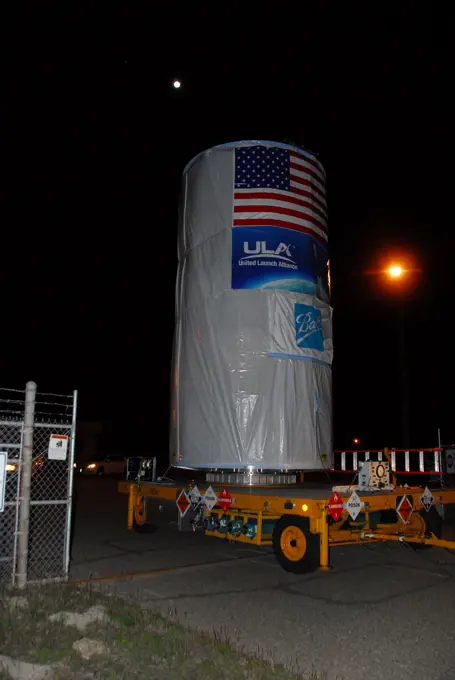
At Vandenberg Air Force Base in California, on Tuesday, April 17, 2018, a United Launch Alliance (ULA) Delta II booster is transported to Space Launch Complex-2 where it will launch NASA's Ice, Cloud and land Elevation Satellite-2, or ICESat-2, satellite. This will be the last flight for the venerable Delta II rocket. ICESat-2, which is being built and tested by Orbital ATK in Gilbert, Arizona, will carry a single instrument called the Advanced Topographic Laser Altimeter System, or ATLAS. The ATLAS instrument is being built and tested at NASAs Goddard Space Flight Center in Greenbelt Maryland. Once in orbit, the satellite is designed to measure the height of a changing Earth, one laser pulse at a time, 10,000 laser pulses a second. ICESat-2 will help scientists investigate why, and how much, Earths frozen and icy areas, called the cryosphere, are changing.
6145-45162592
At Vandenberg Air Force Base in California, on Tuesday, April 17, 2018, a United Launch Alliance (ULA) Delta II booster is transported to Space Launch Complex-2 where it will launch NASA's Ice, Cloud and land Elevation Satellite-2, or ICESat-2, satellite. This will be the last flight for the venerable Delta II rocket. ICESat-2, which is being built and tested by Orbital ATK in Gilbert, Arizona, will carry a single instrument called the Advanced Topographic Laser Altimeter System, or ATLAS. The ATLAS instrument is being built and tested at NASAs Goddard Space Flight Center in Greenbelt Maryland. Once in orbit, the satellite is designed to measure the height of a changing Earth, one laser pulse at a time, 10,000 laser pulses a second. ICESat-2 will help scientists investigate why, and how much, Earths frozen and icy areas, called the cryosphere, are changing.
6145-44731685
CAPE CANAVERAL, Fla. -  A convoy of trucks passes a launch pad as it makes the journey from Port Canaveral, Fla., to the Vehicle Assembly Building's high bay 4 at NASA's Kennedy Space Center in Florida.  The trucks carry Ares I-X upper stage simulator segments. The upper stage simulators will be used in the test flight identified as Ares I-X in 2009.  The Ares I-X test flight will provide NASA an early opportunity to test and prove hardware, facilities and ground operations associated with the Ares I crew launch vehicle. It also will allow NASA to gather critical data during ascent of the integrated Orion crew exploration vehicle and the Ares I rocket. The data will ensure the entire vehicle system is safe and fully operational before astronauts begin traveling to orbit.  The simulator segments will simulate the mass and the outer mold line and will be more than 100 feet of the total vehicle height of 327 feet.  The simulator comprises 11 segments that are approximately 18 feet in diam
1746-29000460
preserved Douglas C-47 Dakota aircraft at Kibbutz Revivim, Negev Desert, Southern Israel
6145-44801617
SDO MOVE FROM ASTROTECH TO PAD 41 - LIFT & MATE
1848-56112071
Heavy load at night through a town
1889-49018512
Tundra Buggy Vehicles Parked In A Row; Churchill, Manitoba, Canada
6145-44985583
CAPE CANAVERAL, Fla. - At NASAs Kennedy Space Center in Florida, the Project Morpheus prototype lander has been positioned on a transportable launch platform at the north end of the Shuttle Landing Facility. A portion of the hazard field is in the foreground. The lander will be prepared for a tethered test that includes lifting it 20 feet by crane, ascending another 10 feet, maneuvering backwards 10 feet, and then flying forward and descending to its original position, landing at the end of the tether. Testing of the prototype lander was performed at NASAs Johnson Space Center in Houston in preparation for tethered and free flight testing at Kennedy.The landing facility will provide the lander with the kind of field necessary for realistic testing, complete with rocks, craters and hazards to avoid. Morpheus utilizes an autonomous landing and hazard avoidance technology, or ALHAT, payload that will allow it to navigate to clear landing sites amidst rocks, craters and other hazards d
6145-44541490
STS028-S-002 (8 Aug 1989)  --- The five astronaut crewmembers for STS-28 leave the Operations and Checkout (O&C) Building to board a transfer van en route to Launch Complex 39 for a date with Columbia.  Left to right are Astronauts Mark N. Brown, James C. Adamson, David C. Leestma, Richard N. Richards and Brewster H. Shaw Jr.
6145-55187104
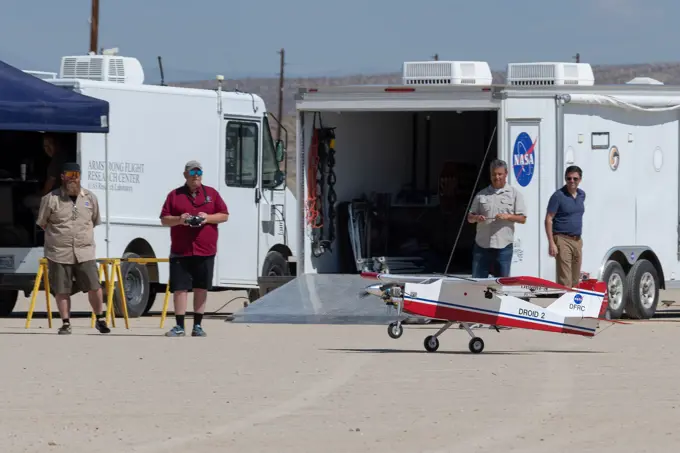
. Robert "Red" Jensen lands the DROID 2 (Dryden Remotely Operated Integrated Drone 2) aircraft at NASA's Armstrong Flight Research Center in Edwards, California, as part of the Advanced Exploration of Reliable Operation at Low Altitudes: Meteorology, Simulation, and Technology campaign. The focus was to study wind to provide data for safe takeoff and landing of future air taxis.
6145-44621460
KENNEDY SPACE CENTER, FLA. -  A Mercury/Redstone rocket on display at the Pass and Identification Building at the entrance to Kennedy Space lies on its side following Hurricane Frances. The storm's path over Florida took it through Cape Canaveral and KSC property during Labor Day weekend.
4093-11938
Hummer Earth Two TV Series Vehicle weird
6145-45247979
Engineers at the Marshall Space Flight Center (MSFC) have been testing Magnetic Launch Assist Systems, formerly known as Magnetic Levitation (MagLev) technologies. To launch spacecraft into orbit, a Magnetic Launch Assist system would use magnetic fields to levitate and accelerate a vehicle along a track at a very high speed. Similar to high-speed trains and roller coasters that use high-strength magnets to lift and propel a vehicle a couple of inches above a guideway, the launch-assist system would electromagnetically drive a space vehicle along the track. A full-scale, operational track would be about 1.5-miles long and capable of accelerating a vehicle to 600 mph in 9.5 seconds. This photograph shows a subscale model of an airplane running on the experimental track at MSFC during the demonstration test. This track is an advanced linear induction motor. Induction motors are common in fans, power drills, and sewing machines. Instead of spinning in a circular motion to turn a shaft or
6145-44588930
KENNEDY SPACE CENTER, FLA. - Columbia debris arriving at KSC from the collection point at Barksdale Air Force Base, Shreveport, La., awaits identification and placement in the RLV Hangar near the Shuttle Landing Facility.  Workers there will attempt to reconstruct the orbiter as part of the ongoing investigation of the accident that destroyed the Columbia and claimed the lives of seven astronauts as they returned to Earth after a 16-day research mission, STS-107.
6188-64535027
Front view of Indian air force fighter plane displaced for public view at Santa Cruz airport area, Bombay Mumbai, Maharashtra, India Copyright: xManoejxPaateel/DinodiaxPhotox
6145-44593705
KENNEDY SPACE CENTER, FLA. - On Pad 17-A, Cape Canaveral Air Force Station, the first stage of the Delta II rocket is ready for lift up the launch tower. The Delta will launch the Mars Exploration Rover (MER-A) vehicle. The MER Mission consists of two identical rovers designed to cover roughly 110 yards each Martian day over various terrain. Each rover will carry five scientific instruments that will allow it to search for evidence of liquid water that may have been present in the planet's past.  Identical to each other, the rovers will land at different regions of Mars.  Launch date for this first of NASA's two Mars Exploration Rover missions is scheduled no earlier than June 6.
1899-76347922
Nogales, Arizona, The Nogales-Grand Avenue border crossing between the United States and Mexico.
6145-44821586
STS-335 LAUNCH ON NEED - LAST SRB SEGMENTS ARRIVAL - SLF TRACKS
6177-V53479371
6145-44821589
STS-335 LAUNCH ON NEED - LAST SRB SEGMENTS ARRIVAL - SLF TRACKS
7119-70410795
USA, Connecticut, Groton. Exhibits of equipment outside the Submarine Force Museum
6145-52244775
060801-N-4995K-140. Base: M/V Kellie Chouest Country: Pacific Ocean (POC)
7003-71253063
New Zealand, South Island, Otago, Oamaru, Steampunk HQ, Steampunk Zeppelin
1848-60297612
Soviet underwater anchor mine. Museum of the World ocean. Kaliningrad (until 1946 Koenigsberg), Russia, Europe
6188-55541476
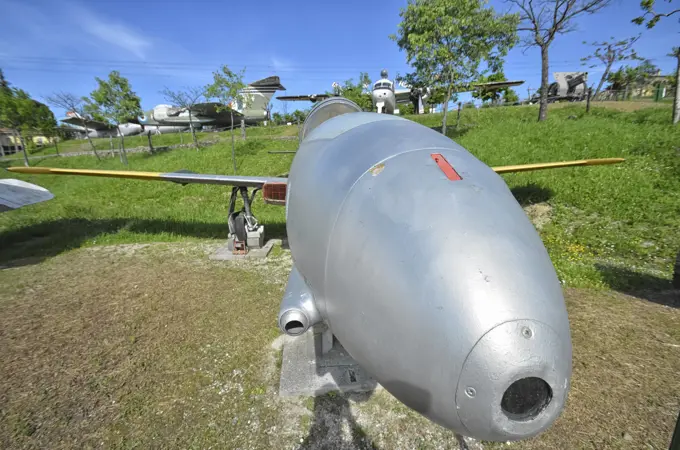
The TS-11 Iskra jet trainer Front view of the TS-11 Iskra jet trainer Copyright: xZoonar.com/LeonardoxBrigantix 9302255
6145-45172864
NASA's Orion spacecraft that flew Exploration Flight Test-1 on Dec. 5, 2014 is seen as it arrives at the White House complex, Saturday, July 21, 2018 in Washington, DC. Lockheed Martin, NASAs prime contractor for Orion, began manufacturing the Orion crew module in 2011 and delivered it in July 2012 to NASA's Kennedy Space Center where final assembly, integration and testing was completed. More than 1,000 companies across the country manufactured or contributed elements to the spacecraft.
4093-26629
crash truck airport authority fire department air show street
1848-55304748
Sea torpedo
6177-V53459767
6145-44971952
(TRACT) Transport Rotorcraft Aircraft Testbed: Helicopter airframe drop test at NASA Langley's Landing and Impact Research Facility (LandIR)
6145-58966370
The Soyuz TMA-02M spacecraft is rolled out by train on its way to the launch pad at the Baikonur Cosmodrome, Kazakhstan, Sunday, June 5, 2011.  The launch of the Soyuz spacecraft with Expedition 28 Soyuz Commander Sergei Volkov of Russia, NASA Flight Engineer Mike Fossum and JAXA (Japan Aerospace Exploration Agency) Flight Engineer Satoshi Furukawa is scheduled for 2:15 a.m. local time on Wednesday, June 8, 2011.
6145-51988648
Severe Storms and Tornadoes,  Enterprise, AL, March 3, 2007   The FEMA Mobile Emergency Response Support (MERS) vehicle at Enterprise High School this morning. The MERS vehicle is has satellite communications to stay connected with FEMA's computer network in all disaster situations. Mark Wolfe/FEMA.. Photographs Relating to Disasters and Emergency Management Programs, Activities, and Officials
PREVIOUS
of 2
NEXT
2401 S. Ervay, Suite 206
Dallas, Texas 75215
United States
Get Started
Free ResearchMy BoardsMy Cart
For Creators
How To License Your ContentContributor PortalFrame of Mind
Resources
API accessPricing
Contact
+1 866 236 0087help@viewpictures.co.uk Contact form
©2026 View Pictures. All Rights Reserved. -A
This site is protected by reCAPTCHA and Google Privacy Policy and Terms of Service apply.