My Boards
View Pictures
  • My Boards

Spacecraft and Satellites

3D renderings of various spacecraft, including GPS satellites, the International Space Station, and Earth resources satellites, highlighting advanced technology in orbit.

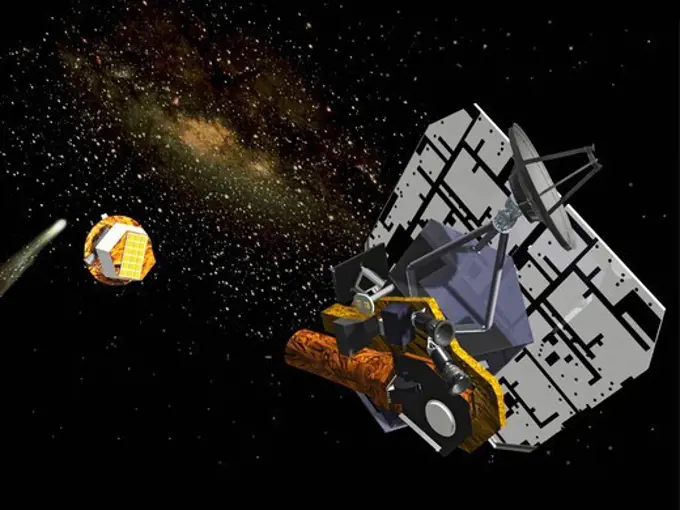
Deep Impact Spacecraft
169 assets in this story
4128-38524520
Space exploration, conceptual illustration
4239R-3403
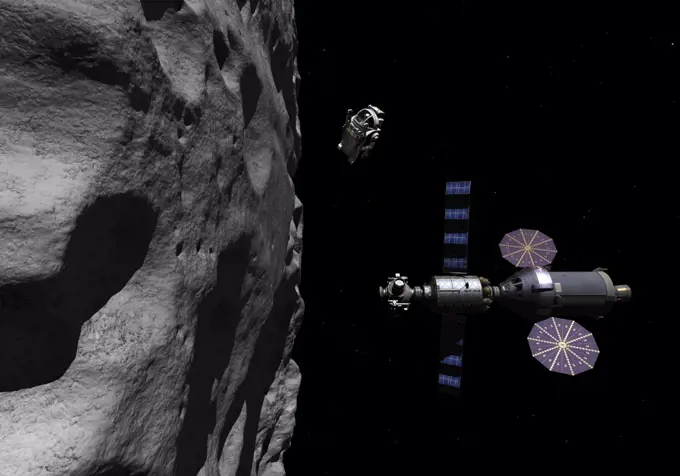
A Manned Maneuvering Vehicle (MMV) piloted by a single astronaut descends toward the surface of a small asteroid. The MMV is designed to travel several miles from the main vessel with life support and fuel enough for a day's exploration.
4128R-17802
Space junk, computer artwork.
6145-45079063
This artist's concept of the Rosetta mission's Philae lander on the surface of comet 67P/Churyumov-Gerasimenko, is from an animation showing the upcoming deployment of Philae and its subsequent science operations on the surface of the comet.
6145-45089089
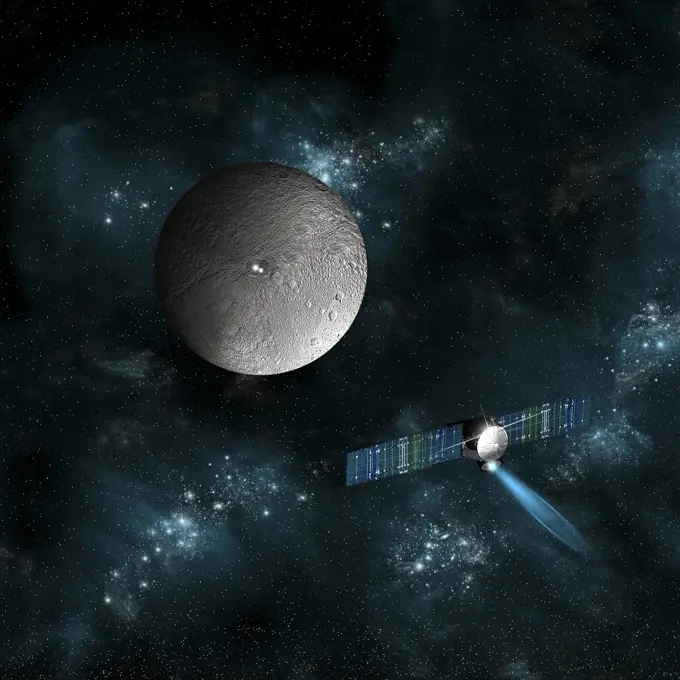
This artist's concept shows NASA's Dawn spacecraft arriving at the dwarf planet Ceres, the most massive body in the asteroid belt. Dawn is the first mission to visit a dwarf planet.
6145-52086507
Artist's global concept of the NAVSTAR Global Positioning System Satellite. Country: Unknown
4239-69155110
A manned orbital maintenance platform approaches the Chandra X-ray Observatory.
6177-V53833456
4128-17927652
Space junk around Earth, illustration
4239R-20480775
An artist's concept of the Planck spacecraft. Planck was launched with the Herschel spacecraft, though the two missions separated shortly after launch and operate independently from each other.
6145-44609379
Pre-Planning the Last
4239R-3397
For even longer missions the Deep Space Vehicle (DSV) could be mated with an Extended Stay Module (ESM). The ESM would offer additional life support and accommodations for a crew of three or four for deep space missions lasting 90 days or longer.
1746-111944322
Artist's impression of Pioneer 10's flyby of Jupiter. Pioneer 10 (originally designated Pioneer F) is an American space probe, launched in 1972 and weighing 258 kilograms (569 pounds), that completed the first mission to the planet Jupiter. Thereafter, Pioneer 10 became the first of five artificial objects to achieve the escape velocity that will allow them to leave the Solar System.
1525-21258746
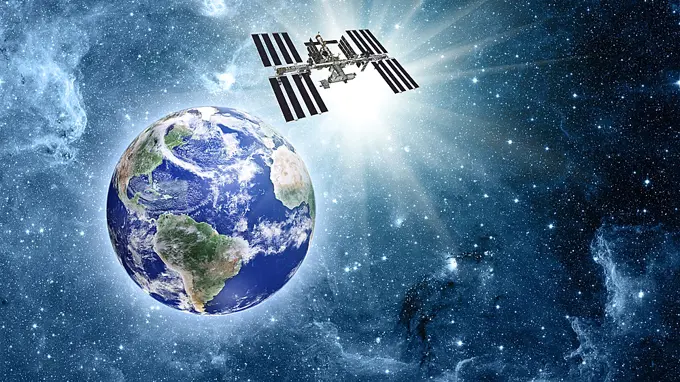
Space station over blue planet earth in space.
1848-57204357
Lunarbase
6145-45244600
In this 1988 artist's concept, the Orbital Maneuvering Vehicle (OMV), closes in on a satellite. As envisioned by Marshall Space Flight plarners, the OMV would be a remotely-controlled free-flying space tug which would place, rendezvous, dock, and retrieve orbital payloads.
6188-58104699
lunar landing mission on the Moon lunar landing mission on the Moon Copyright: xZoonar.com/StanislavxRishnyakx 14361624
6145-45248196
JSC2001-E-00356 (January 2001) --- Artist's rendering of early STS-98/ISS 5A with the Space Shuttle Atlantis in view during rendezvous and docking operations.
6145-45244842
In response to President Reagan's directive to NASA to develop a permanent marned Space Station within a decade, part of the State of the Union message to Congress on January 25, 1984, NASA and the Administration adopted a phased approach to Station development. This approach provided an initial capability at reduced costs, to be followed by an enhanced Space Station capability in the future. This illustration depicts a configuration with enhanced capabilities. It builds on the horizontal boom and module pattern of the revised baseline. This configuration would feature dual keels, two vertical spines 105-meters long joined by upper and lower booms. The structure carrying the modules would become a transverse boom of a basically rectangular structure. The two new booms, 45-meters in length, would provide extensive accommodations for attached payloads, and would offer a wide field of view. Power would be increased significantly, with the addition if a 50-kW solar dynamic power system.
4239R-6014
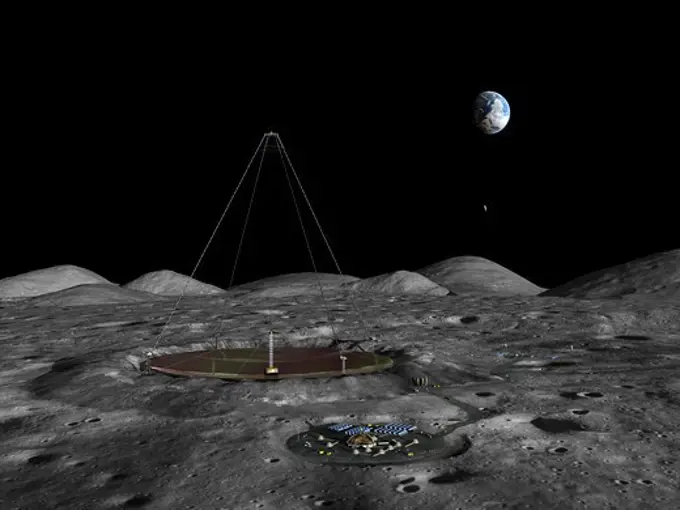
A giant liquid mirror telescope lies nestled in a lunar crater.
4239-69155124
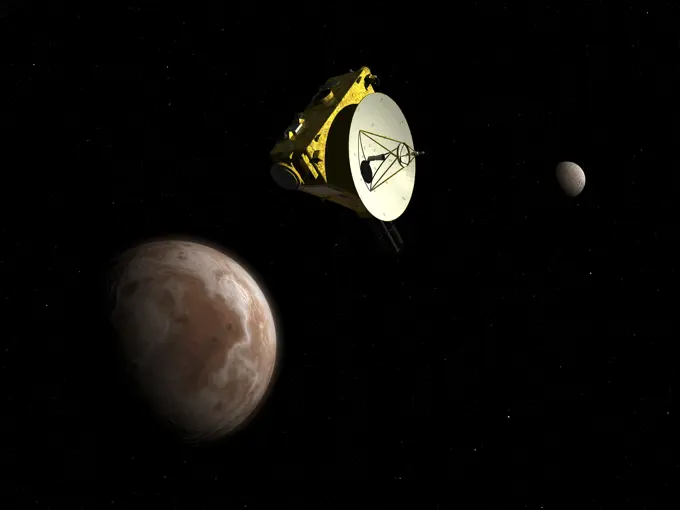
New Horizons spacecraft flies by dwarf planet Pluto and its moon Charon.
4239-57495603
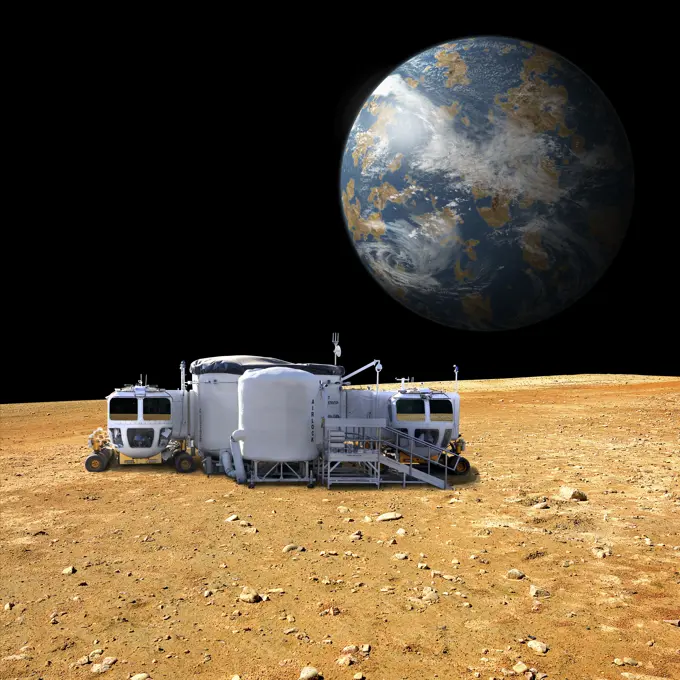
An artist's depiction of a lunar base on a barren moon.
6145-55186697
SWOT in Orbit (Illustration). The international Surface Water and Ocean Topography (SWOT) satellite is shown in orbit over Earth in this illustration, with sunlight glinting off one of its solar arrays and both antennas of its Ka-band Radar Interferometer (KaRIn) instrument extended. The mission is a collaborative effort between NASA and the French space agency Centre National d'Études Spatiales (CNES) - with contributions from the Canadian Space Agency (CSA) and the UK Space Agency. KaRIn is the scientific heart of the SWOT satellite, which will survey the water on more than 90% of Earth's surface, measuring the height of water in lakes, rivers, reservoirs, and the ocean. To do that, KaRIn will transmit radar pulses to Earth's surface and use its two antennas to triangulate the return signals that bounce back. Mounted at the ends of a boom 33 feet (10 meters) long, the antennas will collect data along a swath 30 miles (50 kilometers) wide on either side of the satellite. KaRIn will op
4128R-12576094
Spacecraft landing on asteroid, computer illustration.
6145-44586556
Artist's concept of Mars Odyssey mapping mission.
6145-52118507
An artist's concept of Soviet land, air and space-based lasers. (Soviet Military Power, 1987). Country: Unknown
6145-45224823
iss061e028279 (Nov. 4, 2019) --- The U.S. Cygnus space freighter approaches the International Space Station carrying over four tons of science experiments, crew supplies and station hardware. The Canadarm2 robotic arm, guided by NASA astronaut Jessica Meir with fellow Flight Engineer Christina Koch as her back up, is poised to capture the 12th resupply ship from Northrop Grumman.
4128R-15466152
Communications satellite in space, illustration
6145-45263035
Illustration of the twin spacecraft of the NASA/German Research Centre for Geosciences (GFZ) Gravity Recovery and Climate Experiment Follow-On (GRACE-FO) mission. GRACE-FO will continue tracking the evolution of Earth's water cycle by monitoring changes in the distribution of mass on Earth.
6145-45265417
Illustration of NASA's OCO-3 mounted on the underside of the International Space Station.
1457R-930
Astronomy telescope in space, Spitzer Space Telescope
1525R-78260
Voyager 2Neptune & Triton8/24/89 Rendering
6145-45265883
This artist's concept shows the Lunar Flashlight spacecraft, a six-unit CubeSat designed to search for ice on the Moon's surface using special lasers. The spacecraft will use its near-infrared lasers to shine light into shaded polar regions on the Moon, while an onboard reflectometer will measure surface reflection and composition.
4389-2014
Spitzer Space Telescope
6145-44508119
As part of a Mars sample return mission, a rocket will carry a container of sample tubes with Martian rock and soil samples into orbit around Mars and release it for pick up by another spacecraft. This illustration shows a concept for a Mars Ascent Vehicle (left) releasing a sample container (right) high above the Martian surface. NASA and the European Space Agency are solidifying concepts for a Mars sample return mission after NASA's Mars 2020 rover collects rock and soil samples and stores them in sealed tubes on the planet's surface for potential future return to Earth. NASA will deliver a Mars lander in the vicinity of Jezero Crater, where Mars 2020 will have collected and cached samples. The lander will carry a NASA rocket (the Mars Ascent Vehicle) along with an ESA Sample Fetch Rover that is roughly the size of NASA's Opportunity Mars rover. The fetch rover will gather the cached samples and carry them back to the lander for transfer to the ascent vehicle; additional samples coul
6145-45299497
This illustration shows NASA's Mars 2020 spacecraft carrying the Perseverance rover as it approaches Mars. Hundreds of critical events must execute perfectly and exactly on time for the rover to land on Mars safely on Feb. 18, 2021. Solar panels powering the spacecraft are visible on the cruise state at the top. The cruise stage is attached to the aeroshell, which encloses the rover and descent stage. Entry, Descent, and Landing, or EDL, begins when the aeroshell reaches the top of the Martian atmosphere, traveling nearly 12,500 mph (20,000 kph). It ends about seven minutes later, with Perseverance stationary on the Martian surface.
6145-45001204
Artist's impression of the Rosetta orbiter at comet 67P/Churyumova-Gerasimenko. The image is not to scale.
4186-58630534
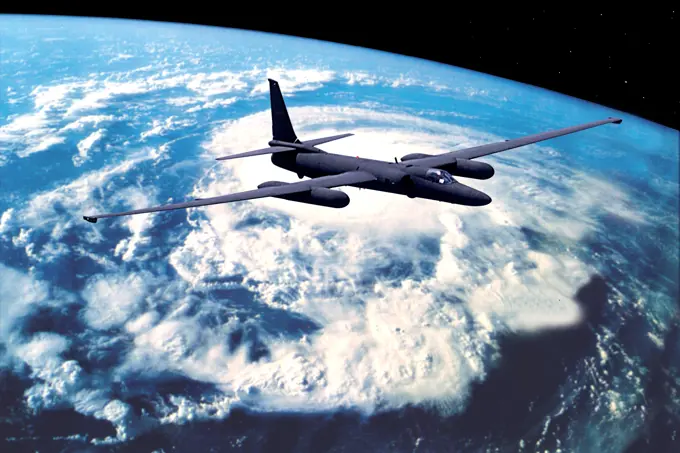
1950s LOCKHEED U-2 TR-2 SPY PLANE FLYING OVER EARTH GLOBE COMPOSITE IMAGE
4239-69155135
Lunar cycler centrifuge
4128-20043075
Relativistic Klystron Amplifier, illustration
4128R-15466203
Communications satellite in space, illustration
6145-45245660
In the 1960's U.S. Government laboratories, under Project Orion, investigated a pulsed nuclear fission propulsion system. Based on Project Orion, an interplanetary vehicle using pulsed fission propulsion would incorporate modern technologies for momentum transfer, thermal management, and habitation design.
1815-65068227
Cute astronaut in space with a satellite and asteroid.
1746-21120476
Artist's rendition of GOES D/E/F series of satellites in orbit 1980
6145-44483098
This illustration shows NASA's Mars Ascent Vehicle (MAV) in powered flight. The MAV will carry tubes containing Martian rock and soil samples into orbit around Mars, where ESA's Earth Return Orbiter spacecraft will enclose them in a highly secure containment capsule and deliver them to Earth.
4128R-17009
Lunar satellite array. Conceptual computer artwork of an array of satellites on the Moon.
4239-57495585
Artist's concept of the Dawn spacecraft as it approaches an encounter with Ceres.
4239-57493915
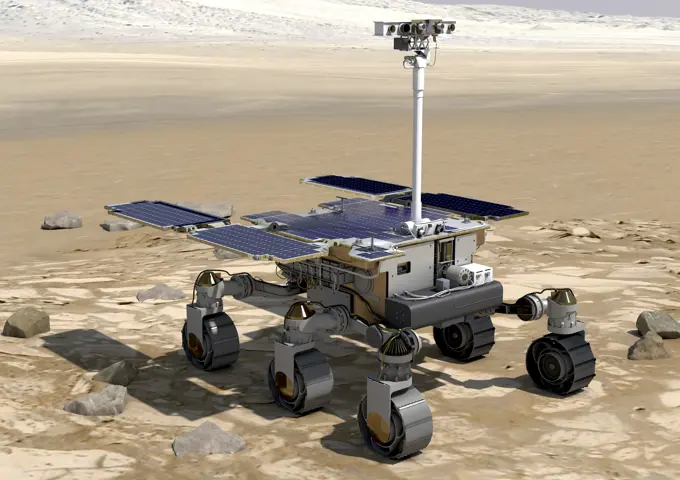
Artist's concept of the Rosalind Franklin ExoMars rover on a Mars landscape.
6145-44521600
This image is a single frame from a computer animation, which begins with a view of Mars created with images from NASA's Mars Odyssey spacecraft in which color is used to emphasize the Martian topographic, andesite, and basalt compositional differences.
1788-20760681
The Cassini-Huygens spacecraft in orbit around Saturn, July-December 2004, illustration.
4239R-20480384
November 3, 2007 - View of the repaired solar array photographed during the STS-120 mission's fourth session of extravehicular activity (EVA) while Space Shuttle Discovery is docked with the International Space Station.
4128R-13941039
Astronaut in space, illustration.
6145-44807934
Artist rendering Torus Sphere. Space Colony Concept. Exterior view of several neighboring colonies. ref NASA SP-413; Space Settlements A Design Study
4128R-15221076
Satellite, illustration
6145-44484682
This illustration depicts NASA's Double Asteroid Redirection Test (DART) spacecraft prior to impact at the Didymos binary asteroid system. DART's target asteroid is the moonlet Dimorphos, which orbits the larger asteroid Didymos; the pair are not a threat to Earth. This asteroid system will be a testing ground to see if intentionally crashing a spacecraft into an asteroid is an effective way to change its course, should an Earth-threatening asteroid be discovered in the future. The Johns Hopkins Applied Physics Laboratory in Laurel, Maryland, manages the DART mission for NASA's Planetary Defense Coordination Office as a project of the agency's Planetary Missions Program Office. DART is the world's first planetary defense test mission, intentionally executing a kinetic impact into Dimorphos to slightly change its motion in space. While the asteroid does not pose any threat to Earth, the DART mission will demonstrate that a spacecraft can autonomously navigate to a kinetic impact on a re
6145-54413803
Artist's concept of an MX missile during launch from a horizontal shelter. Country: Unknown
6145-45230525
This illustration depicts the design features of the Hubble Space Telescope's (HST's) Support Systems Module (SSM). The SSM is one of the three major elements of the HST and encloses the other two elements, the Optical Telescope Assembly (OTA) and the Scientific Instruments (SI's). The purpose of the HST, the most complex and sensitive optical telescope ever made, is to study the cosmos from a low-Earth orbit. By placing the telescope in space, astronomers are able to collect data that is free of the Earth's atmosphere. The HST detects objects 25 times fainter than the dimmest objects seen from Earth and provides astronomers with an observable universe 250 times larger than visible from ground-based telescopes, perhaps as far away as 14 billion light-years. The HST views galaxies, stars, planets, comets, possibly other solar systems, and even unusual phenomena such as quasars, with 10 times the clarity of ground-based telescopes. The spacecraft is 42.5-feet (13-meters) long and weighs
6145-45233388
The family of High Energy Astronomy Observatory (HEAO) instruments consisted of three unmarned scientific observatories capable of detecting the x-rays emitted by the celestial bodies with high sensitivity and high resolution. The celestial gamma-ray and cosmic-ray fluxes were also collected and studied to learn more about the mysteries of the universe. High-Energy rays cannot be studied by Earth-based observatories because of the obscuring effects of the atmosphere that prevent the rays from reaching the Earth's surface. They had been observed initially by sounding rockets and balloons, and by small satellites that do not possess the needed instrumentation capabilities required for high data resolution and sensitivity. The HEAO carried the instrumentation necessary for this capability. In this photograph, an artist's concept of three HEAO spacecraft is shown HEAO-1, launched on August 12, 1977; HEAO-2, launched on November 13, 1978; and HEAO-3, launched on September 20. 1979.
4409-28579961
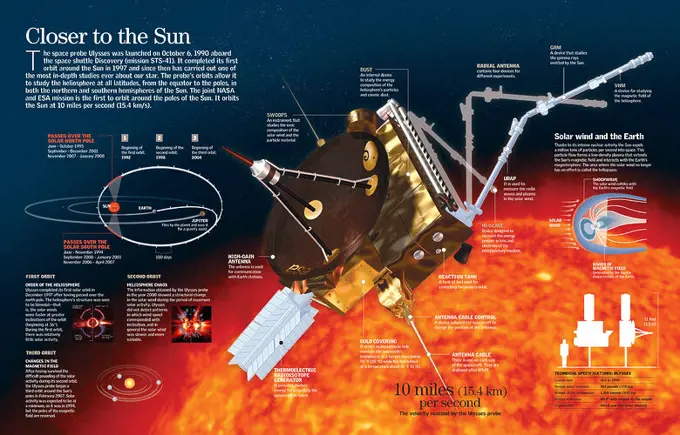
Infographic about the Ulysses space probe launched into space in 1990 with the aim of studying the Sun. Adobe InDesign (.indd); 6259x4015.
4128R-17847
Curiosity rover. Computer artwork of the Mars Science Laboratory MSL mission rover, Curiosity, on the Martian surface.
6145-45240536
This artist's conception depicts the High Energy Astronomy Observatory (HEAO)-1 in orbit. The first observatory, designated HEAO-1, was launched on August 12, 1977 aboard an Atlas/Centaur launch vehicle and was designed to survey the sky for additional x-ray and gamma-ray sources as well as pinpointing their positions. The HEAO-1 was originally identified as HEAO-A but the designation was changed once the spacecraft achieved orbit. The HEAO project involved the launching of three unmarned scientific observatories into low Earth orbit between 1977 and 1979 to study some of the most intriguing mysteries of the universe; pulsars, black holes, neutron stars, and super nova. Hardware support for the imaging instruments was provided by American Science and Engineeing. The HEAO spacecraft were built by TRW, Inc. under project management of the Marshall Space Flight Center.
6145-45113986
This artist's concept shows NASA's Spitzer Space Telescope. Spitzer begins its 'Beyond' mission phase on Oct. 1, 2016. Spitzer is depicted in the orientation it assumes to establish communications with ground stations.
4389-729
Experimental Solar Powered Aircraft Model
6145-45244579
This image illustrates the overall Hubble Space Telescope (HST) configuration. The HST is the product of a partnership between NASA, European Space Agency Contractors, and the international community of astronomers. It is named after Edwin P. Hubble, an American Astronomer who discovered the expanding nature of the universe and was the first to realize the true nature of galaxies. The purpose of the HST, the most complex and sensitive optical telescope ever made, is to study the cosmos from a low-Earth orbit. By placing the telescope in space, astronomers are able to collect data that is free of the Earth's atmosphere. The HST detects objects 25 times fainter than the dimmest objects seen from Earth and provides astronomers with an observable universe 250 times larger than visible from ground-based telescopes, perhaps as far away as 14 billion light-years. The HST views galaxies, stars, planets, comets, possibly other solar systems, and even unusual phenomena such as quasars, with 10 t
6145-45244746
Pictured here is an artist's depiction of Rockwell's Vertical Landing Single-Stage-to-Orbit (SSTO) Reusable Launch Vehicle (RLV) deploying a satellite concept. The development of the RLV is essential in the cost reduction of future space travel.
4128-28970809
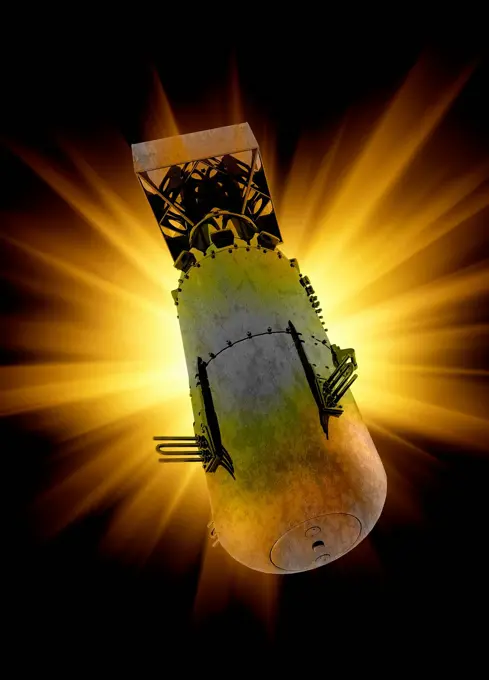
Atomic bomb, illustration
4128R-9500
Space tourism, conceptual artwork
4128R-15466188
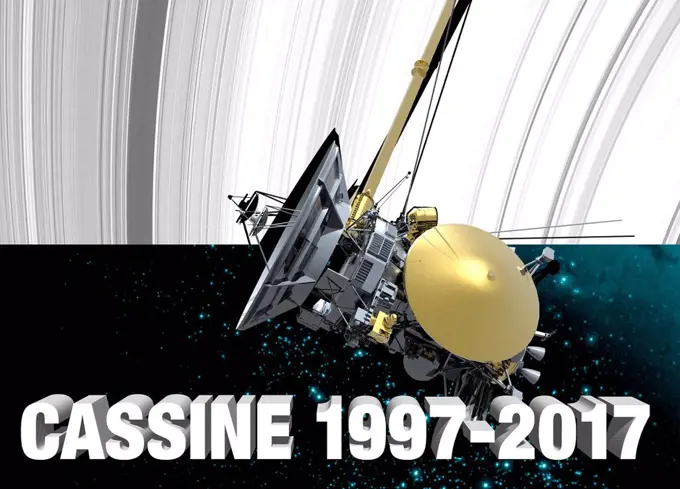
Cassini spacecraft, illustration., illustration
6145-45137684
jsc2021e007962 (6/26/2020) --- A CAD rendering of the Ionosphere Thermosphere Scanning Photometer for Ion-Neutral Studies (IT-SPINS). IT-SPINS produces two-dimensional (2D) tomographic imaging of Earths ionosphere in order to increase fundamental understanding of its structure. Image courtesy of Montana State University.
PREVIOUS
of 2
NEXT
2401 S. Ervay, Suite 206
Dallas, Texas 75215
United States
Get Started
Free ResearchMy BoardsMy Cart
For Creators
How To License Your ContentContributor PortalFrame of Mind
Resources
API accessPricing
Contact
+1 866 236 0087help@viewpictures.co.uk Contact form
©2026 View Pictures. All Rights Reserved. -B
This site is protected by reCAPTCHA and Google Privacy Policy and Terms of Service apply.