My Boards
View Pictures
  • My Boards

Spacecraft Preparation and Assembly

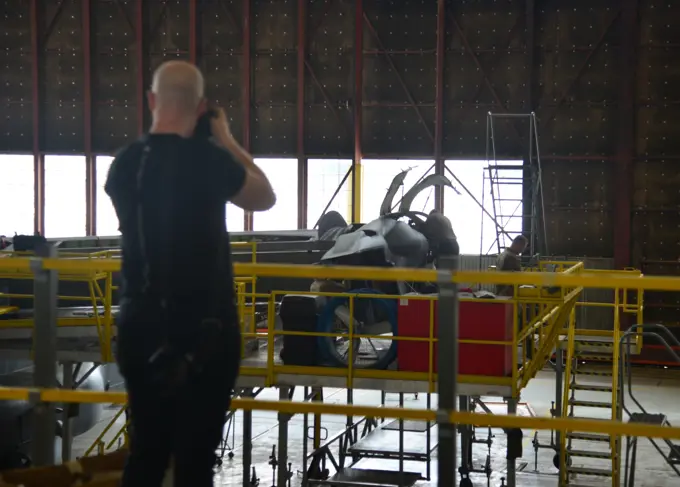
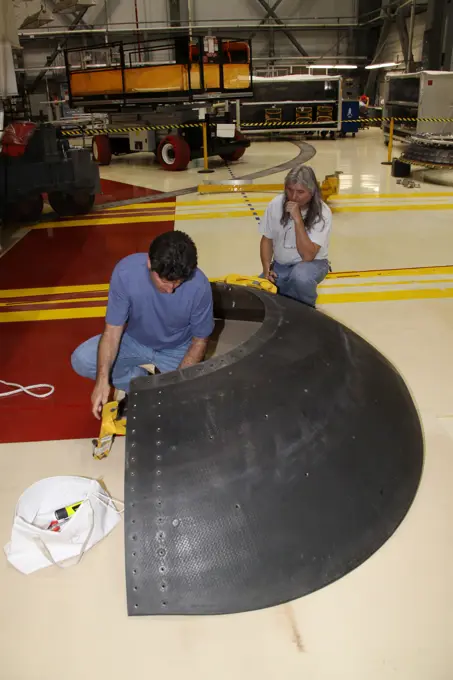
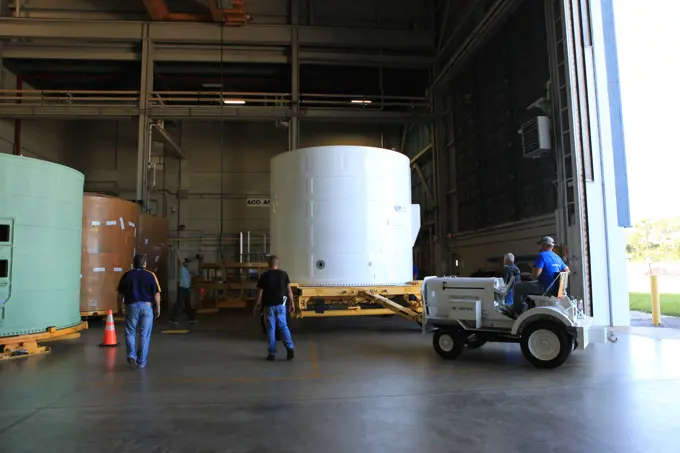
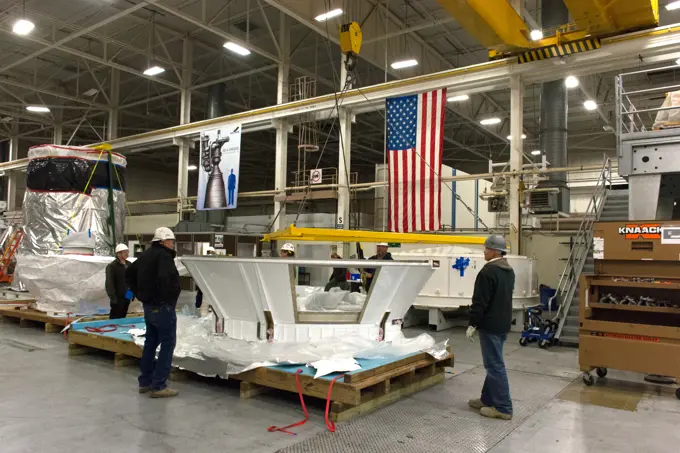
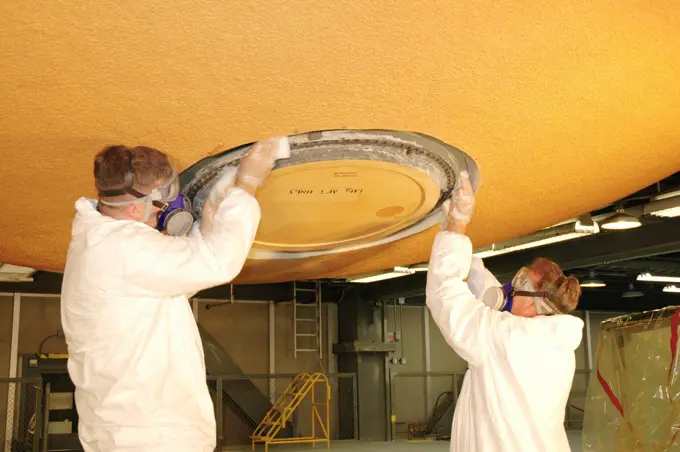
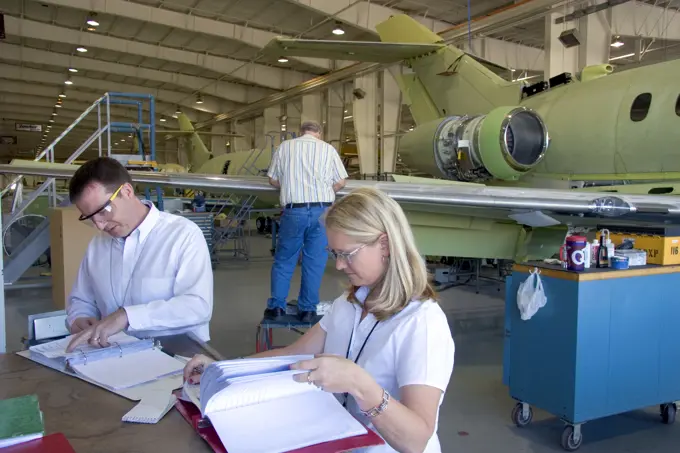
Technicians work on assembling components of spacecraft, including engines and fairings, in industrial facilities, showcasing teamwork and advanced technology in space exploration.

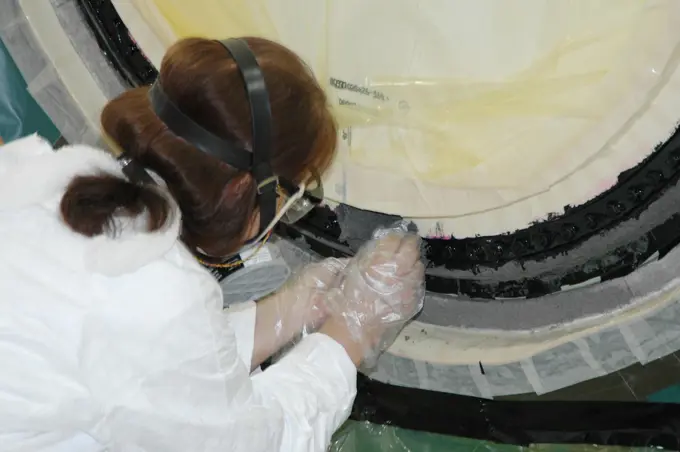
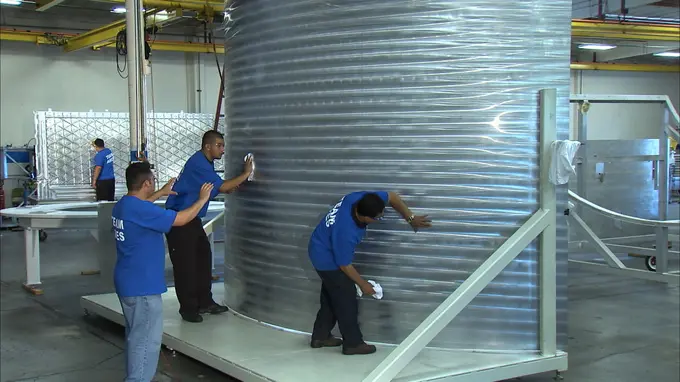
SOFIA (Stratospheric Observatory for Infrared Astronomy) primary mirror being coated in the Ames N-211 Vacuum Chamber.
185 assets in this story
6145-45220215
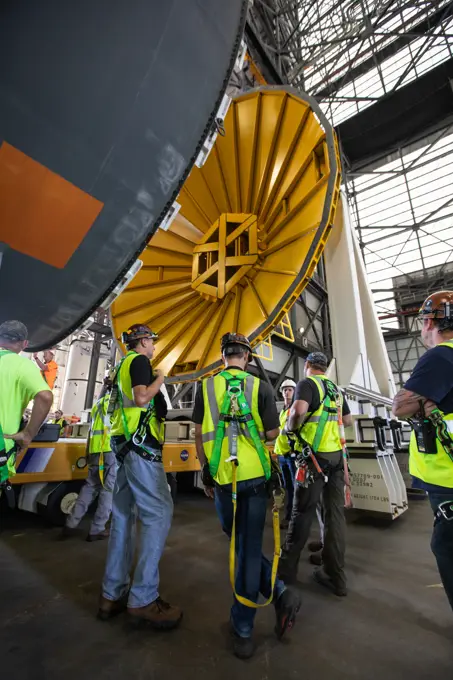
Inside the Vehicle Assembly Building at NASAs Kennedy Space Center in Florida, NASA and Jacobs TOSC workers monitor the progress as a cover, called the spider, is attached to the top of the Space Launch System (SLS) Core Stage pathfinder on Oct. 3, 2019. With the spider secured in place, a crane will be attached to it to lift the pathfinder into the vertical position. The 212-foot-long core stage pathfinder arrived in NASA's Pegasus Barge at Kennedys Launch Complex 39 turn basin wharf on Sept. 27, 2019. The Pegasus Barge made its first delivery to Kennedy in support of the agency's Artemis missions. The upgraded 310-foot-long barge arrived, ferrying the SLS core stage pathfinder, a full-scale mock-up of the rocket's core stage. It will be used by Exploration Ground Systems and its contractor, Jacobs, to practice offloading, moving and stacking maneuvers, using important ground support equipment to train employees and certify all the equipment works properly. The pathfinder will stay
6145-44899018
CAPE CANAVERAL, Fla. - Inside Orbiter Processing Facility-2 at NASAs Kennedy Space Center in Florida, United Space Alliance technicians prepare to install a ferry flight door on space shuttle Endeavour. The work is part of Transition and Retirement of the remaining space shuttles, Endeavour and Atlantis. Endeavour is being prepared for public display at the California Science Center in Los Angeles. Its ferry flight to California is targeted for mid-September. Endeavour was the last space shuttle added to NASAs orbiter fleet. Over the course of its 19-year career, Endeavour spent 299 days in space during 25 missions.
6145-44582040
KENNEDY SPACE CENTER, FLA.  -- The node structural test article (STA) is prepared to be offloaded through the open nose of the Super Guppy transport aircraft following its arrival at Kennedy Space Center from Marshall Space Flight Center in Huntsville, Ala. It was moved to KSC for storage. An exact replica of the Unity Node on the International Space Station, the node STA was used at MSFC for testing and validation purposes. The Unity Node is the pressurized element that connects the other ISS pressurized modules together and was the first U.S. element to launch.
6145-44814420
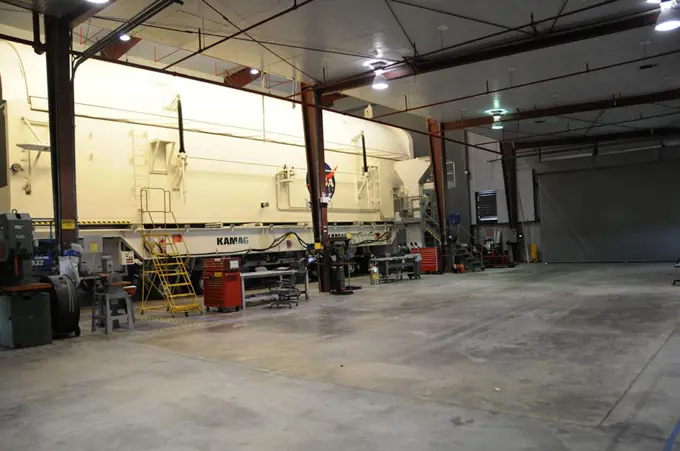
Interior View of CRF
6145-44889917
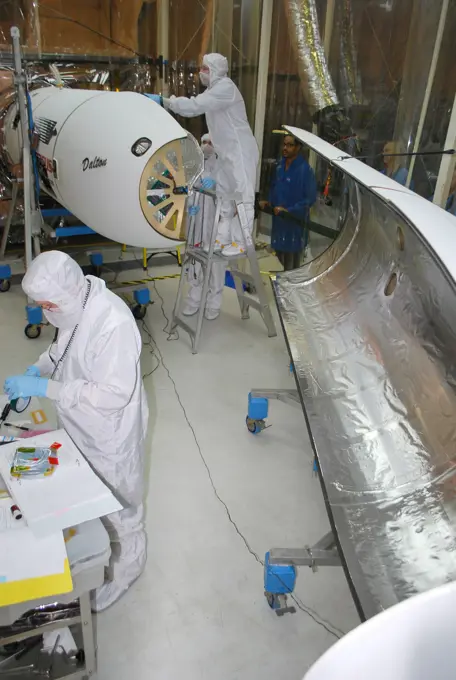
VANDENBERG AFB, Calif. - Technicians install one half of the payload fairing over the NuSTAR spacecraft as they continue to process the spacecraft and its Pegasus rocket for launch. The second half of the fairing stands ready for installation. NuSTAR stands for Nuclear Spectroscopic Telescope Array.
1525R-64140
6145-45065966
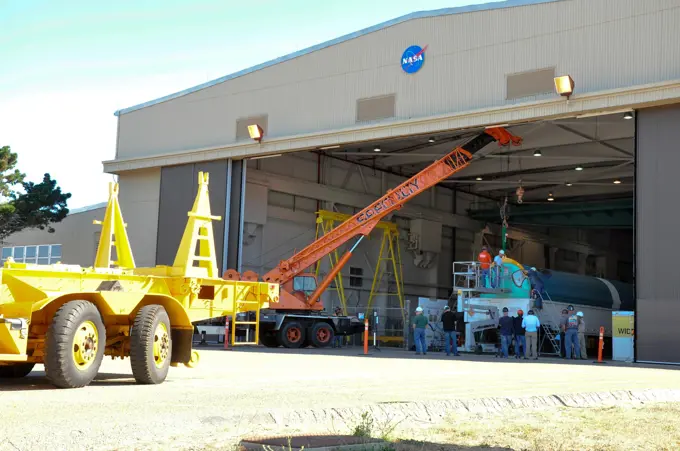
VANDENBERG AIR FORCE BASE, Calif. - A crane is positioned to offload the first stage of a United Launch Alliance Delta II rocket following its arrival at NASA hangar 836 on Vandenberg Air Force Base in California. The launch vehicle will be used to deliver NASA's Soil Moisture Active Passive mission, or SMAP, into orbit.SMAP will provide global measurements of soil moisture and its freeze/thaw state. These measurements will be used to enhance understanding of processes that link the water, energy and carbon cycles, and to extend the capabilities of weather and climate prediction models. SMAP data also will be used to quantify net carbon flux in boreal landscapes and to develop improved flood prediction and drought monitoring capabilities. Launch is scheduled for November 2014.
6145-54100204
Vertical Magazine photographer Lloyd Horgan documented 58th Special Operations Wing aircraft maintenance at Kirtland Air Force Base, New Mexico. April 20, 2022
6145-44594738
KENNEDY SPACE CENTER, FLA. -  Workers in NASA Spacecraft Hangar AE remove sections of the transportation canister from around the Space Infrared Telescope Facility (SIRTF), which has been returned to the hangar from the launch pad.   SIRTF will remain in the clean room until it returns to the pad in early August. One of NASA's largest infrared telescopes to be launched, SIRTF will obtain images and spectra by detecting the infrared energy, or heat, radiated by objects in space.
6145-58968195
The Orion Lockheed Martin team continues fabricating and assembling composite structures for the Exploration Flight Test-1 (EFT-1) Orion service module and launch abort system at NASA's Michoud Assembly Facility in New Orleans on Feb. 5, 2013. Part of Batch image transfer from Flickr.
6145-44854743
Discovery T&R, Right Hand Inner Heat Shield Removal from Engine #1
6145-45142935
The Exploration Mission-1 (EM-1) left-hand forward skirt for NASA's Space Launch System (SLS) solid rocket boosters arrives inside the high bay at the Booster Fabrication Facility (BFF) at NASA's Kennedy Space Center in Florida. In the BFF, the forward skirt will be inspected and prepared for use on the left-hand solid rocket booster for EM-1. NASA's Orion spacecraft will fly atop the SLS rocket on its first uncrewed flight test.
6145-45067548
VANDENBERG AIR FORCE BASE, Calif. - Workers secure the first stage of the United Launch Alliance Delta II rocket for NASA's Soil Moisture Active Passive mission, or SMAP, onto the launch stand at Space Launch Complex 2 on Vandenberg Air Force Base in California.SMAP will provide global measurements of soil moisture and its freeze/thaw state. These measurements will be used to enhance understanding of processes that link the water, energy and carbon cycles, and to extend the capabilities of weather and climate prediction models. SMAP data also will be used to quantify net carbon flux in boreal landscapes and to develop improved flood prediction and drought monitoring capabilities. Launch is scheduled for November 2014.
6145-50605526
A92675 NRDS BUILDINGS & EQUIPMENT DON COLLINS (Project Engineer) MAR 17 92 EG&G/NTS PHOTO LAB Publication Date: 3/17/1992  BUILDINGS; BUILDINGS & EQUIPMENT; EDGERTON, GERMESHAUSEN & GRIER; EG&G; EQUIPMENT; EQUIPMENT & FACILITIES; EQUIPMENT & INSTRUMENTS; EQUIPMENT (SNL); INSTRUMENTS & EQUIPMENT; LANL; NEVADA; NEVADA TEST SITE; NRDS; NTS; NUCLEAR ENERGY TECHNOLOGY; NUCLEAR ROCKET DEVELOPMENT STA; NUCLEAR TESTING; SANDIA EQUIPMENT & FACILITIES; TEST SITES; TOWERS; UGT; UNDERGROUND TESTING; NRDS-BUILDINGS & EQUIPMENT  historical images. 1972 - 2012. Department of Energy. National Nuclear Security Administration. Photographs Related to Nuclear Weapons Testing at the Nevada Test Site.
6145-54208765
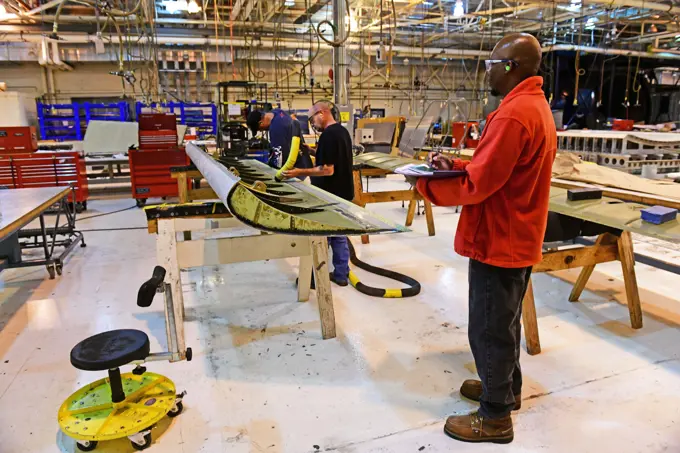
Antonio Driskell, right, Warner Robins Air Logistics Complex quality assurance specialist, observes Edward Brown, center, 574th Composite Repair Flight sheet metal mechanic, and Al Walker, 574th Composite Repair Flight sheet metal mechanic, as they work on a C-5 aircraft wing slat at Robins Air Force Base, Georgia, Sept. 28, 2022. Part of the Quality Assurance Office duties are to observe the work environment and see if workers are cleaning as they go, a process known as good housekeeping.
6145-45154338
At Vandenberg Air Force Base in California, technicians inspect the boattail adaptor interface that will connect the Centaur upper stage to the payload fairing for NASA's upcoming Interior Exploration using Seismic Investigations, Geodesy and Heat Transport, or InSight, mission to land on Mars. InSight will liftoff atop a United Launch Alliance Atlas V rocket to send the spacecraft on the first mission to explore the Red Planet's deep interior. It will investigate processes that shaped the rocky planets of the inner solar system including Earth. Liftoff from Vandenberg is scheduled for May 5, 2018.
6145-44602245
KENNEDY SPACE CENTER, FLA. -  In the Orbiter Processing Facility, the media record workers on the job preparing the orbiter Atlantis for Return to Flight. Both local and national reporters representing print and TV networks were invited to see work in progress on Atlantis, including the reinstallation of the Reinforced Carbon-Carbon panels on the orbiters wing leading edge; wiring inspections; and checks of the engines in the Orbital Maneuvering System.
6145-58969353
An Artemis I Orion cone panel is prepared for welding at the Michoud Assembly Facility in New Orleans, Louisiana on Oct. 12, 2015. Part of Batch image transfer from Flickr.
4128-V58561639
6145-44965252
In the Mojave Desert in California, students and engineers checkout the Garvey Spacecraft Corporation's Prospector P-18D rocket engine. The rocket is scheduled for launch June 15 with the RUBICS-1 payload on a high-altitude, suborbital flight. The rocket will carry four satellites made from four-inch cube section.Collectively known as CubeSats, the satellites will record shock, vibrations and heat inside the rocket. They will not be released during the test flight, but the results will be used to prove or strengthen their designs before they are carried into orbit in 2014 on a much larger rocket. A new, lightweight carrier is also being tested for use on future missions to deploy the small spacecraft. The flight also is being watched closely as a model for trying out new or off-the-shelf technologies quickly before putting them in the pipeline for use on NASA's largest launchers.  Built by several different organizations, including a university, a NASA field center and a high school
6145-44644580
KENNEDY SPACE CENTER, FLA.  - Lockheed Martin technicians from NASA's Michoud Assembly Facility in Louisiana clean the area around the "manhole" on the external tank designated for mission STS-121. The work is part of the process in removing and replacing the external tank's four liquid hydrogen main engine cutoff sensors, which indicate whether the tank still has fuel during its climb to orbit. After the cleaning, the manhole will be removed to provide access to the area of the sensors for their removal.
6145-45049748
CAPE CANAVERAL, Fla. - Inside the Vehicle Assembly Building at NASAs Kennedy Space Center in Florida, ground support technicians have attached crane lines to a portion of the treads on the C truck of crawler-transporter 2, or CT-2, so they can be lifted up and away. The treads are being removed in order to gain access to remove the gear boxes. Work continues in high bay 2 to upgrade CT-2. The modifications are designed to ensure CT-2s ability to transport launch vehicles currently in development, such as the agencys Space Launch System, to the launch pad. The Ground Systems Development and Operations Program office at Kennedy is overseeing the upgrades. For more than 45 years the crawler-transporters were used to transport the mobile launcher platform and the Apollo-Saturn V rockets and, later, space shuttles to Launch Pads 39A and B.
6145-58963670
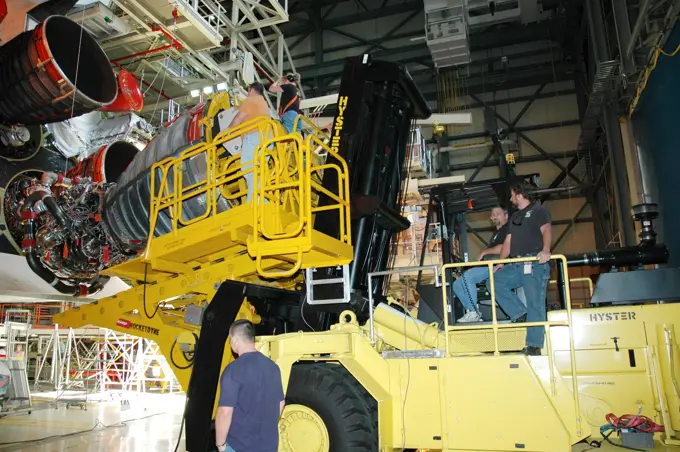
KENNEDY SPACE CENTER, FLA. - In the Orbiter Processing Facility, the Hyster lift raises the third Space Shuttle Main Engine (SSME) into position behind Discovery for installation. Discovery is designated as the Return to Flight vehicle for mission STS-114. Recent improvements to the SSME include the introduction of redesigned high-pressure turbopumps into the SSME fleet. The new pumps are designed and built by Pratt and Whitney at West Palm Beach, Fla. SSMEs and the Pratt and Whitney turbopumps are tested at Stennis Space Center in Mississippi. Engines and engine components are delivered to Kennedy Space Center to be prepared for flight.
1889-13757763
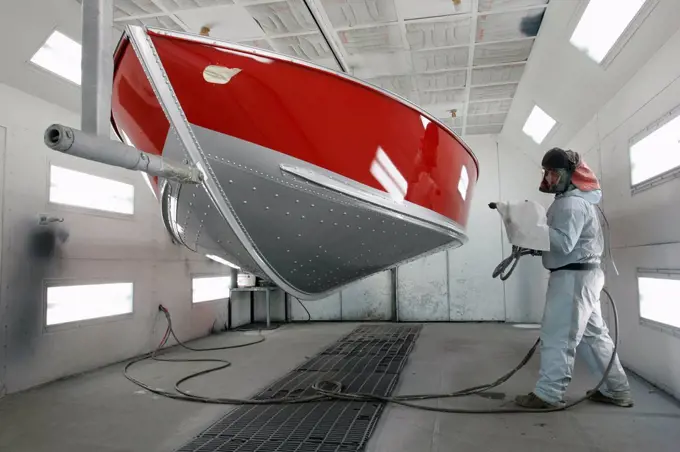
Boat Being Painted In Boat Factory
1815R-13618358
Mechanic opening hangar gate
6145-58969013
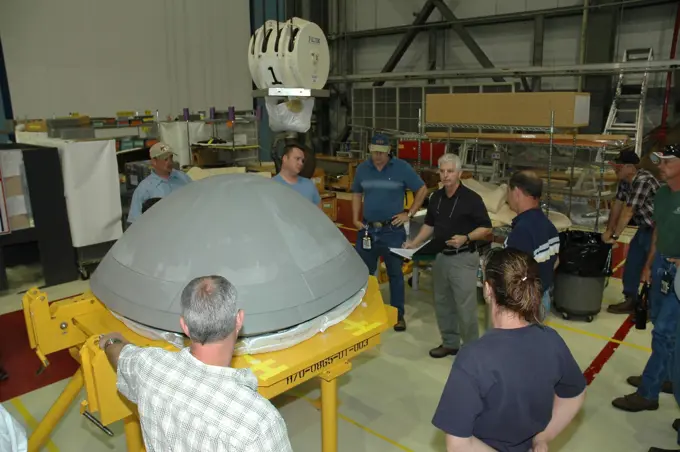
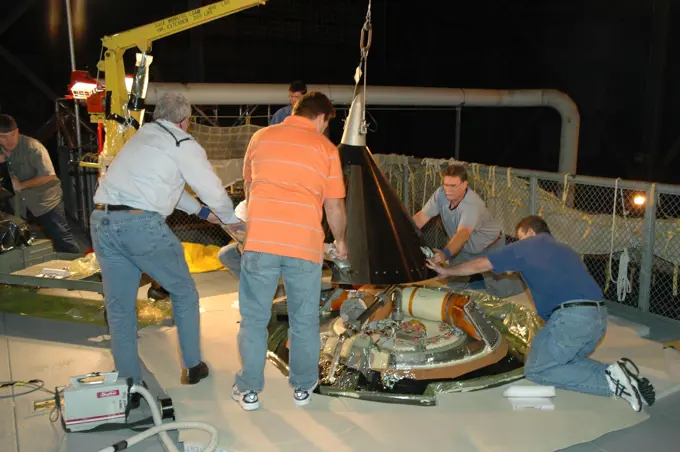
Engineers at Kennedy Space Center prepare the Orion heat shield for transport to Marshall Space Flight Center for testing on March 2, 2015. The heat shield flew on Orion's Exploration Flight Test-1 (EFT-1) in December 2014, protecting the spacecraft from 4000 degree F temperatures during reentry.  Part of Batch image transfer from Flickr.
6145-44645085
KENNEDY SPACE CENTER, FLA. -   In Orbiter Processing Facility bay 2 at NASA's Kennedy Space Center, workers are preparing to move and install the reinforced carbon-carbon nose cap (on the stand) onto Endeavour.  The nose cap is insulated with thermal protection system blankets made of a woven ceramic fabric.  The special blankets help insulate the vehicle's nose cap and protect it from the extreme temperatures it will face during a mission.
6145-58972084
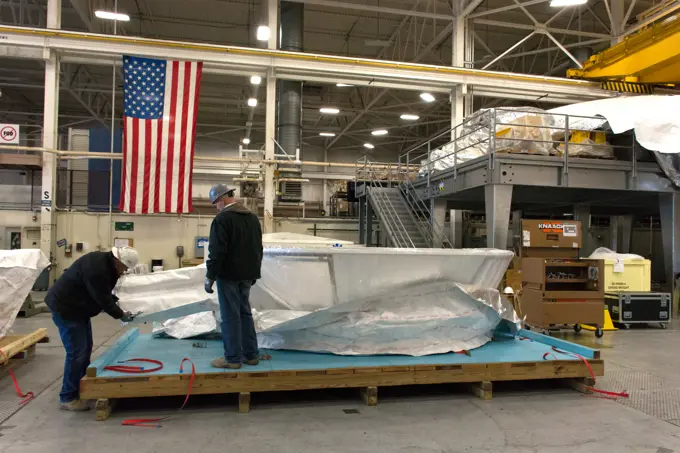
VANDENBERG AIR FORCE BASE, Calif. - In the NASA Building 836 high bay at Vandenberg Air Force Base in California, workers prepare to replace the lid on the shipping container that delivered the fairing for NASA's Orbiting Carbon Observatory-2 mission, or OCO-2. The fairing will protect OCO-2 during launch aboard a United Launch Alliance Delta II rocket from Space Launch Complex 2 in July. OCO-2 will collect precise global measurements of carbon dioxide in the Earth's atmosphere and provide scientists with a better idea of the chemical compound's impacts on climate change. Scientists will analyze this data to improve our understanding of the natural processes and human activities that regulate the abundance and distribution of this important atmospheric gas.
6145-44591024
KENNEDY SPACE CENTER, FLA. - Workers on an upper level of the launch tower on Launch Complex 17-B, Cape Canaveral Air Force Station, watch as the Boeing Delta II second stage is lifted. It will be mated with the first stage, completing the erection of the launch vehicle for NASA's Space Infrared Telescope Facility. SIRTF will obtain images and spectra by detecting the infrared energy, or heat, radiated by objects in space. Most of this infrared radiation is blocked by the Earth's atmosphere and cannot be observed from the ground. Consisting of an 0.85-meter telescope and three cryogenically cooled science instruments, SIRTF is one of NASA's largest infrared telescopes to be launched.
6145-58968434
Technicians at Textron in Wimington, MA, inspect the Exploration Flight Test-1 (EFT-1) Orion heat shield after a cold soak test on Nov. 22, 2013. Part of Batch image transfer from Flickr.
6145-44622731
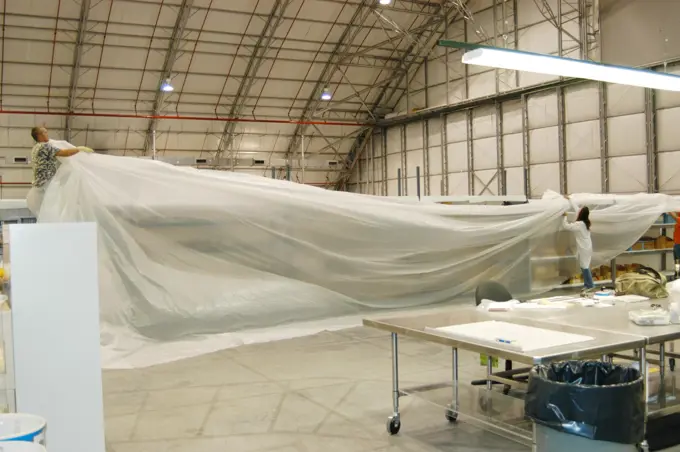
KENNEDY SPACE CENTER, FLA. - In the Reusable Launch Vehicle (RLV) Hangar, workers secure stretch sheets of plastic over racks of equipment in preparation for the arrival of Hurricane Jeanne, expected to impact Central Florida Sunday. This is the fourth hurricane in 45 days to make landfall somewhere in the state.  The Thermal Protection System (TPS) Facility suffered extensive damage from Hurricane Frances, causing the relocation of equipment to the RLV.
6145-44965704
CAPE CANAVERAL, Fla. -- Technicians in the Vehicle Assembly Building at NASAs Kennedy Space Center in Florida, are removing cover plates in preparation for replacing the roller bearing assemblies on crawler-transporter 2, or CT-2. The modifications are designed to ensure CT-2's ability to transport launch vehicles currently in development, such as the agency's Space Launch System which will send the Orion spacecraft carrying humans to new destinations in the solar system.The Ground Systems Development and Operations Program office at Kennedy is overseeing the upgrades to CT-2 so that it can carry NASAs Space Launch System heavy-lift rocket and new Orion spacecraft to the launch pad. For more than 45 years the crawler-transporters were used to transport the mobile launcher platform and the Apollo-Saturn V rockets and, later, space shuttles to Launch Pads 39A and B.
6145-45154336
At Vandenberg Air Force Base in California, technicians inspect the boattail adaptor interface that will connect the Centaur upper stage to the payload fairing for NASA's upcoming Interior Exploration using Seismic Investigations, Geodesy and Heat Transport, or InSight, mission to land on Mars. InSight will liftoff atop a United Launch Alliance Atlas V rocket to send the spacecraft on the first mission to explore the Red Planet's deep interior. It will investigate processes that shaped the rocky planets of the inner solar system including Earth. Liftoff from Vandenberg is scheduled for May 5, 2018.
6145-44604629
KENNEDY SPACE CENTER, FLA. -  In the Orbiter Processing Facility, workers install the liquid oxygen feedline for the 17-inch disconnect on orbiter Discovery. The 17-inch liquid oxygen and liquid hydrogen disconnects provide the propellant feed interface from the external tank to the orbiter main propulsion system and the three Shuttle main engines.
6145-54226101
ROBINS AIR FORCE BASE, Ga. - Clayton Cox, 562nd Aircraft Maintenance Squadron aircraft sheet metal mechanic, taps out screws to remove a C-17 aircraft trailing edge panel at Robins Air Force Base, Georgia, Dec. 8, 2022. Each C-17 aircraft has one of four cycles to be completed based on the age and configuration of the aircraft.
6145-45007188
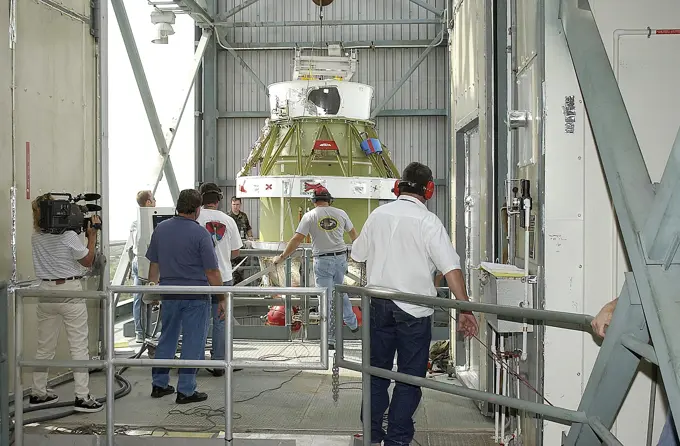
VANDENBERG AIR FORCE BASE, Calif. - As the cover of the transportation trailer is lifted in the high bay of the Building 836 hangar on Vandenberg Air Force Base in California, the second stage for NASA's Orbiting Carbon Observatory-2 mission, or OCO-2, comes into view.OCO-2 is scheduled to launch aboard a United Launch Alliance Delta II rocket from Space Launch Complex 2 in July. The rocket's second stage will insert OCO-2 into a polar Earth orbit.  OCO-2 will collect precise global measurements of carbon dioxide in the Earth's atmosphere and provide scientists with a better idea of the chemical compound's impacts on climate change. Scientists will analyze this data to improve our understanding of the natural processes and human activities that regulate the abundance and distribution of this important atmospheric gas.
6145-44615490
KENNEDY SPACE CENTER, FLA. -- Workers attach a crane to one of the Rudder Speed Brake Actuators that are being removed from the orbiter Atlantis for shipment to the vendor for inspection.  An actuator is a motor that moves the tail rudder back and forth to help steer it during landing and brake its speed. The vertical tail consists of a structural fin surface made of aluminum, the Rudder Speed Brake surface, a tip and a lower trailing edge.  The rudder splits into two halves to serve as a speed brake. The vertical tail and Rudder Speed Brake are covered with a reusable thermal protection system.  Atlantis is undergoing maintenance and inspection in the Orbiter Processing Facility for a future mission.
6145-44622730
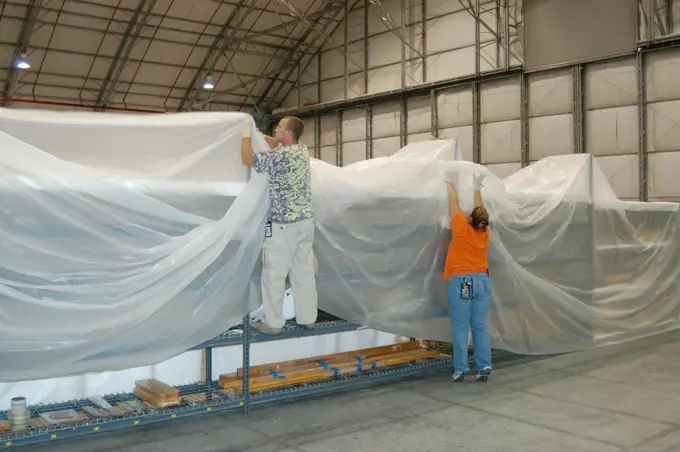
KENNEDY SPACE CENTER, FLA. - In the Reusable Launch Vehicle (RLV) Hangar, workers stretch sheets of plastic over racks of equipment in preparation for the arrival of Hurricane Jeanne, expected to impact Central Florida Sunday. This is the fourth hurricane in 45 days to make landfall somewhere in the state.  The Thermal Protection System (TPS) Facility suffered extensive damage from Hurricane Frances, causing the relocation of equipment to the RLV.
6145-45270817
NASA Administrator Jim Bridenstine looks up at the first core stage of the agencys Space Launch System rocket during a tour of the B-2 Test Stand Monday, Feb. 10, 2020, at NASAs Stennis Space Center near Bay St. Louis, Mississippi. Over the coming months, the first core stage of the SLS rocket will be undergoing a series of integrated Green Run tests prior to its maiden flight.
6145-44602482
In the Vehicle Assembly Building, Jack Nowling, with United Space Alliance, moves a final piece of Columbia debris into place in the Vehicle Assembly Building (VAB). All of the pieces received and collected in the Columbia Reconstruction Hangar have been catalogued and moved to a permanent site in the VAB.
6145-52122266
Technicians prepare to mate the second satellite to Spacecraft II in Bldg. 995. Base: Vandenberg Air Force Base State: California (CA) Country: United States Of America (USA)
6145-45012430
MSL - Atlas 2nd Stage Move Lift & Stacking
6145-44648482
KENNEDY SPACE CENTER, FLA. -     In the Orbiter Processing Facility bay 1, workers look over a new window they installed in Atlantis.  The orbiter is being processed for launch in late August on mission STS-115. It will carry a truss and other key components on the Space Shuttle Program's 19th mission to the International Space Station.
6145-44560730
KENNEDY SPACE CENTER, FLA. -- The Z1 Integrated Truss Segment (ITS), a major element of the STS-92 mission scheduled for launch aboard Space Shuttle Atlantis in January 1999, is lowered into its workstand for processing in KSC's Space Station Processing Facility (SSPF). The Z-1 truss supports the staged buildup of International Space Station (ISS) on this third scheduled flight for ISS. The Z1 truss allows the temporary installation of the U.S. power module to Node 1. Early in the assembly sequence, the purpose of Z1 is to provide a mounting location for Ku-band and S-band telemetry and extravehicular activity (EVA) equipment. It also provides common berthing mechanism hardcover stowage. In addition, it will assist with the execution of nonpropulsive attitude control. The truss arrived at KSC on Feb. 17 for preflight processing in the SSPF
6145-58969354
An Artemis I Orion cone panel is prepared for welding at the Michoud Assembly Facility in New Orleans, Louisiana on Oct. 12, 2015. Part of Batch image transfer from Flickr.
6145-44778516
CAPE CANAVERAL, Fla. - In the Vehicle Assembly Building at NASA's Kennedy Space Centers in Florida, a technician sets up equipment to support terahertz scans of five ice frost ramps on the external fuel tank, designated ET-133, for space shuttle Atlantis STS-129 mission.  The ice frost ramps are made from foam insulation and cover brackets that hold pressurization lines on the outside of the external tank. Terahertz scans are wave frequency analysis in the infrared band that can see through the foam insulation to help look for any voids or pockets where the foam is not bonded to the metal primer. The ramps being scanned were on the top part of the tank in the same area where foam came off during the last two shuttle launches. The data will be used to help assess whether foam on ET-132, the fuel tank attached to shuttle Discovery at Kennedys Launch Pad 39A, is fit for its flight on the STS-128 mission to the International Space Station.
6145-44624285
The Soyuz TMA-5 spacecraft is mated to its booster rocket in a processing hangar at the Baikonur Cosmodrome in Kazakhstan Monday, October 11, 2004, in preparation for its rollout to the launch pad October 12 and its liftoff October 14 to carry Expedition 10 Commander and NASA Science Officer Leroy Chiao, Flight Engineer and Soyuz Commander Salizhan Sharipov and Russian Space Forces cosmonaut Yuri Shargin to the International Space Station.
6145-44644604
KENNEDY SPACE CENTER, FLA. -  In the Vehicle Assembly Building at NASA's Kennedy Space Center, workers remove the nose cap on top of external tank number 119, the tank designated for mission STS-121.  The cap is being removed in order to install a new gaseous oxygen vent valve under the nose cap. Vapors are created prior to launch as the liquid oxygen in the external tank boils off. At the forward end of each external tank propellant tank is a vent and relief valve that can be opened before launch for venting or by excessive tank pressure for relief. The vent function is available only before launch. Mission STS-121 to the International Space Station is scheduled for launch in July.
6145-44695639
KENNEDY SPACE CENTER, FLA. --  In the hypergolic maintenance facility at NASA's Kennedy Space Center, a technician (right) adjusts equipment during testing of the Ares I-X Roll Control System, or RoCS.  The RoCS Servicing Simulation Test is to gather data that will be used to help certify the ground support equipment design and validate the servicing requirements and processes. The RoCS is part of the Interstage structure, the lowest axial segment of the Upper Stage Simulator.  In an effort to reduce costs and meet the  schedule, most of the ground support equipment that will be used for the RoCS servicing is of space shuttle heritage.  This high-fidelity servicing simulation will provide confidence that servicing requirements can be met with the heritage system.  At the same time, the test will gather process data that will be used to modify or refine the equipment and processes to be used for the actual flight element.
6145-58969102
NASA and Lockheed Martin Orion leadership visits the team at Michoud Assembly Facility in New Orleans, Louisiana to thank them for their efforts in building the Orion spacecraft for Exploration Flight Test-1 (EFT-1) on March 16, 2015.  Part of Batch image transfer from Flickr.
6145-44731957
CAPE CANAVERAL, Fla. -  Inside the Vehicle Assembly Building high bay 4 at NASA's Kennedy Space Center in Florida, workers from NASA's Glenn Research Center remove the blue shrink-wrapped covers on these Ares I-X upper stage simulator segments.  The protective covers were used for shipping.  The upper stage simulator will be used in the test flight identified as Ares I-X in 2009.  The segments will simulate the mass and the outer mold line and will be more than 100 feet of the total vehicle height of 327 feet.  The simulator comprises 11 segments that are approximately 18 feet in diameter.  Most of the segments will be approximately 10 feet high, ranging in weight from 18,000 to 60,000 pounds, for a total of approximately 450,000 pounds.
1589R-13339653
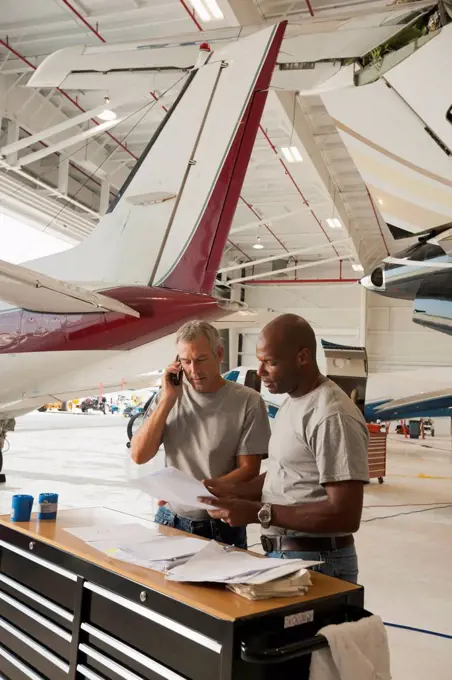
Men working in airplane hangar
6145-44583585
KENNEDY SPACE CENTER, FLA. - Workers on the launch tower on NASA's Space Launch Complex 2 (SLC-2), Vandenberg Air Force Base, Calif., help guide the interstage of the Delta II rocket toward the first stage. The rocket will carry the ICESat and CHIPSat satellites into Earth orbits. ICESat is a 661-pound satellite known as Geoscience Laser Altimeter System (GLAS) that will revolutionize our understanding of ice and its role in global climate change and how we protect and understand our home planet.  It will help scientists determine if the global sea level is rising or falling.  It will look at the ice sheets that blanket the Earth's poles to see if they are growing or shrinking.  It will assist in developing an understanding of how changes in the Earth's atmosphere and climate effect polar ice masses and global sea level. CHIPSat, a suitcase-size 131-pound satellite, will provide invaluable information into the origin, physical processes and properties of the hot gas contained in the in
6145-44648480
KENNEDY SPACE CENTER, FLA. -    In the Orbiter Processing Facility bay 1, workers lift the new window to be installed in Atlantis. The orbiter is being processed for launch in late August on mission STS-115. It will carry a truss and other key components on the Space Shuttle Program's 19th mission to the International Space Station.
6145-58963701
KENNEDY SPACE CENTER, FLA. - In the mobile service tower on Pad 17-B, Cape Canaveral Air Force Station , Fla., the Boeing Delta II interstage adapter is being lowered out of the tower. The interstage adapter was found to be faulty during a review of launch vehicle hardware. It will be replaced, and the second stage previously removed will be re-installed within a few days. Launch of Deep Impact is now scheduled no earlier than Jan. 12.
6145-44616303
KENNEDY SPACE CENTER, FLA.  -  United Space Alliance technician J.C. Harrison steers while NASAs Scott Thurston guides a piece of Columbia debris through a gate in the Vehicle Assembly Building, where the debris is stored.  This piece is one of eight being released to The Aerospace Corporation in El Segundo, Calif., for testing and research.  Thurston is the Columbia debris coordinator. The Aerospace Corporation requested and will receive graphite/epoxy honeycomb skins from an Orbital Maneuvering System pod, Main Propulsion System Helium tanks, a Reaction Control System Helium tank and a Power Reactant Storage Distribution system tank. The company will use the parts to study re-entry effects on composite materials. NASA notified the Columbia crews families about the loan before releasing the items for study.  Researchers believe the testing will show how materials are expected to respond to various heating and loads' environments. The findings will help calibrate tools and models use
6145-44645820
KENNEDY SPACE CENTER, FLA. -- In the transfer aisle of the Vehicle Assembly Building, a worker packs type 2 ablator over the bolts around the "manhole" or cover on the bottom of external tank number 119.  The manhole was removed to access the area where the tank's four liquid hydrogen engine cutoff sensors were replaced. The tank is being prepared to launch Space Shuttle Discovery on mission STS-121 in July.
6145-58969408
MAF Orion MGMT Visit
6145-58967950
T&R/Atlantis, Window #4 installation and Inspection
6145-45074842
CAPE CANAVERAL, Fla. -- At NASA's Kennedy Space Center in Florida, Mike Tillema, chief of Flight Operations in the Operations Support Division of NASA Center Operations, center, discusses plans for a training session to practice use of a Bambi Bucket in honing firefighting techniques. Bill Martin, a URS Federal Technical Services pilot in NASA Flight Operations, is on the left, with crew chief Mark Smith, also of URS.Firefighters respond to wildfires with teams on the ground and in the air. The most up-to-date tools include helicopters that use Bambi Buckets large quantities of water. NASA Flight Operations teams are training to perfect the skills needed to ensure they are ready to use tools, such as the Bambi Bucket, in the event of an out-of-control blaze at the spaceport.
1848-49854052
Germany, Berlin, 25. 11. 2020, BER, check-in, baggage claim, Terminal 1, Europe
6145-58963036
KENNEDY SPACE CENTER, FLA. - At NASAs Kennedy Space Center, the 2004 class of astronaut candidates get a close look at an External Tank in the Vehicle Assembly Building. The class of 14 candidates includes three candidates from the Japan Aerospace Exploration Agency as well as three educator astronauts, who were school teachers chosen from thousands of applicants.
6145-58961216
KENNEDY SPACE CENTER, FLA. - In NASAs Orbiter Processing Facility bay 2, workers gather as the orbiter Endeavours electrical system is partially powered up, after nearly 2 years. Full power-up will take place in October. Endeavour has been in its Orbiter Major Modification period, which began in December 2003. In that time, 124 modifications were completed, including installing the glass cockpit; 150 miles of wiring were inspected; and more than 1,000 tiles were bonded. This is the second full modification conducted at Kennedy.
6145-44525001
KENNEDY SPACE CENTER, FLA. -- Banks of lights dry tiles on orbiter Atlantis in the Orbiter Processing Facility. Significant rainstorms during the orbiters turnaround for a ferry flight home from Edwards Air Force Base, Calif., caused the moisture problem. The tiles are part of the Thermal Protection System used on orbiters for extreme temperatures encountered during landing
6145-44595007
KENNEDY SPACE CENTER, FLA. -  A member of the Columbia Reconstruction Project Team refers to the drawings of Columbia behind her as she explains current results of the investigation.  The final shipment of debris arrived on this date - recovery efforts have been concluded in East Texas.  Prior to this final shipment, the total number of items at KSC is 82,567, weighing 84,800 pounds or 38 percent of the total dry weight of Columbia.  Of those items, 78,760 have been identified, with 753 placed on the left wing grid in the RLV Hangar.
6145-45147954
NOAA's Geostationary Operation Environmental Satellite-S (GOES-S) is being offloaded from a C-5 transport aircraft onto the flatbed of a heavy-lift truck at the Shuttle Landing Facility at NASA's Kennedy Space Center in Florida. The satellite will be transported to the Astrotech Space Operations facility in Titusville, Florida to prepare it for launch. GOES-S is the second in a series of four advanced geostationary weather satellites. The GOES-R series - consisting of the GOES-R, GOES-S, GOES-T and GOES-U spacecraft - will significantly improve the detection and observation of environmental phenomena that directly affect public safety, protection of property and the nation's economic health and prosperity. GOES-S is slated to launch March 1, 2018 aboard a United Launch Alliance Atlas V rocket from Cape Canaveral Air Force Station in Florida.
6145-44594201
KENNEDY SPACE CENTER, FLA. - In the RLV Hangar, Shuttle Test Director Steve Altemus (left), a member of the Columbia Reconstruction Project Team, discusses the status of the investigation into the Space Shuttle Columbia accident with NASA Administrator Sean O'Keefe (right). To date, more than 70,000 items have been delivered to KSC for use in the ongoing mishap investigation.
4409-50086898
Barcelona, 01/17/2019. Ferrán Adria at Elbullifoundation. Photos: Ines Baucells Archdc.
4329-170
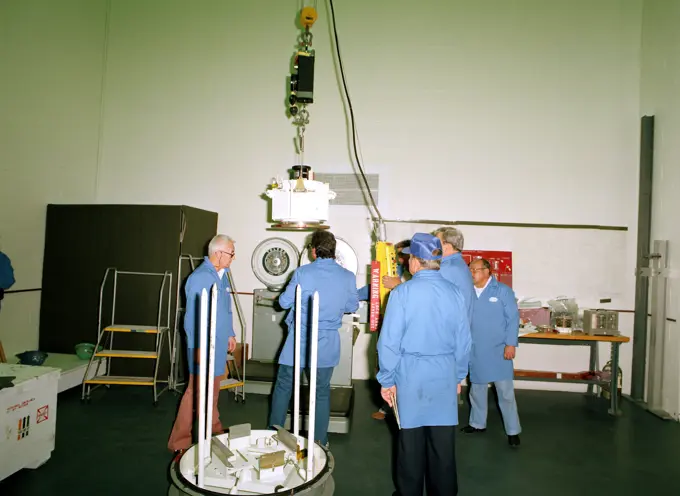
Professional telescope builder Jim Wray is dwarfed by the giant fork arms for a 24" computer controlled telescope that is going to Palomar Observatory. Jim builds each telescope from parts that he has designed and eash telescope is hand assembled.
6145-52284471
Depot aircraft equipment (DVM). Maintenance and overhaul to Bölkow BO-105C helicopters.
6145-44798179
STS-132 ATLANTIS - RCC PANEL REMOVAL
6145-45165627
On the third day of NASA's 9th Robotic Mining Competition, May 16, judges watch as a robot miner digs in the dirt in the mining arena at NASA's Kennedy Space Center Visitor Complex in Florida. More than 40 student teams from colleges and universities around the U.S. will use their mining robots to dig in a supersized sandbox filled with BP-1, or simulated Lunar soil, gravel and rocks, and participate in other competition requirements. The Robotic Mining Competition is a NASA Human Exploration and Operations Mission Directorate project designed to encourage students in science, technology, engineering and math, or STEM fields. The project provides a competitive environment to foster innovative ideas and solutions that could be used on NASA's deep space missions.
6145-58958534
CAPE CANAVERAL, Fla. -- At the Kennedy Space Center Visitor Complex in Florida, construction crews remove 16,000 square feet of plastic shrink-wrap from the space shuttle Atlantis. The spacecraft was enclosed in the plastic shrink-wrap since November of last year to protect the artifact from dust and debris during construction of the 90,000-square-foot facility. Last November, the space shuttle Atlantis made its historic final journey to its new home, traveling 10 miles from the Kennedy Space Center's Vehicle Assembly Building to the spaceport's visitor complex. The new $100 million 'Space Shuttle Atlantis' facility will include interactive exhibits that tell the story of the 30-year Space Shuttle Program and highlights the future of space exploration. The 'Space Shuttle Atlantis' exhibit scheduled to open June 29, 2013.
6145-45093365
JOHNNY STEPHENSON, PATRICK SCHEUERMANN, AND AARON STANFIELD WITH SCALE MODLS OF SLS MOBILE LAUNCH PLATFORM AND CRAWLER
7137-70494535
Engineers work at the Beechcraft factory in Wichita, Kansas.
6145-58962243
KENNEDY SPACE CENTER, FLA. - At the Cape Canaveral Air Force Station Skid Strip, workers inside a Russian Antonov AH-124-100 cargo airplane roll out the booster segment for a Lockheed Martin Atlas V. The Atlas V, designated AV-007, is the launch vehicle for the Mars Reconnaissance Orbiter (MRO). The MRO is designed for a series of global mapping, regional survey and targeted observations from a near-polar, low-altitude Mars orbit. These observations will be unprecedented in terms of the spatial resolution and coverage achieved by the orbiters instruments as they observe the atmosphere and surface of Mars while probing its shallow subsurface as part of a follow the water strategy. The orbiter is undergoing environmental tests in facilities at Lockheed Martin Space Systems in Denver, Colo., and is on schedule for a launch window that begins Aug. 10. Launch will be from Launch Pad 41 at Cape Canaveral Air Force Station in Florida.
6188-62364270
Museum Art Culture Science Air Force Museum Berlin
6145-58967299
Technicians begin welding the Exploration Flight Test-1 (EFT-1) Orion pressure vessel at NASAs Michoud Assembly Facility in New Orleans on Sept. 9, 2011. Orions pressure vessel is underlying frame of the crew module that will provide an air-tight, habitable space for astronauts on future missions to the Moon. Part of Batch image transfer from Flickr.
6145-54165010
Matthew Miller, left, 572nd Commodities Maintenance Support Squadron Life Support survival equipment repairer, and Victor Ware, 572nd Commodities Maintenance Support Squadron Life Support work repairer, pack a 20-man life raft into a crate at Robins Air Force Base, Georgia, July 20, 2022. Once the raft is in the crate it is placed in an oven for several hours to soften the material.
6145-44735630
CAPE CANAVERAL, Fla. -  At the Parachute Refurbishment Facility at NASA's Kennedy Space Center in Florida, workers begin hanging the parachutes recovered from sea after the launch of space shuttle Endeavour on the STS-126 mission onto a monorail system. The parachutes are used to slow the descent of the solid rocket boosters that are jettisoned during liftoff.  The monorail will transport each parachute into a 30,000-gallon washer and a huge dryer heated with 140-degree air at 13,000 cubic feet per minute. One pilot, one drogue and three main canopies per booster slow the boosters fall from about 360 mph to 50 mph.  After the chutes are cleaned and repaired, they must be carefully packed into their bags so they will deploy correctly the next time they are used.
6145-45290449
Teams with NASAs Exploration Ground Systems and supporting contractors conduct prototype testing of a new rainbird system at the agencys Kennedy Space Center in Florida on March 24, 2021, that can be used for the crewed Artemis II mission to the Moon. Rainbirds are large water nozzles located on the mobile launcher (ML) that release a high volume of water when the Space Launch System (SLS) rocket lifts off, protecting the vehicle, launch pad, and ML by absorbing some of the heat and energy generated during launch. The test involved running various water pressures through small-scale, 3D-printed nozzles to capture data that can be used to develop full-scale replacement nozzles for future missions under the Artemis program.
6145-44689358
Under the goals of the Vision for Space Exploration, Ares I is a chief component of the cost-effective space transportation infrastructure being developed by NASA's Constellation Program. This transportation system will safely and reliably carry human explorers back to the moon, and then onward to Mars and other destinations in the solar system. The Ares I effort includes multiple project element teams at NASA centers and contract organizations around the nation, and is managed by the Exploration Launch Projects Office at NASA's Marshall Space Flight Center (MFSC). ATK Launch Systems near Brigham City, Utah, is the prime contractor for the first stage booster. ATK's subcontractor, United Space Alliance of Houston, is designing, developing and testing the parachutes at its facilities at NASA's Kennedy Space Center in Florida. NASA's Johnson Space Center in Houston hosts the Constellation Program and Orion Crew Capsule Project Office and provides test instrumentation and support personne
6145-45055556
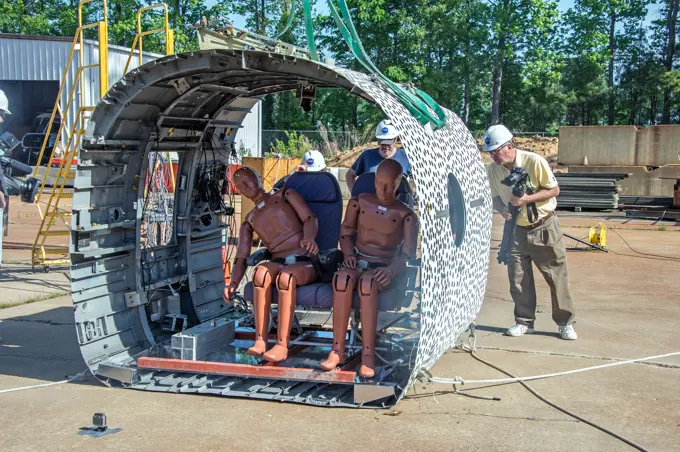
(Tract)2 Transport Rotorcraft Airframe Crash Testbed; Full Frame Drop Test: rotary wing crash worthiness, impact research at NASA Langley Research Center's Landing and Impact Research (LandIR) Facility  Building 1297
6145-48907380
OLYMPUS DIGITAL CAMERA
6145-45148673
Inside the Prototype Development Laboratory at NASA's Kennedy Space Center in Florida, engineers and technicians hold a banner marking the successful delivery of a liquid oxygen test tank called Tardis. From left, are Todd Steinrock, chief, Fabrication and Development Branch, Prototype Development Lab; David McLaughlin, electrical engineering technician; Phil Stroda, mechanical engineering technician; Perry Dickey, lead electrical engineering technician; and Harold McAmis, lead mechanical engineering technician. Engineers and technicians worked together to develop the tank and build it at the lab to support cryogenic testing at Johnson Space Center's White Sands Test Facility in Las Cruces, New Mexico. The 12-foot-tall, 3,810-pound aluminum tank will be shipped to White Sands for testing.
PREVIOUS
of 2
NEXT
2401 S. Ervay, Suite 206
Dallas, Texas 75215
United States
Get Started
Free ResearchMy BoardsMy Cart
For Creators
How To License Your ContentContributor PortalFrame of Mind
Resources
API accessPricing
Contact
+1 866 236 0087help@viewpictures.co.uk Contact form
©2026 View Pictures. All Rights Reserved. -A
This site is protected by reCAPTCHA and Google Privacy Policy and Terms of Service apply.