My Boards
View Pictures
  • My Boards

Spacecraft Preparation and Launch

Images depict the handling of spacecraft components at a launch facility, showcasing the preparation of rocket fairings and panels for NASA missions.

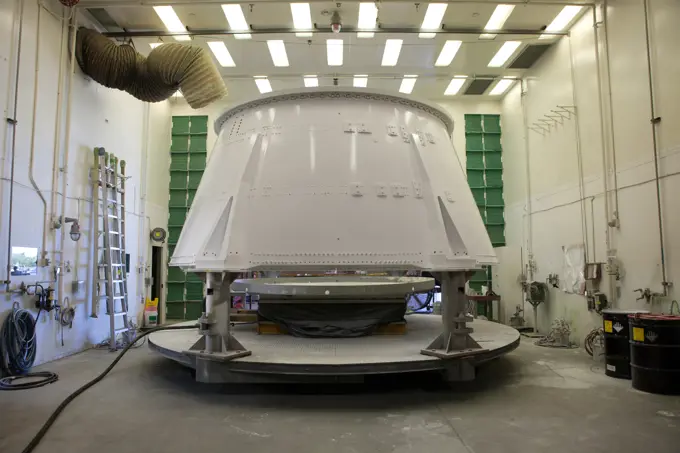
The launch abort system ogive panels are prepared for installation onto the Orion Exploration Flight Test-1 (EFT-1) launch abort system in the Launch Abort System Facility (LASF) at Kennedy Space Center on April 16, 2014. Part of Batch image transfer from Flickr.
173 assets in this story
6145-58959378
VANDENBERG AFB, Calif. - Technicians begin processing NASA's IRIS spacecraft at Vandenberg where the spacecraft will be readied for launch aboard an Orbital Sciences Pegasus XL rocket. IRIS is short for Interface Region Imaging Spectrograph and the spacecraft's mission will improve our understanding of how heat and energy move through the deepest levels of the suns atmosphere, thereby increasing our ability to forecast space weather.
6145-45124508
Inside an environmentally controlled shipping container the Orbital ATK OA-7 Cygnus spacecraft's pressurized cargo module (PCM) moves from an airlock to the high bay of the Space Station Processing Facility of NASA's Kennedy Space Center in Florida. Scheduled to launch on March 19, 2017, the Orbital ATK OA-7 mission will lift off atop a United Launch Alliance Atlas V rocket from Space launch Complex 41 at Cape Canaveral Air Force Station. The commercial resupply services mission to the International Space Station will deliver thousands of pounds of supplies, equipment and scientific research materials that improve life on Earth and drive progress toward future space exploration.
6145-45081526
CAPE CANAVERAL, Fla. - At NASA's Kennedy Space Center in Florida, assembly has begun on the first of 24 light emitting diode LED panels for installation in the new countdown clock at the spaceport's Press Site. The new modern, multimedia display will be similar to the screens seen at sporting venues. The new screen will be nearly 26 feet wide by 7 feet high, a foot taller than the original clock.The historic countdown clock was designed by Kennedy engineers and built by space center technicians before Apollo 12 in 1969. NASA has requested to acquire the countdown clock from the agencys Artifact Working Group at the agency's Headquarters for likely display at the Kennedy Space Center Visitor Complex.
6145-44703613
VANDENBERG AIR FORCE BASE, Calif.  -  Ground support equipment associated with the OSTM/Jason-2 satellite is offloaded from the cargo plane at Vandenberg Air Force Base.  The equipment will accompany the satellite to the Astrotech processing facility.  The OSTM, or Ocean Topography Mission, on the Jason-2 satellite is a follow-on to Jason-1. It will take oceanographic studies of sea surface height into an operational mode for continued climate forecasting research and science and industrial applications.  This satellite altimetry data will help determine ocean circulation, climate change and sea-level rise. OSTM is a joint effort by the National Oceanic and Atmospheric Administration, NASA, Frances Centre National dEtudes Spatiales and the European Meteorological Satellite Organisation. OSTM/Jason-2 will be launched aboard a United Launch Alliance Delta II 7320 from Vandenberg on June 15.
6145-45154846
Inside Building 836 at Vandenberg Air Force Base in California, the first half of the payload fairing for the United Launch Alliance (ULA) Delta II rocket has been lifted out of its shipping container. The metal framing around it is being secured on a stand that allows the fairing to be rotated. NASA's Ice, Cloud and land Elevation Satellite-2 (ICESat-2) is scheduled to launch on the final ULA Delta II rocket later this year. ICESat-2 will measure the height of a changing Earth, one laser pulse at a time, 10,000 laser pulses a second. The satellite will carry a single instrument, the Advanced Topographic Laser Altimeter System. ICESat-2 will help scientists investigate why, and how much our planet's frozen and icy areas, called the cryosphere, is changing in a warming climate.
6145-45114220
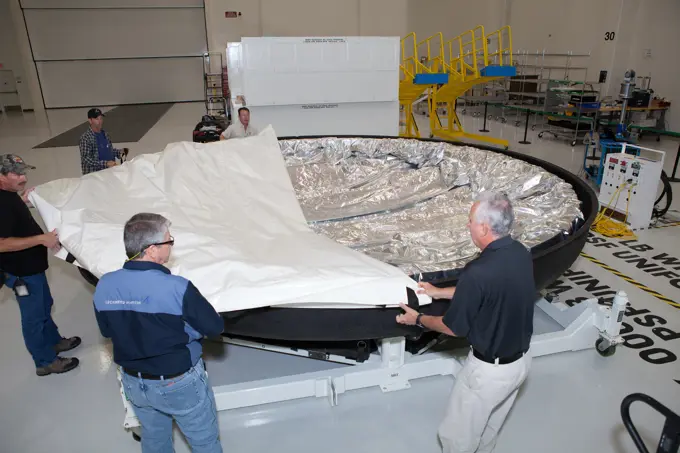
Inside the high bay in the Neil Armstrong Operations and Checkout Building at NASAs Kennedy Space Center in Florida, technicians with Lockheed Martin start to remove the protective covering from the Orion heat shield for Exploration Mission 1 (EM-1). The heat shield arrived aboard NASAs Super Guppy aircraft at the Shuttle Landing Facility, managed and operated by Space Florida, from Lockheed Martins manufacturing facility near Denver. The Orion spacecraft will launch atop NASAs Space Launch System rocket on EM-1, an uncrewed test flight, targeted for November 2018.
6145-45056021
CAPE CANAVERAL, Fla. - Part of NASA's International Space Station-RapidScat scatterometer instrument is visible inside its protective enclosure as it arrives at the Space Station Processing Facility at Kennedy Space Center in Florida.ISS-RapidScat is the first scientific Earth-observing instrument designed to operate from the exterior of the space station. It will measure Earth's ocean surface wind speed and direction, providing data to be used in weather and marine forecasting. Built at NASA's Jet Propulsion Laboratory, ISS-RapidScat is slated to fly on the SpaceX-4 commercial cargo resupply flight in 2014.
6145-58958428
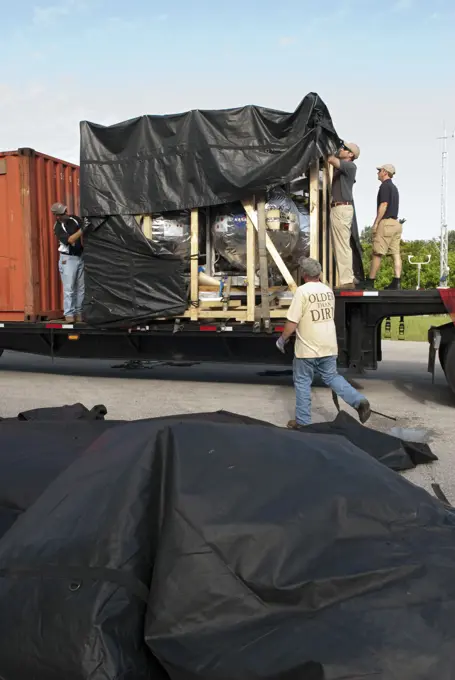
VANDENBERG AFB, Calif. - Workers unload NASA's IRIS spacecraft from a truck at the processing facility at Vandenberg where the spacecraft will be readied for launch aboard an Orbital Sciences Pegasus XL rocket. IRIS is short for Interface Region Imaging Spectrograph and the spacecraft's mission will improve our understanding of how heat and energy move through the deepest levels of the suns atmosphere, thereby increasing our ability to forecast space weather.
6145-44828076
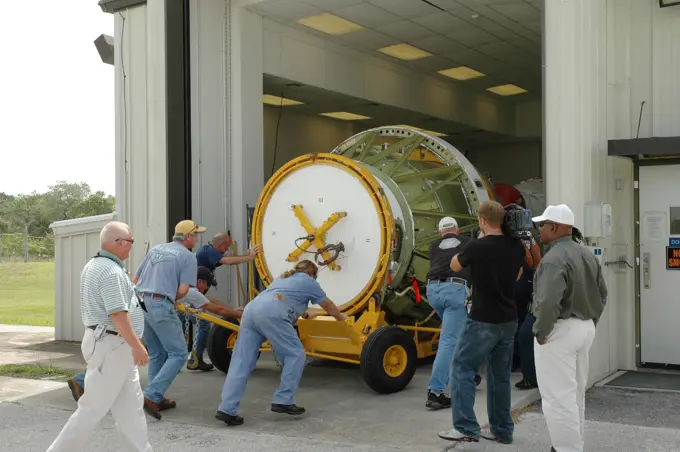
VANDENBERG AIR FORCE BASE, Calif. -- At Vandenberg Air Force Base in California, workers cautiously roll one half of the fairing that will envelop NASA's Glory satellite into VAFB's payload processing facility. Both halves of the fairing will be installed around the spacecraft to protect it from the weather on the ground as well as from the atmosphere during flight.A four-stage Taurus XL rocket will carry Glory into low Earth orbit. Once Glory reaches orbit, it will collect data on the properties of aerosols and black carbon. It also will help scientists understand how the sun's irradiance affects Earth's climate. Launch is scheduled for 2:09 a.m. PST Nov. 22. For information, visit www.nasa.gov/glory.
6145-54676613
Artemis III Core Stage Segment Move to Work Stand. The engine section of the Space Launch System rockets core stage for NASAs Artemis III mission arrives at the Space Station Processing Facility (SSPF) at NASAs Kennedy Space Center in Florida on Dec. 15, 2022. The section was shipped from Michoud Assembly Facility in New Orleans on Dec. 10, 2022 aboard the Pegasus barge, was offloaded, and transferred to the SSPF. Teams will begin processing operations ahead of final integration in the Vehicle Assembly Building. Artemis III will send astronauts, including the first woman and first person of color, on a mission aboard the Orion spacecraft to the surface of the Moon.
6145-44717270
CAPE CANAVERAL, Fla. - In the Payload Hazardous Servicing Facility at NASA's Kennedy Space Center, a technician removes the protective cover from the Soft Capture and Rendezvous System, or SCRS.  The SCRS will enable the future rendezvous, capture and safe disposal of Hubble by either a crewed or robotic mission. The SCRS greatly increases the current shuttle capture interfaces on Hubble, therefore significantly reducing the rendezvous and capture design complexities associated with the disposal mission. The SCRS comprises the Soft Capture Mechanism system and the Relative Navigation System and is part of the payload on the fifth and final Hubble servicing mission, STS-125, targeted for launch Oct. 8.
6145-44889125
CAPE CANAVERAL, Fla. - This overhead view of the prototype rover Artemis Jr. for NASAs Regolith and Environment Science and Oxygen and Lunar Volatile Extraction, or RESOLVE, project was taken in a test facility behind the Operations and Checkout Building at NASAs Kennedy Space Center in Florida and provides a clear view of its solar array, as well as the placement of the ramps that provide it with an avenue to mount or dismount the prototype lander beneath it. RESOLVE consists of a rover and drill provided by the Canadian Space Agency to support a NASA payload that is designed to prospect for water, ice and other lunar resources. RESOLVE also will demonstrate how future explorers can take advantage of resources at potential landing sites by manufacturing oxygen from soil. NASA will conduct field tests in July outside of Hilo, Hawaii, with equipment and concept vehicles that demonstrate how explorers might prospect for resources and make their own oxygen for survival while on other
6145-44834735
CAPE CANAVERAL, Fla. -- In the Canister Rotation Facility at NASA's Kennedy Space Center in Florida, workers monitor the progress of the payload canister as an overhead crane rotates it into a vertical position.The canister will then be delivered to Launch Pad 39A, lifted into the rotating service structure where the module will be moved into the clean room before it is installed into space shuttle Discovery's payload bay. Discovery and its STS-133 crew will deliver the PMM, packed with supplies and critical spare parts, as well as Robonaut 2, the dexterous humanoid astronaut helper, to the International Space Station. Launch is targeted for 4:40 p.m. EDT, Nov. 1.
6145-44508388
KENNEDY SPACE CENTER, FLA. --  In the Space Station Processing Facility, an overhead crane lowers the cover from the SPACEHAB module (at left) onto the floor. The module, part of the payload on mission STS-106, will be placed in the payload canister for transport to the launch pad. STS-106 is scheduled to launch Sept. 8 at 8:31 a.m. EDT
6145-44917905
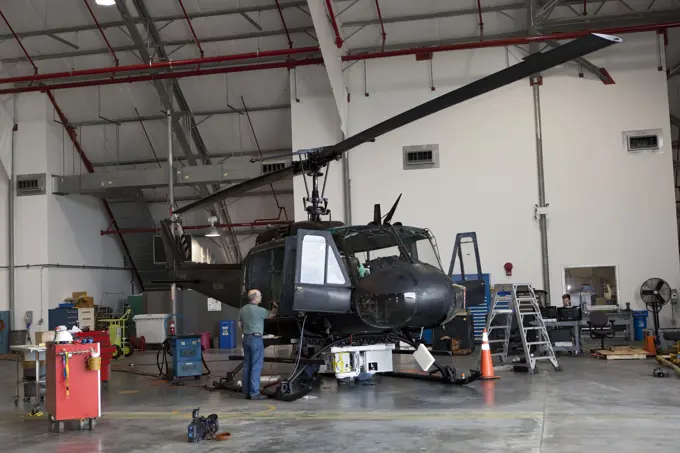
CAPE CANAVERAL, Fla. - Near the Shuttle Landing Facility at NASA's Kennedy Space Center in Florida, hazard avoidance instrumentation it being prepared for installation on a Huey helicopter.Led by the Johnson Space Center and supported by Jet Propulsion Laboratory and Langley Research Center, the Autonomous Landing Hazard Avoidance Technology, or ALHAT, laser system provides a planetary lander the ability to precisely land safely on a surface while detecting any dangerous obstacles such as rocks, holes and slopes. Just north of Kennedy's Shuttle Landing Facility runway, a rock- and crater-filled planetary scape has been built so engineers can test the ability to negotiate away from risks.
6145-45157344
General overview and detail, Close-Out, photos of the  SLS Orion Stage Adapter EM-1...exterior overall views (5)
6145-55975028
SWOT Spacecraft Transport from Astrotech to SpaceX Facility. The Surface Water and Ocean Topography (SWOT) spacecraft is transported from Astrotech to the SpaceX facility at Vandenberg Space Force Base in California on Nov. 21, 2022. SWOT is the first mission that will observe nearly all water on Earths surface, measuring the height of water in the planets lakes, rivers, reservoirs, and the ocean. The satellite is set to launch aboard a SpaceX Falcon 9 rocket in December from Vandenbergs Space Launch Center-4 East. NASAs Launch Services Program, based at the agencys Kennedy Space Center in Florida, is managing the launch service.
6145-44828097
VANDENBERG AIR FORCE BASE, Calif. -- At Vandenberg Air Force Base in California, the payload cone for NASA's Glory mission is pictures secured inside its cargo carrier. The payload cone is an adapter that interfaces the Taurus XL rocket with the spacecraft.A four-stage Taurus XL rocket will carry Glory into low Earth orbit. Once Glory reaches orbit, it will collect data on the properties of aerosols and black carbon. It also will help scientists understand how the sun's irradiance affects Earth's climate. Launch is scheduled for 2:09 a.m. PST Nov. 22. For information, visit www.nasa.gov/glory.
6145-58971549
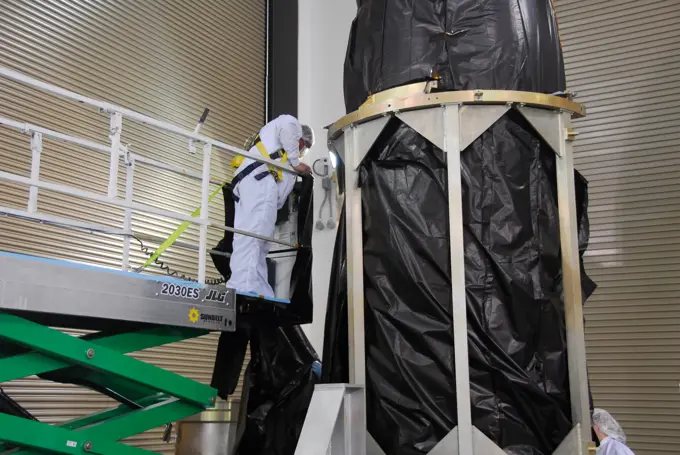
VANDENBERG AIR FORCE BASE, Calif. -- A technician prepare to remove the covering of the payload fairing for the Glory mission. He is working inside the Astrotech payload processing facility at Vandenberg Air Force Base in California. The payload fairing will protect the Glory spacecraft from aerodynamic pressures and heating during the first part of its climb into orbit. Once Glory reaches orbit, it will collect data on the properties of aerosols and black carbon. It also will help scientists understand how the sun's irradiance affects Earth's climate. Launch is scheduled for 5:09 a.m. EST Feb. 23.
6145-44573083
KENNEDY SPACE CENTER, FLA. -- An overhead crane lifts the saucer-like 27.5-ton lid of an altitude chamber in the Operations and Checkout Building high bay. The chamber was recently reactivated, after a 24-year hiatus, to perform leak tests on International Space Station pressurized modules at the launch site. Originally, two chambers were built to test Apollo Program flight hardware. They were last used in 1975 during the Apollo-Soyuz Test Project. After installation of new vacuum pumping equipment and controls, a new control room, and a new rotation handling fixture, the chamber again became operational in February 1999. The chamber, which is 33 feet in diameter and 50 feet tall, is constructed of stainless steel. The first module that will be tested for leaks is the U.S. Laboratory. No date has been determined for the test
4239R-20478906
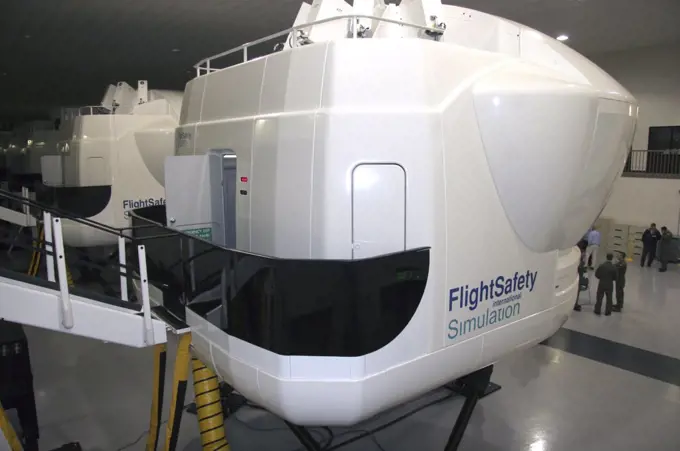
January 30, 2009 - U.S. Air Force helicopter pilots will train on the first of two new TH-1H Weapons System Trainers displayed for the public at Warrior Hall, near Fort Rucker, Alabama. The new full motion simulators are part of the Army's Flight School XXI Program and will be used to train Air Force helicopter pilots on the updated and modernized TH-1H helicopter that replaces the Army UH-1H previously used for training.
6145-44898153
CAPE CANAVERAL, Fla. - NASA's Morpheus lander, a vertical test bed vehicle, is unloaded at the Kennedy Space Center in Florida. Morpheus is designed to demonstrate new green propellant propulsion systems and autonomous landing and an Autonomous Landing and Hazard Avoidance Technology, or ALHAT, system.Checkout of the prototype lander has been ongoing at NASAs Johnson Space Center in Houston in preparation for its first free flight. The SLF site will provide the lander with the kind of field necessary for realistic testing. Project Morpheus is one of 20 small projects comprising the Advanced Exploration Systems, or AES, program in NASAs Human Exploration and Operations Mission Directorate. AES projects pioneer new approaches for rapidly developing prototype systems, demonstrating key capabilities and validating operational concepts for future human missions beyond Earth orbit.
6145-45094165
The last of the five sunshield layers responsible for protecting the optics and instruments of NASAs James Webb Space Telescope is now complete. Read more a href= http //go.nasa.gov/2erZV41 rel= nofollow go.nasa.gov/2erZV41 /a b a href= http //www.nasa.gov/audience/formedia/features/MP_Photo_Guidelines.html rel= nofollow NASA image use policy. /a /b b a href= http //www.nasa.gov/centers/goddard/home/index.html rel= nofollow NASA Goddard Space Flight Center /a /b enables NASAs mission through four scientific endeavors Earth Science, Heliophysics, Solar System Exploration, and Astrophysics. Goddard plays a leading role in NASAs accomplishments by contributing compelling scientific knowledge to advance the Agencys mission. b Follow us on a href= http //twitter.com/NASAGoddardPix rel= nofollow Twitter /a /b b Like us on a href= http //www.facebook.com/pages/Greenbelt-MD/NASA-Goddard/395013845897 ref=tsd rel= nofollow Facebook /a /b b Find us on a href= http //instagrid.me/nasagoddard/
6145-45125522
NASA exhibits on display at Super Bowl - NFL Live Event at Discovery Green.  Photo Date: January 26, 2017.  Location: Discovery Green - Houston, TX.
6145-45025432
SPACE X MMRTG Offload and Lift for Insertion
6145-44653774
KENNEDY SPACE CENTER, FLA. -  On Launch Pad 17-B at Cape Canaveral Air Force Station in Florida, workers maneuver the transporter carrying the second stage segment of a Delta II rocket into the High-Pressure Test Facility for leak testing.  The segment was destacked from the Delta II rocket in the mobile service tower.  At the Boeing plant in Alabama, a leak was observed in the second-stage oxidizer tank for another Delta II that had been scheduled to launch in November; therefore, all identical tanks scheduled for launch in the near future are being checked.  The second stage for the Delta II that will launch STEREO cannot be effectively tested while atop the first stage at Pad 17-B. STEREO stands for Solar Terrestrial Relations Observatory and comprises two spacecraft.  The STEREO mission is the first to take measurements of the sun and solar wind in 3-dimension. This new view will improve our understanding of space weather and its impact on the Earth.  STEREO is expected to lift off
6145-58969710
On Feb. 21, 2017 engineers successfully install ESAs European Service Module Propulsion Qualification Module (PQM) at NASAs White Sands Test Facility in New Mexico that was delivered by Airbus - ESAs prime contractor for the Service Module. The module will be equipped with a total of 21 engines to support NASAs Orion spacecraft: one U.S. Space Shuttle Orbital Maneuvering System (OMS) engine, eight auxiliary thrusters and 12 smaller thrusters produced by Airbus Safran Launchers in Germany. The all-steel PQM structure is used to test the propulsion systems on Orion, including hot firing of the OMS engine and thrusters.
6145-45249756
jsc2002e38731 (2002) --- Overall oblique view of the Treadmill Vibration Isolation System (TVIS) Chassis Assembly for use in the International Space Station (ISS) Service Module (SM).
6145-44898609
CAPE CANAVERAL, Fla. - NASA's Morpheus lander, a vertical test bed vehicle, is being transported out of its checkout building for a short trip to a launch position at the Shuttle Landing Facility, or SLF, at the Kennedy Space Center in Florida. Morpheus is designed to demonstrate new green propellant propulsion systems and autonomous landing and an Autonomous Landing and Hazard Avoidance Technology, or ALHAT, system.Checkout of the prototype lander has been ongoing at NASAs Johnson Space Center in Houston in preparation for its first free flight. The SLF site will provide the lander with the kind of field necessary for realistic testing. Project Morpheus is one of 20 small projects comprising the Advanced Exploration Systems, or AES, program in NASAs Human Exploration and Operations Mission Directorate. AES projects pioneer new approaches for rapidly developing prototype systems, demonstrating key capabilities and validating operational concepts for future human missions beyond Ea
6145-58968123
CAPE CANAVERAL, Fla. - A full-size test mock-up of the Orion spacecraft moves inside the Multi-Payload Processing Facility, or MPPF, at NASA's Kennedy Space Center in Florida to test the path flight hardware will take during future launch processing.Orion is the exploration spacecraft designed to carry crews to space beyond low Earth orbit. It will provide emergency abort capability, sustain the crew during the space travel and provide safe re-entry from deep space return velocities. The first unpiloted test flight of the Orion is scheduled to launch in 2014 atop a Delta IV rocket and in 2017 on a Space Launch System rocket.
6145-55974229
Cygnus Pressurized Cargo Module Arrival. A crane is used to lift the Northrop Grumman Cygnus spacecraft's pressurized cargo module (PCM) off a flatbed truck after arrival at the Space Station Processing Facility of NASA's Kennedy Space Center in Florida on Aug. 2, 2023. The PCM is sealed in an environmentally controlled shipping container. Cygnus will launch later this year atop a SpaceX Falcon 9 rocket from Launch Complex 39A at Kennedy to the International Space Station. Cygnus will undergo prelaunch processing at Kennedy before it is transported to SpaceXs integration facility.
6145-45273707
The heat shield for NASAs Artemis II mission is in view inside the Neil Armstrong Operations and Checkout Building at the agencys Kennedy Space Center in Florida on March 18, 2020. Using augmented reality (AR) goggles, technicians are completing the work on the heat shield. Orion manufacturer Lockheed Martin provided the goggles to technicians to help place tapes where components will be installed on the crew module, heat shield and other components for Artemis II, the first crewed mission aboard the spacecraft. Using the AR goggles saves significant labor and time to complete tasks. Manufactured by Microsoft, the goggles, called HoloLens2, are the second version used by Lockheed.
6145-44967657
CAPE CANAVERAL, Fla. -- At NASAs Kennedy Space Center in Florida, a technician uses a forklift to remove the Optical Payload for Lasercomm Science, or OPALS, experiment from a truck at the Space Station Processing Facility. The optical technology demonstration experiment arrived from the agencys Jet Propulsion Laboratory in Pasadena, Calif. NASA will use the International Space Station to test OPALS communications technology that could dramatically improve spacecraft communications, enhance commercial missions and strengthen transmission of scientific data. The experiment is slated to fly later this year aboard a SpaceX Dragon commercial resupply mission to the space station. The mission is expected to run 90 days after installation on the outside of the station.
1746-21131572
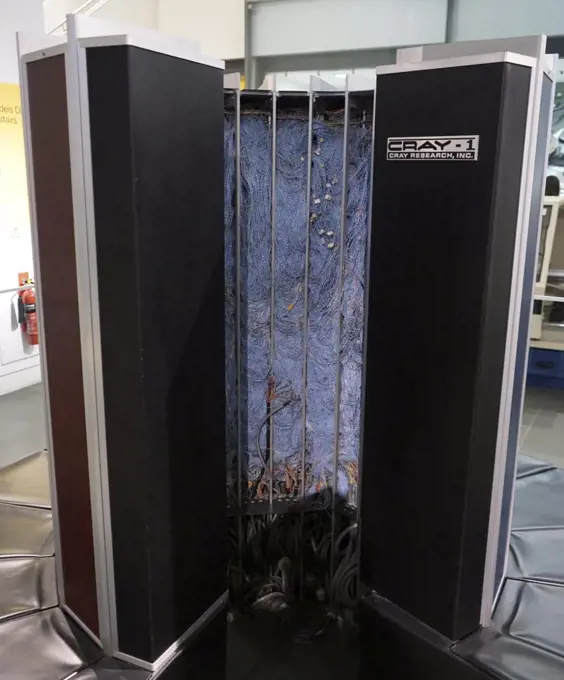
The Cray-1A Supercomputer, designed, manufactured and marketed by Chief engineer Seymour Cray (1925-1996) of Cray Research. Dated 20th Century
6145-45224572
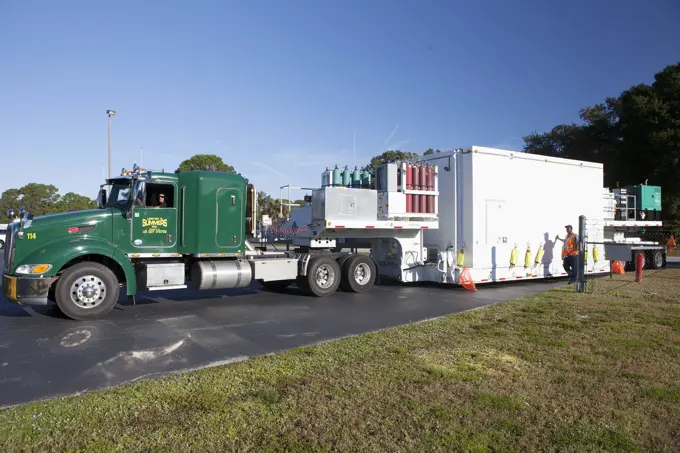
The Solar Orbiter spacecraft is moved out of an Antonov An-124 cargo plane at NASA Kennedy Space Centers Launch and Landing Facility on Nov. 1, 2019. The spacecraft was delivered to the Florida spaceport from Munich, Germany, then transported to the Astrotech Space Operations facility in nearby Titusville. Solar Orbiter is a European Space Agency mission with strong NASA participation. The mission aims to study the Sun, its outer atmosphere and solar winds. The spacecraft will provide the first images of the Suns poles. NASAs Launch Services Program based at Kennedy is managing the launch. Liftoff is scheduled for Feb. 5, 2020, from Cape Canaveral Air Force Station aboard a United Launch Alliance Atlas V rocket.
6145-44501636
KENNEDY SPACE CENTER, FLA. -- A new Enhanced Main Events Controller (E-MEC) for Shuttle Endeavour sits on a table in a Quality trailer in the Launch Pad 39B area. The original E-MEC in Endeavour became suspect during the Jan. 31 launch countdown and mission STS-99 was delayed when NASA managers decided to replace it. Each Shuttle carries two enhanced master events controllers (E-MECs), which provide relays for onboard flight computers to send signals to arm and fire pyrotechnics that separate the solid rockets and external tank during assent. The E-MECs are located in the orbiter's aft compartment and both are needed for the Shuttle to be cleared for flight. Currently Endeavour and Columbia are the only two orbiters with the E-MECs. Built by Rockwell's Satellite Space Electronics Division, Anaheim, Calif., each unit weighs 65 pounds and is approximately 20 inches long, 13 inches wide and 8 inches tall. Previously, three Shuttle flights have been scrubbed or delayed due to faulty MECs:
6145-45059921
CAPE CANAVERAL, Fla. -- Inside the Operations and Checkout Building high bay at NASA's Kennedy Space Center in Florida, a Lockheed Martin technician monitors the progress as a crane is used to lift the Orion service module from a test stand and move it to the Final Assembly and System Testing, or FAST, cell further down the aisle. The Orion crew module will be stacked on the service module in the FAST cell and then both modules will be put through their final system tests for Exploration Flight Test-1, or EFT-1, prior to rolling out of the facility for integration with the United Launch Alliance Delta IV Heavy rocket.Orion is the exploration spacecraft designed to carry astronauts to destinations not yet explored by humans, including an asteroid and Mars. It will have emergency abort capability, sustain the crew during space travel and provide safe re-entry from deep space return velocities. The first unpiloted test flight of Orion, EFT-1, is scheduled to launch later this year atop
6145-44490945
SpaceX SWOT GSE Arrival . The ground service equipment for the Surface Water and Ocean Topography (SWOT) satellite arrives at Vandenberg Space Force Base in California on Oct. 13, 2022. SWOT is the first mission that will observe nearly all water on Earths surface, measuring the height of water in the planets lakes, rivers, reservoirs, and the ocean. The satellite is set to launch aboard a SpaceX Falcon 9 rocket in December from Vandenbergs Space Launch Center-4 East. NASAs Launch Services Program, based at the agencys Kennedy Space Center in Florida, is managing the launch service.
6145-45119986
The right hand aft skirt for NASA's Space Launch System (SLS) rocket has been refurbished and painted and is in a drying cell in a support building at the Hangar AF facility at Cape Canaveral Air Force Station in Florida. The space shuttle-era aft skirt will be used on the right hand booster of the SLS for Exploration Mission 1 (EM-1). NASA is preparing for EM-1, deep space missions, and the Journey to Mars.
6145-54676442
NISAR Science Payload Packaged and Ready to Ship to India. A specially designed, climate-controlled shipping container holding the NASA-ISRO Synthetic Aperture Radar (NISAR) science instrument payload sits outside an airlock at the Spacecraft Assembly Facility at NASA's Jet Propulsion Laboratory on Feb. 26, 2023. The payload was shipped to Bengaluru, India, on March 3, arriving on March 6. There it will be integrated with the satellite body, or bus, and undergo further testing leading up to launch in 2024. The NISAR mission - a joint effort between NASA and the Indian Space Research Organisation - will observe nearly all the planet's land and ice surfaces twice every 12 days, measuring movements in extremely fine detail. It will also survey forests and agricultural regions to understand carbon exchange between plants and the atmosphere. NISAR's science payload will be the most advanced radar system ever launched as part of a NASA mission, and it will feature the largest-ever radar ante
6145-45080578
NOAAs Deep Space Climate Observatory spacecraft, or DSCOVR, wrapped in plastic and secured onto a portable work stand, makes a short trek from the airlock of Building 2 to the high bay of Building 1 at the Astrotech payload processing facility.
6145-44929236
CAPE CANAVERAL, Fla. - NASA's Tracking and Data Relay Satellite, TDRS-K, is enclosed in its payload fairing and prepared for its move atop a transporter from the Astrotech payload processing facility in Titusville, Fla., to its launch site. TDRS-K will lift off atop a United Launch Alliance Atlas V rocket from Cape Canaveral Air Force Station's Space Launch Complex 41, near NASA's Kennedy Space Center.The TDRS-K spacecraft is part of the next-generation series in the Tracking and Data Relay Satellite System, a constellation of space-based communication satellites providing tracking, telemetry, command and high-bandwidth data return services.
6145-44610421
KENNEDY SPACE CENTER, FLA. -  Doors are open on the air-conditioned transportation van that carried NASAs MESSENGER spacecraft from NASAs Goddard Space Flight Center in Greenbelt, Md., to the Astrotech Space Operations processing facilities near KSC.  After offloading, MESSENGER - short for MErcury Surface, Space ENvironment, GEochemistry and Ranging - will be taken into a high bay clean room and employees of the Johns Hopkins University Applied Physics Laboratory, builders of the spacecraft, will perform an initial state-of-health check.  Then processing for launch can begin, including checkout of the power systems, communications systems and control systems.  The thermal blankets will also be attached for flight.  MESSENGER will be launched May 11 on a six-year mission aboard a Boeing Delta II rocket.  Liftoff is targeted for 2:26 a.m. EDT on Tuesday, May 11.
6145-45159829
The Orion Stage Adapter (OSA), secured on flatbed transporter, is inside the low bay at the Space Station Processing Facility (SSPF) at NASA's Kennedy Space Center in Florida. The OSA is the second flight-hardware section of the agency's Space Launch System (SLS) rocket to arrive at Kennedy. The OSA will connect the Orion spacecraft to the upper part of the SLS, the interim cryogenic propulsion stage (ICPS). Both the OSA and ICPS are being stored for processing in the SSPF in preparation for Exploration Mission-1, the first uncrewed, integrated launch of the SLS rocket and Orion spacecraft.
6145-44639872
VANDENBERG AIR FORCE BASE, CALIF. -   Inside Orbital Sciences Building 1555 at Vandenberg Air Force Base in California, workers get ready to install one of the fins on the aft skirt of the Pegasus XL rocket that will launch the Space Technology 5 spacecraft later this month.  ST5 contains three micro-satellites that will be positioned in a "string of pearls" constellation to perform simultaneous multi-point measurements of the Earth's magnetic field using highly sensitive magnetometers.  The scheduled launch date is Feb. 28.
6145-44918158
CAPE CANAVERAL, Fla. - Near the Shuttle Landing Facility at NASA's Kennedy Space Center in Florida, a space agency team installed and tested hazard avoidance instrumentation on a Huey helicopter. Led by the Johnson Space Center and supported by Jet Propulsion Laboratory and Langley Research Center, the Autonomous Landing Hazard Avoidance Technology, or ALHAT, laser system provides a planetary lander the ability to precisely land safely on a surface while detecting any dangerous obstacles such as rocks, holes and slopes. Just north of Kennedy's Shuttle Landing Facility runway, a rock- and crater-filled planetary scape has been built so engineers can test the ability to negotiate away from risks.
6145-44589712
KENNEDY SPACE CENTER, FLA. -- The aeroshell for the Mars Exploration Rover-1 mission is moved into KSC's Multi-Payload Processing Facility.  While at KSC, the rovers, aeroshells and landers will undergo a full mission simulation. All of these flight elements will then be integrated together. After spin balance testing,  each spacecraft will be mated to a solid propellant upper stage booster that will propel the spacecraft out of Earth orbit. Approximately 10 days before launch they will be transported to the launch pad for mating with their respective Boeing Delta II rockets. The rovers will serve as robotic geologists to seek answers about the evolution of Mars, particularly  for a history of water. The rovers will be identical to each other, but will land at different regions of Mars.  Launch of the MER-1 is scheduled for May 30.  MER-2 will follow June 25.
6145-44889130
CAPE CANAVERAL, Fla. - In a test facility behind the Operations and Checkout Building at NASAs Kennedy Space Center in Florida, the prototype rover Artemis Jr. for NASAs Regolith and Environment Science and Oxygen and Lunar Volatile Extraction, or RESOLVE, project has dismounted the RESOLVE lander during a dry run using the ramps attached to the prototype lander.RESOLVE consists of a rover and drill provided by the Canadian Space Agency to support a NASA payload that is designed to prospect for water, ice and other lunar resources. RESOLVE also will demonstrate how future explorers can take advantage of resources at potential landing sites by manufacturing oxygen from soil. NASA will conduct field tests in July outside of Hilo, Hawaii, with equipment and concept vehicles that demonstrate how explorers might prospect for resources and make their own oxygen for survival while on other planetary bodies.
6145-44646617
KENNEDY SPACE CENTER, FLA.  -   NASA's Solar Terrestrial Relations Observatory (STEREO) spacecraft are offloaded and moved into Astrotech, a payload processing facility near Kennedy Space Center in Florida, to begin preparations and final testing for launch. Liftoff will occur aboard a Boeing Delta II rocket from Launch Complex 17 on Cape Canaveral Air Force Station in the summer. STEREO consists of two spacecraft whose mission is the first to take measurements of the sun and solar wind in 3-D. This new view will improve our understanding of space weather and its impact on the Earth.
6145-45081556
At NASA's Kennedy Space Center in Florida, work continues to install 24 light emitting diode LED panels in the new countdown clock at the spaceport's Press Site. The modern, multimedia display is similar to the screens seen at sporting venues. The new screen will be nearly 26 feet wide by 7 feet high, a foot taller than the original clock. The historic countdown clock was designed by Kennedy engineers and built by space center technicians before Apollo 12 in 1969. NASA has requested to acquire the countdown clock from the agencys Artifact Working Group at the agency's Headquarters for display at the Kennedy Space Center Visitor Complex.
6145-44965158
VANDENBERG ABF, Calif. - The launch crew of the Orbital Sciences L-1011 aircraft called "Stargazer" after arrival at Vandenberg Air Force Base for the upcoming launch of the company's Pegasus XL rocket lifting NASA's IRIS solar observatory into orbit. The aircraft will carry the winged rocket to an altitude of 39,000 feet before releasing the Pegasus so its own motors can ignite to send the IRIS into space. The L-1011 is a modified airliner equipped to hold the Pegasus under its body safely. IRIS, short for Interface Region Imaging Spectrograph, is being prepared for launch from Vandenberg June 26. IRIS will open a new window of discovery by tracing the flow of energy and plasma through the chromospheres and transition region into the suns corona using spectrometry and imaging. IRIS fills a crucial gap in our ability to advance studies of the sun-to-Earth connection by tracing the flow of energy and plasma through the foundation of the corona and the region around the sun known as the
6145-45195330
A transportation container carrying NASAs Orbiting Carbon Observatory 3, or OCO-3, payload is moved to a truck for its transport from the Space Station Processing Facility high bay at the agencys Kennedy Space Center in Florida to the SpaceX facility on March 18, 2019. The OCO-3 payload will be stowed in the trunk of SpaceXs Dragon spacecraft, where it will launch aboard a Falcon 9 rocket on the companys 17th Commercial Resupply Services mission to the International Space Station. Launch is scheduled for April 25, 2019, from Launch Complex 40 at Cape Canaveral Air Force Station. Once the payload reaches the station, it will be removed from Dragon and robotically installed on the exterior of the orbiting laboratorys Japanese Experiment Module Exposed Facility Unit, where it will measure and map carbon dioxide from space to provide further understanding of the relationship between carbon and climate.
6145-44591004
KENNEDY SPACE CENTER, FLA. --  Another shipment of Columbia debris is offloaded from the truck at the KSC RLV Hangar.   Inside, the Columbia Reconstruction Project Team is identifying pieces and placing them on a floor grid in a configuration of the orbiter. The team will attempt to reconstruct the bottom of the orbiter as part of the investigation into the accident that caused the destruction of Columbia and loss of its crew as it returned to Earth on mission STS-107.  To date, 35,319 pieces have been shipped to KSC; 1,218 are identified and placed on the grid.
6145-45083345
The Orion crew module is being moved into a covered structure at the Mole Pier at Naval Base San Diego in California where it will be prepared for return to NASA's Kennedy Space Center in Florida. Orion was secured on its crew module recovery cradle in the well deck of the USS Anchorage after it was recovered from the Pacific Ocean. After lifting off at 7:05 a.m. EST on Dec. 5, atop a Delta IV Heavy rocket from Space Launch Complex 37 at Cape Canaveral Air Force Station in Florida, Orion completed a two-orbit, four-and-a-half hour mission to test systems critical to crew safety, including the launch abort system, the heat shield and the parachute system. NASA, the U.S. Navy and Lockheed Martin coordinated efforts to recover Orion after splashdown in the Pacific Ocean. The Ground Systems Development and Operations Program led the recovery efforts.
6145-44646620
KENNEDY SPACE CENTER, FLA.  -    The second of NASA's Solar Terrestrial Relations Observatory (STEREO) spacecraft is moved into Astrotech, a payload processing facility near Kennedy Space Center in Florida, to begin preparations and final testing for launch. Liftoff will occur aboard a Boeing Delta II rocket from Launch Complex 17 on Cape Canaveral Air Force Station in the summer. STEREO consists of two spacecraft whose mission is the first to take measurements of the sun and solar wind in 3-D. This new view will improve our understanding of space weather and its impact on the Earth.
6145-44726088
CAPE CANAVERAL, Fla. -  In the Payload Hazardous Servicing Facility at NASA's Kennedy Space Center, an overhead crane lowers the Super Lightweight Interchangeable Carrier, or SLIC, into the payload canister. The SLIC, one of four carriers associated with the STS-125 mission to service the Hubble Space Telescope, will be moved to Launch Pad 39A.  At the pad, all the carriers will be loaded into space shuttle Atlantis payload bay. Launch of Atlantis is targeted for Oct. 10.
6145-45041198
VANDENBERG AIR FORCE BASE, Calif. -- In the airlock of processing facility 1555 at Vandenberg Air Force Base (VAFB) in California, a crane lifts half of the environmentally controlled shipping container, providing a glimpse of NASA's Nuclear Spectroscopic Telescope Array (NuSTAR).The spacecraft arrived at VAFB Jan. 27 after a cross-country trip which began from Orbital Sciences' manufacturing plant in Dulles, Va., on Jan. 24. Next, NuSTAR will be transferred from the airlock into the processing hangar, joining the Pegasus XL rocket that is set to carry it to space. After checkout and other processing activities are complete, the spacecraft will be integrated with the Pegasus in mid-February and encapsulation in the vehicle fairing will follow. The rocket and spacecraft then will be flown on Orbital's L-1011 carrier aircraft to the Ronald Reagan Ballistic Missile Defense Test Site at the Pacific Ocean's Kwajalein Atoll for launch in March.  The high-energy X-ray telescope will conduct
6145-44798616
GOES-P UNBAGGING & ROTATION
6145-44896027
CAPE CANAVERAL, Fla. - In Firing Room 3 of the Launch Control Center at NASAs Kennedy Space Center in Florida, legacy consoles and monitors are being removed to make way for new systems designed to be flexible so controllers can process and launch multiple types of rockets and spacecraft, whether they are government or commercial models. The historical nature of the consoles is marked with an “artifact” label as some will be displayed in museums and other educational institutions.KSCs Launch Complex 39 is transitioning to support multiple users with the Firing Rooms being modified to be more generic in nature for upcoming programs.
6188-63895945
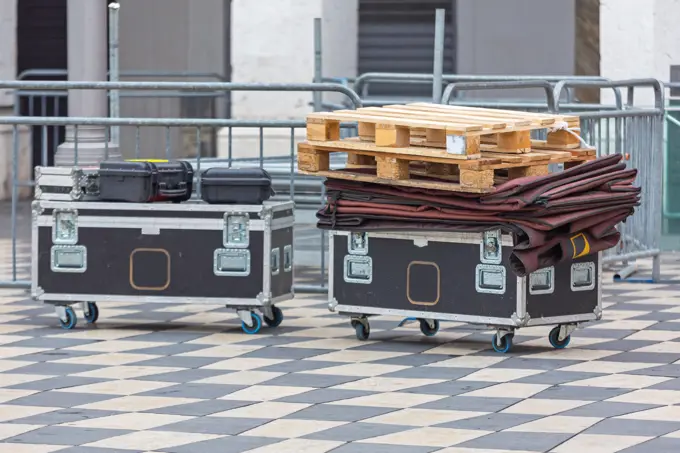
Rack Cases Stage Equipment Packed in Rack Case Wheeled Boxes Copyright: xZoonar.com/MarkoxBericx 14411063
6145-45078080
CAPE CANAVERAL, Fla. - The Magnetospheric Multiscale spacecraft, enclosed in a protective shipping container, are delivered by truck to the Astrotech payload processing facility in Titusville, Florida, near Kennedy Space Center.MMS is a Solar Terrestrial Probes mission comprising four identically instrumented spacecraft that will use Earths magnetosphere as a laboratory to study the microphysics of three fundamental plasma processes: magnetic reconnection, energetic particle acceleration and turbulence.  Launch aboard a United Launch Alliance Atlas V rocket from Space Launch Complex 41 on Cape Canaveral Air Force Station is targeted for March 12, 2015.
6145-58958571
CAPE CANAVERAL, Fla. -- At the Kennedy Space Center Visitor Complex in Florida, construction crews prepare to remove 16,000 square feet of plastic shrink-wrap from the space shuttle Atlantis. The spacecraft was enclosed in the plastic shrink-wrap since November of last year to protect the artifact from dust and debris during construction of the 90,000-square-foot facility. Last November, the space shuttle Atlantis made its historic final journey to its new home, traveling 10 miles from the Kennedy Space Center's Vehicle Assembly Building to the spaceport's visitor complex. The new $100 million 'Space Shuttle Atlantis' facility will include interactive exhibits that tell the story of the 30-year Space Shuttle Program and highlights the future of space exploration. The 'Space Shuttle Atlantis' exhibit scheduled to open June 29, 2013.
6145-44660240
KENNEDY SPACE CENTER, FLA. -    In the Orbiter Processing Facility's bay 1, workers prepare the orbiter boom sensor system for installation on the starboard side of Atlantis's payload bay for mission STS-117.  The 50-foot-long boom attaches to the shuttle arm and provides equipment to inspect the shuttle's heat shield while in space.  It contains an intensified television camera (ITVC) and a laser dynamic range imager, which are mounted on a pan and tilt unit, and a laser camera system (LCS) mounted on a stationary bracket. Mission STS-117 will carry the S3/S4 arrays for installation on the International Space Station.  Launch of Space Shuttle Atlantis is scheduled for March.
6145-58958392
Edwards, Calif. - ED-0144-12 - Plastic wrapping that protected the Sierra Nevada Corporation, or SNC, Dream Chaser flight test vehicle during its transport from Colorado is carefully removed by SNC employee Will Armijo following the craft's arrival at NASA's Dryden Flight Research Center in southern California. The prototype space access vehicle will undergo ground and approach-and-landing flight tests in the coming months at Dryden as part of NASA's Commercial Crew Program, or CCP, development work. SNC is one of three companies working with CCP during the agency's Commercial Crew Integrated Capability, or CCiCap, initiative, which is intended to lead to the availability of commercial human spaceflight services for government and commercial customers.
6145-45079852
Two Magnetospheric Multiscale, or MMS, spacecraft comprising the missions upper stack are transported to the airlock of Building 1 of the Astrotech payload processing facility in Titusville, Florida, near Kennedy Space Center. The two MMS spacecraft comprising the lower stack arrived at Astrotech on Oct. 29. The Magnetospheric Multiscale mission is a Solar Terrestrial Probes mission comprising four identically instrumented spacecraft that will use Earths magnetosphere as a laboratory to study the microphysics of three fundamental plasma processes: magnetic reconnection, energetic particle acceleration and turbulence. Launch aboard a United Launch Alliance Atlas V rocket from Space Launch Complex 41 on Cape Canaveral Air Force Station is targeted for March 12, 2015.
1801-62865368
Details of Inflate structures at Event Production Show. Inflate at Event Production Show, London, United Kingdom. Architect: Inflate, 2018.
6145-44570190
KENNEDY SPACE CENTER, FLA. -- After nightfall, a truck carrying the container that holds the U.S. laboratory module begins the trip from the Shuttle Landing Facility to the Space Station Processing Facility. Intended for the International Space Station, the lab is scheduled to undergo pre-launch preparations before its launch aboard the Shuttle Endeavour on mission STS-98. The laboratory comprises three cylindrical sections with two end cones. Each end-cone contains a hatch opening for entering and exiting the lab. The lab will provide a shirtsleeve environment for research in the areas of life science, microgravity science, Earth science and space science. Designated Flight 5A, this mission is targeted for launch in early 2000
6145-44610420
KENNEDY SPACE CENTER, FLA. -  Shipped in an air-conditioned transportation van from NASAs Goddard Space Flight Center in Greenbelt, Md., NASAs MESSENGER spacecraft, the first Mercury orbiter, arrives at the Astrotech Space Operations processing facilities near KSC.    MESSENGER - short for MErcury Surface, Space ENvironment, GEochemistry and Ranging - will be offloaded and taken into a high bay clean room.  After the spacecraft is removed from its shipping container, employees of the Johns Hopkins University Applied Physics Laboratory, builders of the spacecraft, will perform an initial state-of-health check.  Then processing for launch can begin, including checkout of the power systems, communications systems and control systems.  The thermal blankets will also be attached for flight.  MESSENGER will be launched May 11 on a six-year mission aboard a Boeing Delta II rocket.  Liftoff is targeted for 2:26 a.m. EDT on Tuesday, May 11.
6145-51989556
Boulder, Colo., Sep. 14, 2013   FEMA's Denver Mobile Emergency Response Support (MERS) provides emergency communications support to the Urban Search and Rescue Incident Support Team White at the Boulder Municipal Airport.. Photographs Relating to Disasters and Emergency Management Programs, Activities, and Officials
6145-45081301
At NASA's Kennedy Space Center in Florida, the historic countdown clock at the spaceport's Press Site is disassembled for removal. Kennedy has requested to acquire the countdown clock from the agencys Artifact Working Group at NASA Headquarters for likely display at the Kennedy Space Center Visitor Complex. A new modern multimedia display soon will be installed, similar to the screens seen at sporting venues, is in the works. The new screen will be nearly 26 feet wide by 7 feet high. The old timepiece was designed by Kennedy engineers and built by Kennedy technicians in 1969. Not including the triangular concrete and aluminum base, the famous landmark is nearly six feet high, 26 feet wide and 3 feet deep. The new display will be similar in size, with the screen being nearly 26 feet wide by seven feet high.
4389-830
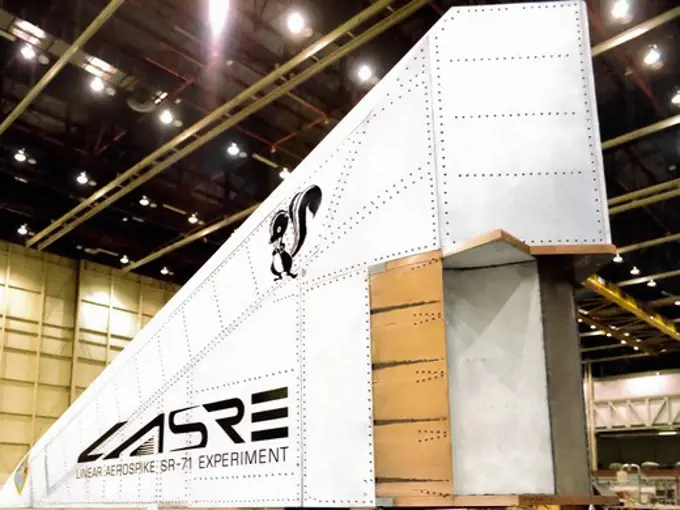
Linear Aerospike SR-71 Experiment (LASRE)
6188-63795966
14.10.2024, Deutschland, NRW, Digitale Transformation, Städte, Aufdruck öGefördert durch das Bundesministerium für Wohnen, Stadtentwicklung und Bauwesen* auf dem mobilen Stadtlabor Bochum der Smart City Innovation Unit SCIU, E-Fahrzeug, Deutschland *** 14 10 2024, Germany, NRW, Digital Transformation, Cities, imprint öFunded by the Federal Ministry of Housing, Urban Development and Building on the mobile city laboratory Bochum of the Smart City Innovation Unit SCIU , E vehicle, Germany Copyright: xD.xKerlekin/SnowfieldxPhotographyx SF141024BauwesenD
6145-58968151
CAPE CANAVERAL, Fla. - Near the Shuttle Landing Facility at NASA's Kennedy Space Center in Florida, a space agency team installed and tested hazard avoidance instrumentation on a Huey helicopter. Led by the Johnson Space Center and supported by Jet Propulsion Laboratory and Langley Research Center, the Autonomous Landing Hazard Avoidance Technology, or ALHAT, laser system provides a planetary lander the ability to precisely land safely on a surface while detecting any dangerous obstacles such as rocks, holes and slopes. Just north of Kennedy's Shuttle Landing Facility runway, a rock- and crater-filled planetary scape has been built so engineers can test the ability to negotiate away from risks.
PREVIOUS
of 2
NEXT
2401 S. Ervay, Suite 206
Dallas, Texas 75215
United States
Get Started
Free ResearchMy BoardsMy Cart
For Creators
How To License Your ContentContributor PortalFrame of Mind
Resources
API accessPricing
Contact
+1 866 236 0087help@viewpictures.co.uk Contact form
©2026 View Pictures. All Rights Reserved. -B
This site is protected by reCAPTCHA and Google Privacy Policy and Terms of Service apply.