My Boards
View Pictures
  • My Boards

Spacecraft Preparation and Launch Scenes

Images depicting spacecraft assembly, payload bay operations, and preparations for launch at Kennedy Space Center, emphasizing engineering details.

STS-131 MPLM LEONARDO MEDIA EVENT
281 assets in this story
6145-55974870
OSIRIS-REx Sample Return. A container with the science canister from NASAs OSIRIS-REx mission is seen aboard a C-17 Globemaster aircraft, Monday, Sept. 25, 2023, at the Department of Defense's Utah Test and Training Range. The sample was collected from the asteroid Bennu in October 2020 by NASAs OSIRIS-REx spacecraft.
6145-58959705
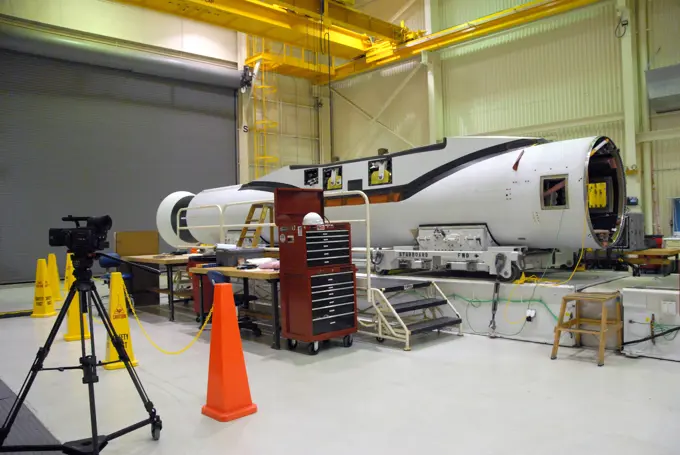
VANDENBERG AIR FORCE BASE, Calif. -- In a processing facility at Vandenberg Air Force Base in California, the three stages of the Pegasus XL launch vehicle are seen immediately prior to installation of the vehicles wing. The Orbital Sciences Corp. Pegasus rocket will launch the Nuclear Spectroscopic Telescope Array (NuSTAR) into space. After the rocket and spacecraft are processed at Vandenberg, they will be flown on the Orbital Sciences L-1011 carrier aircraft to the Ronald Reagan Ballistic Missile Defense Test Site at the Pacific Oceans Kwajalein Atoll for launch. The high-energy x-ray telescope will conduct a census for black holes, map radioactive material in young supernovae remnants, and study the origins of cosmic rays and the extreme physics around collapsed stars. For more information, visit science.nasa.gov_missions_nustar_.
6145-45045956
CAPE CANAVERAL, Fla. - NASA astronaut candidates Andrew Morgan, from left, Victor Glover, Josh Cassada, Anne McClain and Jessica Meir tour the Apollo Saturn V Center at Kennedy Space Center in Florida during a daylong set of briefings and tours of different facilities at NASA's primary launch center. The astronaut class of 2013 was selected by NASA after an extensive year-and-a-half search. The new group will help the agency push the boundaries of exploration and travel to new destinations in the solar system.
6145-44853189
CAPE CANAVERAL, Fla. -- In the Space Station Processing Facility at NASA's Kennedy Space Center in Florida, media check out and learn more about the Alpha Magnetic Spectrometer-2 (AMS). AMS is a particle physics detector, designed to operate as an external experiment on the International Space Station. It will use the unique environment of space to study the universe and its origin by searching for dark matter.AMS-2 will fly to the station aboard space shuttle Endeavour's STS-134 mission targeted to launch April 19 at 7:48 p.m. EDT.
6177-V53838712
6145-45282190
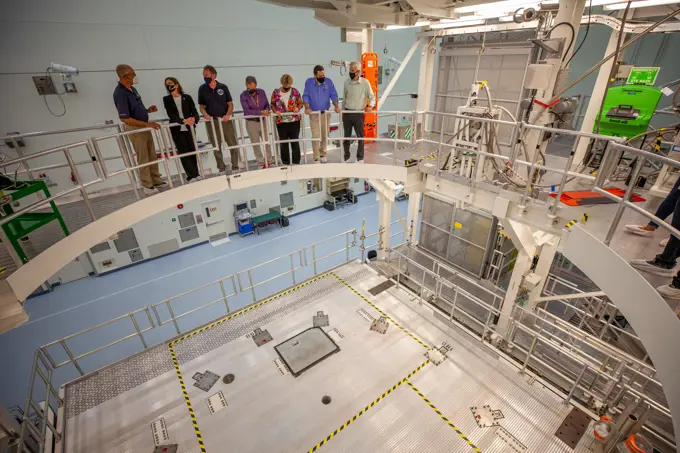
Catherine Koerner, second from left, NASA Orion Program manager, along with senior managers from Orion, Exploration Ground Systems (EGS) and TOSC, tours the Multi-Payload Processing Facility (MPPF) at NASAs Kennedy Space Center in Florida on Oct. 5, 2020. Accompanying her, from left are Skip Williams, operations manager for the MPPF spacecraft offline element integration team; Mike Bolger, EGS manager; Nicolas Kindred, TOSC flow manager; Annette Hasbrook, Orion Program assistant manager; Jeremy Parsons, EGS deputy manager; and Scott Wilson, Orion Production Operations manager. Koerner viewed spacecraft hardware and processing facilities for the Artemis I and II missions. The first in a series of increasingly complex missions, Artemis I will test the Orion spacecraft and Space Launch System as an integrated system ahead of crewed flights to the Moon. Under the Artemis program, NASA will land the first woman and the next man on the Moon in 2024.
6145-44748051
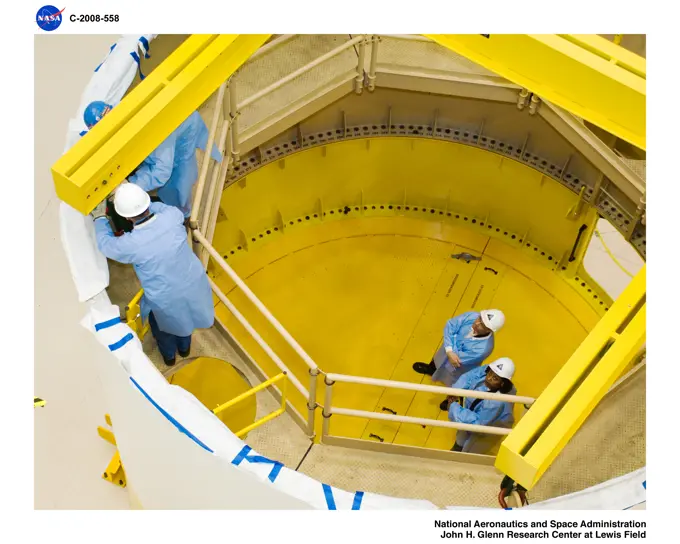
CAPE CANAVERAL, Fla. - In high bay 4 of the Vehicle Assembly Building at NASA's Kennedy Space Center in Florida, a ballast assembly is lowered into the Ares I-X segment 7. Ballast assemblies are being installed in the upper stage 1 and 7 segments and will mimic the mass of the fuel. Their total weight is approximately 160,000 pounds.  Ares I-X is the test vehicle for the Ares I, which is part of the Constellation Program to return men to the moon and beyond.  Ares I is the essential core of a safe, reliable, cost-effective space transportation system that eventually will carry crewed missions back to the moon, on to Mars and out into the solar system. Ares I may also use its 25-ton payload capacity to deliver resources and supplies to the International Space Station, or to "park" payloads in orbit for retrieval by other spacecraft bound for the moon or other destinations. The Ares I-X is targeted for launch in July 2009.
6145-45259430
This view looks upward toward the InSight Mars lander suspended upside down. It shows the top of the lander's science deck with the mission's two main science instruments -- the Seismic Experiment for Interior Structure (SEIS) and the Heat Flow and Physical Properties Probe (HP3) -- plus the robotic arm and other subsystems installed. The photo was taken Aug. 9, 2017, in a Lockheed Martin clean room facility in Littleton, Colorado. The InSight mission (for Interior Exploration using Seismic Investigations, Geodesy and Heat Transport) is scheduled to launch in May 2018 and land on Mars Nov. 26, 2018. It will investigate processes that formed and shaped Mars and will help scientists better understand the evolution of our inner solar system's rocky planets, including Earth.
6145-44580375
KENNEDY SPACE CENTER, FLA. -- Columbia sits inside an protective tent used to keep out moisture.  The orbiter is next scheduled to fly on mission STS-107 no earlier than Nov. 29.  STS-107 is a research mission. The payload includes the Hitchhiker Bridge, a carrier for the Fast Reaction Experiments Enabling Science, Technology, Applications and Research (FREESTAR) that incorporates eight high priority secondary attached shuttle experiments, plus the SHI Research Double Module (SHI/RDM), also known as SPACEHAB.
6145-44597145
KENNEDY SPACE CENTER, FLA. -   In the Space Station Processing Facility, the lid is removed from the container with the Japanese Experiment Module (JEM) pressure module inside.  A research laboratory, the pressurized module is the first element of the JEM, named "Kibo" (Hope), to be delivered to KSC.   The National Space Development Agency of Japan (NASDA) developed the laboratory at the Tsukuba Space Center near Tokyo and is Japan's primary contribution to the Station. It will enhance the unique research capabilities of the orbiting complex by providing an additional environment for astronauts to conduct science experiments.  The JEM also includes an exposed facility (platform) for space environment experiments, a robotic manipulator system, and two logistics modules. The various JEM components will be  assembled in space over the course of three Shuttle missions.
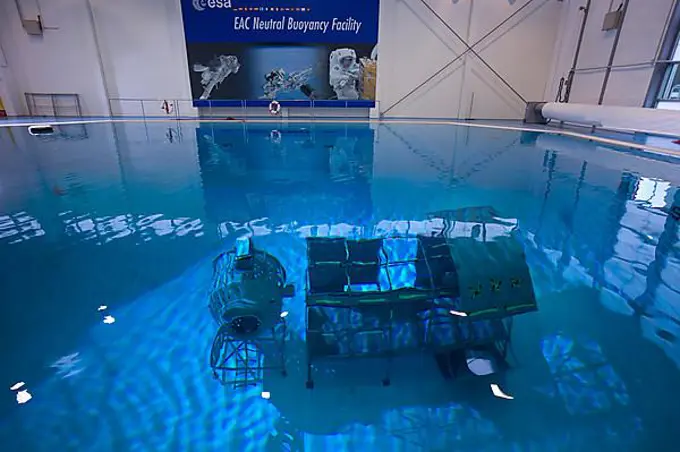
1848-55212876
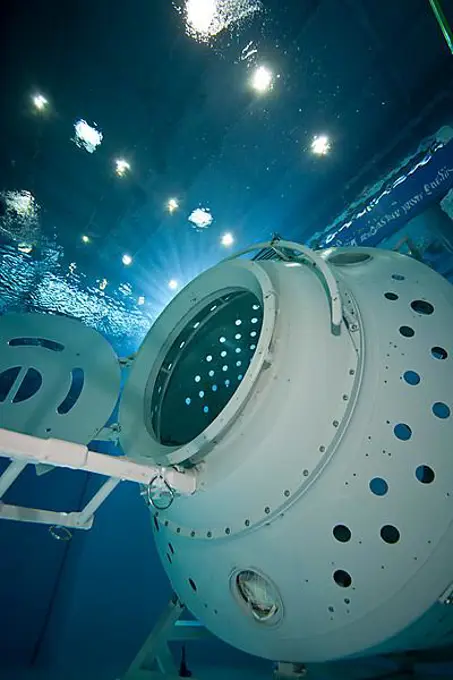
A module of a space station reproduction in a diving basin, European Space Agency, ESA, European Astronaut Center, EAC, Cologne, North Rhine-Westphalia, Germany, Europe
6145-44965074
VANDENBERG ABF, Calif. - The Orbital Sciences Pegasus XL rocket that will lift NASA's IRIS solar observatory into orbit in June is seen in a hangar at Vandenberg Air Force Base. IRIS, short for Interface Region Imaging Spectrograph, is being prepared for launch from Vandenberg June 26. IRIS will open a new window of discovery by tracing the flow of energy and plasma through the chromospheres and transition region into the suns corona using spectrometry and imaging. IRIS fills a crucial gap in our ability to advance studies of the sun-to-Earth connection by tracing the flow of energy and plasma through the foundation of the corona and the region around the sun known as the heliosphere.
6145-44470918
A group of U.S. Navy divers, Air Force pararescumen and Coast Guard rescue swimmers practice Orion underway recovery techniques this week in the Neutral Buoyancy Laboratory (NBL) at NASAs Johnson Space Center in Houston on Sept. 21, 2016, to prepare for the first test flight of an uncrewed Orion spacecraft with the agencys Space Launch System rocket during Artemis I. Part of Batch images transfer from Flickr.
6145-45252310
SOLID ROCKET BOOSTER
6145-58963344
KENNEDY SPACE CENTER, FLA. - On Launch Pad 17-B at Cape Canaveral Air Force Station, the second stage of the Boeing Delta II rocket arrives at the mobile service tower for mating to the rocket. The Delta II will launch NASAs Deep Impact spacecraft. A NASA Discovery mission, Deep Impact will probe beneath the surface of Comet Tempel 1 on July 4, 2005, when the comet is 83 million miles from Earth, and reveal the secrets of its interior. After releasing an impactor on a course to hit the comets sunlit side, Deep Impacts flyby spacecraft will collect pictures and data of how the crater forms, measure the craters depth and diameter, as well as the composition of the interior of the crater and any material thrown out, and determine the changes in natural outgassing produced by the impact. It will send the data back to Earth through the antennas of the Deep Space Network.
6145-44599838
KENNEDY SPACE CENTER, FLA.  - In the mobile service tower on Launch Pad 17-B, Cape Canaveral Air Force Station, workers watch as the first half of the fairing moves closer around the Space Infrared Telescope Facility (SIRTF). SIRTF will obtain images and spectra by detecting the infrared energy, or heat, radiated by objects in space. Consisting of a 0.85-meter telescope and three cryogenically cooled science instruments, SIRTF will be the largest infrared telescope ever launched into space. It is the fourth and final element in NASAs family of orbiting “Great Observatories.” Its highly sensitive instruments will give a unique view of the Universe and peer into regions of space that are hidden from optical telescopes.
6145-45067003
SAN DIEGO, Calif. - Inside the U.S. Navys USS Anchorage, NASA, Lockheed Martin and U.S. Navy personnel watch as the well deck fills with water around the Orion boilerplate test vehicle during a portion of Underway Recovery Test 2 in the Pacific Ocean off the coast of San Diego. Tether lines are attached to the test vehicle to control it and a safety barrier has been installed to prevent Orion from going further into the well deck. The test will help the team prepare for recovery of the Orion crew module on its return from a deep space mission. The underway recovery test will allow the team to demonstrate and evaluate the recovery processes, procedures, new hardware and personnel in open waters.The Ground Systems Development and Operations Program is conducting the underway recovery test. Orion is the exploration spacecraft designed to carry astronauts to destinations not yet explored by humans, including an asteroid and Mars. It will have emergency abort capability, sustain the crew
6145-44572818
In the Space Shuttle Main Engine Facility, the STS-93 crew poses in the nozzle of Space Shuttle Columbia's main engine. From left, they are Mission Specialist Michel Tognini of France, who represents the Centre National d'Etudes Spatiales (CNES), Commander Eileen Collins, Mission Specialist Catherine G. Coleman, Pilot Jeffrey S. Ashby, and Mission Specialist Steven A. Hawley. STS-93, scheduled to launch July 9 aboard Space Shuttle Columbia, has the primary mission of the deployment of the Chandra X-ray Observatory. Formerly called the Advanced X-ray Astrophysics Facility, Chandra comprises three major elements: the spacecraft, the science instrument module (SIM), and the world's most powerful X-ray telescope. Chandra will allow scientists from around the world to see previously invisible black holes and high-temperature gas clouds, giving the observatory the potential to rewrite the books on the structure and evolution of our universe
1746-29971925
Automated Luna-3 station; the first automated station with an attitude control system, in outer space. it was launched on October 4,1959 and orbited the Moon for first time. The satellite transmitted photo televised images, of the dark side of the Moon. It was designed by OKB-1 and was launched by Vostok launch-vehicle
6145-44830390
CAPE CANAVERAL, Fla. -- In the Space Station Processing Facility at NASA's Kennedy Space Center in Florida, a technician monitors the progress of the Payload Attach System, or PAS, as it is lifted up to the Alpha Magnetic Spectrometer, or AMS, where it will be attached to the bottom of the AMS. The PAS provides a method of securely connecting the payload to the International Space Station.AMS, a state-of-the-art particle physics detector, is designed to operate as an external module on the International Space Station. It will use the unique environment of space to study the universe and its origin by searching for dark matter. AMS will fly to the station aboard space shuttle Endeavour's STS-134 mission targeted to launch Feb. 26, 2011.
6145-54457759
DN-ST-89-01987. Country: Unknown
6145-55975118
Artemis I Orion Recovery Operations. NASAs Orion spacecraft for the Artemis I mission was successfully recovered inside the well deck of the USS Portland on Dec. 11, 2022 off the coast of Baja California. After launching atop the Space Launch System rocket on Nov. 16, 2022 from the agencys Kennedy Space Center in Florida, Orion spent 25.5 days in space before returning to Earth, completing the Artemis I mission.
6145-58969325
Teams perform a series of tests at NASAs Neutral Buoyancy Laboratory (NBL) at the agencys Johnson Space Center in Houston on Oct. 7, 2015, to evaluate the most efficient way for astronauts to get out of the Orion spacecraft after weeks or months away from Earth. Part of Batch image transfer from Flickr.
6145-44560506
NASA PLUM BROOK B-2 FACILITY WITH DELTA III 2ND STAGE
6177-V53550758
6145-45048697
CAPE CANAVERAL, Fla. - A crane lowers the Project Morpheus prototype lander onto a launch pad at a new launch site at the north end of the Shuttle Landing Facility at NASA's Kennedy Space Center in Florida. Engineers and technicians are preparing Morpheus for an automated landing and hazard avoidance technology, or ALHAT, and laser test at the new launch site. The launch pad was moved to a different location at the landing facility to support the next phase of flight testing. The seventh free flight test of Morpheus occurred on March 11. The 83-second test began at 3:41 p.m. EDT with the Morpheus lander launching from the ground over a flame trench and ascending to 580 feet. Morpheus then flew its fastest downrange trek at 30 mph, travelling farther than before, 837 feet. The lander performed a 42-foot divert to emulate a hazard avoidance maneuver before descending and touching down on Landing Site 2, at the northern landing pad inside the ALHAT hazard field. Morpheus landed within one
6145-45045184
CAPE CANAVERAL, Fla. -- Standing beneath the midbody of space shuttle Endeavour, members of the news media interview Stephanie Stilson, NASA flow director for the shuttles' transition and retirement, inside Orbiter Processing Facility-2 at NASA's Kennedy Space Center in Florida. Stilson was one of several shuttle experts available for interviews around the outside of Endeavour and inside the shuttle's crew compartment.Ongoing transition and retirement activities are preparing the spacecraft for public display at the California Science Center in Los Angeles. Endeavour flew 25 missions during its 19-year career.
6145-44858249
STS-135 ET-138 External Tank Mated to SRB's
6145-44551041
KENNEDY SPACE CENTER, FLORIDASTS-82 PREPARATIONS VIEW --- Payload processing workers in the Kennedy Space Center (KSC) Vertical Processing Facility (VPF) prepare to integrate the Space Telescope Imaging Spectrograph (STIS), suspended at center, into the Orbiter Replacement Unit (ORU) Carrier and Scientific Instrument Protective Enclosure (SIPE).  STIS will replace the Goddard High Resolution Spectrograph (GHRS) on the Hubble Space Telescope (HST).  Four of the seven STS-82 crew members will perform a series of spacewalks to replace two scientific instruments with two new instruments, including STIS, and perform other tasks during the second HST servicing mission.  HST was deployed nearly seven years ago and was initially serviced in 1993.
6145-45251031
Operation to stack Ares 1-X Segment US5 onto US4
1746-29971949
Automated Luna-3 station; the first automated station with an attitude control system, in outer space. it was launched on October 4,1959 and orbited the Moon for first time. The satellite transmitted photo televised images, of the dark side of the Moon. It was designed by OKB-1 and was launched by Vostok launch-vehicle
6145-45203427
Artwork simulating a view inside the International Space Station marks the entranceway to the high bay in the Space Station Processing Facility (SSPF) at NASA's Kennedy Space Center in Florida, on May 16, 2019. The center is celebrating the SSPFs 25th anniversary. The facility was built to process elements for the International Space Station. Now it is providing support for current and future NASA and commercial provider programs, including Commercial Resupply Services, Artemis 1, sending the first woman and next man to the Moon, and deep space destinations including Mars.
6145-48824312
undefined. 1972 - 2012. Department of Energy. National Nuclear Security Administration. Photographs Related to Nuclear Weapons Testing at the Nevada Test Site.
6145-44964028
VANDENBERG AFB, Calif. - An Orbital Sciences Pegasus XL rocket undergoes launch preparations inside a hangar at Vandenberg Air Force Base for NASA's IRIS mission, short for Interface Region Imaging Spectrograph. Scheduled for launch from Vandenberg June 26, IRIS will open a new window of discovery by tracing the flow of energy and plasma through the chromospheres and transition region into the suns corona using spectrometry and imaging. IRIS fills a crucial gap in our ability to advance studies of the sun-to-Earth connection by tracing the flow of energy and plasma through the foundation of the corona and the region around the sun known as the heliosphere.
6145-44719843
S74-25394 (10 July 1974) --- A group of American and Soviet engineers of the Apollo-Soyuz Test Project working group three examines an ASTP docking set-up following a docking mechanism fitness test conducted in Building 13 at the Johnson Space Center. Working Group No. 3 is concerned with ASTP docking problems and techniques. The joint U.S.-USSR ASTP docking mission in Earth orbit is scheduled for the summer of 1975. The Apollo docking mechanism is atop the Soyuz docking mechanism.
6145-44471189
The Orion team prepares the parachute test vehicle for the final drop test which will qualify Orion's parachutes for human flight on Sept. 10, 2018...On September 12, 2018 an Orion test capsule will be dropped from a C-17 aircraft at an altitude of more than six miles to verify the spacecrafts complex system of 11 parachutes, cannon-like mortars, and pyrotechnic devices work in sequence to slow the capsules descent for a safe landing on Earth.
824-63197809
Reportage in the National Oncology Particle Therapy Centre in Milan, Italy (The CNAO - Centro Nazionale di Adroterapia Oncologica). Particle therapy is a state-of-the-art technique used to treat cancer. It consists of using hadrons, protons (proton therapy) and cabon ions (carbon-ion treatment) to irradiate tumours. It has two therapeutic purposes, a high ballistic accuracy which allows healthy tissue surrounding the tumour to be spared, and a greater efficiency at treating certain cancers. The CNAO is the only centre to own carbon-ion treatment technology in Europe. The synchrotron.
6145-48825806
A870162 U12P MISSION CYBER FAC H.E. WRAP STALLER (Project Engineer) JAN 13 87 EG&G/NTS PHOTO LAB Publication Date: 1/13/1987  EDGERTON, GERMESHAUSEN & GRIER; EG&G; EQUIPMENT & INSTRUMENTS; EQUIPMENT (SNL); FAC ASSEMBLY; FAC ASSEMBLY PLATFORM; FAC H.E. WRAP; HIGH ENERGY FAC; INSTRUMENTS & EQUIPMENT; MALE; MEN (ADD MALE MODIFIER); MISSION CYBER; NEVADA TEST SITE; NTS; NUCLEAR ENERGY TECHNOLOGY; NUCLEAR TESTING; P-TUNNEL; STALLER, GEORGE; SUITS, BODY; TAPES (ADHESIVE); TAPING (WRAPPING); TEST SITES; TUNNELS; U12P; U12P MISSION CYBER; UGT; UNDERGROUND; UNDERGROUND TESTING; WEAPONS TECHNOLOGY; WORKERS  historical images. 1972 - 2012. Department of Energy. National Nuclear Security Administration. Photographs Related to Nuclear Weapons Testing at the Nevada Test Site.
6145-44640656
KENNEDY SPACE CENTER, FLA.   On Complex 41 at Cape Canaveral Air Force Station in Florida, workers move the radioisotope thermoelectric generator (RTG) into an area of the fairing containing the New Horizons spacecraft, to which it will be attached.  Designed and integrated at the Johns Hopkins University Applied Physics Laboratory (APL) in Laurel, Md., New Horizons will launch on a nine-and-a-half-year voyage to Pluto. Typical of RTG-based systems, as on past outer-planet missions, New Horizons does not have a battery for storing power. At the start of the mission, the RTG, which provides power through the natural radioactive decay of plutonium dioxide fuel, will supply approximately 240 watts (at 30 volts of direct current) - the spacecraft’s shunt regulator unit maintains a steady input from the RTG and dissipates power the spacecraft cannot use at a given time. By July 2015 (the earliest Pluto encounter date) that supply decreases to 200 watts at the same voltage, so New Horizons
6145-45078342
3608a:At the Gagarin Cosmonaut Training Center in Star City, Russia, Expedition 42/43 Soyuz Commander Anton Shkaplerov of the Russian Federal Space Agency (Roscosmos) flashes a thumbs up as he enters a Soyuz simulator October 31 for the second day of qualification exams. Overlooking Shkaplerov is a wall mural depicting the image of Yuri Gagarin, the first human to fly in space. Shkaplerov, NASA Flight Engineer Terry Virts and European Space Agency Flight Engineer Samantha Cristoforetti are preparing for launch in the Soyuz TMA-15M spacecraft from the Baikonur Cosmodrome in Kazakhstan Nov. 24, Kazakh time, for a 5 ½ month mission on the International Space Station.NASA/Stephanie Stoll
6145-52104431
A front view of an FTM-1 AGM-86 air-launched cruise missile (ALCM). Country: Unknown
6145-44719598
S73-36435 (25 Sept. 1973) --- Astronaut Jack R. Lousma, Skylab 3 pilot, egresses the Skylab 3 Command Module aboard the prime recovery ship, USS New Orleans, during recovery operations in the Pacific Ocean. Astronauts Lousma; Alan L. Bean, commander; and Owen L. Garriott, science pilot, had just completed a successful 59-day visit to the Skylab space station in Earth orbit. The Skylab 3 spacecraft splashed down in the Pacific about 230 miles southwest of San Diego, California.
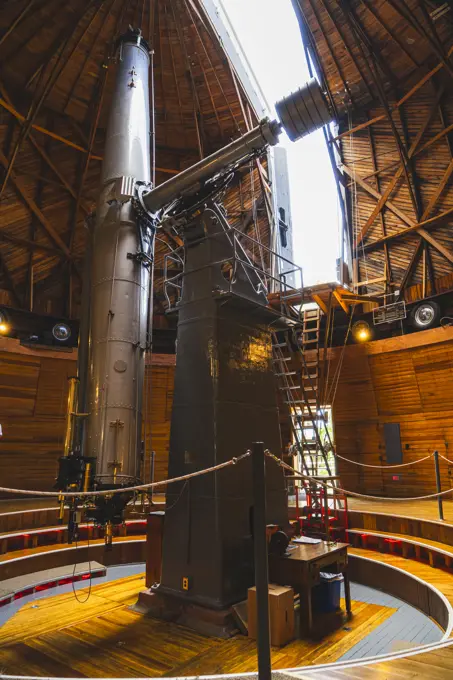
5514-69430939
Refractor telescope inside Lowell Observatory vertical
6145-52086530
A view of a multiple independently-targetable re-entry vehicle (MIRV). Country: Unknown
6145-44577241
KENNEDY SPACE CENTER, FLA. -- On Launch Pad 17-A, Cape Canaveral Air Force Station, workers observe the second stage of the Boeing Delta II rocket as it is lowered into position for mating with the first stage. The rocket is the launch vehicle for the Comet Nucleus Tour (CONTOUR) spacecraft that will provide the first detailed look into the heart of a comet -- the nucleus. Flying as close as 60 miles (100 kilometers) to at least two comets, the spacecraft will take the sharpest pictures yet of a nucleus while analyzing the gas and dust that surround these rocky, icy building blocks of the solar system.  Launch of CONTOUR is scheduled for July 1, 2002
6145-45217751
jsc2019e053738 - At the Baikonur Cosmodrome in Kazakhstan, spaceflight participant Hazzaa Ali Almansoori of the United Arab Emirates poses for pictures Sept. 20 before inspecting the Soyuz MS-15 spacecraft during final fit check activities. Almansoori and Expedition 61 crewmembers Oleg Skripochka of Roscosmos and Jessica Meir of NASA will launch Sept. 25 on the Soyuz MS-15 spacecraft for a mission on the International Space Station...NASA/Victor Zelentsov
6145-44548974
STS79-E-5371 (24 September 1996) --- Approaching the end of a stay in space exceeding six months, astronaut Shannon W. Lucid floats through the tunnel that connects Spacehab to the Space Shuttle Atlantis' cabin.
6145-44880243
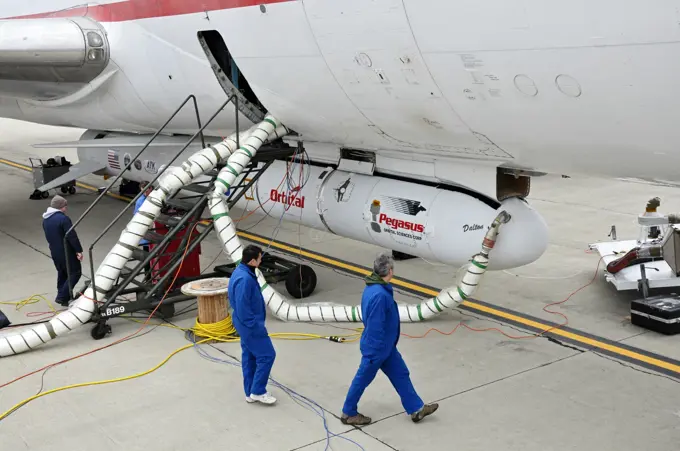
NUSTAR, Transfer of the Pegasus to the AIT
6145-44692809
KENNEDY SPACE CENTER, FLA. --  In the Orbiter Processing Facility, STS-123 crew members check out the underside of space shuttle Endeavour.  From left are Mission Specialists Garrett Reisman, Richard Linnehan and Robert Behnken, and Commander Dominic Gorie. They and other crew members are at NASA's Kennedy Space Center for a crew equipment interface test, a process of familiarization with payloads, hardware and the space shuttle.  Reisman will join the Expedition 16 crew on the International Space Station, replacing flight engineer Leopold Eyharts. The STS-123 mission is targeted for launch on space shuttle Endeavour on Feb. 14.  It will be the 25th assembly flight of the station.
6145-45209198
The inaugural Glenn Symposium focused on advancements in aerospace technology including power and propulsion, autonomy and communications, low boom supersonics, hypersonics, and more. Discussion also encompassed humans returning to the moon, including challenges associated with the 2024 mission.
1848-55212866
European Space Agency, ESA, European Astronaut Center, EAC, Cologne, North Rhine-Westphalia, Germany, Europe
6145-44509033
Astronauts Stuart A. Roosa, and Alfred M. Worden training a tRendezvous Docking Simulator NASA Langley. Worden was one of the 19 astronauts selected by NASA in April 1966. He served as a member of the astronaut support crew for the Apollo 9 flight and as backup command module pilot for the Apollo 12 flight.Colonel Roosa was one of the 19 astronauts selected by NASA in April 1966. He was a member of the astronaut support crew for the Apollo 9 flight.
6145-44830700
Interior view of the Space Station Processing Facility
4404-1366
USA, Florida, Kennedy Space Center, Saturn V first stage F1 engine
6145-58970084
Vice President Mike Pence visited and gave remarks in the Neil Armstrong Operations and Checkout Building at NASAs Kennedy Space Center in Florida on July 20, 2019 to commemorate the 50th anniversary of the agencys Apollo 11 Moon landing and announce to America the completion of NASAs Orion crew capsule, shown here on July 19, 2019, for the first Artemis lunar mission.
4413-78063549
193 cm telescope in its dome, Haute-Provence Observatory (OHP), an astronomical observatory located since 1936 in Saint-Michel-l'Observatoire, Alpes-de-Haute-Provence, France.
6145-44752579
STS-131 MPLM LEONARDO HATCH CLOSURE
6145-45051077
VANDENBERG AIR FORCE BASE, Calif. - Workers monitor the Delta II second stage for NASA's Orbiting Carbon Observatory-2 mission, or OCO-2, as it is lifted into position for mating with the rocket's first stage in the mobile service tower at Space Launch Complex 2 on Vandenberg Air Force Base in California. OCO-2 is scheduled to launch aboard a United Launch Alliance Delta II rocket in July. The rocket's second stage will insert OCO-2 into a polar Earth orbit.  OCO-2 will collect precise global measurements of carbon dioxide in the Earth's atmosphere and provide scientists with a better idea of the chemical compound's impacts on climate change. Scientists will analyze this data to improve our understanding of the natural processes and human activities that regulate the abundance and distribution of this important atmospheric gas.
6145-44638564
KENNEDY SPACE CENTER, FLA. - In NASA Kennedy Space Centers Orbiter Processing Facility Bay 3, workers inspect and measure thermal protection system gap fillers in Discoverys forward and midbody areas. This work is being performed after two gap fillers were found protruding from the underside of Discovery on the July 26 Return to Flight mission, STS-114. New installation procedures are being developed to ensure the gap fillers stay in place and do not pose any hazard on re-entry to the atmosphere.  The white strings stretching across the belly of the orbiter separate prioritized work zones.  The work seen here is in zone 1.
6145-44965151
VANDENBERG ABF, Calif. - The Orbital Sciences Pegasus XL rocket that will lift NASA's IRIS solar observatory into orbit is moved from a hangar onto a transporter at Vandenberg Air Force Base. IRIS, short for Interface Region Imaging Spectrograph, is being prepared for launch from Vandenberg June 26. IRIS will open a new window of discovery by tracing the flow of energy and plasma through the chromospheres and transition region into the suns corona using spectrometry and imaging. IRIS fills a crucial gap in our ability to advance studies of the sun-to-Earth connection by tracing the flow of energy and plasma through the foundation of the corona and the region around the sun known as the heliosphere.
6145-44745966
CAPE CANAVERAL, Fla. --  The second stage of the Delta 2 rocket for the launch of NASA's Kepler spacecraft arrives on Complex 17-B at Cape Canaveral Air Force Station in Florida.  The second stage will be lifted into the mobile service tower for mating with the first stage. The Kepler mission is specifically designed to survey our region of the Milky Way galaxy to discover hundreds of Earth-size and smaller planets in or near the habitable zone and determine how many of the billions of stars in our galaxy have such planets.  Results from this mission will allow us to place our solar system within the continuum of planetary systems in the Galaxy.  NASA's planet-hunting Kepler mission is scheduled to launch no earlier than March 5, 2009.
6145-44962152
DATE: 5-21-13LOCATION: NBL - Pool TopsideSUBJECT:  Mike Hopkins during INCR-37 ISS EVA Maintenance 95027 run with astronaut Kathleen Rubins.
6145-44783440
EDWARDS AIR FORCE BASE, Calif. - (ED09-0253-73) The nose of Space Shuttle Discovery peers out from work platforms while undergoing servicing in the Mate-DeMate Device at NASAs Dryden Flight Research Center in preparation for its ferry flight to NASAs Kennedy Space Center in Florida. Discovery returned to Earth Sept. 11 on the STS-128 mission, landing at Edwards Air Force Base in California.  The shuttle delivered more than 7 tons of supplies, science racks and equipment, as well as additional environmental hardware to sustain six crew members on the International Space Station.
6145-45159361
NASA's Super Guppy aircraft arrives to the U.S. Armys Redstone Airfield in Huntsville, Alabama, April 2, to pick up flight hardware for NASAs Space Launch System - its new, deep-space rocket that will enable astronauts to begin their journey to explore destinations far into the solar system. The Guppy will depart on Tuesday, April 3 to deliver the Orion stage adapter to NASAs Kennedy Space Center in Florida for flight preparations. On Exploration Mission-1, the first integrated flight of the SLS and the Orion spacecraft, the adapter will connect Orion to the rocket and carry 13 CubeSats as secondary payloads. Rumaasha Maasha stands in front of the Orion stage adapter in the cargo hold of NASA's Super Guppy aircraft. The Orion stage adapter, the top of the rocket that connects the Space Lauch System to Orion, will carry 13 CubeSats as secondary payloads on Exploration Mission-1, the first integrated flight of SLS and the Orion spacecraft. Guppy transported the adapter to Kennedy Spa
4404-1243
USA, Arizona, Tucson, Titan missile in underground silo at Titan Missile Museum
6145-44900392
CAPE CANAVERAL, Fla. - In Orbiter Processing Facility Bay 2 at NASAs Kennedy Space Center in Florida, Kennedy Space Center Director Bob Cabana, far right, watches as, left to right, United Space Alliance quality inspector Ken Carson, along with technicians Gary Hamilton and Joe Walsh remove protective covers in preparation to close the space shuttle Endeavour's hatch. The orbiter is undergoing final preparations for its cross-country ferry flight to California.The work is part of Transition and Retirement of the remaining space shuttles, Endeavour and Atlantis. Endeavour is being prepared for public display at the California Science Center in Los Angeles. Its ferry flight to California is targeted for mid-September. Endeavour was the last space shuttle added to NASAs orbiter fleet. Over the course of its 19-year career, Endeavour spent 299 days in space during 25 missions.
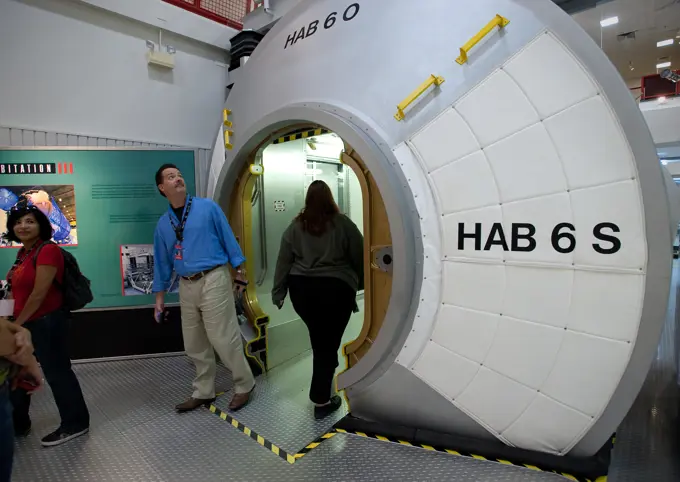
6145-44792440
NASA Twitter followers tour the International Space Station Center at the Kennedy Space Center in Cape Canaveral, Fla. as part of a two-day Tweetup event, Sunday, Nov. 15, 2009. Tweeps had the chance to enter full-scale mock-ups of the Habitation Module and see how Space Station crew members live, sleep and work.
6145-44891732
VANDENBERG AFB, Calif. - The Orbital Sciences Pegasus XL rocket with its NuSTAR spacecraft after attachment to the L-1011 carrier aircraft known as "Stargazer." The Pegasus will launch NuSTAR into space where the high-energy x-ray telescope will conduct a census for black holes, map radioactive material in young supernovae remnants, and study the origins of cosmic rays and the extreme physics around collapsed stars.
6145-45092865
CG4G9159 --- (6 May 2015) --- At the Gagarin Cosmonaut Training Center in Star City, Russia, Expedition 44/45 Flight Engineer Kjell Lindgren of NASA joins his crewmates, Oleg Kononenko of the Russian Federal Space Agency (Roscosmos) and Kimya Yui of the Japan Aerospace Exploration Agency (not pictured), in the International Space Station Zvezda Service Module training mockup on the first of two days of qualification exams May 6. The trio is preparing for launch from the Baikonur Cosmodrome in Kazakhstan on May 27, Kazakh time, in the Soyuz TMA-17M spacecraft to begin a five and a half month mission to the International Space Station.
6145-58968445
Technicians at Textron in Wimington, MA, perform X-ray testing on the Exploration Flight Test-1 (EFT-1) Orion heat shield on Nov. 23, 2013. Part of Batch image transfer from Flickr.
6145-44583587
KENNEDY SPACE CENTER, FLA. - On the launch tower on NASA's Space Launch Complex 2 (SLC-2), Vandenberg Air Force Base, Calif., the second stage of a Delta II rocket sits mated with the first stage. The rocket will carry the ICESat and CHIPSat satellites into Earth orbits. ICESat is a 661-pound satellite known as Geoscience Laser Altimeter System (GLAS) that will revolutionize our understanding of ice and its role in global climate change and how we protect and understand our home planet.  It will help scientists determine if the global sea level is rising or falling.  It will look at the ice sheets that blanket the Earth's poles to see if they are growing or shrinking.  It will assist in developing an understanding of how changes in the Earth's atmosphere and climate effect polar ice masses and global sea level. CHIPSat, a suitcase-size 131-pound satellite, will provide invaluable information into the origin, physical processes and properties of the hot gas contained in the interstellar
6145-44965153
VANDENBERG ABF, Calif. - The Orbital Sciences Pegasus XL rocket that will lift NASA's IRIS solar observatory into orbit is moved from a hangar onto a transporter at Vandenberg Air Force Base. IRIS, short for Interface Region Imaging Spectrograph, is being prepared for launch from Vandenberg June 26. IRIS will open a new window of discovery by tracing the flow of energy and plasma through the chromospheres and transition region into the suns corona using spectrometry and imaging. IRIS fills a crucial gap in our ability to advance studies of the sun-to-Earth connection by tracing the flow of energy and plasma through the foundation of the corona and the region around the sun known as the heliosphere.
4389-2310
PAGEOS Satellite
6145-44607055
KENNEDY SPACE CENTER, FLA. -  Standing inside Discoverys payload bay, Carol Scott (right), lead orbiter engineer, talks about her job as part of a special feature for the KSC Web.  With his back to the camera is Bill Kallus, Media manager in the KSC Web Studio.  Behind Scott can be seen the open hatch of the airlock, which provides support functions such as airlock depressurization and repressurization, extravehicular activity equipment recharge, liquid-cooled garment water cooling, EVA equipment checkout, donning and communications. The outer hatch isolates the airlock from the unpressurized payload bay when closed and permits the EVA crew members to exit from the airlock to the payload bay when open.
6145-45230526
This is a cutaway illustration of the Neutral Buoyancy Simulator (NBS) at the Marshall Space Flight Center (MSFC ). The MSFC NBS provided an excellent environment for testing hardware to examine how it would operate in space and for evaluating techniques for space construction and spacecraft servicing. Here, engineers, designers, and astronauts performed various tests to develop basic concepts, preliminary designs, final designs, and crew procedures. The NBS was constructed of welded steel with polyester-resin coating. The water tank was 75-feet (22.9- meters) in diameter, 40-feet (12.2-meters) deep, and held 1.32 million gallons of water. Since it opened for operation in 1968, the NBS had supported a number of successful space missions, such as the Skylab, Solar Maximum Mission Satellite, Marned Maneuvering Unit, Experimental Assembly of Structures in Extravehicular Activity/Assembly Concept for Construction of Erectable Space Structures (EASE/ACCESS), the Hubble Space Telescope, and
6145-45054648
0937:At the Gagarin Cosmonaut Training Center in Star City, Russia, Expedition 40/41 Flight Engineer Reid Wiseman of NASA admires a model of the old Russian Salyut space station at the Gagarin Museum May 8 as he and his crewmates enter the final weeks of their pre-launch training. Wiseman, Alexander Gerst of the European Space Agency and Max Suraev of the Russian Federal Space Agency (Roscosmos) are preparing for launch May 29, Kazakh time, in the Soyuz TMA-13M spacecraft from the Baikonur Cosmodrome in Kazakhstan for a 5 ½ month mission on the International Space Station.NASA/Stephanie Stoll
1848-54998380
Telescope, observatory on Mt. Koenigstuhl, Heidelberg, Baden-Wuerttemberg, Germany, Europe
6145-58964796
KENNEDY SPACE CENTER, Fla. -- The High Energy Solar Spectroscopic Imager (HESSI) spacecraft, which will be launched by a Pegasus XL rocket, arrives at the Skid Strip at Cape Canaveral Air Force Station. Part of NASA's Small Explorer Program, HESSI's primary mission is to explore the basic physics of particle acceleration and explosive energy release in solar flares. Launch is scheduled for no earlier than June 14
6145-45296443
Teams with NASAs Exploration Ground Systems and contractor Jacobs prepare to lower the Space Launch System (SLS) core stage - the largest part of the rocket - onto the mobile launcher, in between the twin solid rocket boosters, inside High Bay 3 of the Vehicle Assembly Building at NASAs Kennedy Space Center in Florida on June 12, 2021. The 188,000-pound core stage, with its four RS-25 engines, will provide more than 2 million pounds of thrust during launch and ascent, and coupled with the boosters, will provide more than 8.8 million pounds of thrust to send the Artemis I mission to space. Under the Artemis program, NASA will land the first woman and first person of color on the Moon, as well as establish a sustainable presence on the lunar surface in preparation for human missions to Mars.
6145-44704633
CLV ascent model installation 9x7ft. wind tunnel test-97-0180 with Marshall space Flight Center crew Darin Reed, Chrissi Hamilton, Don Nance, Bill Crosby
6145-44560484
The STS-90 Neurolab payload is lowered into position into the cargo bay of Space Shuttle Columbia today in Orbiter Processing Facility bay 3. Investigations during the Neurolab mission will focus on the effects of microgravity on the nervous system. Specifically, experiments will study the adaptation of the vestibular system, the central nervous system, and the pathways that control the ability to sense location in the absence of gravity, as well as the effect of microgravity on a developing nervous system. The crew of STS-90, slated for launch in April, will include Commander Richard Searfoss, Pilot Scott Altman, Mission Specialists Richard Linnehan, Dafydd (Dave) Williams, M.D., and Kathryn (Kay) Hire, and Payload Specialists Jay Buckey, M.D., and James Pawelczyk, Ph.D
PREVIOUS
of 3
NEXT
2401 S. Ervay, Suite 206
Dallas, Texas 75215
United States
Get Started
Free ResearchMy BoardsMy Cart
For Creators
How To License Your ContentContributor PortalFrame of Mind
Resources
API accessPricing
Contact
+1 866 236 0087help@viewpictures.co.uk Contact form
©2026 View Pictures. All Rights Reserved. -A
This site is protected by reCAPTCHA and Google Privacy Policy and Terms of Service apply.