My Boards
View Pictures
  • My Boards

Spacecraft Preparation and Testing

Images depict various stages of spacecraft preparation and testing, showcasing technicians working on simulators, launch systems, and research modules in high-tech environments.

STS-132 ATLANTIS - RCC PANEL REMOVAL
185 assets in this story
6145-58967872
PHOTO DATE:  03-19-12LOCATION:   Bldg. 9NW - ISS MockupsSUBJECT: Expedition 34/35 crew training
6145-44868650
NASA astronaut Doug Hurley crawls out of the Crew Compartment Trainer (CCT) II mockup while Rex Walheim waits as the crew of STS-135 trains in the Space Vehicle Mockup Facility (SVMF) at the Johnson Space Center  on Wednesday, June 29, 2011, in Houston. The training marked the crew's final scheduled session in JSC Building 9, or SVMF. ( NASA Photo / Houston Chronicle, Smiley N. Pool )
6145-44501650
In the Space Station Processing Facility, STS-98 Mission Specialist Thomas D. Jones (Ph.D.) gets a closeup view of the cover on the window of the U.S. Lab Destiny. Along with Commander Kenneth D. Cockrell and Pilot Mark Polansky, Jones is taking part in a Multi-Equipment Interface Test (MEIT) on this significant element of the International Space Station. During the STS-98 mission, the crew will install the Lab on the station during a series of three space walks. The mission will provide the station with science research facilities and expand its power, life support and control capabilities. The U.S. Laboratory Module continues a long tradition of microgravity materials research, first conducted by Skylab and later Shuttle and Spacelab missions. Destiny is expected to be a major feature in future research, providing facilities for biotechnology, fluid physics, combustion, and life sciences research. The Lab is planned for launch aboard Space Shuttle Atlantis on the sixth ISS flight, cu
6145-45048693
10-37-11-3:In the Integration Facility at the Baikonur Cosmodrome in Kazakhstan, Expedition 39/40 Flight Engineer Steve Swanson of NASA boards his Soyuz TMA-12M spacecraft March 21 as he and his crewmates wrapped of training for their upcoming launch to the International Space Station. Swanson, Soyuz Commander Alexander Skvortsov of the Russian Federal Space Agency (Roscosmos) and Flight Engineer Oleg Artemyev of Roscosmos  are scheduled to launch March 26, Kazakh time, for a six-month mission on the orbital laboratory.NASA/Victor Zelentsov
6145-44745409
CAPE CANAVERAL, Fla. --  In the Parachute Refurbishment Facility at NASA's Kennedy Space Center in Florida, the parachutes are packed for the Ares I-X development flight in July 2009. The first stage of the new Ares I rocket and Orion spacecraft will use parachutes to return to Earth. Ares I-X is the test vehicle for the Ares I, which is part of the Constellation Program to return men to the moon and beyond.  Ares I is the essential core of a safe, reliable, cost-effective space transportation system that eventually will carry crewed missions back to the moon, on to Mars and out into the solar system. Ares I may also use its 25-ton payload capacity to deliver resources and supplies to the International Space Station, or to "park" payloads in orbit for retrieval by other spacecraft bound for the moon or other destinations.
6145-45166093
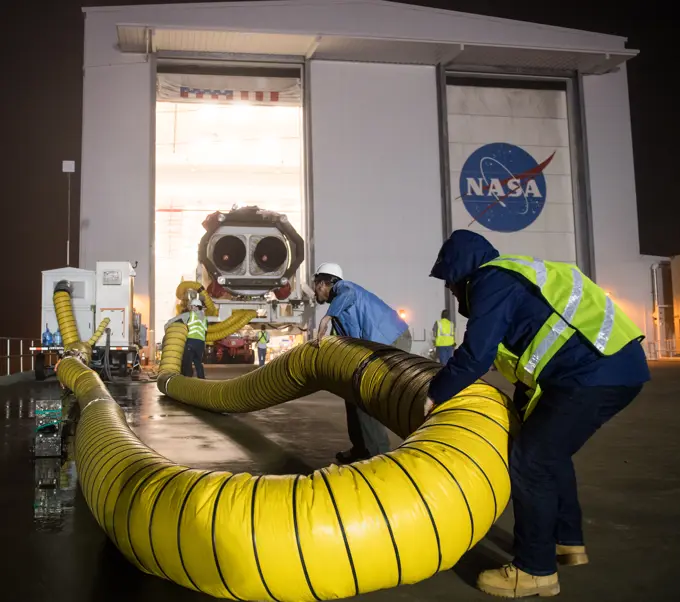
An Orbital ATK rocket is seen as it is rolled out to launch Pad-0A at Wallops Flight Facility Thursday, May 17, 2018 at Wallops Island, VA. The Antares will launch a Cygnus spacecraft on a cargo resupply mission to the International Space Station. The mission is Orbital ATKs ninth contracted cargo delivery flight to the space station for NASA. Included in the 7,400 pounds of cargo onboard Cygnus, are science experiments, crew supplies, and vehicle hardware.
6145-44917621
PHOTO DATE: 11/28/12 LOCATION:   B9 ARGOS/POGO LABSUBJECT:  ESA astronaut (UK) Timothy Peake during ISS EVA PGT/ARGOS training.
6145-44745411
CAPE CANAVERAL, Fla. -- In the Parachute Refurbishment Facility at NASA's Kennedy Space Center in Florida, the parachutes are packed for the Ares I-X development flight in July 2009.  The first stage of the new Ares I rocket and Orion spacecraft will use parachutes to return to Earth. Ares I-X is the test vehicle for the Ares I, which is part of the Constellation Program to return men to the moon and beyond.  Ares I is the essential core of a safe, reliable, cost-effective space transportation system that eventually will carry crewed missions back to the moon, on to Mars and out into the solar system. Ares I may also use its 25-ton payload capacity to deliver resources and supplies to the International Space Station, or to "park" payloads in orbit for retrieval by other spacecraft bound for the moon or other destinations.
6145-44949013
PHOTO DATE:  03-28-13LOCATION:  NBL - Pool Topside SUBJECT:  Expedition 39 (Soyuz 37) crew members Rick Mastracchio and Koichi Wakata during pre-dive briefing, preparations and suitup, then lowering into the water.
6145-44916628
ISS033-E-022198 (17 Nov. 2012) --- Russian cosmonaut Oleg Novitskiy, Expedition 34 flight engineer, closes the hatch between the Soyuz 31 (TMA-05M) and the International Space Stations Rassvet Mini-Research Module 1 (MRM1) as the three Expedition 33 crew members prepare to undock from the station. Russian cosmonaut Evgeny Tarelkin, flight engineer, is visible in the foreground.
6145-44478429
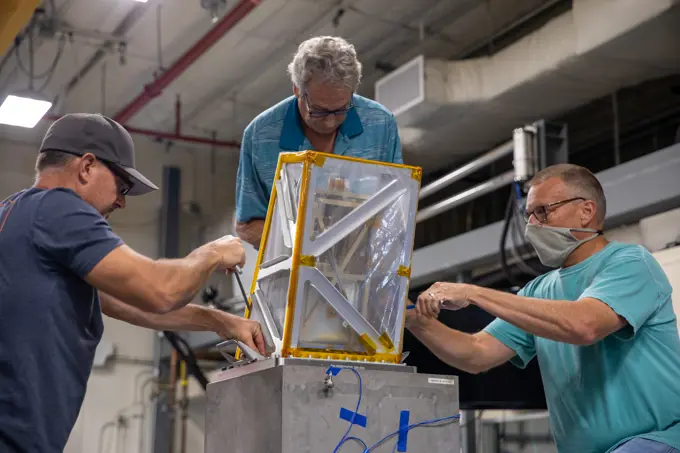
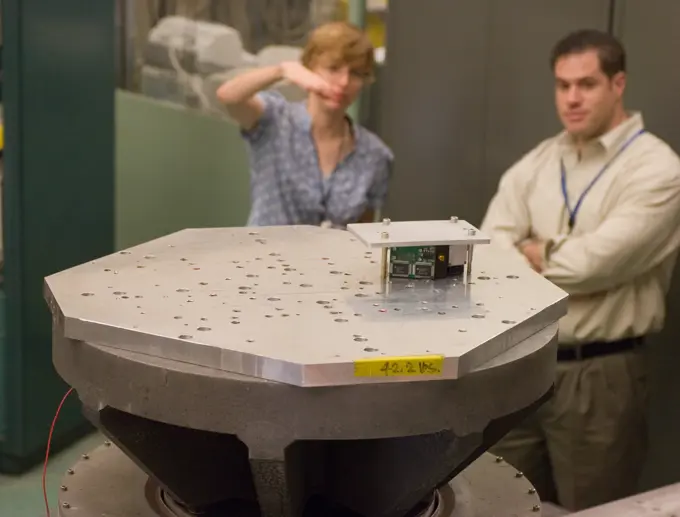
Engineers at NASAs Kennedy Space Center prepare the Mass Spectrometer observing lunar operations (MSolo) instrument for vibration testing inside the Florida spaceports Cryogenics Laboratory on Aug. 3, 2022. MSolo is a commercial off-the-shelf mass spectrometer modified to work in space and will help analyze the chemical makeup of landing sites on the Moon, as well as study water on the lunar surface. Researchers and engineers are preparing MSolo instruments to launch on four robotic missions as part of NASAs Commercial Lunar Payload Services - commercial deliveries beginning in 2023 that will perform science experiments, test technologies, and demonstrate capabilities to help NASA explore the Moon and prepare for crewed missions to the lunar surface.
6145-44717264
CAPE CANAVERAL, Fla. -  In the Payload Hazardous Servicing Facility at NASA's Kennedy Space Center, technicians unlatch the cover of the Wide Field Camera 3, or WFC3,shipping container before removing it.  As Hubble enters the last stage of its life, WFC3  will be Hubble's next evolutionary step, allowing Hubble to peer ever further into the mysteries of the cosmos. WFC3 will study a diverse range of objects and phenomena, from young and extremely distant galaxies, to much more nearby stellar systems, to objects within our very own solar system.  WFC3 will take the place of Wide Field Planetary Camera 2, which astronauts will bring back to Earth aboard the shuttle. WFC3 is part of the payload on the fifth and final Hubble servicing mission, STS-125, targeted for launch Oct. 8.
6145-58970862
jsc2021e052205 (8/26/2020) --- A preflight imagery of personnel posing with the CUAVA-1 flight module prior to thermal vacuum testing at the Australian Research Council Industrial Transformation Training Centre (AITC). Image
6145-44600854
United Space Alliance workers explain tile installation around Discoverys nose landing gear to Shuttle Program Manager Bill Parsons (center). Discovery has been undergoing Orbiter Major Modifications. The OMM work ranged from wiring, control panels and black boxes to gaseous and fluid systems tubing and components. These systems were deserviced, disassembled, inspected, modified, reassembled, checked out and reserviced, as were most other systems onboard. The work included the installation of the Multifunction Electronic Display Subsystem (MEDS) - a state-of-the-art “glass cockpit.”
6145-44497748
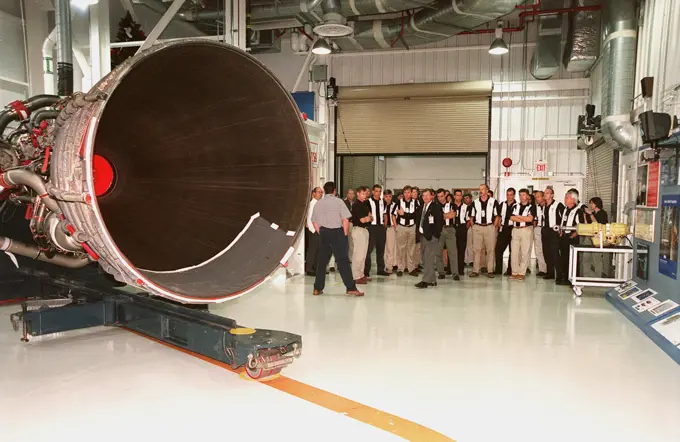
The 1998 astronaut candidate class (group 17) gather in the Space Shuttle Main Engine Processing (SSMEP) Facility. In the foreground is one of the main shuttle engines. The class is at KSC for training activities, including fire training and a flight awareness program, plus touring the OPF, SSME Processing Facility, VAB, SSPF, launch pads, SLF, Apollo/Saturn V Center and the crew headquarters. The U.S. candidates in the '98 class are Clayton C. Anderson, Lee J. Archambault, Tracy E. Caldwell (Ph.D.), Gregory E. Chamitoff (Ph.D.), Timothy J. Creamer, Christopher J. Ferguson, Michael J. Foreman, Michael E. Fossum, Kenneth T. Ham, Patricia C. Hilliard (M.D.), Gregory C. Johnson, Gregory H. Johnson, Stanley G. Love (Ph.D.), Leland D. Melvin, Barbara R. Morgan, William A. Oefelein, John D. Olivas (Ph.D.), Nicholas J.M. Patrick (Ph.D.), Alan G. Poindexter, Garrett E. Reisman (Ph.D.), Steven R. Swanson, Douglas H. Wheelock, Sunita L. Williams, Neil W. Woodward III, George D. Zamka; and the in
6145-54684453
. Testing Perseverance's Regolith Bit Here on Earth. Optimism, a full-scale replica of NASA's Perseverance Mars rover, tests a model of Perseverance's regolith bit in a pile of simulated regolith - broken rock and dust - at the agency's Jet Propulsion Laboratory in Southern California. As with rock cores, Perseverance uses a drill on the end of its robotic arm to collect regolith samples. But to gather the loose material of Martian regolith the rover employs a different drill bit that looks like a spike with small holes on its end. A key objective for Perseverance's mission on Mars is astrobiology, including the search for signs of ancient microbial life. The rover will characterize the planet's geology and past climate, pave the way for human exploration of the Red Planet, and be the first mission to collect and cache Martian rock and regolith (broken rock and dust). Subsequent NASA missions, in cooperation with ESA (European Space Agency), would send spacecraft to Mars to collect the
6145-45119466
NASA astronauts Suni WIlliams and Eric Boe check the Boeing Mission Simulator at the Boeing facility in St. Louis, Missouri, prior to its completion and shipment to NASA's Johnson Space Center in Houston. The simulator is a full-scale mockup of Boeing's Starliner spacecraft. The simulator will be used to train crews to fly the spacecraft.
6145-45147691
jsc2017e134973 - At the Gagarin Cosmonaut Training Center in Star City, Russia, Expedition 54-55 prime crewmember Norishige Kanai of the Japan Aerospace Exploration Agency (JAXA) is seen in a space station trainer as part of the crews qualification exam training activities Nov. 28. Kanai, Anton Shkaplerov of the Russian Federal Space Agency (Roscosmos) and Scott Tingle of NASA will launch Dec. 17 on their Soyuz MS-07 spacecraft for a five-month mission on the International Space Station...NASA/Elizabeth Weissinger.
6145-44643358
Space Shuttle 3% scale model to analyze removal of PAL ramp and other effects i the 9x7ft w.t. with Mike Lopez
6145-45062560
DATE: 6-25-14LOCATION: Bldg 9NW - POGOSUBJECT: Expedition 42/43 ESA astronaut Samantha Cristoforetti during ISS EVA POGO 2 training with instructor Sandy Fletcher.
6145-44643530
Space Shuttle 3% scale model to analyze removal of PAL ramp and other effects i the 9x7ft w.t.
6145-45158632
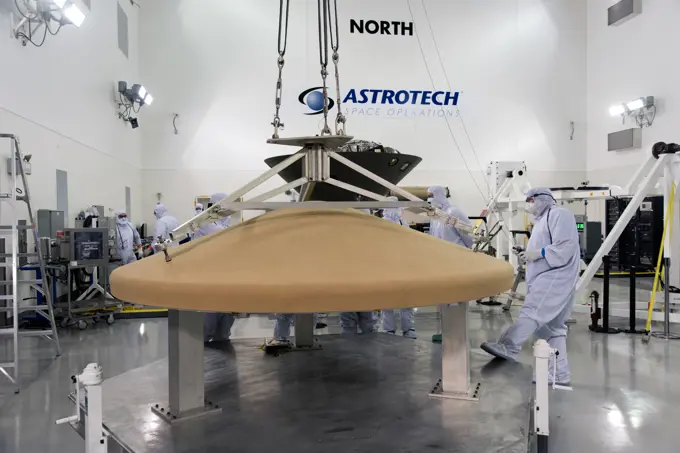
In the Astrotech facility at Vandenberg Air Force Base in California, the heatshield is lifted for placement on NASA's Interior Exploration using Seismic Investigations, Geodesy and Heat Transport, or InSight, Mars lander. InSight will be the first mission to look deep beneath the Martian surface. It will study the planet's interior by measuring its heat output and listen for marsquakes. The spacecraft will use the seismic waves generated by marsquakes to develop a map of the planets deep interior. The resulting insight into Mars formation will provide a better understanding of how other rocky planets, including Earth, were created. InSight is scheduled for liftoff May 5, 2018.
6145-45213726
Technicians removed the solar array from NASA's Ionospheric Connection Explorer (ICON) during a deployment test inside Building 1555 at Vandenberg Air Force Base in California on Aug. 10, 2019. ICON is being prepared for its launch on a Pegasus XL rocket, attached beneath the company's L-1011 Stargazer aircraft. Launch is scheduled for Oct. 10, 2019, from the Skid Strip at Cape Canaveral Air Force Station in Florida. ICON will study the frontier of space - the dynamic zone high in Earth's atmosphere where terrestrial weather from below meets space weather above. The explorer will help determine the physics of Earth's space environment and pave the way for mitigating its effects on our technology and communications systems.
6145-44897912
JSC2012-E-105469 (25 July 2012) --- Canadian Space Agency astronaut Chris Hadfield, Expedition 34 flight engineer and Expedition 35 commander, gets help donning a training version of his Extravehicular Mobility Unit (EMU) spacesuit in preparation for a spacewalk training session in the waters of the Neutral Buoyancy Laboratory (NBL) near NASA's Johnson Space Center.
1783-13884114
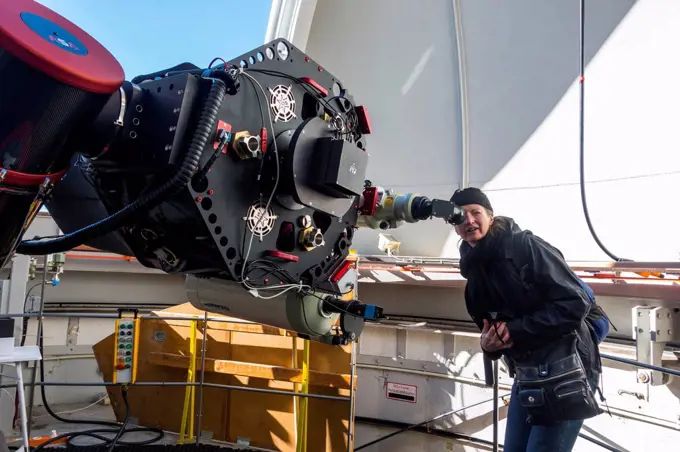
Gornergrat observatory, the second highest observatory in Europe, High Altitude research station; Switzerland
6145-44686730
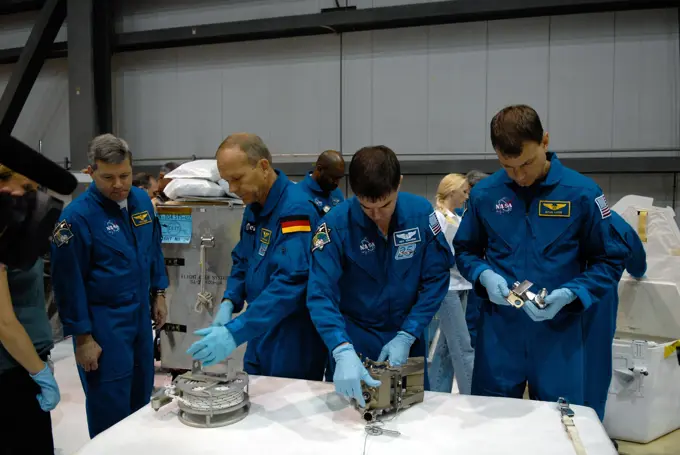
KENNEDY SPACE CENTER, FLA. -- In the Orbiter Processing Facility, STS-122 crew members practice working with equipment for the mission.  From left are Commander Stephen Frick and Mission Specialists Hans Schlegel, Leland Melvin (behind), Rex Walheim and Stanley Love.  Schlegel represents the European Space Agency.  The crew is at Kennedy Space Center to take part in a crew equipment interface test, which includes equipment familiarization.  The mission will carry and install the Columbus Lab,  a multifunctional, pressurized laboratory that will be permanently attached to Node 2 of the space station to carry out experiments in materials science, fluid physics and biosciences, as well as to perform a number of technological applications. It is Europes largest contribution to the construction of the International Space Station and will support scientific and technological research in a microgravity environment.  STS-122 is targeted for launch in December.
6145-44750457
CAPE CANAVERAL, Fla. - NASA's Lunar Reconnaissance Orbiter, or LRO, spacecraft completes its journey to NASA's Kennedy Space Center in Florida.  The spacecraft was built by engineers at Goddard Space Flight Center, where it recently completed two months of tests in a thermal vacuum chamber. The orbiter will carry seven instruments to provide scientists with detailed maps of the lunar surface and enhance our understanding of the moon's topography, lighting conditions, mineralogical composition and natural resources. Information gleaned from LRO will be used to select safe landing sites, determine locations for future lunar outposts and help mitigate radiation dangers to astronauts. The polar regions of the moon are the main focus of the mission because continuous access to sunlight may be possible and water ice may exist in permanently shadowed areas of the poles.  Accompanying LRO on its journey to the moon will be the Lunar Crater Observation and Sensing Satellite, or LCROSS, a missio
6145-44982630
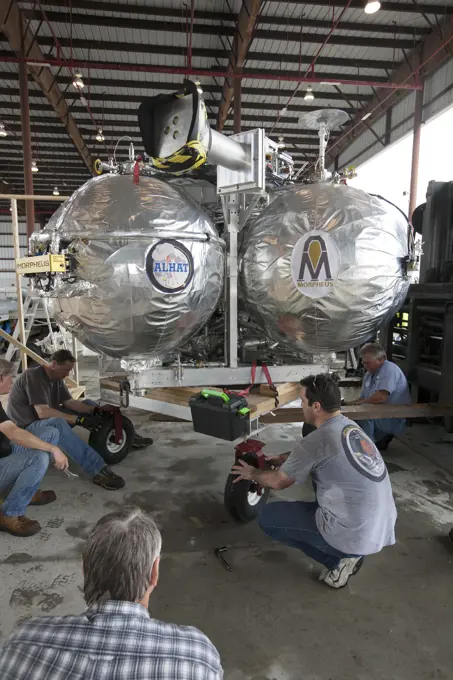
CAPE CANAVERAL, Fla. -- At NASAs Kennedy Space Center in Florida, technicians position the Project Morpheus lander onto a transporter inside a support building at the Shuttle Landing Facility, or SLF. Testing of the prototype lander has been ongoing at NASAs Johnson Space Center in Houston in preparation for free flight testing at Kennedy.The SLF will provide the lander with the kind of field necessary for realistic testing, complete with rocks, craters and hazards to avoid. Morpheus utilizes an autonomous landing and hazard avoidance technology, or ALHAT, payload that will allow it to navigate to clear landing sites amidst rocks, craters and other hazards during its descent. Project Morpheus is one of 20 small projects comprising the Advanced Exploration Systems, or AES, program in NASAs Human Exploration and Operations Mission Directorate. AES projects pioneer new approaches for rapidly developing prototype systems, demonstrating key capabilities and validating operational conce
6145-44656616
Transfer of Ares 1 Mock-Up
6145-45164076
NASA's Ionospheric Connection Explorer (ICON) is moved to a clean room on May 4, 2018, inside Building 1555 at Vandenberg Air Force Base in California. The explorer will launch on June 15, 2018, from Kwajalein Atoll in the Marshall Islands (June 14 in the continental United States) on Orbital ATK's Pegasus XL rocket, which is attached to the company's L-1011 Stargazer aircraft. ICON will study the frontier of space - the dynamic zone high in Earth's atmosphere where terrestrial weather from below meets space weather above. The explorer will help determine the physics of Earth's space environment and pave the way for mitigating its effects on our technology, communications systems and society.
6145-44851879
S133-E-007911 (1 March 2011) --- NASA astronaut Alvin Drew, STS-133 mission specialist, is pictured in the newly-installed Permanent Multipurpose Module (PMM) of the International Space Station while space shuttle Discovery remains docked with the station.
6145-44704627
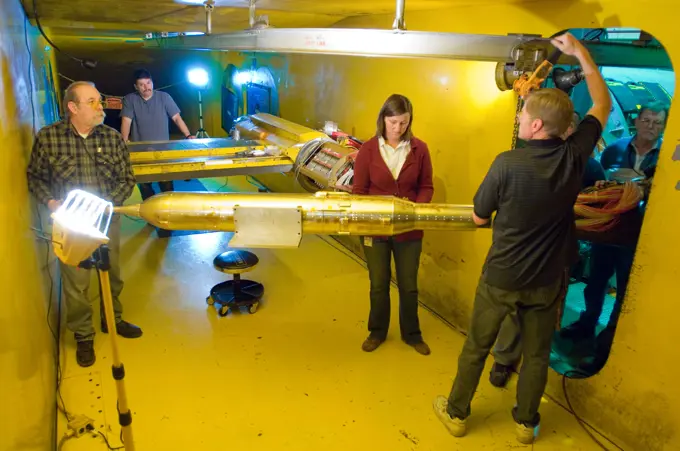
CLV ascent model installation 9x7ft. wind tunnel test-97-0180 with Marshall space Flight Center crew Darin Reed, Chrissi Hamilton, Don Nance, Bill Crosby
6145-58971720
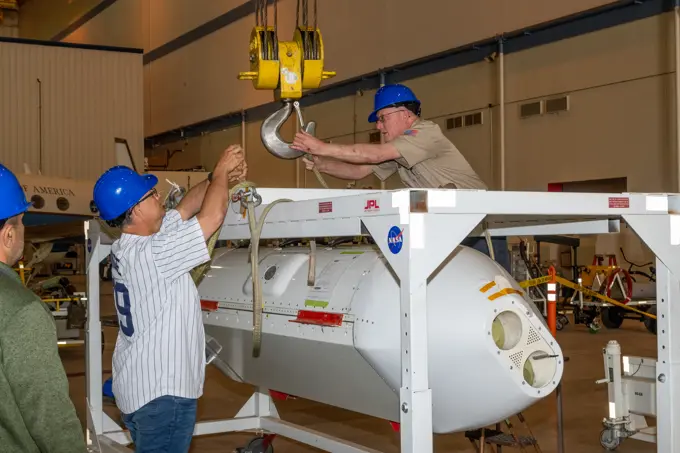
On Aug. 17 and 18, 2023, engineers at NASA's Jet Propulsion Laboratory in Southern California tested the landing system for a proposed future mission that would touch down on Jupiter's icy moon Europa. This system for the proposed Europa Lander is an evolution of hardware used on previous NASA lander missions. It includes the architecture used for the sky crane maneuver that helped lower NASA's Curiosity and Perseverance rovers onto the Martian surface, which would give the lander the stability it needs during touchdown. Although this landing architecture was developed with Europa as the target, it could be adapted for use at other moons and celestial bodies with challenging terrain. Four bridles, suspended from an overhead simulated propulsive descent stage, maintain a level lander body. The four legs conform passively to the terrain they encounter as the lander body continues to descend toward the surface. Each leg consists of a four-bar linkage mechanism that controls the leg's pose
6145-44872019
CAPE CANAVERAL, Fla. -- In the high bay of the RTG storage facility at NASA's Kennedy Space Center in Florida, the multi-mission radioisotope thermoelectric generator (MMRTG) for NASA's Mars Science Laboratory (MSL) mission is enclosed in a protective mesh container, known as the "gorilla cage," for transport to the Payload Hazardous Servicing Facility (PHSF). The cage protects the MMRTG and allows any excess heat generated to dissipate into the air.  In the PHSF, the MMRTG temporarily will be installed on the MSL rover, Curiosity, for a fit check but will be installed on the rover for launch at the pad. The MMRTG will generate the power needed for the mission from the natural decay of plutonium-238, a non-weapons-grade form of the radioisotope. Heat given off by this natural decay will provide constant power through the day and night during all seasons. Curiosity, MSL's car-sized rover, has 10 science instruments designed to search for signs of life, including methane, and help dete
6145-44604084
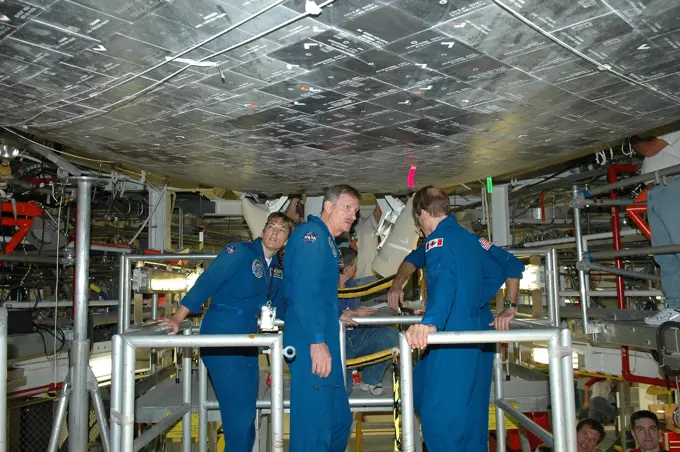
KENNEDY SPACE CENTER, FLA. -  In the Orbiter Processing Facility, STS-114 Mission Commander Eileen Collins looks closely at a reinforced carbon-carbon panel on the wing of Atlantis.  She and other crew members are at KSC to take part in crew equipment and orbiter familiarization.
6145-44649564
KENNEDY SPACE CENTER, FLA. -  In the Orbiter Processing Facility, STS-115 crew members examine tiles on the orbiter Atlantis,  the designated launch vehicle for their mission. From left are Mission Specialists Heidemarie Stefanyshyn-Piper, Joseph Tanner and Steven MacLean, who represents the Canadian Space Agency.  The crew is at the center for Crew Equipment Interface Test activities, which involves equipment familiarization,  a routine part of astronaut training and launch preparations.  The mission will deliver the second port truss segment, the P3/P4 Truss, to attach to the first port truss segment, the P1 Truss, as well as deploy solar array set 2A and 4A.  Launch on Space Shuttle Atlantis is scheduled for late August.
6145-44545320
S95-12491 (8 June 1995) --- Canadian astronaut Chris A. Hadfield is seen during training at the Manipulator Development Facility (MDF) in the Systems Integration Facility at the Johnson Space Center (JSC).  Hadfield will join four other NASA astronauts for the STS-74 mission aboard the Space Shuttle Atlantis later this year.
6177-V53993986
6145-44998184
CAPE CANAVERAL, Fla. - Members of the news media view the Project Morpheus prototype lander inside a hangar near the Shuttle Landing Facility at NASAs Kennedy Space Center in Florida. Speaking to the media is Jon Olansen, the Morpheus project manager at Johnson Space Center in Houston. Morpheus successfully completed its third free flight test Jan. 16. The 57-second test began at 1:15 p.m. EST with the Morpheus lander launching from the ground over a flame trench and ascending about 187 feet, nearly doubling the target ascent velocity from the last test in December 2013. The lander flew forward, covering about 154 feet in 20 seconds before descending and landing within 11 inches of its target on a dedicated pad inside the autonomous landing and hazard avoidance technology, or ALHAT, hazard field. Project Morpheus tests NASAs ALHAT and an engine that runs on liquid oxygen and methane, or green propellants, into a fully-operational lander that could deliver cargo to other planetary sur
6145-44900364
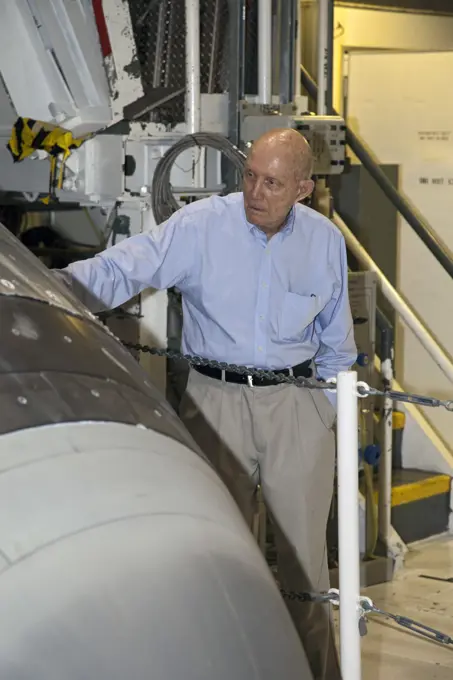
CAPE CANAVERAL, Fla. - Lt. Gen. Thomas P. Stafford, former astronaut and Air Force test pilot, looks over space shuttle Endeavour in Orbiter Processing Facility-2 at NASA's Kennedy Space Center in Florida. Stafford flew two Gemini missions, commanded Apollo 10 and commanded the Apollo-Soyuz test mission during his NASA career.
6177-V53848280
6145-44564112
S98-07959 (5 June 1998) --- U.S. Sen. John H. Glenn Jr. (D.-Ohio) simulates emergency egress from a space shuttle in trouble during a series of training exercises in the Johnson Space Center's systems integration facility. Sharon Jones monitors the STS-95 payload specialist's rappelling performance.
6145-58969031
The Orion leadership visited Ames Research Center in California on March 2, 2015 to recognize the great work performed at the center in support of Orion's first flight, Exploration Flight Test-1 (EFT-1). Part of Batch image transfer from Flickr.
6145-44821029
Lunarbotics - Preparation of Robots
6145-44890418
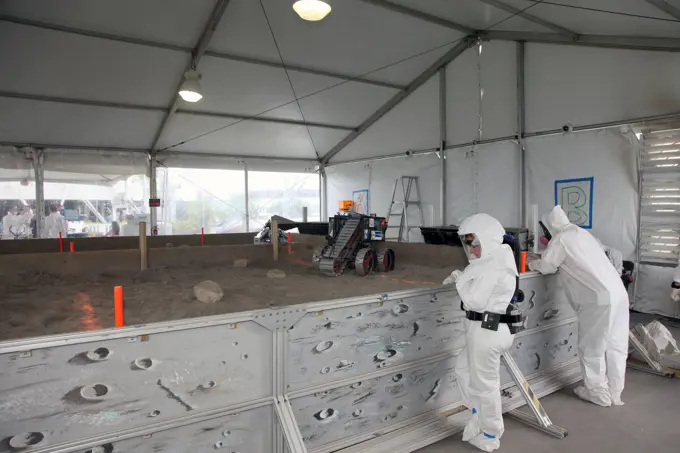
CAPE CANAVERAL, Fla. - At NASAs Kennedy Space Center Visitor Complex in Florida, two judges monitor the progress of two Lunabots inside the Lunarena during NASAs Lunabotics Mining Competition.The mining competition is sponsored by NASA Kennedy Space Centers Education Office for the agencys Exploration Systems Mission Directorate. Undergraduate and graduate students from more than 50 universities and colleges in the U.S. and other countries use their remote-controlled Lunabots to maneuver and dig in a supersized sandbox filled with a crushed material that has characteristics similar to lunar soil.
4269-1846
Sacley Center of the French Atomic Energy Commission (Commissariat à l'Energie Atomique, CEA), France. Samples from of the Tchernobyl nuclear accident of April 26 1986 are analysed in order to determine their radioactivity.
6145-44614961
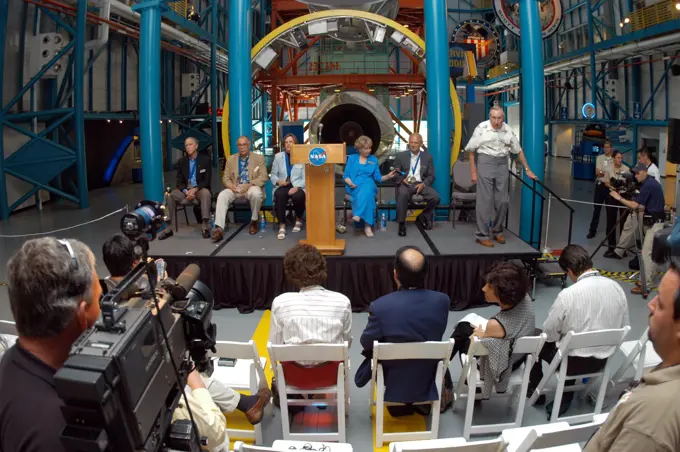
KENNEDY SPACE CENTER, FLA. --  At the Apollo/Saturn V Center at KSC, the newest inductees to the Astronaut Hall of Fame get ready for a press conference following the induction ceremony.  Seated from left are  Richard O. Covey, commander of the Hubble Space Telescope repair mission; Frederick D. Gregory, the first African-American to command a space mission and the current NASA deputy administrator; Kathryn D. Sullivan, the first American woman to walk in space; June Scobee, representing her late husband Francis R. "Dick" Scobee, commander of the ill-fated 1986 Challenger mission; and Norman E. Thagard, the first American to occupy Russias Mir space station. The U.S. Astronaut Hall of Fame opened in 1990 to provide a place where space travelers could be remembered for their participation and accomplishments in the U.S. space program. To be eligible for induction, an individual must have been a U.S. citizen, a NASA astronaut, and out of the active astronaut corps at least five years. T
6145-58960322
CAPE CANAVERAL, Fla. --- At NASA's Kennedy Space Center in Florida, the Class of 2009 Astronaut Candidates, also called ASCANs, take a picture in a high bay of the Vehicle Assembly Building. From left, are NASA's Jeanette J. Epps, Kathleen 'Kate' Rubins, Army Lt. Col. Mark T. Vande, Kjell N. Lindgren and Navy Lt. Cmdr. Gregory R. 'Reid' Wiseman, CSA's David Saint-Jacques, NASA's Air Force Lt. Col. Michael S. Hopkins and Air Force Maj. Jack D. Fischer, JAXA's Kimiya Yui and Takuya Onishi, NASA's Serena M. Aunon, CSA's Jeremy Hansen, NASA's Navy Cmdr. Scott D. Tingle, and JAXA's Norishige Kanai.
6145-45187069
Commercial Crew Program (CCP) astronaut Suni Williams in ISS EVA POGO training in SVMF POGO.
6145-58969195
CNN's Rachel Crane at the Space Vehicle Mockup Facility at NASA's Johnson Space Center in Houston on June 23, 2015. Part of Batch image transfer from Flickr.
6145-44642004
VANDENBERG AIR FORCE BASE, CALIF. - Inside Orbital Sciences Building 1555 at Vandenberg Air Force Base in California, workers prepare the fairing to be installed around the Space Technology 5 (ST5) spacecraft.  The ST5 contains three microsatellites with miniaturized redundant components and technologies.  Each will validate New Millennium Program selected technologies, such as the Cold Gas Micro-Thruster and X-Band Transponder Communication System.  After deployment from the Pegasus, the micro-satellites will be positioned in a “string of pearls” constellation that demonstrates the ability to position them to perform simultaneous multi-point measurements of the magnetic field using highly sensitive magnetometers.  The data will help scientists understand and map the intensity and direction of the Earths magnetic field, its relation to space weather events, and affects on our planet.  With such missions, NASA hopes to improve scientists ability to accurately forecast space weather a
6145-54676436
Juno testing in Glenn Extreme Environments Rig, GEER Laboratory. Juno is a solar-powered NASA spacecraft that spans the width of a basketball court and makes long, looping orbits around giant planet Jupiter
6145-45120247
In the Integration Facility at the Baikonur Cosmodrome in Kazakhstan, Expedition 50-51 backup crewmember Jack Fischer of NASA climbs aboard the Soyuz MS-03 spacecraft Nov. 2 during pre-launch training. Fischer, Paolo Nespoli of the European Space Agency and Fyodor Yurchikhin of the Russian Federal Space Agency (Roscosmos) will back up the prime crewmembers, Peggy Whitson of NASA, Oleg Novitskiy of Roscosmos and Thomas Pesquet of the European Space Agency, who will launch Nov. 18, Baikonur time, for a six-month mission on the International Space Station.NASA/Alexander Vysotsky
6145-55975189
. NASA Armstrongs ER-2 aircraft is uploaded with instruments for its ALOFT mission.  The ER-2 will fly at high altitudes above the Floridian coastline to collect data about the energetic characteristics and behavior of lightning and thunderclouds.  Scientists from the University of Bergen, Norway will interpret that data from the ground and collaborate with NASA pilots to safely collect the most accurate data for this project about the power of lightning.
6145-55971087
. The Uninhabited Aerial Vehicle Synthetic Aperture Radar, UAVSAR, is prepared for installation onto NASAs C-20A aircraft.THE UAVSAR uses a technique called interferometry to detect and measure very subtle deformations in the Earths surface, and the pod is specially designed to be interoperable with unmanned aircraft in the future.It will gather data from Gabon, Africa in September of 2023.
6145-45222772
Virtual Intelligent Planetary Exploration Rover, VIPER Mobility Platform Testing
6145-55975320
OSIRIS-REx Sample Return Training. Recovery teams participate in clean room tours and rehearsals in preparation for the retrieval of the sample return capsule from NASA's OSIRIS-REx mission, Monday, July 17, 2023, at the Department of Defense's Utah Test and Training Range. The sample was collected from the asteroid Bennu in October 2020 by NASAs OSIRIS-REx spacecraft and will return to Earth on September 24th, landing under parachute at the Utah Test and Training Range.
6145-44962227
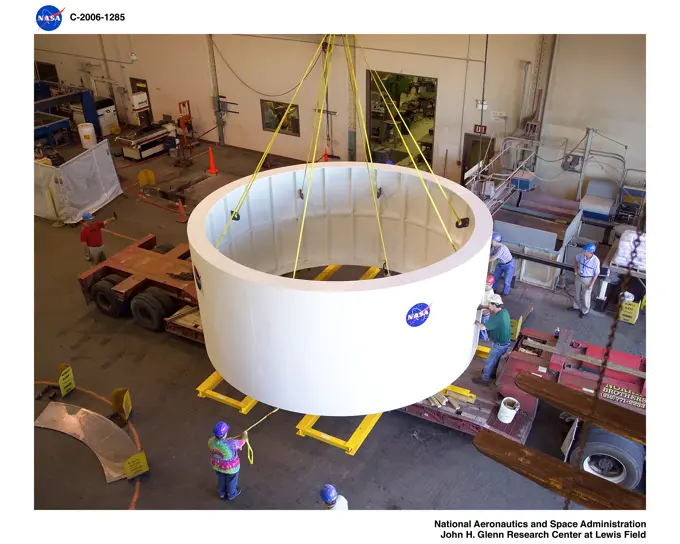
DAVID BEAMAN, MANAGER OF THE SPACECRAFT & PAYLOAD INTEGRATION OFFICE AT NASA'S SPACE LAUNCH SYSTEM, DISCUSSES THE FINER POINTS OF THE CONSTRUCTIONS OF THE SLS ADAPTER RING WITH NASA ASSOCIATE ADMINISTRATOR ROBERT LIGHTFOOT DURING MR. LIGHTFOOT'S VISIT TO THE MARSHALL SPACE FLIGHT CENTER
6145-44704631
CLV ascent model installation 9x7ft. wind tunnel test-97-0180 with Marshall space Flight Center crew Darin Reed, Chrissi Hamilton, Don Nance, Bill Crosby
6145-44656602
LCROSS (Lunar Crater Observation Sensing Satellite) Near InfraRed Spectrometer shake test in Ames N-244 high bay EEL Lab - with Kimberly Ennico and Anthony Colaprete
6145-45204443
Sandy Krasner from NASA's Jet Propulsion Laboratory discusses the Mars InSight lander with attendees of a Mars celebration Friday, May 31, 2019, in Mars, Pennsylvania. NASA is in the small town to celebrate Mars exploration and share the agencys excitement about landing astronauts on the Moon in five years. The celebration includes a weekend of Science, Technology, Engineering, Arts and Mathematics (STEAM) activities.
6145-44703872
VANDENBERG AIR FORCE BASE, Calif. - In Building 1555, workers secure the fillet into place on the Pegasus XL launch vehicle.  The Pegasus will launch NASA's Interstellar Boundary Explorer Mission, or IBEX, satellite from Kwajalein Island in the Marshall Islands, South Pacific.  IBEX will make the first map of the boundary between the solar system and interstellar space.  IBEX is the first mission designed to detect the edge of the solar system. As the solar wind from the sun flows out beyond Pluto, it collides with the material between the stars, forming a shock front. IBEX contains two neutral atom imagers designed to detect particles from the termination shock at the boundary between the solar system and interstellar space. IBEX also will study galactic cosmic rays, energetic particles from beyond the solar system that pose a health and safety hazard for humans exploring beyond Earth orbit. IBEX will make these observations from a highly elliptical orbit that takes it beyond the inte
6145-45068286
LOS ANGELES, Calif. - NASA astronaut Nicole Stott talks with a reporter in the well deck of the USS Anchorage during L.A. Navy Days in Los Angeles. NASA, Lockheed Martin and the U.S. Navy completed Underway Recovery Test 2 on the Orion boilerplate test vehicle in the Pacific Ocean off the coast of San Diego to prepare for recovery of the Orion crew module on its return from a deep space mission. The underway recovery test allowed the teams to demonstrate and evaluate the recovery processes, procedures, new hardware and personnel in open watersThe Ground Systems Development and Operations Program conducted the underway recovery test. Orion is the exploration spacecraft designed to carry astronauts to destinations not yet explored by humans, including an asteroid and Mars. It will have emergency abort capability, sustain the crew during space travel and provide safe re-entry from deep space return velocities. The first unpiloted test flight of the Orion is scheduled to launch in 2014 a
6145-45101542
Maryland's Sen. Barbara Mikulski greeted employees at NASA's Goddard SpaceFlight Center in Greenbelt, Maryland, during a packed town hall meetingJan. 6. She discussed her history with Goddard and appropriations for NASAin 2016.Read more: http://www.nasa.gov/feature/goddard/2016/maryland-sen-barbara-mikulski-visits-nasa-goddard
6145-44733478
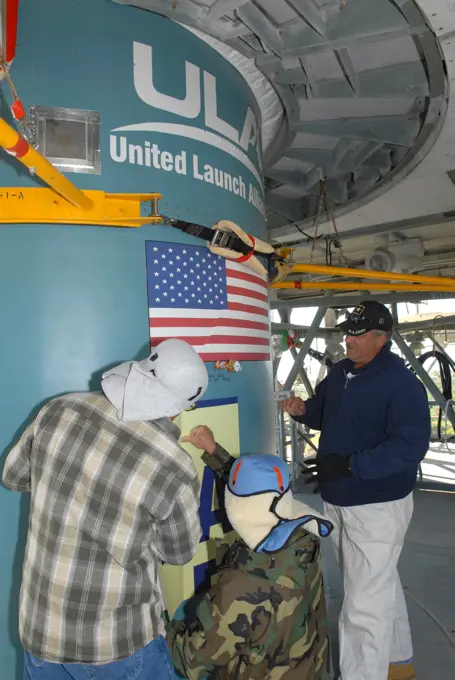
CAPE CANAVERAL, Fla. -    Workers at Launch Complex 17-B on Cape Canaveral Air Force Station in Florida place the large patch that describes the Kepler spacecraft mission to be launched on the Delta 2 rocket. The Kepler mission is specifically designed to survey our region of the Milky Way galaxy to discover hundreds of Earth-size and smaller planets in or near the habitable zone and determine how many of the billions of stars in our galaxy have such planets. Results from this mission will allow us to place our solar system within the continuum of planetary systems in the Galaxy.
6145-44770134
While a test rover rolls off a plywood surface into a prepared bed of soft soil, rover team members Colette Lohr (left) and Kim Lichtenberg (center) eye the wheels digging into the soil and Paolo Bellutta enters the next driving command.
6145-44900432
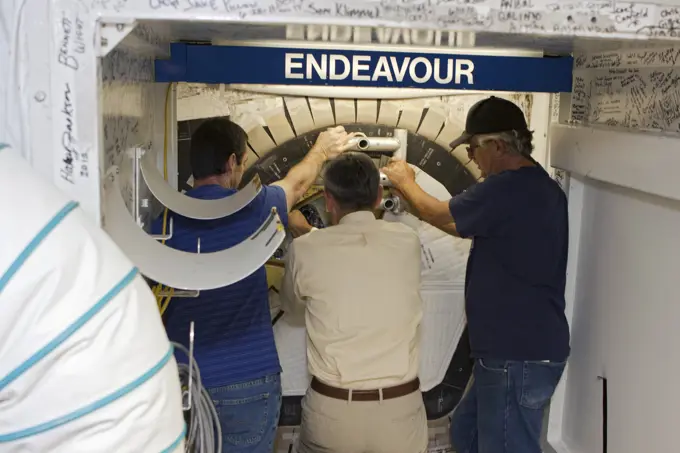
CAPE CANAVERAL, Fla. - In Orbiter Processing Facility Bay 2 at NASAs Kennedy Space Center in Florida, Kennedy Space Center Director Bob Cabana, center, uses a "T"-shaped tool to lock the space shuttle Endeavour's hatch as United Space Alliance technicians Gary Hamilton, left, and Joe Walsh assist. The orbiter is undergoing final preparations for its cross-country ferry flight to California.The work is part of Transition and Retirement of the remaining space shuttles, Endeavour and Atlantis. Endeavour is being prepared for public display at the California Science Center in Los Angeles. Its ferry flight to California is targeted for mid-September. Endeavour was the last space shuttle added to NASAs orbiter fleet. Over the course of its 19-year career, Endeavour spent 299 days in space during 25 missions.
6145-44833014
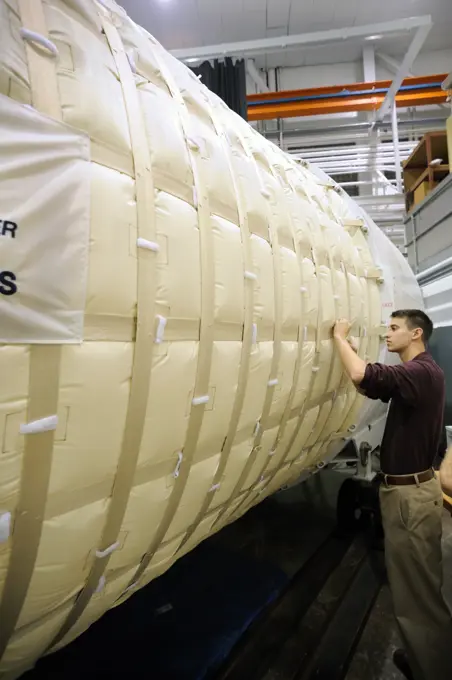
Expandable Lunar Habitat (X-Hab).ILC Dover, under contract by NASA Langley Research Center, and in cooperation withNASA Johnson Space Center has designed and manufactured an expandable lunar habitat.This cylindrical habitat, or Expandable Lunar Habitat (X-Hab) is a hybrid system with twohard end caps and a deployable softgoods section in the center.
6145-44616301
KENNEDY SPACE CENTER, FLA.  -  In the Vehicle Assembly Building (VAB), Scott Thurston (red shirt) stands by while a United Space Alliance worker (blue shirt) gets ready to start moving pieces of Columbia debris, such as the PRSD tank in front, for transfer to a shipping facility and delivery to The Aerospace Corporation in El Segundo, Calif.  Thurston is the Columbia debris coordinator.  The pieces have been released for loan to the non-governmental agency for testing and research.   The Aerospace Corporation requested and will receive graphite/epoxy honeycomb skins from an Orbital Maneuvering System pod, Main Propulsion System Helium tanks, a Reaction Control System Helium tank and a Power Reactant Storage Distribution system tank. The company will use the parts to study re-entry effects on composite materials. NASA notified the Columbia crews families about the loan before releasing the items for study.  Researchers believe the testing will show how materials are expected to respond
6145-44970694
Date: 08-19-13Location: Boeing Houston FacilitySubject: NASA Administrator Charlie Bolden visiting the Boeing CST-100 facility
6145-44728193
VANDENBERG AIR FORCE BASE, Calif.  -   In Hangar 1555 on Vandenberg Air Force Base in California, a worker paints the name Mercator” on the nose of the Pegasus XL rocket.  The rocket is the launch vehicle for NASA’s Interstellar Boundary Explorer, or IBEX, spacecraft. The IBEX satellite will make the first map of the boundary between the Solar System and interstellar space. The name Mercator was chosen in honor of Gerardus Mercator, the Flemish cartographer (or map maker).  In addition to the many maps that he made, he also invented a technique to create terrestrial and celestial globes out of paper mache, allowing for greater production than the carved wooden or brass globes that were previously used. IBEX is targeted for launch from the Kwajalein Atoll, a part of the Marshall Islands in the Pacific Ocean, on Oct.  19.  IBEX will be launched aboard the Pegasus rocket dropped from under the wing of an L-1011 aircraft flying over the Pacific Ocean. The Pegasus will carry the spacecraft
6145-45079820
5295:In the Integration Facility at the Baikonur Cosmodrome in Kazakhstan, Expedition 42/43 crewmember Anton Shkaplerov of the Russian Federal Space Agency (Roscosmos) climbs into the Soyuz TMA-15M spacecraft during a fit check” dress rehearsal Nov. 12. Shkaplerov, Samantha Cristoforetti of the European Space Agency and Terry Virts of NASA will launch Nov. 24, Kazakh time, from Baikonur for a 5 ½ month mission on the International Space Station.NASA/Victor Ivanov
6145-44744154
CAPE CANAVERAL, Fla. - In the Parachute Refurbishment Facility at NASA's Kennedy Space Center, United Space Alliance senior aero composite technicians Dior Hubel (left) and Marcia Jones-Clark pack a colorful main parachute slated for use on the Ares I-X test flight.  The new parachutes are red, white and blue. The launch is targeted for July 2009 from Kennedys Launch Pad 39B and will provide an early opportunity to test and prove hardware, facilities and ground operations associated with the Ares I rocket.  The Ares I-X rocket is a combination of existing and simulator hardware that will resemble the Ares I crew launch vehicle in size, shape and weight. It will provide valuable data to guide the final design of the Ares I, which will launch astronauts in the Orion crew exploration vehicle. The test flight also will bring NASA one step closer to its exploration goals of returning humans to the moon for sustained exploration of the lunar surface and missions to destinations beyond.
6145-45235438
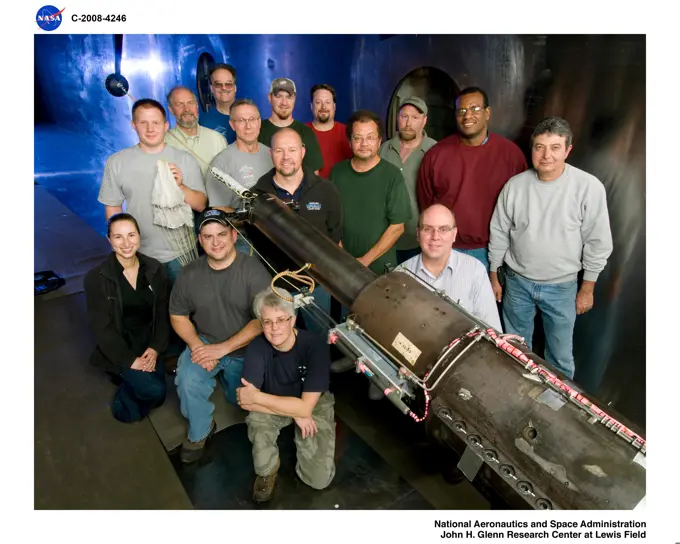
Center Director John McCarthy, left, and researcher Al Johns pose with a one-third scale model of a Grumman Aerospace tilt engine nacelle for Vertical and Short Takeoff and Landing (V/STOL) in the 9- by 15-Foot Low Speed Wind Tunnel at the National Aeronautics and Space Administration
6145-45206738
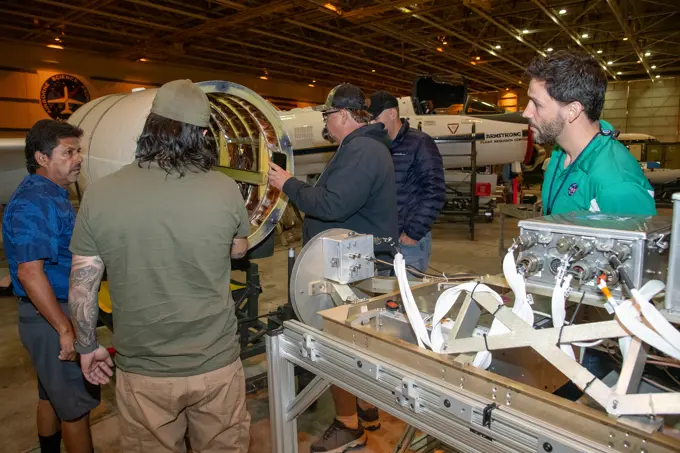
NASAs 2017 astronaut candidates toured aircraft hangar at Armstrong Flight Research Center, in Southern California where they checked out a F-15 cockpit. The center is using its fleet of supersonic research support aircraft for sonic boom research, including the F-15, which will fly in tandem with the X-59 QueSST during early flight test stages, and the F-18, which is conducting supersonic research in support of the overall mission.
6145-44846012
VANDENBERG AIR FORCE BASE, Calif. -- At Space Launch Complex 576-E at Vandenberg Air Force Base in California, the engineering team that installed the Poly Picosatellite Orbital Deployer, or P-POD, assembly to the Taurus rocket's third stage pose for a photo opportunity. From left to right are Kevin Harrington, Cuong Nguyen, Ryan Nugent, Richard Nielsen and Larry Fineberg. The P-POD holds three CubeSats or tiny satellites, designed and created by university and college students that will be carried on the Taurus rocket along with the Glory spacecraft.   The Orbital Sciences Corp. Taurus XL rocket will carry Glory into low Earth orbit. Once Glory reaches orbit, it will collect data on the properties of aerosols and black carbon. It also will help scientists understand how the sun's irradiance affects Earth's climate. Launch is scheduled for 5:09 a.m. EST Feb. 23. For information, visit www.nasa.gov/glory.
6145-45100787
NASA ADMINISTRATOR BOLDEN IS BRIEFED ON NEA SCOUT PROGRESS BY ALEX SOBEY
6145-45094139
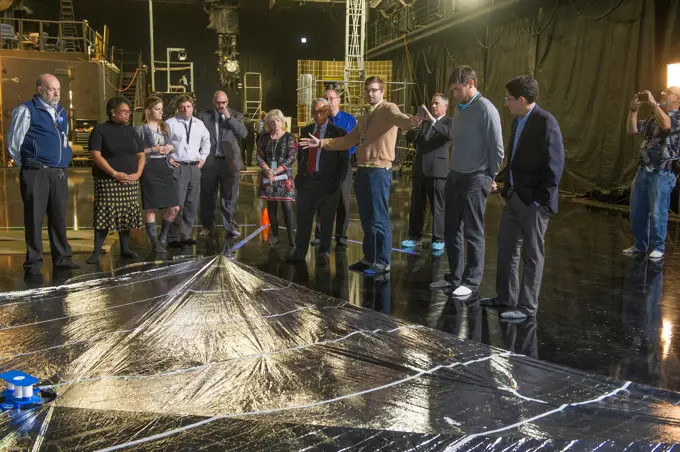
The full-scale mock-up of NASA's MarCO spacecraft held by Farah Alibay, a systems engineer for the project, is dwarfed by the one-half-scale model of NASA's Mars Reconnaissance Orbiter behind her.
6145-45271338
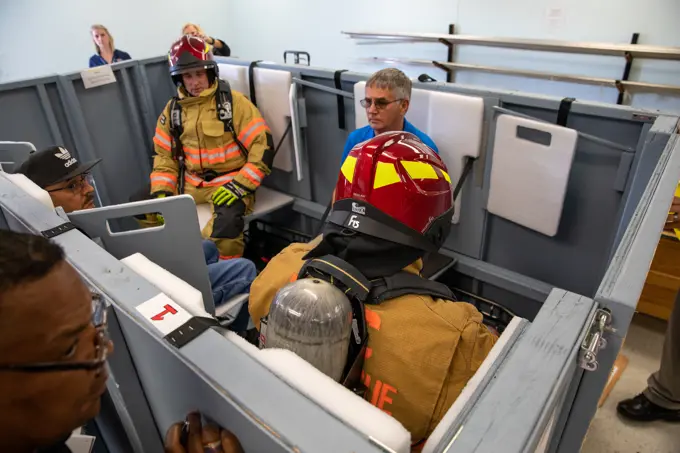
Members of NASA Kennedy Space Centers Fire Rescue team conduct a series of trial scenarios in a mock-up of a launch pad escape basket on Feb. 19, 2020. Kennedys prime contractor Reynolds, Smith and Hill presented the mock-up to NASA, Kennedy Fire Rescue personnel and other stakeholders at the Florida spaceport. The basket would be utilized at Launch Pad 39B in the unlikely event of an emergency at the pad requiring evacuation during crewed missions under the Artemis Program. The actual egress basket will be designed larger than ones used during the shuttle era in order to accommodate fire rescue crew, astronauts and closeout crew. During the presentation, items such as basket release location, seat depth to accommodate firefighters in full gear, sequence of loading and more were addressed. Engineers will take what they learned during this presentation and discussion to advance the design of the pad egress system.
6145-44579652
SOLID ROCKET BOOSTER AFT SKIRT IMAGES
6145-55172365
Regions - Images Relating to the Discover-AQ Program - images and video clips relating to the Discover-AQ Program. Discover-AQ stands for Deriving Information on Surface conditions from COlumn and VERtically resolved observations relevant to Air Quality , Environmental Protection Agency
6145-45102969
LISA PRENDERGAST HANGS INCREMENT 44 PLAQUE, BECKY GRIMALDI, ASTRONAUTS KIMIYA YUI, AND KJELL LINDGREN ALSO PICTURED
6145-44731767
Mars Science Laboratory (MSL) Flexible Canopy Testing in the Glenn Research Center, 10x10 Supersonic Wind Tunnel
6145-44618408
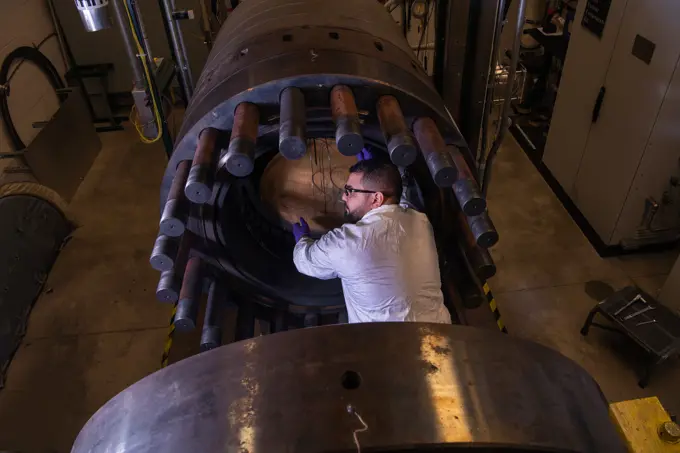
The grand opening of NASAs new, world-class laboratory for research into future space transportation technologies located at the Marshall Space Flight Center (MSFC) in Huntsville, Alabama, took place in July 2004. The state-of-the-art Propulsion Research Laboratory (PRL) serves as a leading national resource for advanced space propulsion research. Its purpose is to conduct research that will lead to the creation and development of innovative propulsion technologies for space exploration. The facility is the epicenter of the effort to move the U.S. space program beyond the confines of conventional chemical propulsion into an era of greatly improved access to space and rapid transit throughout the solar system. The laboratory is designed to accommodate researchers from across the United States, including scientists and engineers from NASA, the Department of Defense, the Department of Energy, universities, and industry. The facility, with 66,000 square feet of useable laboratory space, f
6145-45158884
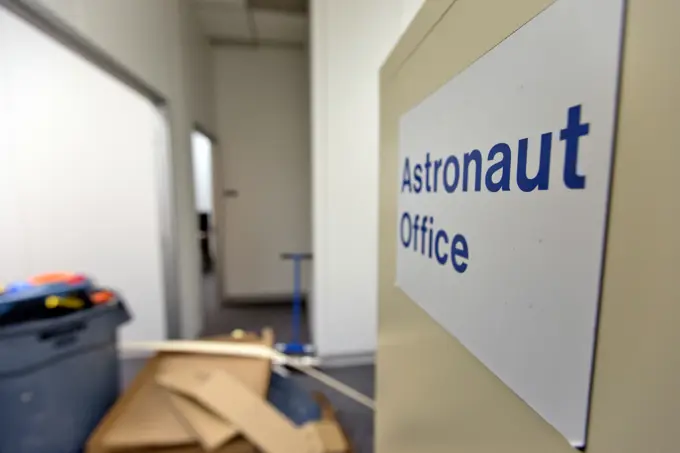
A sign marks the entrance to the Astronaut Office inside the Astronaut Crew Quarters in the Neil Armstrong Operations and Checkout Building at NASA's Kennedy Space Center in Florida. The crew quarters are being prepared for the next generation of space explorers. The walls are receiving fresh coats of paint and new flooring is being installed. The historic facility housed Apollo and space shuttle astronauts before and after their missions into space.
PREVIOUS
of 2
NEXT
2401 S. Ervay, Suite 206
Dallas, Texas 75215
United States
Get Started
Free ResearchMy BoardsMy Cart
For Creators
How To License Your ContentContributor PortalFrame of Mind
Resources
API accessPricing
Contact
+1 866 236 0087help@viewpictures.co.uk Contact form
©2026 View Pictures. All Rights Reserved. -A
This site is protected by reCAPTCHA and Google Privacy Policy and Terms of Service apply.