My Boards
View Pictures
  • My Boards

Spacecraft Preparation Operations

Images showcasing NASA's spacecraft and equipment assembly processes, highlighting technicians at work in high-tech facilities, with detailed machinery and collaborative efforts.

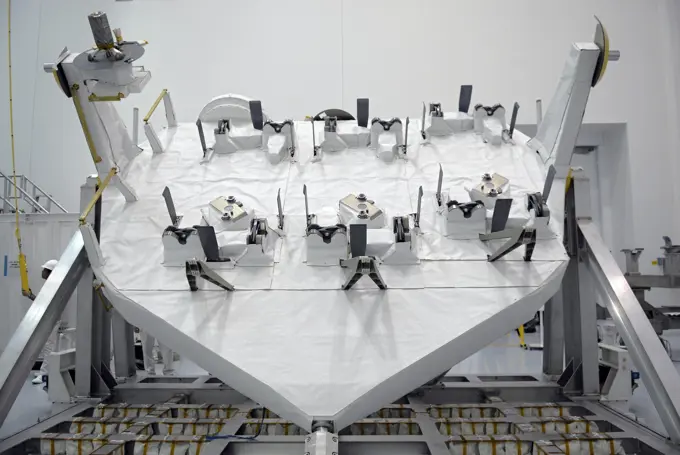
The launch abort system ogive panels are prepared for installation onto the Orion Exploration Flight Test-1 (EFT-1) launch abort system in the Launch Abort System Facility (LASF) at Kennedy Space Center on April 16, 2014. Part of Batch image transfer from Flickr.
264 assets in this story
6145-44881286
CAPE CANAVERAL, Fla. -- In Orbiter Processing Facility-2 at NASAs Kennedy Space Center in Florida, United Space Alliance technicians secure several of space shuttle Endeavours main propulsion system tanks after they were removed from the orbiters mid-body. The tanks will be retained for possible future use on the agencys Space Launch System Program.  The work is part of Endeavours transition and retirement processing. The spacecraft is being prepared for public display at the California Science Center in Los Angeles. Endeavour flew 25 missions, spent 299 days in space, orbited Earth 4,671 times and traveled 122, 883, 151 miles over the course of its 19-year career.
6145-44731687
CAPE CANAVERAL, Fla. -  Trucks carrying the blue Ares I-X upper stage simulator segments are lined up outside the Vehicle Assembly Building's high bay 4 at NASA's Kennedy Space Center in Florida.  The segments will be offloaded inside bay 4. The upper stage simulators will be used in the test flight identified as Ares I-X in 2009.  The Ares I-X test flight will provide NASA an early opportunity to test and prove hardware, facilities and ground operations associated with the Ares I crew launch vehicle. It also will allow NASA to gather critical data during ascent of the integrated Orion crew exploration vehicle and the Ares I rocket. The data will ensure the entire vehicle system is safe and fully operational before astronauts begin traveling to orbit.  The simulator segments will simulate the mass and the outer mold line and will be more than 100 feet of the total vehicle height of 327 feet.  The simulator comprises 11 segments that are approximately 18 feet in diameter.  Most of the s
6145-44908423
CAPE CANAVERAL, Fla. - Test operators examine a model capsule after a of test inside the Vehicle Assembly Building at NASA's Kennedy Space Center in Florida to test a rotor system landing design. The design would give a capsule the stability and control of a helicopter, but would not be powered. Instead, the wind passing over the rotors as the capsule descends would make the blades turn, a process called auto-rotation. The intent is to give real spacecraft a soft landing with enough control that they could touch down anywhere in the world, whether it be a runway or parking lot. In other words, wherever a helicopter could land, a spacecraft could land, too.
6145-44998181
CAPE CANAVERAL, Fla. - Members of the news media view the Project Morpheus prototype lander inside a hangar near the Shuttle Landing Facility at NASAs Kennedy Space Center in Florida. Speaking to the media is Jon Olansen, the Morpheus project manager at Johnson Space Center in Houston. Morpheus successfully completed its third free flight test Jan. 16. The 57-second test began at 1:15 p.m. EST with the Morpheus lander launching from the ground over a flame trench and ascending about 187 feet, nearly doubling the target ascent velocity from the last test in December 2013. The lander flew forward, covering about 154 feet in 20 seconds before descending and landing within 11 inches of its target on a dedicated pad inside the autonomous landing and hazard avoidance technology, or ALHAT, hazard field. Project Morpheus tests NASAs ALHAT and an engine that runs on liquid oxygen and methane, or green propellants, into a fully-operational lander that could deliver cargo to other planetary sur
6145-44727410
CAPE CANAVERAL, Fla. -  In the Space Station Processing Facility at NASA's Kennedy Space Center in Florida, the Kibo Experiment Logistics Module Exposed Section, or ELM-ES, is exposed after removal of the shipping container. The ELM-ES is one of the final components of the Japan Aerospace Exploration Agency's Kibo laboratory for the International Space Station.  It can provide payload storage space and can carry up to three payloads at launch. In addition, the ELM-ES provides a logistics function where it can be returned to the ground aboard the space shuttle. The ELM-ES will be carried aboard space shuttle Endeavour on the STS-127 mission targeted for launch May 15, 2009.
6145-44743838
CAPE CANAVERAL, Fla. - In the Vehicle Assembly Building high bay 4 at NASA's Kennedy Space Center in Florida, one of the Ares I-X upper stage simulator segments bears the decal of the U.S. flag.  The upper stage simulator will be used in the test flight identified as Ares I-X in 2009.  Ares I-X is the test vehicle for the Ares I, which is part of the Constellation Program to return men to the moon and beyond.  Ares I is the essential core of a safe, reliable, cost-effective space transportation system that eventually will carry crewed missions back to the moon, on to Mars and out into the solar system. Ares I may also use its 25-ton payload capacity to deliver resources and supplies to the International Space Station, or to "park" payloads in orbit for retrieval by other spacecraft bound for the moon or other destinations.
6145-45137430
iss052e002482 (6/15/2017) --- A view of the Japanese Experiment Module (JEM) Internal Ball Camera aboard the International Space Station (ISS). This device is a free-flying camera robot that provides real time video downlink and photographs. It is expected to reduce the crew time requirements to support video recording of activities, especially at the blind spot of existing JEM internal cameras.
6145-52097597
An overall outside view of a KC-135 Stratotanker aircraft simulator used for flight control simulation and integration testing during a KC-135 re-engine program at the Boeing Company. Base: Wichita State: Kansas (KS) Country: United States Of America (USA)
6145-44508986
KENNEDY SPACE CENTER, FLA. -- With the lid removed, the wrapped Mobile Base System (MBS) is revealed inside its transport container. The MBS is part of the Canadian Space Agencys Space Station Remote Manipulator System (SSRMS), which is part of the payload on mission STS-100 to the International Space Station
6145-45195348
The Space Test Program-Houston 6 (STP-H6) payload is inside the Space Station Processing Facility high bay at NASAs Kennedy Space Center in Florida on March 19, 2019. It is being prepared for its move to the SpaceX facility where it will be will be stowed in the trunk of the Dragon spacecraft for delivery to the International Space Station on SpaceXs 17th Commercial Resupply Services mission (CRS-17) for NASA. STP-H6 is an x-ray communication investigation that will be used to perform a space-based demonstration of a new technology for generating beams of modulated x-rays. This technology may be useful for providing efficient communication to deep space probes, or communicating with hypersonic vehicles where plasma sheaths prevent traditional radio communications. CRS-17 is scheduled to launch from Space Launch Complex 40 on Cape Canaveral Air Force Station in late April.
6145-44510614
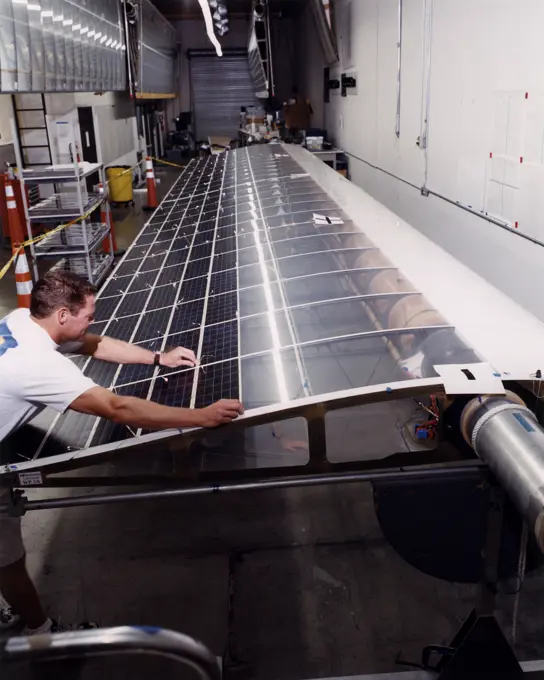
Technician Marshall MacCready carefully lays a panel of solar cells into place on a wing section of the Helios Prototype flying wing at AeroVironment's Design Development Center in Simi Valley, California. The bi-facial cells, manufactured by SunPower, Inc., of Sunnyvale, California, are among 64,000 solar cells which have been installed on the solar-powered aircraft to provide electricity to its 14 motors and operating systems.
6145-44707033
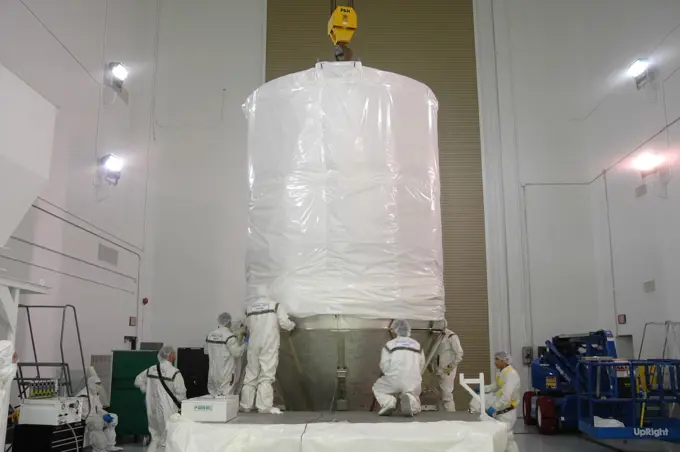
VANDENBERG AIR FORCE BASE, Calif. -   The shipping canister is ready to be placed over the Ocean Surface Topography Mission, or OSTM/Jason 2, spacecraft for transport to the launch pad.  The launch of the OSTM/Jason 2 aboard a Delta II rocket is scheduled for Friday, June 20, from Vandenberg Air Force Base in California. The launch window extends from 12:46 a.m. to 12:55 a.m. PDT. The satellite will be placed in an 830-mile-high orbit at an inclination of 66 degrees after separating from the Delta II 55 minutes after liftoff.  The five primary science instruments of the Ocean Surface Topography Mission aboard the Jason 2 spacecraft are dedicated to measuring ocean surface height. These measurements will be used to evaluate and forecast climate changes and improve weather forecasting. The results also are expected to help forecasters better predict hurricane intensity.
6145-44968449
Crew Commercial Office's PAO activities for Boeing's rollout of their CST-100 capsule - "First Look" Media Event.  Photo Date: July 22, 2013.  Location: Boeing - Houston Product Support Center.
6145-44580388
The upper wing surfaces of the Active Aeroelastic Wing F/A-18 test aircraft are covered with accelerometers and other sensors during ground vibration tests at NASA Dryden Flight Research Center.
6145-45084610
NASA's Orion spacecraft is viewed by members of the media at the Launch Abort System Facility at NASA's Kennedy Space Center in Florida. Orion made the 8-day, 2,700 mile overland trip back to Kennedy from Naval Base San Diego in California. Analysis of date obtained during its two-orbit, four-and-a-half hour mission Dec. 5 will provide engineers detailed information on how the spacecraft fared. The Ground Systems Development and Operations Program led the recovery, offload and transportation efforts.
6145-45123017
Representative Ted Yoho (R-FL) and staff visited Goddard on Dec 9, 2016 via invitation from Center Director Chris Scolese. District staff was updated on current work at Goddard and toured Hyperwall,James Webb Space Telescope, and Robotic Operations Center.
6145-44956154
CAPE CANAVERAL, Fla. -- At the Kennedy Space Center Visitor Complex in Florida, construction crews are removing 16,000 square feet of plastic shrink-wrap from the space shuttle Atlantis. The spacecraft was enclosed in the plastic shrink-wrap since November of last year to protect the artifact from dust and debris during construction of the 90,000-square-foot facility.Last November, the space shuttle Atlantis made its historic final journey to its new home, traveling 10 miles from the Kennedy Space Center's Vehicle Assembly Building to the spaceport's visitor complex. The new $100 million "Space Shuttle Atlantis" facility will include interactive exhibits that tell the story of the 30-year Space Shuttle Program and highlights the future of space exploration. The "Space Shuttle Atlantis" exhibit scheduled to open June 29, 2013.
6145-44987385
CAPE CANAVERAL, Fla. -- Inside the Operations and Checkout Building high bay at NASAs Kennedy Space Center in Florida, technicians remove the cover from a shipping container that carries one of the three main parachutes for the Orion spacecraft. The parachute will be prepared for installation on Orion. The Orion spacecraft is being prepared for its first unpiloted flight test, Exploration Flight Test-1, or EFT-1, scheduled for launch atop a Delta IV rocket in September 2014. The Orion spacecraft is designed to carry astronauts to destinations not yet explored by humans. It will have emergency abort capability, sustain the crew during space travel and provide safe re-entry from deep space return velocities. Orion is scheduled to launch atop NASAs Space Launch System rocket in 2017.
6145-44827706
CAPE CANAVERAL, Fla. -- In the Space Station Processing Facility at NASA's Kennedy Space Center in Florida, NASA hosted a media event featuring Robonaut (R2), a dexterous humanoid astronaut helper, to the public.R2 will fly to the International Space Station aboard space shuttle Discovery on the STS-133 mission. Although it will initially only participate in operational tests, upgrades could eventually allow the robot to realize its true purpose -- helping spacewalking astronauts with tasks outside the space station.
6145-44701789
CAPE CANAVERAL, Fla. --- In Orbiter Processing Facility Bay 3 at NASA's Kennedy Space Center, space shuttle Discovery's payload bay doors are closed for the rollover to the Vehicle Assembly Building. In the VAB, the shuttle will be stacked with the solid rocket boosters and external tank for launch.   Discovery is the designated vehicle on the STS-124 mission to the International Space Station.  On the mission, the shuttle will transport the Kibo Japanese Experiment Module - Pressurized Module and the Japanese Remote Manipulator System. The payload will be installed at the launch pad.  Launch is targeted for May 25.
6145-44639617
KENNEDY SPACE CENTER, FLA. - Technicians monitor the fairing enclosing New Horizons as it is positioned atop a Lockheed Martin Atlas V launch vehicle in the Vertical Integration Facility at Complex 41 on Cape Canaveral Air Force Station. New Horizons carries seven scientific instruments that will characterize the global geology and geomorphology of Pluto and its moon Charon, map their surface compositions and temperatures, and examine Pluto's complex atmosphere. After that, flybys of Kuiper Belt objects from even farther in the solar system may be undertaken in an extended mission. New Horizons is the first mission in NASA's New Frontiers program of medium-class planetary missions. The spacecraft, designed for NASA by the Johns Hopkins University Applied Physics Laboratory in Laurel, Md., will launch aboard a Lockheed Martin Atlas V rocket and fly by Pluto and Charon as early as summer 2015.
6145-44579113
Looking ever so much like an alien spacecraft, the Altus II remotely piloted aircraft shows off some of the instruments and camera lenses mounted in its nose for a lightning study over Florida flown during the summer of 2002.
6145-44597082
KENNEDY SPACE CENTER, FLA. -   Workers in the Space Station Processing Facility prepare to remove the lid of the container with the Japanese Experiment Module (JEM) pressure module inside. A research laboratory, the pressurized module is the first element of the JEM, named "Kibo" (Hope), to be delivered to KSC.   The National Space Development Agency of Japan (NASDA) developed the laboratory at the Tsukuba Space Center near Tokyo and is Japan's primary contribution to the Station. It will enhance the unique research capabilities of the orbiting complex by providing an additional environment for astronauts to conduct science experiments.  The JEM also includes an exposed facility (platform) for space environment experiments, a robotic manipulator system, and two logistics modules. The various JEM components will be  assembled in space over the course of three Shuttle missions.
6145-45114210
Inside the Neil Armstrong Operations and Checkout Building high bay at NASAs Kennedy Space Center in Florida, a crane removes the top of the shipping container carrying the Orion heat shield for Exploration Mission 1 (EM-1). The heat shield arrived aboard the agencys Super Guppy aircraft at the Shuttle Landing Facility, managed and operated by Space Florida, from Lockheed Martins manufacturing facility near Denver. The heat shield will be offloaded and moved into the high bay for processing. The Orion spacecraft will launch atop NASAs Space Launch System rocket on EM-1, an uncrewed test flight, in 2018.
6145-52145127
Civilian workers from General Atomics Aeronautical Systems, Inc. are shown doing a preflight check on the Predator unmanned aerial vehicle (UAV) inside a hangar. The preflight is for a simulated Navy reconnaissance flight for Command Carrier Group One (CCG-1). The UAV is to provide "near real-time" infrared and color video coverage during its flight. The test aircraft is operated by a joint armed services detachment working with the contractor. Base: Saint Nicholas Island State: California (CA) Country: United States Of America (USA)
6145-45126771
iss050e041989 (2/14/2017) --- Photo documentation of the Radio Frequency Identification (RFID) cable installation in the U.S. Laboratory aboard the International Space Station (ISS). The RFID-Enabled Autonomous Logistics Management (REALM) (RFID Logistics Awareness) investigation tests a radio-based inventory control system to keep track of everything inside the football-field-sized ISS. Some aspects of the technology are commonly used on Earth, but other aspects are experimental in nature.
6145-45084608
NASA's Orion spacecraft is viewed by members of the media at the Launch Abort System Facility at NASA's Kennedy Space Center in Florida. Lou Garcia, with the Ground Systems Development and Operations Program, or GSDO, speaks to the media during the viewing opportunity. The spacecraft's cross-country return, a 2,700 mile road trip from Naval Base San Diego to Kennedy, sets the stage for in-depth analysis of data obtained during Orion's trip to space. It will provide engineers with detailed information on how the spacecraft fared during its two-orbit, 4.5-hour flight test, completed on Dec. 5. GSDO led the recovery, offload and transportation efforts.
6145-44685392
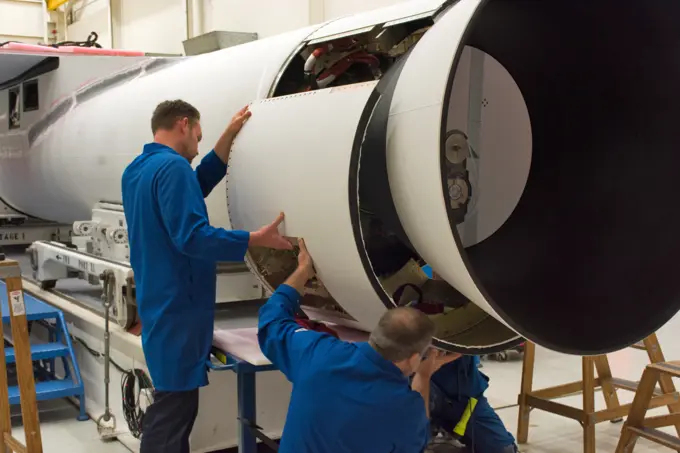
KENNEDY SPACE CENTER, FLA. -- At Astrotech Space Operations in Titusville, Fla., workers ensure the upper transportation canister is securely attached to the lower segments.  The transportation canister will protect the spacecraft and booster during transfer to Launch Pad 17-B at Cape Canaveral Air Force Station (CCAFS). During its nearly decade-long mission, the Dawn mission will study the asteroid Vesta and dwarf planet Ceres, celestial bodies believed to have accreted early in the history of the solar system. To carry out its scientific mission, the Dawn spacecraft will carry a visible camera, a visible and infrared mapping spectrometer, and a gamma ray and neutron spectrometer, whose data will be used in combination to characterize these bodies.  In addition to the three instruments, radiometric and optical navigation data will provide data relating to the gravity field and thus bulk properties and internal structure of the two bodies. Data returned from the Dawn spacecraft could p
6145-58958581
CAPE CANAVERAL, Fla. -- At the Kennedy Space Center Visitor Complex in Florida, construction crews begin removing 16,000 square feet of plastic shrink-wrap from the space shuttle Atlantis. The spacecraft was enclosed in the plastic shrink-wrap since November of last year to protect the artifact from dust and debris during construction of the 90,000-square-foot facility. Last November, the space shuttle Atlantis made its historic final journey to its new home, traveling 10 miles from the Kennedy Space Center's Vehicle Assembly Building to the spaceport's visitor complex. The new $100 million 'Space Shuttle Atlantis' facility will include interactive exhibits that tell the story of the 30-year Space Shuttle Program and highlights the future of space exploration. The 'Space Shuttle Atlantis' exhibit scheduled to open June 29, 2013.
6145-44552612
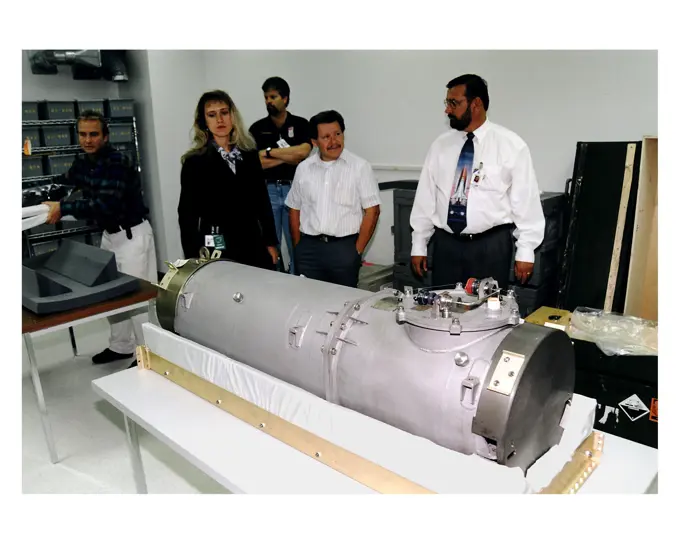
An oxygen generator destined to replace a malfunctioning unit on the Russian Mir Space Station is the object of much curiosity during preflight preparations in the SPACEHAB Payload Processing Facility. A SPACEHAB Double Module on the Space Shuttle Atlantis will carry the oxygen generator to Mir during STS-84, the sixth Shuttle-Mir docking. The nearly 300-pound generator, manufactured by RSC Energia in Russia, will replace one of two Mir units that have been malfunctioning recently. The generator functions by electrolysis, which separates water into its oxygen and hydrogen components. The hydrogen is vented and the oxygen is used for breathing by the Mir crew. The generator is 4.2 feet in length and 1.4 feet in diameter. STS-84, which is planned to include a Mir crew exchange of astronaut C. Michael Foale for Jerry M. Linenger, is targeted for a May 15 liftoff
6145-45203296
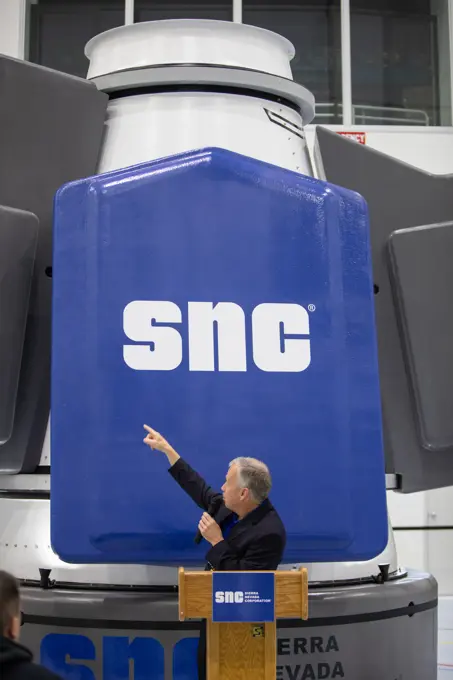
In view in this photograph, taken on May 16, 2019, is the area where the Sierra Nevada Corporation will process its Dream Chaser spacecraft in the high bay of the Space Station Processing Facility (SSPF) at NASA's Kennedy Space Center in Florida. The center is celebrating the SSPFs 25th anniversary. The facility was built to process elements for the International Space Station. Now it is providing support for current and future NASA and commercial provider programs, including Commercial Resupply Services, Artemis 1, sending the first woman and next man to the Moon, and deep space destinations including Mars.
6145-45138458
Technicians install the aft skirt on the Orbital ATK Pegasus XL rocket July 8, 2017, inside Building 1555 at Vandenberg Air Force Base in California. When the aft skirt is installed, the rudder and fins can be installed. The Pegasus rocket is being prepared for NASA's Ionospheric Connection Explorer, or ICON, mission. The explorer will launch on June 15, 2018, from Kwajalein Atoll in the Marshall Islands (June 14 in the continental United States) on Orbital ATKS's Pegasus XL, which is attached to the company's L-1011 Stargazer aircraft. ICON will study the frontier of space - the dynamic zone high in Earth's atmosphere where terrestrial weather from below meets space weather above. The explorer will help determine the physics of Earth's space environment and pave the way for mitigating its effects on our technology, communications systems and society.
6145-45204435
Astrobotic Mission Director, Sharad Bhaskaran , third from left, speaks about their lunar lander with, from left to right, NASA Press Officer, Felicia Chou; NASA Associate Administrator, Science Mission Directorate, Thomas Zurbuchen; Astrobotic CEO, John Thornton; Chairman of the Board of Intuitive Machines, Kam Ghaffarian; VP of Research and Development of Intuitive Machines, Tim Crain; President and CEO of OrbitBeyond, Siba Padhi; and Chief Science Officer, OrbitBeyond, Jon Morse, Friday, May 31, 2019, at Goddard Space Flight Center in Md. Astrobotic, Intuitive Machines, and OrbitBeyond have been selected to provide the first lunar landers for the Artemis program's lunar surface exploration.
6145-44727406
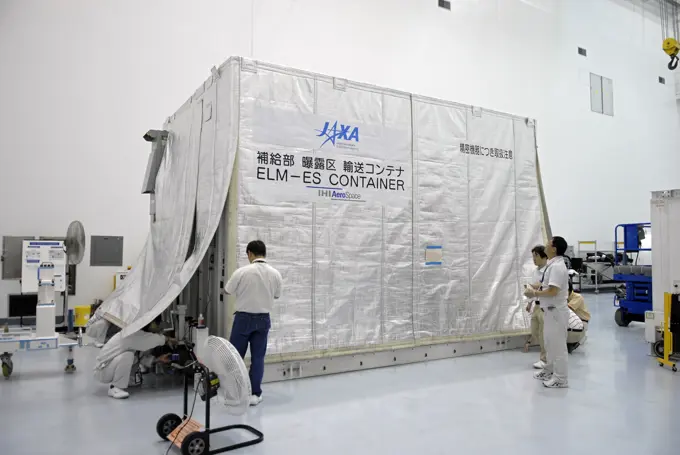
CAPE CANAVERAL, Fla. -   The Kibo Experiment Logistics Module Exposed Section, or ELM-ES, shipping container is uncovered in the Space Station Processing Facility at NASA's Kennedy Space Center in Florida.  The ELM-ES is one of the final components of the Japan Aerospace Exploration Agency's Kibo laboratory for the International Space Station.  It can provide payload storage space and can carry up to three payloads at launch. In addition, the ELM-ES provides a logistics function where it can be returned to the ground aboard the space shuttle. The ELM-ES will be carried aboard space shuttle Endeavour on the STS-127 mission targeted for launch May 15, 2009.
6145-44622989
KENNEDY SPACE CENTER, FLA. - In the Orbiter Processing Facility, the wing of the orbiter Atlantis is covered in plastic, part of the preparation to protect the vehicles from possible damage by Hurricane Jeanne.  The storm ravaged Central Florida for 21 hours as it crossed the shoreline on the east coast Sept. 25-26.  Hurricane Jeanne was the fourth hurricane in 6 weeks to batter the state.
6145-44493535
The Canadian Space Agency's (CSA) Space Station Remote Manipulator System (SSRMS) arrives at the Space Station Processing Facility at KSC to begin a campaign of prelaunch processing activities. CSA's first contribution to the International Space Station (ISS), the SSRMS is the primary means of transferring payloads between the orbiter payload bay and the ISS for assembly. The 56-foot-long robotic arm includes two 12-foot booms joined by a hinge. Seven joints on the arm allow highly flexible and precise movement. Latching End Effectors are mounted on each end of the arm for grappling. Video cameras mounted on the booms and end effectors will give astronauts maximum visibility for operations and maintenance tasks on the ISS. The SSRMS is scheduled to be launched aboard Space Shuttle Endeavour on STS-100, currently planned for July 2000
6145-44967661
CAPE CANAVERAL, Fla. -- At NASAs Kennedy Space Center in Florida, a technician uses a forklift to move the Optical Payload for Lasercomm Science, or OPALS, experiment to the air lock entrance at the Space Station Processing Facility. The optical technology demonstration experiment arrived from the agencys Jet Propulsion Laboratory in Pasadena, Calif.  NASA will use the International Space Station to test OPALS communications technology that could dramatically improve spacecraft communications, enhance commercial missions and strengthen transmission of scientific data. The experiment is slated to fly later this year aboard a SpaceX Dragon commercial resupply mission to the space station. The mission is expected to run 90 days after installation on the outside of the station.
6145-45195322
Workers prepare to move NASAs Orbiting Carbon Observatory 3, or OCO-3, payload container out of the Space Station Processing Facility high bay at the agencys Kennedy Space Center in Florida onto a truck that will transport it to the SpaceX facility on March 18, 2019. The OCO-3 payload will be stowed in the trunk of SpaceXs Dragon spacecraft, where it will launch aboard a Falcon 9 rocket on the companys 17th Commercial Resupply Services mission to the International Space Station. Launch is scheduled for April 25, 2019, from Launch Complex 40 at Cape Canaveral Air Force Station. Once the payload reaches the station, it will be removed from Dragon and robotically installed on the exterior of the orbiting laboratorys Japanese Experiment Module Exposed Facility Unit, where it will measure and map carbon dioxide from space to provide further understanding of the relationship between carbon and climate.
6145-44641991
VANDENBERG AIR FORCE BASE, CALIF. - Inside Orbital Sciences Building 1555 at Vandenberg Air Force Base in California, the Pegasus XL launch vehicle stands ready for mating with the Space Technology 5 (ST5) spacecraft.  The ST5 contains three microsatellites with miniaturized redundant components and technologies. Each will validate New Millennium Program selected technologies, such as the Cold Gas Micro-Thruster and X-Band Transponder Communication System.  After deployment from the Pegasus, the micro-satellites will be positioned in a “string of pearls” constellation that demonstrates the ability to position them to perform simultaneous multi-point measurements of the magnetic field using highly sensitive magnetometers.  The data will help scientists understand and map the intensity and direction of the Earths magnetic field, its relation to space weather events, and affects on our planet.  With such missions, NASA hopes to improve scientists ability to accurately forecast space we
6145-45262495
The Cold Atom Laboratory consists of two standardized containers that will be installed on the International Space Station. The larger container is called a quad locker, and the smaller container is called a single locker. The quad locker contains CAL's physics package, or the compartment where CAL will produce clouds of ultra-cold atoms.
6145-58963445
KENNEDY SPACE CENTER, FLA. - At the Delta Operations Center on Cape Canaveral Air Force Station, Fla., Wendell Perez checks an overhead crane being attached to the Delta second stage nozzle for a Boeing Delta IV launch vehicle. The nozzle is being lifted from its shipping container and moved to another site on the floor for inspection. The Delta IV is scheduled to launch the GOES-N satellite in May 2005. Geostationary Operational Environmental Satellites are sponsored by the National Aeronautics and Space Administration (NASA) and the National Oceanic and Atmospheric Administration (NOAA). GOES-N is the first in the next series of GOES satellites, N-P. The multimission GOES series N-P will be a vital contributor to weather, solar and space operations and science. The GOES N-P series will aid activities ranging from severe storm warnings to resource management and advances in science.
6145-44972500
LAS VEGAS, Nev. - A mock-up of The Boeing Company's CST-100 spacecraft floats following the third and final series of simulated contingency water landing scenarios at Bigelow Aerospace's headquarters near Las Vegas. The CST-100 is designed for ground landings, but could splash down on the water, if necessary. The tests are part of the companys ongoing work supporting its funded Space Act Agreement with NASAs Commercial Crew Program, or CCP, during the Commercial Crew Integrated Capability, or CCiCap, initiative. CCP is intended to lead to the availability of commercial human spaceflight services for government and commercial customers to low-Earth orbit. Future development and certification initiatives eventually will lead to the availability of human spaceflight services for NASA to send its astronauts to the International Space Station, where critical research is taking place daily.
1848-56659422
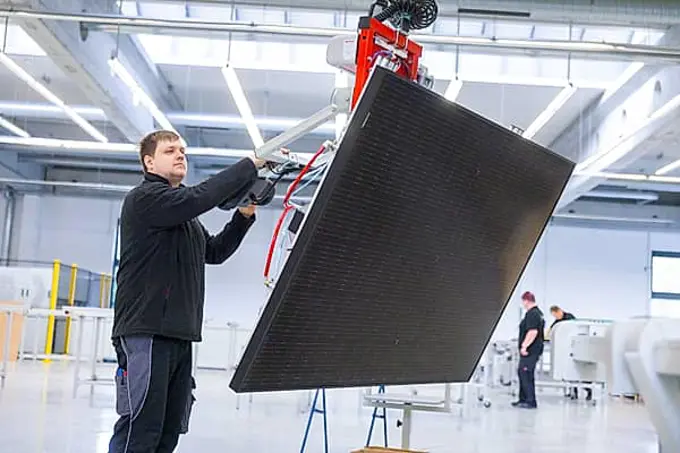
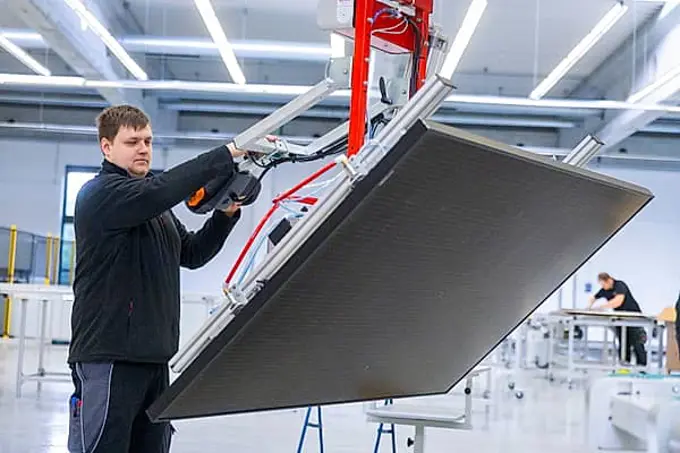
Sunmaxx PVT is a new innovative developer of photovoltaic thermal solar modules. The Fraunhofer ISE has confirmed an overall efficiency of 80% for the PX-1 premium module. The innovation is the combination of photovoltaics and solar thermal energy in one element, Ottendorf-Okrilla, Saxony, Germany, Europe
6145-45217763
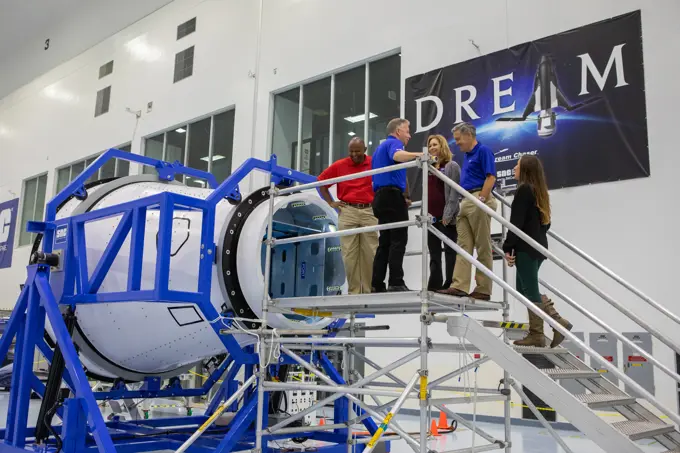
A mockup of the cargo logistics module for Sierra Nevada Corporations Dream Chaser, the companys reusable spaceplane, arrived at the Space Station Processing Facility (SSPF) at NASAs Kennedy Space Center in Florida in August. On Sept. 20, 2019, senior leadership had the opportunity to view the cargo module in the SSPF high bay. From left are Kelvin Manning, Kennedy associate director, technical; Steve Lindsey, vice president, Space Exploration Systems, Sierra Nevada Corporation; Kennedy Deputy Director Janet Petro; and Kennedy Center Director Bob Cabana. The SSPF is providing support for current and future NASA and commercial provider programs, including Commercial Resupply Services, Artemis 1, sending the first woman and next man to the Moon, and deep space destinations including Mars.
6145-58969823
While engineers in Europe continue to outfit the Orion spacecrafts service module for Artemis I in preparation for shipment to NASAs Kennedy Space Center in Florida next year, work is already beginning on the service module that will power, propel, cool and provide air and water for the first crewed mission in the Orion spacecraft in the early 2020s. On Sept. 19, 2017, technicians at Thales Alenia in Turin, Italy, work on the primary structure of the European Service Module that will carry astronauts in Orion beyond the Moon during Artemis II. ESA (European Space Agency) and its contractors are providing Orions service module for its first two missions atop the Space Launch System rocket. NASA is leading the next steps in human space exploration and will send astronauts to the vicinity of the Moon to build and test the systems needed for challenging missions to deep space destinations including Mars. NASA is working with domestic and international partners to solve the great challenges
1848-56659421
Sunmaxx PVT is a new innovative developer of photovoltaic thermal solar modules. The Fraunhofer ISE has confirmed an overall efficiency of 80% for the PX-1 premium module. The innovation is the combination of photovoltaics and solar thermal energy in one element, Ottendorf-Okrilla, Saxony, Germany, Europe
6145-45293402
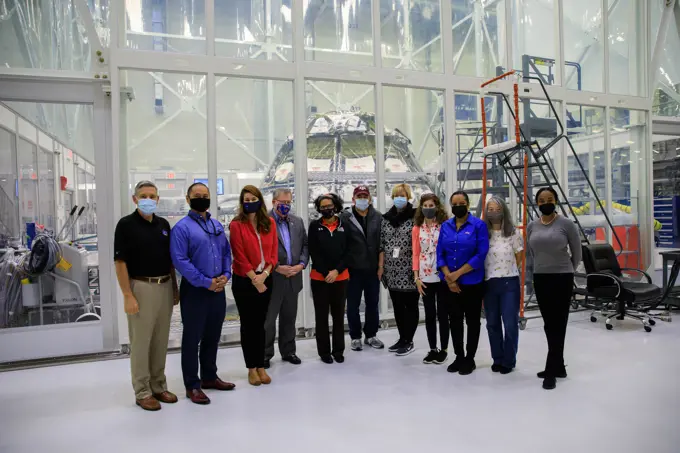
Senior leaders with Kennedy Space Center in Florida, familiarize newly appointed officials from NASA Headquarters with the centers facilities during a tour on April 19, 2021. The group is inside the Neil Armstrong Operations and Checkout Building high bay, where Orion crew module spacecraft are readied for the Artemis II mission. Artemis II will be the first crewed launch of SLS and Orion and will pave the way for landing the first woman and first person of color on the lunar surface. It will be a proving ground for deep space exploration, leading the agencys efforts under the Artemis program for a sustainable presence on the Moon and preparing for human missions to Mars.
6145-55974231
Cygnus Pressurized Cargo Module Arrival. The Northrop Grumman Cygnus spacecrafts pressurized cargo module (PCM) for the companys 20th commercial resupply mission is lifted and moved by crane in its environmentally controlled shipping container inside the high bay in the Space Station Processing Facility at NASA's Kennedy Space Center in Florida on Aug. 2, 2023. Cygnus will launch later this year atop a SpaceX Falcon 9 rocket from Launch Complex 39A at Kennedy to the International Space Station. Cygnus will undergo prelaunch processing at Kennedy before it is transported to SpaceXs integration facility.
6145-44470915
A group of U.S. Navy divers, Air Force pararescumen and Coast Guard rescue swimmers practice Orion underway recovery techniques this week in the Neutral Buoyancy Laboratory (NBL) at NASAs Johnson Space Center in Houston on Sept. 21, 2016, to prepare for the first test flight of an uncrewed Orion spacecraft with the agencys Space Launch System rocket during Artemis I. Part of Batch images transfer from Flickr.
6145-58958885
Edwards, Calif. - ED-0144-10 - Plastic wrapping that protected the Sierra Nevada Corporation, or SNC, Dream Chaser flight test vehicle during its transport from Colorado is carefully removed by SNC employee Will Armijo following the craft's arrival at NASA's Dryden Flight Research Center in southern California. The prototype space access vehicle will undergo ground and approach-and-landing flight tests in the coming months at Dryden as part of NASA's Commercial Crew Program, or CCP, development work. SNC is one of three companies working with CCP during the agency's Commercial Crew Integrated Capability, or CCiCap, initiative, which is intended to lead to the availability of commercial human spaceflight services for government and commercial customers.
6145-44971333
CAPE CANAVERAL, Fla. - United Launch Alliance Atlas V rocket first and second stages arrive at the Atlas Spaceflight Operations Center, or ASOC, at Cape Canaveral Air Force Station, Fla., to begin processing for the Mars Atmosphere and Volatile Evolution, or MAVEN, spacecraft to the Red Planet. MAVEN is being prepared for its scheduled launch in November from Cape Canaveral Air Force Station, Fla. atop a United Launch Alliance Atlas V rocket. Positioned in an orbit above the Red Planet, MAVEN will study the upper atmosphere of Mars in unprecedented detail.
6145-58967414
Wayne Cook, Weights Chief, inspects the Pipistrel-USA, Taurus G4 as it rest on a scale built into the floor of the hanger during the 2011 Green Flight Challenge, sponsored by Google, at the Charles M. Schulz Sonoma County Airport in Santa Rosa, Calif. on Monday, Sept. 26, 2011.  NASA and the Comparative Aircraft Flight Efficiency (CAFE) Foundation are having the challenge with the goal to advance technologies in fuel efficiency and reduced emissions with cleaner renewable fuels and electric aircraft.
6145-45204213
Commercial Lunar Payload Services Announcement was made at Goddard May 31, 2019. Tom Zurbuchen, AA Science Mission Directorate, congratulated three companies for providing lunar landers for Artermis: Astrobotic, Intuitive Machines, and OrbitBeyond
6145-44898710
CAPE CANAVERAL, Fla. - Mike Woolley of the United Launch Alliance, right, shows an Atlas V rocket to Dr. Mason Peck, NASA's chief technologist, during Peck's visit to Cape Canaveral Air Force Station in Florida.
6145-45177022
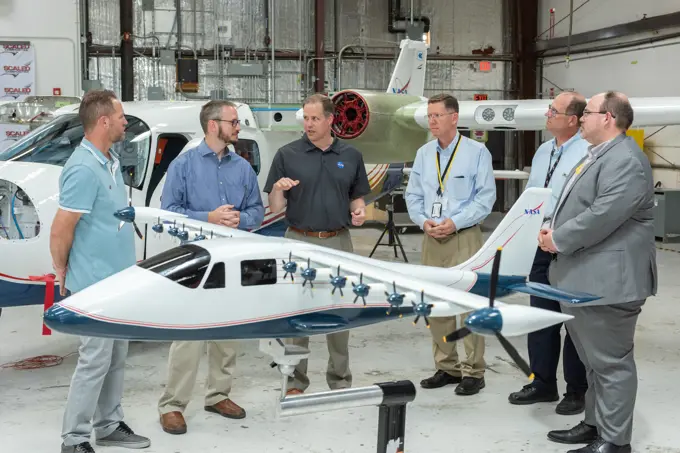
Administrator Bridenstine hears about the progress to modify the Tecnam P2006T from a combustion aircraft to an all-electric aircraft. Armstrongs X-57 team and ESAero, the prime contractor for the plane, are doing the briefing. The final configuration model of X-57 stands in front of group.
6145-58968068
The Orion crew module pressure vessel for Exploration Flight Test-1 (EFT-1) is unveiled at a ceremony at the Operations and Checkout (O&C) Building at NASAs Kennedy Space Center in Florida on July 2, 2012. Orion Program Manager Mark Geyer is visible talking to others. Part of Batch image transfer from Flickr.
6145-45269357
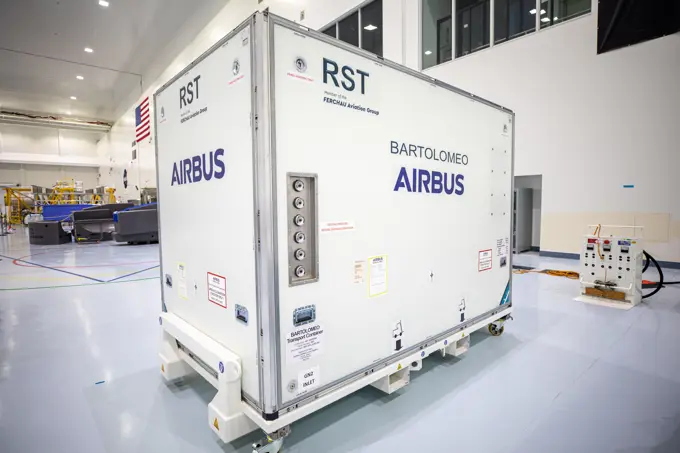
The Bartolomeo platform that will be carried to the International Space Station aboard SpaceXs 20th Commercial Resupply Services (CRS-20) mission for NASA is inside its shipping container in the Space Station Processing Facility high bay at the agencys Kennedy Space Center in Florida on Jan. 30, 2020. Bartolomeo was manufactured by Airbus Defence and Space. The platform will attach to the exterior of the space stations European Columbus Module. Named for the younger brother of Christopher Columbus, the platform has the capability to host external payloads in low-Earth orbit on the station. CRS-20 is scheduled to launch aboard SpaceXs Dragon cargo spacecraft atop the companys Falcon 9 rocket in March 2020.
6145-45275613
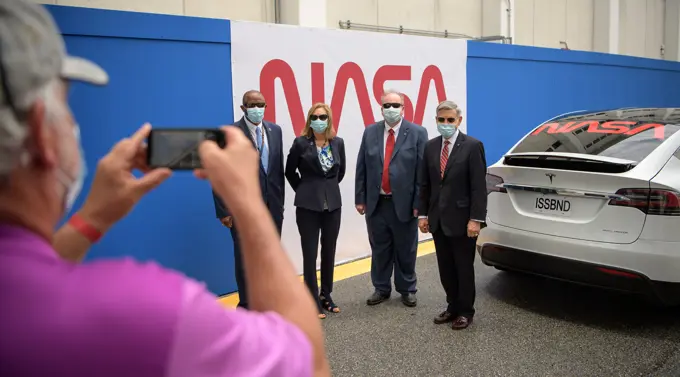
NASA Kennedy Space Center Associate Technical Director Kelvin Manning, left, Kennedy Space Center Deputy Director Janet Petro, Kennedy Space Center Associate Director, Management, Burt Summerfield, and Kennedy Space Center Director Bob Cabana, right, pose for a group photograph as they wait to see NASA astronauts Douglas Hurley and Robert Behnken depart the Neil A. Armstrong Operations and Checkout Building for Launch Complex 39A to board the SpaceX Crew Dragon spacecraft for the Demo-2 mission launch, Wednesday, May 27, 2020, at NASAs Kennedy Space Center in Florida. NASAs SpaceX Demo-2 mission is the first launch with astronauts of the SpaceX Crew Dragon spacecraft and Falcon 9 rocket to the International Space Station as part of the agencys Commercial Crew Program. The test flight serves as an end-to-end demonstration of SpaceXs crew transportation system. Todays launch of Behnken and Hurley was scrubbed due to weather and is now scheduled for 3:22 p.m. EDT on Saturday, May 30
7003-69659244
England, London, South Kensington, Science Museum, Ernie 1, early English digital computer, 1957
6145-44685914
KENNEDY SPACE CENTER, FLA. --   A media event at NASA's Kennedy Space Center highlighted the next piece to be added to the International Space Station, the Italian-built Node-2 module, known as Harmony.  In the background next to the poster is Glenn C. Chin, mission manager for International Space Station and Spacecraft Processing, who talks to reporters about processing of the Harmony module.  Harmony will launch aboard space shuttle Discovery on mission STS-120, targeted for launch Oct. 23.  The module is scheduled to be transferred at the end of the month to Launch Pad 39A, in preparation for its journey to the station.  Harmony is approximately 21 feet long and 14 feet in diameter. It will act as an internal connecting port and passageway to additional international science labs and cargo spacecraft. The pressurized module will increase the living and working space inside the station and serve as a work platform outside for the station's robotic arm.
6145-45060192
CAPE CANAVERAL, Fla. - John Elbon, The Boeing Company's vice president general manager of Boeing Space Systems, discusses the CST-100 spacecraft during a ceremony inside Orbiter Processing Facility 3 at NASA's Kennedy Space Center in Florida.
6145-45226515
Steve Lindsey, senior vice president of strategy for Sierra Nevada Corporation Space Systems and a former NASA astronaut, discusses the capabilities of the companys Shooting Star cargo module during a media day event in the Space Station Processing Facility high bay at Kennedy Space Center on Nov. 19, 2019. Shooting Star will attach to the back of the companys Dream Chaser spacecraft. The cargo module will deliver more than 12,000 pounds of supplies and other cargo to the International Space Station for NASA as part of the Commercial Resupply Services-2 contract.
6145-44788562
VANDENBERG AIR FORCE BASE, Calif. - At Space Launch Complex 2 at Vandenberg Air Force Base in California, workers guide the interstage of the United Launch Alliance Delta II rocket for launch of NASA's Wide-field Infrared Survey Explorer, or WISE, into place on top of the rocket's first stage in the pad's mobile service tower.WISE will survey the entire sky at infrared wavelengths, creating a cosmic clearinghouse of hundreds of millions of objects which will be catalogued and provide a vast storehouse of knowledge about the solar system, the Milky Way, and the universe. Launch is scheduled for Dec. 7.  For additional information, visit http://wise.ssl.berkeley.edu.
6145-45217966
A mockup of the cargo logistics module for Sierra Nevada Corporations Dream Chaser, the companys reusable spaceplane, arrived at the Space Station Processing Facility (SSPF) at NASAs Kennedy Space Center in Florida in August. On Sept. 20, 2019, senior leadership had the opportunity to view the cargo module in the SSPF high bay. From left are Kelvin Manning, Kennedy associate director, technical; Burt Summerfield, associate director, management; John Roth, vice president, Business Development Space Systems, Sierra Nevada Corporation; Kennedy Center Director Bob Cabana; Steve Lindsey, vice president, Space Exploration Systems, Sierra Nevada Corporation; Kennedy Deputy Director Janet Petro; and Nate Wood, Sierra Nevada Corporation. The SSPF is providing support for current and future NASA and commercial provider programs, including Commercial Resupply Services, Artemis 1, sending the first woman and next man to the Moon, and deep space destinations including Mars.
PREVIOUS
of 3
NEXT
2401 S. Ervay, Suite 206
Dallas, Texas 75215
United States
Get Started
Free ResearchMy BoardsMy Cart
For Creators
How To License Your ContentContributor PortalFrame of Mind
Resources
API accessPricing
Contact
+1 866 236 0087help@viewpictures.co.uk Contact form
©2026 View Pictures. All Rights Reserved. -A
This site is protected by reCAPTCHA and Google Privacy Policy and Terms of Service apply.