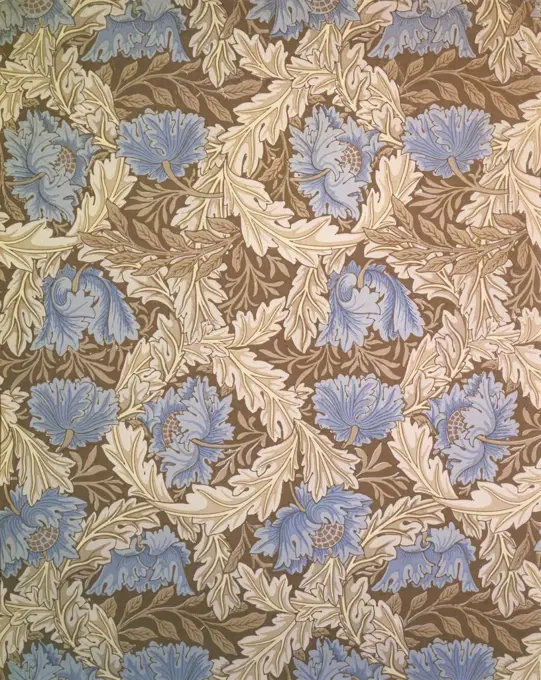
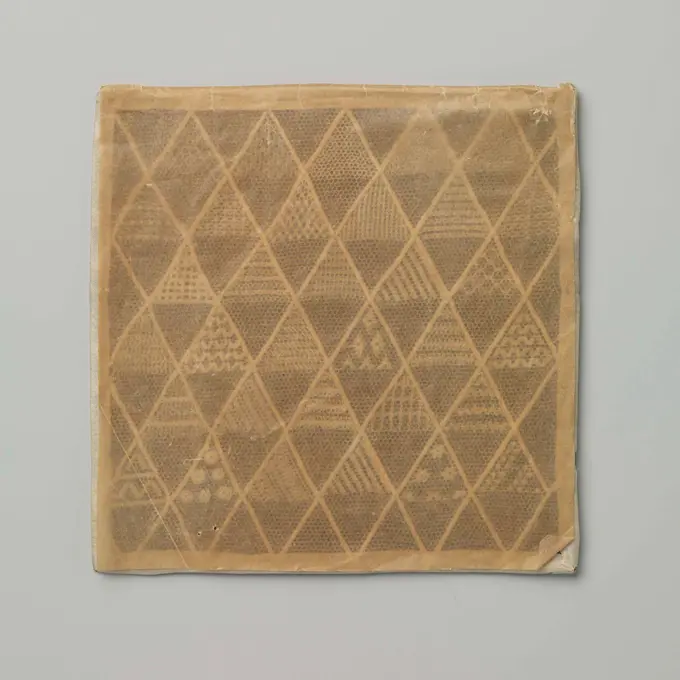
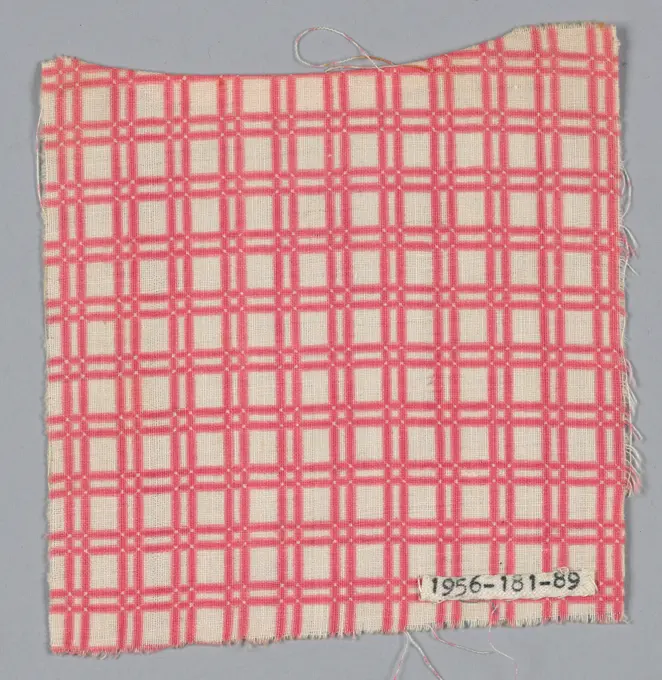
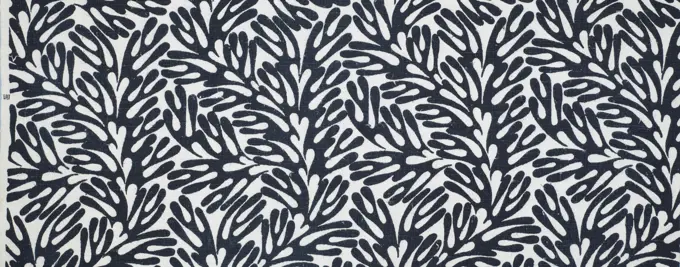
Textile Fragments

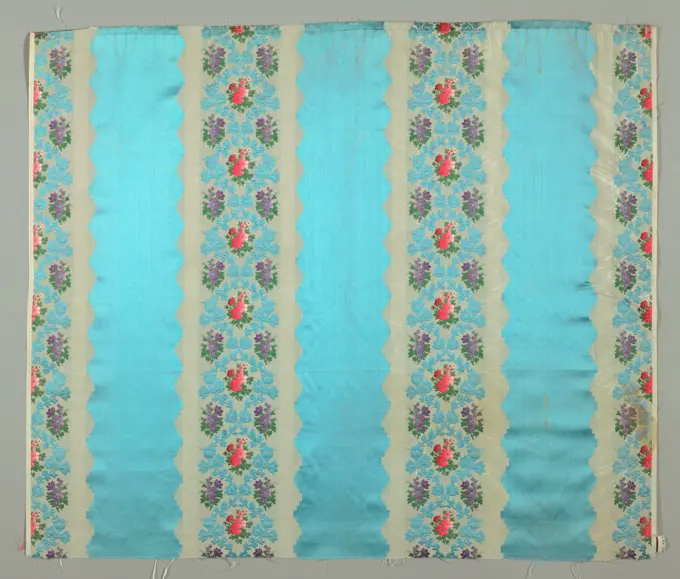
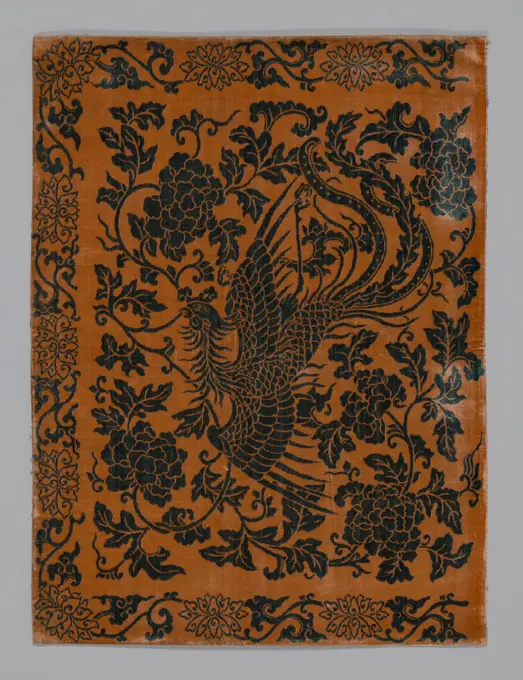
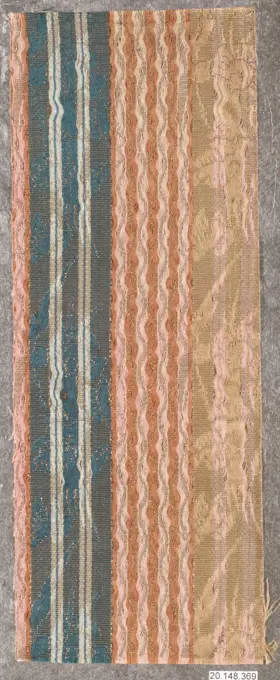
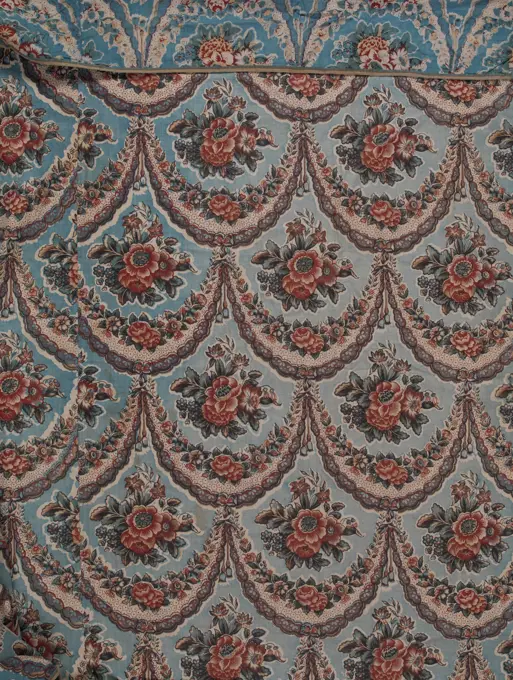
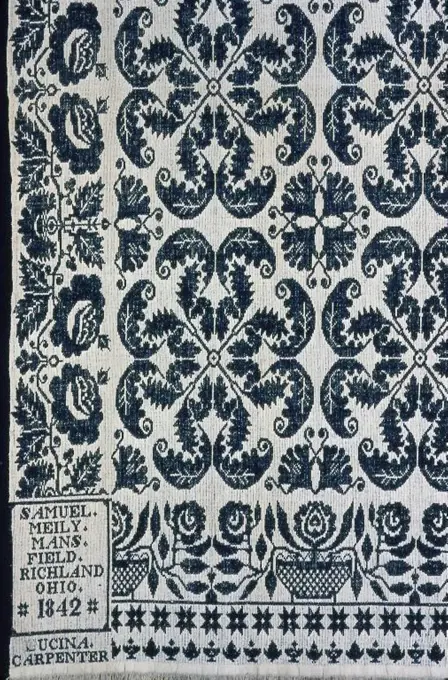
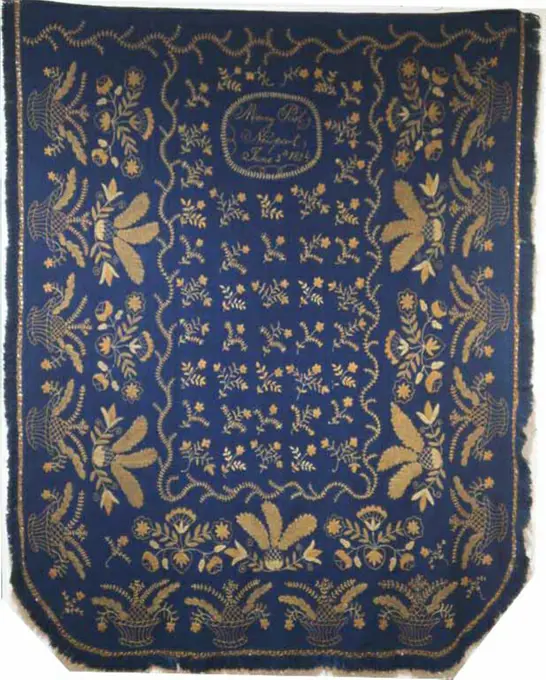
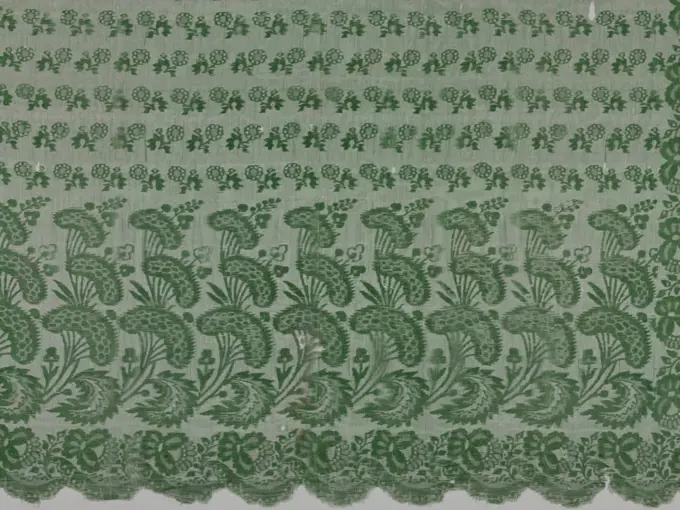
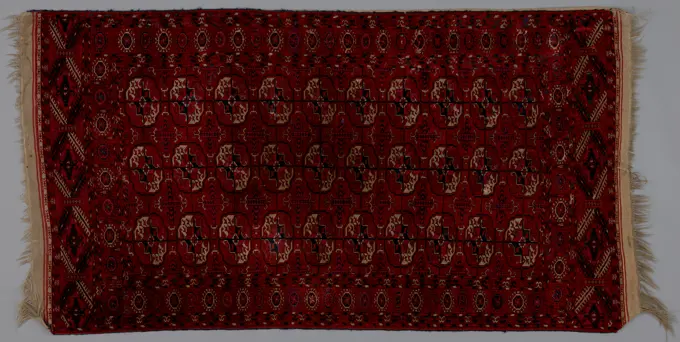
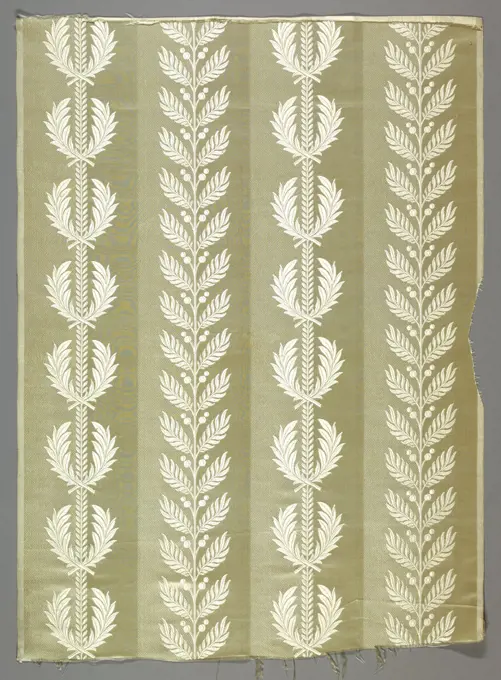
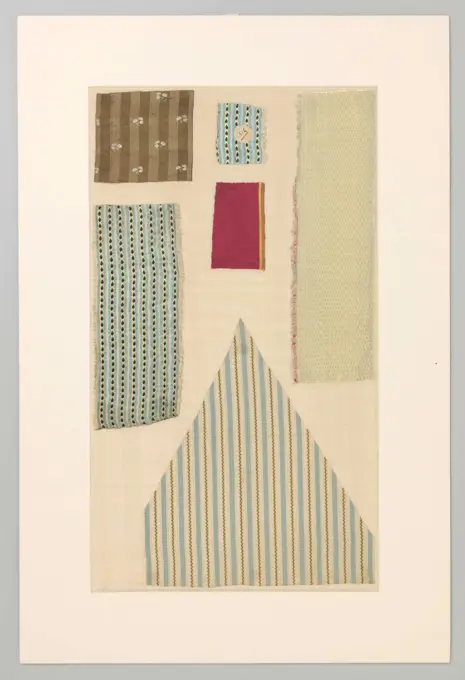
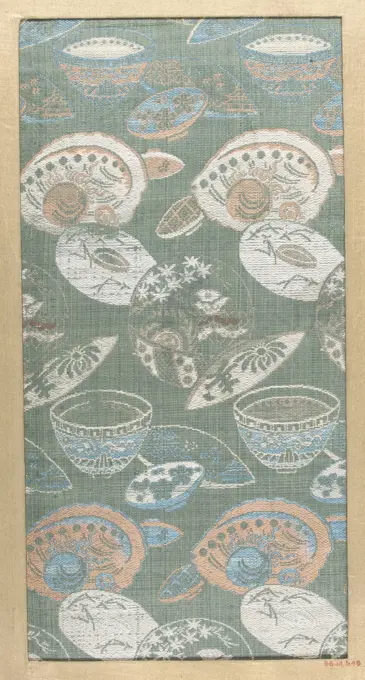
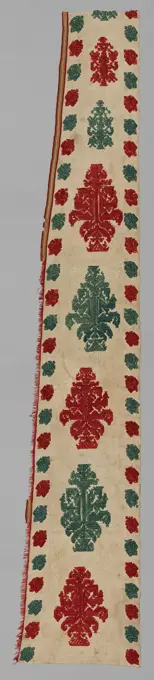
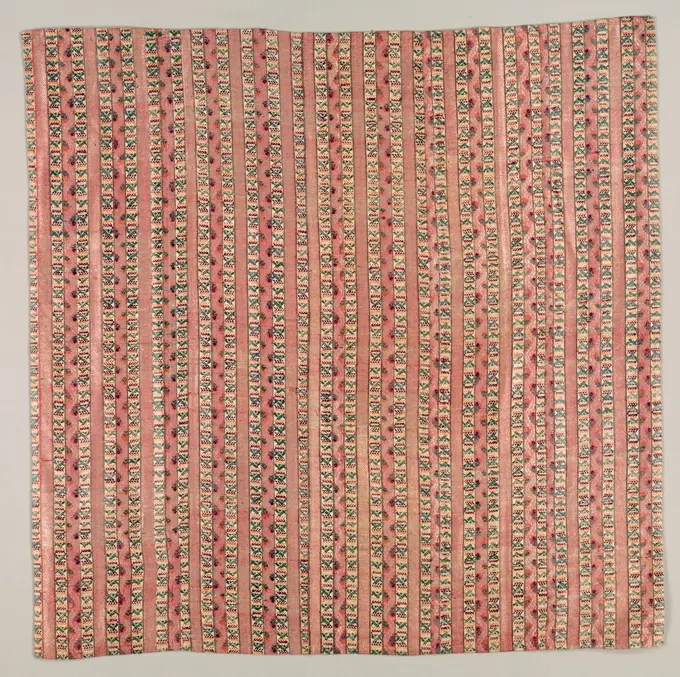
Variety of textile fragments in different colors and patterns, showcasing intricate designs from silk and cotton fabrics.

Fragment, Medium: linen Technique: bobbin lace, discontinuous tape, 17th century, lace, Fragment
Brisé fan and case, Painted ivory sticks, silk ribbon, faceted stone, Brisé fan. Painted ivory sticks. Obverse: figures of man and woman in landscape. Gorge and borders in Vernis Martin” style, showing floral motifs within miniature cartouches. Reverse: landscape without figures. Rivet is set with a faceted stone. Fan case has removable lid., France, England, late 19th century, costume & accessories, Brisé fan and caseArabian ornamentTwo striples bordered and separated by a garland. In the left one, above, a bunch of flowers and ears of grain, below, a bunch of flowers and corn fastened by bowknots and connected by a ribbon. Beside it are two butterflies. At right are two bunches of ears of grain fastened by bowknots and connected by a waved stem with blossoms leaves and spirals. Beside a ribbon two butterflies. Below, parts of peacock feathers. Pen and brown ink, brush and brown wash, graphite on lined off-white laid paper. Date: 1746-1809. Museum: Cooper Hewitt, Smithsonian Design Museum.Piece 16th-17th century Italian. Piece 223489Textile, Medium: silk Technique: printed by engraved roller on plain weave, Silk border or flounce printed with lace-like floral and diaper pattern with black rosettes against a grey ground. One green warp; two wefts, black and green,both used for patterning., possibly USA, possibly France, 1825-1850, woven textiles, TextileLinnamast napkin with design "hawthorn", Chris Lebeau, c. 1900 - c. 1925 Linnamast napkin with the hawthorn motif, design 528. The corners have a crowned monogram (G IV or VI). The napkin is made for George from England. Eindhoven linen (material) jacquard Linnamast napkin with the hawthorn motif, design 528. The corners have a crowned monogram (G IV or VI). The napkin is made for George from England. Eindhoven linen (material) jacquardCross -shaped fragment brOOCHED SIDE, c. 1740 - c. 1775 Fragment silk tissue. The cross -shaped fragment consists of three sewing fragments. The pattern has multicolored flower vessels with red/white striped bows.  silk Fragment silk tissue. The cross -shaped fragment consists of three sewing fragments. The pattern has multicolored flower vessels with red/white striped bows.  silkFragment; silk, metallicTextile, 19th century; silk; Overall: 74 x 63.2 cm (29 1/8 x 24 7/8 in.)Napkin van Wit Linnamast, S.J. Spaniard, 1859 White Linen Damas napkin with "Convolvulos", Brand Kroon H. Borne linen (material) damask White Linen Damas napkin with "Convolvulos", Brand Kroon H. Borne linen (material) damaskPiece of fabric. unknown, authorFragment. Italy. Date: 1501-1600. Dimensions: 27 x 24.3 cm (10 5/8 x 9 5/8 in.). Silk and gold gilt strips wound around silk fiber core, warp-floatfaced satin weave self-patterned by warp floats, weft floats and areas of plain interlacing. Origin: Italy. Museum: The Chicago Art Institute, Chicago, USA.Napkin made of linen with peel pattern, c. 1700 - c. 1799 White linen napkin with a peel pattern WH 2oonl Netherlands (possibly) linen (material) White linen napkin with a peel pattern WH 2oonl Netherlands (possibly) linen (material)Table Frontal Made 1701-1800 China. Cut velvet .Napkin (from a set of table linens) Belgian late 19th centuryFragment; silk, metallic yarnsFrieze (USA); Manufactured by Janeway & Co. Inc.; machine-printed paper; 168 x 49.5 cm (66 1/8 x 19 1/2 in.)Curtain fabric with seahorses and the emblem of the K.N.S.M. ,, 1900 - 1925 Curtain fabric with seahorses and the emblem of the K.N.S.M. Hell blue impact on yellow chain. Fragment. Netherlands cotton (textile) Curtain fabric with seahorses and the emblem of the K.N.S.M. Hell blue impact on yellow chain. Fragment. Netherlands cotton (textile)Piece 18th century Japan. Piece 71263Piece 18th-19th century Japan. Piece 66673Piece 18th century Japan. Piece 71360Piece ca. 1805-15 Séguin et Cie. Piece 226375Fragment. Culture: French. Dimensions: 17 1/2 × 24 in. (44.5 × 61 cm). Date: 1850-75. Museum: Metropolitan Museum of Art, New York, USA.Length second quarter 19th century British, probably. Length 236677Crown Frieze (USA); Manufactured by Gledhill Wall Paper Co.; machine-printed and embossed; 48 x 48 cm (18 7/8 x 18 7/8 in.)Textile 19th century Japan. Textile 68061Sidewall (USA); Manufactured by Cresswell & Washburn Ltd; machine-printed paper; 91.5 x 49 cm (36 x 19 5/16 in.)Handkerchief, 1800s. France or Flanders, 19th century. Embroidery on linen ground; lace edging; overall: 58.4 x 59.7 cm (23 x 23 1/2 in.).Fragment. France. Date: 1701-1725. Dimensions: . Silk. Origin: France. Museum: The Chicago Art Institute, Chicago, USA.Chalice Cover (Italy); linenBlack Tulle Tulle with colored application side on cardboard, Gustav Schnitzler, c. 1925 Black Tulle Tulle with colored application side on cardboard. The edges are trimmed with a wavy common thread and the pattern consists of a meandering flower branch in the colors red, brown, yellow and green. Nijmegen cardboard. Black Tulle Tulle with colored application side on cardboard. The edges are trimmed with a wavy common thread and the pattern consists of a meandering flower branch in the colors red, brown, yellow and green. Nijmegen cardboard.Piece 1750-60 French. Piece 223247Square Shawl ("Kirking"). Scotland, Edinburgh or Paisley, or England, Norwich. Date: 1830-1835. Dimensions: 188.5 x 169.3 cm (74 1/4 x 66 5/8 in.). Cotton and wool, center of weft-float faced 1:3 'Z' twill weave; borders of weft-float faced 3:1 twill weave with supplementary patterning wefts bound in weft-float faced 1:3 'Z' twill interlacings over warp-float faced twill weave; attached wool and silk, knotted fringe; two selvages present; woven on loom with Jacquard attachment. Origin: Scotland. Museum: The Chicago Art Institute, Chicago, USA.Piece 18th-19th century Japan. Piece 67511Coverlet Made 1842 United States. Cotton and wool, plain weave with plain interlacings of secondary binding warps and patterning wefts (Beiderwand); woven on loom with Jacquard attachment; two loom widths joined; fringed . Samuel Meily (Weaver)Fragment brOOCHED SIDE with pattern of flowers in windows, anonymous, c. 1700 - c. 1799 Fragment in the shape of a rectangle with decoration of 5 flowers, one in the middle and 4 in the corners. The corner flowers are not complete. Persia silk. metal thread twill Fragment in the shape of a rectangle with decoration of 5 flowers, one in the middle and 4 in the corners. The corner flowers are not complete. Persia silk. metal thread twillBedcover Made 1824 New York. As the 19th century progressed, embroidered wool bedcovers became unfashionable, and there was a noticeable decline in their production. Jacquard woven coverlets and quilts made with commercially produced textiles and stylish imported textiles replaced the once-popular wool embroidered bedcovers.. Wool, twill weave; embroidered with wool in detached chain, Roumanian, satin, surface satin and stem stitches; edged with buttonhole-stitched loops and woven cut fringe . Mercy Post (Maker)Bonnet veil, Medium: silk Technique: machine made, Bonnet veil with a pattern of conventionalized flowers in green silk arranged to form a border on three sides enclosing horizontal stripes., Spain, 19th century, lace, Bonnet veilFragment, Medium: silk Technique: 4&1 satin damask, An effulgent sun and a swinging censor in red and white., 17th century, woven textiles, FragmentTextile, Medium: cotton Technique: printed by engraved roller and block printed; glazed, Ground decorated, by molette, in deep cream minute horizontal lines with areas of white moire effect. Pattern of natural size pansy clusters in reddish mauve and white printed over the ground, and small flower clusters in green-glazed., 1851-63, printed, dyed & painted textiles, TextileBorder, Machine-printed paper, Small portion of a paper showing clusters of growing flowers. Printed in reds, browns and greens on neutral green ground. In the Aesthetic style., USA, 1875-85, Wallcoverings, BorderBliżej Kultury unknownPalempore of Sits with pattern of flowering tree ,, 1725 - 1750 Palempore of sits with pattern of flowering tree. Coromandelkust cotton (textile) Palempore of sits with pattern of flowering tree. Coromandelkust cotton (textile)Piece 18th-19th century Japan. Piece. Japan. 18th-19th century. Silk. Textiles-WovenBliżej Kultury unknownSuspenders mid-19th century American. Suspenders. American. mid-19th century. linen, silk, leatherPiece 1837-51 British. Piece 226208Textile, Medium: silk Technique: fancy compound satin weave, Pattern of alternating stripes in plain and fancy satin weave with leaf forms superimposed. Both warps and wefts of same off-white color. Pattern achieved only by variation on weave., Lyons, France, 19th century, woven textiles, TextileTextile Swatches Onondaga Silk Company, Inc. (1925-1981). , 1948-1959. Wool blend, a: 22 x 17 1/2 in. (55.9 x 44.5 cm).    1948-1959Piece 18th-19th century Japan. Piece 67693Chalice cover, Medium: linen, silk Technique: bobbin lace, discontinuous tape, Green silk chalice cover edged with border of Milanese lace showing scrolling pattern filled with animal forms., Milan, Italy, mid-18th century, lace, Chalice coverFragment striped silk tissue with sprinkled flower branches .. fragment striped silk tissue with dark and light brown stripes on which french flour branches in green and white.Piece 18th-19th century Japan. Piece 66272Woman's Beaded Pouch. United States, circa 1840. Costumes; Accessories. Cotton, beadsCloth with Floral and Vegetal Patterns, 1560-1600. Italy, 16th century. Needle lace, filet/lacis (knotted ground and darned in two directions), alternating reticella squares (open cutwork), and bobbin lace edging; bleached linen (est.); mounted: 148 x 151.1 cm (58 1/4 x 59 1/2 in.); overall: 145.1 x 144.2 cm (57 1/8 x 56 3/4 in.). Textiles often incorporate multiple needlework techniques within a single piece. One of the main techniques in this example of lace is called cutwork. In cutwork, portions of the textile ground, such as a linen or cotton cloth, are cut away and threads are removed to create holes. The edges of the hole are then reinforced with embroidery and a pattern of needle lace can be created within the perimeter. Rather than adding to the cloth to create a design, the craftsperson removes threads to fabricate a pattern.Fragment. Italy. Date: 1575-1600. Dimensions: 23 x 9.7 cm (9 1/8 x 3 3/4 in.)Repeat: 6.8 x 4.8 cm (2 3/4 x 1 7/8 in.). Silk, plain weave with supplementary pile warps forming cut and uncut voided velvet. Origin: Italy. Museum: The Chicago Art Institute, Chicago, USA.Napkin (from a set of table linens) Belgian late 19th centuryBower Design  Morris, William(1834-1896 British) Victoria & Albert Museum, London, England David P Willoughby, Apron, c 1940 ApronDarning sampler, Medium: silk embroidery on linen foundation Technique: embroidered in running (pattern darning) and eyelet stitches on plain weave foundation Label: Linen embroidered with silk in pattern darning and eyelet stitches, Twelve darning crosses, then decorative darning patches and central darning zig-zag in center, crowned initials and date., Netherlands, 1767, embroidery & stitching, Darning samplerTextile Fragment, 1800s. Japan, 19th century. Silk; average: 24.8 x 27.3 cm (9 3/4 x 10 3/4 in.).Textile; Manufactured by Schwartz-Huguenin; cottonFragment sits with flower branches and springy leaves. Fragment Sits with a decor of flower branches and here and there springy leaves. A seam and a piece of abnormal sits.Bobbin and Embroidery Lace Handkerchief, 1800s. Belgium, Mechelen, 19th century. Linen center with linen embroidery border and lace edging; average: 33 x 33 cm (13 x 13 in.).Front doubleur. bindings (gathered matter components), Book covers. 1905. Spencer Collection. BookbindingCover Made 1610-1640 France. Linen, twenty-four squares of square netting (filet) embroidered in cloth, darning, and twined double running stitches; alternating with twenty-four squares of linen, plain weave; cut and drawn thread work embroidered in cross, darning, interlocking lace, overcast, and satin stitches; knots, overcast bars, buttonhole, darned, and woven wheels; needle lace filling stitches; appliquÈd with plain weave and embroidered in back, bullion, cross, half cross, detached chain, double running, running, satin, single satin, surface satin, and stem stitches; buttonhole wheels, eyelet holes, and French knots; edged with bobbin straight lace .Handicrafts with forward fillings. Handicraft with cross-onflings on a square of tulle, on blue cardboard. Belonging to series of eight white and ten colored needlework, manufactured by Aagje tapp for obtaining the deed beautiful and / or useful needlework to the industrial school, BK-1974-105-A to R.Pulkari (Head Coverning), 1900-1925, 86 1/2 x 46 1/4 in. (219.71 x 117.48 cm), Cotton, silk; needlework, India, 20th centuryTextile Swatches Onondaga Silk Company, Inc. (1925-1981). , 1948-1959. Silk, metallic yarn, 47 3/4 x 18 in. (121.3 x 45.7 cm).    1948-1959Sidewall, A. H. Davenport, American, J. Zuber et Cie, Block-printed and flocked paper, Flocked symmetrical stylized floral bouquet enclosed in frame-like strapwork with some cross-hatch pattern. Printed in light and dark chartreuse., Alsace, Rixheim, France, 1875-1900, Wallcoverings, SidewallFragment (USA)Piece French 19th century View more. Piece. French. 19th century. Textiles-WovenCharlotte Winter, Textiles in Patchwork Quilt, c 1937 Textiles in Patchwork QuiltSidewall, Machine-printed paper, Green and white floral sprigs, alternating with single green flower. Printed over wide striped bands, a medium gray alternating with fine white pin stripes. The right selvedge has been trimmed on 'b'. Printed in the selvedge: '16 yards' and pattern number '706'., possibly USA, ca. 1870, Wallcoverings, SidewallSample of printed IInen Unknown, Wiener WerkstättePiece 18th-19th century Japan. Piece 65933Sidewall and border, M.H. Birge & Sons Co., 1834, Machine-printed paper, a) Imitation wood panelling in dark browns, on polished paper; b) frieze: imitation wood panelling; c) imitation carved wood panel with metallic gold mount., Buffalo, New York, USA, 1904-1905, Wallcoverings, Sidewall and borderPortion of a Bed Tent, 1700s. Greece, Dodecanese Islands, Rhodes, 18th century. Embroidery: silk on linen tabby ground; overall: 212.4 x 38.8 cm (83 5/8 x 15 1/4 in.).Steel spancing material to the design of Theo Nieuwenhuis in Passe-partout, Theo Nieuwenhuis, c. 1910 Steel spancing material from jacquard-woven cotton designed by Theo Nieuwenhuis in original passe-partout. Each steel has a different design in the colors: olive -green impact on blue necklace; white impact on light gray necklace; dark green chain on light green necklace; Créle -colored impact on white chain. Netherlandsmaker: Helmond Staal: Cotton (Textile). PASE-PARTOUT: Cardboard jacquard Steel spancing material from jacquard-woven cotton designed by Theo Nieuwenhuis in original passe-partout. Each steel has a different design in the colors: olive -green impact on blue necklace; white impact on light gray necklace; dark green chain on light green necklace; Créle -colored impact on white chain. Netherlandsmaker: Helmond Staal: Cotton (Textile). PASE-PARTOUT: Cardboard jacquardPiece 18th century Japan. Piece 71806Prentalbum from Bunrei; Bunrei Gafu. Part two (of two), re-bound in brown hard cover with yellow fantasy pattern; two blades; Original white cover with rosette-shaped emblem and bright pink title strip at the top left; Bright pink cover sheet, title page; 33 sheets: two sheets text; 31 sheets with images of flowers and birds, of which 24 images on a single leaf and twenty on a double leaf; cover sheet (removed), colophon; Two sheath trays of new binding.Close-up of a chairFragment; silkBead Belt. Dated: c. 1936. Dimensions: overall: 34.2 x 25.5 cm (13 7/16 x 10 1/16 in.). Medium: watercolor and graphite on paperboard. Museum: National Gallery of Art, Washington DC. Author: Gordena Jackson.Specimen of Indian lac-work.. Wyatt, M. Digby (Matthew Digby), Sir, 1820-1877. Prints. 1852. The Miriam and Ira D. Wallach Division of Art, Prints and Photographs: Art & Architecture Collection. Decorative arts , Exhibitions, Great Exhibition (1851 : London, England)Quilt, Album pattern begun 1846 Members of the Brown and Turner families Appliqued with various floral and abstract designs, the twenty-five blocks of this quilt are separated by red cotton sashing. The designs in the blocks are cut from fabrics primarily in shades of red and green. All the blocks are hand stitched and signed by different hands, some in ink, some in cross-stitch. The blocks are joined to the sashing by sewing machine. The back is of plain white woven cotton.. Quilt, Album pattern 13877Workpiece for diploma beautiful crafts, Geesje Smid, c. 1890 - c. 1900 Square piece of linen with different phases from Point Coupé Techniek. Netherlands linen (material) Square piece of linen with different phases from Point Coupé Techniek. Netherlands linen (material)Piece 18th-19th century Japan. Piece. Japan. 18th-19th century. Silk. Textiles-WovenSampler, 1827. Germany , early 19th century. Damask and lace patterns on cotton ground; overall: 43.2 x 43.2 cm (17 x 17 in.).Cushion Cover Made 1700-1750 China. Silk, gold-leaf-over-lacquered-paper strips, and gold-leaf-over-lacquered-paper-strip-wrapped silk, warp float faced 2 1 'S' twill weave with weft-float faced 1 2 'S' twill interlacings of secondary binding warps and supplementary patterning and brocading wefts; lined with silk, 4 1 satin damask weave . ManchuFliesen für Vertäfelung und Altarfront Tile for wainscoting and altar front, glazed and painted tiles, 17th century, Huesca Diocesan Museum, Aragon community, Spain Copyright: xZoonar.com/TOLOxBALAGUERx 22307701Textile Swatches Onondaga Silk Company, Inc. (1925-1981). , 1948-1959. Silk, metal, 46 x 12 1/2 in. (116.8 x 31.8 cm).    1948-1959Handkerchief, Medium: linen Technique: needle lace, Handkerchief with a linen center and trimmed with Point de Gaze needle lace. Pattern shows medallions and floral elements., Belgium, 19th century, lace, HandkerchiefBack doubleur. 1896 - 1886. Claretie, Jules (1840-1913). bindings (gathered matter components), Book covers. Spencer Collection. BookbindingGreek Ornament and Etruscan OrnamentSample, Orinoka Mills, (Philadelphia, Pennsylvania, USA), Bright pink ground with white and light green floral strips., USA, ca. 1910, woven textiles, SampleSample (France); silk; Anonymous bequest in memory of Albert and Rebecca Elsberg; 1938-82-189-cÔhi (Stole) Made 1875-1900 Japan. .Mezzaro (shawl Or Headcovering) (Italy); cottonTextile Length, early 19th century. Turkey, early 19th century. Brocaded silk; average: 76.8 x 77.5 cm (30 1/4 x 30 1/2 in.).